TagPort Of Seattle(2405)
-
 2001-05-07
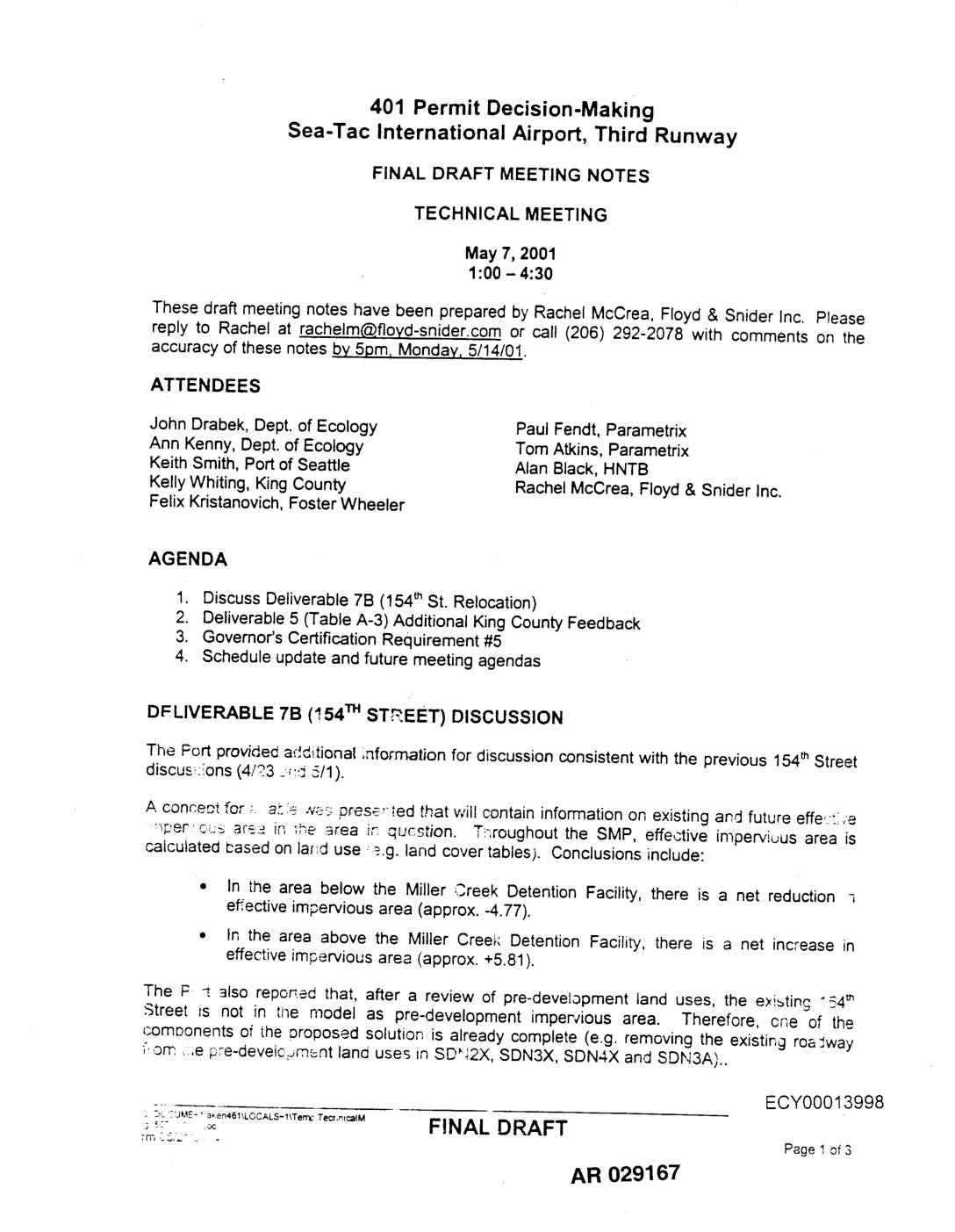
EXH AR029167: 401 Permit Decision-Making Sea-Tac Airport Third Runway Technical Meeting Final Draft Minutes, May 7, 2001
Final draft meeting notes prepared by Rachel McCrea, Floyd & Snider Inc., for the 401 Permit Decision-Making Technical Meeting on Sea-Tac International Airport Third Runway, May 7, 2001. Attendees included John Drabek and Ann Kenny (Dept. of Ecology), Keith Smith (Port Of Seattle), Kelly Whiting (King County), Felix Kristanovich (Foster Wheeler), Paul Fendt and Tom -
 2001-05-06
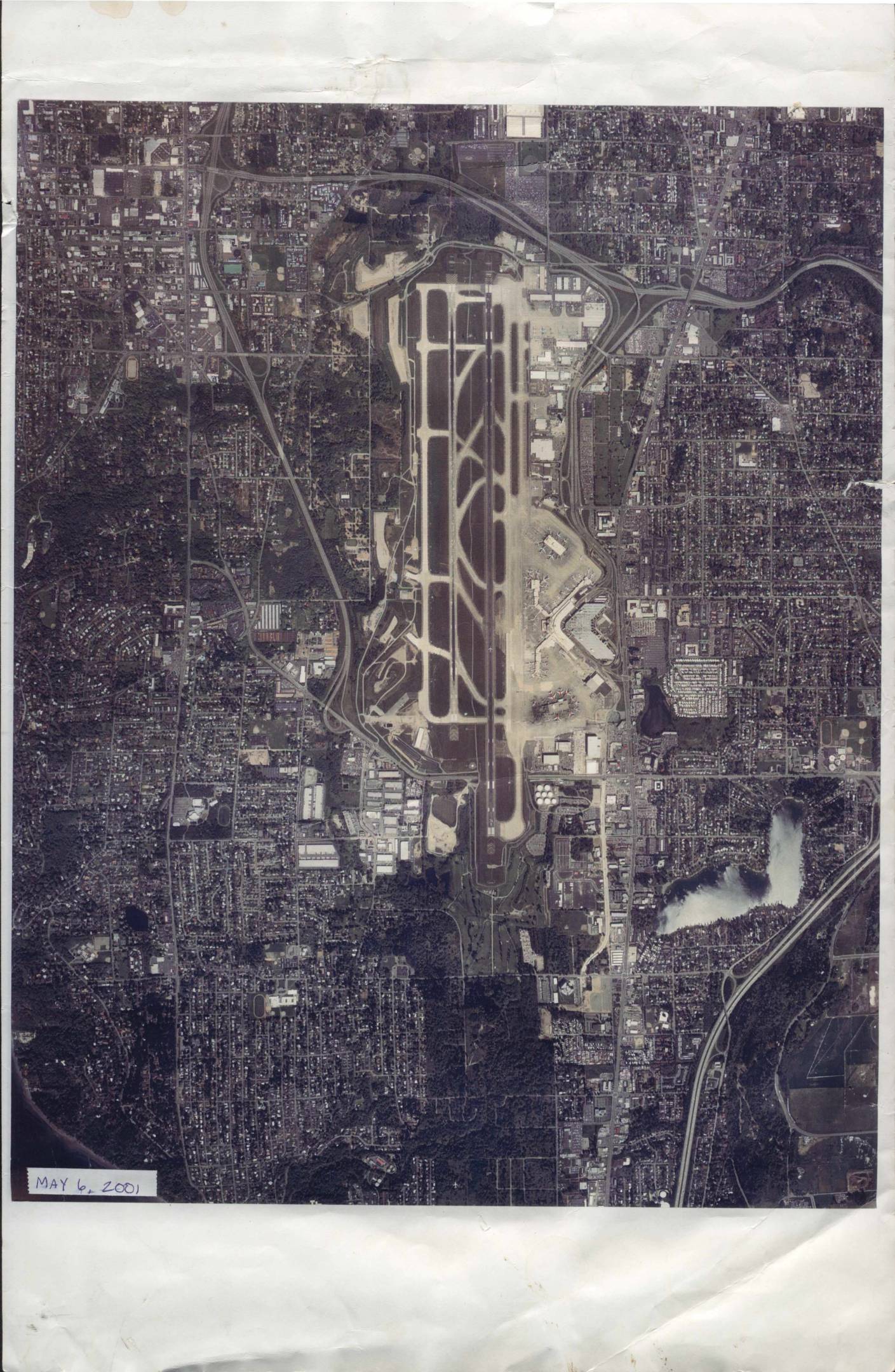
Sea-Tac Airport aerial photograph, May 6, 2001
An aerial photograph of Seattle-Tacoma International Airport (Sea-Tac) and its surrounding neighborhoods, taken on May 6, 2001, by Walker and Associates Photogrammetric and GIS Services of Seattle, WA. The image, printed at an approximate scale of 1 inch equals 1,700 feet, shows the airport's runways, taxiways, terminals, and the densely developed residential and commercial areas nearby. It is identified under negative number 1245 SEATAC PP-3 and work order number 26599, and is copyrighted 2001. -
 2001-05-03
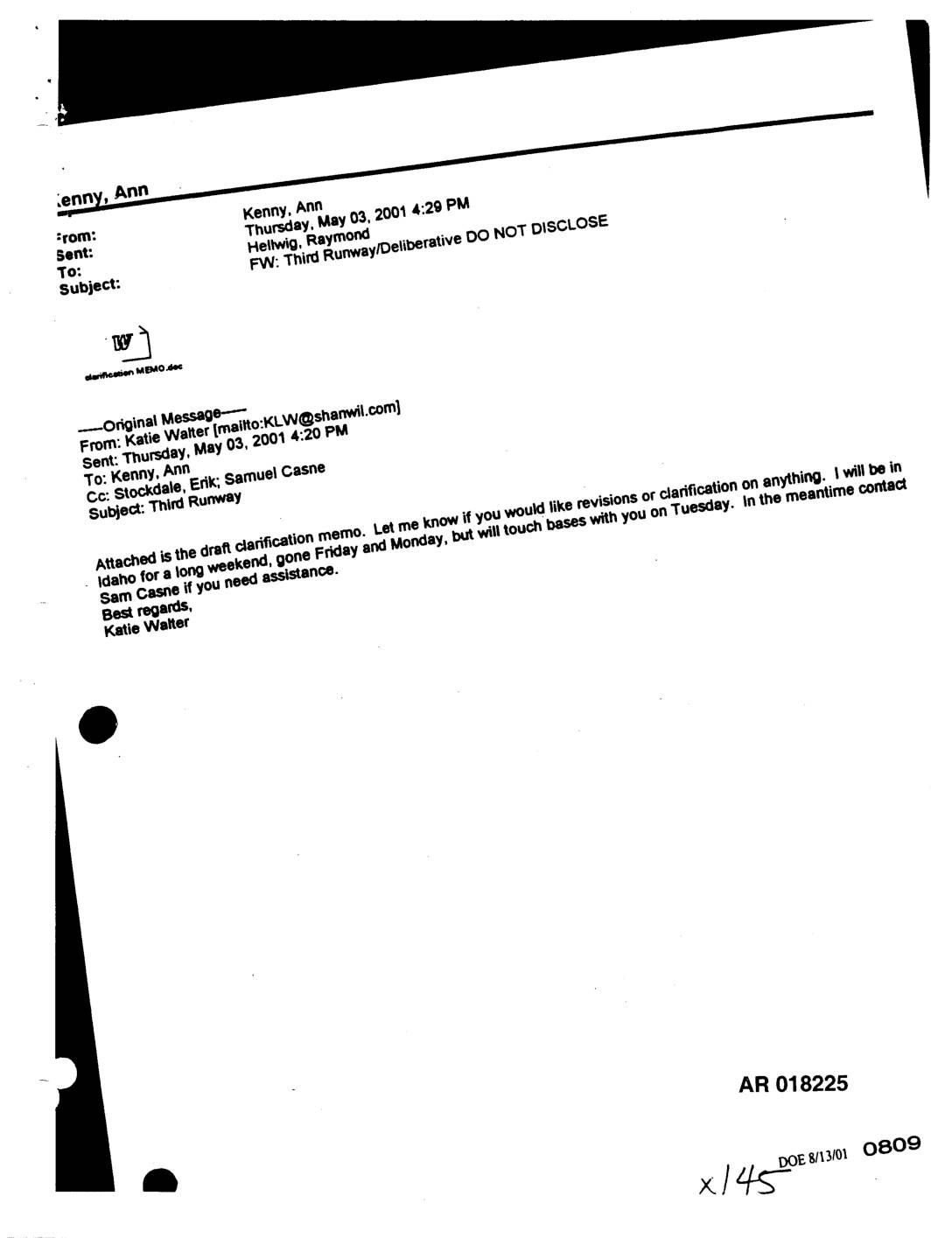
EXH AR018225: Draft Memorandum — Outstanding Issues for Port Resolution (Third Runway Natural Resource Mitigation Plan)
Draft memorandum dated April 25, 2001 from Katie L. Walter of Shannon & Wilson, Inc. to Ann Kenny and Erik Stockdale of Washington Department of Ecology, regarding outstanding issues for Port Of Seattle resolution on the Natural Resource Mitigation Plan for Sea-Tac Airport proposed Third Runway. Forwarded by Ann Kenny to Raymond Hellwig on May -
 2001-05-03
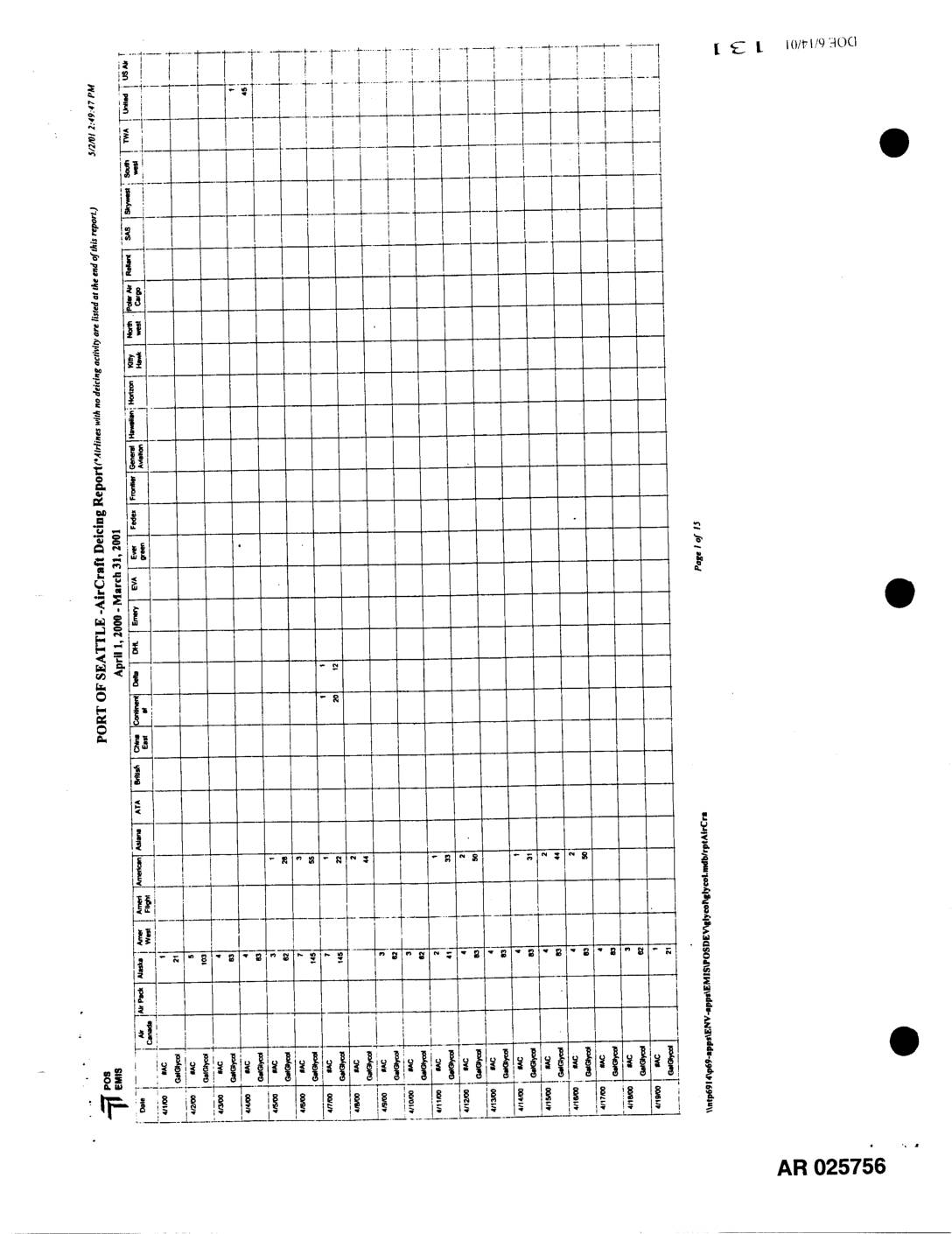
EXH AR025756: Aircraft Deicing RP Apr 1 2000–Mar 31 2001
This document is a Port of Seattle AirCraft Deicing Report covering the period April 1, 2000 through March 31, 2001, generated on May 2, 2001. It tracks deicing activity by date and airline carrier—including Alaska, American, Alaska Airlines, Delta, and others—recording the volumes of deicing fluid (BAC and GalGlycol) applied at Seattle-Tacoma International Airport. The multi-page report notes that airlines with no deicing activity are listed at the end of the report. -
 2001-05-01
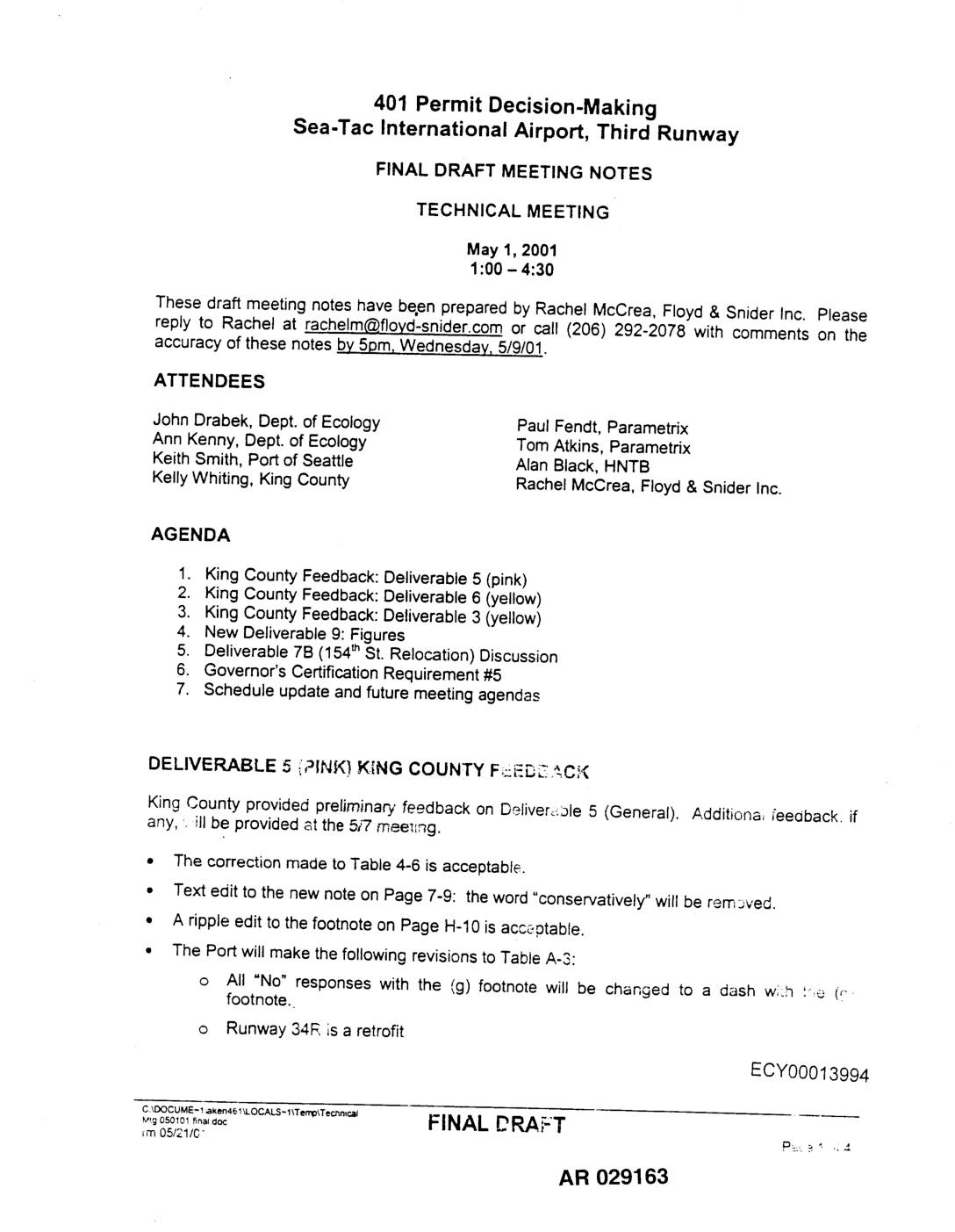
EXH AR029163: 401 Permit Decision-Making, Sea-Tac Airport Third Runway — Technical Meeting Notes, May 1, 2001
Final draft meeting notes from a 401 Permit Decision-Making technical meeting on May 1, 2001, regarding Sea-Tac International Airport Third Runway, prepared by Rachel McCrea of Floyd & Snider Inc. Attendees included John Drabek and Ann Kenny (Dept. of Ecology), Keith Smith (Port Of Seattle), Kelly Whiting (King County), Paul Fendt and Tom Atkins (Parametrix), -
 2001-05-01
EXH AR050379: Wetland Photographs and Maps — Master Plan Update Improvements, Seattle-Tacoma International Airport
Wetland photographs and maps prepared by Parametrix, Inc. for the Port Of Seattle, documenting wetlands and other Waters of the U.S. in the Miller Creek Basin near Seattle-Tacoma International Airport (STIA) as part of the Master Plan Update Improvements. AR 050379–050381. Includes photo point map showing delineated wetlands verified and not verified by ACOE (Army -
 2001-05-01
EXH AR031166: Wetland Photographs and Maps — Master Plan Update Improvements, Sea-Tac Airport
Wetland photographs and maps prepared by Parametrix, Inc. for Port Of Seattle, May 2001, as part of the Master Plan Update Improvements for Seattle-Tacoma International Airport. Document AR031166 includes a Wetlands Atlas covering North and West Sides of Sea-Tac Airport, with 15 map sections showing surveyed wetland boundaries, estimated wetland boundaries, and other estimated or -
 2001-04-30
EXH AR050083: Response to Comments — Master Plan Update Improvements at Seattle-Tacoma International Airport, Permit 1996-4-02325
Port of Seattle response to agency and public comments on Section 404 Clean Water Act permit application (JARPA, reference 1996-4-02325) for Master Plan Update improvements at Seattle-Tacoma International Airport. Covers U.S. Army Corps of Engineers public notice history (December 19, 1997; September 30, 1999; December 27, 2000), wetland fill acreages, Miller Creek channel relocation, Highline -
 2001-04-30
EXH AR050378: Response to Comments — Master Plan Update Improvements at Seattle-Tacoma International Airport, Permit 1996-4-02325
Port Of Seattle response to agency and public comments on Section 404 Clean Water Act permit application (JARPA, permit 1996-4-02325) for Master Plan Update improvements at Seattle-Tacoma International Airport. Document AR050378 covers comments received following the December 27, 2000 second revised public notice issued by the U.S. Army Corps of Engineers. Responds to Tom Luster, -
 2001-04-30
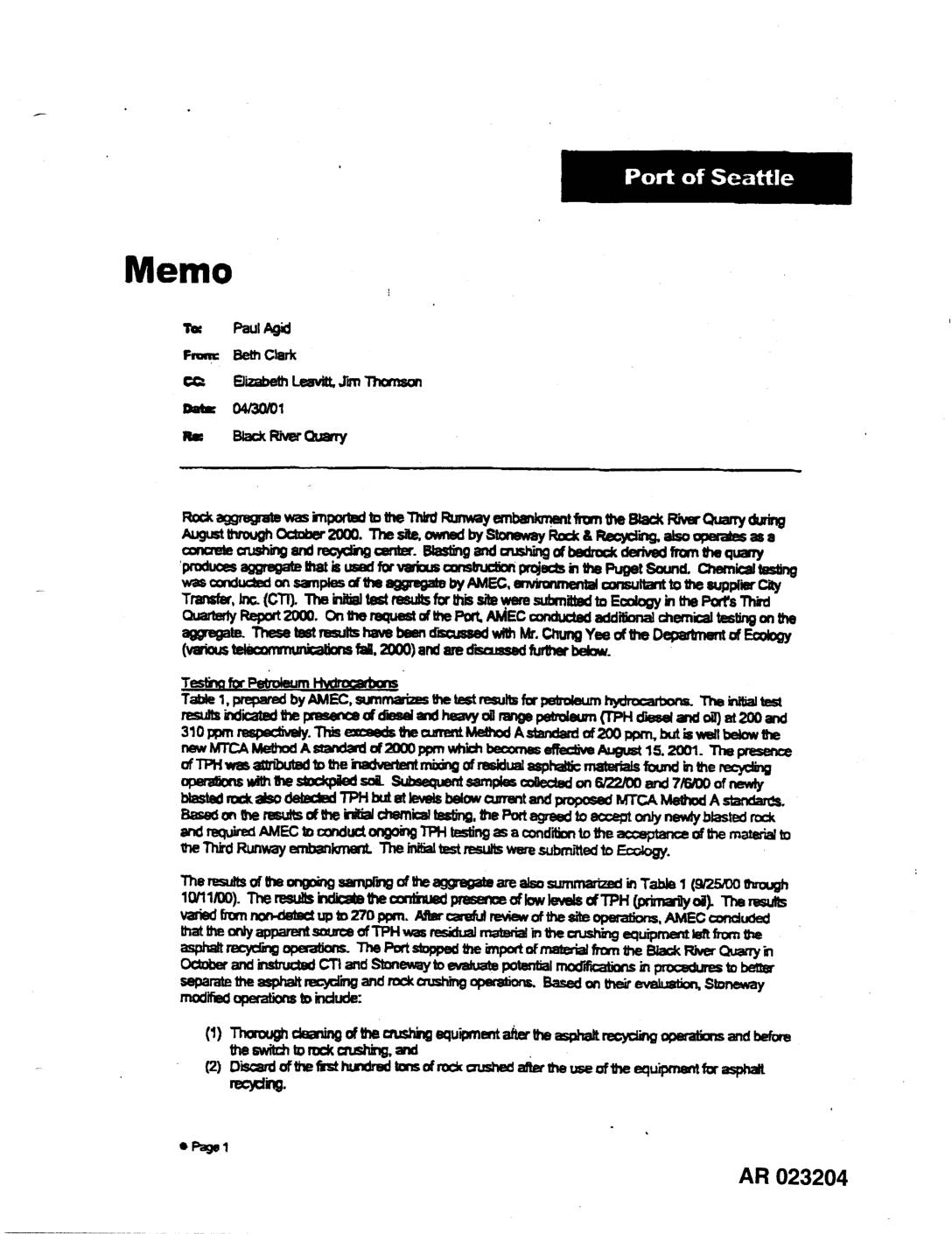
EXH AR023204: Memo — Black River Quarry Aggregate Testing (TPH & Metals)
A Port of Seattle memo from April 2001 summarizes environmental testing of rock aggregate imported from the Black River Quarry for use in the Third Runway embankment project. Testing by environmental consultant AMEC found petroleum hydrocarbons (TPH) and elevated copper levels in some samples, prompting operational changes at the quarry including equipment cleaning and discarding the first hundred tons of rock after asphalt recycling operations. Follow-up testing confirmed that contaminant levels fell below MTCA Method A cleanup standards, and the Port halted material imports from the quarry in mid-October 2000 pending resolution.