TagNoise(262)
-
 1973-07-27
Public health and welfare criteria for noise
This 1973 U.S. Environmental Protection Agency document establishes scientific criteria for understanding how noise affects public health and welfare, including hearing damage, annoyance, communication interference, and property value loss. Prepared by EPA's Office of Noise Abatement and Control under the Noise Control Act of 1972, it describes cause-and-effect relationships between noise exposure and human health impacts. The criteria laid out in this document were intended to serve as a foundation for developing future noise standards and regulations, though the document itself does not constitute a standard or regulation. -
 1973-07-18
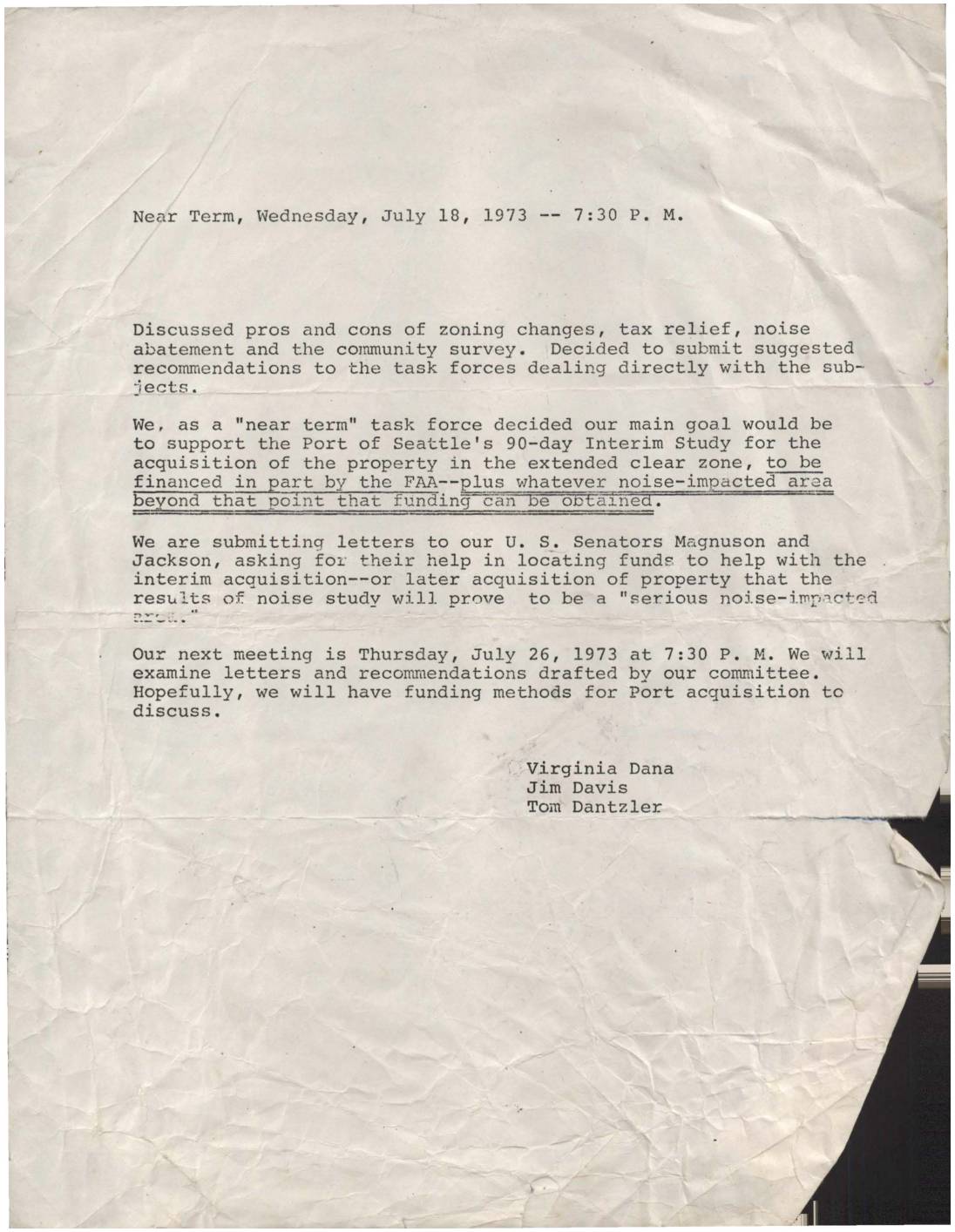
Near Term Task Force Meeting Minutes: July 18, 1973
Minutes from a July 18, 1973 'Near Term' task force meeting focused on Sea-Tac Airport noise issues, in which members agreed to support the Port of Seattle's 90-day Interim Study for acquiring property in the extended clear zone, with partial FAA funding. The group also decided to write to U.S. Senators Magnuson and Jackson to seek additional funds for interim and future property acquisition in serious noise-impacted areas. The next meeting was scheduled for July 26, 1973, to review draft letters and explore funding options. -
 1973-05-02
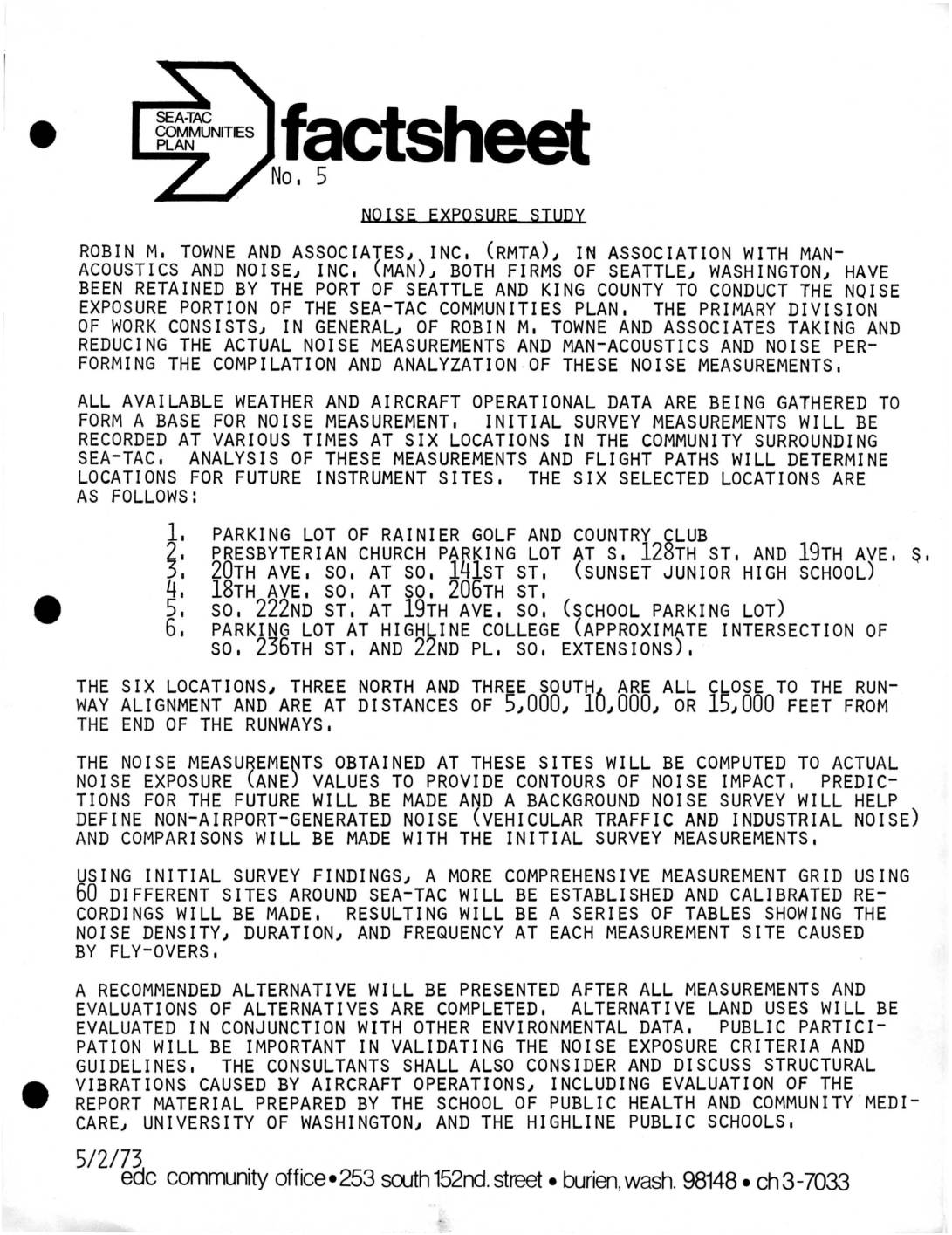
Sea-Tac Communities Plan Fact Sheet No. 5: Noise Exposure Study
This 1973 fact sheet describes a noise exposure study commissioned by the Port of Seattle and King County to measure aircraft noise impacts around Seattle-Tacoma International Airport. Two Seattle firms, Robin M. Towne and Associates and Man-Acoustics and Noise, Inc., conducted measurements at six community locations ranging from 5,000 to 15,000 feet from the runway ends, with plans to expand to 60 sites. The study aimed to produce noise exposure contours, future noise predictions, and alternative land-use recommendations, while also accounting for non-airport noise sources and structural vibrations caused by aircraft operations. -
 1973-01-11
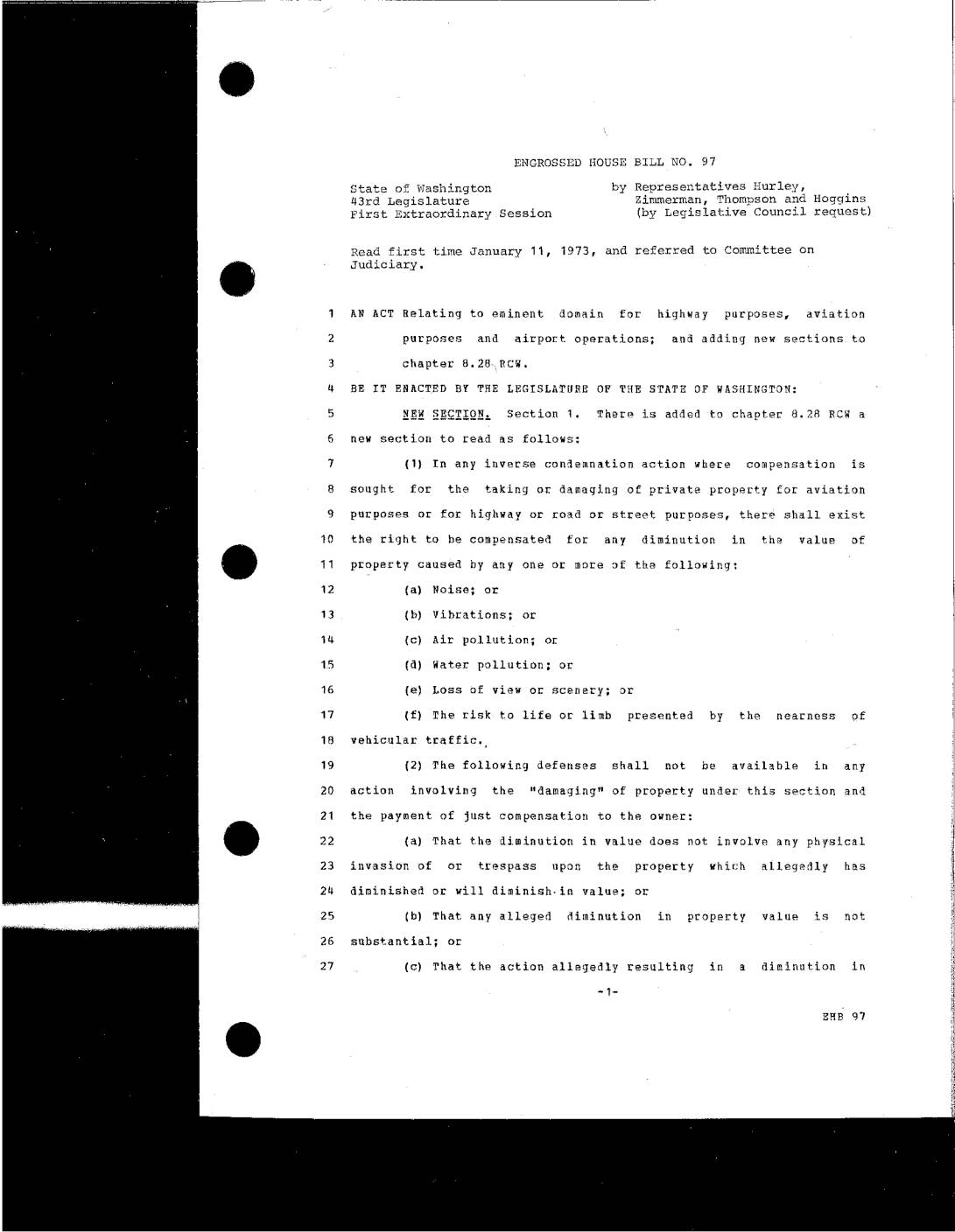
Engrossed House Bill No. 97
Engrossed House Bill No. 97, introduced in Washington State's 43rd Legislature in January 1973, establishes the right of property owners to seek compensation in inverse condemnation actions when their property value is diminished due to highway, aviation, or airport operations. Qualifying impacts include noise, vibrations, air pollution, water pollution, loss of view or scenery, and risk to life from nearby traffic. The bill also limits recovery to properties within one-quarter mile of a highway right-of-way or within one hundred yards of an airport facility, and requires actions to be filed within three years of the alleged taking or damaging. -
 1973-01-01
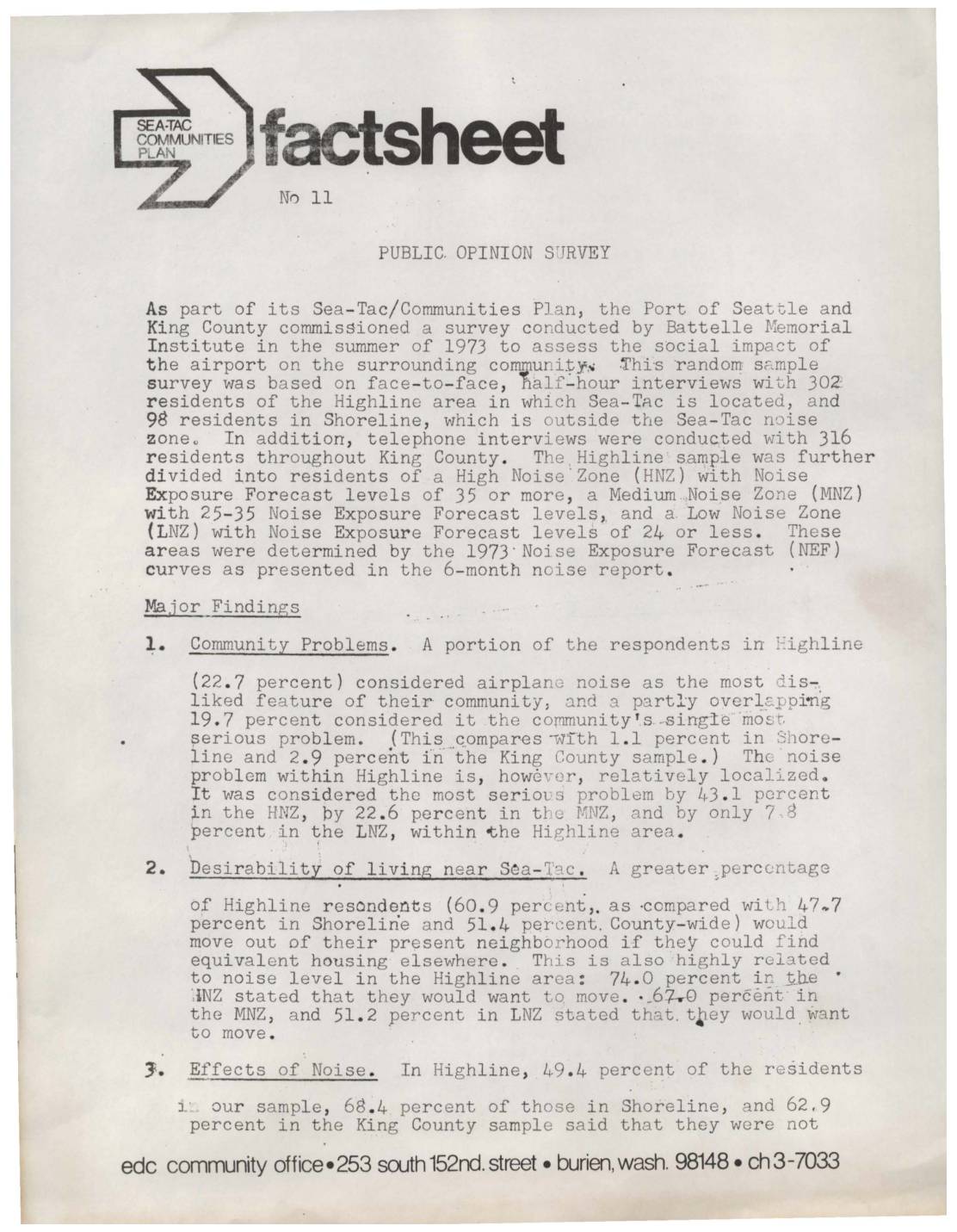
Public Opinion Survey: Sea-Tac Communities Plan Factsheet No. 11
A 1973 public opinion survey commissioned by the Port of Seattle and King County found that nearly one in five Highline-area residents considered airplane noise from Sea-Tac Airport their community's single most serious problem, with concern rising sharply among those living in the highest-noise zones. Highline residents were more likely to want to move than those in quieter comparison areas, though the survey also found that the Port of Seattle was viewed favorably by a strong majority across all groups surveyed. -
 1972-11-06
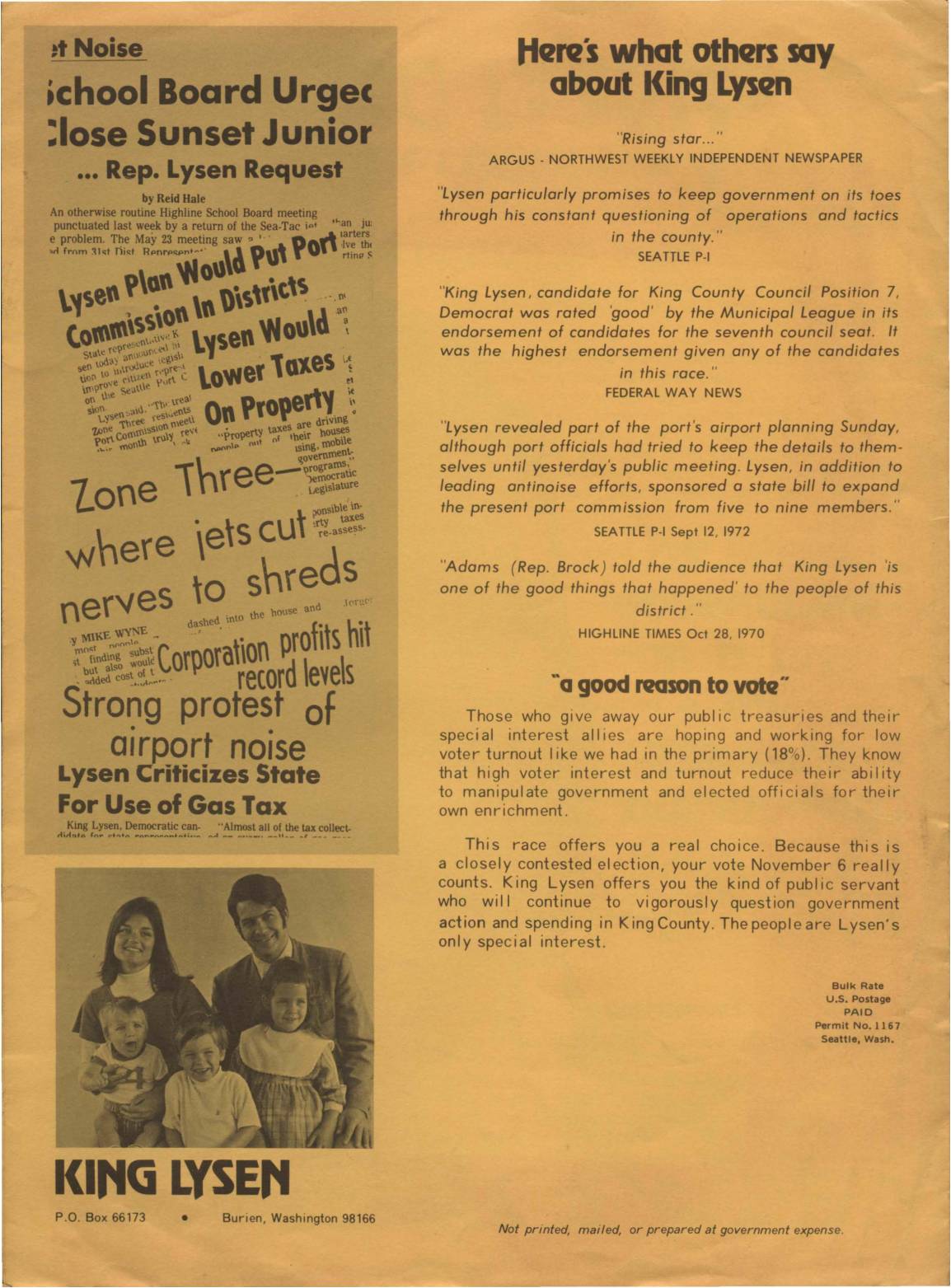
King Lysen for King County Council Position 7 campaign mailer
This is a campaign mailer for King Lysen, a Democratic candidate for King County Council Position 7 in the early 1970s, highlighting his record of challenging government spending and operations in King County, Washington. Lysen was notably active in anti-noise efforts related to Sea-Tac Airport, including revealing port airport planning details to the public and sponsoring a state bill to expand the port commission from five to nine members. The mailer compiles endorsements from outlets such as the Seattle Post-Intelligencer, the Argus, and the Federal Way News, emphasizing his reputation as a government watchdog and advocate for residents affected by airport noise. -
 1972-09-01
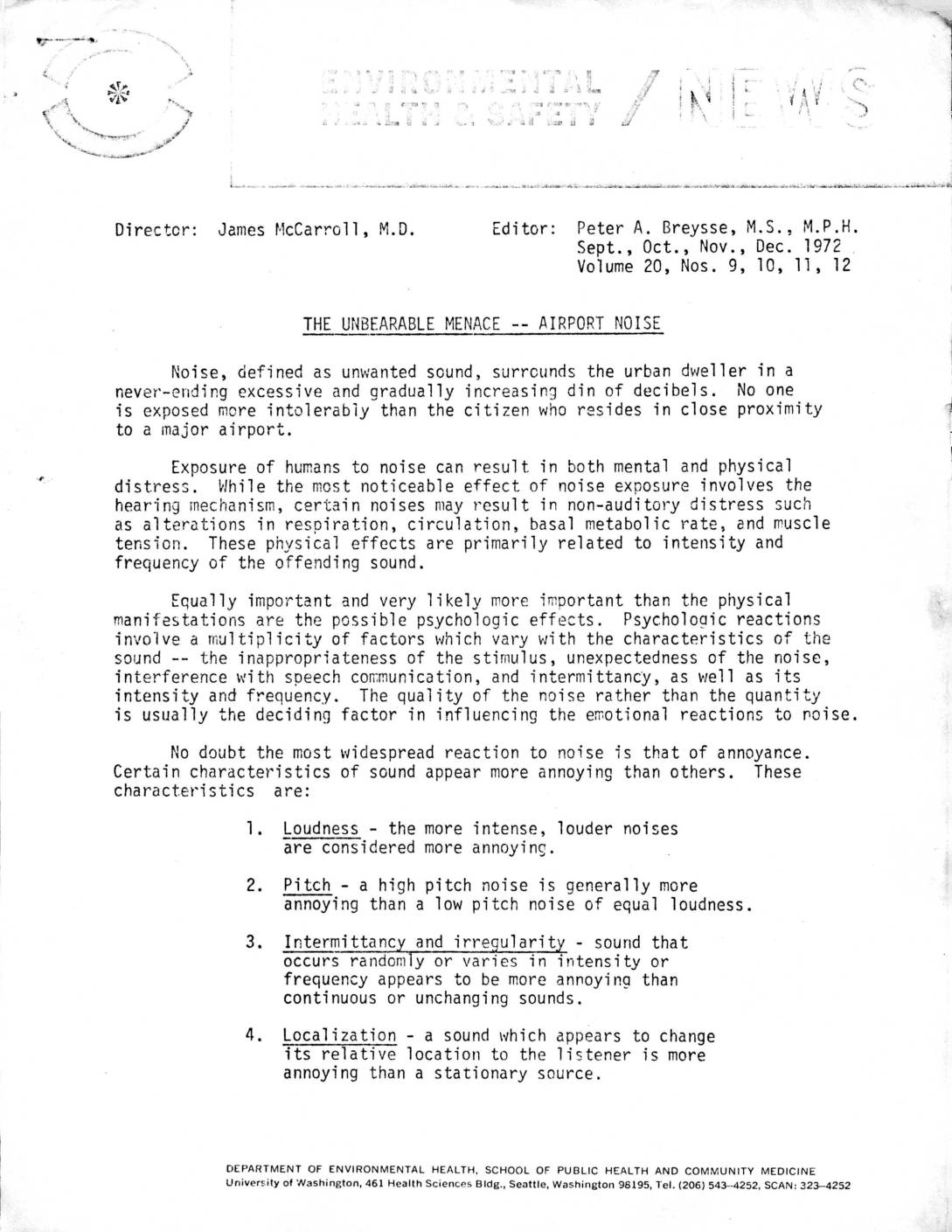
The Unbearable Menace — Airport Noise
A 1972 University of Washington environmental health report examines the serious health impacts of aircraft noise on residents living near Seattle-Tacoma Airport, including sleep disturbance, psychological effects, and interference with speech in schools. Noise measurements taken at four locations near the airport recorded up to 95 dBA, with dozens of flyovers exceeding 75 dBA even during nighttime sleeping hours, levels researchers considered potentially hazardous to mental and physical health. The report also highlights special risks for vulnerable groups such as young children, the elderly, the sick, and night-shift workers. -
 1972-09-01
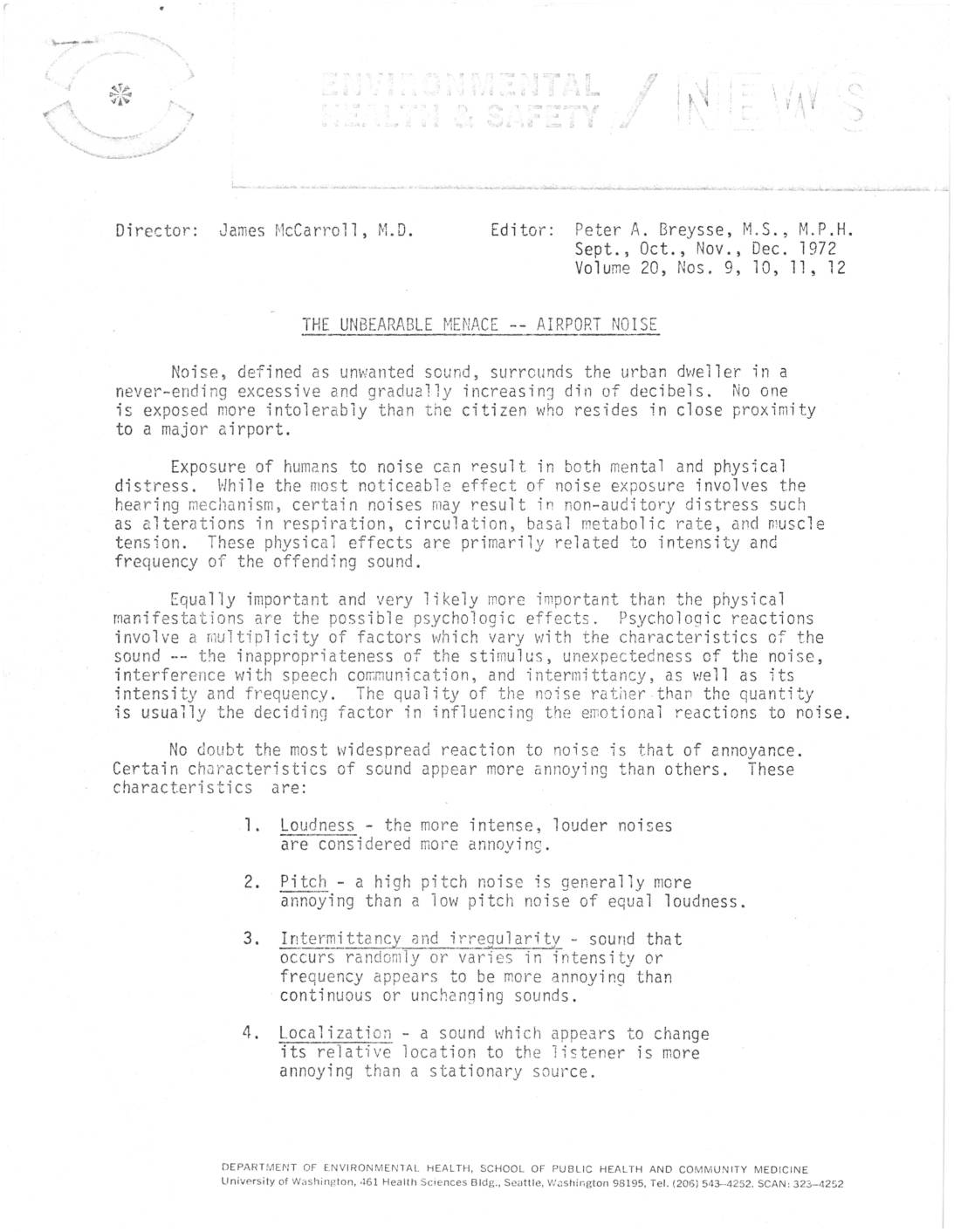
The unbearable menace — airport noise
A 1972 University of Washington environmental health report examines the serious physical and psychological effects of aircraft noise on residents living near Seattle-Tacoma Airport. On-site measurements recorded up to 95 dBA indoors, with hundreds of daily flyovers exceeding 75 dBA—levels shown by research to disrupt sleep, impair children's school performance, and pose long-term mental and physical health risks. The report also highlights how excessive ambient noise in nearby schools interferes with speech comprehension and the learning process. -
 1972-06-14
Aircraft noise study: Sea-Tac Airport Zone Three
A June 1972 noise study conducted by Washington State's Department of Social and Health Services measured aircraft noise levels at twelve locations near homes and schools in Zone Three around Sea-Tac Airport. All recorded noise levels exceeded 80 dBA, with a peak of 107 dBA, caused by jet aircraft including the 707, 727, 737, 747, and DC-8 during landing approaches and takeoffs. The study was requested by citizens representing 2,184 residences in the zone and aimed to assess the health impact of low-flying aircraft noise on the surrounding community. -
 1971-11-08
Technical background for noise abatement in HUD’s operating programs
This 1971 technical report, prepared by Theodore J. Schultz of Bolt Beranek and Newman Inc. for the U.S. Department of Housing and Urban Development (HUD), provides the scientific and technical background for noise abatement measures in HUD's housing programs. It supports HUD's guidelines for assessing noise exposure at residential sites, offering detailed evaluation procedures for determining acceptable noise levels near housing developments. The report was originally published in September 1970 and later revised to align with updated HUD noise exposure assessment guidelines.