TagNoise(262)
-
 2011-04-15
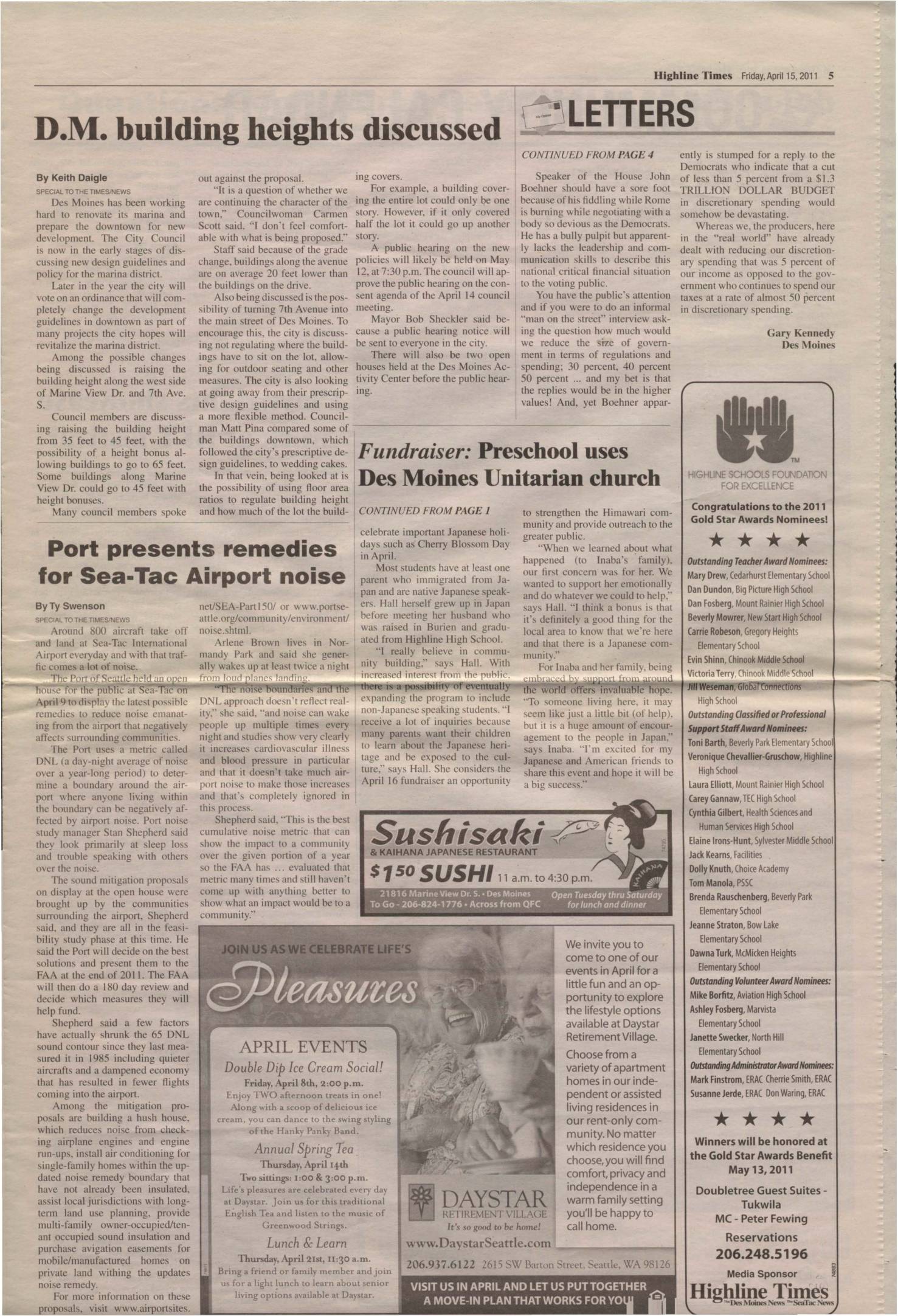
Port presents remedies for Sea-Tac Airport noise
The Port of Seattle held a public open house at Sea-Tac International Airport on April 9, 2011, to present feasibility-stage proposals for reducing airport noise affecting surrounding communities. Mitigation options under consideration included building a hush house to muffle engine run-ups, installing air conditioning in uninsulated single-family homes within the updated 65 DNL noise boundary, providing sound insulation for multi-family and mobile homes, and assisting local jurisdictions with long-term land-use planning. The Port planned to submit its recommended solutions to the FAA by the end of 2011, after which the FAA would conduct a 180-day review to determine which measures it would help fund. -
 2010-08-19
Appendix N – Forecast approval
This document is Appendix N of the Seattle-Tacoma International Airport Part 150 Noise Compatibility Study Update, compiled by Landrum & Brown in October 2013. It contains the FAA's official approval, dated August 19, 2010, of the aviation activity forecast submitted by Sea-Tac Airport in July 2010. The FAA determined that the forecast provided adequate justification for total aircraft operations and authorized its use in the airport's Noise Compatibility Plan Update. -
 2010-02-20
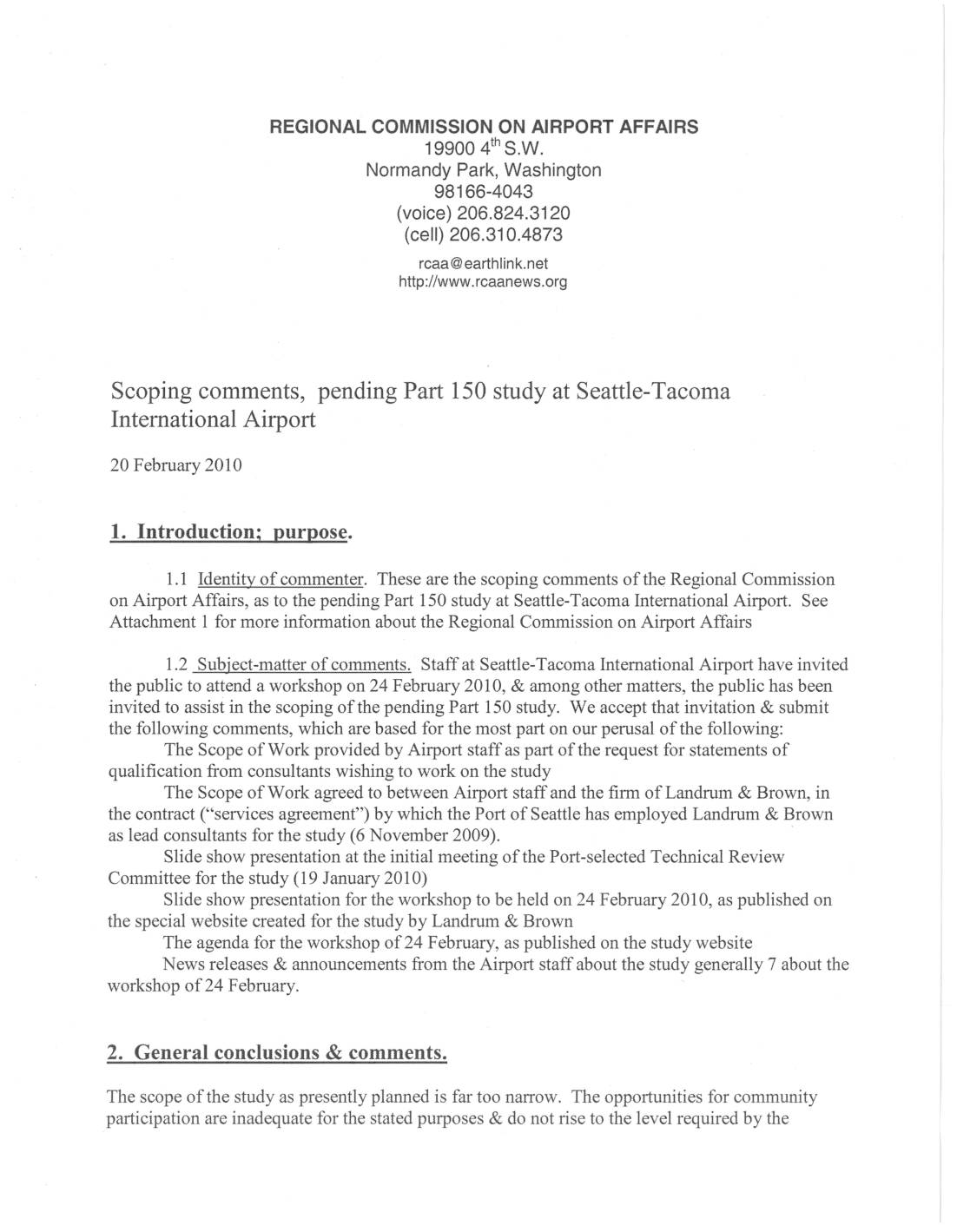
Scoping Comments, Pending Part 150 Study at Seattle-Tacoma International Airport
The Regional Commission on Airport Affairs submitted formal scoping comments in February 2010 criticizing the planned Part 150 noise study at Seattle-Tacoma International Airport as too narrow in scope and insufficient in public participation opportunities. The comments call for improvements in study documentation standards, including proper indexing, clear citations, author transparency, and plain-English presentation of data. The commission also urges that public comment periods be at least 60 days and not scheduled around major holidays. -
 2009-12-10
Aviation noise impact: A historical perspective
This December 2009 presentation by Kenneth J. Plotkin of Wyle Laboratories examines the history of aviation noise impact research, tracing how noise metrics evolved over time and what was learned—or lost—along the way. It outlines the FAA's Aviation Noise Impacts Research Roadmap, whose goals include improving understanding of annoyance and sleep disruption, developing exposure-to-impact assessments, and informing policy, mitigation strategies, and cost-benefit models. The presentation emphasizes the importance of learning from past research efforts to avoid repeating mistakes in future noise policy decisions. -
 2008-04-01
Monetary value of undisturbed sleep
A Swiss study interviewed 67 patients with obstructive sleep apnea who used CPAP therapy to estimate the monetary value people place on undisturbed sleep. Patients valued a good night's sleep at an average of about 70 Swiss francs per night, and after adjusting for the difference in severity between sleep apnea and traffic noise disturbance, the researchers estimated that noise-free sleep is worth roughly 7 to 24 Swiss francs per person per night. The findings suggest that sleep disrupted by road traffic noise carries a significant monetary cost that should be factored into airport and transportation noise policy decisions. -
2007-04-02
Massachusetts v EPA, 549 U.S. 497 (2007)
Annotation Primary HoldingThe Clean Air Act allows the Environmental Protection Agency to regulate greenhouses gases because they qualify as air pollutants. Also, standing requires showing a concrete harm that can be traced to the defendant and remedied by the courts. Read More Syllabus SYLLABUS OCTOBER TERM, 2006 MASSACHUSETTS V. EPA SUPREME COURT OF THE -
 2002-01-01
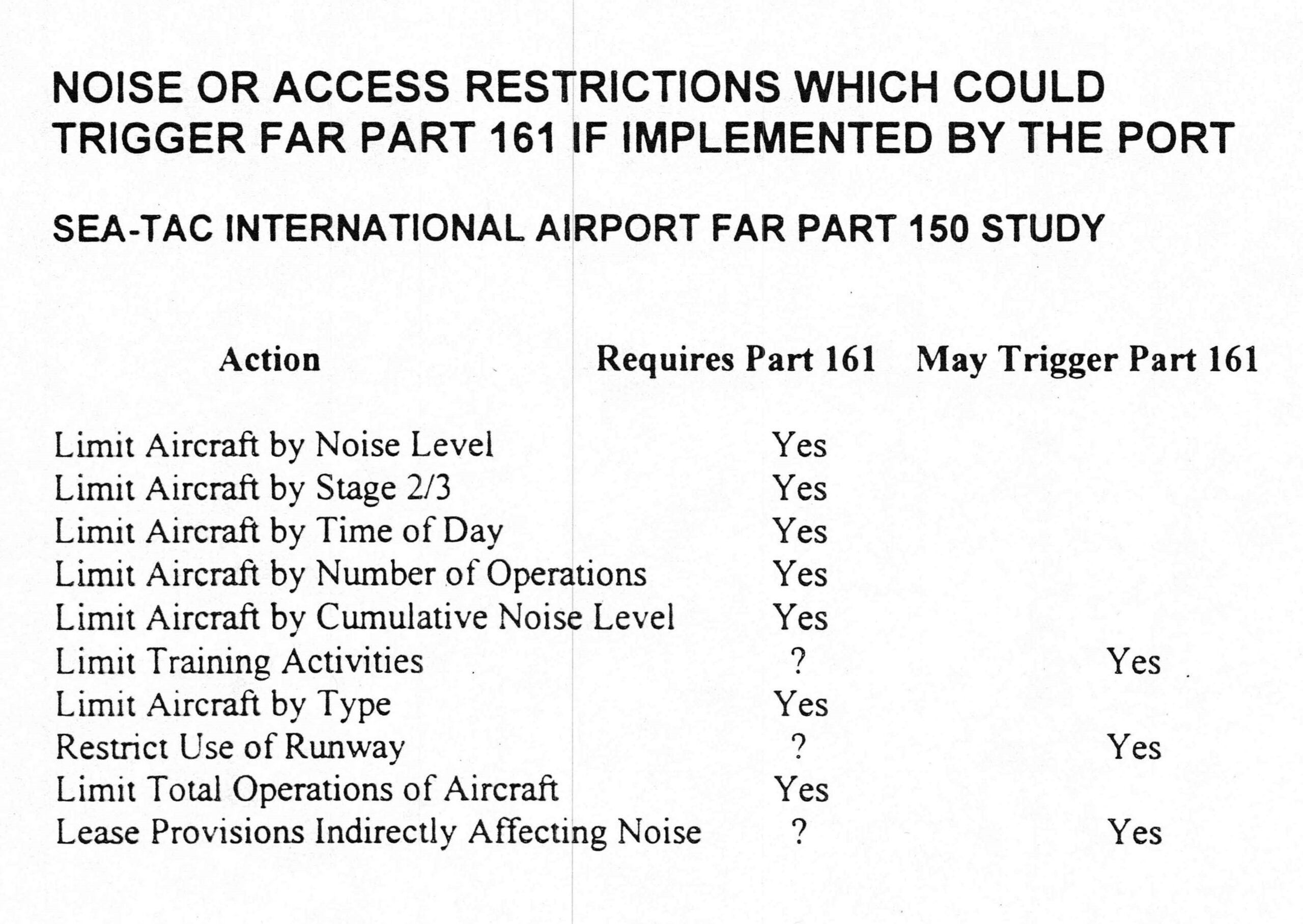
FAR Part 150 Study Table: Airport Noise Restrictions and FAR Part 161 Compliance Requirements
A table from the Sea-Tac International Airport FAR Part 150 Study listing airport actions (such as limiting aircraft by noise level, time of day, type, and runway use) and indicating whether each action definitively requires FAR Part 161 compliance or may potentially trigger it. Actions including limiting training activities, restricting runway use, and lease provisions indirectly affecting noise are marked with '?' under 'Requires Part 161' but 'Yes' under 'May Trigger Part 161.' -
 2001-06-22
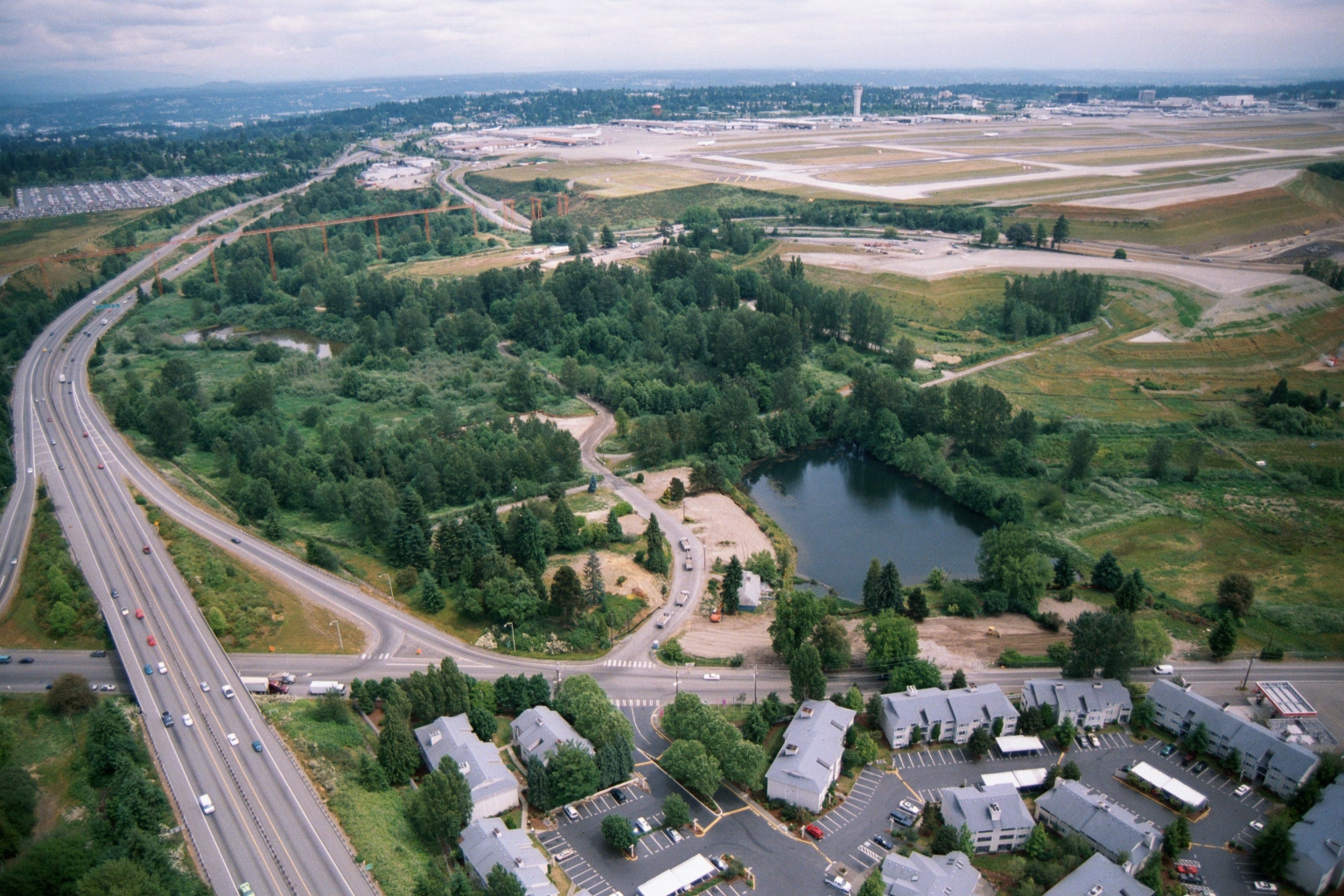
Aerial View of Sea-Tac Airport Showing Runways, SR-99 Corridor, and Adjacent Residential Land Uses
Aerial photograph looking north toward Seattle-Tacoma International Airport (Sea-Tac), showing the airport's runways and terminal area in the background. In the foreground are a multi-lane highway (likely SR-99 or I-5 corridor), a wooded green buffer zone with a retention pond, and a residential apartment complex, illustrating the airport's relationship to surrounding land uses relevant to noise-policy planning. -
 2001-06-22
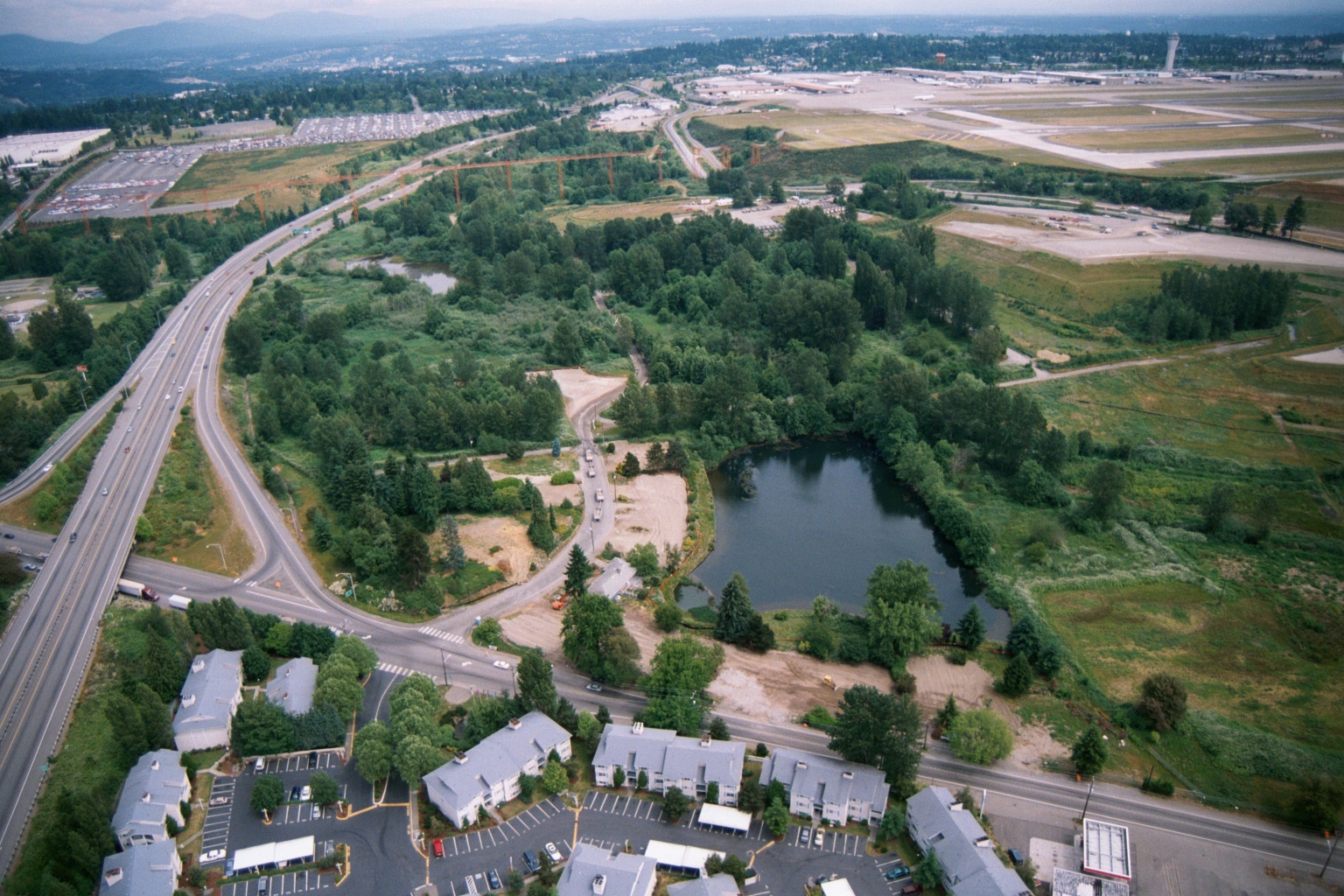
Aerial View of Sea-Tac Airport Runway Area and Surrounding Residential Development
Aerial photograph looking north toward Seattle-Tacoma International Airport (Sea-Tac), showing the airport's runways and tarmac in the upper right, a curved highway interchange (likely SR-99 or I-5 corridor area), a retention pond surrounded by green space, and apartment complexes in the foreground. The image appears to document land use and development patterns in the airport noise-impact zone, likely in the SeaTac/Tukwila area of Washington State. -
Aircraft Noise: The Ailment And The Treatment
By Arline L. Bronzaft, Ph.D., Chair, Aircraft Noise Abatement Group of New York and New Jersey (ANAG) | Hearing Rehabilitation Quarterly – Special Edition (2001) THE NEW MEANING OF F.A.A. The summer of 2000 was marked by an unusually high number of aircraft delays, especially at LaGuardia Airport in New York City. These delays continued