TagNoise Abatement Procedures(92)
-
 2019-10-18
Detailed Responses to City of Burien Questions
The Port of Seattle responds to questions from the City of Burien about aircraft noise studies, noise abatement procedures, and community mitigation programs at Seattle-Tacoma International Airport. The Port clarifies that its 2014 Part 150 noise study covered all three runways and actually showed a smaller noise-impacted area due to quieter aircraft technology, and that the upcoming Sustainable Airport Master Plan environmental review will further assess noise impacts. The document also addresses concerns about the pace of sound insulation programs, the transparency of the StART community advisory process, and the legal and regulatory constraints that limit the Port's ability to mandate certain noise reduction measures. -
 2019-10-18
Detailed Responses to City of Burien Questions
The Port of Seattle responds to questions from the City of Burien about aircraft noise studies, noise abatement procedures, and community mitigation programs at Seattle-Tacoma International Airport. The Port clarifies that its 2014 Part 150 noise study covered all three runways and actually showed a smaller noise-impacted area due to quieter aircraft technology, and that the upcoming Sustainable Airport Master Plan environmental review will further assess noise impacts. The document also addresses concerns about the pace of sound insulation programs, the transparency of the StART community advisory process, and the legal and regulatory constraints that limit the Port's ability to mandate certain noise reduction measures. -
 2019-10-18
Detailed responses to City of Burien questions
The Port of Seattle responded in October 2019 to detailed questions from the City of Burien about aircraft noise management at Sea-Tac Airport, addressing concerns about noise studies, abatement procedures, sound insulation programs, and community engagement. The Port defended its 2014 Part 150 noise study as covering all three runways and argued that improved aircraft technology has actually reduced the noise-impacted area since the previous study. It also outlined ongoing mitigation efforts, including a Late-Night Noise Limitation Program, over $300 million spent on sound insulation for thousands of homes, and the upcoming Sustainable Airport Master Plan environmental review, which will reassess noise impacts across all runways. -
 2019-09-12
Late night noise reduction programs take effect
In September 2019, the Port of Seattle announced two new programs to reduce late-night aircraft noise at Seattle-Tacoma International Airport. A revised Runway Use Agreement with the FAA took effect on September 4, limiting use of the Third Runway (16R/34L) between midnight and 5 a.m., while a new voluntary Late Night Noise Limitation Program encourages airlines to schedule flights during less noise-sensitive hours or switch to quieter aircraft during the same period. Both initiatives stemmed from recommendations by the Sea-Tac Airport Stakeholder Advisory Round Table (StART). -
 2019-08-28
StART August 28, 2019 Meeting Recap
The Sea-Tac Stakeholder Advisory Round Table (StART) met on August 28, 2019 to discuss airport noise reduction efforts, federal policy priorities, and an overview of Part 150 noise studies. Key updates included progress on a Revised Runway Use Agreement, the launch of a Late Night Noise Limitation Program, and a new noise complaint system. The meeting also addressed the temporary suspension of three neighboring cities from StART, with airport leadership pledging improved communication and good-faith efforts to re-engage those communities. -
 2019-05-14
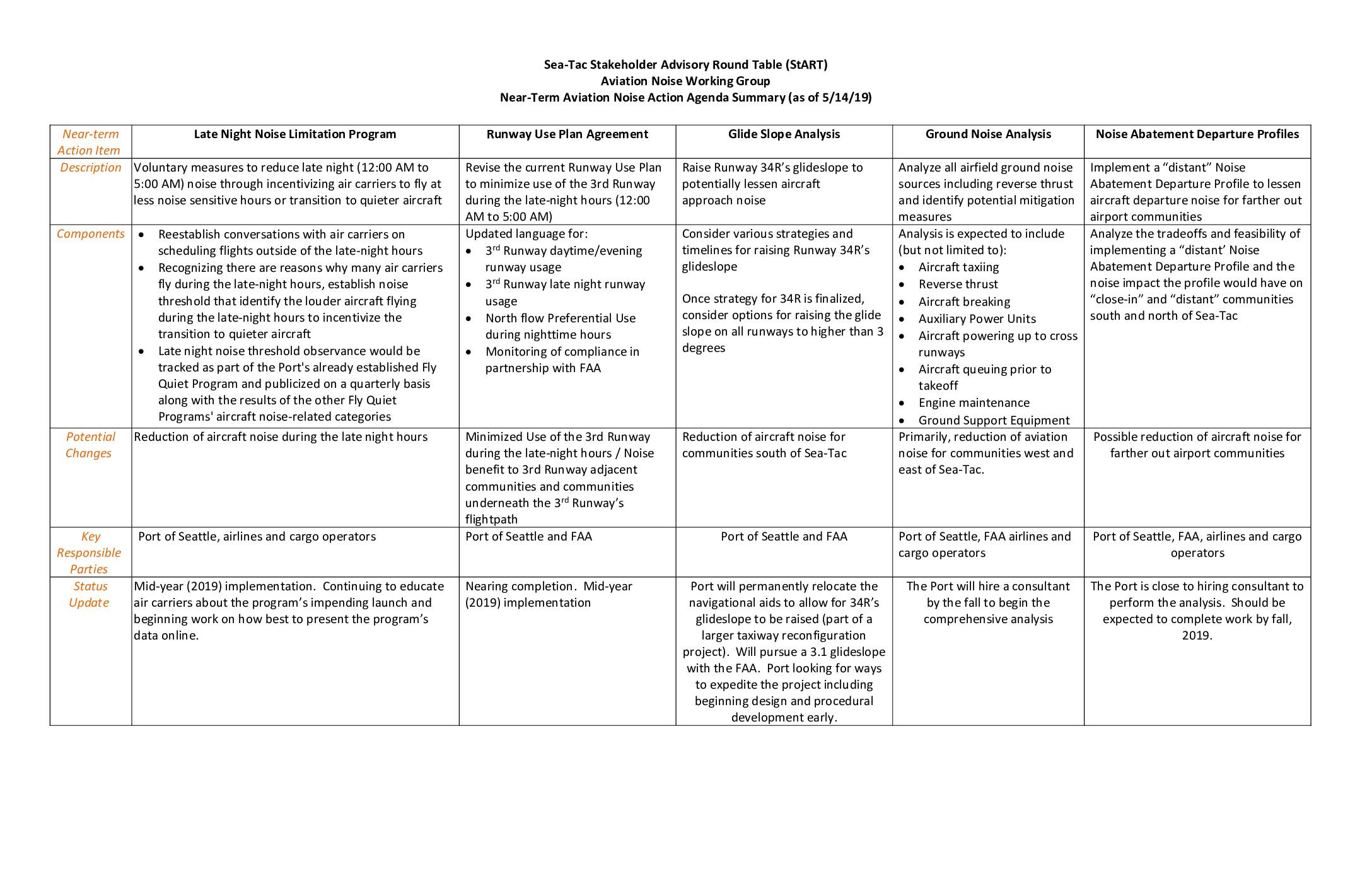
Sea-Tac Stakeholder Advisory Round Table (StART) Aviation Noise Working Group near-term aviation noise action agenda summary (as of 5/14/19)
The Sea-Tac Stakeholder Advisory Round Table (StART) Aviation Noise Working Group outlined five near-term action items in 2019 aimed at reducing aircraft noise for communities surrounding Seattle-Tacoma International Airport. These actions include a Late Night Noise Limitation Program to discourage loud flights between midnight and 5 AM, revisions to the Runway Use Plan to limit 3rd Runway use at night, raising the glideslope on Runway 34R to reduce approach noise, a comprehensive ground noise analysis, and a study of 'distant' noise abatement departure profiles. The Port of Seattle, FAA, airlines, and cargo operators share responsibility for implementing these measures, with most initiatives targeted for mid-to-late 2019 completion. -
 2018-01-24
Aircraft arrivals analysis: Progress update
This January 2018 progress update from ESA presents an analysis of aircraft arrivals at Seattle-Tacoma International Airport (SEA), examining whether notable changes occurred between 2013, 2015, and 2017. The study uses radar flight track data from July and December of each year to compare fleet mix, runway usage, and aircraft altitudes at six nautical miles from the airport. Key questions addressed include whether arrival numbers increased, whether traffic flow patterns shifted between north and south flow, and whether arriving aircraft were flying at different altitudes over the study period. -
 2018-01-01
City of Phoenix Aviation Department 2018 Annual Noise Report
The City of Phoenix Aviation Department's 2018 Annual Noise Report covers noise exposure trends across Phoenix Sky Harbor International (PHX), Phoenix Deer Valley (DVT), and Phoenix Goodyear (GYR) airports for calendar year 2018. The report recorded 434,252 total operations at PHX, 53,280 noise complaints, and a 99.65% compliance rate with noise abatement procedures. Key highlights include FAA community workshops, implementation of updated flight departure routes, renewal of the Noise and Operations Management System contract, and passage of the FAA Reauthorization bill containing nearly 20 noise-related provisions. -
 2012-07-25
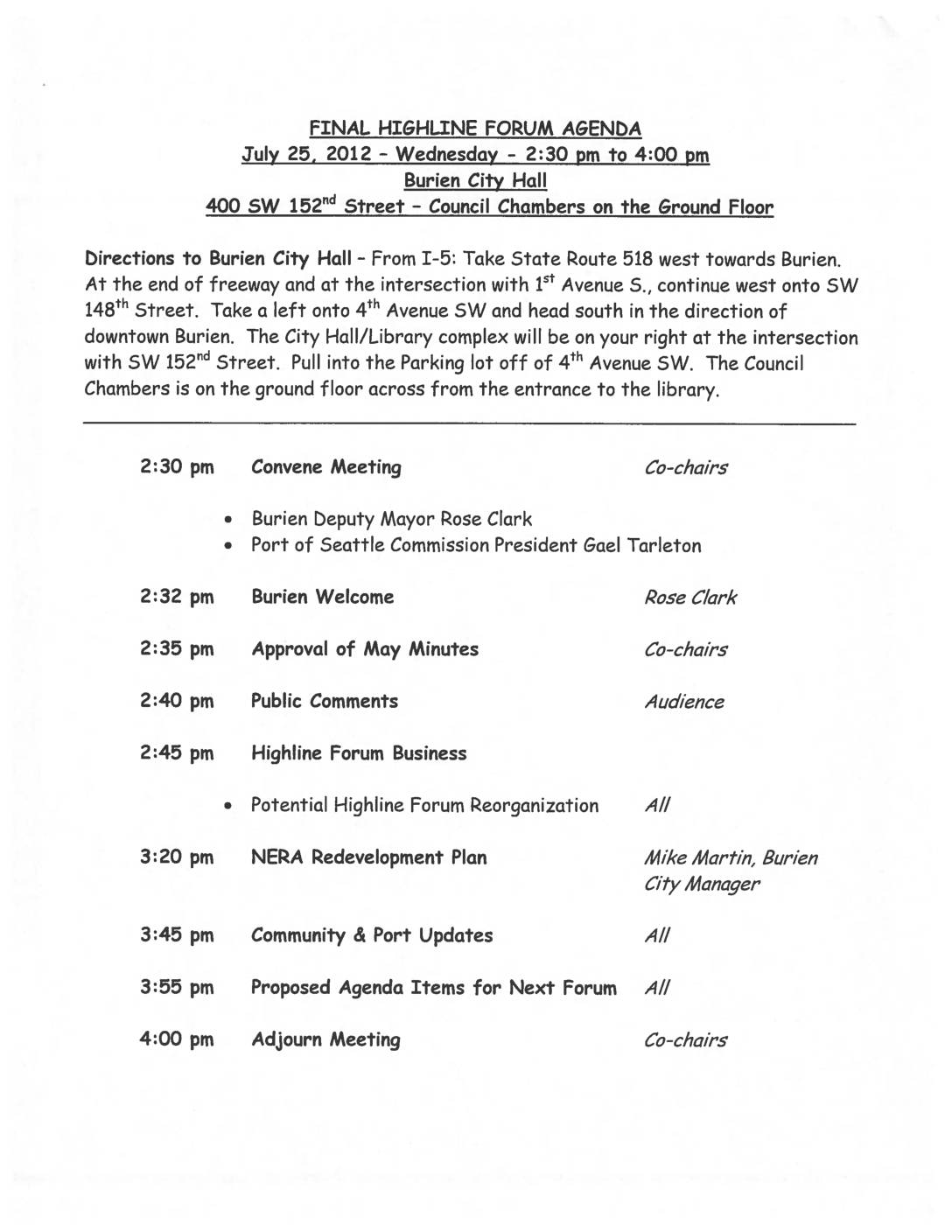
Highline Forum Agenda and Draft Minutes: July 25, 2012 and May 23, 2012
The Highline Forum, a regional body representing cities near Seattle-Tacoma International Airport, met in May 2012 to discuss Sea-Tac's noise abatement procedures, including how the airport manages north and south flow air traffic patterns and monitors airline compliance rates. Port of Seattle staff acknowledged that the airport has limited formal enforcement tools for noise compliance, relying instead on collaboration with the FAA to identify and address patterns of non-compliance. A follow-up meeting was scheduled for July 25, 2012, at Burien City Hall to continue discussions on community and port issues. -
 2012-05-23
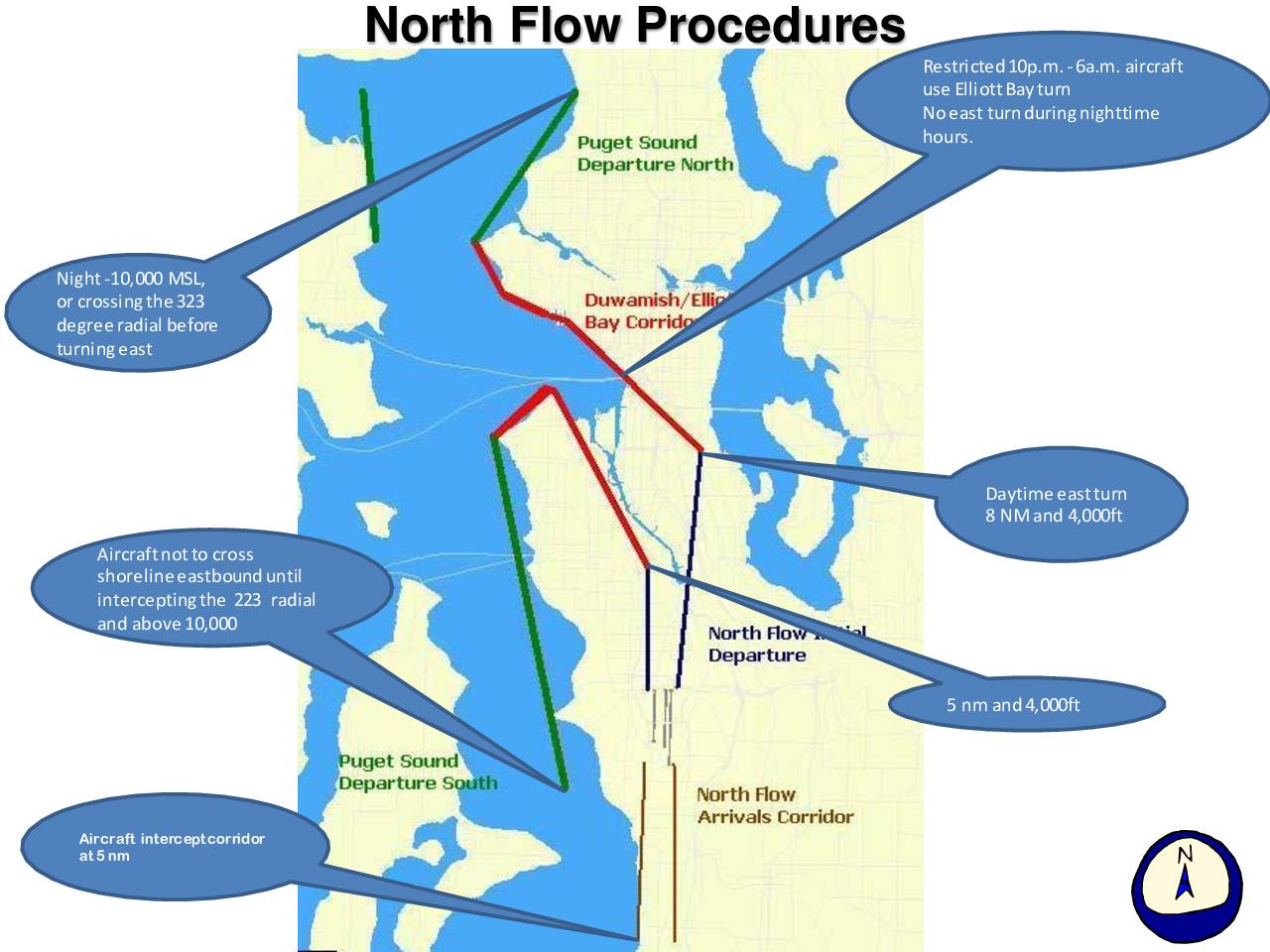
North Flow and South Flow Noise Abatement Procedures: Sea-Tac Airport
This document outlines flight procedures for Seattle-Tacoma International Airport (Sea-Tac) designed to reduce noise impacts on surrounding communities, covering both North Flow and South Flow operations. Key rules include restrictions on eastbound turns during nighttime hours (10 p.m.–6 a.m.), minimum altitude and distance requirements before turning, and designated corridors for arrivals and departures over Puget Sound and Elliott Bay. Compliance data from March 2012 shows that 89 out of 2,431 daytime South Flow eastbound arrivals turned south of the 520 Bridge early, violating the preferred procedure, with Alaska Airlines (ASA) and Southwest Airlines (SWA) accounting for the largest shares of non-compliant flights.