TagNoise Abatement Procedures(92)
-
 1998-01-01
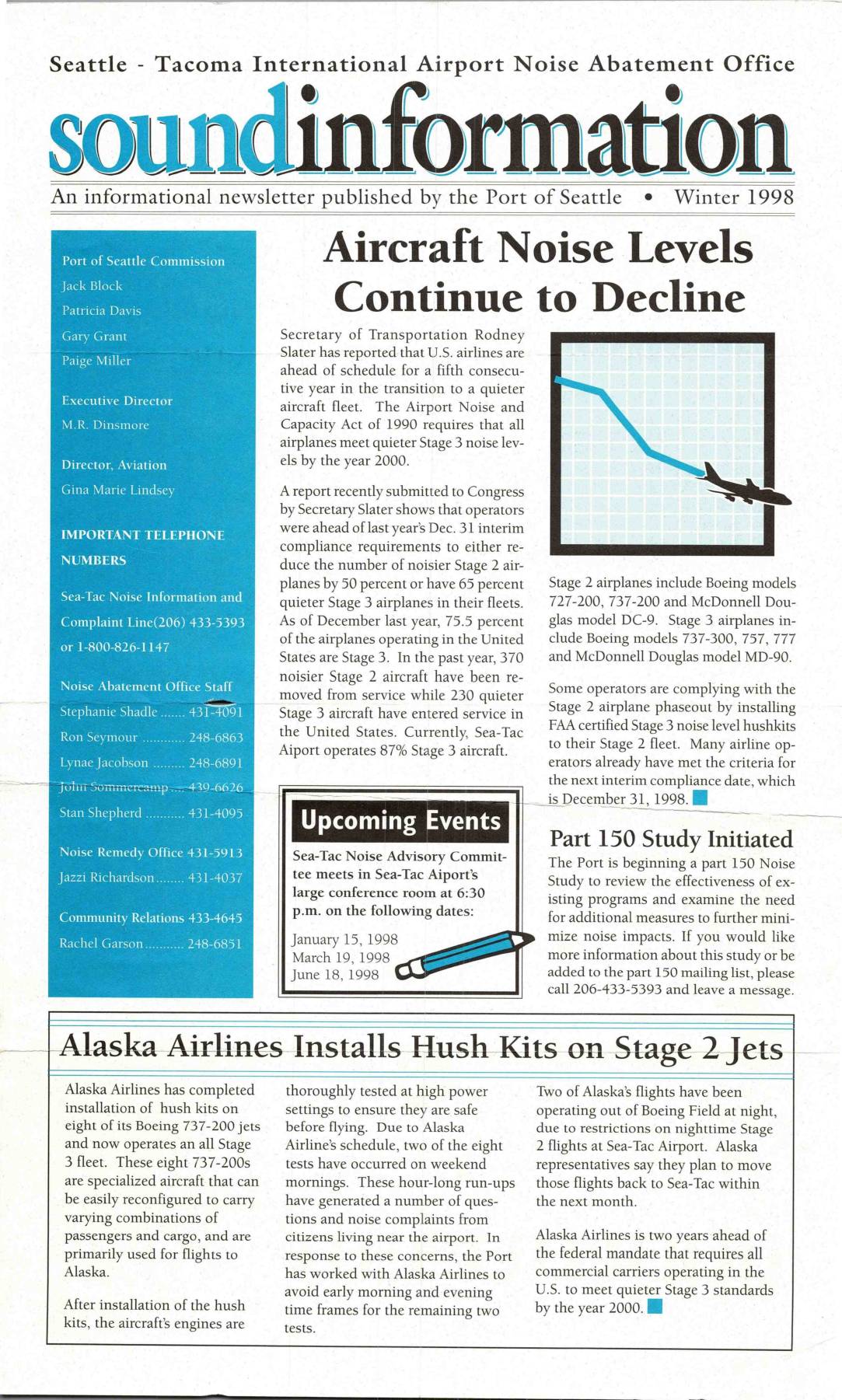
Sound Information: Sea-Tac Airport Noise Abatement Office Newsletter, Winter 1998
This Winter 1998 newsletter from the Seattle-Tacoma International Airport Noise Abatement Office reports that U.S. airline fleets are transitioning ahead of schedule to quieter Stage 3 aircraft, with 75.5% of U.S. planes and 87% of Sea-Tac flights already meeting the standard required by the year 2000. Alaska Airlines completed hush kit installations on its Boeing 737-200 jets, achieving full Stage 3 compliance two years early, though engine testing caused some community noise concerns. Quarterly reports for mid-1997 also detail nighttime flight restrictions, noise complaint line activity, flight procedure compliance rates, and progress on a home insulation remediation program that had assisted over 7,000 homeowners. -
 1996-08-01
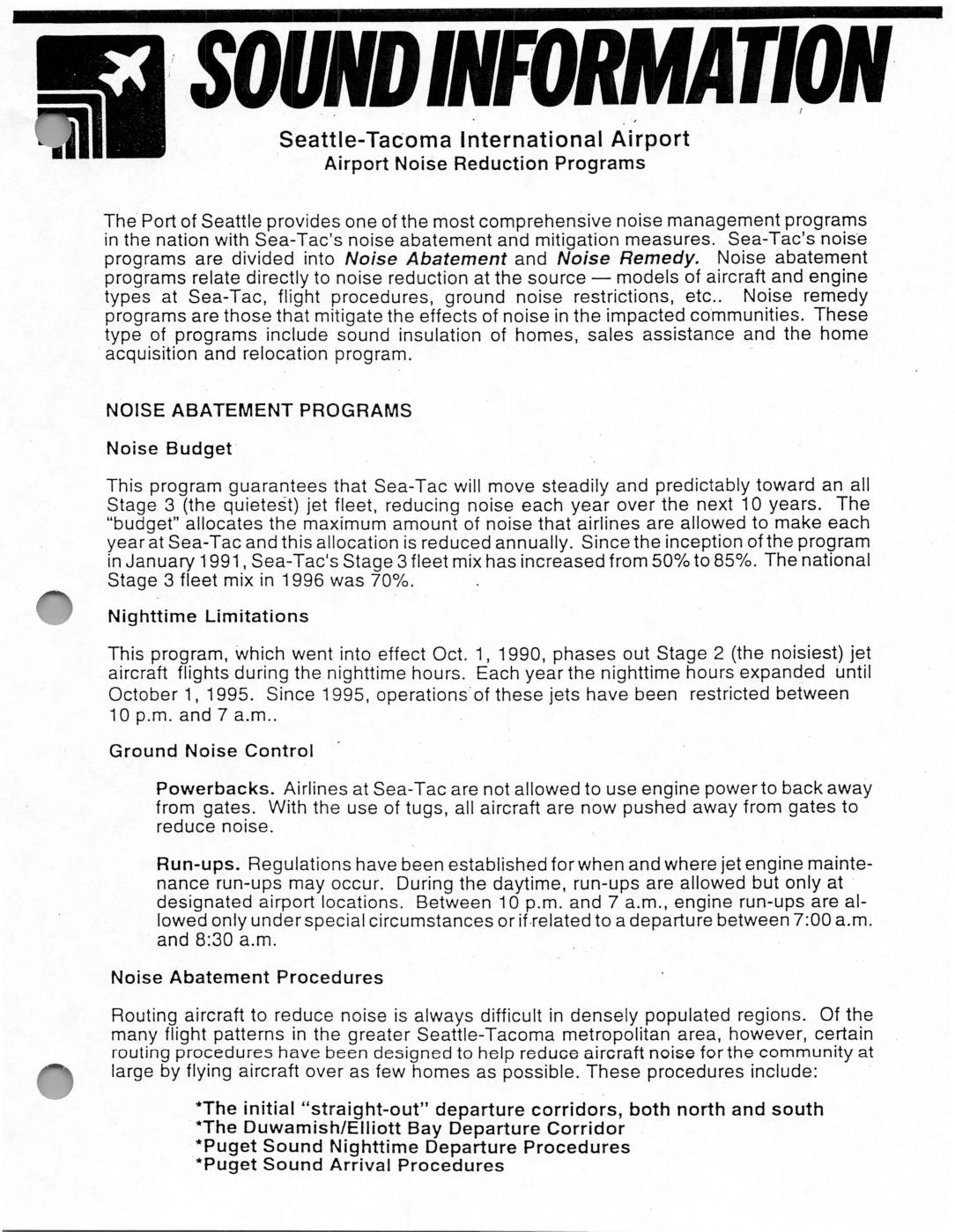
STIA Airport Noise Reduction Programs: Sound Information Fact Sheets
Seattle-Tacoma International Airport operates one of the nation's most comprehensive airport noise management programs, divided into Noise Abatement measures — such as restricting the noisiest Stage 2 jets at night, controlling ground engine use, and routing flight paths over fewer homes — and Noise Remedy programs that help affected residents through home sound insulation, sales assistance, and a completed acquisition program that purchased 1,400 severely impacted homes. The Port of Seattle also monitors noise levels through an 11-station system and tracks flight paths using FAA radar data to ensure compliance. Residents can report concerns or request information 24 hours a day via the Noise Information/Complaint Line at 433-5393 or toll-free at 1-800-826-1147. -
 1996-03-27
Comparison of Expert Arbitration Panel’s review of noise and demand/system management issues at Sea-Tac Airport in March 1996 and FAA’s record of approval of Sea-Tac’s Part 150 noise compatibility program
This document compares a 1996 Expert Arbitration Panel's findings on aircraft noise at Seattle-Tacoma International Airport with the FAA's 2013-2018 Part 150 Noise Compatibility Program approval, revealing that many of the same unresolved noise abatement and mitigation issues identified decades ago remain unaddressed today. Communities surrounding Sea-Tac — including Burien, Normandy Park, and Des Moines — continue to experience increasing noise and air pollution as flight operations have grown from 387,000 in 1995 to over 438,000 in 2018. The document calls out regulators and the Port of Seattle for failing to make meaningful progress on commitments such as nighttime flight restrictions, engine run-up controls, and departure corridor compliance. -
 1995-12-04
Seattle 4-Post Decision and Order
This 1995 FAA Decision and Order addresses longstanding air traffic congestion and inefficiency problems at Seattle-Tacoma International Airport (Sea-Tac), stemming from outdated flight route procedures established in the 1970s. The document explains that existing arrival and departure routes caused safety concerns, reduced airport capacity, and increased controller workload, particularly when runway directions changed multiple times daily. It also notes that the so-called 'noise abatement' procedures from 1974 were not based on any coherent noise reduction plan, but were largely the result of moving flight paths away from communities that had complained. -
 1994-03-01
Seattle-Tacoma International Airport: Airport Noise Reduction Programs
Seattle-Tacoma International Airport operates one of the nation's most comprehensive airport noise management programs, divided into Noise Abatement measures — such as restricting noisy Stage 2 jets at night, controlling ground engine use, and routing flights over fewer homes — and Noise Remedy programs that help affected residents through home sound insulation, sales assistance, and a relocation program that has already moved over 3,900 people. The Port of Seattle also maintains a 24-hour noise complaint hotline and an 11-station monitoring system to track and reduce noise levels around the airport. Residents can contact the Port directly for information, to report concerns, or to learn about eligibility for free home insulation. -
 1993-04-21
Sound Information: Sea-Tac Noise Abatement Report, Fourth Quarter 1992
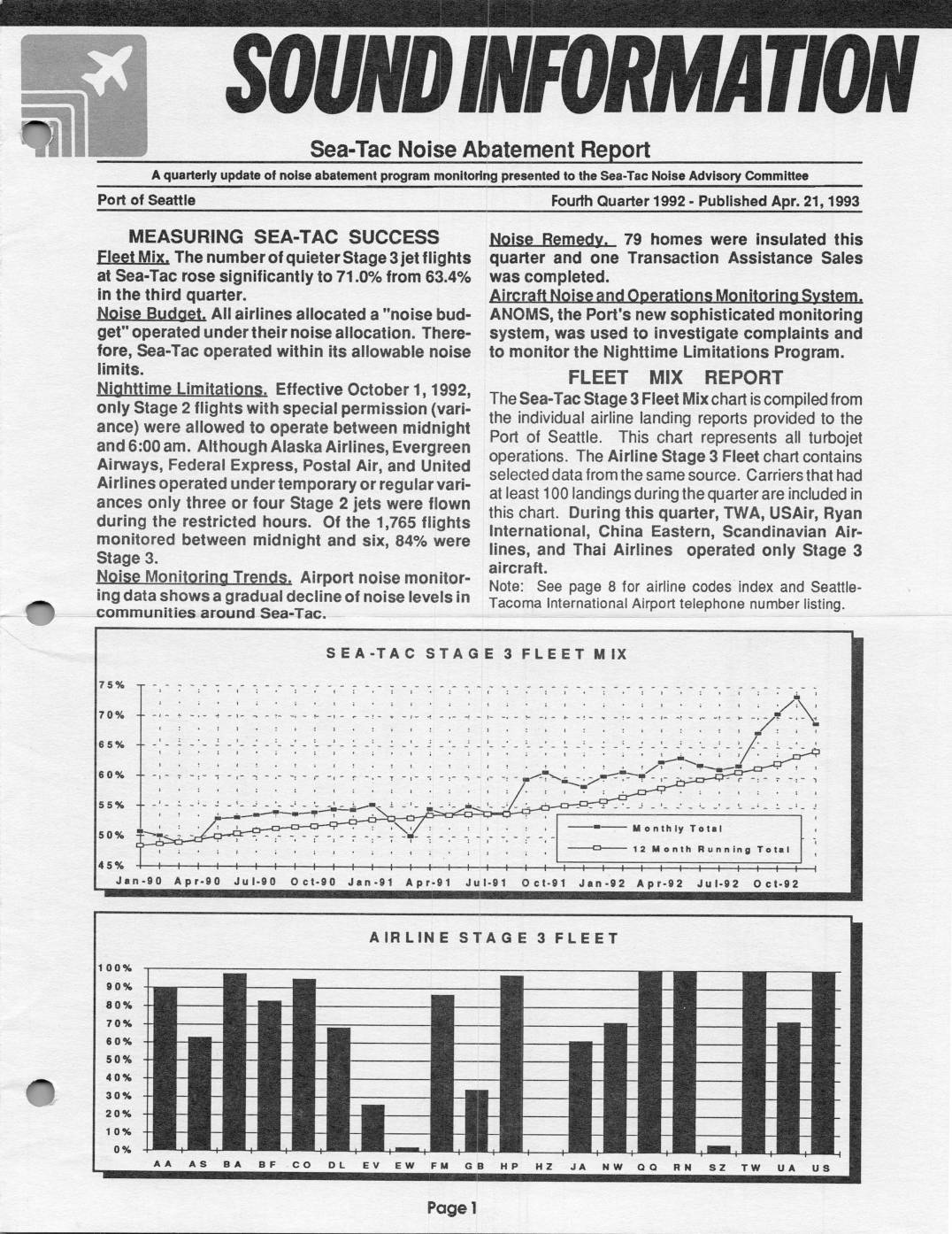
This quarterly Sea-Tac Noise Abatement Report from the Port of Seattle (Q4 1992) tracks progress in reducing airport noise, highlighting that 71% of jet flights were operated by quieter Stage 3 aircraft, up from 63.4% the previous quarter. All airlines stayed within their allocated noise budgets, and new nighttime restrictions effective October 1, 1992 limited louder Stage 2 jets between midnight and 6:00 a.m. The report also outlines noise abatement flight procedures designed to route departing and arriving aircraft over industrial areas and water to minimize noise impacts on surrounding communities. -
 1991-03-31
Port Of Seattle Flight Track Sample: South Flow Arrivals/Departures — Pre- and Post-Four Post Plan Comparison Maps
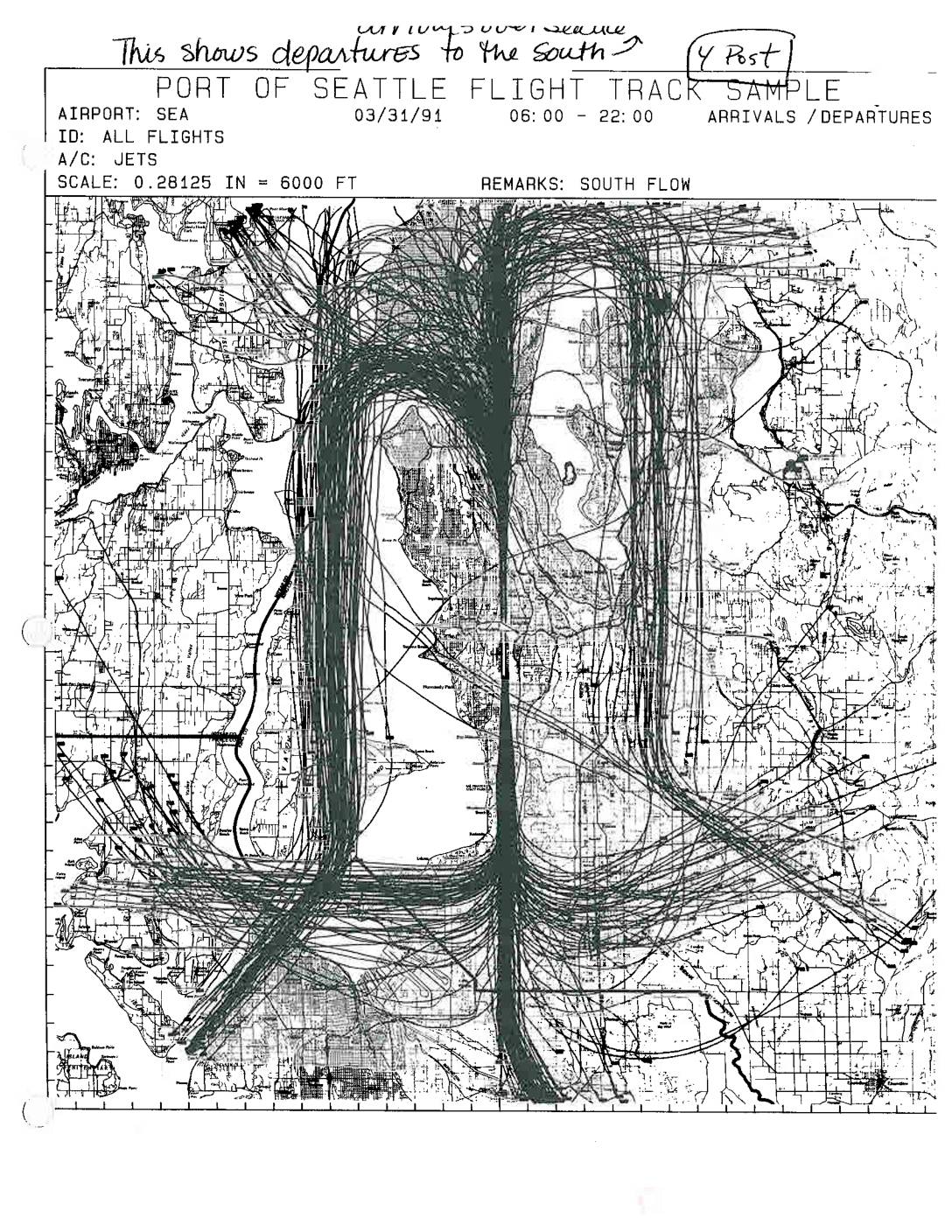
These two Port of Seattle Flight Track Sample maps compare jet aircraft arrival and departure patterns at Seattle-Tacoma International Airport (SEA) under south flow conditions, one from March 22, 1989 (pre-4 Post) and one from March 31, 1991 (4 Post). Both charts plot all jet flight tracks between approximately 4:30–24:00 and 6:00–22:00 respectively, showing how flight paths over the Seattle region shifted between the two periods. The maps are annotated to highlight southbound departures and arrivals over Seattle, serving as visual evidence for noise impact analysis related to airport runway and procedure policy changes. -
 1990-05-03
Resolution No. 3062: Endorsing the agreement of the Seattle-Tacoma International Airport Noise Mediation Committee
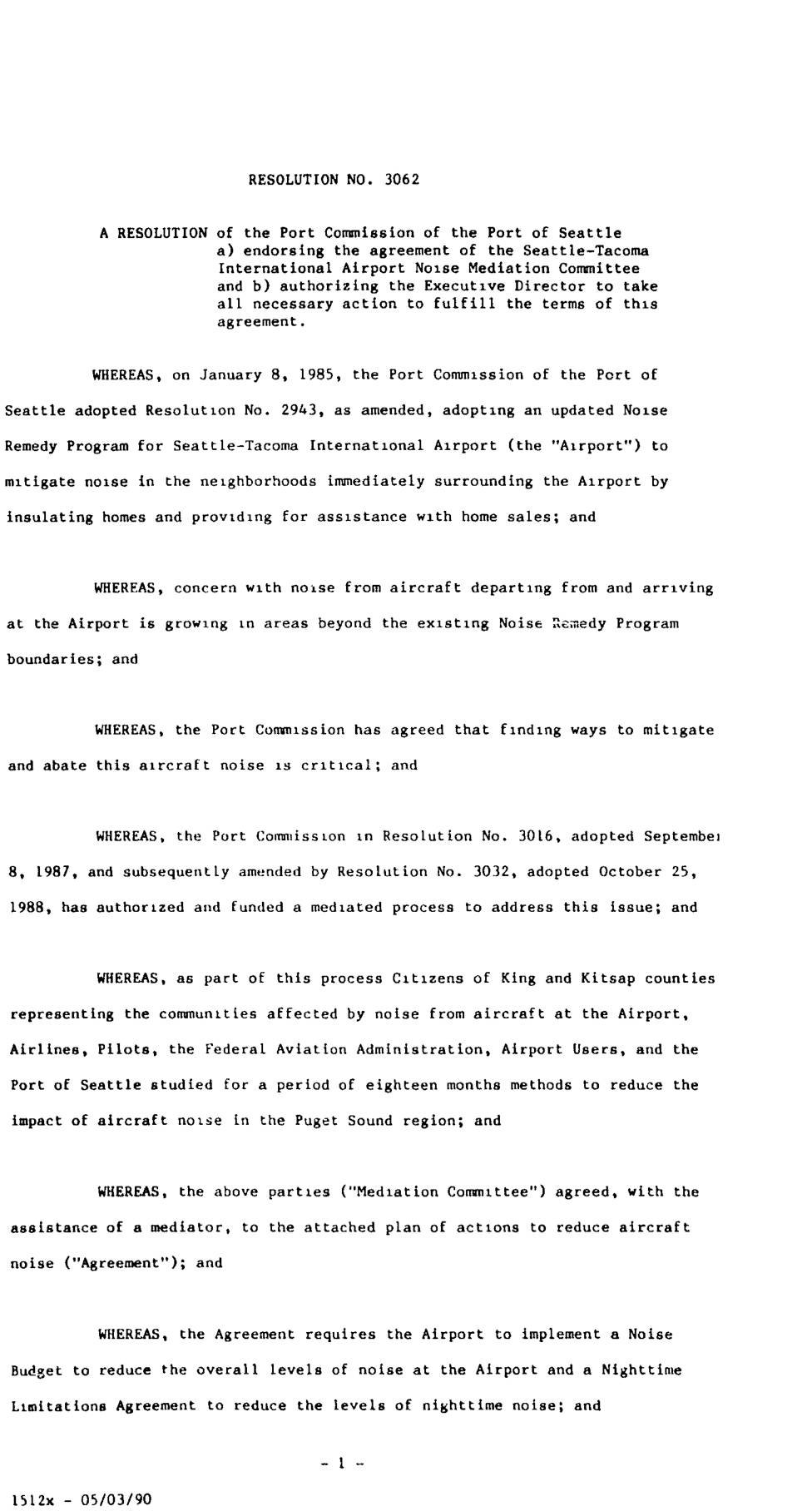
In 1990, the Port of Seattle's Port Commission passed Resolution No. 3062, endorsing an agreement reached by the Seattle-Tacoma International Airport Noise Mediation Committee after 18 months of study by community representatives, airlines, pilots, the FAA, and airport users. The agreement established a Noise Budget and Nighttime Limitations program aimed at reducing aircraft noise levels by at least 50% by 2001 compared to a 1989 baseline, while also expanding the existing Noise Remedy Program to insulate more homes and remove financial burdens from homeowners. The resolution authorized the Executive Director to implement the agreement's terms, including revising airport regulations, entering noise limitation agreements with airline tenants, and installing a Noise Management System to monitor compliance. -
 1990-03-31
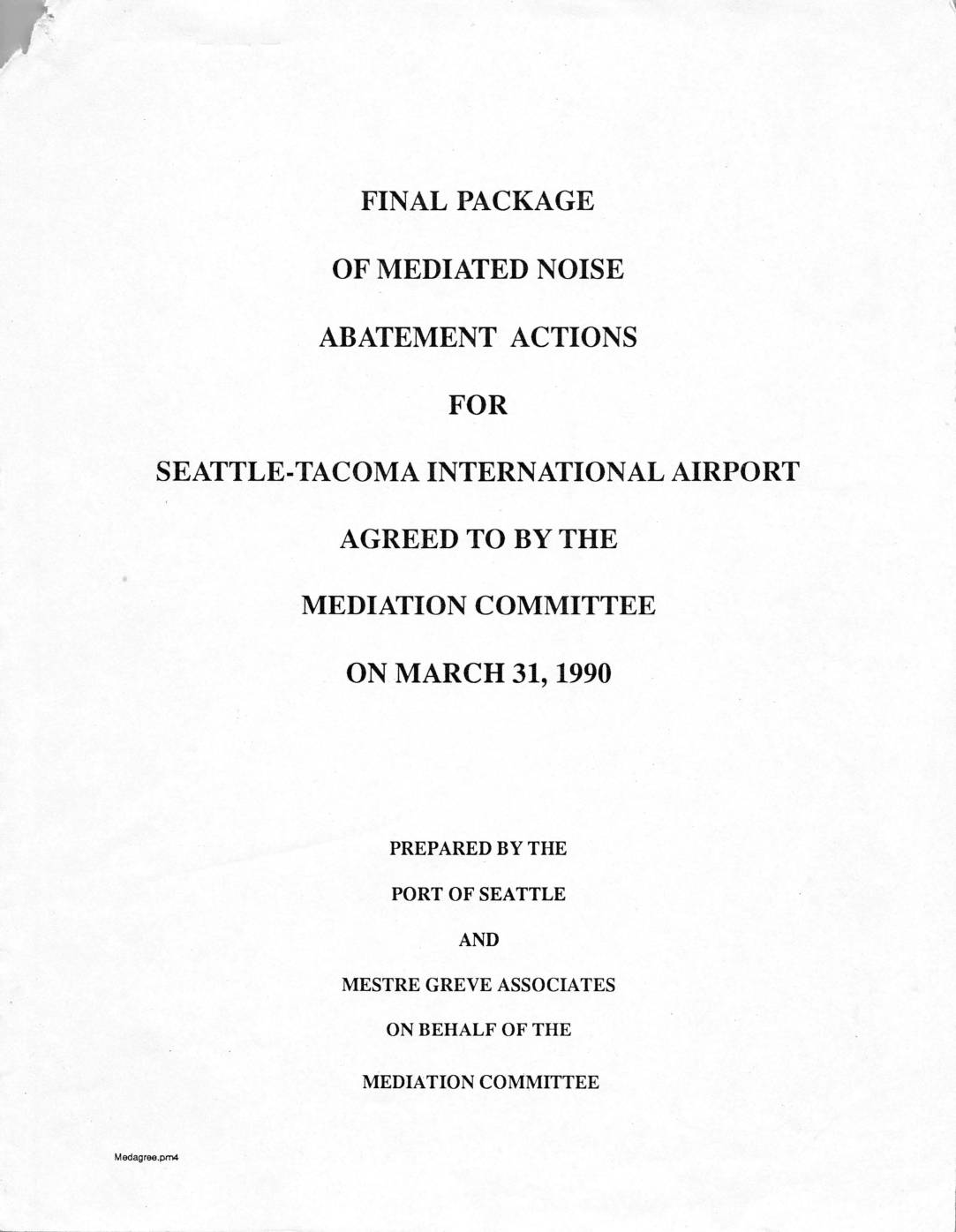
Final package of mediated noise abatement actions for Seattle-Tacoma International Airport
This document outlines the Final Package of Mediated Noise Abatement Actions for Seattle-Tacoma International Airport, agreed upon by the Mediation Committee on March 31, 1990. It covers a wide range of noise reduction measures, including nighttime flight restrictions, a noise remedy and insulation program for affected communities, improved flight corridor procedures, and a comprehensive noise management and monitoring system. According to technical consultants, full implementation of these agreements could reduce noise levels by approximately 50% in the communities surrounding the airport. -
 1990-03-31
Final Package of Mediated Noise Abatement Actions for Seattle-Tacoma International Airport, Agreed to by the Mediation Committee, March 31, 1990
This 1990 document outlines a comprehensive package of noise abatement actions for Seattle-Tacoma International Airport, agreed upon by a Mediation Committee on March 31, 1990. It covers measures such as nighttime flight restrictions, soundproofing programs for nearby homes and public buildings, improved flight corridors, and a new noise management monitoring system. According to the technical consultant involved, full implementation of these agreements could reduce noise levels by approximately 50% for communities surrounding the airport.