TagNoise Abatement Procedures(92)
-
 2012-05-23
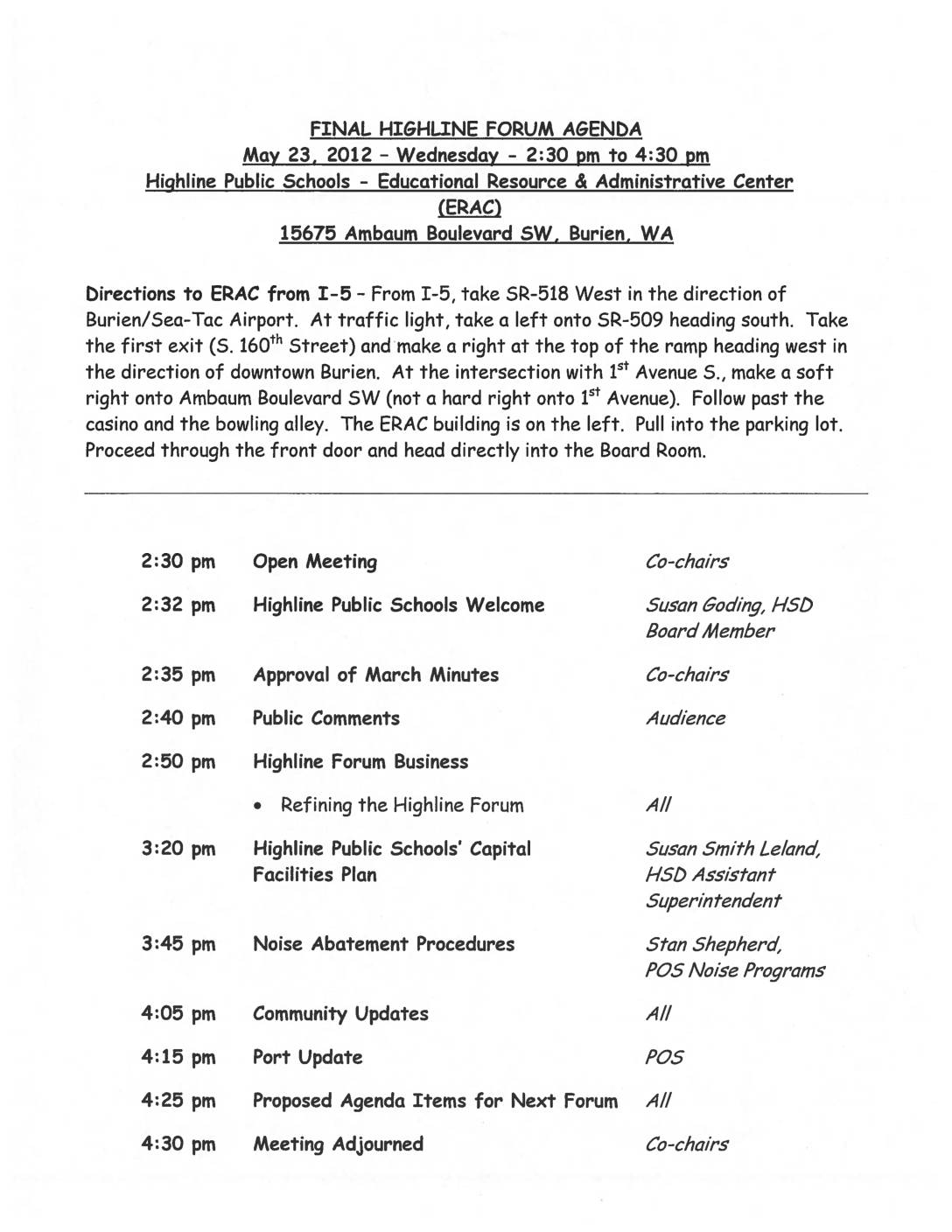
Highline Forum Agenda and Draft Minutes: May 23, 2012 and March 28, 2012
The Highline Forum, a community advisory group connecting the Port of Seattle with nearby cities including Burien, SeaTac, and Des Moines, held meetings in early 2012 to discuss Sea-Tac Airport-related issues including noise abatement procedures, the Port's Century Agenda economic development goals, and a cleanup update for the Lora Lake contamination site. The May 23, 2012 agenda featured a dedicated session on noise abatement procedures presented by Port of Seattle Noise Programs representative Stan Shepherd, alongside discussions on refining the Forum's structure and Highline Public Schools' Capital Facilities Plan. Draft minutes from the March 28, 2012 meeting document community leaders raising concerns about job quality, regional transportation infrastructure, and tourism development in the Southwest King County area surrounding the airport. -
 2012-01-25
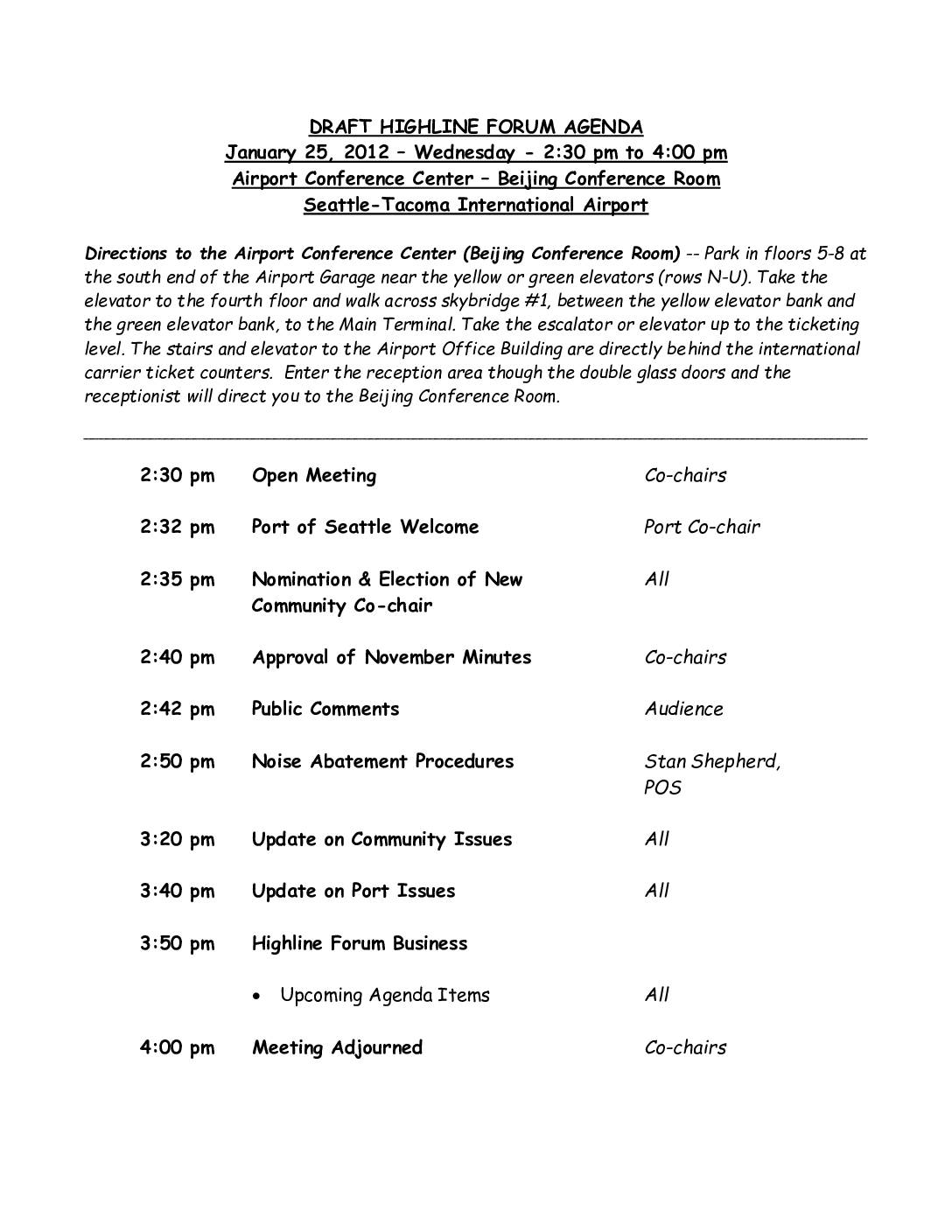
Highline Forum Draft Agenda, January 25, 2012
The Highline Forum held a public meeting on January 25, 2012, at the Seattle-Tacoma International Airport Conference Center, running from 2:30 to 4:00 pm. The agenda included a presentation on Noise Abatement Procedures by Stan Shepherd of the Port of Seattle, along with updates on community and port issues, election of a new Community Co-chair, and public comments. This draft agenda reflects the forum's ongoing role in addressing airport noise policy and community concerns related to Sea-Tac Airport operations. -
 2010-12-06
Letter of agreement: Informal runway use program, Seattle-Tacoma International Airport
This document outlines the Runway Use Agreement between the FAA and the Port of Seattle at Seattle-Tacoma International Airport (Sea-Tac), effective December 6, 2010. It establishes preferred runway assignments for arrivals and departures under various weather and traffic conditions, while making clear that safety and air traffic management always take priority. The agreement does not change existing FAA practices but aims to provide consistency and transparency for the public regarding how runways are used. -
 2003-05-16
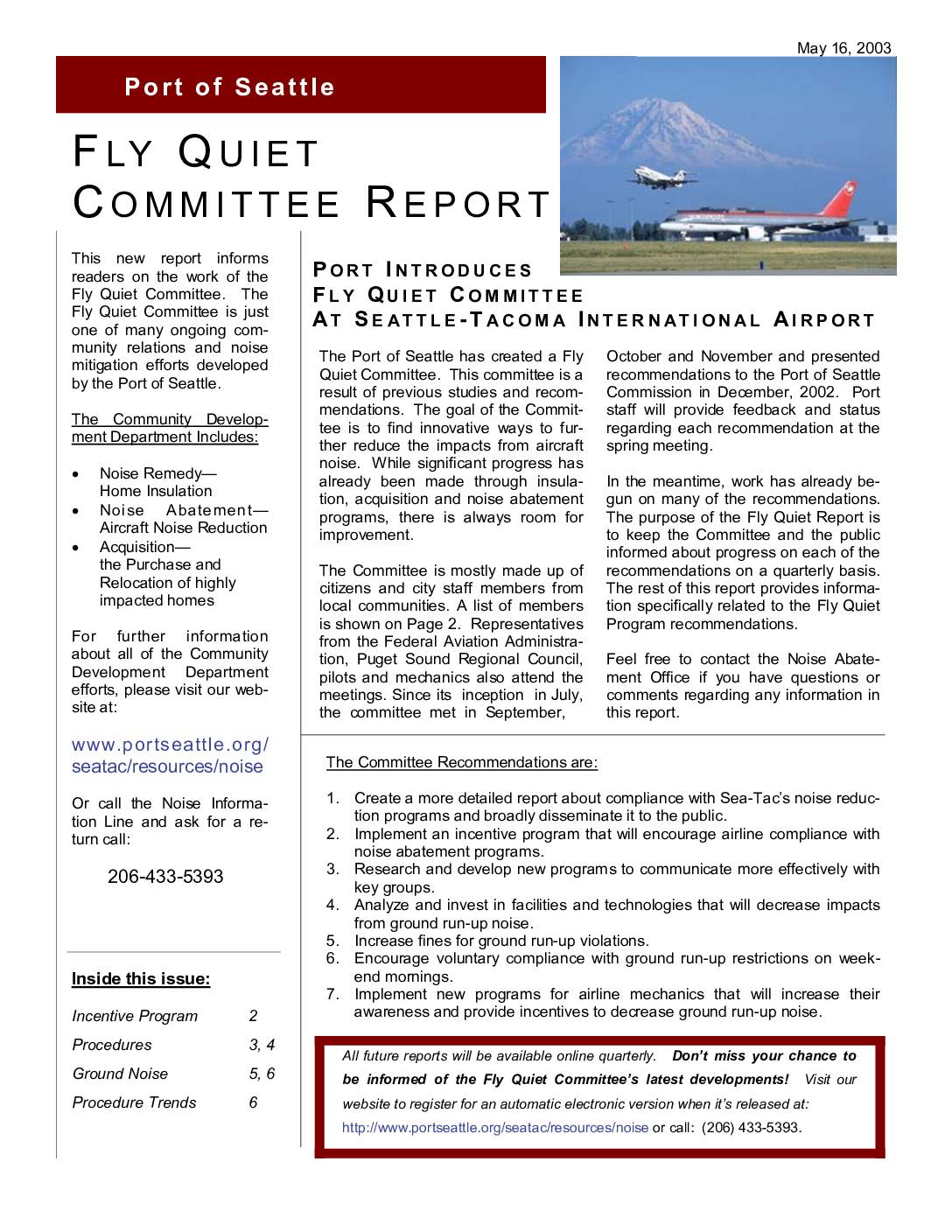
Fly Quiet Committee Report: Port Introduces Fly Quiet Committee at Seattle-Tacoma International Airport, Third Quarter 2002
The Port of Seattle introduced the Fly Quiet Committee at Seattle-Tacoma International Airport to find innovative ways to reduce aircraft noise impacts on surrounding communities. The committee, made up of local citizens, city staff, and aviation representatives, developed seven key recommendations including creating detailed compliance reports, launching an airline incentive program modeled after Chicago O'Hare's point-based system, and addressing ground run-up noise through increased fines and new technologies. The report also outlines existing noise abatement flight procedures governing how aircraft depart and arrive at Sea-Tac to minimize noise over residential areas. -
 1999-11-29
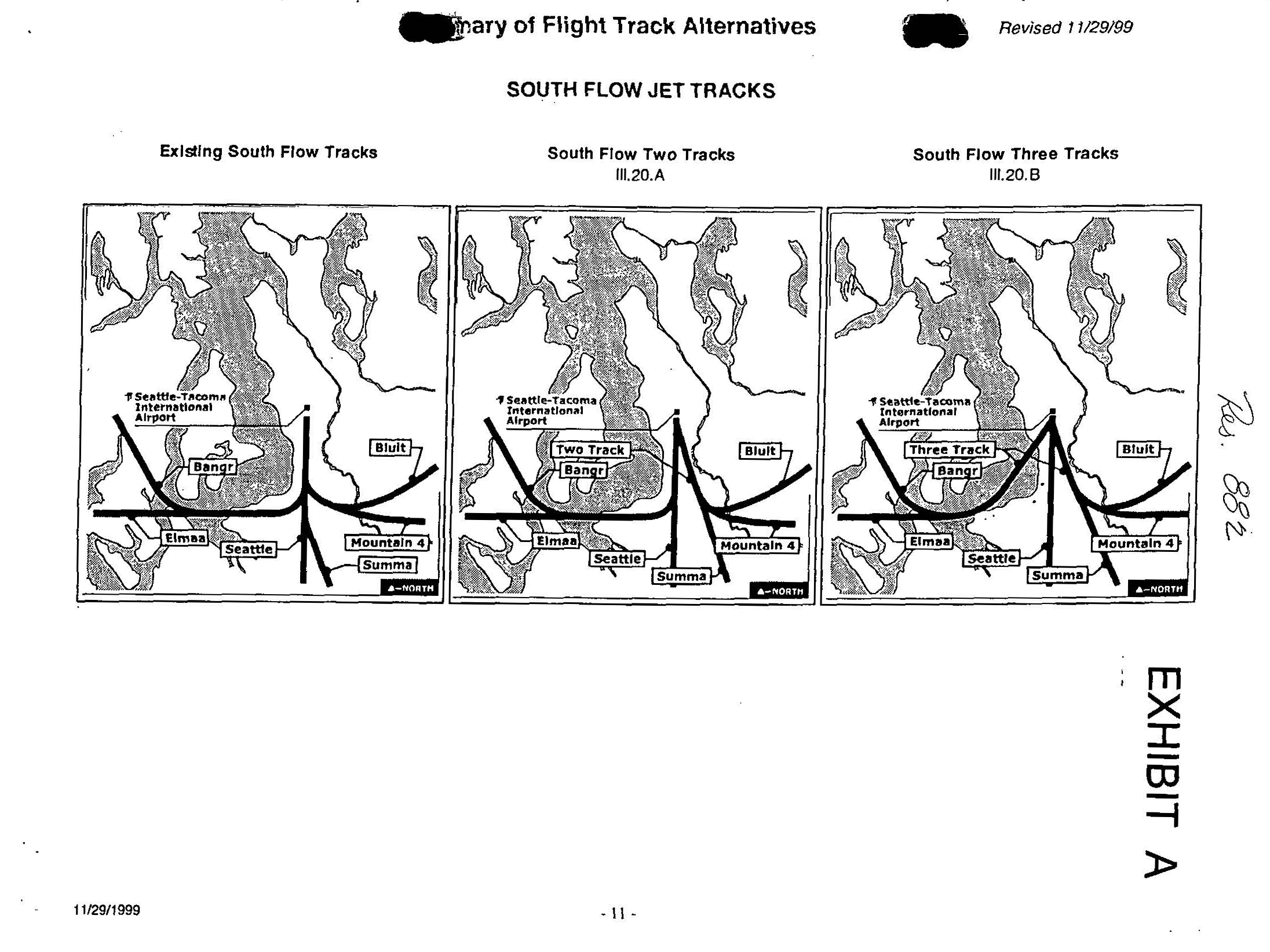
Des Moines Resolution No. 882 Exhibit A: South Flow Two Tracks Flight Track Alternative Maps
A page from a document titled 'Summary of Flight Track Alternatives,' revised 11/29/1999, showing three maps comparing South Flow Jet Track options for Seattle-Tacoma International Airport: Existing South Flow Tracks, South Flow Two Tracks (III.20.A), and South Flow Three Tracks (III.20.B). The maps display named waypoints including Bangr, Bluit, Elmaa, Seattle, Mountain 4, and Summa, and the document is marked as Exhibit A. -
 1999-11-02
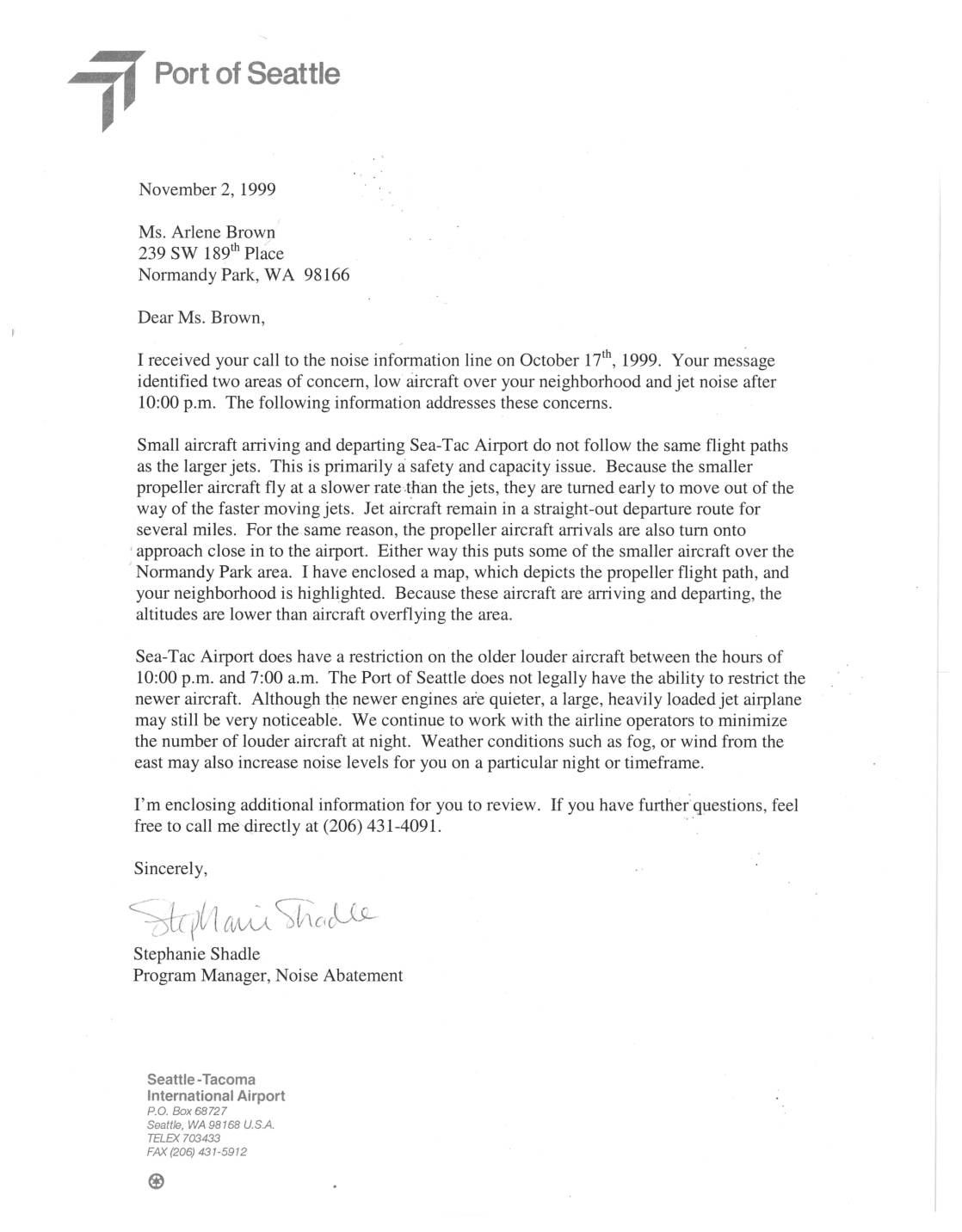
Letter to Arlene Brown regarding aircraft noise concerns in Normandy Park
In this November 1999 letter, the Port of Seattle's Noise Abatement Program Manager responds to a Normandy Park resident's complaints about low-flying aircraft and late-night jet noise near Sea-Tac Airport. The letter explains that smaller propeller aircraft fly different, lower-altitude flight paths than jets for safety reasons, which brings them over residential neighborhoods like Normandy Park. It also notes that while Sea-Tac restricts older, louder aircraft between 10:00 p.m. and 7:00 a.m., the Port lacks legal authority to restrict newer aircraft, though it works with airlines to minimize nighttime noise. -
 1999-01-01
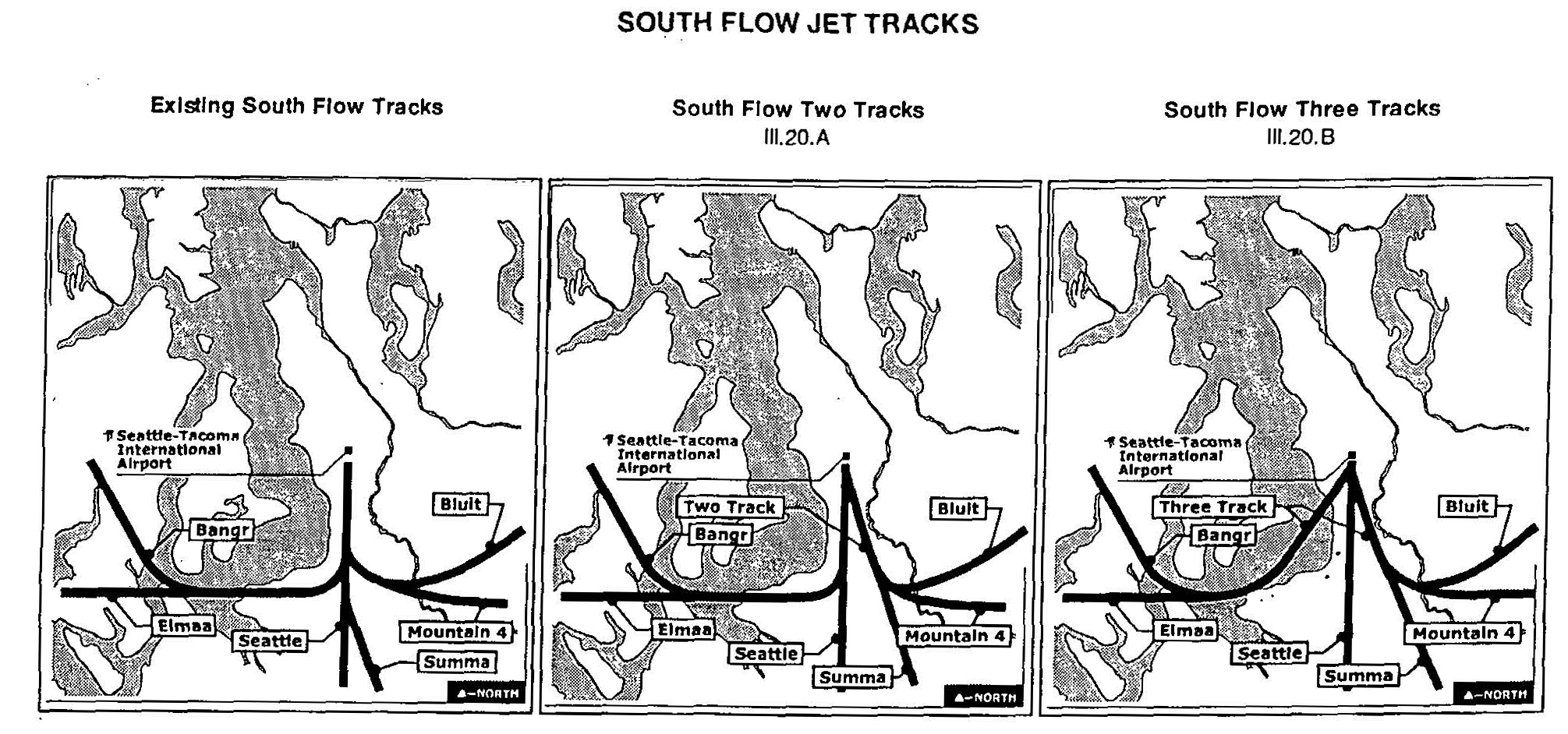
Resolution No. 882 Expressing the Council’s Preference for the South Flow Flight Track, 1999
Three maps comparing existing and proposed south flow jet departure tracks at Seattle-Tacoma International Airport, showing waypoints including Bangr, Bluit, Elmaa, Seattle, Summa, and Mountain 4. The proposed alternatives are labeled 'South Flow Two Tracks' (III.20.A) and 'South Flow Three Tracks' (III.20.B), consistent with an environmental or noise impact study for Sea-Tac Airport. -
 1998-07-22
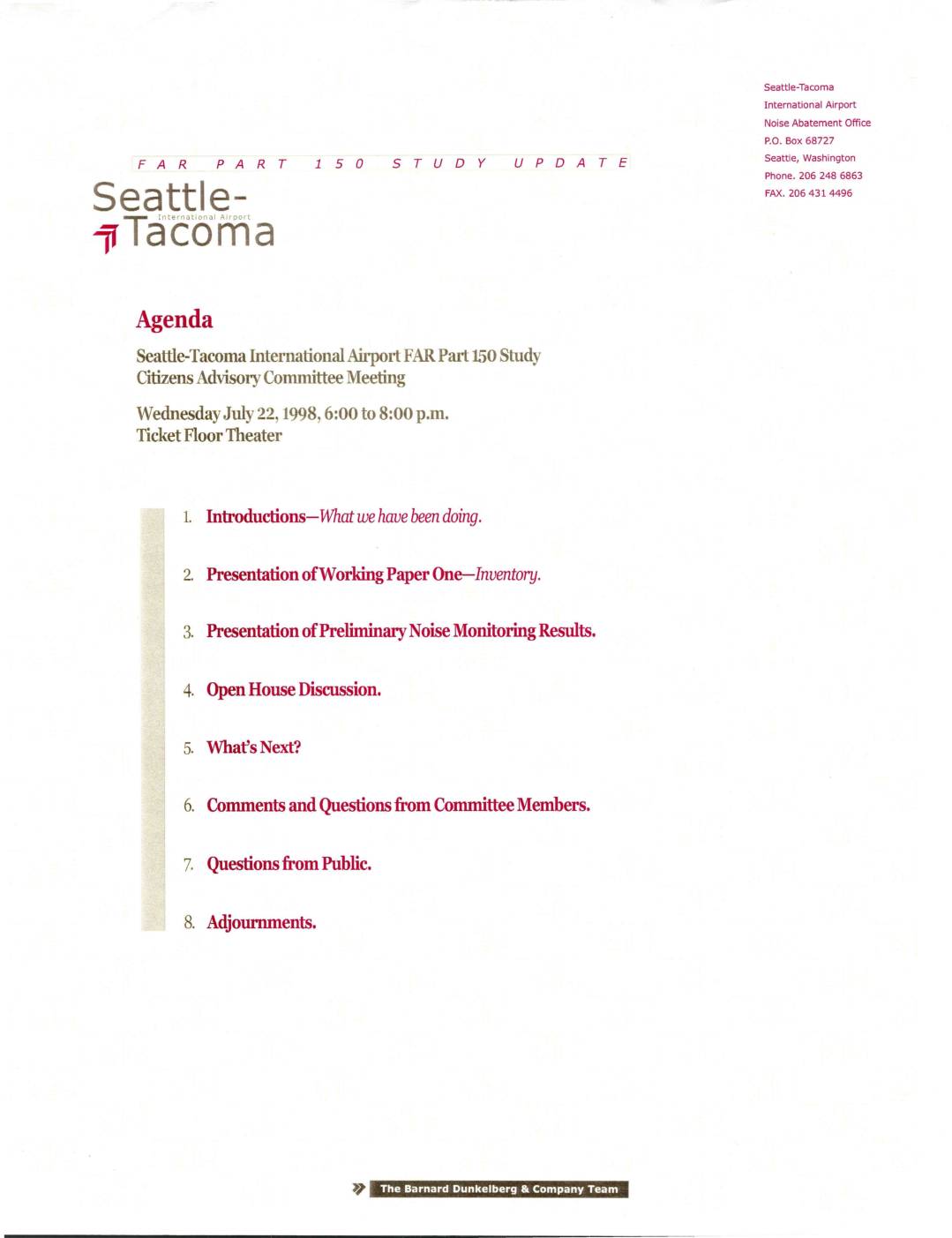
Sea-Tac FAR Part 150 Study Update: Citizens Advisory Committee Meeting Agenda and Schedule, July 1998
This document contains materials from the Seattle-Tacoma International Airport FAR Part 150 Noise Study, including an agenda for a Citizens Advisory Committee meeting held on July 22, 1998, at the airport's Main Terminal Building. The meeting covered topics such as a presentation of Working Paper One on inventory, preliminary noise monitoring results, and an open house discussion. A tentative schedule for follow-up meetings through December 1998 was also included, covering sub-committee sessions and additional CAC/TAC public meetings. -
 1998-06-01
Sound Information: Sea-Tac Airport Noise Abatement Office Newsletter, Summer 1998
This Summer 1998 newsletter from the Seattle-Tacoma International Airport Noise Abatement Office covers the Noise Remedy/Home Sound Insulation Program, explaining how the program boundary was established using 65 DNL noise contours and noting that 6,375 of 10,000 eligible homes had been insulated by Q1 1998. It also includes a quarterly report on fleet noise compliance, flight pattern changes, and an update on the Part 150 Noise Study, which was set to be presented at a public open house on July 23, 1998. Additionally, the newsletter lists upcoming regional airshow events for summer 1998, including Seafair and the Blue Angels, along with associated noise complaint contact numbers. -
 1998-05-01
Seattle-Tacoma International Airport FAR Part 150 Study Update: Regulatory Environmental Meeting
This May 1998 document from the Barnard Dunkelberg & Company Team presents a FAR Part 150 Study Update for Seattle-Tacoma International Airport, covering the history of federal aviation noise policy. It traces key regulatory milestones including the FAA Aviation Noise Abatement Policy of 1976, the Aviation Safety and Noise Abatement Act of 1979, and the Airport Noise and Capacity Act of 1990. The document explains what FAR Part 150 is, what it means for airport operators and surrounding communities, and how voluntary land-use compatibility studies evolved into formal regulatory requirements over time.