TagNoise Abatement Procedures(92)
-
 2023-06-07
Noise programs & NextGen briefing
This Port of Seattle briefing, presented by Noise Programs Manager Stan Shepherd, covers key topics related to aircraft noise management at Seattle-Tacoma International Airport, including flight procedures, noise contours, and mitigation programs. It highlights a steady rise in noise complaints received through the Noise Information Hotline and online forms, growing from 2,172 inquiries in 2014 to 2,959 in 2016, with a small number of repeat callers accounting for the majority of contacts each year. -
 2022-09-12
City of Naples City Council and Naples Airport Authority Joint Workshop Meeting Minutes – September 12, 2022
Minutes from a September 12, 2022 joint workshop between the Naples, Florida City Council and Naples Airport Authority cover discussions on the Airport Master Plan, noise reduction efforts, and community concerns about increasing jet traffic. Key topics included raising aircraft flight path ceilings to reduce noise, the possibility of reclassifying Naples as a Class C airport, and whether the Master Plan's growth projections were already outdated given a 40% surge in jet traffic. Residents and neighborhood association representatives called for equitable distribution of noise impacts and urged immediate action rather than waiting for a formal noise study to be completed. -
 2022-07-14
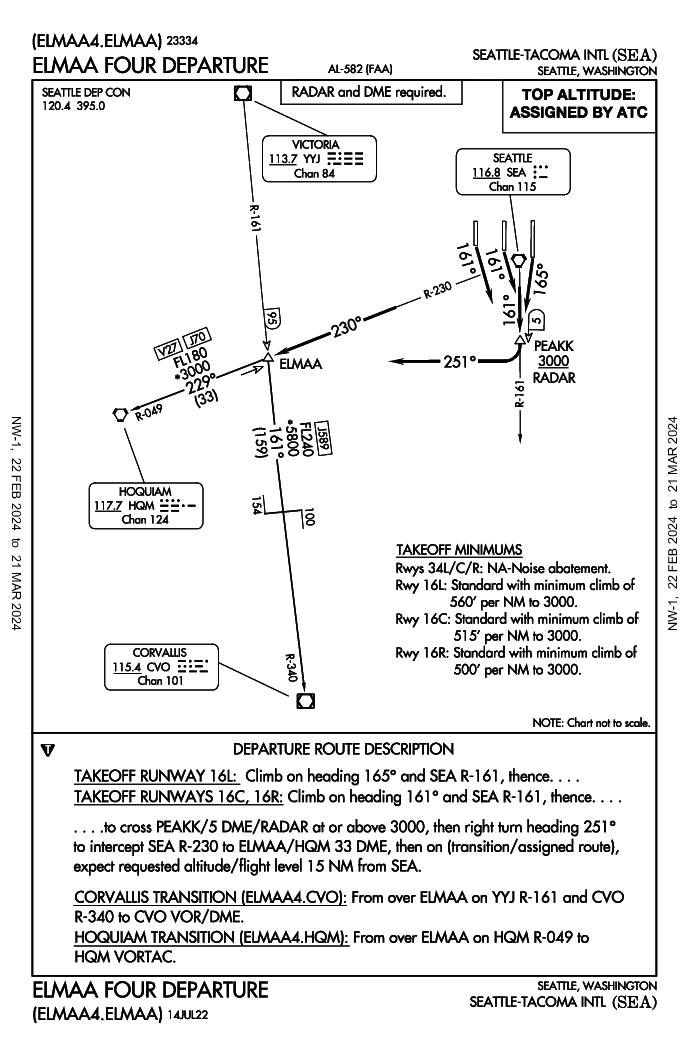
ELMAA Four Departure (ELMAA4.ELMAA) — Seattle-Tacoma International Airport Standard Instrument Departure
The ELMAA Four Departure is a standard instrument departure procedure for Seattle-Tacoma International Airport (SEA) that routes aircraft southward after takeoff on runways 16L, 16C, or 16R. Departing aircraft climb on headings of 161°–165°, cross the PEAKK waypoint at or above 3,000 feet, then turn right to intercept the SEA R-230 radial toward the ELMAA fix, with onward transitions available to Hoquiam (HQM) or Corvallis (CVO). Notably, departures from runways 34L, 34C, and 34R are not authorized due to noise abatement restrictions, and minimum climb gradients of up to 560 feet per nautical mile are required depending on the runway used. -
 2022-05-19
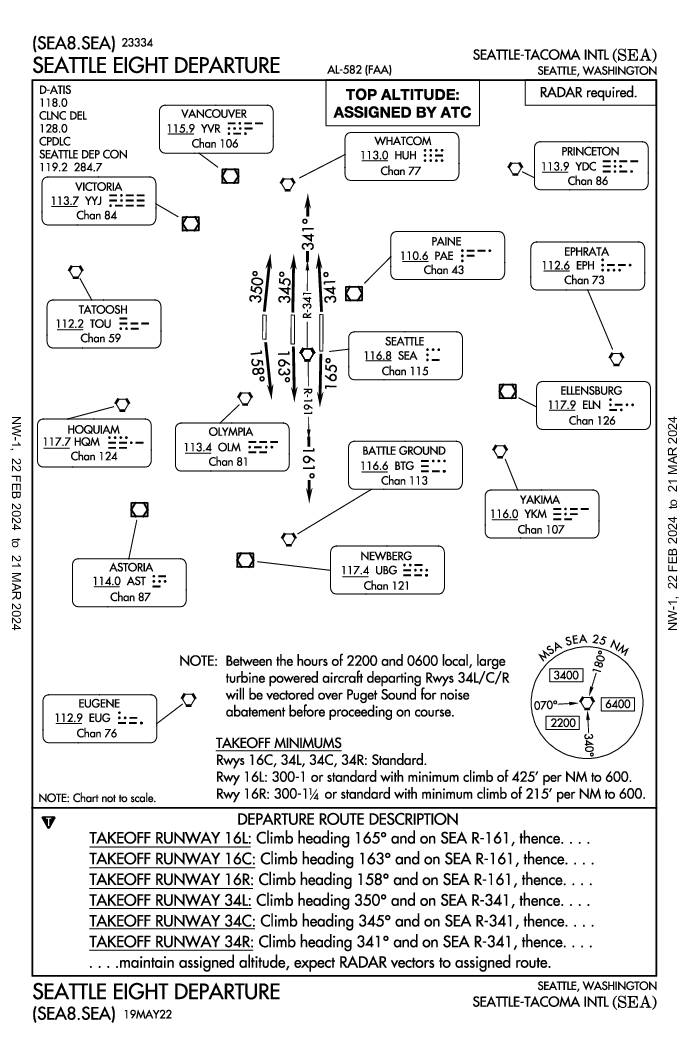
Seattle Eight Departure (SEA8.SEA) — Standard Instrument Departure Chart
The Seattle Eight Departure (SEA8.SEA) is a standard instrument departure procedure for Seattle-Tacoma International Airport, outlining specific climb headings and routes for each runway to guide aircraft safely after takeoff. A notable noise-abatement provision requires large turbine-powered aircraft departing runways 34L, 34C, and 34R between 10 PM and 6 AM local time to be vectored over Puget Sound before proceeding on course. The procedure requires radar and assigns top altitude by ATC, with special minimum climb gradients applicable to runways 16R and 16L. -
 2022-05-01
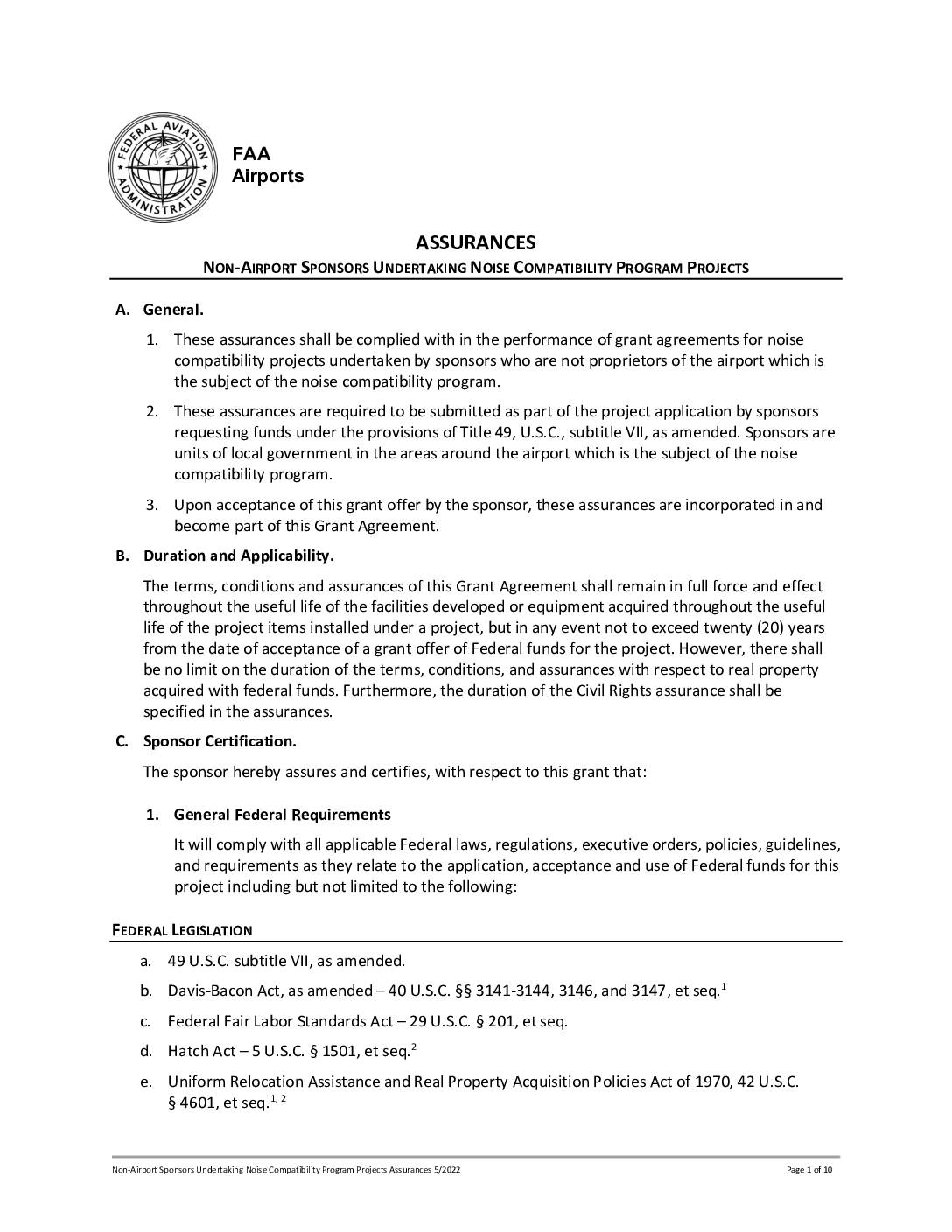
Assurances: Non-airport sponsors undertaking noise compatibility program projects
This FAA document outlines the legal assurances that non-airport sponsors (such as local governments near an airport) must agree to when receiving federal grant funds for noise compatibility projects. Sponsors must comply with a wide range of federal laws, executive orders, and regulations — covering areas like civil rights, environmental protection, labor standards, and property acquisition — for the duration of the project, up to 20 years. These assurances become legally binding upon acceptance of the federal grant offer. -
 2022-04-24
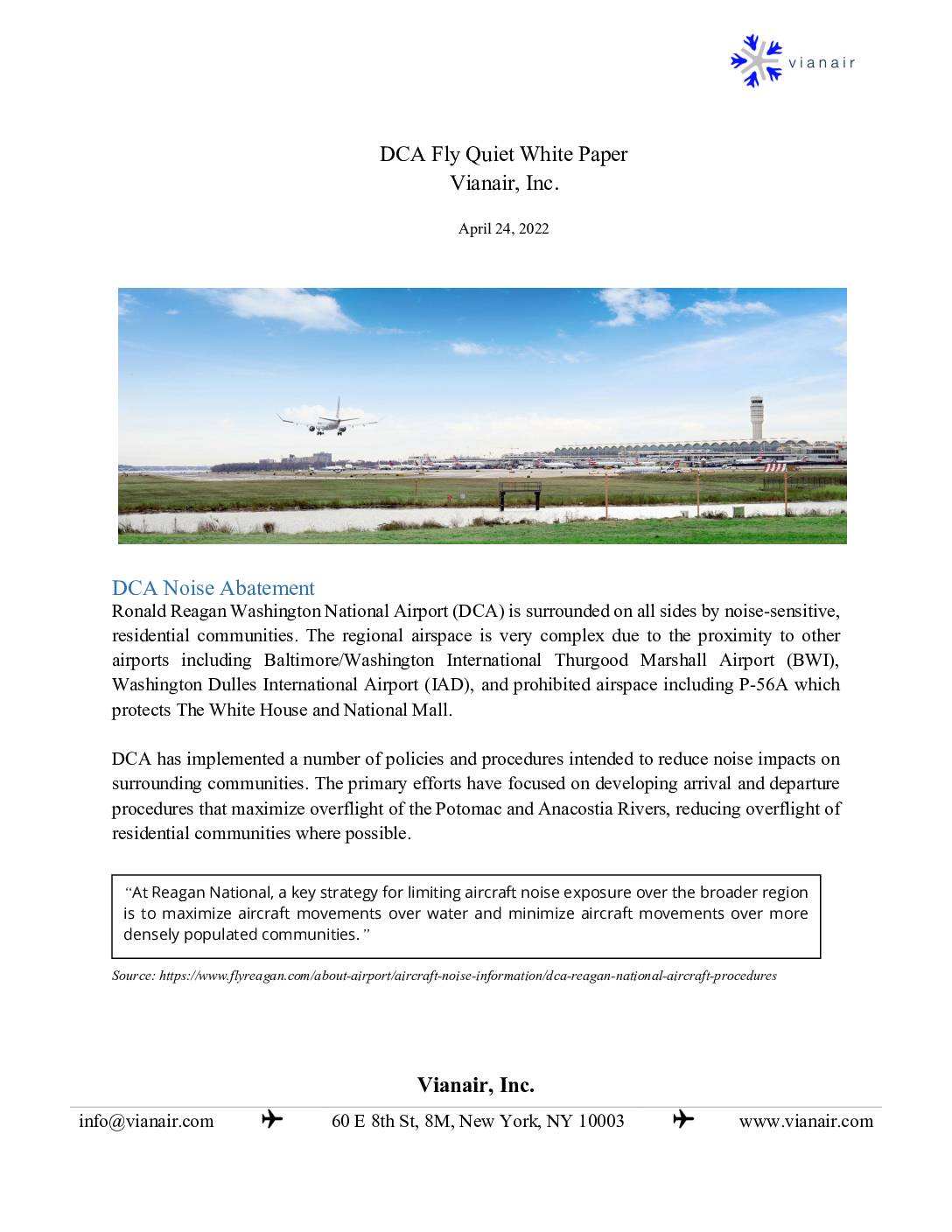
DCA Fly Quiet White Paper
This white paper by Vianair, Inc. outlines a proposed 'Fly Quiet' noise abatement program for Ronald Reagan Washington National Airport (DCA), where aircraft are encouraged to fly over the Potomac and Anacostia Rivers to reduce noise impacts on surrounding residential communities. The paper draws on best practices from airports with established Fly Quiet programs, including Seattle-Tacoma International Airport, describing three core program components: operational procedures, conformance monitoring, and community/industry engagement. It explores how elements such as preferential runway use, nighttime operations rules, and optimized flight procedures could be applied at DCA to minimize aircraft noise exposure. -
 2022-04-24
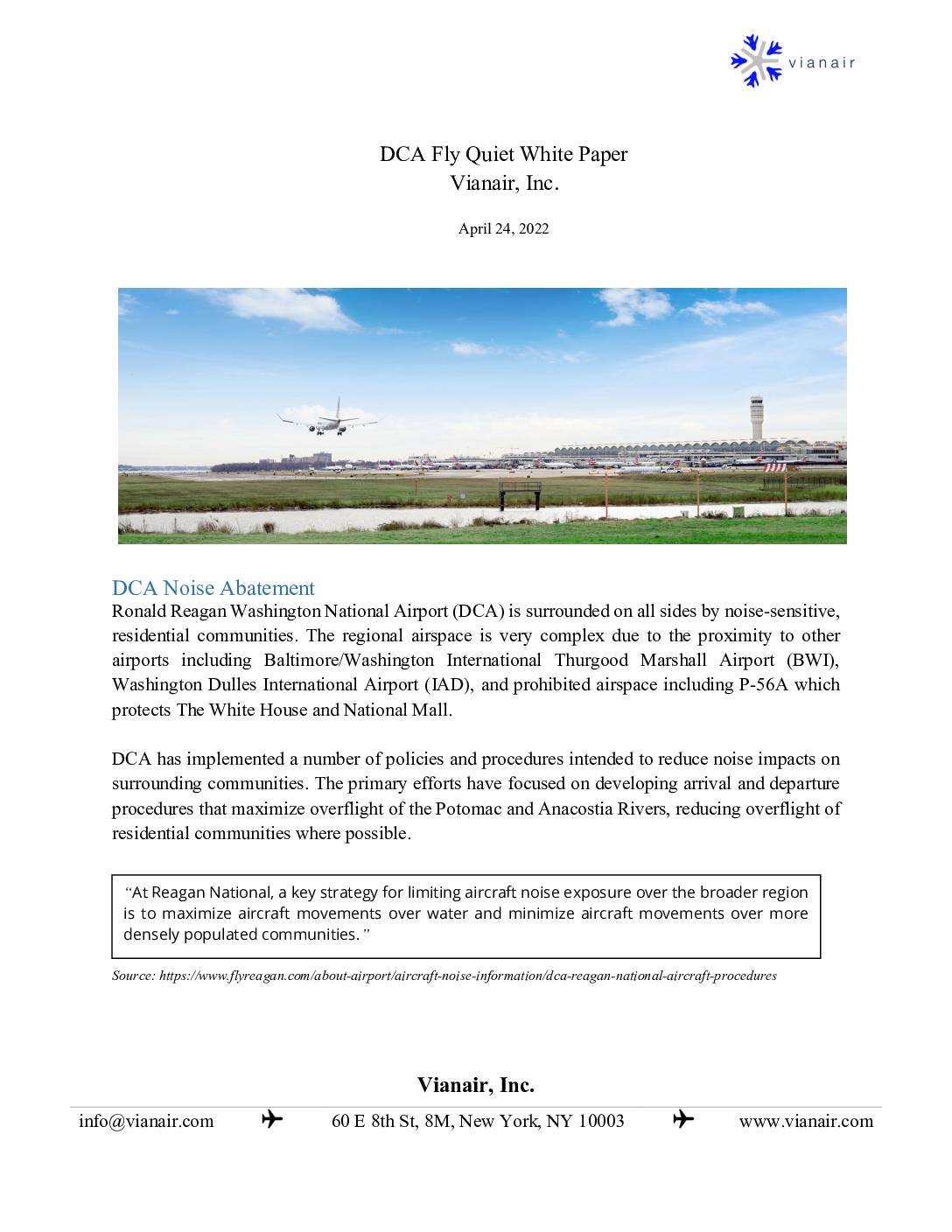
DCA Fly Quiet White Paper
White paper by Vianair, Inc. (April 24, 2022) proposing a Fly Quiet noise abatement program for Ronald Reagan Washington National Airport (DCA). Covers three core components of Fly Quiet programs: operational procedures (preferential runway use, continuous descent approaches, thrust/flap/gear departure profiles), conformance monitoring, and industry/community engagement. Addresses DCA-specific elements including fleet mix data, nighttime operations -
 2021-11-05
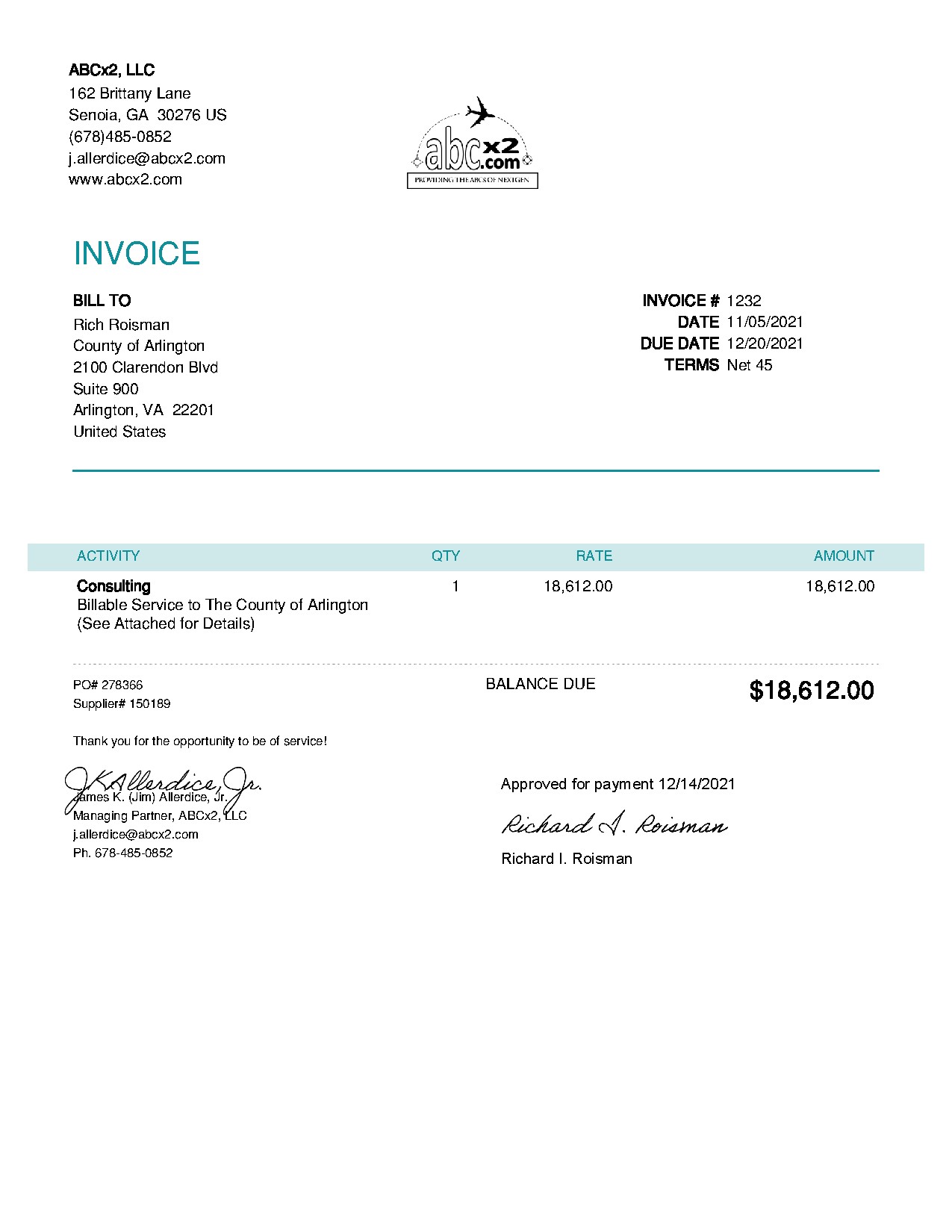
Invoice #1232 – ABCx2, LLC consulting services to County of Arlington
This invoice and supporting detail document a consulting billing of $18,612 submitted by ABCx2, LLC to Arlington County in November 2021 for aviation-related services during period 2021_10, including SID (Standard Instrument Departure) procedure design, noise analysis, whitepaper development, and FAA policy strategy meetings related to Ronald Reagan Washington National Airport (DCA). The work was performed by a team of consultants and subcontractors—including Vianair, who conducted flight design, noise analysis, and results visualization—as part of the larger Arlington Phase II project, which carried a total budget of $150,000 and had accumulated $112,999.50 in billings across seven periods. The invoice was approved for payment on December 14, 2021, by Arlington County's Richard I. Roisman. -
 2021-10-08
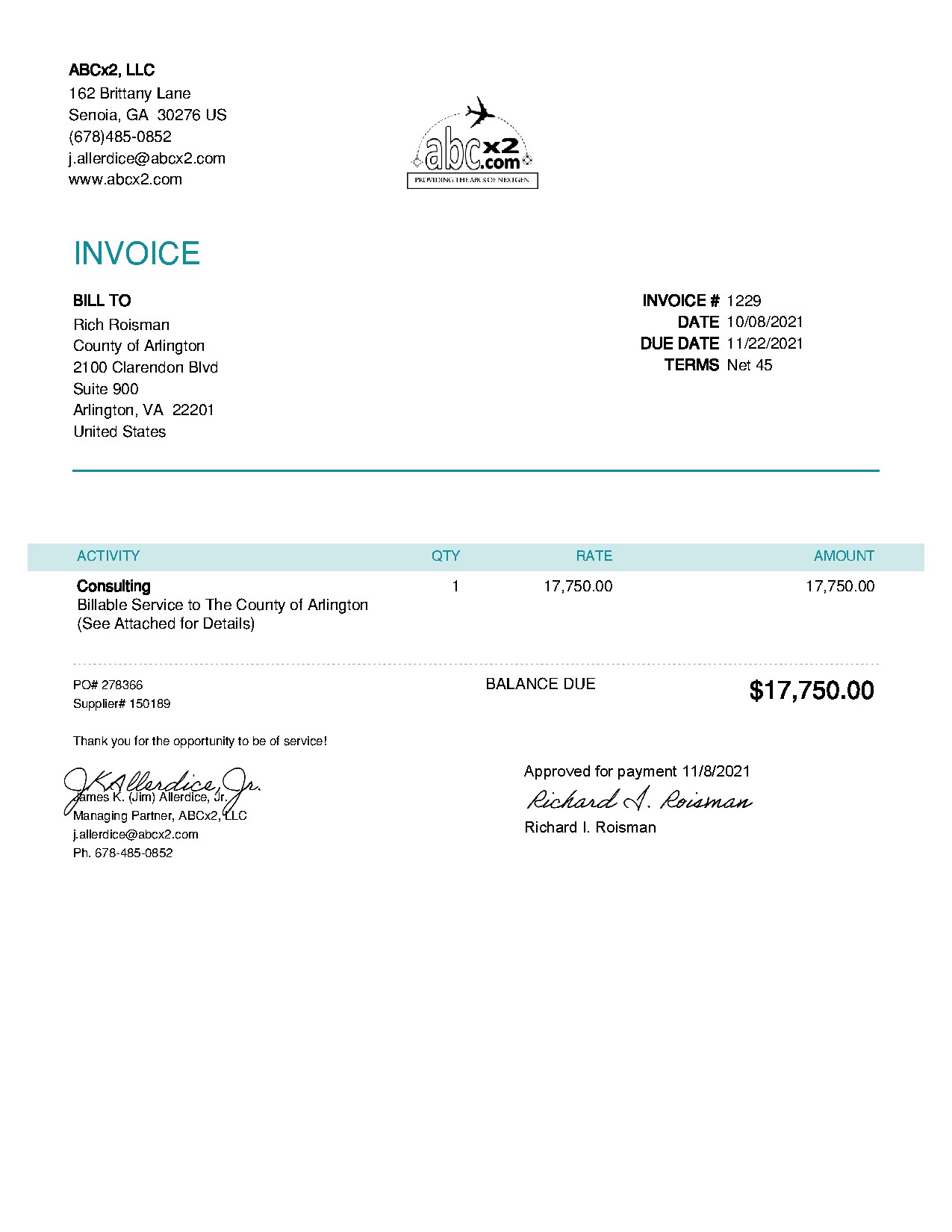
Invoice #1229 – ABCx2, LLC consulting services to County of Arlington
This document is an invoice dated October 8, 2021, from ABCx2, LLC to the County of Arlington, Virginia, for $17,750 in consulting services related to aviation noise policy work, including SID (Standard Instrument Departure) design meetings, white paper drafting, and flight tracking analysis. The attached billing detail shows the work was performed in September 2021 by a team including aviation consultants and a flight analysis firm called Vianair, with tasks involving FAA coordination and NextGen Advisory Committee engagement. The invoice represents one installment of a broader Phase II project with a total budget of $150,000, of which approximately $94,387 had been billed through September 2021. -
 2021-09-27
Federal Airport Noise Regulations and Programs
Congressional Research Service report R46920 by Rachel Y. Tang analyzing federal airport noise regulations and programs, including Airport Noise Compatibility Planning (14 C.F.R. Part 150) established under the Aviation Safety and Noise Abatement Act of 1979 (P.L. 96-193) and Airport Noise and Access Restrictions (14 C.F.R. Part 161) under the Airport Noise and Capacity Act