TagNEPA(390)
-
 2018-02-05
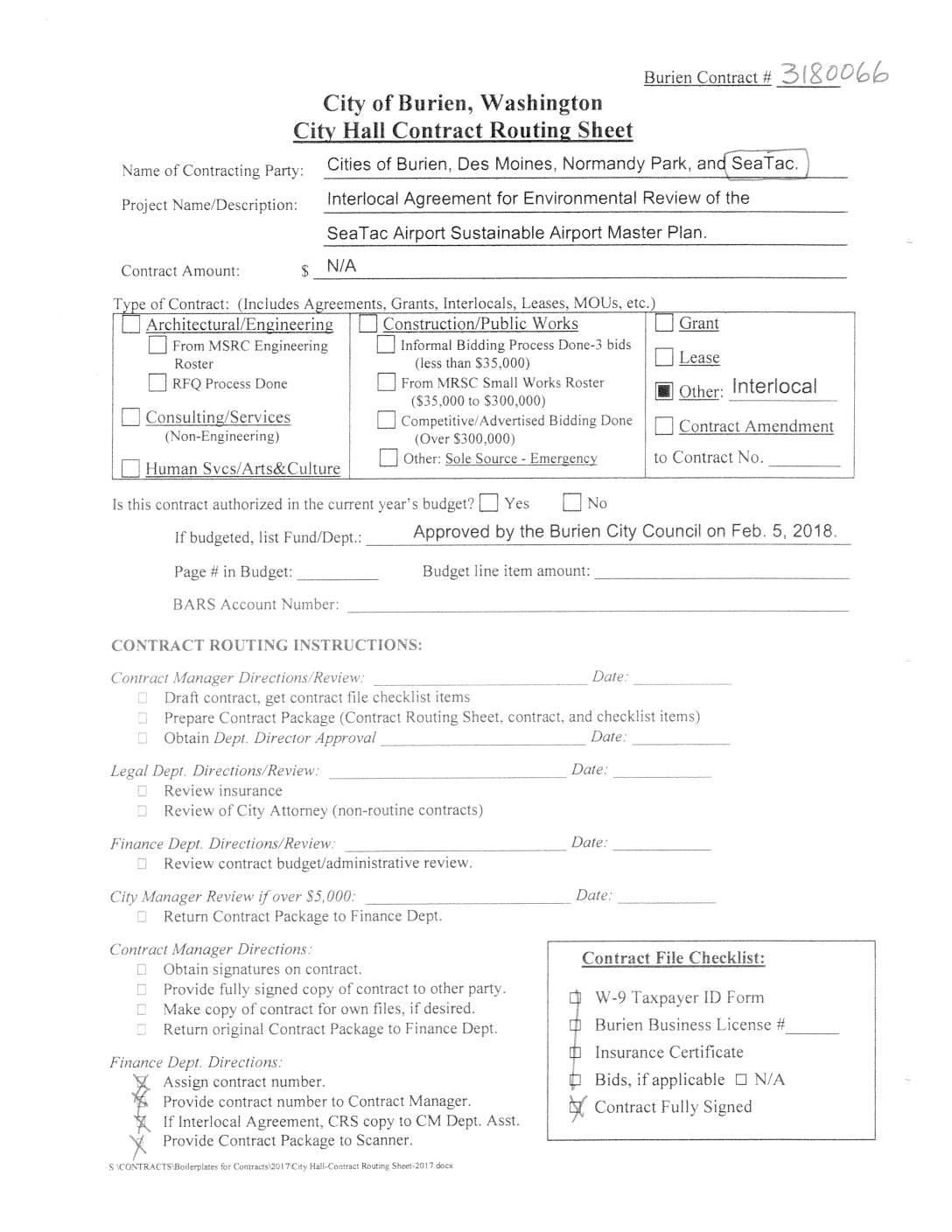
Interlocal Agreement Between the Cities of Burien, Des Moines, Normandy Park and Sea-Tac for Environmental Review of the Sea-Tac Airport Sustainable Airport Master Plan
The cities of Burien, Des Moines, Normandy Park, and SeaTac entered into an interlocal agreement to coordinate their review of the Port of Seattle's Sustainable Airport Master Plan (SAMP), which outlines airport growth over the next 20 years. The agreement establishes a process for the four cities to jointly analyze environmental impacts, submit coordinated comments under NEPA and SEPA, and potentially hire shared consultants to assist with their response. Approved by the Burien City Council on February 5, 2018, the agreement aims to give the neighboring cities a stronger, unified voice in evaluating potential negative impacts from Sea-Tac Airport expansion. -
 2017-11-01
Puget Sound Gateway Program – Phase 1 of the SR 509 Completion Project: Noise technical report
This 2017 Noise Technical Report, prepared by The Greenbusch Group for the Washington State Department of Transportation, evaluates the noise impacts of Phase 1 of the SR 509 Completion Project near Seattle-Tacoma International Airport. It compares the proposed highway improvements against a 2003 environmental impact study, assessing changes in noise levels, affected residents, and noise abatement measures such as sound walls. The report concludes with recommendations for minimizing construction and long-term traffic noise impacts on surrounding communities. -
 2017-10-01
Technical memorandum No. 6 Final – Alternatives
This October 2017 Technical Memorandum, prepared by Leigh Fisher for the Port of Seattle, outlines development alternatives for Seattle-Tacoma International Airport as part of its Sustainable Airport Master Plan. It covers a wide range of potential airport improvements, including airfield capacity enhancements, passenger terminal expansion, ground access and parking, air cargo facilities, and general aviation. The document evaluates options such as runway relocations, new taxiway configurations, and midfield terminal development to meet long-term aviation demand. -
 2017-08-29
City of Phoenix v. Huerta and Federal Aviation Administration: U.S. Court of Appeals, D.C. Circuit Opinion (No. 15-1158)
A federal appeals court ruled in 2017 that the FAA acted arbitrarily when it changed flight routes at Phoenix Sky Harbor International Airport in 2014 without adequately consulting city officials or thoroughly reviewing environmental impacts. The new routes increased air traffic over historic neighborhoods and public parks by 300%, yet the FAA conducted consultations only with low-level employees who lacked the authority to speak on the city's behalf. The case highlights the legal obligations federal agencies have to meaningfully engage local governments and assess noise impacts before implementing major flight path changes. -
2017-06-08
FAA calls for comment on proposed use of Runway 34
for use by turboprop planes The Federal Aviation Administration (FAA) is conducting an analysis under the National Environmental Policy Act (NEPA) to determine the environmental effects of a westerly heading for turboprop aircraft departing from Runway 34 at Seattle-Tacoma International Airport (SEA). The heading would only be used when the airport is landing and departing -
 2017-06-02
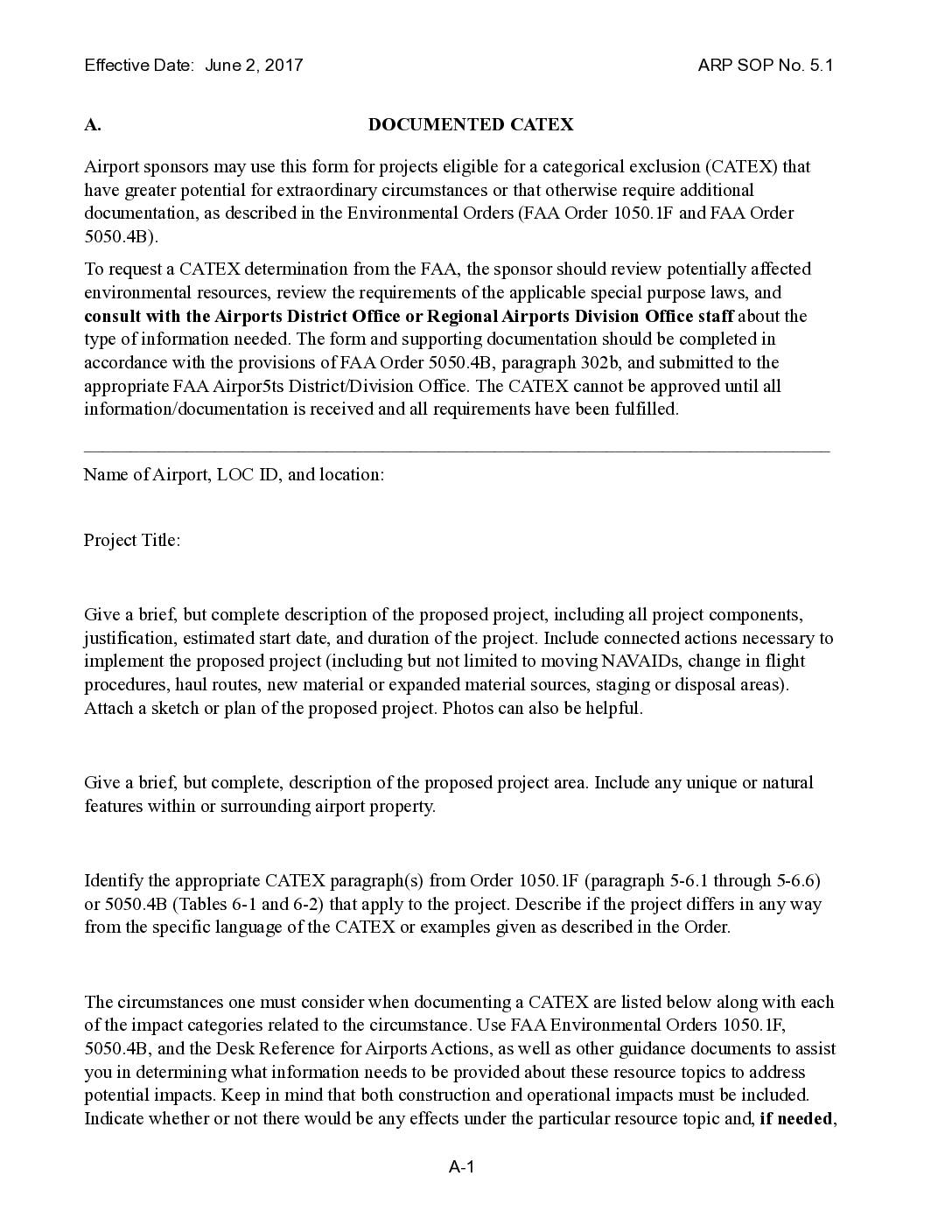
ARP SOP No. 5.1: Documented Categorical Exclusion (CATEX) Form
This FAA form (ARP SOP No. 5.1, effective June 2, 2017) guides airport sponsors through the process of requesting a Categorical Exclusion (CATEX) determination for projects that may have extraordinary environmental circumstances. It requires sponsors to document potential impacts across key resource areas, including historic and cultural resources under the National Historic Preservation Act and protected lands under Department of Transportation Act Sections 4(f) and 6(f). Sponsors must consult with their FAA Airports District or Regional Division Office and submit all required documentation before a CATEX can be approved. -
 2017-01-18
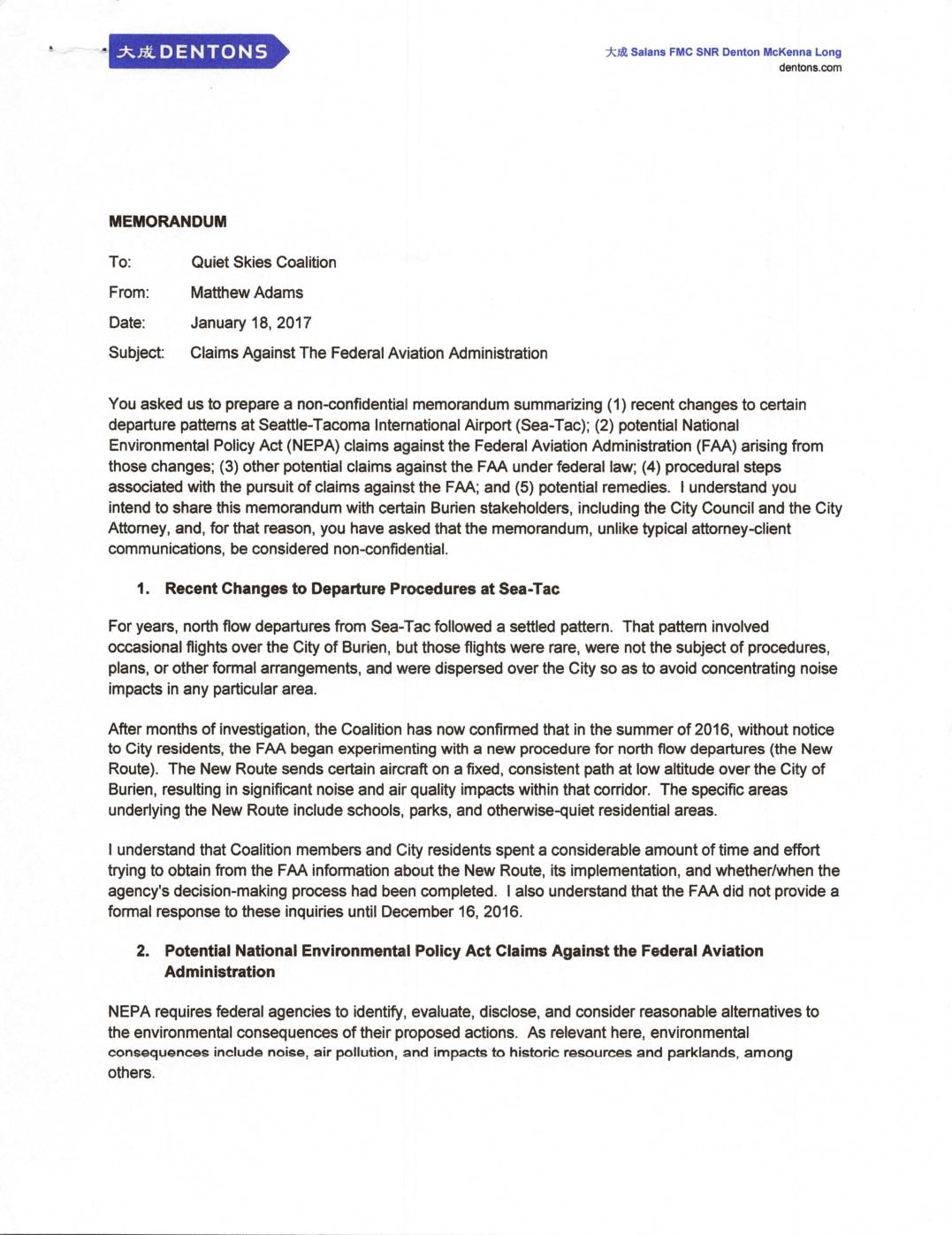
Memorandum: Claims against the Federal Aviation Administration
A January 2017 legal memorandum from law firm Dentons to the Quiet Skies Coalition outlines potential claims against the Federal Aviation Administration (FAA) over a new flight departure route introduced at Seattle-Tacoma International Airport in summer 2016. The new route directs aircraft on a fixed low-altitude path over schools, parks, and residential areas in the City of Burien without prior public notice. The memo concludes that the FAA likely violated the National Environmental Policy Act (NEPA) by failing to conduct or document the required environmental review before implementing the route. -
 2017-01-11
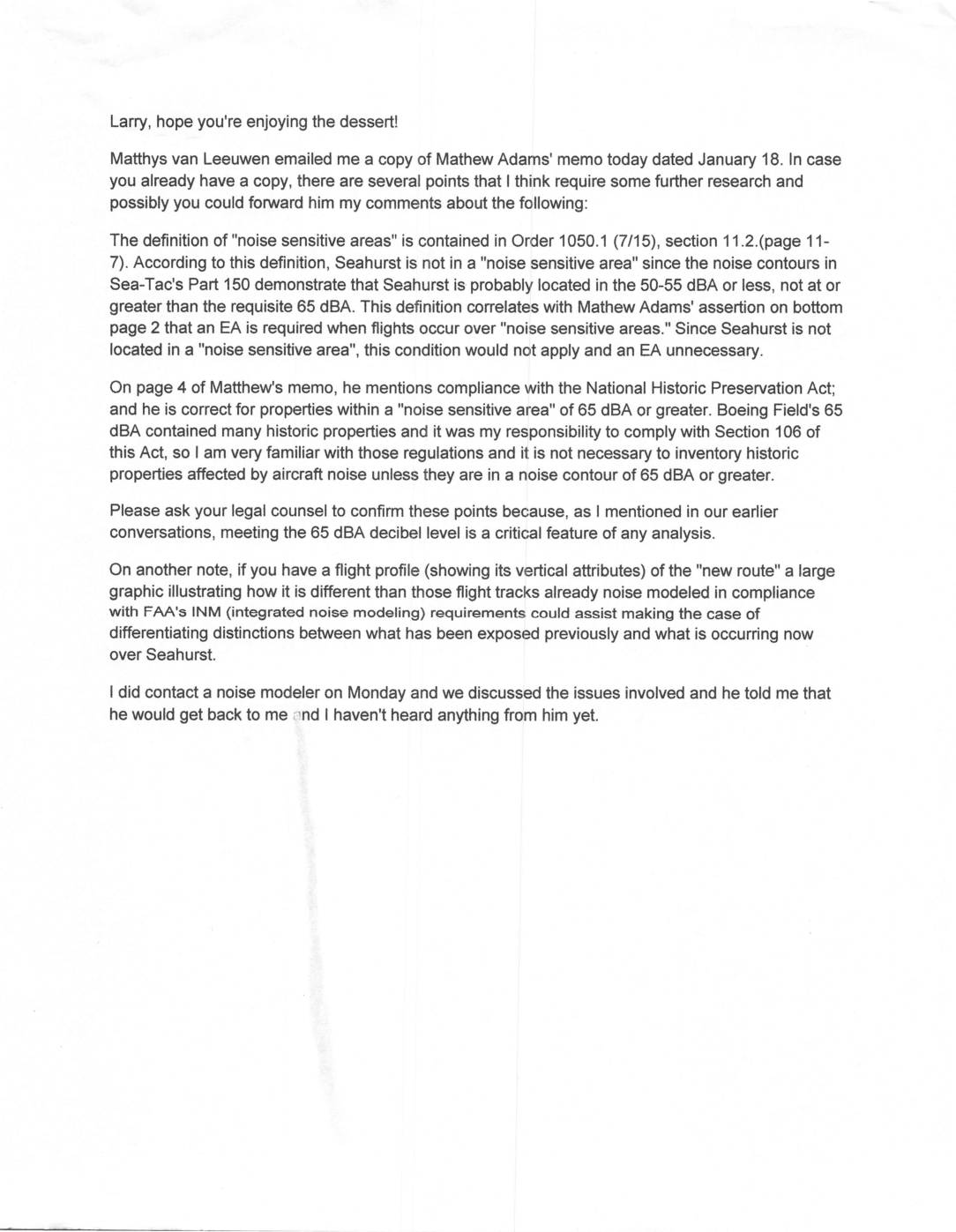
Confidential–Issues concerning litigation
These documents contain communications from January 2017 regarding aircraft noise concerns over the Seahurst and White Center neighborhoods near Seattle-Tacoma International Airport. A noise consultant advises that Seahurst likely falls below the FAA's 65 dBA threshold that defines 'noise sensitive areas,' arguing this means an Environmental Assessment (EA) and historic property inventory are not required. Separately, a Burien resident emails city officials sharing research from Sea-Tac's Part 150 Study suggesting that flights over these neighborhoods were anticipated and approved, and that the absence of an EIS may not constitute valid grounds for litigation by the Quieter Skies coalition. -
 2016-07-01
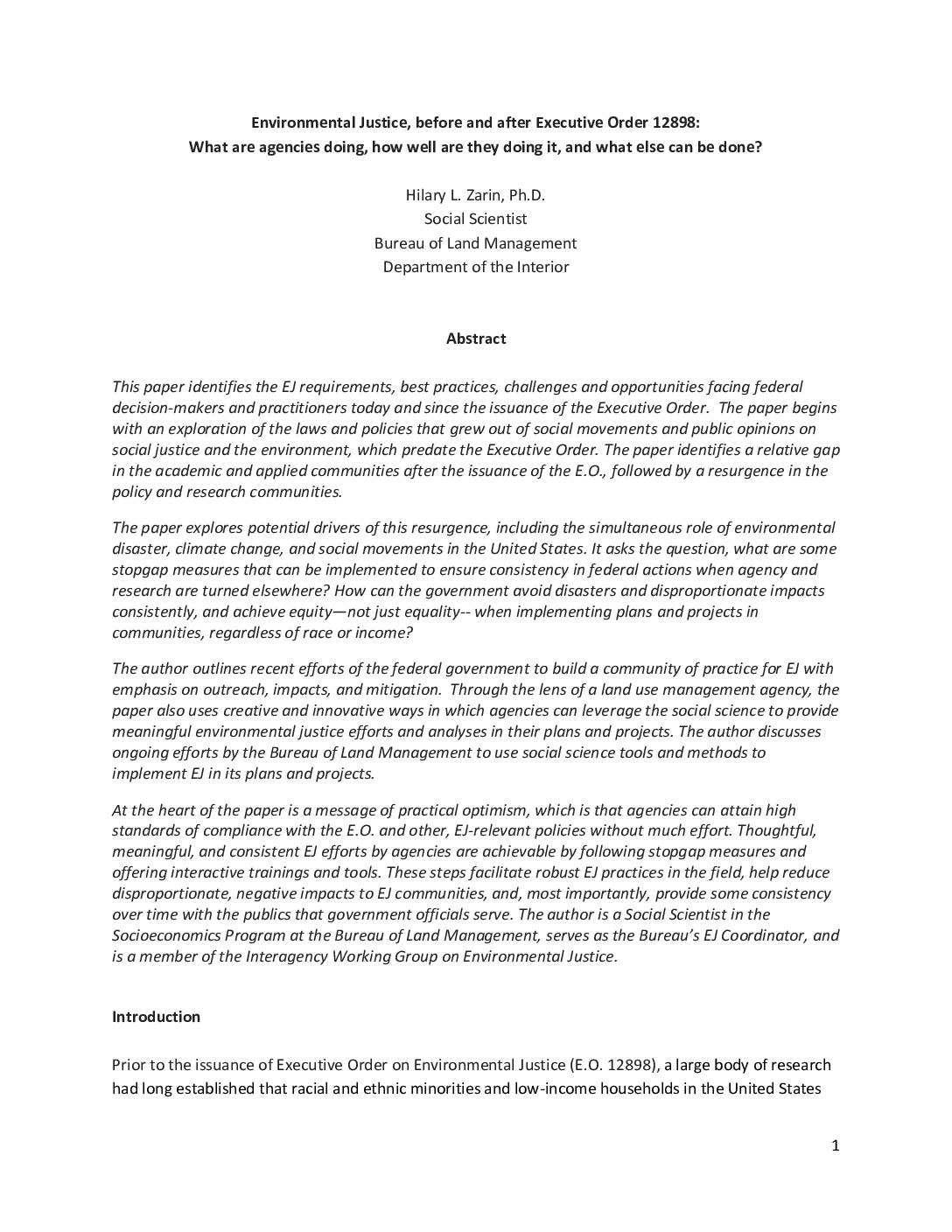
Environmental Justice, before and after Executive Order 12898: What are agencies doing, how well are they doing it, and what else can be done?
This academic paper examines how U.S. federal agencies have addressed Environmental Justice (EJ) since President Clinton's 1994 Executive Order 12898, which required agencies to reduce disproportionate pollution burdens on low-income and minority communities. The author, a Bureau of Land Management social scientist, reviews agency compliance efforts, highlights case studies like the Flint water crisis, and argues that practical steps such as staff training and social science tools can help agencies consistently protect vulnerable communities regardless of shifting political priorities. -
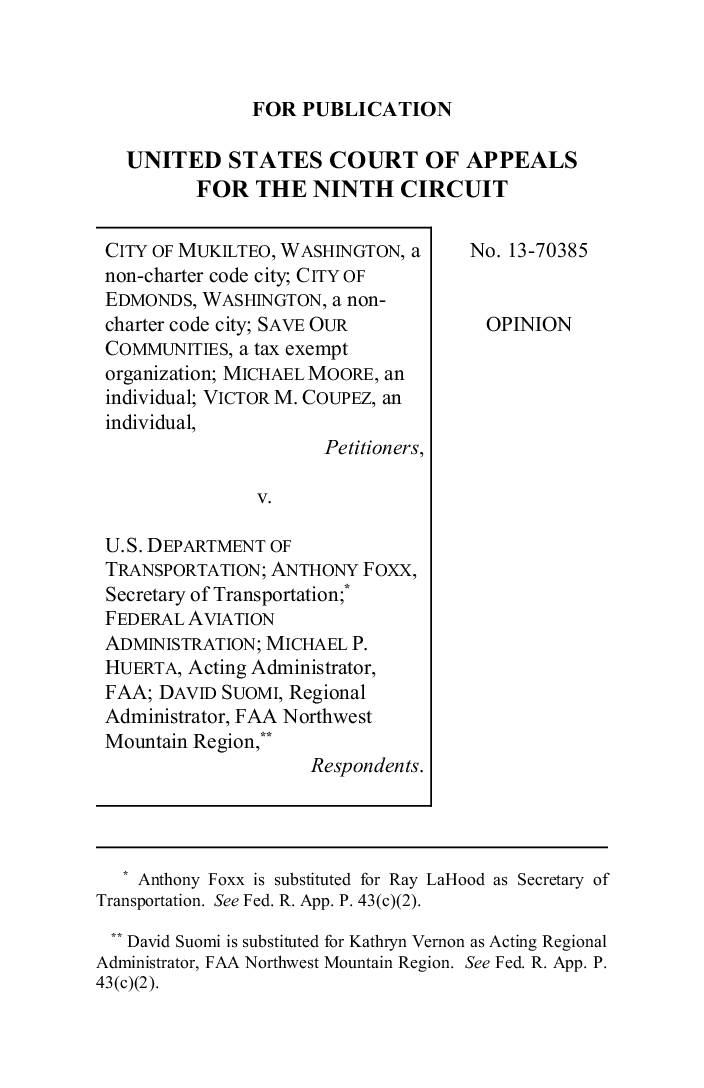 2016-03-04
City of Mukilteo v. U.S. Department of Transportation: Ninth Circuit Opinion on FAA Environmental Review for Paine Field Commercial Service
A federal appeals court denied a challenge by the cities of Mukilteo and Edmonds, Washington, along with local residents and advocacy groups, to the FAA's decision to open Paine Field near Everett to commercial passenger service without requiring a full Environmental Impact Statement. The court ruled that the FAA's environmental review process was conducted in good faith and was not arbitrary or capricious, finding that the agency properly assessed foreseeable noise and environmental impacts under the National Environmental Policy Act.