Skip to content
  • STNI
  • Statistics
    • Ops and Passengers
      • King County International Airport (Boeing Field) Annual Operations
    • Financials
    • Aviation fuel uplift in the State of Washington 2018 – 2025
      • Aviation Fuel Tax Revenue in the State of Washington 1983-2025
      • Aviation Fuel Uplift at Sea-Tac Airport
    • Air Quality Monitoring
    • Flight Tracking
      • Flow and Flight Tracks
      • Five Year Comparison
      • Busiest Hours and Days
    • SEL Noise Reports & Graphs
      • About The Permanent Noise Monitors
      • Minutes of Quiet by Noise Monitor
      • Noise Events mapped
      • Noise Events (SEL)
    • Runways
    • Employees
    • Real Estate
      • Port Properties and Trees mapped
    • Parking
  • Events
  • Protest
    • Regular Events
    • Legislation 2026
    • Complain about a particular flight
    • Advocacy Organizations
    • Media Outlets
    • People
    • The Port of Seattle
      • Commission Meetings
      • Public Records Requests
      • StART
      • Highline Forum
    • Contact Your Electeds
  • Resources
    • FAQs
      • FAA Occurrences/Accidents/Indents
    • The SAMP
      • SAMP Public Comment Template
        • Two versions of Appendix K: NEPA/SEPA 2018 vs 2023
      • SAMP NTP: 31 projects by the numbers
      • SEPA Draft EIS (2026)
      • SAMP Record of Decision/FONSI (2025)
      • SAMP Draft EA (October 2024)
      • 2018 Scoping
    • Port Packages
      • Port Package Property Costs
      • Port Packages mapped
      • The Port Package Explainer
      • So you want a (first-time) Port Package? Start here
      • Port Package Looker Upper
      • How do I determine if I have a Port Package or Avigation Easement?
      • Progress on Port Package Update legislation
      • Having a Port Package Problem?
      • Port Package Site Visit Follow-Up
    • Document Library
    • Explainers
      • The Airport Law Cheat Sheet
      • The Grant Explainer
    • External Articles
    • History
      • Timeline
      • The Sea-Tac Communities Plan
        • Sea-Tac Communities Plan – Planning Maps
      • PSRC Third Runway Decision Process
    • Studies
    • Videos
  • Stories
  • Mission
  • Subscribe
  • Contact
Scroll down to content

Get InformedStay Informedx

I understand that you will never share my information with anyone, you will only use it to keep me updated on relevant events and that I may unsubscribe at any time.

STNI

STNISea-Tac Noise.Info

  • Solve for Sea-Tac. Solve for every airport.
  • Since 2016, working to obtain justice for everyone living under the flight path.
  • Less Noise. Cleaner Air. Better Public Health. Compensation.
  • Everything you think you know about the airport is wrong.

TagKing County Council(44)

Advanced Search Options

  • Dates
  • Media
    • External Articles
    • Images
    • PDFs
    • Video
    • Audio
  • Order By
  • 1980-08-01

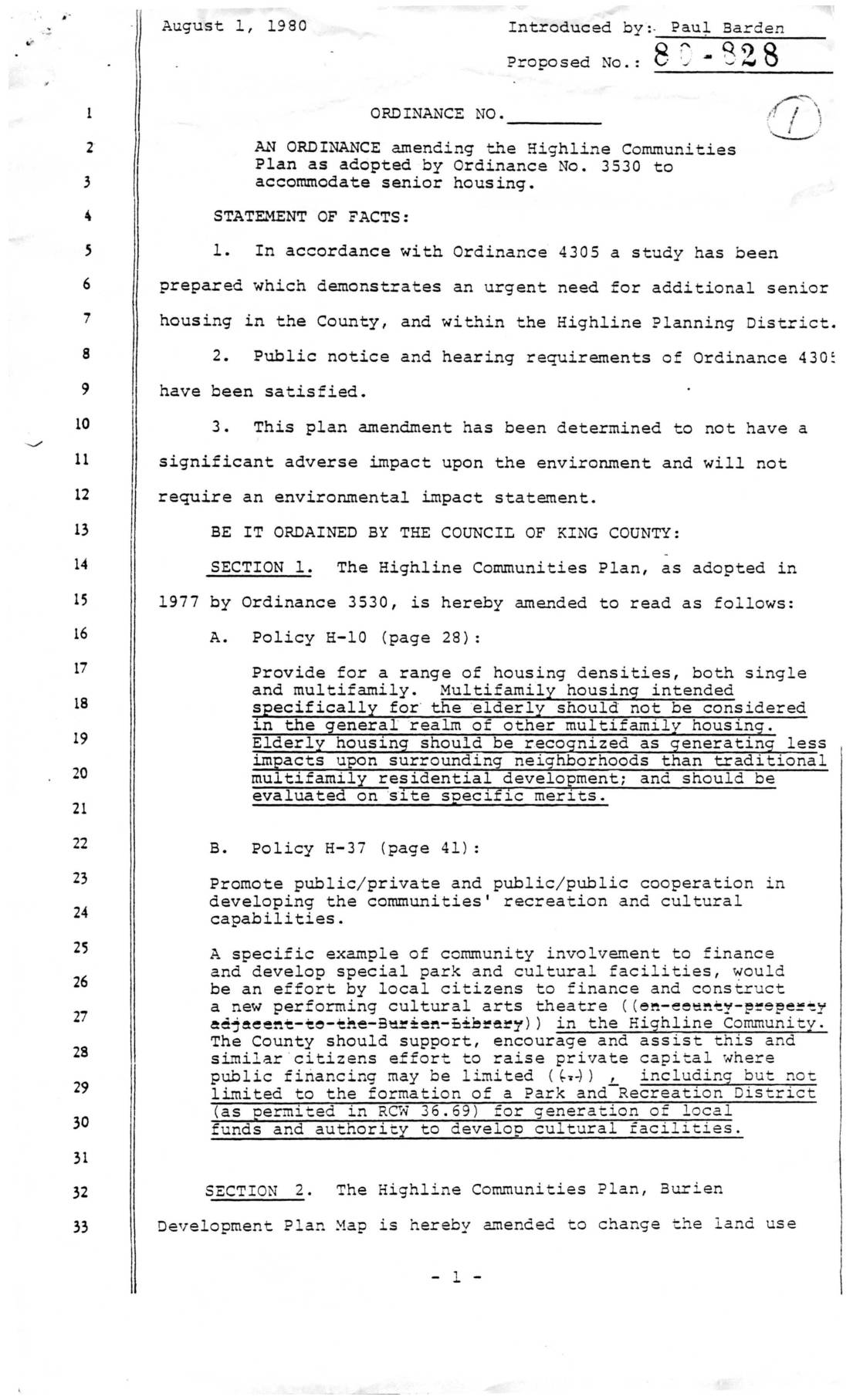
    King County Ordinance 80-828: Amending the Highline Communities Plan to Accommodate Senior Housing

    A 1980 King County ordinance amending the Highline Communities Plan to better accommodate senior housing, recognizing that elderly-focused multifamily housing generates less neighborhood impact than traditional multifamily development and should be evaluated on its own site-specific merits. The ordinance also updates cultural facilities policy to encourage public-private cooperation in developing a performing arts theatre in the Highline Community, including through the possible formation of a Park and Recreation District.
    CategoriesCorrespondence TagsBurien, Highline Communities Plan, Highline Community Plan, Housing, King County Council, Land Use, Paul BardenFolderHighline Community Plan
  • 1980-03-04

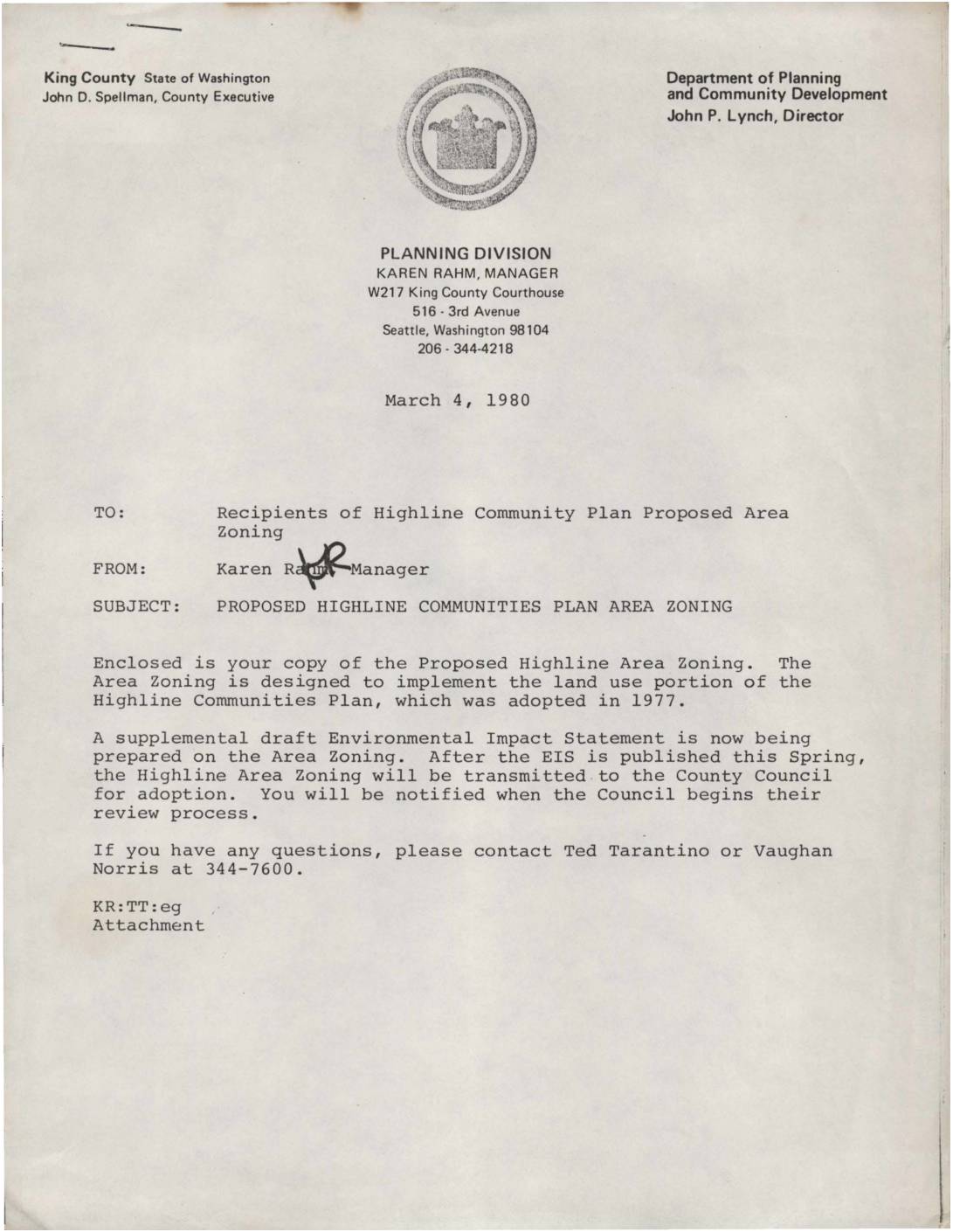
    Proposed Highline Communities Plan Area Zoning: Transmittal Letter from King County Planning Division

    A March 1980 memo from King County's Planning Division manager Karen Rahm notifies recipients about the Proposed Highline Communities Plan Area Zoning, a zoning framework designed to implement the land use guidelines of the 1977 Highline Communities Plan. The memo states that a supplemental draft Environmental Impact Statement was being prepared and would be published in Spring 1980, after which the zoning proposal would be sent to the County Council for adoption. Handwritten notes on the reverse reference page 56, suggesting a potential rezoning from SR to ML (Medium Light industrial) with consideration of buffer zones around ML areas.
    TagsEnvironmental Impact Statement, Highline Community Plan, King County, King County Council, Land Use, NEPAFolderKing County
  • 1979-12-21

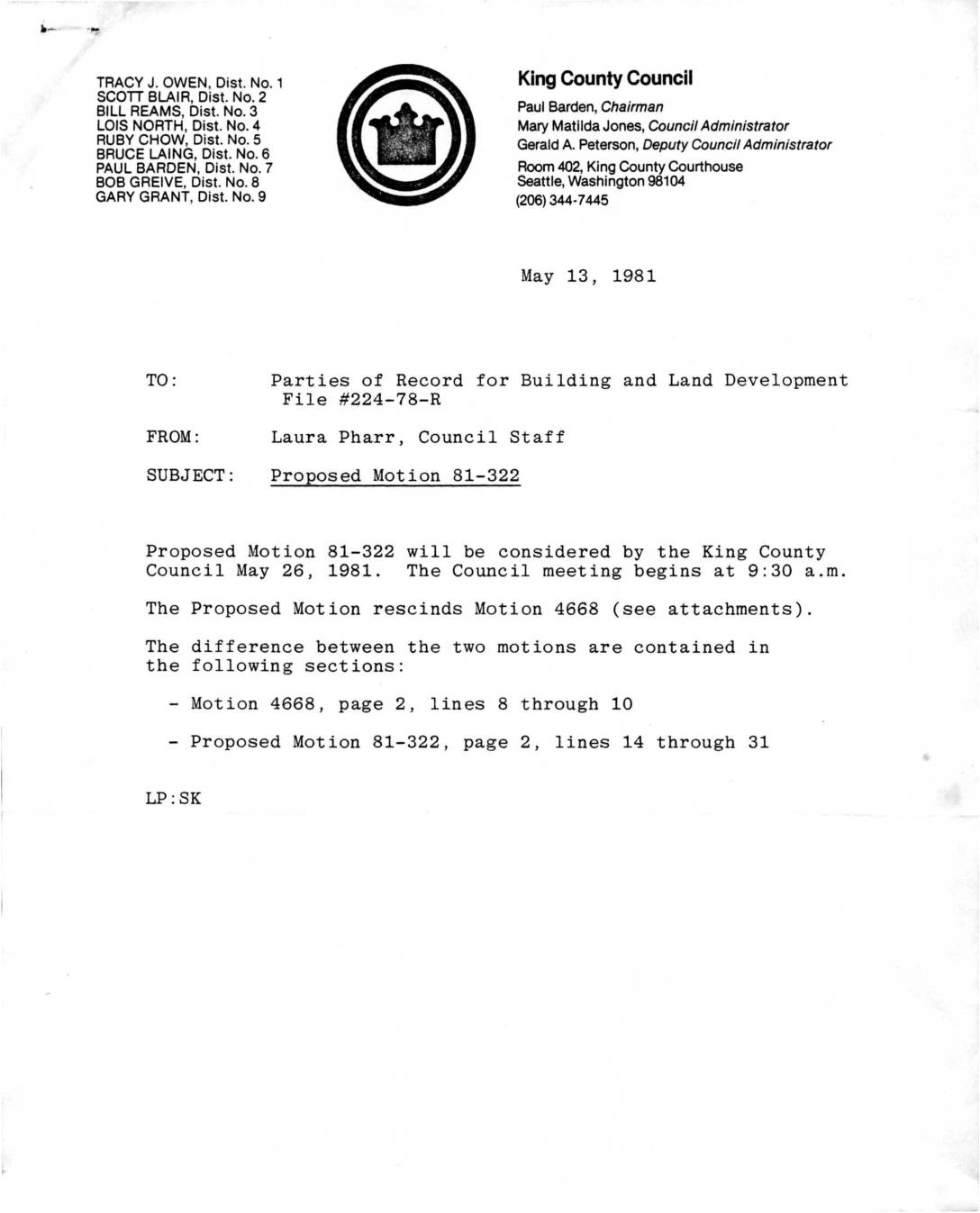
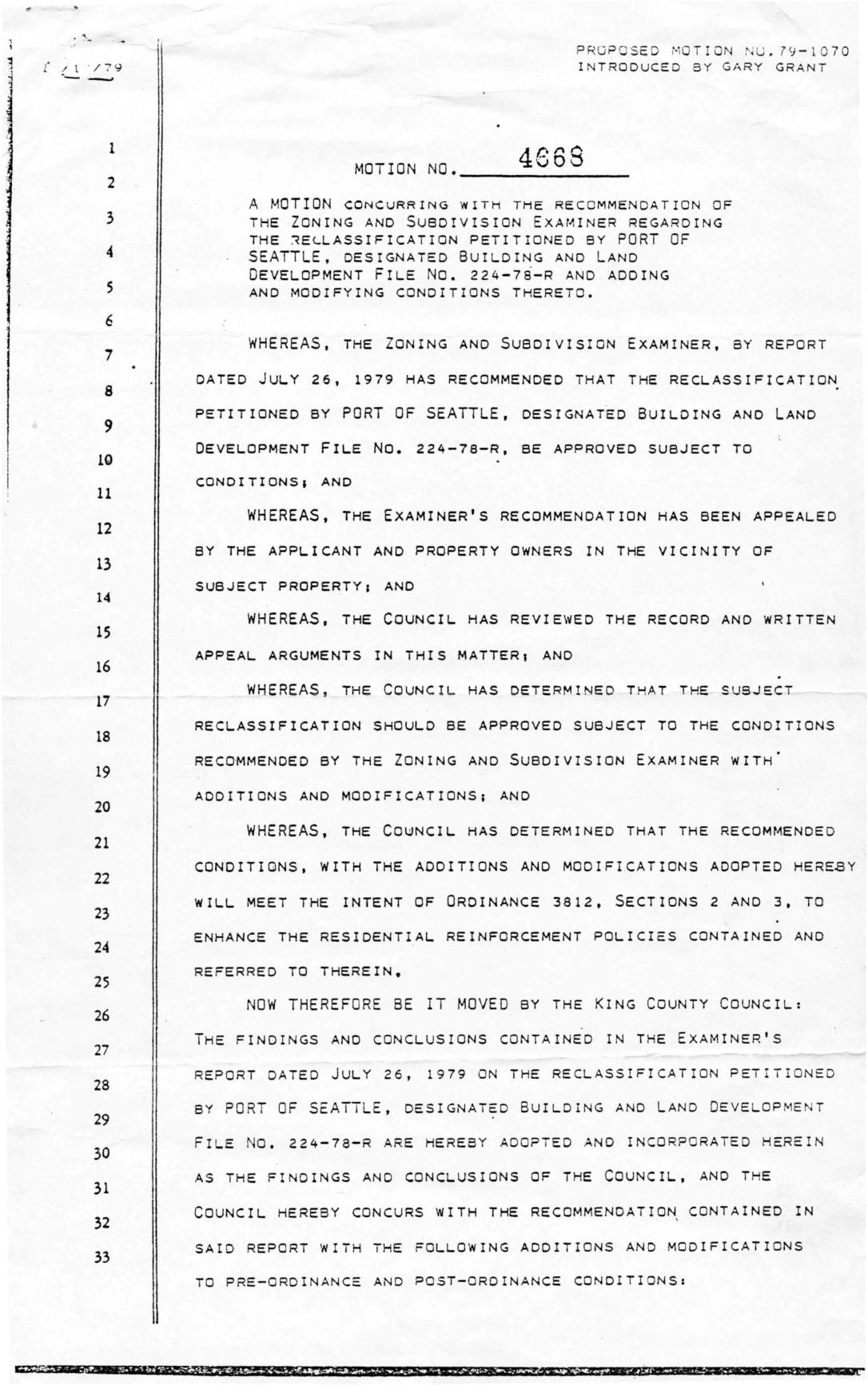
    Motion No. 4668: King County Council Motion Concurring with Zoning and Subdivision Examiner Recommendation Regarding Reclassification Petitioned by Port Of Seattle, Building and Land Development File No. 224-78-R

    In December 1979, the King County Council passed Motion No. 4668, concurring with the Zoning and Subdivision Examiner's recommendation to approve a land reclassification petitioned by the Port of Seattle (File No. 224-78-R), related to development of a Boeing facility near Sea-Tac Airport. As conditions of approval, the Port of Seattle was required to provide 5 acres for a neighborhood park along 12th Avenue South and to enter into a memorandum of understanding with King County freezing development on a 55-acre Westside Greenbelt buffer zone for ten years. The motion also mandated a separate public hearing in affected communities during the site plan approval process, reflecting efforts to balance airport-related development with residential stability concerns.
    Tags224-78-R, Boeing HQ, King County Council, Land Use, NSTP, Port Of Seattle, Westside Hilltop Survival CommitteeFolderProposed Boeing HQ 1978
  • 1979-08-17

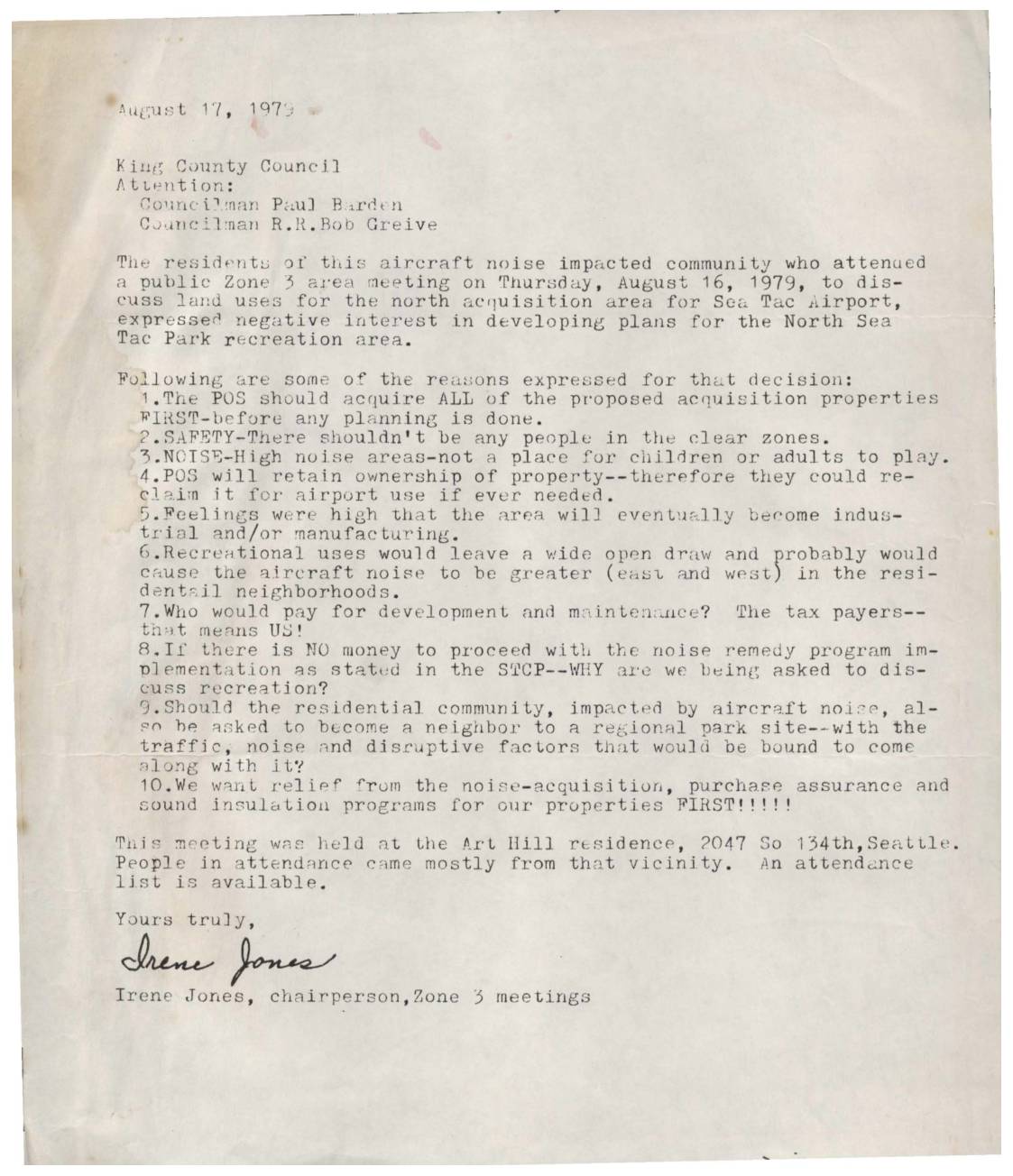
    Letter to King County Council Regarding North Sea-Tac Park Recreation Area

    In an August 17, 1979 letter to the King County Council, Irene Jones, chairperson of Zone 3 meetings, conveyed strong opposition from local residents to developing a recreational park in the North Sea-Tac area near the airport. Attendees at a public meeting cited safety concerns, high noise levels, and potential tax burdens as reasons against the park plan, arguing that the land should first be fully acquired by the POS before any development is considered. Residents emphasized that their top priority was relief through noise-acquisition, purchase assurance, and sound insulation programs for their existing properties.
    CategoriesCorrespondence Tagscommunity engagement, King County, King County Council, Noise Remedy Program, North Sea-Tac Park, Sea-Tac Airport, Zone 3 CommitteeFolderZone 3 Committee
  • 1978-01-01

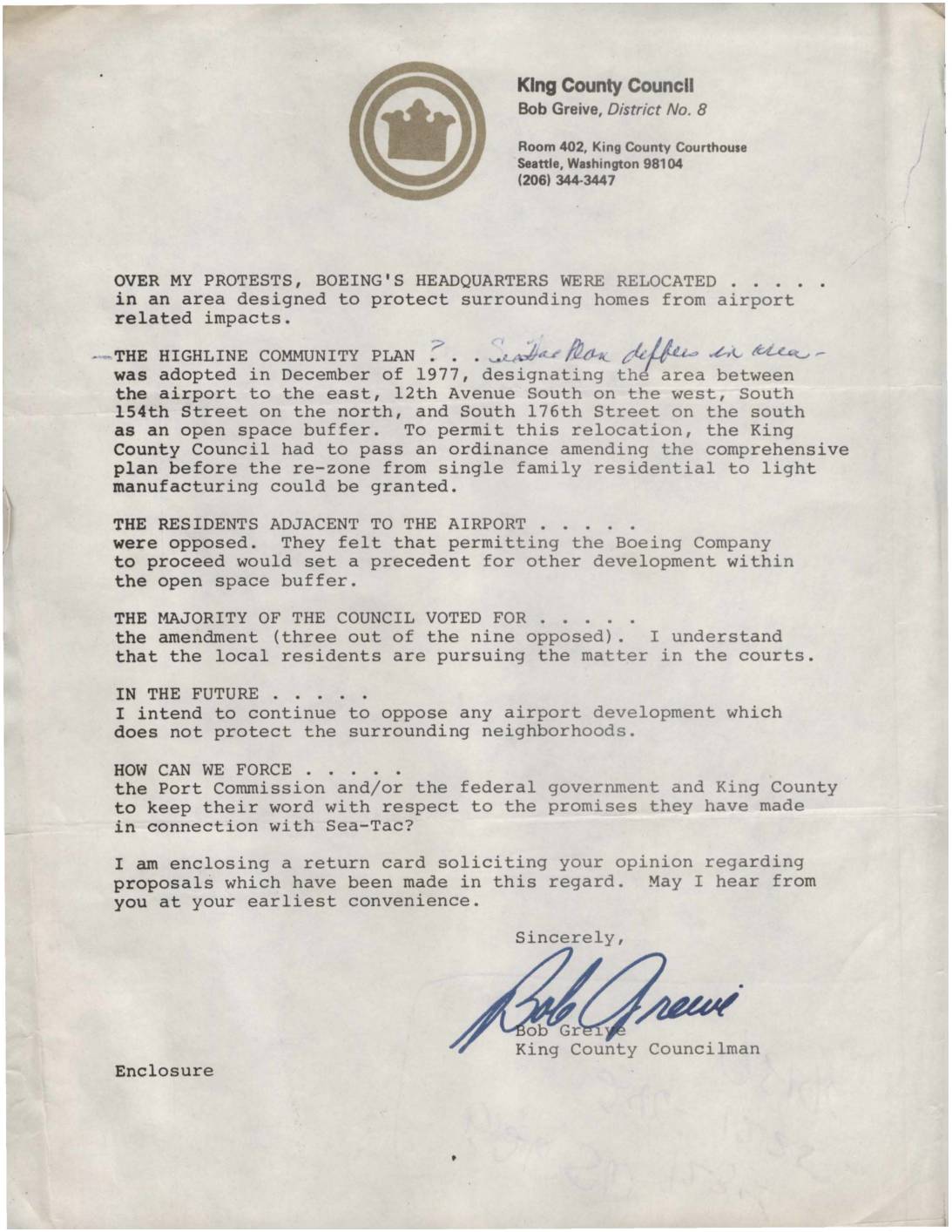
    Letter from King County Councilman Bob Grieve on Boeing HQ Relocation and Highline Community Plan

    King County Councilman Bob Greive wrote to constituents expressing his opposition to the relocation of Boeing's headquarters into an open space buffer zone near Sea-Tac Airport, an area designated under the 1977 Highline Community Plan to protect nearby residents from airport-related impacts. Despite his protests, the King County Council voted to amend the comprehensive plan and rezone the land from single-family residential to light manufacturing, with only three of nine council members opposing the measure. Greive vowed to continue fighting airport development that threatened surrounding neighborhoods and asked residents for their input on how to hold the Port Commission, federal government, and King County accountable to their promises regarding Sea-Tac.
    CategoriesCorrespondence Tags224-78-R, Bob Grieve, Boeing, Boeing HQ, Highline Community Plan, King County, King County Council, Land Use, Sea-Tac AirportFolderProposed Boeing HQ 1978
  • 1978-01-01

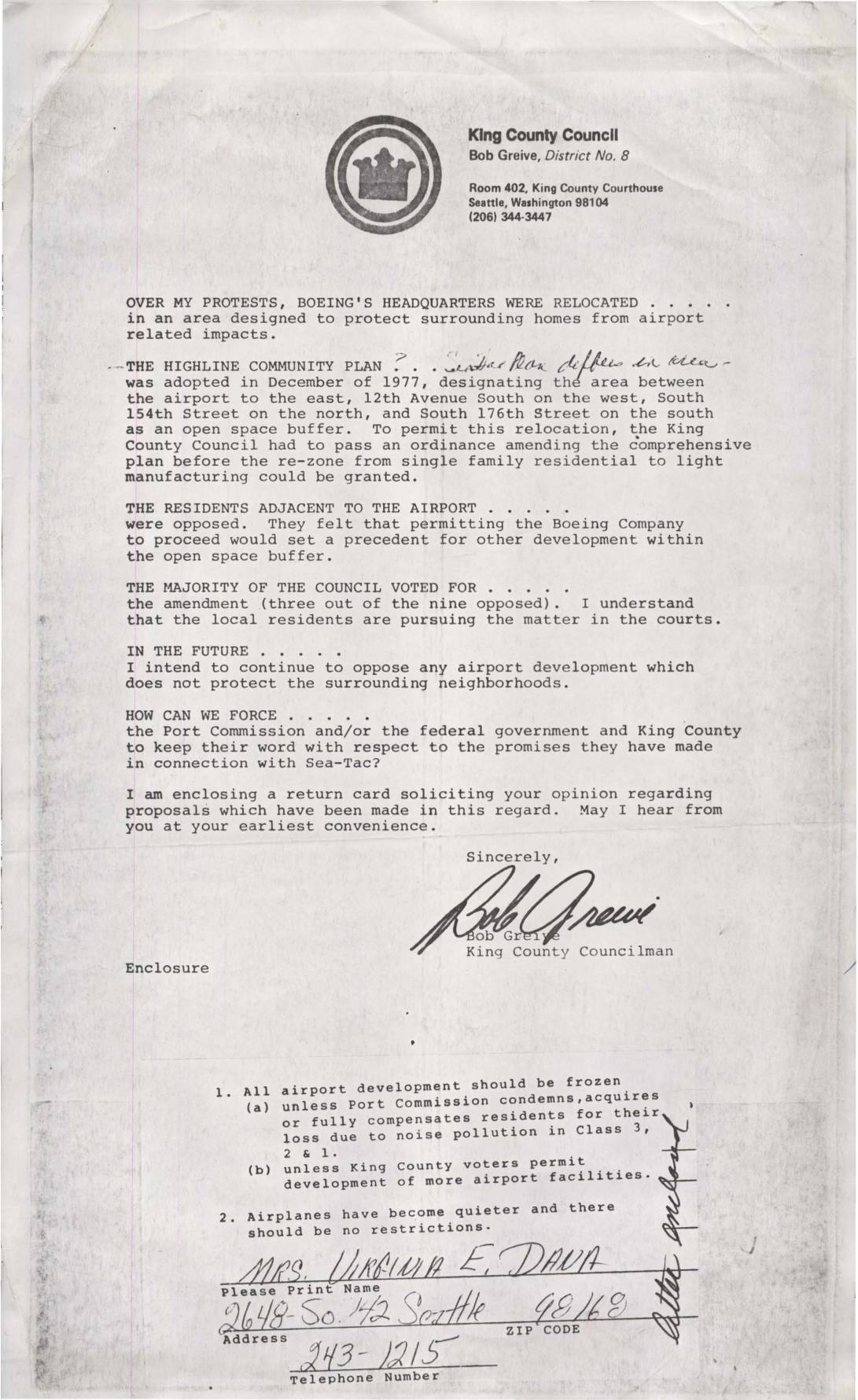
    Letter from King County Councilman Bob Grieve on Boeing HQ Relocation and Sea-Tac Airport Development

    King County Councilman Bob Greive wrote to constituents explaining his opposition to Boeing's headquarters relocation into an area designated as an open space buffer under the 1977 Highline Community Plan, which was meant to protect neighborhoods surrounding Sea-Tac Airport from noise and development impacts. Despite protests from nearby residents and three dissenting council votes, the majority approved an ordinance amending the comprehensive plan to allow rezoning from single-family residential to light manufacturing. Greive solicited public opinion on proposals to hold the Port Commission, federal government, and King County accountable for promises made regarding Sea-Tac's impact on surrounding communities.
    CategoriesCorrespondence, History Tags224-78-R, Bob Grieve, Boeing HQ, Highline Community Plan, King County Council, Sea-Tac AirportFolderProposed Boeing HQ 1978
  • 1977-05-12

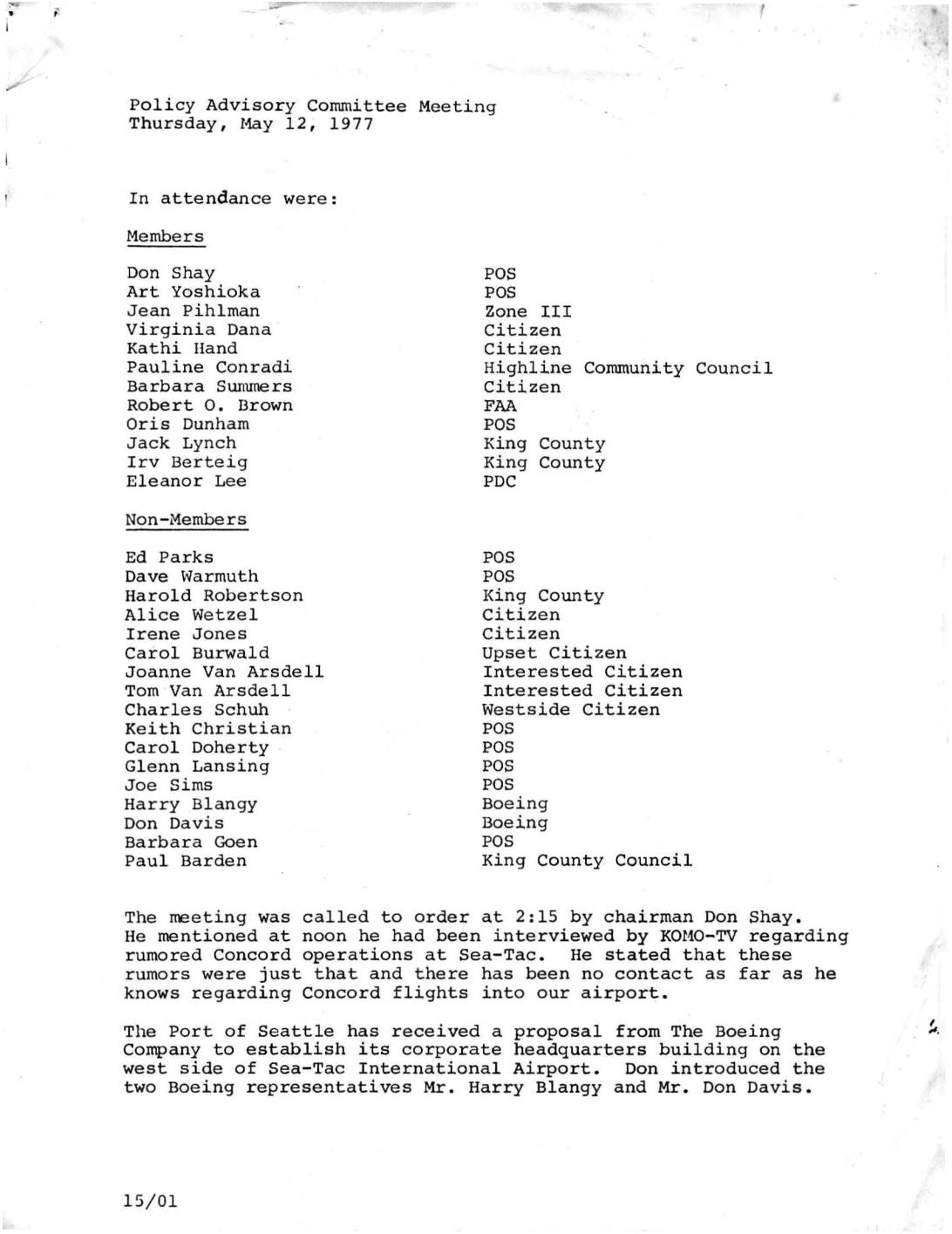
    Policy Advisory Committee Meeting Minutes: Boeing Corporate Headquarters Proposal at Sea-Tac Airport

    Minutes from a May 12, 1977 Policy Advisory Committee meeting at Sea-Tac International Airport, covering Boeing's preliminary proposal to build its corporate headquarters on approximately 12 acres on the airport's west side. The proposal required an amendment to the Sea-Tac/Communities Plan and raised community concerns about traffic, parking, landscaping, and the potential relocation of a planned viewpoint park. Port of Seattle officials emphasized that any development would need extensive buffering, no westerly road access, and maximum community participation in the decision-making process.
    TagsBoeing HQ, King County Council, Policy Advisory Committee, Port Of Seattle, Sea-Tac Communities PlanFoldercommittees
  • 1977-03-14

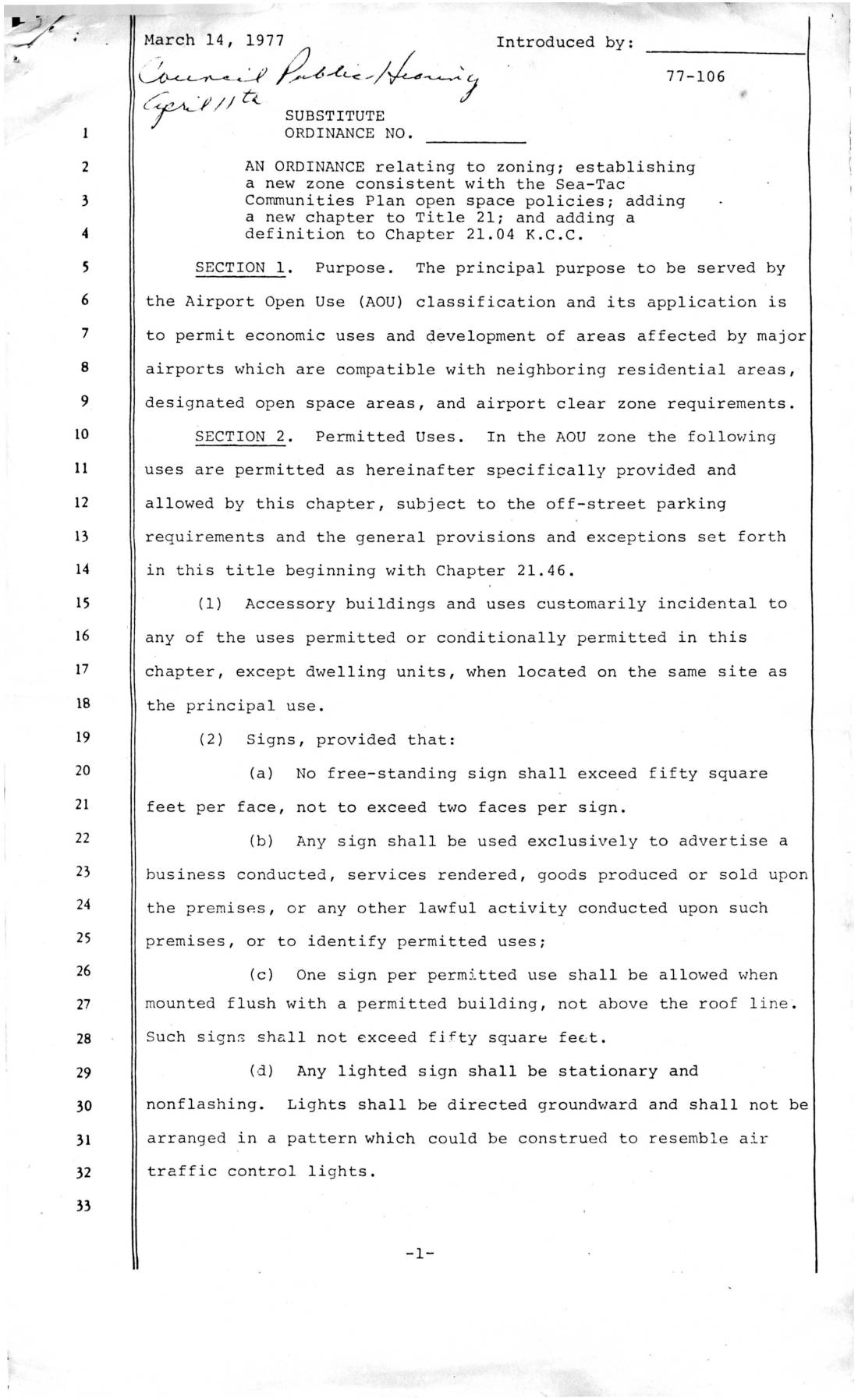
    Substitute ordinance establishing Airport Open Use (AOU) zoning classification

    Ordinance 77-106, introduced in March 1977, established the Airport Open Use (AOU) zoning classification for areas around major airports like Sea-Tac, allowing compatible economic activities such as agriculture, public parks, commercial recreation, and public utility facilities while protecting neighboring residential areas. The ordinance sets strict conditions on signage, building setbacks, landscaping buffers, and livestock density to minimize conflicts with adjacent residential zones. Uses like golf courses, outdoor storage, and cemeteries require conditional use permits when the property borders residential (R or S) zones.
    TagsAirport Open Use Zoning, King County Council, Land Use, ordinances, Sea-Tac Communities PlanFoldermisc
  • 1976-09-01

    Exhibit 16: Highline Communities Plan — Legal and Administrative Framework, Committee Members, and Forward Thrust Fund Reallocation Request (1976–1977)

    This document contains materials from the 1977 Highline Communities Plan, outlining the legal and administrative framework governing the Highline area near Sea-Tac Airport in King County, Washington. It references key planning documents including the 1964 King County Comprehensive Plan and the 1976 Sea-Tac Communities Plan, which sought to balance airport operations with surrounding residential communities through noise mitigation measures such as property acquisition, insulation programs, and land use controls. A 1976 memo from the Highline Communities Plan Committee also requests that Forward Thrust funds not be reallocated until the Highline Communities Plan was formally adopted.
    TagsHighline Communities Plan, King County, King County Council, King County Policy Development Commission, Sea-Tac Communities PlanFolderHighline Community Plan
  • 1976-03-18

    Letter from Virginia Dana to Councilwoman Bernice Stern regarding Sea Tac Communities Plan and redlining

    In a March 1976 letter to Councilwoman Bernice Stern, Seattle resident Virginia Dana raises concerns about 'redlining' and FHA mortgage commitments affecting homeowners near Sea-Tac Airport, citing the impact of noise maps and inconsistent land acquisition policies on property marketability. Dana, a citizen participant in the Sea Tac Communities Plan, also submits a statement praising the collaborative community planning effort and urging the Port of Seattle and King County to formally adopt the Plan without delay. She calls for continued monitoring of airport noise programs and stresses that residents who engaged in good faith throughout the process deserve a finalized, implemented plan.
    CategoriesCorrespondence TagsBernice Stern, King County Council, Sea-Tac Communities Plan, Virginia DanaFoldermisc

Posts pagination

Page 1 Page 2 Page 3 Page 4 Page 5
Sidebar On/Off

Upcoming Events

  • Stay Grounded Event: Night trains, not night planes!
    Add to CalendarMSunday Sep 13: 12:00am
    Ntnnp social media3

    For the past two years, more than 220 initiatives from 15 countries have declared September 13th as the International day for the ban of night flights at airports. In parallel, activists across Europe have been gathering for pyjama parties for night trains – coordinated in 2024 and 2025 by Back on Track and Stay Grounded.

    [...]
  • Burien Airport Committee Meeting September 15, 2026
    Add to CalendarMTuesday Sep 15: 6:00pm
    400 SW 152nd St, Burien, WA 98166
    Burien airport committee 15 sep 2026 agenda pdf pdf

    a) Part 150 Noise Study (Emily Inlow-Hood) — 15 minutes
    b) SAMP Update and Next Steps (Brian Davis and Sarah Moore) — 15 minutes
    c) Legislative Updates — 10 minutes
       • SCA (Sarah Moore)
       • Work with Sen. Orwall (Brian Davis)
    d) StART Reorganization (Jeff Harbaugh and Karen Veloria) — 10 minutes

    [...]

[See all...]


Help study childhood asthma. Get free HEPA filter!

read more...

Issues

Sea-Tac Airport is currently undergoing the largest and longest expansion in its history, collectively known as the Sustainable Airport Master Plan (SAMP). Some of it you can already hear, but you’re probably not aware of what it all means. Here’s what you need to know.
read more...

Read This!

As the source for federal transportation grants, the Puget Sound Regional Council was charged with developing a system to meet the growing need for commercial aviation. When the search for a second airport failed, they authorized the Port of Seattle to build the Third Runway, with a mandate to develop a noise abatement and mitigation program. In their effort to stop the Third Runway, the ACC argued over every detail of the Port's efforts--including property buyouts and sound insulation. The dispute was meant to be settled by a three member Expert Arbitration Panel. This is their final report. It finds 2-1, that the Port's program was insufficient in several respects. Despite that, funding for the Third Runway was approved by the PSRC, and the 'Port Package' program, proceeded largely unchanged. Expert Arbitration Panel's final decision finding that the Port of Seattle had not shown sufficient reduction in real on-the-ground noise impacts to satisfy noise reduction conditions required for approval of a third runway at Sea-Tac International Airport. The majority decision concluded the Port's noise abatement programs were insufficient despite being impressive in scope.
continue...

The Podcast!

Subscribe to the only podcast devoted to policies, politics, history, impacts for people living under the flight path everywhere. It’s definitely not just about noise!
  • Sea-Tac Noise.Info
  • Connect with STNI

    • Subscribe
    • Port Package Problem?
    • Donate
    • Podcast
    • Socials
      • Facebook
      • X (Twitter)
      • Bluesky
      • Instagram

    "Highline Forum agenda: Aircraft altitudes" — , 2018

  • Learn

    • Frequently Asked Questions
    • Explainers
    • Youtube
    • Research Requests
    • Make a complaint
  • Goals

    Fulfill the promises of 1976:
    • Compensation
    • Reduced noise
    • Improved air quality
    • Environmental remediation
Login/Register
©2026•Data Privacy

Message

We use cookies to provide basic functionality. We also provide access to search engines in order to provide site analytics. We do not sell or share your data.
V V