TagFAA(687)
-
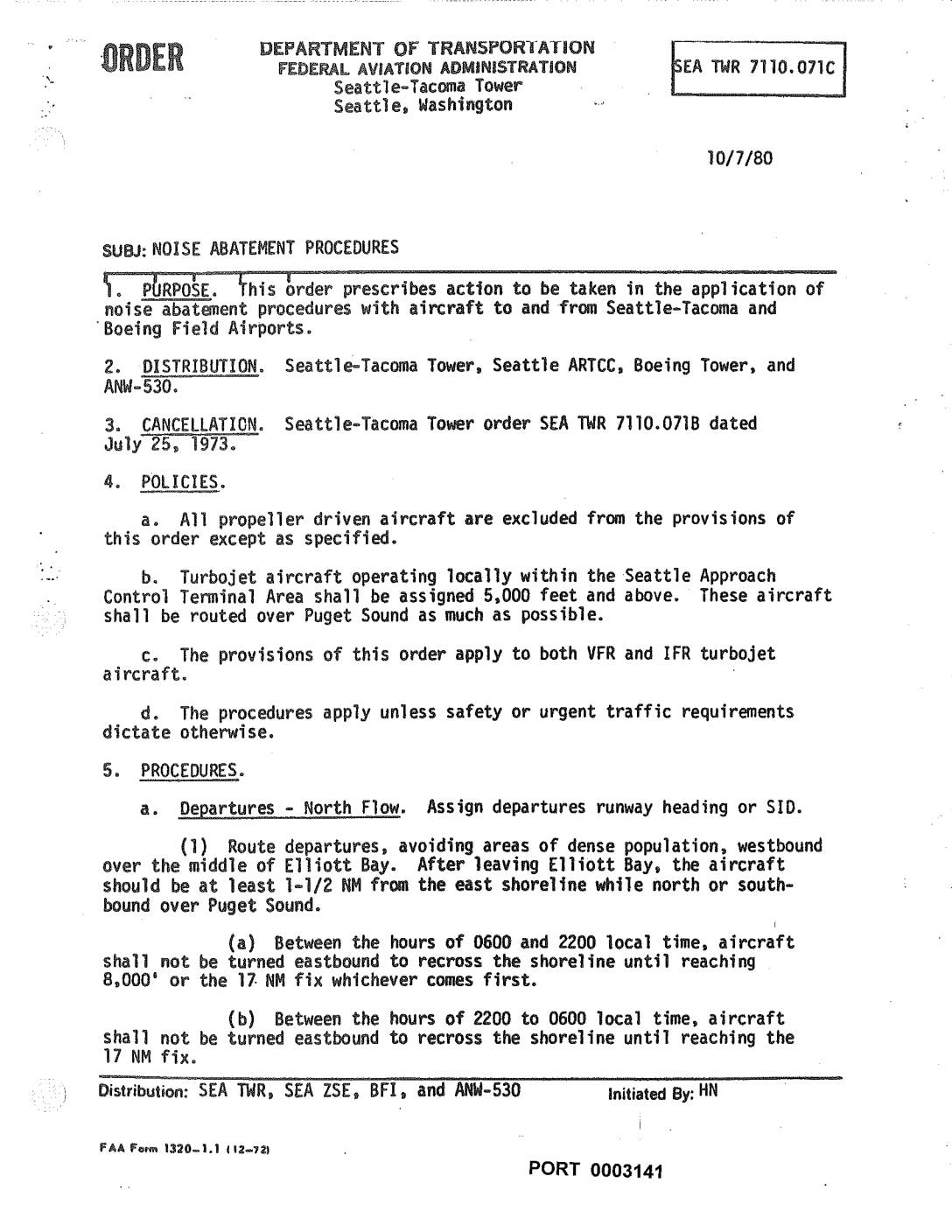 1980-10-07
SEA TWR 7110.071C: Noise Abatement Procedures, Seattle-Tacoma Tower
This 1980 Federal Aviation Administration order establishes noise abatement procedures for aircraft operating to and from Seattle-Tacoma International Airport and Boeing Field. It directs turbojet aircraft to fly over Puget Sound and Elliott Bay whenever possible, sets altitude and distance restrictions before aircraft can turn toward populated shoreline areas, and defines preferred takeoff and landing runways to minimize noise impact. The procedures apply to both VFR and IFR turbojet flights, with stricter nighttime rules between 2200 and 0600 local time. -
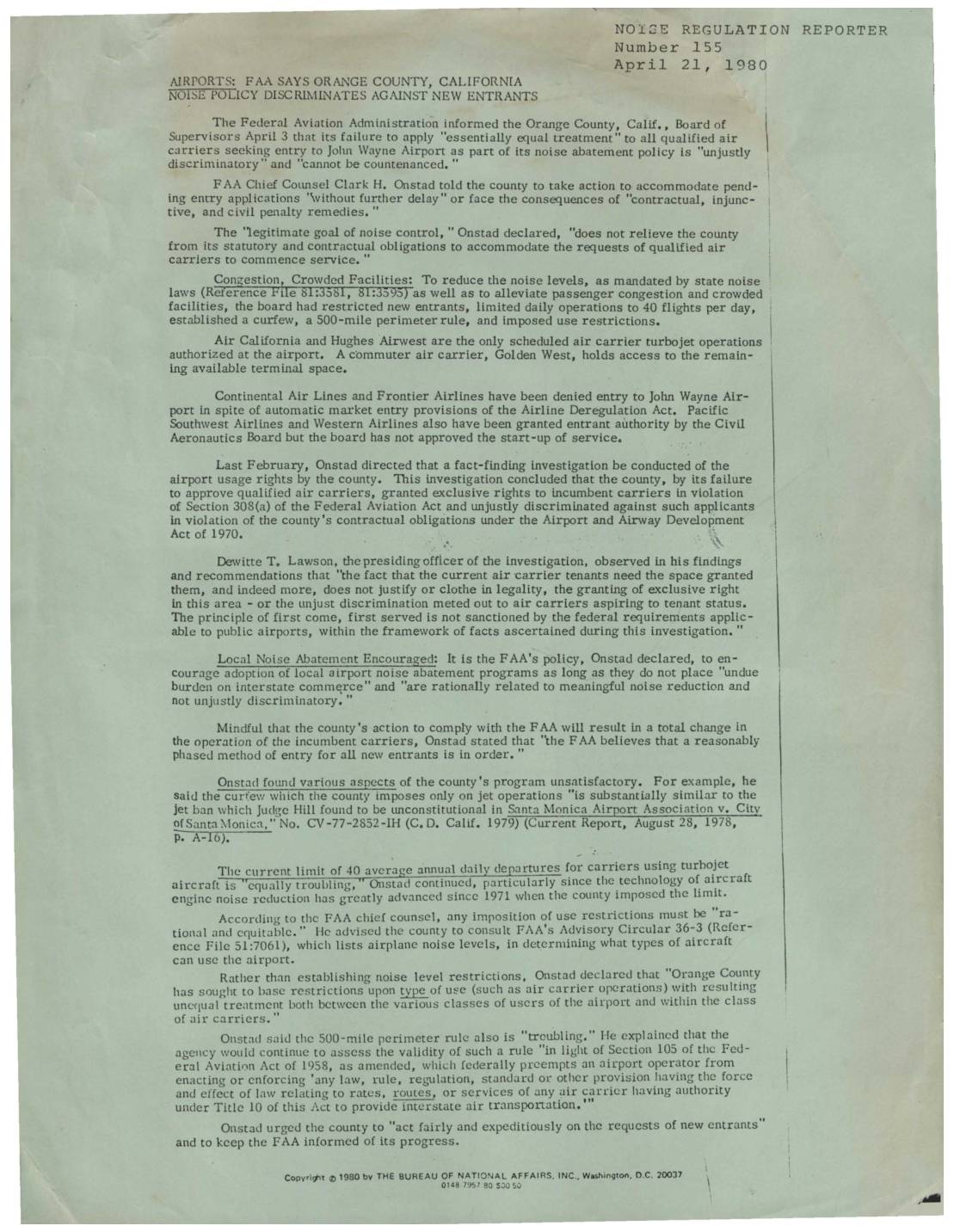 1980-04-21
FAA Says Orange County, California Noise Policy Discriminates Against New Entrants
In April 1980, the Federal Aviation Administration ruled that Orange County, California's noise abatement policy at John Wayne Airport was unlawfully discriminatory because it blocked new airlines from entering while protecting existing carriers. The FAA warned the county to accommodate pending entry applications from airlines like Continental and Frontier without further delay, or face legal and financial penalties. While the FAA supported local noise control efforts, it made clear that such policies must treat all qualified air carriers equally and not place undue burdens on interstate commerce. -
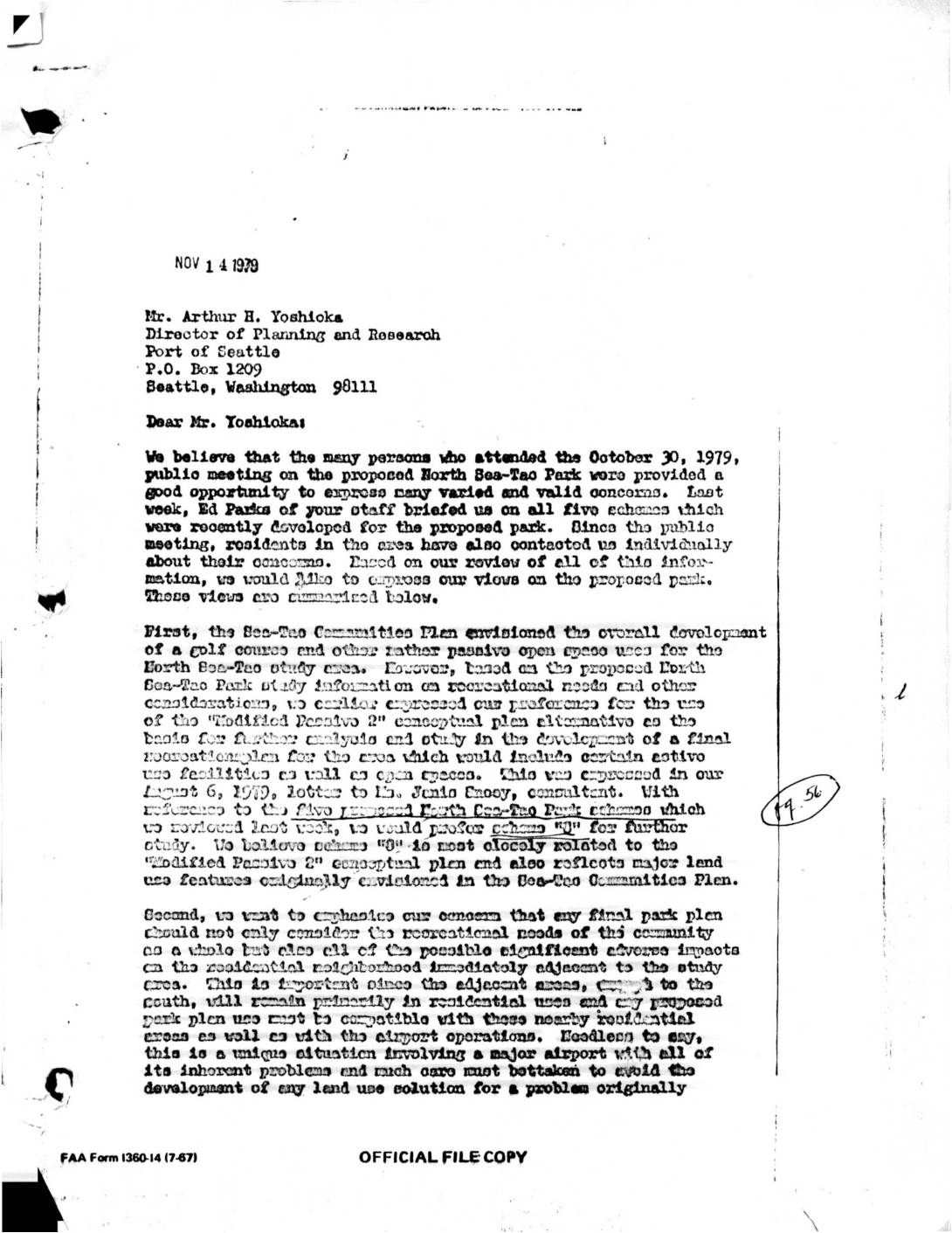 1979-11-14
Letter to Arthur H. Yoshioka re: North Sea-Tac Park planning
A November 1979 FAA letter to the Port of Seattle expresses support for a 'Modified Passive 2' conceptual plan for the proposed North Sea-Tac Park, while urging that any final park plan carefully weigh adverse impacts on adjacent residential neighborhoods and airport operations. The letter emphasizes that residents in the immediate study area should have meaningful input into the final park plan, and calls for close collaboration among the Port, King County, consultants, and citizens to minimize conflicts between park uses and the unique challenges posed by proximity to a major airport. -
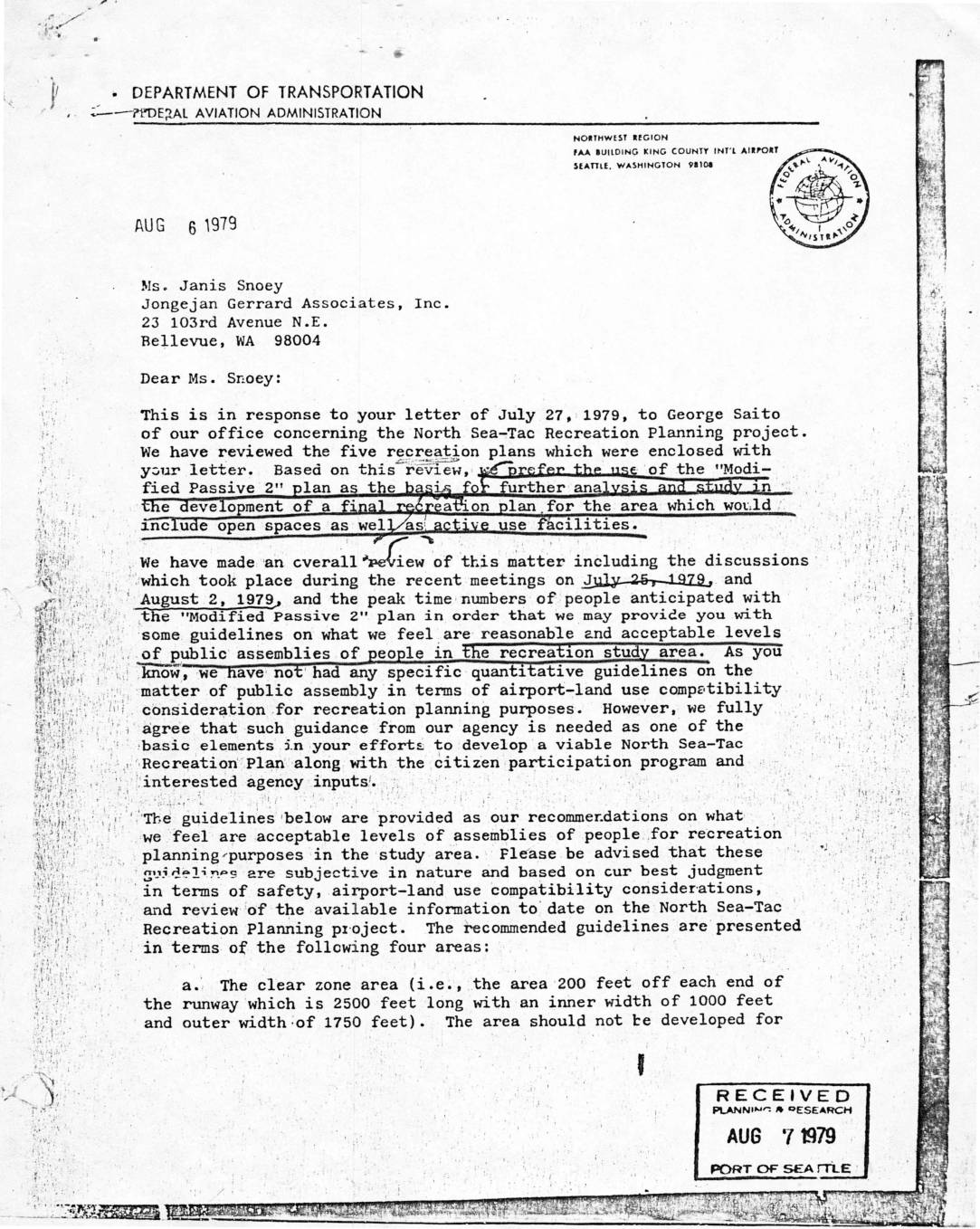 1979-08-06
FAA letter to Jongejan Gerrard Associates regarding North Sea-Tac Recreation Planning guidelines
In this August 6, 1979 letter from the FAA's Northwest Region to Jongejan Gerrard Associates, the agency provides guidelines on acceptable crowd density levels for recreation planning near Sea-Tac Airport. The FAA outlines four zones around the runway, each with specific limits on peak-time people per acre, ranging from no intensive use in the clear zone closest to the runway to no more than 40 people per acre in outlying areas. The letter also discourages any recreation development that could create bird hazards, incompatible lighting, or electronic interference with airport operations. -
 1979-08-02
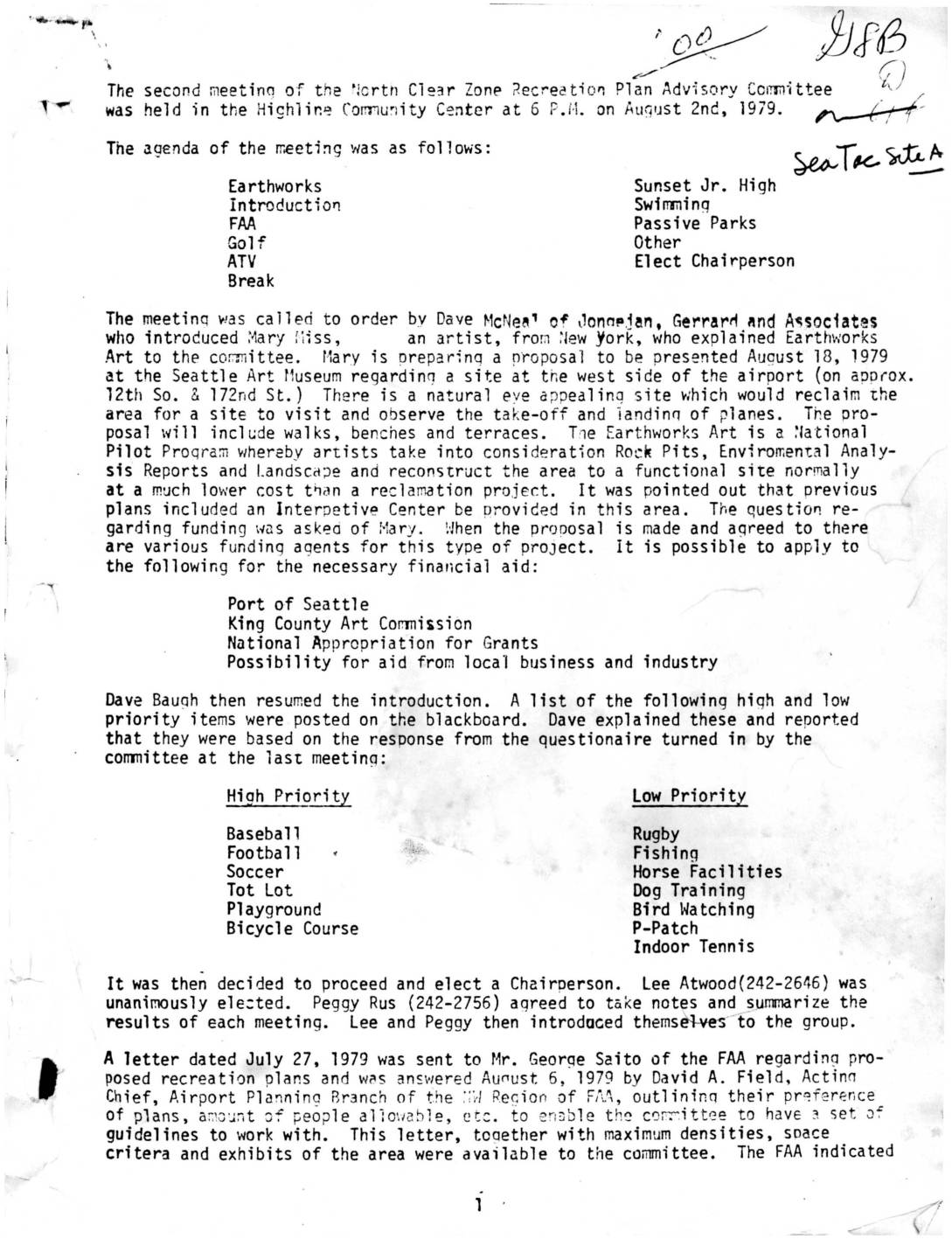
Minutes: North Clear Zone Recreation Plan Advisory Committee, Second Meeting – August 2, 1979
Minutes from the August 2, 1979 second meeting of the North Clear Zone Recreation Plan Advisory Committee, held at the Highline Community Center, covering proposed recreational uses for land near Sea-Tac Airport's north clear zone. Topics discussed included an Earthworks Art installation, FAA density guidelines (1.5 people per acre), a possible 9-hole golf course, ATV facilities, use of Sunset Jr. High School, and passive park development around Tub Lake and Lake Reba. Lee Atwood was elected Chairperson, and the committee agreed to reconvene with the consulting firm to develop workable recreation plan recommendations within FAA constraints. -
 1979-07-30
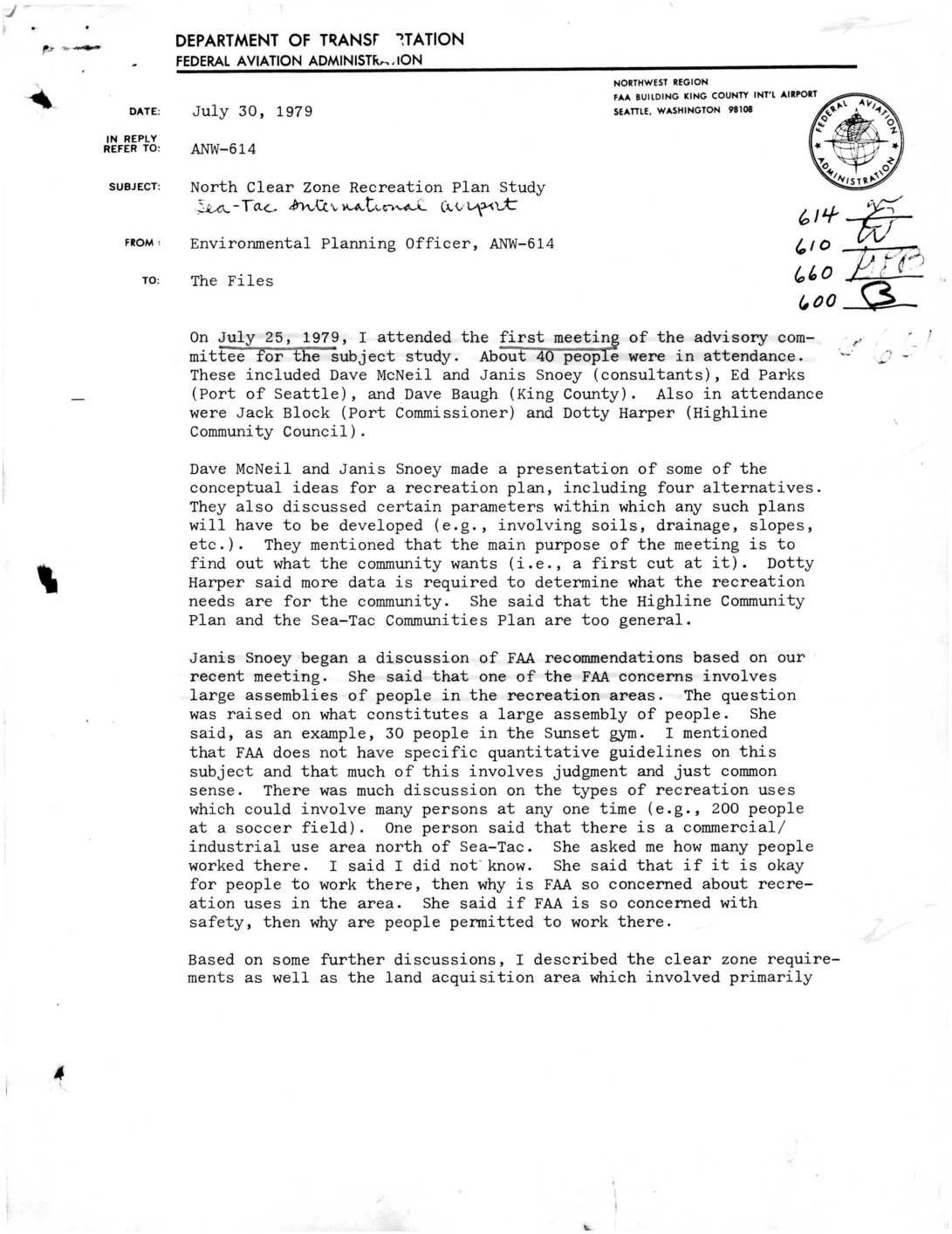
North Clear Zone Recreation Plan Study – Sea-Tac International Airport
A July 1979 FAA memo summarizes the first advisory committee meeting on a proposed recreation plan for the North Clear Zone near Sea-Tac International Airport. The meeting, attended by about 40 community members, consultants, and Port of Seattle representatives, centered on what types of recreational uses—such as soccer fields, golf courses, and bike trails—would be compatible with airport safety guidelines, with the FAA cautioning against intensive uses and large fixed spectator facilities in the clear zone. The group requested more specific, quantitative FAA guidelines on acceptable land use, and a follow-up meeting was scheduled for August 8, with the full study expected to take six months and potentially set precedents for recreational land use near major airports. -
 1979-07-27
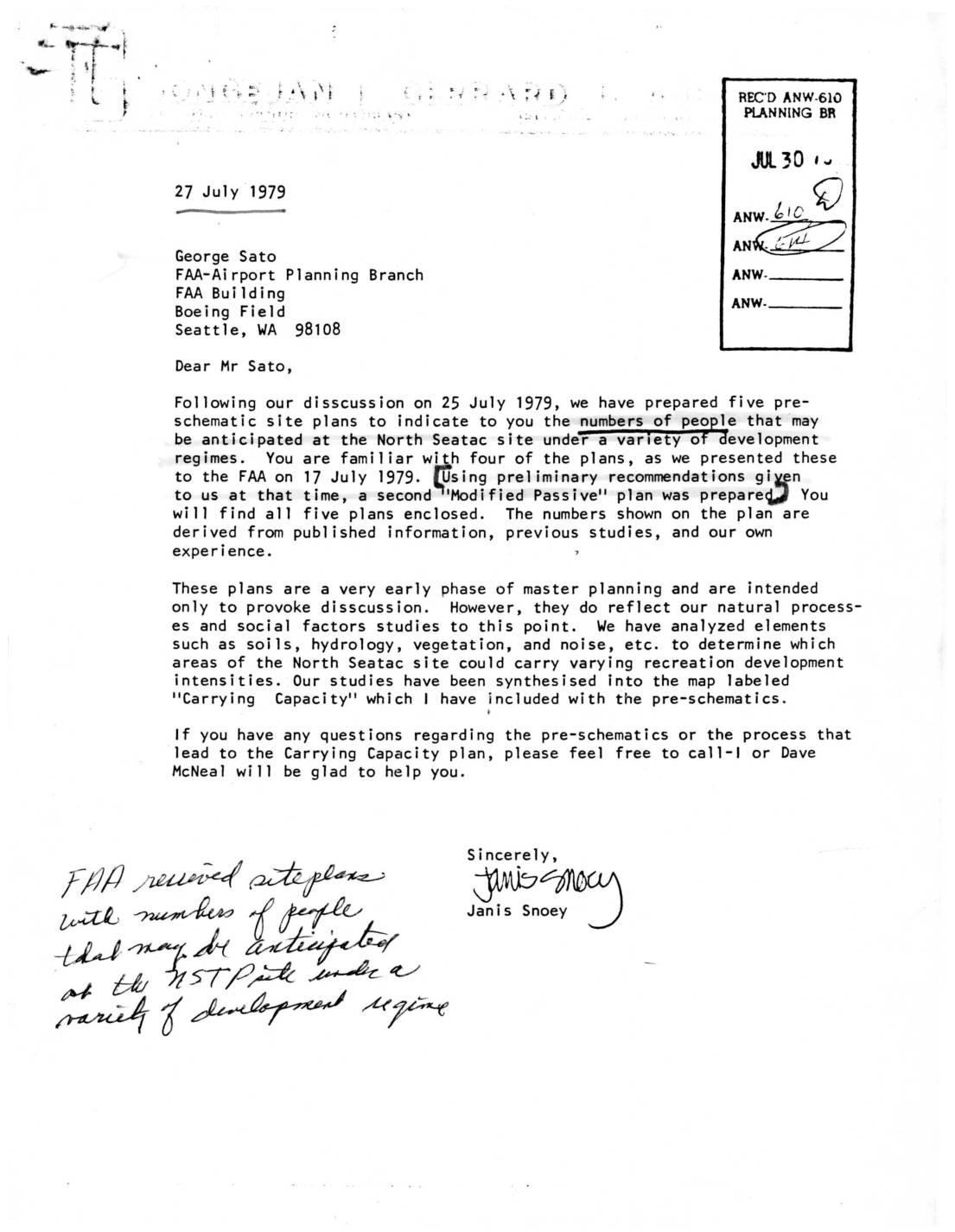
Letter to FAA North Sea-Tac site development plans and carrying capacity analysis
A July 1979 letter from planner Janis Snoey to FAA Airport Planning Branch representative George Sato transmits five pre-schematic site plans for the North Sea-Tac Park, showing projected peak-time visitor numbers under various development scenarios. The plans, prepared following an FAA meeting on July 17, 1979, are accompanied by a 'Carrying Capacity' map that classifies park areas by development suitability—from very high intensity (sports fields, motorcycle trails) to low intensity (foot paths only)—based on analysis of soils, hydrology, vegetation, and noise. The documents were intended solely to provoke discussion during the early master planning phase for the North Sea-Tac site. -
 1979-07-25
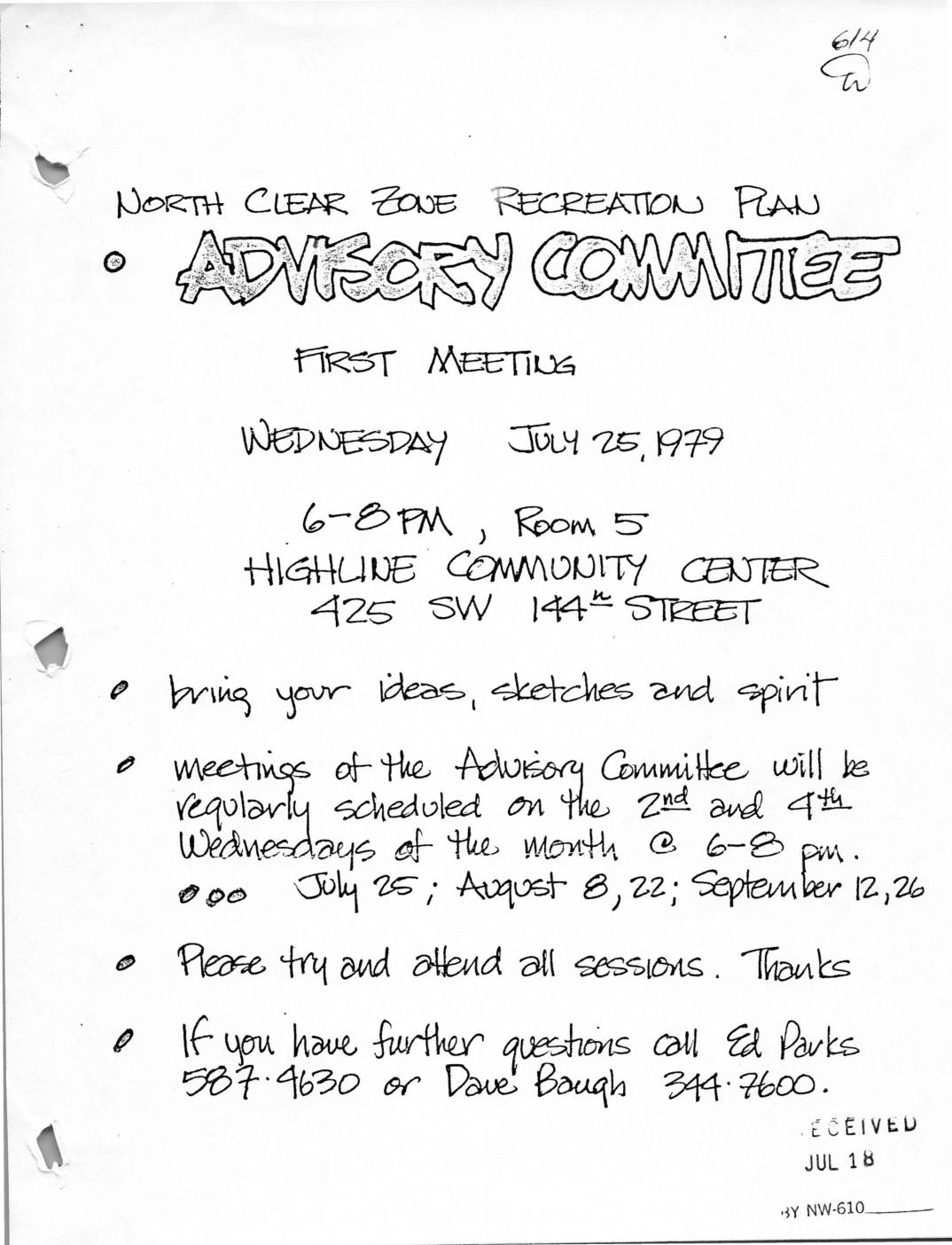
North Clear Zone Recreation Plan Advisory Committee: First Meeting Notice and Steering Committee Materials, July 25, 1979
This document contains materials from the first Steering Committee meeting for North Sea-Tac Park, held on July 25, 1979, as part of the North Clear Zone Recreation Plan advisory process. The committee, supported by consultants Jongejan/Gerrard/Associates, was tasked with gathering community input and developing a master plan for the park based on environmental analysis, public proposals, and FAA recommendations. Early public feedback showed a majority favoring an 18-hole golf course, while other suggestions included a greenbelt, passive park, and facilities for various age groups. -
 1978-08-28
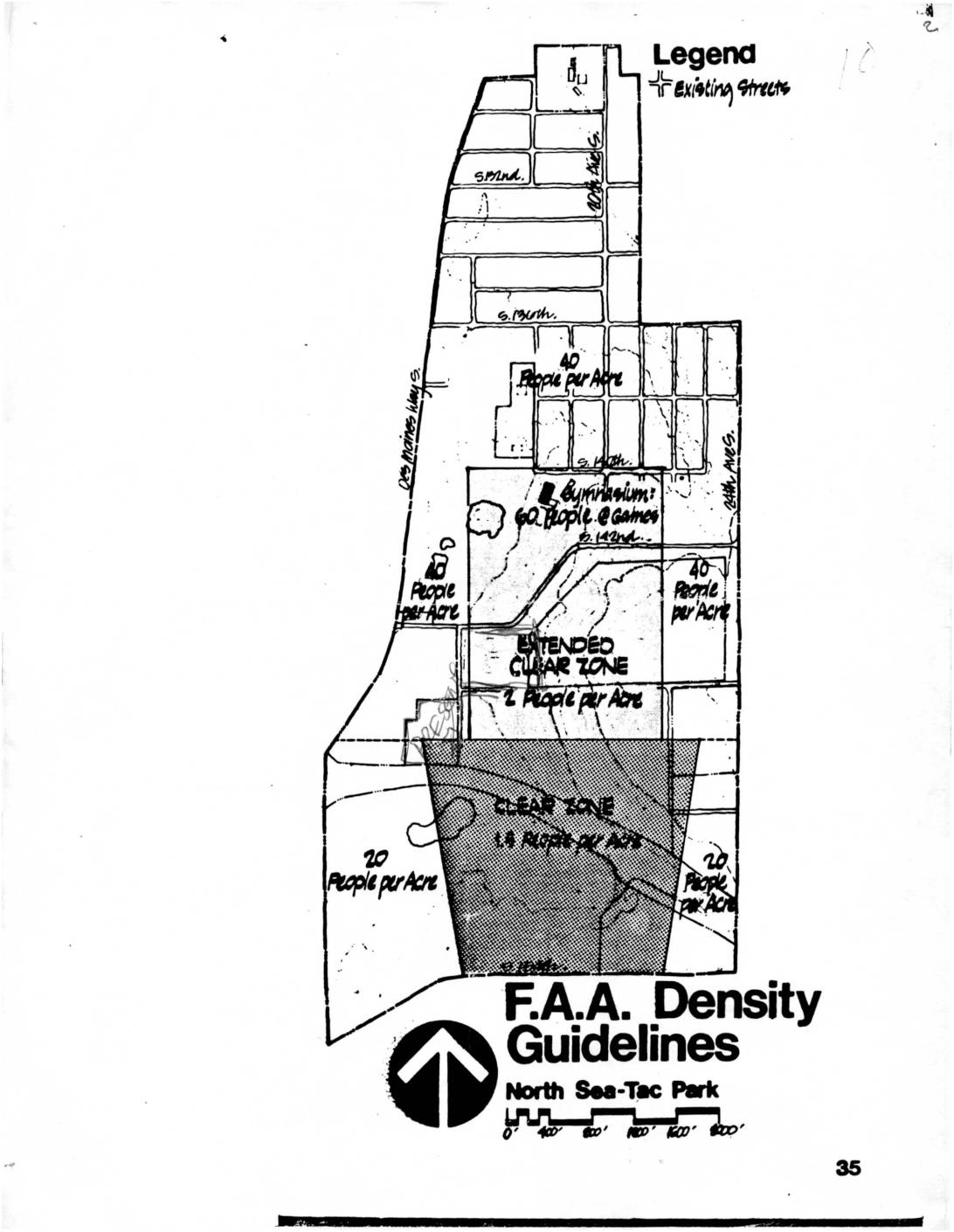
FAA Noise Density Guidelines North Sea-Tac Park
This document presents F.A.A. Density Guidelines for North Sea-Tac Park, a neighborhood near Seattle-Tacoma International Airport. It maps out population density limits across different zones, ranging from 1.5 people per acre in the Clear Zone closest to the airport, to 2 people per acre in the Extended Clear Zone, up to 20-40 people per acre in areas farther from the runway. The guidelines reflect FAA safety and noise policy restrictions that limit how many residents can live in areas most directly affected by airport flight paths. -
 1978-02-06
Background report on Concorde flight operations
This 1978 background report, prepared for the Washington State House of Representatives, examines the potential impact of allowing Concorde supersonic jet flights at Seattle-Tacoma International Airport (SeaTac). It finds that even one Concorde flight per day would expose an additional 1,000 residents to severe aircraft noise and could increase the Port of Seattle's property acquisition costs by $10–15 million. The report also explores the legal boundaries of airport noise regulations following a landmark court case that affirmed airport proprietors may set their own noise rules, provided those rules are reasonable, non-arbitrary, and non-discriminatory.