TagFAA(687)
-
 1983-11-09
Airport Noise Remedy Update – Henry M. Jackson International Airport
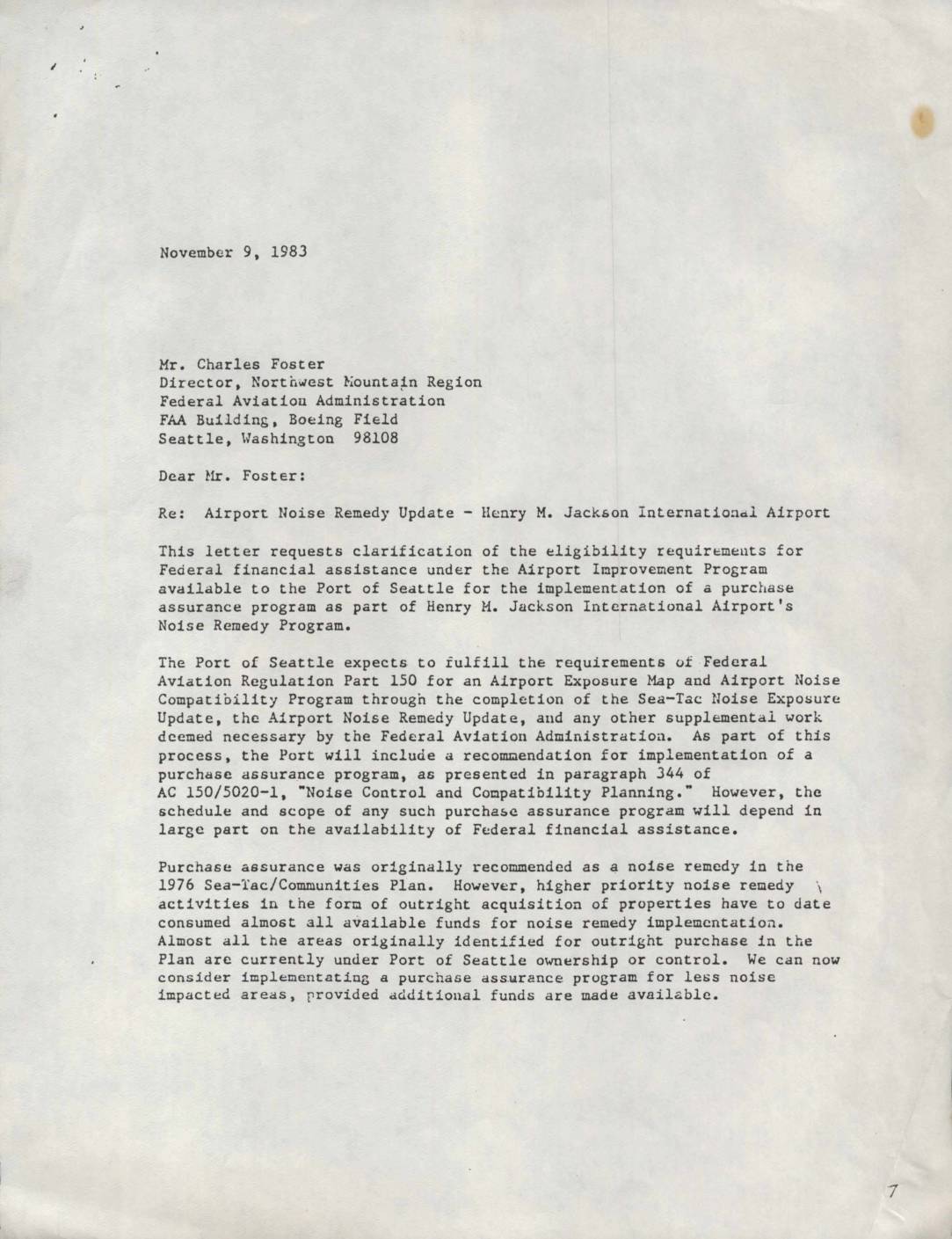
In a November 1983 letter to the FAA's Northwest Mountain Region Director, Port of Seattle Executive Director Richard D. Ford requested clarification on federal funding eligibility for a purchase assurance program under Henry M. Jackson International Airport's Noise Remedy Program. The Port sought guidance on several key issues, including the level of federal financial assistance available, which types of residential properties and program costs would qualify, and compliance requirements with federal relocation law. The letter noted that while outright property acquisitions had consumed most available noise remedy funds to date, the Port was now ready to consider a purchase assurance program for less noise-impacted areas if additional federal funding could be secured. -
 1983-09-23
Airport capacity and delay
This FAA Advisory Circular (AC 150/5060-5), issued September 23, 1983, provides procedures for computing airport capacity and aircraft delay for use in airport planning and design. It defines capacity as the maximum number of operations that can occur in an hour, and delay as the time difference between a constrained and unconstrained aircraft operation. The document updates and replaces earlier FAA capacity criteria circulars to reflect changes in the national aircraft fleet and improvements in air traffic control practices. -
 1983-08-05
Noise control and compatibility planning for airports
This 1983 FAA Advisory Circular (AC 150/5020-1) provides guidance for airports on noise control and land-use compatibility planning under FAR Part 150 and the Aviation Safety and Noise Abatement Act of 1979. It outlines a standardized system for measuring airport noise, identifying compatible and incompatible land uses near airports, and developing Noise Exposure Maps and Noise Compatibility Programs. Participation in the program is voluntary, and it aims to reduce existing noise conflicts around airports while preventing new incompatible development through cooperation among airport operators, planners, and community members. -
 1982-06-01
Regional Airport System Plan
The Regional Airport System Plan, published in June 1982 by the Puget Sound Council of Governments (PSCOG), provides policy guidance for aviation planning across the greater Puget Sound region, including the Seattle-Tacoma area. Prepared with funding from member jurisdictions, the Washington State Department of Transportation, the Federal Aviation Administration, and the Port of Seattle, the plan addresses regional airport system needs and aviation forecasts. It was developed under the oversight of PSCOG's Standing Committee on Transportation, which included representatives from King, Pierce, Snohomish, and Kitsap counties. -
 1982-02-11
Port Of Seattle Memorandum: Forecast of Aviation Demand for King County International Airport (Boeing Field) and Sea-Tac International Airport — Airspace Study
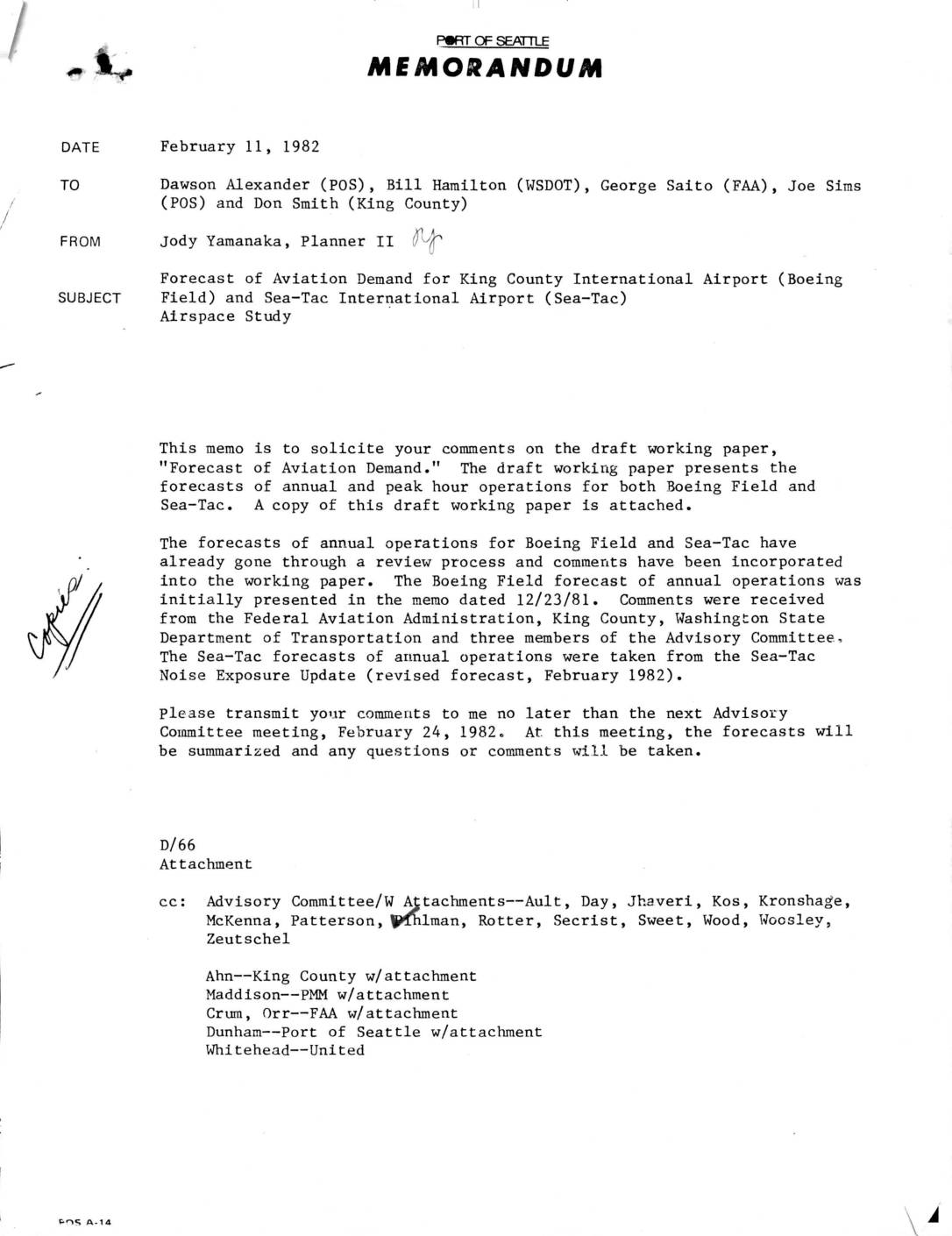
A 1982 Port of Seattle memorandum presents draft forecasts of aviation demand for Sea-Tac International Airport and Boeing Field, projecting aircraft operations through the year 2000. The forecasts cover annual take-offs and landings as well as peak-hour traffic under both visual and instrument flight conditions, with Sea-Tac's total annual operations expected to grow from roughly 214,000 in 1980 to over 261,000 by 2000. The document was circulated to FAA, King County, and Washington State DOT representatives for review as part of an airspace capacity and noise planning study. -
 1982-01-15
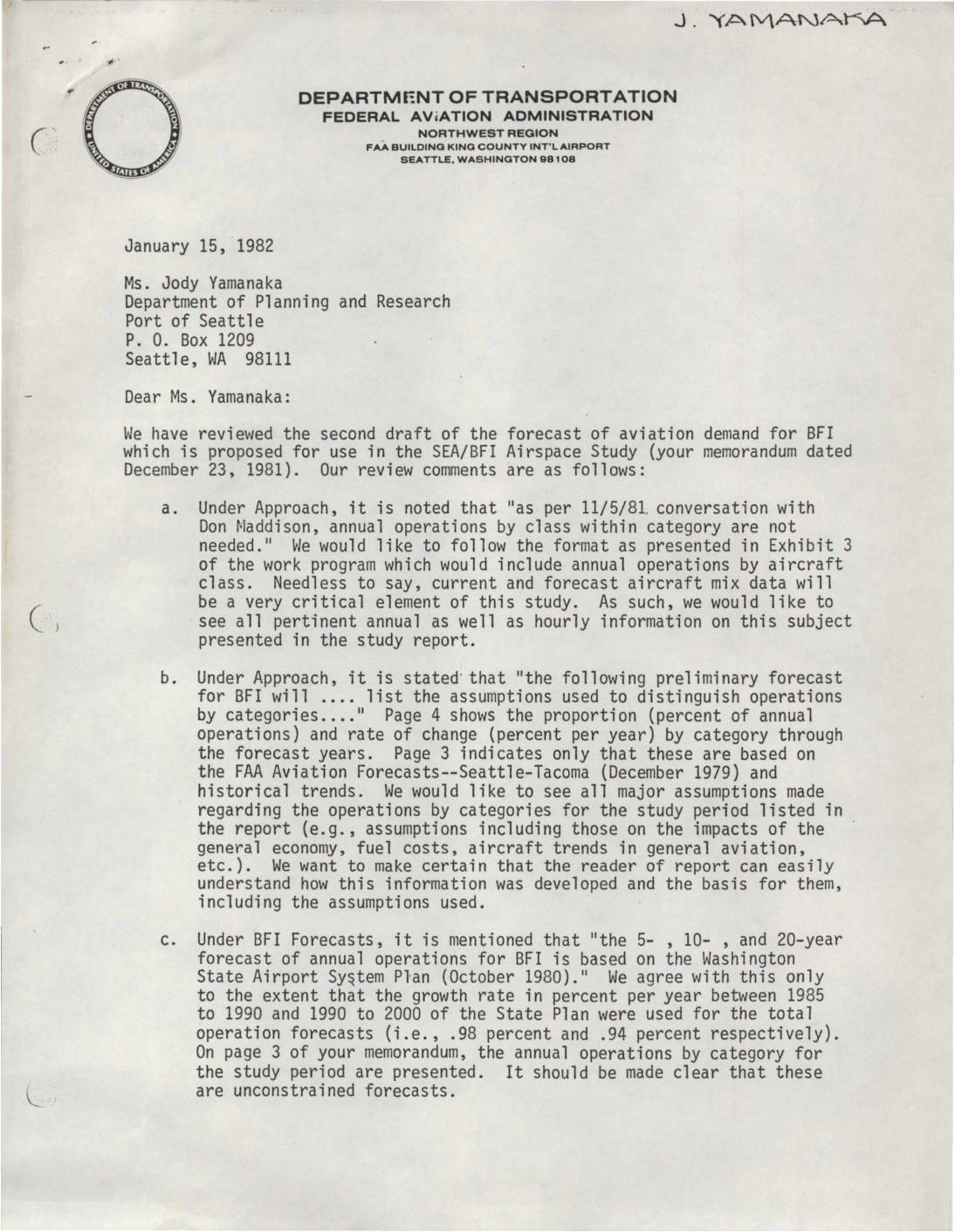
Letter from FAA to Jody Yamanaka, Port Of Seattle, Regarding BFI Aviation Demand Forecast Review
A January 1982 letter from the FAA's Northwest Region to the Port of Seattle reviews a draft aviation demand forecast for Boeing Field (BFI) prepared for the SEA/BFI Airspace Study. The FAA requests that the final report include more detailed aircraft mix data by class, a full list of assumptions behind the forecasts (such as economic conditions, fuel costs, and general aviation trends), and a clear indication that the projections are unconstrained. The agency also recommends presenting both high and low forecast ranges to account for uncertainty, particularly in long-range general aviation projections. -
 1981-12-17
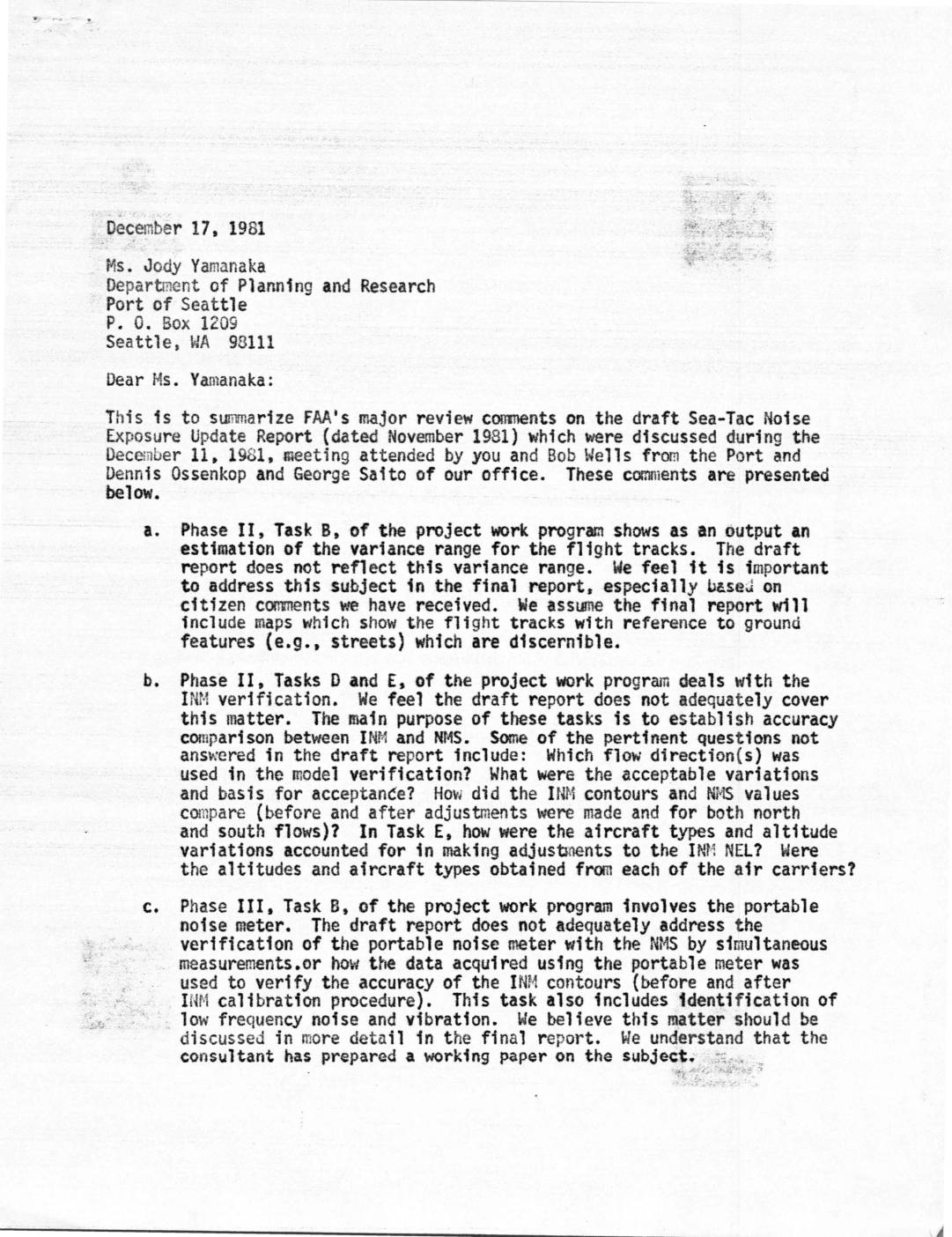
FAA Review Comments on Draft Sea-Tac Noise Exposure Update Report: Letter to Jody Yamanaka
A December 17, 1981 letter from FAA Acting Chief Mark A. Beisse to the Port of Seattle summarizes the FAA's major review comments on the draft Sea-Tac Noise Exposure Update Report. The letter identifies multiple deficiencies in the draft, including inadequate coverage of flight track variance ranges, INM model verification, portable noise meter data, and noise impact projections under different operational scenarios. The FAA requested that these issues be addressed in the final report and asked the Port to clarify whether certain project tasks, such as a population and land use survey, would be dropped from the study. -
 1981-11-27
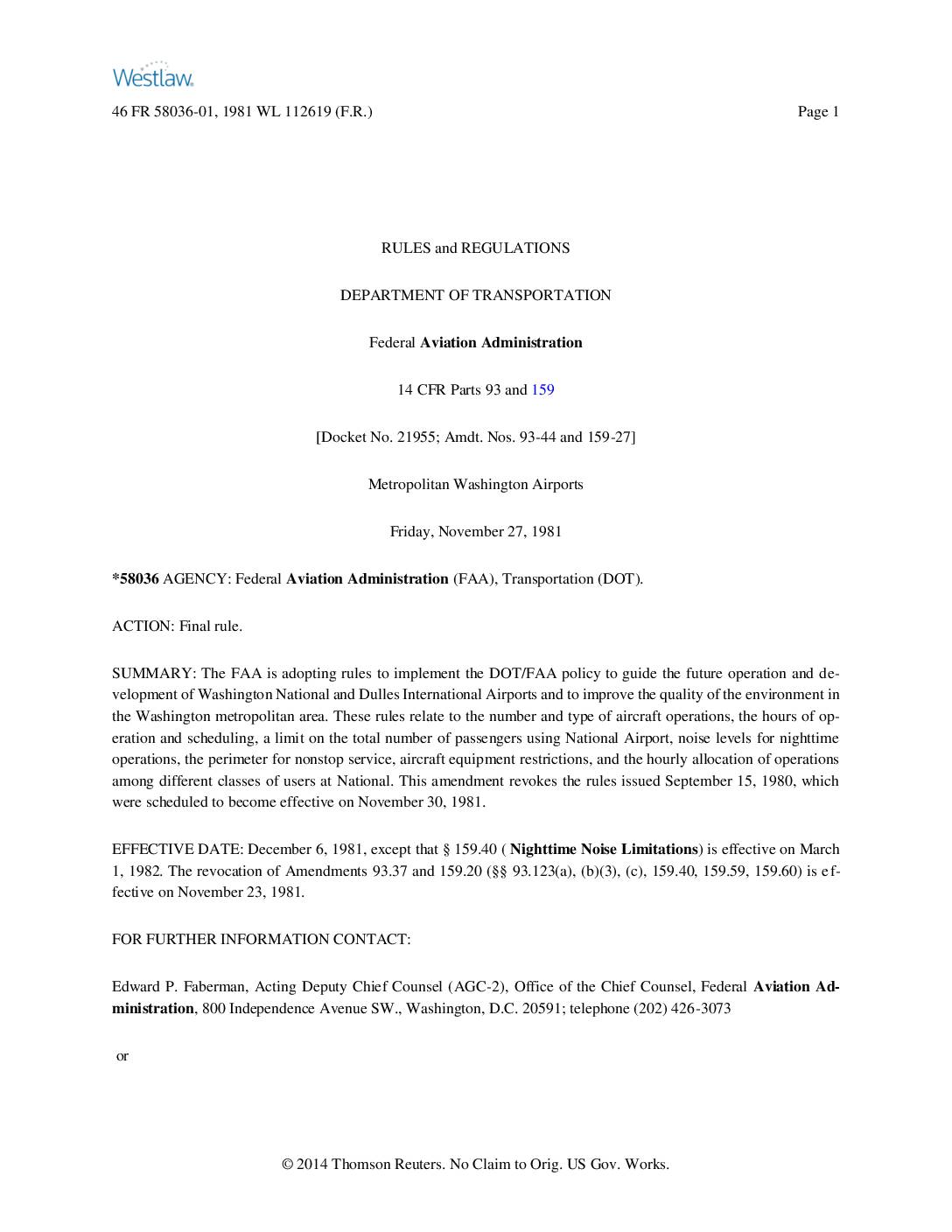
Metropolitan washington airports
Federal Aviation Administration final rule implementing DOT/FAA policy to guide the future operation and development of Washington National and Dulles International Airports. The rules address aircraft operations, scheduling, passenger limits, noise restrictions, and the perimeter for nonstop service at National Airport. -
 1981-10-01
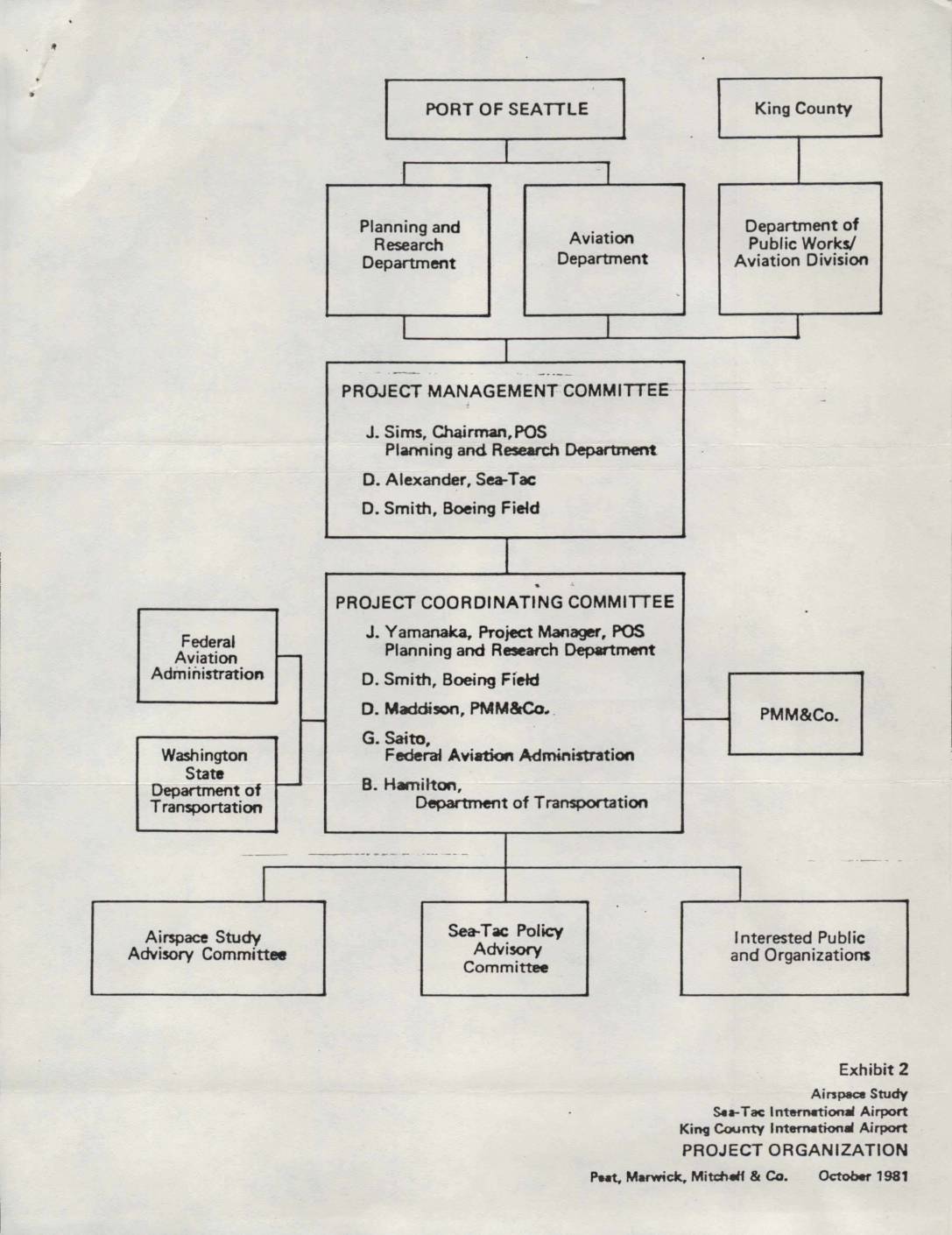
Exhibit 2: Airspace Study, Sea-Tac International Airport / King County International Airport — Project Organization
This 1981 organizational chart from Peat, Marwick, Mitchell & Co. outlines the project structure for an Airspace Study covering Sea-Tac International Airport and King County International Airport (Boeing Field). The study was jointly overseen by the Port of Seattle and King County, with a Project Management Committee chaired by J. Sims and a Project Coordinating Committee led by Project Manager J. Yamanaka, drawing participation from the Federal Aviation Administration and the Washington State Department of Transportation. Advisory input was provided by the Airspace Study Advisory Committee, the Sea-Tac Policy Advisory Committee, and interested members of the public and organizations. -
 1981-01-31
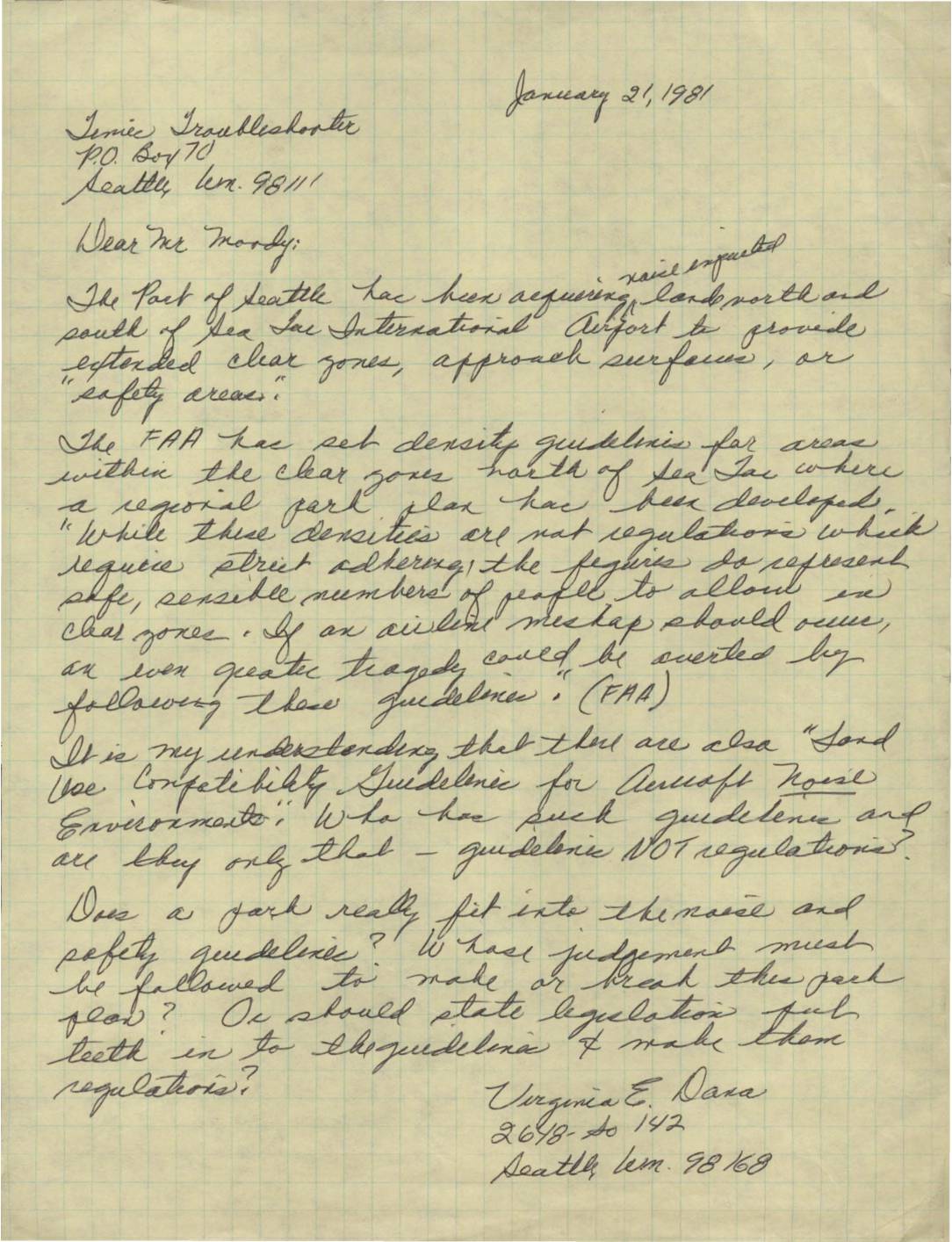
Letter to Times Troubleshooter regarding FAA guidelines
In this January 21, 1981 letter to Janice Troubleshooter of Seattle, resident Virginia E. Dana raises concerns about the Port of Seattle's land acquisition near Sea-Tac International Airport for clear zones and safety areas. She questions whether FAA density guidelines and land use compatibility guidelines for aircraft noise environments are enforceable regulations or merely voluntary guidelines, and whether a proposed regional park plan is appropriate for these safety-sensitive zones. Dana calls for state legislation to give these guidelines regulatory teeth.