TagFAA(687)
-
FAA ‘The Sea-Tac Success Story’ 09/1977
A draft cover page for a report titled 'Planning for the Airport and Its Environs: The Sea-Tac Success Story,' prepared for the Federal Aviation Administration Office of Environmental Quality in Washington, D.C. The report was prepared by Peat, Marwick, Mitchell & Co. of San Mateo, California, and dated September 1977. -
 1977-09-01
Planning for the airport and its environs: The Sea-Tac success story
In the absence of such guidance, what may be termed a "let them sue" approach was essentially followed by the Port during the period from 1957 to 1972. -
 1975-06-09
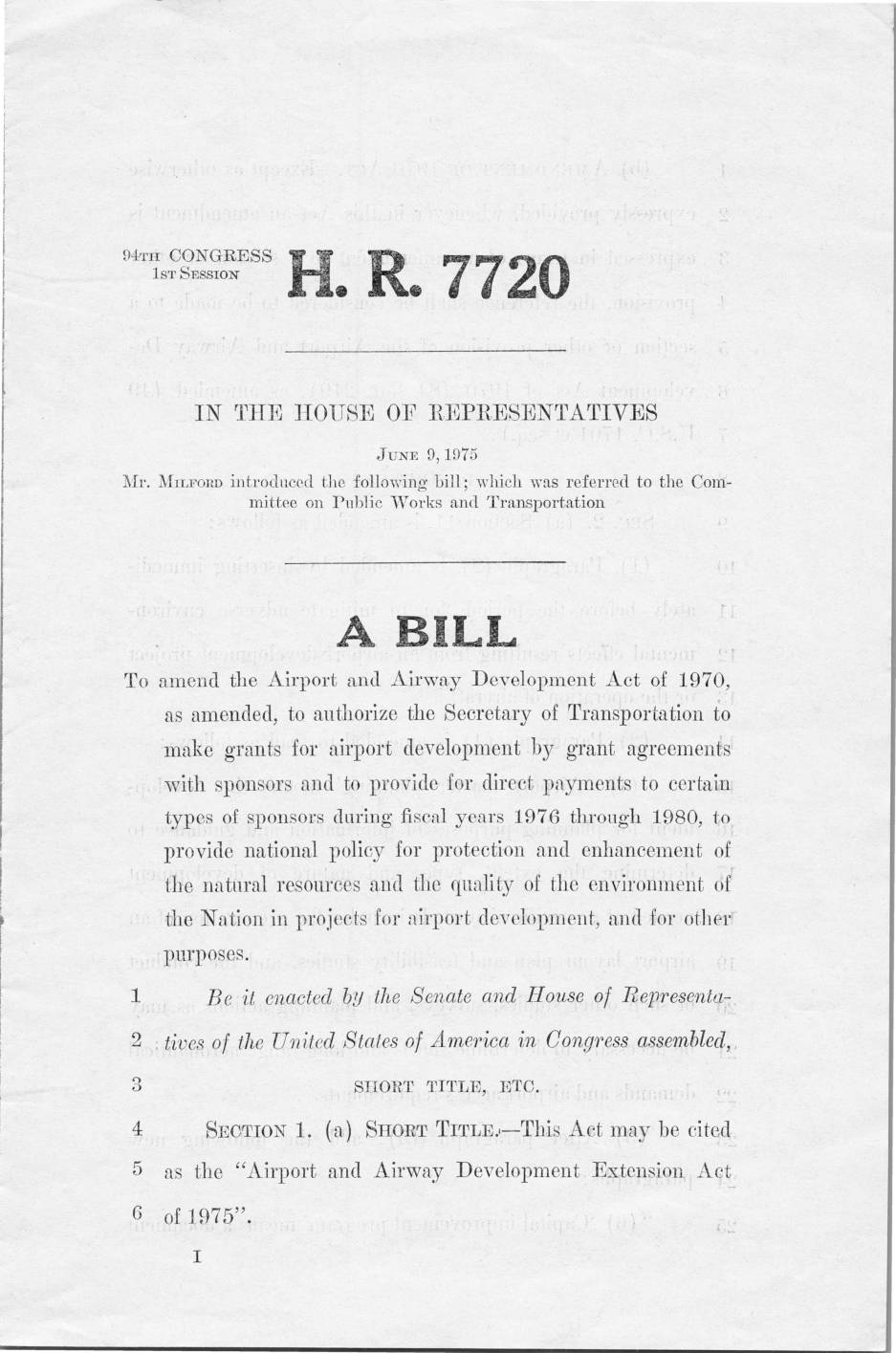
H.R. 7720: Airport and Airway Development Extension Act of 1975
H.R. 7720, the Airport and Airway Development Extension Act of 1975, was introduced in the House of Representatives on June 9, 1975, to amend the Airport and Airway Development Act of 1970. The bill sought to authorize the Secretary of Transportation to make grants for airport development and provide direct payments to certain sponsors during fiscal years 1976 through 1980. It also established national policy for protecting and enhancing natural resources and environmental quality in airport development projects, including measures to mitigate adverse environmental effects from airport operations and aircraft. -
 1974-07-01
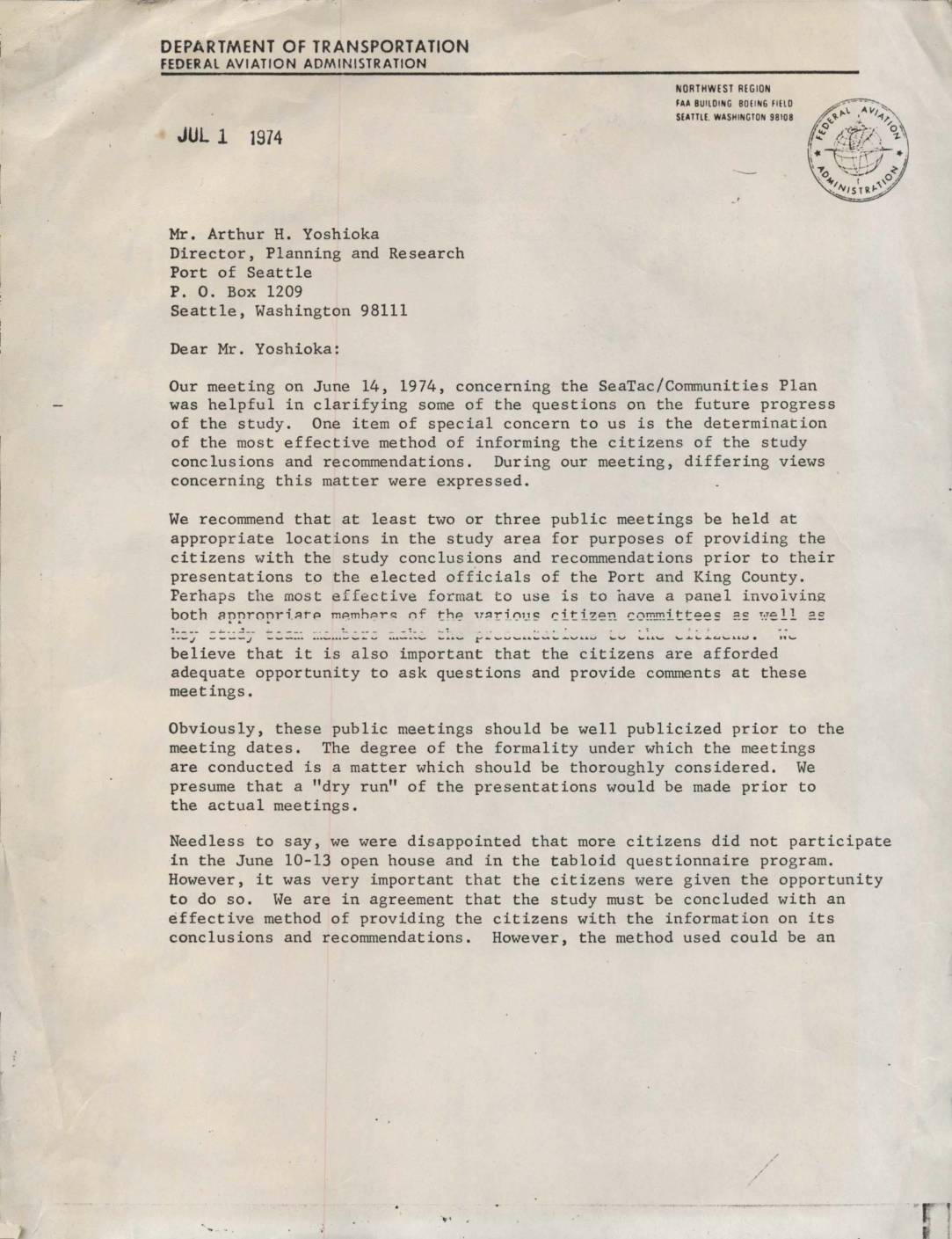
Letter to Arthur H. Yoshioka regarding SeaTac/Communities Plan public meetings
In this July 1974 letter, George L. Buley of the FAA's Airports Planning Branch writes to Arthur H. Yoshioka of the Port of Seattle regarding the SeaTac/Communities Plan study. Buley recommends holding two or three public meetings in the study area to present the study's conclusions and recommendations to citizens before they are brought before elected officials of the Port and King County. He emphasizes the importance of well-publicized meetings that allow citizens adequate opportunity to ask questions, and urges that the topic be discussed at the upcoming July PAC and TAC meetings. -
 1974-04-03
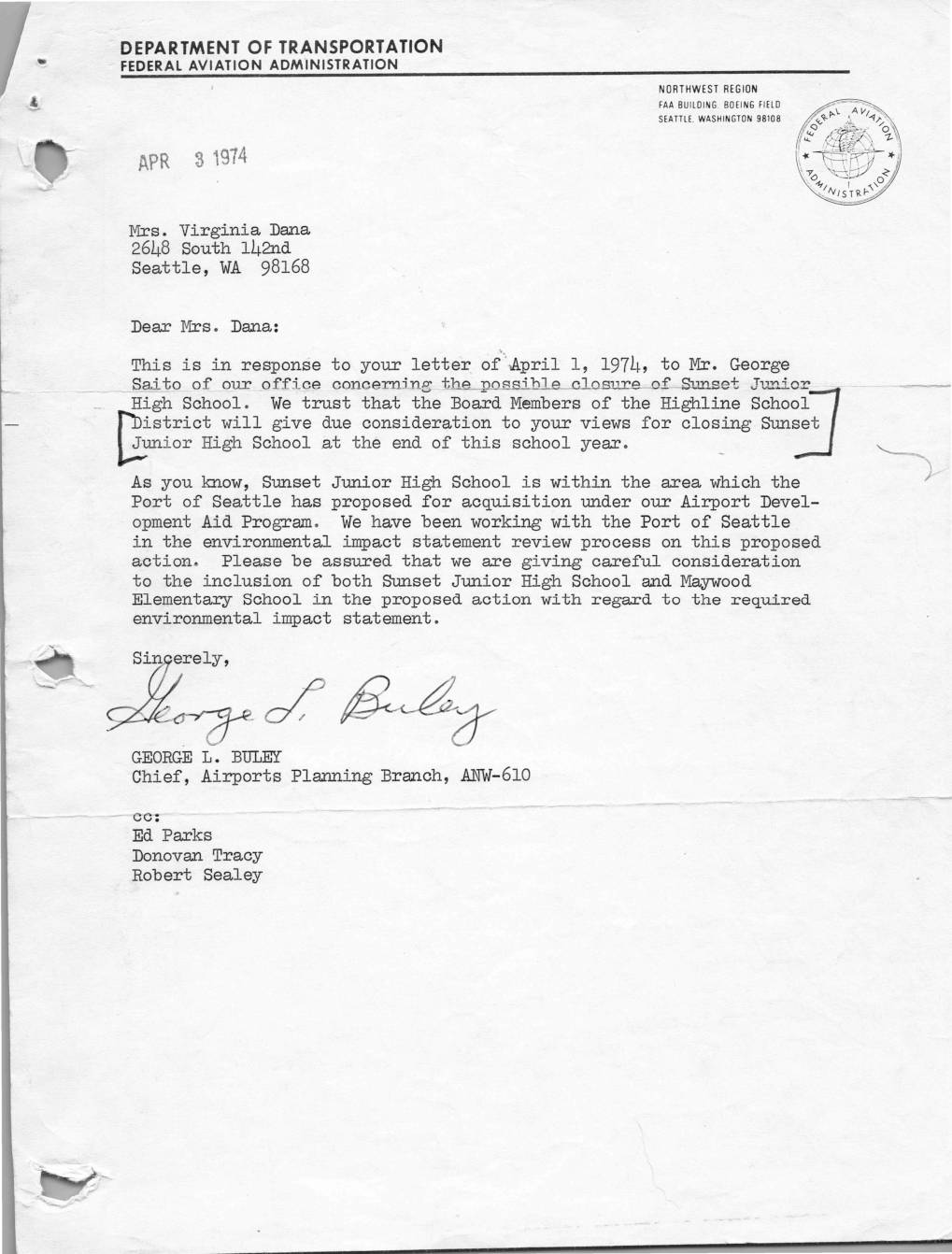
FAA Response Letter to Virginia Dana Regarding Sunset Junior High School Closure
A April 3, 1974 letter from FAA Northwest Region Chief of Airports Planning George L. Buley responds to Seattle resident Mrs. Virginia Dana regarding the possible closure of Sunset Junior High School. The letter acknowledges that the school falls within an area the Port of Seattle proposed to acquire under the FAA's Airport Development Aid Program, and confirms the FAA was actively working with the Port on an environmental impact statement covering the proposed acquisition. Both Sunset Junior High School and Maywood Elementary School were being considered in that environmental review process. -
 1974-03-25
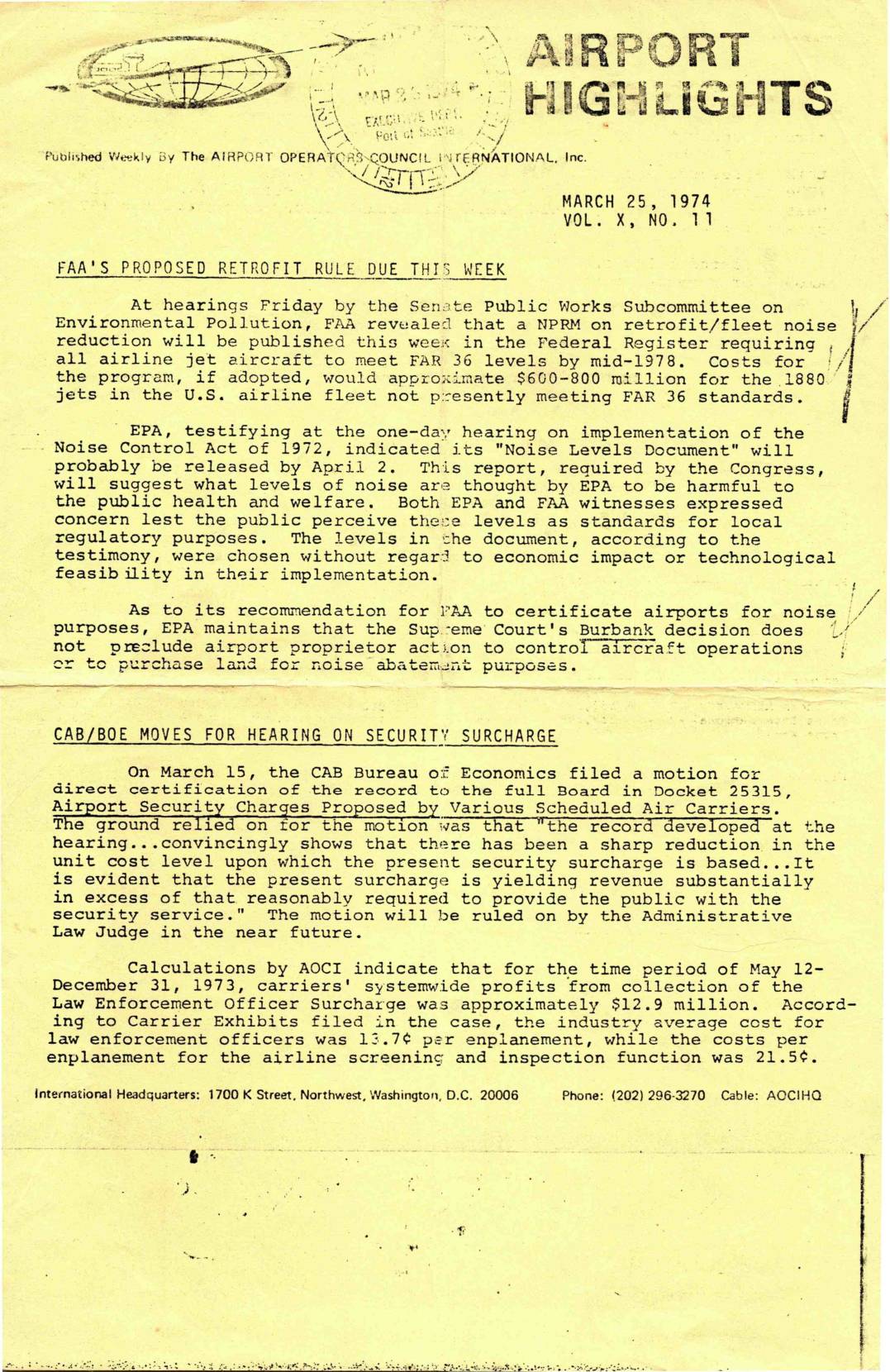
Airport Highlights: FAA’s proposed retrofit rule and CAB/BOE security surcharge hearing, March 25, 1974
A March 25, 1974 edition of Airport Highlights reports that the FAA was set to publish a proposed rule requiring all U.S. airline jet aircraft to meet FAR 36 noise standards by mid-1978, at an estimated cost of $600–800 million for the roughly 1,880 non-compliant jets in the fleet. The EPA was also preparing to release its 'Noise Levels Document' by April 2, outlining noise levels considered harmful to public health, though officials cautioned it should not be treated as a local regulatory standard. Additionally, the CAB Bureau of Economics moved for a full Board hearing on airport security surcharges, citing evidence that carriers were collecting revenue far exceeding their actual security costs. -
 1974-01-30
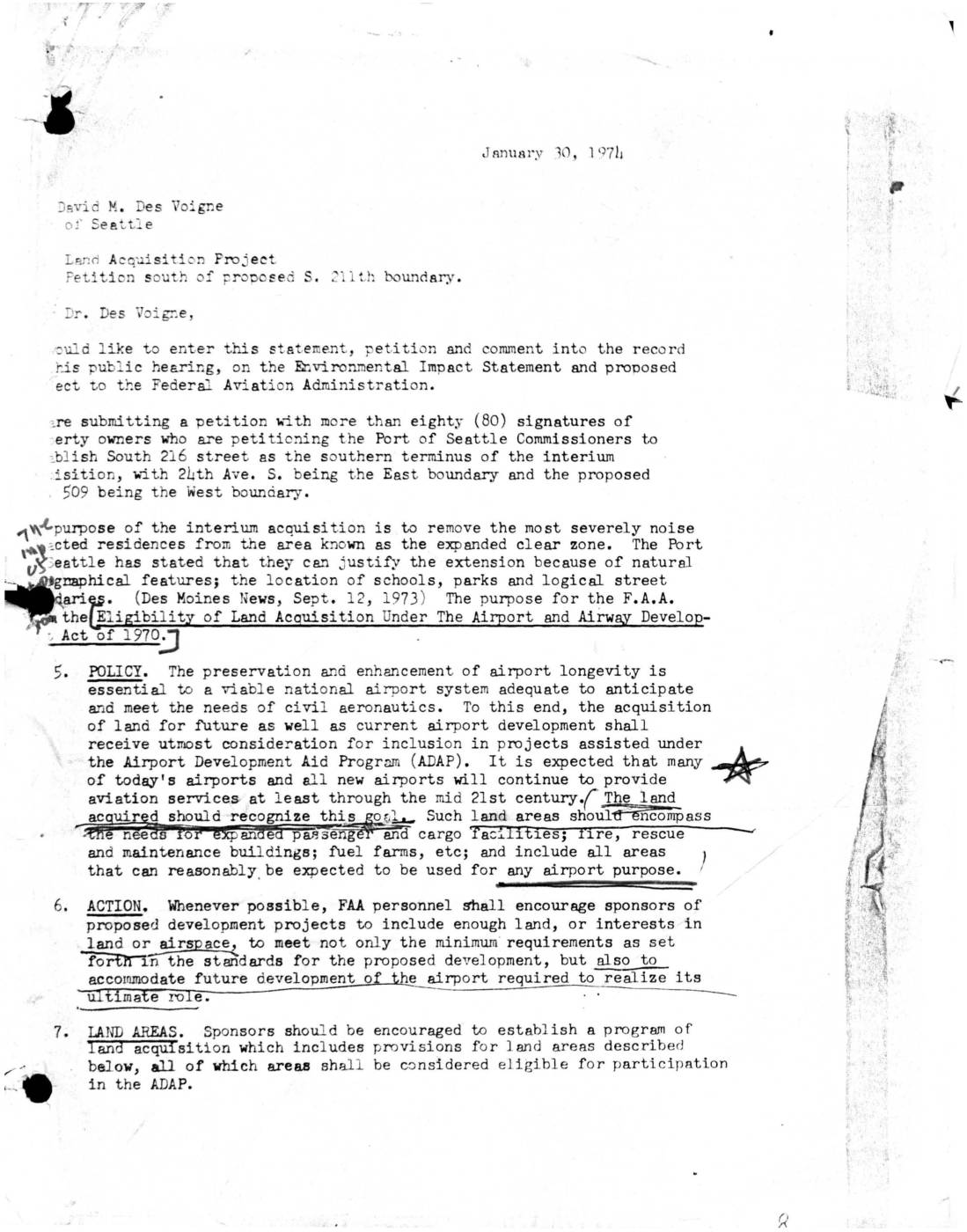
Letter to Port Of Seattle: Petition to Establish South 216th Street as Southern Terminus of Interim Land Acquisition
A January 30, 1974 letter submitted to David M. Des Voigne of the Port of Seattle presents a petition signed by more than 80 property owners requesting that South 216th Street be established as the southern boundary of an interim land acquisition project near Sea-Tac Airport, bounded by 24th Ave. S. to the east and proposed Highway 509 to the west. The petitioners sought to remove the most severely noise-impacted residences from the expanded clear zone. The letter also cites FAA policy under the Airport and Airway Development Act of 1970, which encourages land acquisition to accommodate both current and long-term airport development needs. -
 1973-09-07
Report and recommendations re interim land acquisition, Sea-Tac International Airport
In September 1973, the Port of Seattle outlined a plan to acquire approximately 610 residential properties and 75 acres of open land surrounding Sea-Tac International Airport to create expanded clear zones north and south of the runways. The total estimated property cost was $15.46 million, with the Port anticipating over $8 million in federal FAA assistance and covering the remainder from airport revenues between 1974 and 1977. Under the best-case scenario, actual land acquisition could not begin until after July 1, 1974, following required environmental impact statements, housing relocation plans, and a multi-month FAA review process. -
 1973-09-07
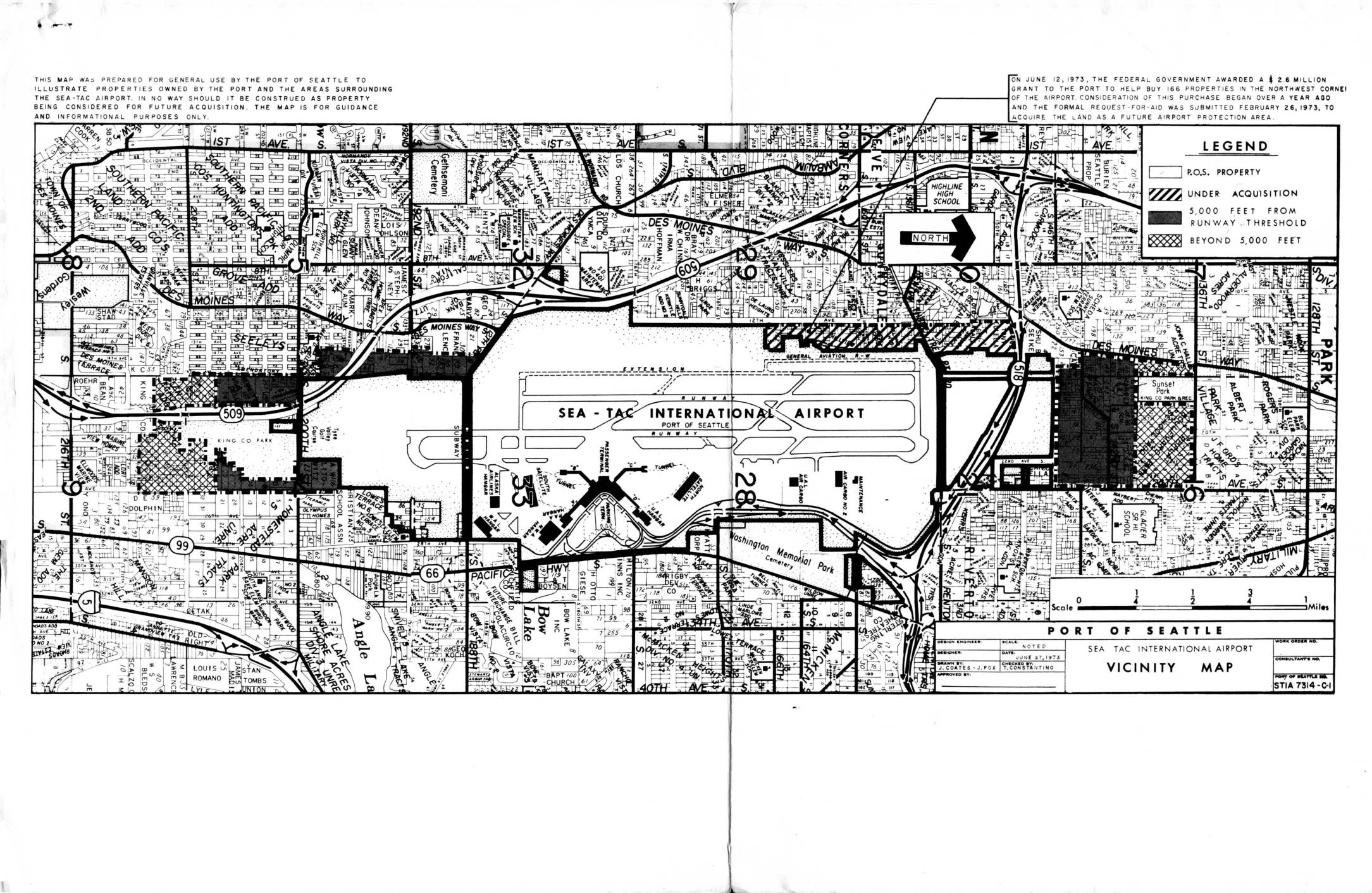
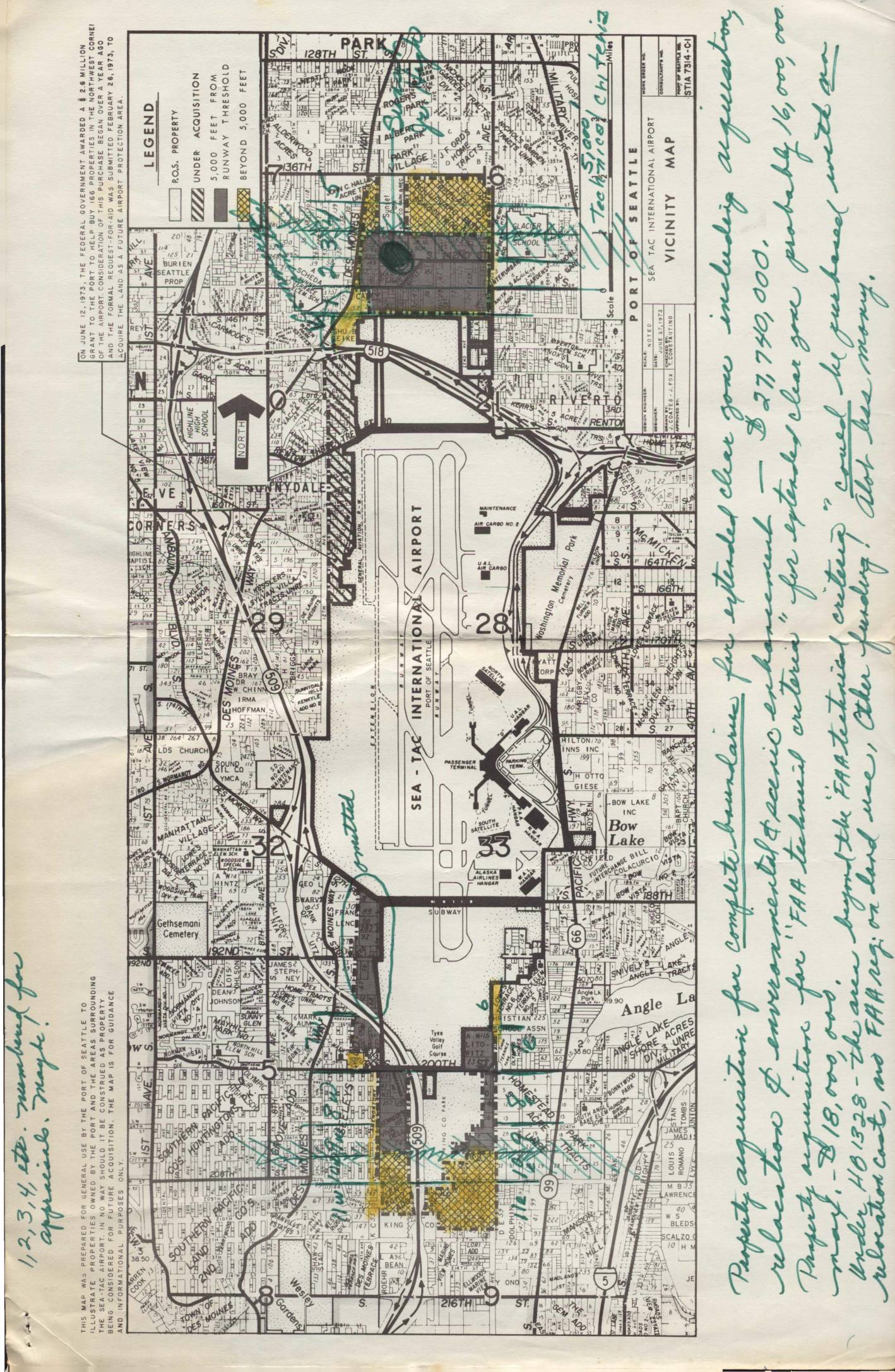
Land use map, heavily notated with property acquisition notes by Virginia Dana
In September 1973, the Port of Seattle's Director of Aviation recommended an interim land acquisition program around Sea-Tac International Airport, targeting approximately 610 residential parcels and 75 acres of open land in clear zones north and south of the runways. The estimated cost of the acquisitions was $15.46 million, with the FAA expected to contribute over $8 million and the Port of Seattle covering the remaining $8 million from airport revenues between 1974 and 1977. Under the best-case timeline, actual land purchases could not begin until after July 1, 1974, following completion of environmental impact statements, housing relocation plans, and FAA review. -
 1973-09-07
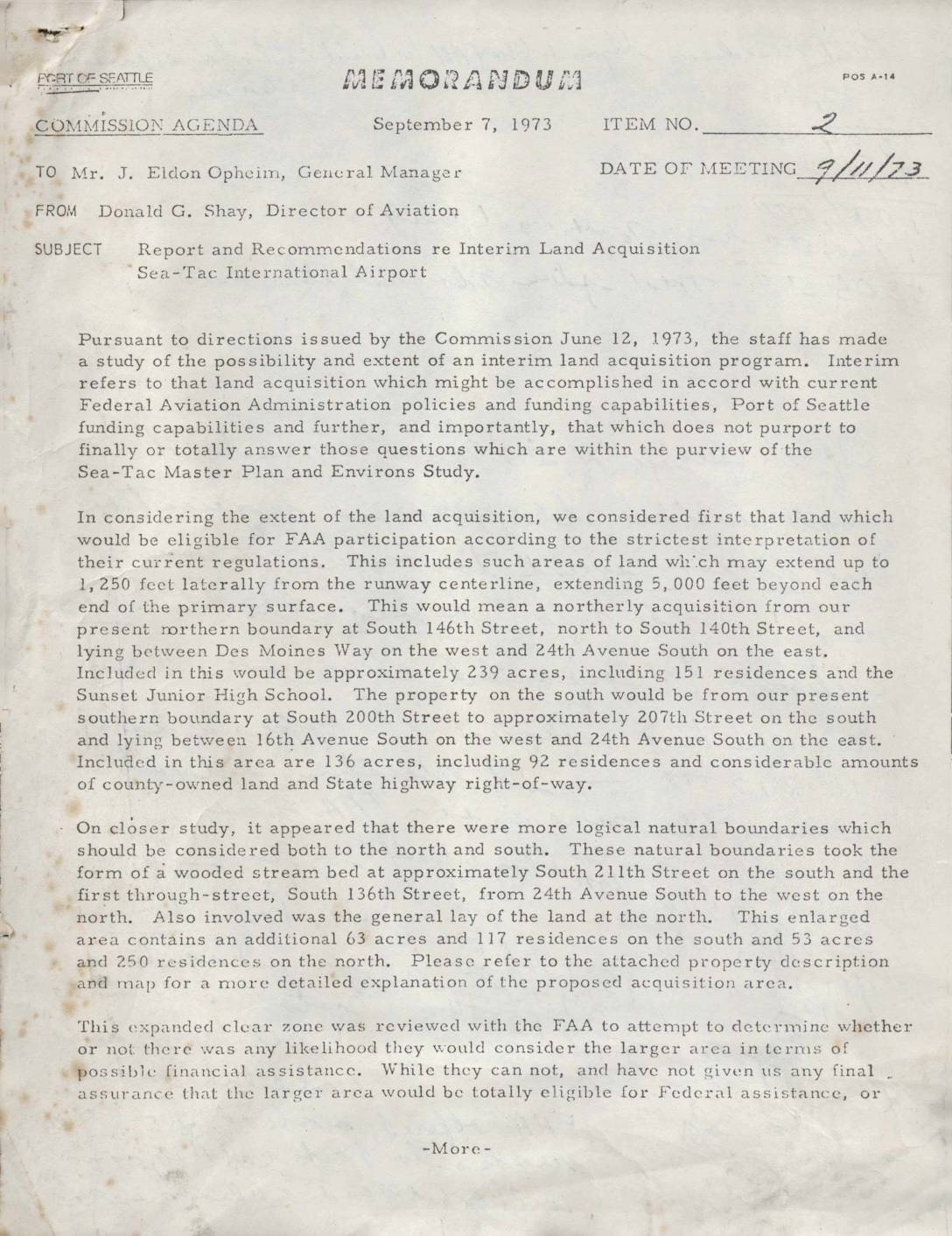
Report and recommendations re interim land acquisition, Sea-Tac International Airport
A 1973 Port of Seattle memorandum outlines a proposed interim land acquisition program around Sea-Tac International Airport, targeting properties to the north and south of the airport's existing boundaries to establish expanded clear zones. The plan covers approximately 610 residential parcels and 75 acres of open land valued at an estimated $15.46 million, with the Port seeking over $8 million in Federal Aviation Administration funding to offset costs. Land acquisition was projected to begin no earlier than July 1, 1974, following required environmental impact statements, housing relocation plans, and FAA review and approval.