TagEnvironmental Justice(100)
-
 2021-04-20
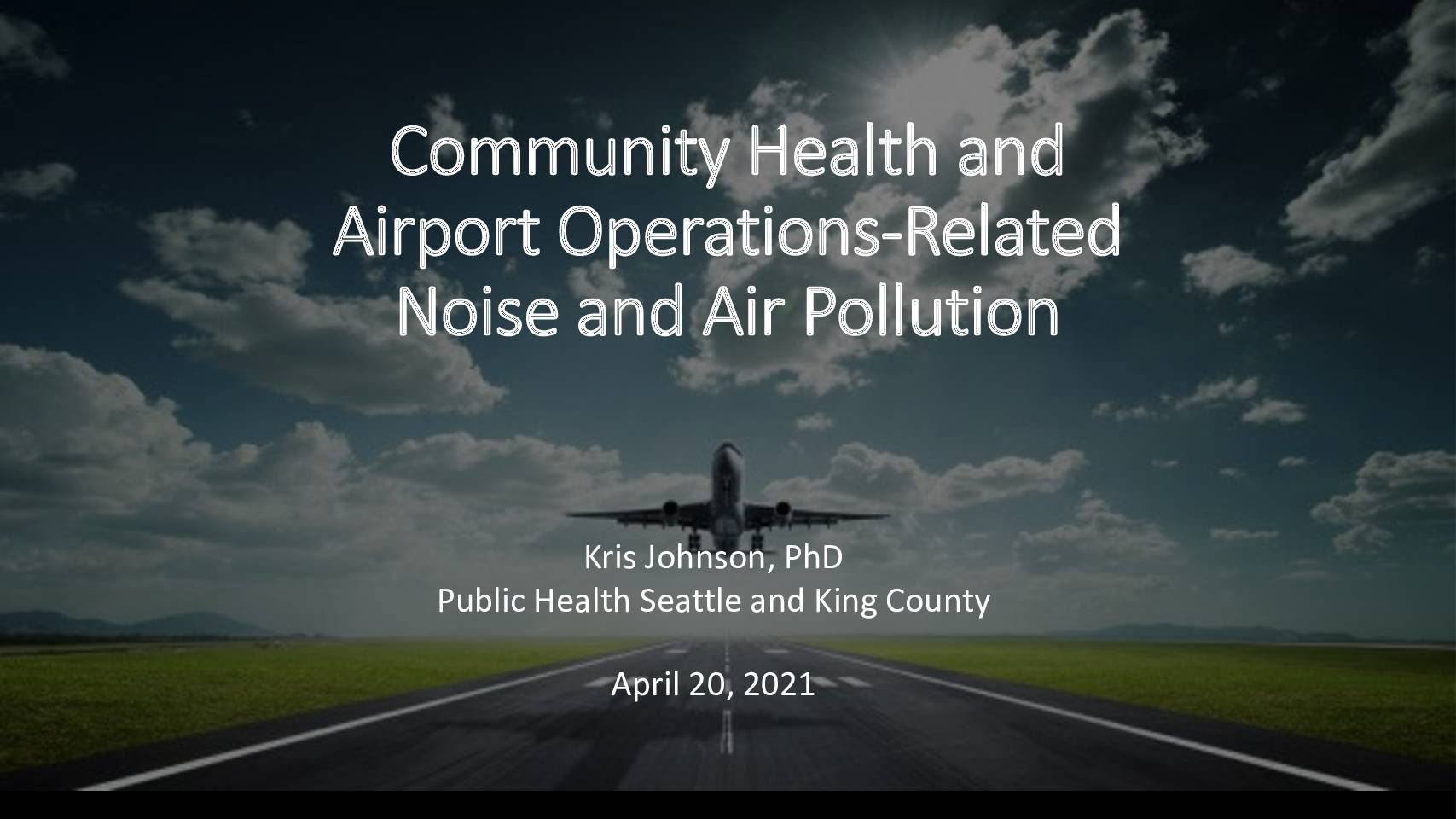
Community health and airport operations-related noise and air pollution
A 2021 presentation by Public Health Seattle and King County examines how noise and air pollution from Seattle-Tacoma International Airport (SeaTac) affect nearby communities. It covers community health profiles, the current strength of scientific evidence, a University of Washington study on ultrafine particles (UFP), and recommendations for addressing health impacts. The affected communities are notably diverse, with people of color — particularly Native Hawaiian/Pacific Islander and Black/African American residents — making up a disproportionately large share of the airport-area population compared to King County as a whole. -
 2021-04-19
King County 2020 Strategic Climate Action Plan
King County's 2020 Strategic Climate Action Plan outlines the county's comprehensive approach to addressing climate change through three main areas: reducing greenhouse gas emissions, supporting sustainable and resilient frontline communities, and preparing for climate change impacts. The plan emphasizes equity and community engagement, particularly for historically underserved populations, and was developed with input from a Climate Equity Community Task Force representing diverse community organizations. It builds on progress made since the county's 2015 climate plan and sets targets and policies across transportation, energy, buildings, food systems, and land use. -
 2021-03-12
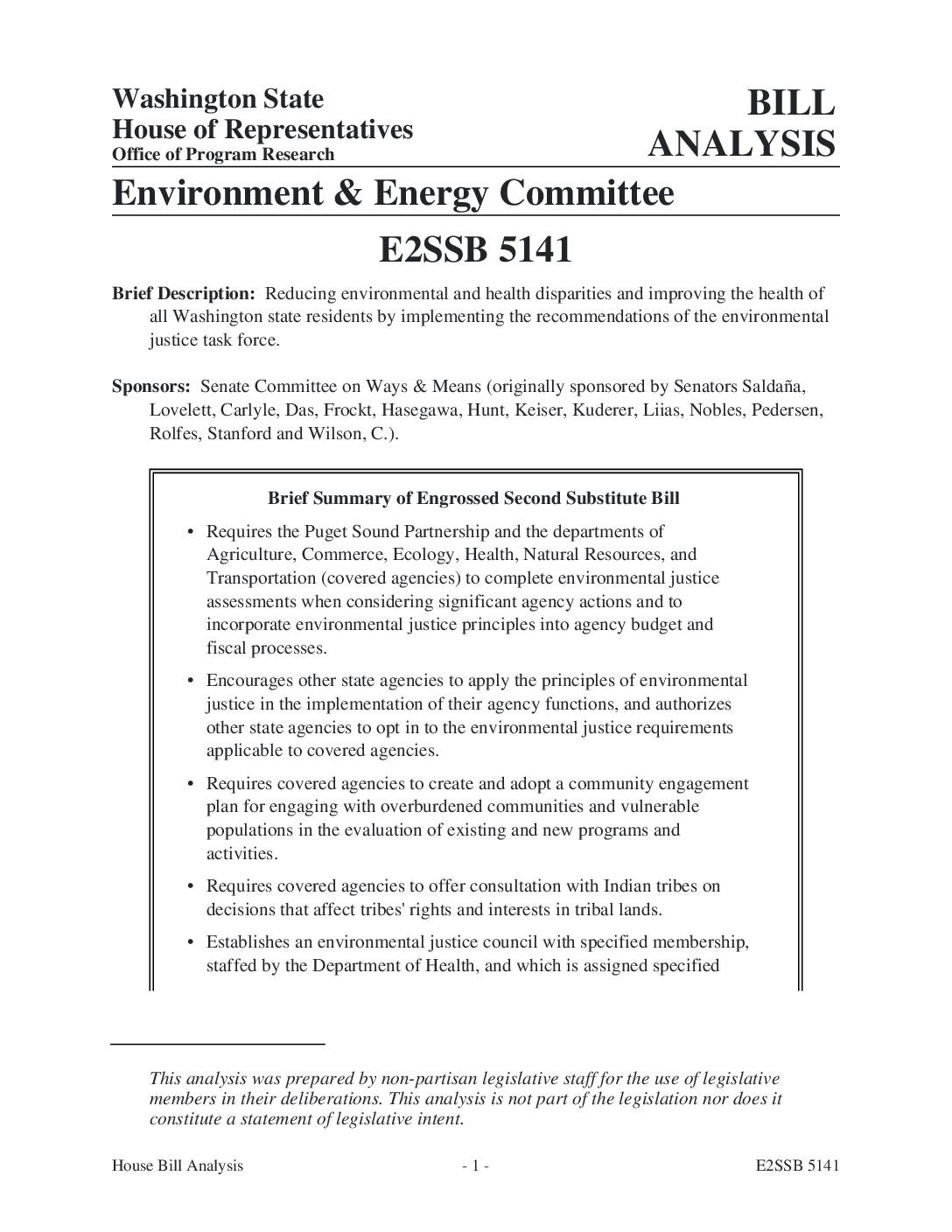
E2SSB 5141: House Bill Analysis — Reducing Environmental and Health Disparities (HEAL Act)
Washington State Senate Bill 5141 requires several state agencies, including the departments of Ecology, Health, Transportation, and others, to incorporate environmental justice principles into their planning and decision-making processes. The bill mandates that these agencies complete environmental justice assessments for significant actions, create community engagement plans for overburdened communities, and consult with Indian tribes on decisions affecting tribal lands. An environmental justice council would be established to oversee implementation, and the Department of Health would maintain an environmental health disparities map tracking conditions across Washington communities. -
 2021-01-01
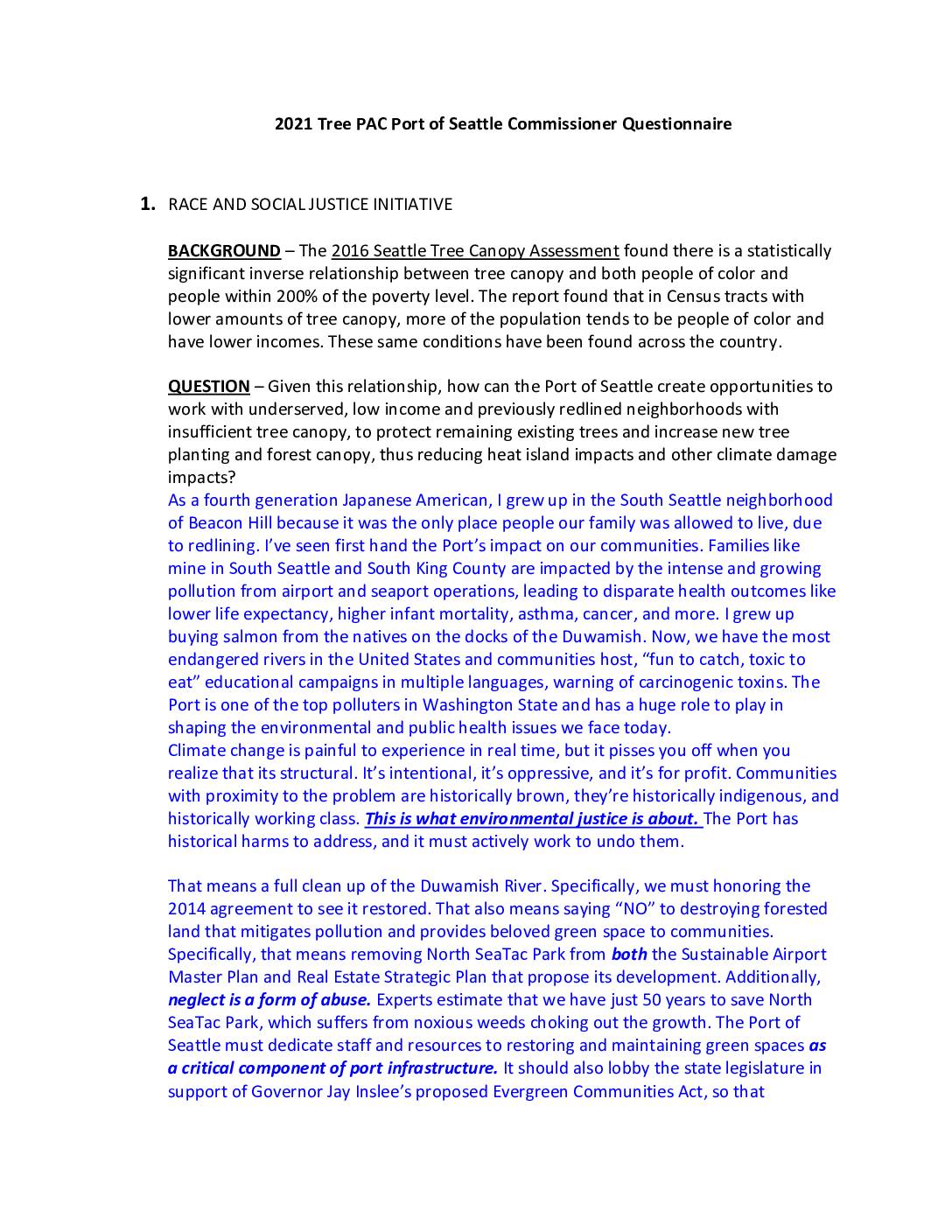
2021 Tree PAC Port Of Seattle Commissioner Questionnaire: Toshiko Hasegawa
This 2021 Tree PAC questionnaire captures Port of Seattle Commissioner candidate responses on environmental justice, tree canopy, and pollution issues affecting South Seattle and South King County communities. The candidate, a fourth-generation Japanese American raised in Beacon Hill, advocates for cleaning up the Duwamish River, preserving North SeaTac Park from development, and expanding urban tree canopy in historically redlined neighborhoods. Key proposals include partnering with cities and King County to strengthen tree protection ordinances, requiring environmental justice evaluations before Port projects, and empowering Indigenous tribes as land stewards. -
 2021-01-01
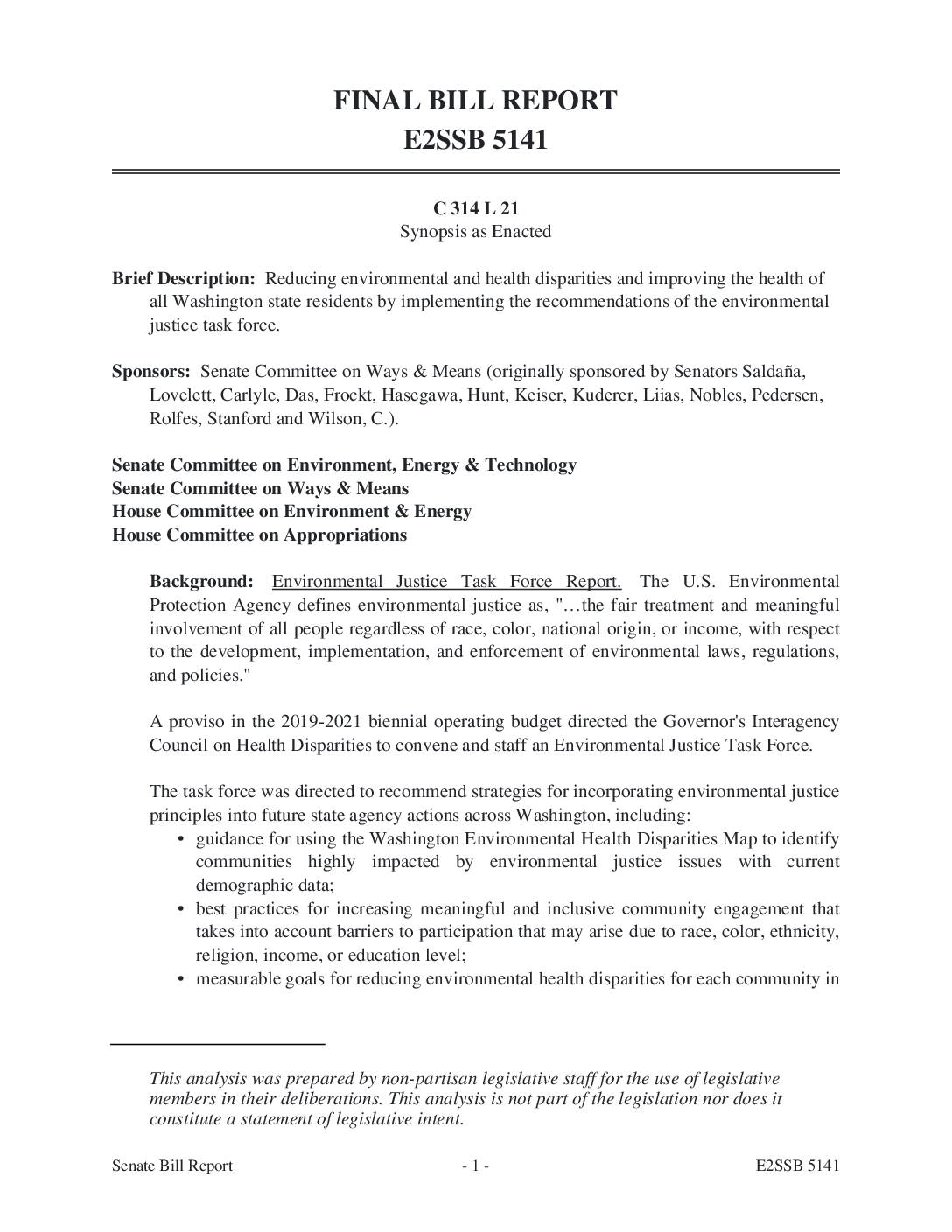
Final Bill Report: E2SSB 5141 — Washington Environmental Justice Act (HEAL Act)
Washington State's E2SSB 5141, enacted in 2021, requires key state agencies including Transportation and Ecology to incorporate environmental justice principles into their planning and decision-making processes, with a focus on protecting overburdened communities from disproportionate environmental and health harms. Agencies must develop community engagement plans by 2022, environmental justice implementation plans by 2023, and conduct formal environmental justice assessments for significant actions such as new rules, grants, and capital investments. Note: this legislation addresses statewide environmental justice policy broadly and does not specifically address Sea-Tac Airport noise issues. -
 2020-12-01
Washington 2021 State Energy Strategy: Transitioning to an equitable clean energy future
The Washington 2021 State Energy Strategy, published by the Washington State Department of Commerce in December 2020, outlines a blueprint for transitioning the state to clean energy by 2050, with the goal of nearly eliminating fossil fuel use while sustaining economic growth. The strategy emphasizes affordable and reliable energy, meeting science-based greenhouse gas emission limits, and ensuring that Tribes, rural communities, and low-income households are included as partners in the transition. Note: this document addresses statewide energy and climate policy and does not contain content related to Sea-Tac Airport noise policy. -
 2020-08-20
Comments on the FAA EA: SAMP Environmental Assessment
Public comments opposing the FAA Environmental Assessment (EA) for the Sea-Tac Airport Sustainable Airport Master Plan (SAMP), arguing the project should not be approved on seven grounds: false premise/purpose and need, disproportionate mortality and morbidity in affected communities, untrustworthy NAAQS air pollution calculations, inadequate cumulative impact analysis, missing environmental justice analysis, missing children’s health analysis, -
2020-08-20
Comments on the FAA EA: SAMP Environmental Assessment
This document presents formal public comments opposing an FAA Environmental Assessment for expansion projects at Seattle-Tacoma International Airport, arguing that the stated justification for growth is misleading because FAA safety regulations would naturally cap operations without new gates. The comments raise concerns about disproportionate air pollution health impacts on nearby residents, flawed emissions modeling dating back to the 1990s, and inadequate environmental justice and cumulative impact analyses. The author contends that adding gates and terminals is the true driver of increased flight operations, not an unavoidable surge in demand that would occur regardless of expansion. -
 2020-07-12
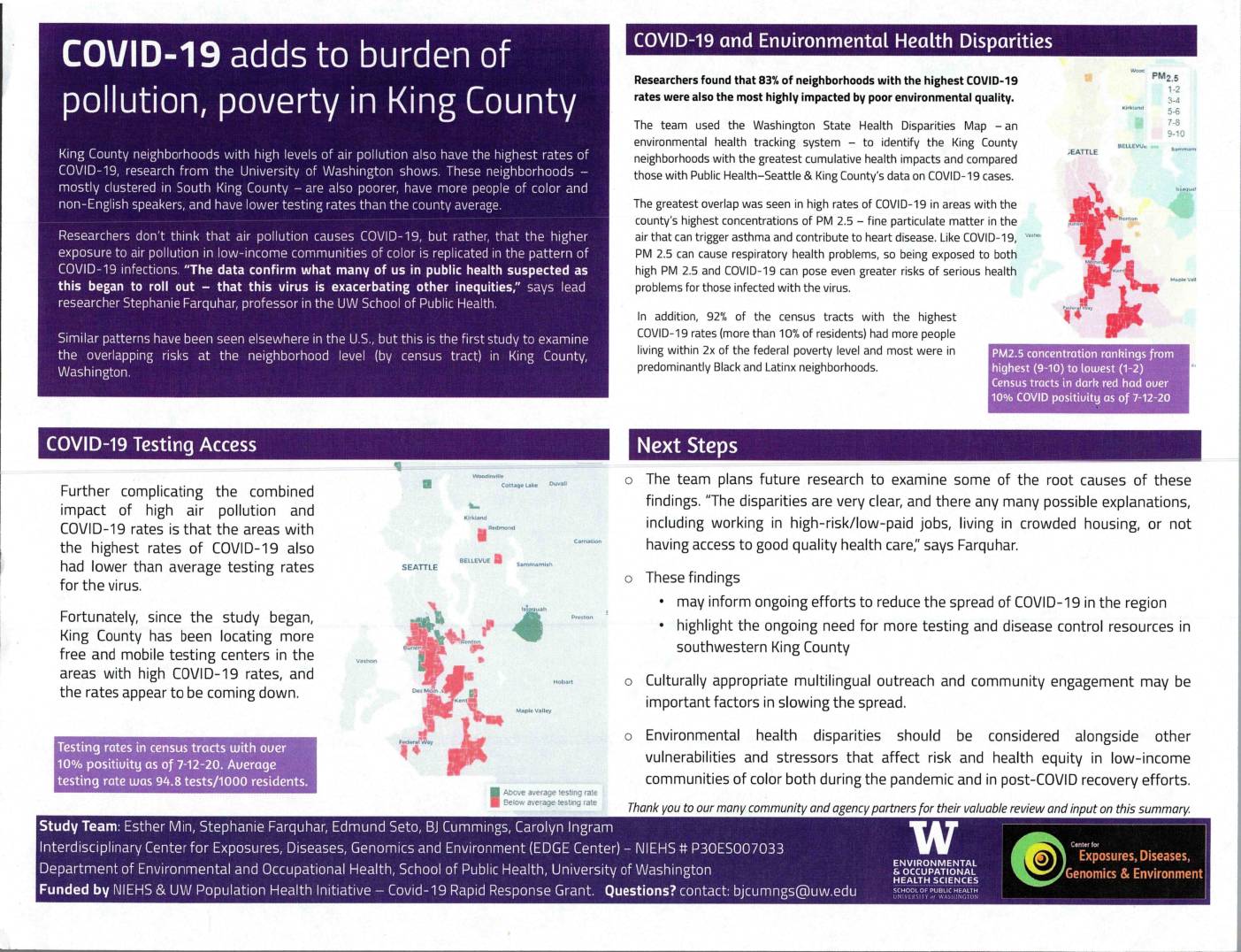
COVID-19 adds to burden of pollution, poverty in King County
A University of Washington study found that King County neighborhoods with the highest air pollution levels, concentrated in South King County, also experienced the highest COVID-19 infection rates. These areas are predominantly lower-income communities of color with below-average COVID-19 testing access. Researchers note that environmental health disparities, not air pollution as a direct cause, mirror the patterns of COVID-19 spread, and call for more testing resources and culturally appropriate outreach in affected communities. -
 2020-06-09
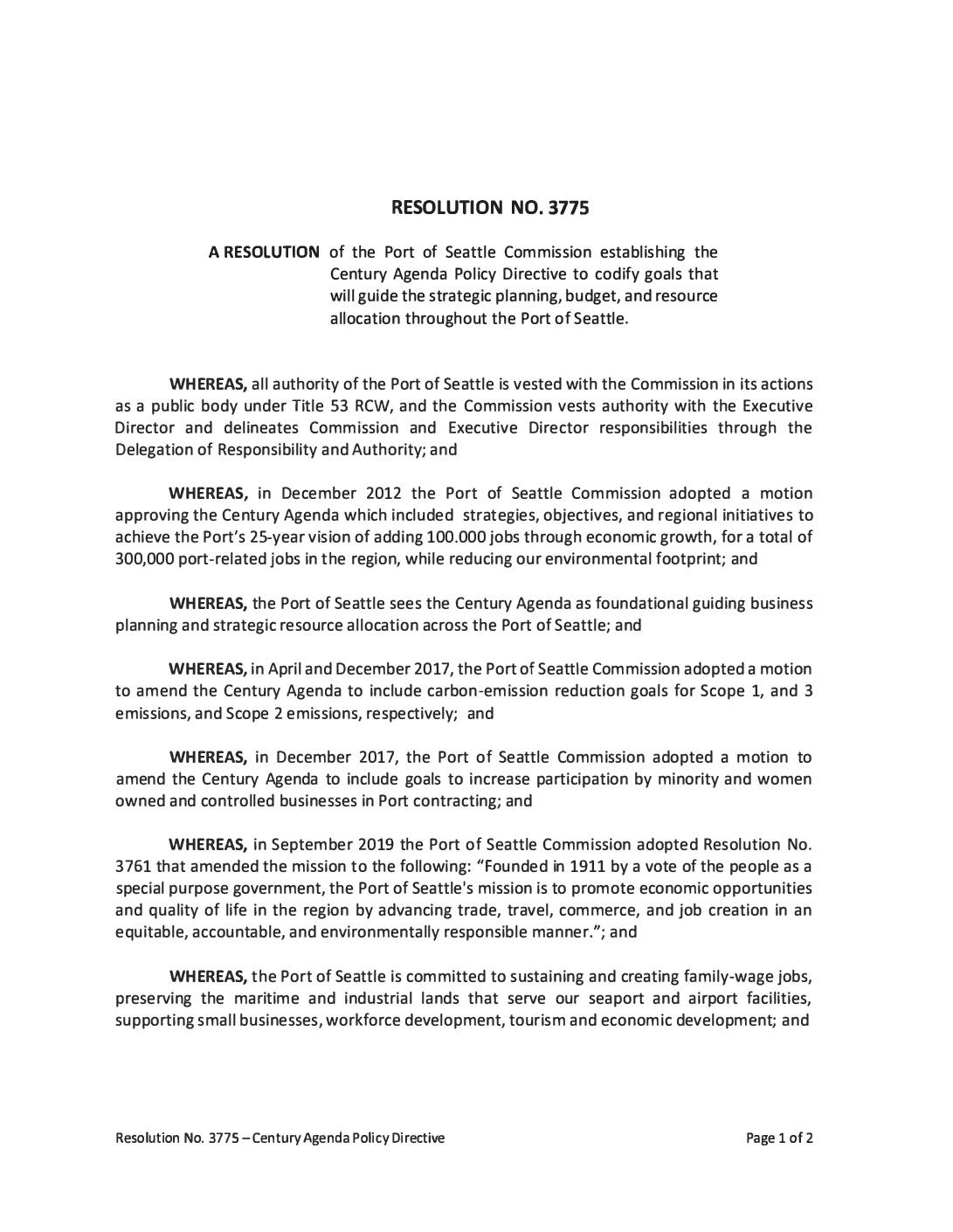
Resolution no. 3775 – Century Agenda policy directive
Port of Seattle Commission resolution establishing the Century Agenda Policy Directive to codify goals guiding strategic planning, budget, and resource allocation. The resolution formalizes the Port’s 25-year vision of adding 100,000 jobs while reducing environmental footprint, and incorporates amendments for carbon emission reduction goals and increased participation by minority and women-owned businesses.