Notes
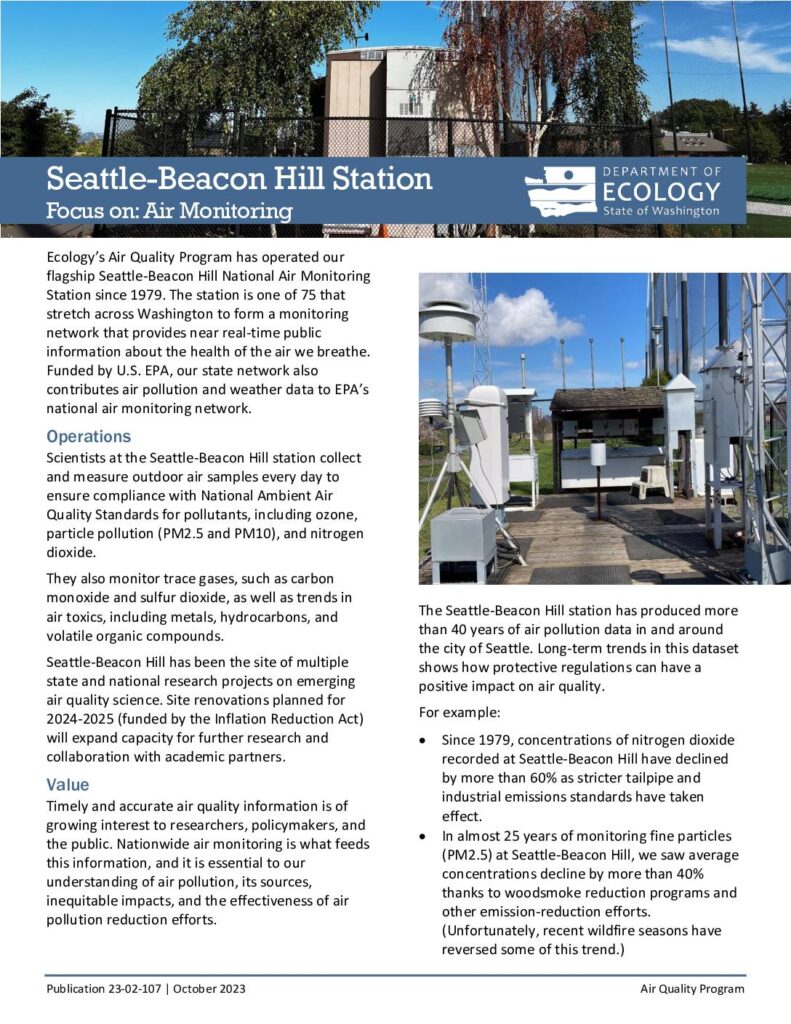
Washington State Department of Ecology Air Quality Program fact sheet (Publication 23-02-107, October 2023) describing the Seattle-Beacon Hill National Air Monitoring Station, operated since 1979 as one of 75 stations in Washington’s air monitoring network funded by U.S. EPA. Covers pollutants monitored including ozone, PM2.5, PM10, nitrogen dioxide, carbon monoxide, sulfur dioxide, lead, hydrocarbons, and volatile organic compounds. Reports 60% decline in nitrogen dioxide since 1979, 40% decline in PM2.5 concentrations, and near-elimination of lead following removal from gasoline. Notes 2024-2025 site renovations funded by the Inflation Reduction Act, environmental justice focus on overburdened communities in Beacon Hill and South Seattle near the Duwamish historic fishing grounds, and tracking of Clean Energy Transformation Act, Cap-and-Invest program, Clean Fuel Standard, and Zero-emission Vehicles programs.