TagDes Moines Creek(162)
-
 1998-07-01
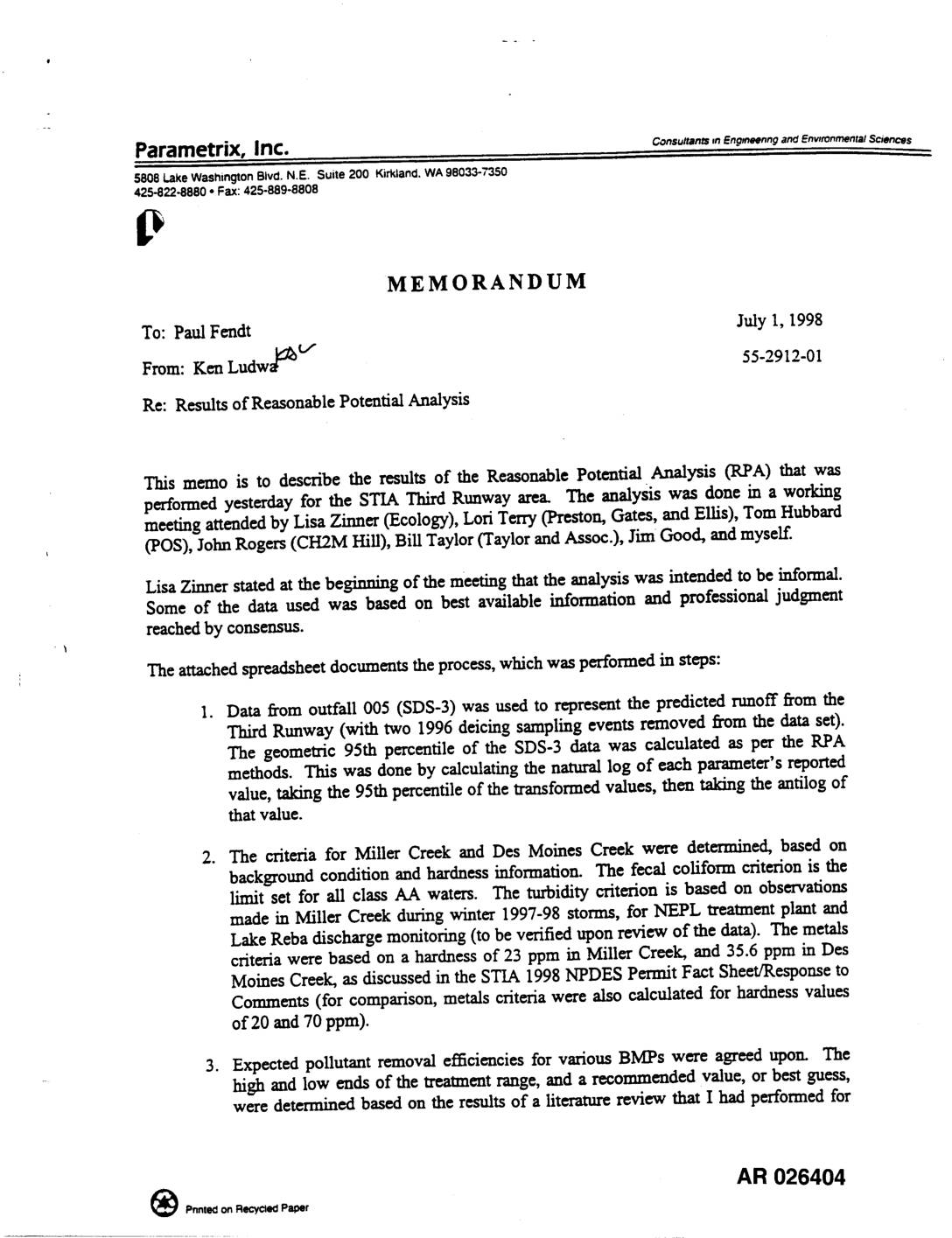
EXH AR026404: Memo — Reasonable Potential Analysis Results, STIA Third Runway
A 1998 internal memo from Parametrix, Inc. summarizes the results of a Reasonable Potential Analysis (RPA) conducted for the Seattle-Tacoma International Airport (STIA) Third Runway project, assessing whether stormwater runoff from the new runway could exceed water quality criteria in Miller Creek and Des Moines Creek. The analysis found that most pollutant concentrations after treatment with best management practices (BMPs) such as bioswales, sand filters, and wet ponds would meet criteria, with the exception of copper, which remained above acceptable levels. The memo also notes that existing pollutant concentrations in the receiving waterways during storms already exceeded criteria, even before accounting for Third Runway runoff. -
 1998-02-03
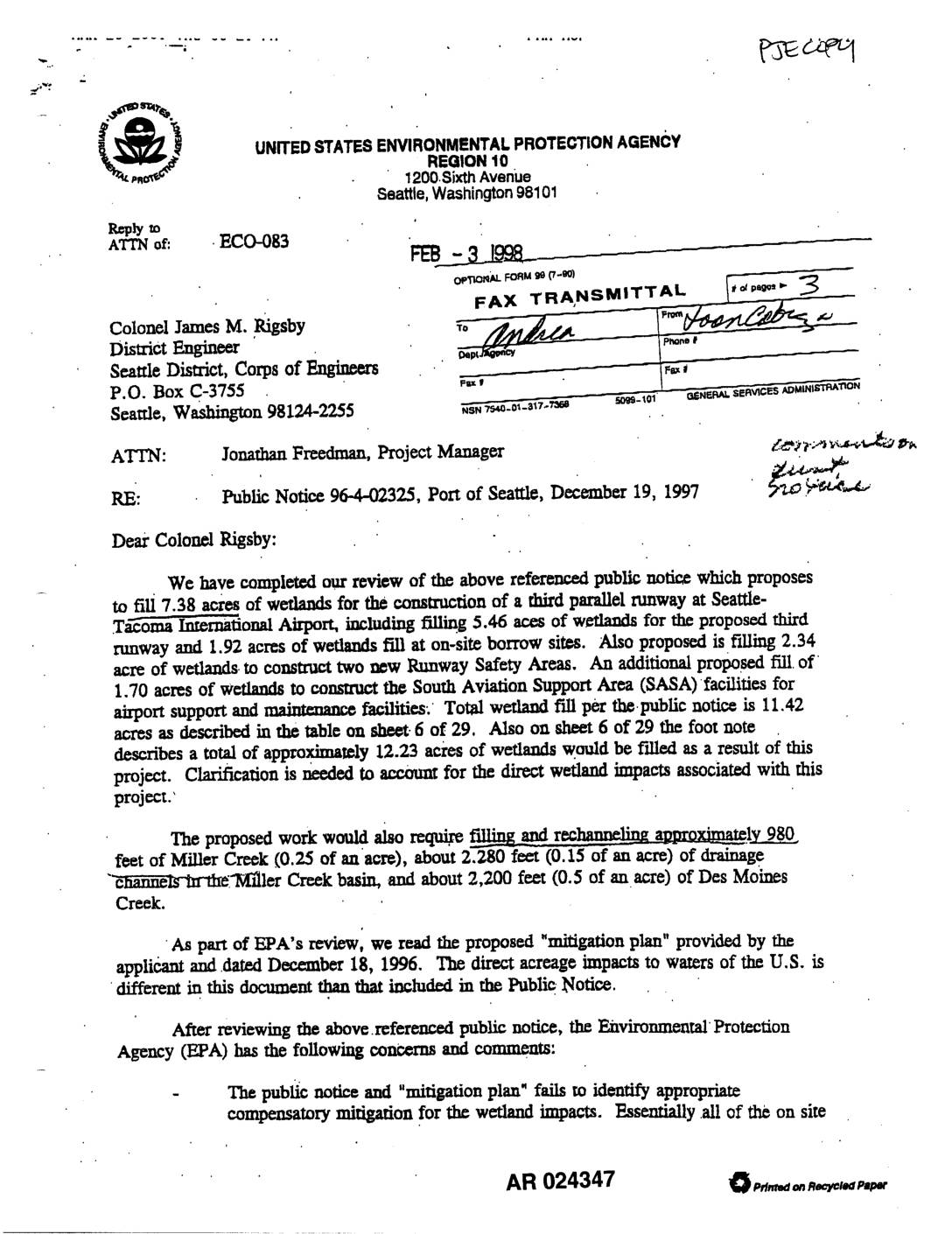
EXH AR024347: EPA Region 10 Letter to Army Corps re Public Notice 96-4-02325 Third Runway Wetlands Fill
In February 1998, the U.S. EPA Region 10 wrote to the Army Corps of Engineers recommending denial of a permit for the Port of Seattle's proposed third parallel runway at Seattle-Tacoma International Airport, citing concerns over the filling of more than 11 acres of wetlands and portions of Miller Creek and Des Moines Creek. The EPA objected that the applicant's mitigation plan relied almost entirely on off-site wetland replacement in the Green River Valley rather than within the affected watersheds, and questioned whether alternatives to wetland fills for the South Aviation Support Area and on-site borrow areas had been adequately explored. The agency indicated it was willing to work with the Corps and the Port to identify solutions that would satisfy both aviation safety needs and Clean Water Act Section 404(b)(1) requirements. -
 1997-11-01
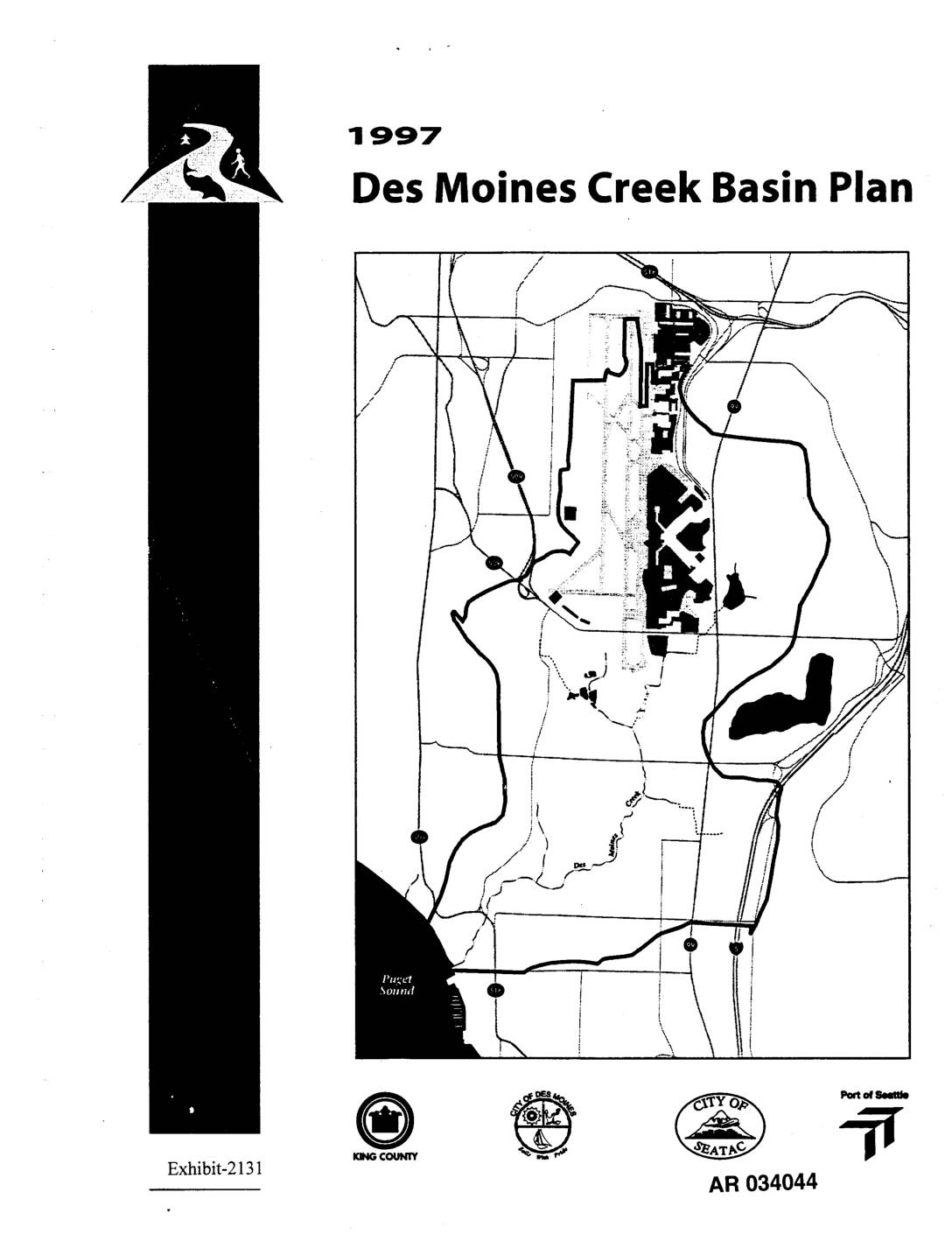
Exhibit 2131: Des Moines Creek Basin Plan (1997)
1997 Des Moines Creek Basin Plan, November 1997, prepared by the Des Moines Creek Basin Committee comprising City of SeaTac, City of Des Moines, Port of Seattle, and King County. Project technical team led by King County Department of Natural Resources, Water and Land Resources Division, with contributors including David Masters, David Hartley, Alan Johnson, -
 1997-06-01
Exhibit AR022300: Port Of Seattle Storm Water Receiving Environment Monitoring Report for NPDES Permit No. WA-002465-1
This June 1997 report, prepared by the Port of Seattle for Washington State's Department of Ecology, presents storm water receiving environment monitoring results conducted under NPDES Permit No. WA-002465-1. It covers water quality topics including instream toxicity bioassays, sediment quality, identification of pollution sources, metals speciation, vegetation management, and streambank erosion in Miller Creek and Des Moines Creek watersheds near Sea-Tac Airport. The findings assess the environmental impact of airport storm water runoff on local waterways and identify contributing pollution sources within each creek basin. -
 1997-06-01
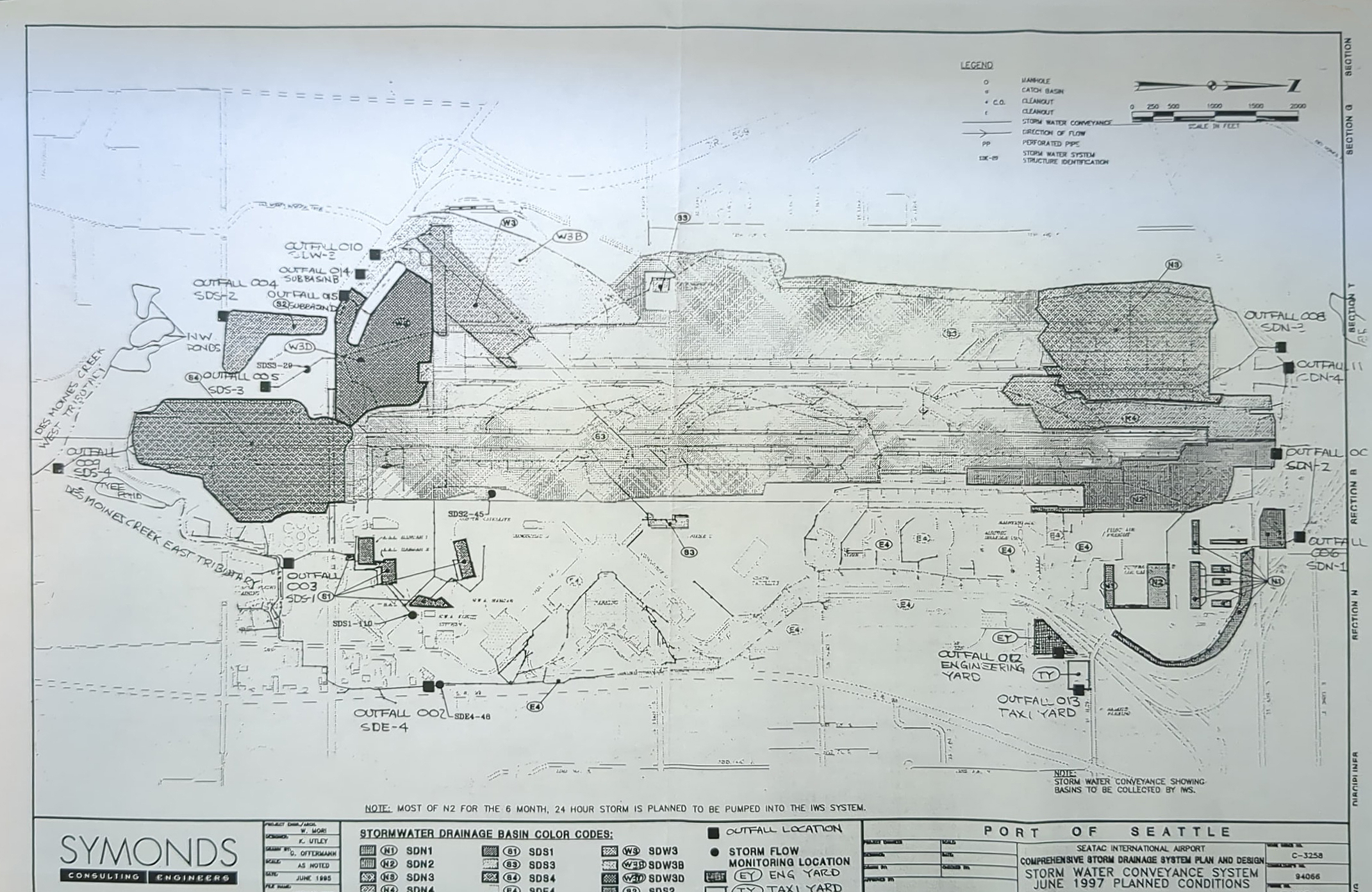
Symonds Stormwater System June 1997
Engineering drawing prepared by Symonds Consulting Engineers for the Port of Seattle, titled 'Comprehensive Storm Drainage System Plan and Design – Storm Water Conveyance System, June 1997 Planned Conditions' (Drawing No. C-3258, Project No. 94066). The plan depicts SeaTac International Airport's stormwater drainage basins, outfall locations (Outfalls 002–016), storm flow monitoring locations, and drainage connections to Des Moines Creek and its east tributary. -
 1996-11-01
EXH AR039950: Fill Material Alternative Delivery Method Study for Third Runway, Phase I — Seattle-Tacoma International Airport
HNTB-prepared Final Draft Phase I study (November 1996) for Sea-Tac Airport Third Runway fill material alternative delivery methods. Evaluates transport corridors including Corridor 1 (Des Moines Creek barge transfer and land conveyor), Corridor 2 (SR 509 conveyor, truck, rail), and Corridor 3 (SR 518 conveyor, truck, rail). Covers technical viability, construction/environmental permitting (local, state, federal), -
 1993-12-22
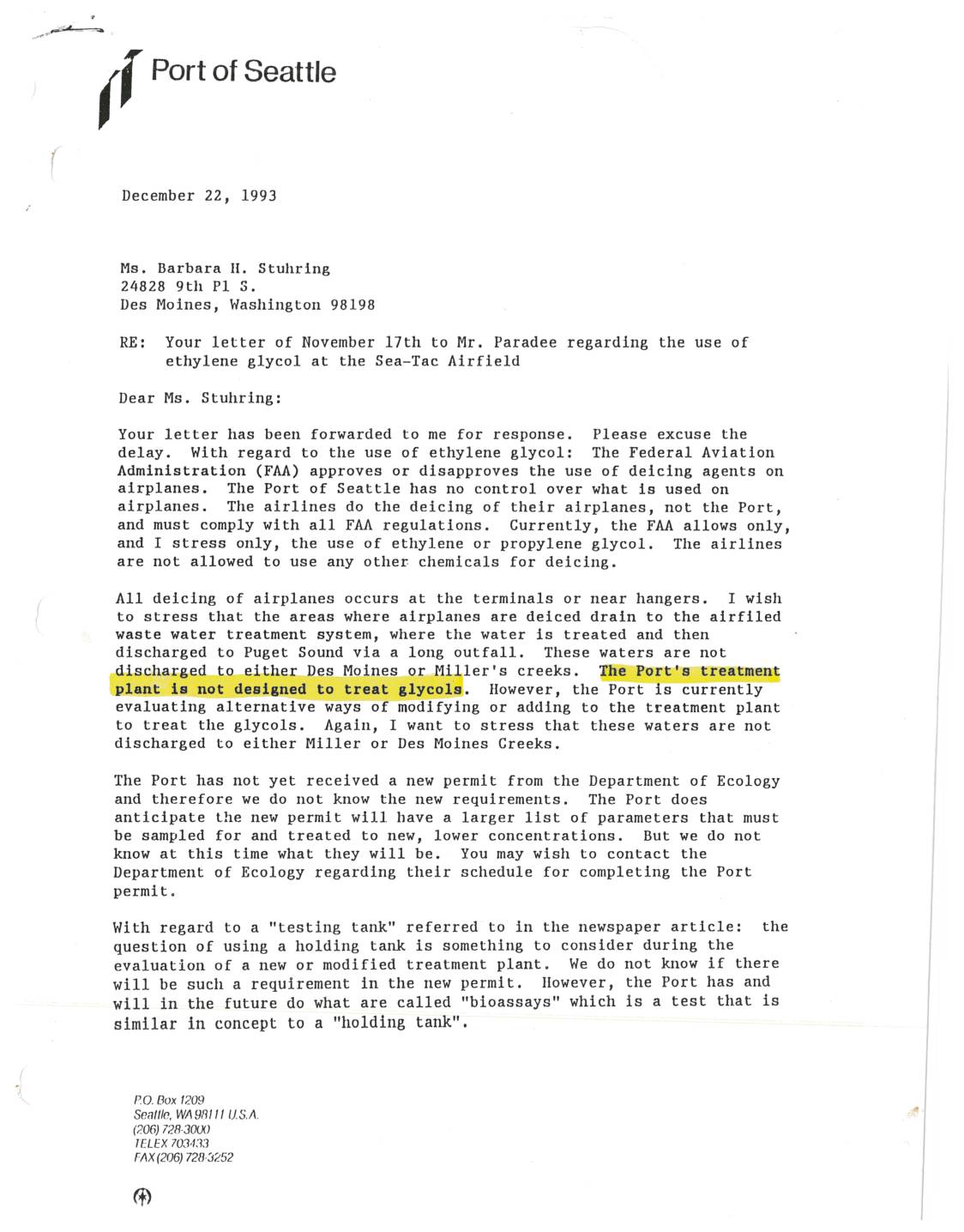
Port Of Seattle Letter to Barbara Stuhring: Ethylene Glycol Deicing at Sea-Tac Airport and Wastewater Treatment
A 1993 letter from the Port of Seattle to a Des Moines resident explains that airline deicing at Sea-Tac Airport uses only FAA-approved ethylene or propylene glycol, and that wastewater from deicing drains to the airport's treatment system before being discharged to Puget Sound — not to Miller or Des Moines Creeks. The Port acknowledged its treatment plant was not designed to handle glycols and was evaluating upgrades. A follow-up 1996 letter challenges a contradictory statement in the airport's Final Environmental Impact Statement, which claimed most deicing fluids were contained and treated by the Port's Industrial Wastewater System. -
 1992-02-01
Des Moines Creek water quality study
A 1992 water quality study of Des Moines Creek, prepared by Parametrix, Inc. for the FAA and Port of Seattle, assessed the health of the creek during storm runoff events. The creek, which originates near Sea-Tac International Airport and flows to Puget Sound, had its aquatic ecosystem severely damaged by jet fuel spills in 1985 and 1986. The study sampled seven locations along the creek and three tributaries to identify water quality problems and determine whether stormwater pollution from airport operations was causing toxic conditions. -
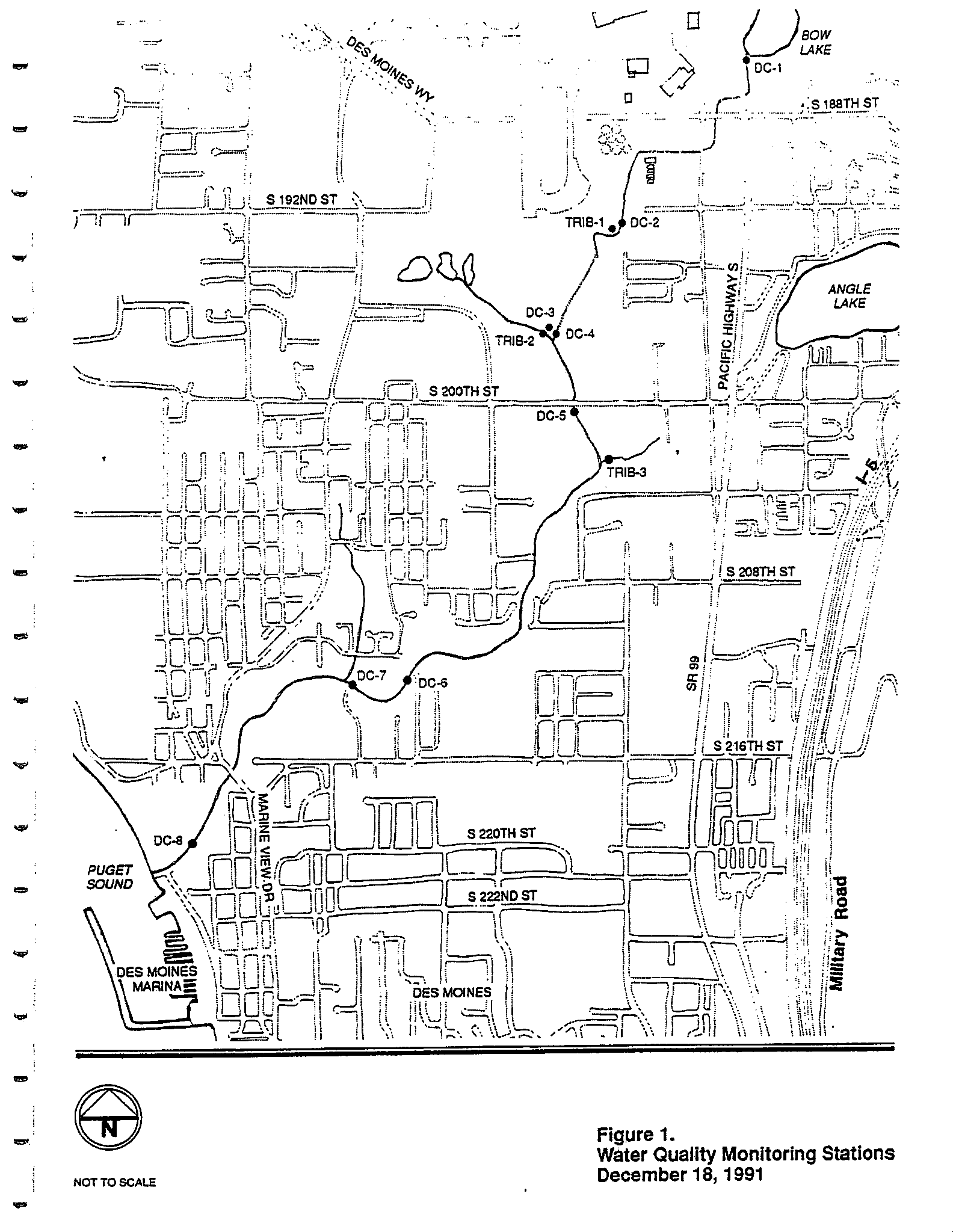 1991-12-18
Des Moines Creek Parametrix 1992 Water Quality Study Monitoring Stations Map
A map dated December 18, 1991 showing water quality monitoring stations (labeled DC-1 through DC-8 and TRIB-1 through TRIB-3) along Des Moines Creek and its tributaries in the Des Moines, Washington area near Sea-Tac Airport. The map identifies local landmarks including Bow Lake, Angle Lake, Puget Sound, Des Moines Marina, and major roads including Pacific Highway S, SR 99, and Military Road. -
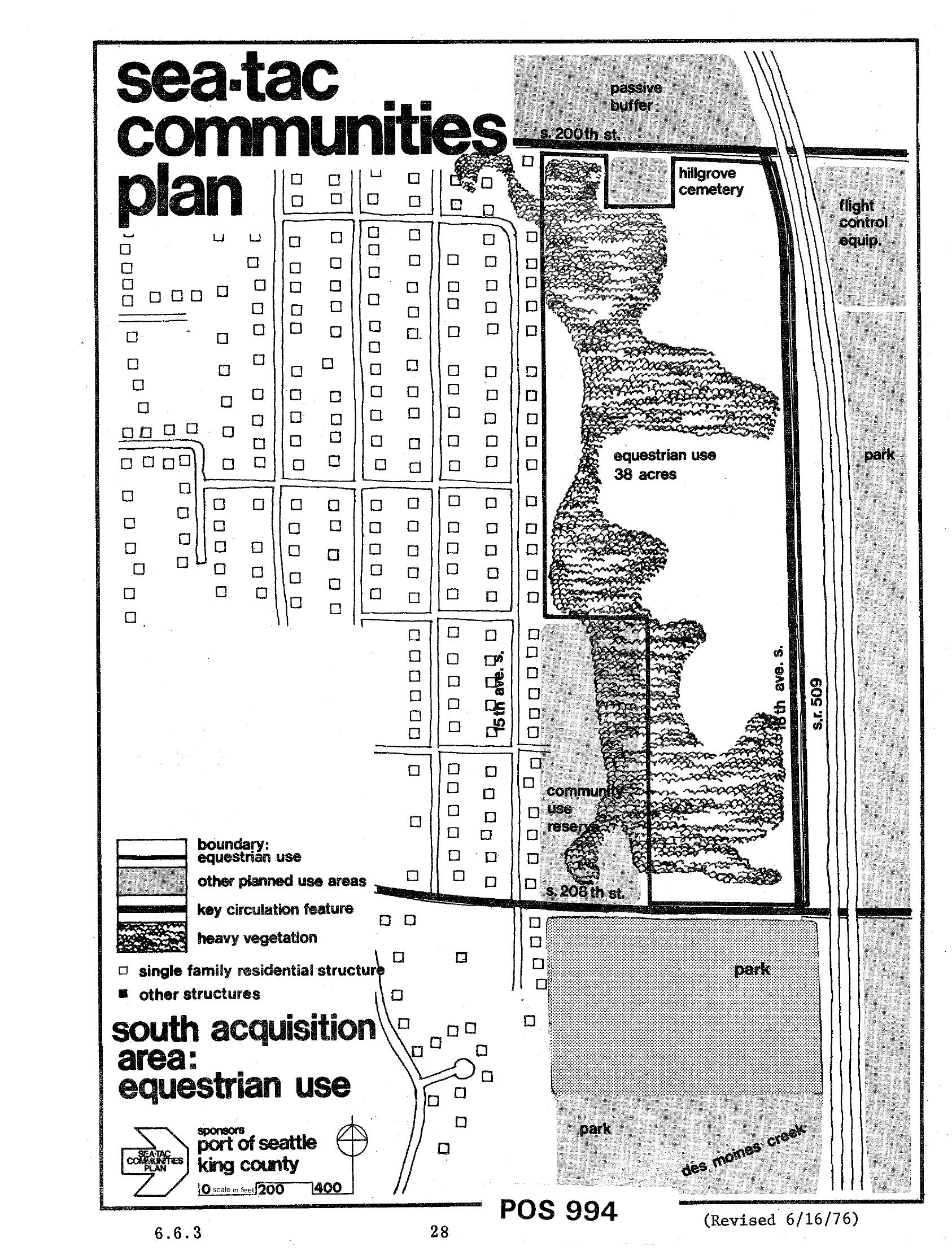 1976-06-16
Sea-Tac Communities Plan South Acquisition Area Equestrian Zone Map, June 1976
A planning map labeled 'Sea-Tac Communities Plan' showing the south acquisition area designated for equestrian use, featuring a 38-acre equestrian zone, Hillgrove Cemetery, a community use reserve, and adjacent park areas near Des Moines Creek. The document is numbered POS 994, revised June 16, 1976, sponsored by the Port of Seattle and King County, and catalogued as page 28, section 6.6.3.