Tagcommunity development(41)
-
 2017-07-17
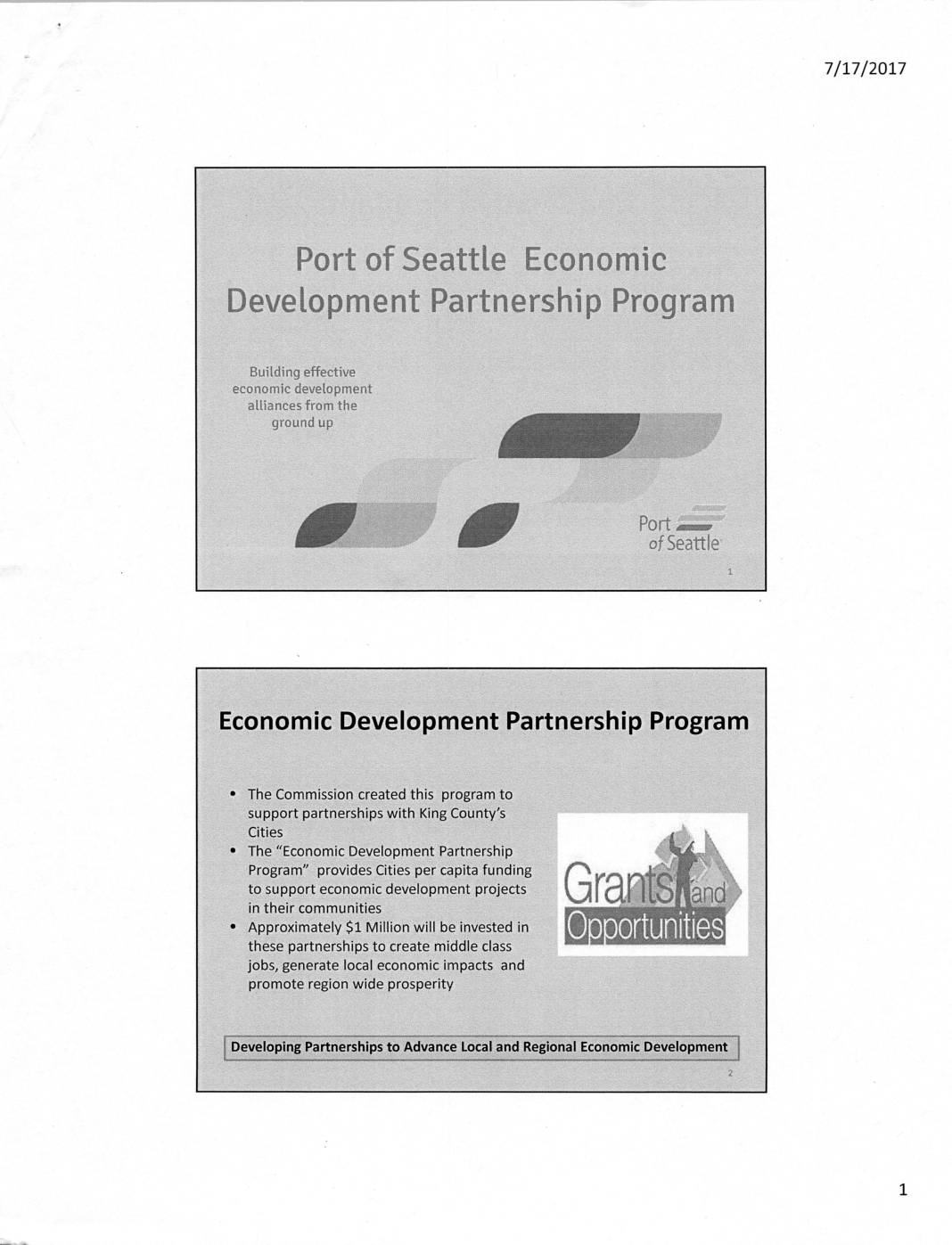
Port Of Seattle Economic Development Partnership Program
The Port of Seattle's Economic Development Partnership Program provides approximately $1 million in annual grant funding to the 38 cities in King County, distributed on a $1-per-capita basis (capped at $65,000, with a $5,000 minimum for the smallest cities). Cities can use the funds for eligible activities such as business recruitment, small business development, tourism, and downtown revitalization, but not for capital projects, and must provide a 50 percent local match. Cities may partner with local nonprofits or collaborate regionally to maximize the impact of their projects. -
 2015-12-10
City of Des Moines 2016 Parks, Recreation & Senior Services Master Plan
This is the City of Des Moines, Washington 2016 Parks, Recreation & Senior Services Master Plan, adopted by the Des Moines City Council on December 10, 2015. The plan covers existing park resources, programs, and demographics, along with a needs assessment, facility development priorities, cost estimates, and funding strategies for the city's parks and recreation system. It also includes goals, policies, and implementation strategies for parks, recreation, and open space. -
 2015-05-27
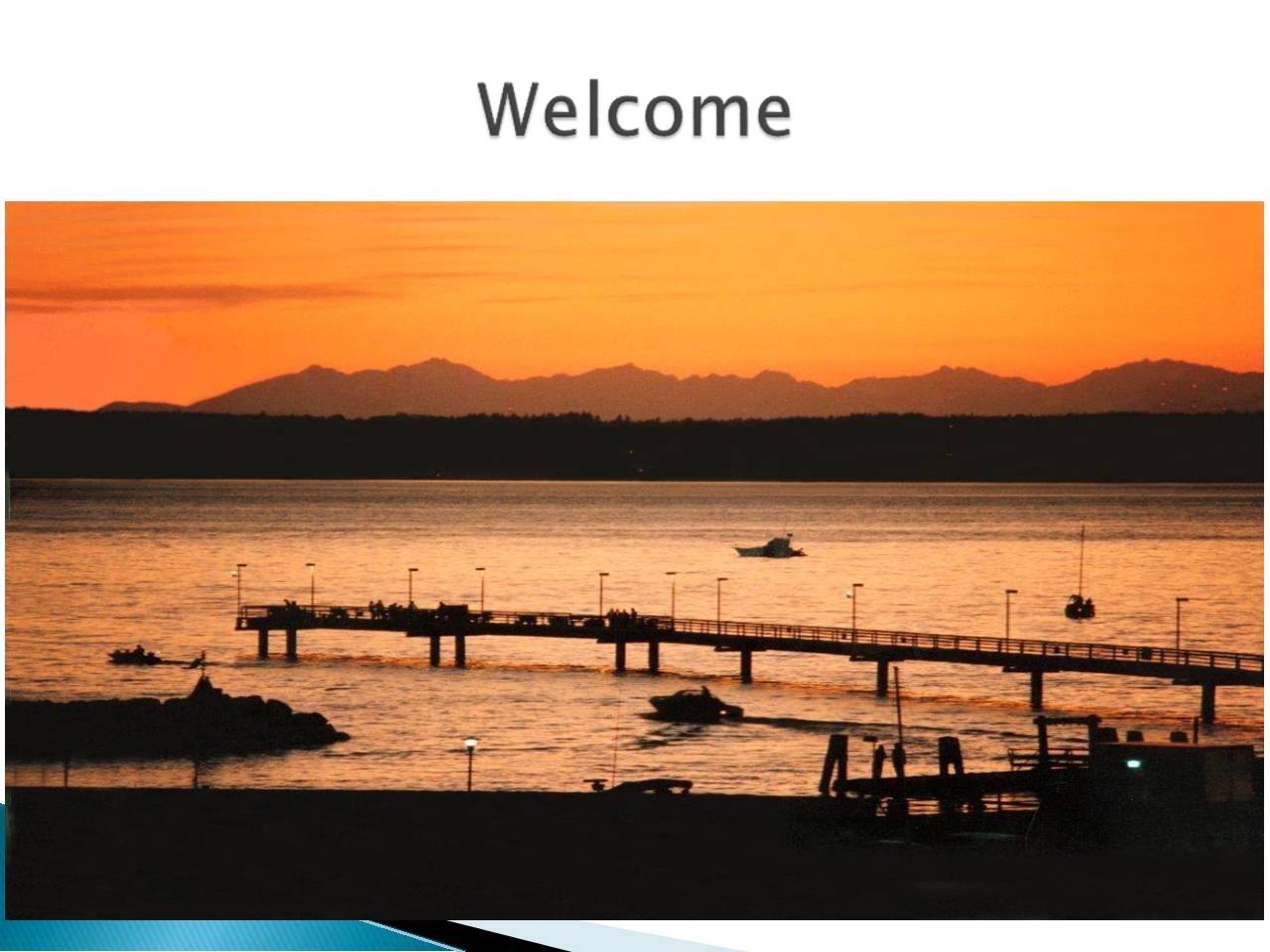
City of Des Moines Economic Development Presentation
This presentation from the City of Des Moines, Washington outlines the city's economic development context, noting its population of roughly 30,000 residents across 6.5 square miles and a median household income of $60,000. The city faces suburban challenges including transitioning toward more urbanized town centers and achieving fiscal self-sufficiency, complicated by the fact that 50% of its potential trade capture area lies underwater in Puget Sound. The city's strategy focuses on increasing overall economic demand rather than competing directly with neighboring communities. -
 2010-04-01
Northeast Redevelopment Area (NERA) appendix
The Northeast Redevelopment Area (NERA) Appendix is a supporting document to the Redevelopment Plan and Implementation Strategy, dated April 2010. It contains nine sections covering existing conditions, market conditions, critical area studies, community involvement, transportation infrastructure, economic summaries, comprehensive plan and zoning amendments, and a Miller Creek Greenway concept report. This appendix provides the technical and community engagement background needed to guide redevelopment planning decisions for the NERA. -
 2008-02-06
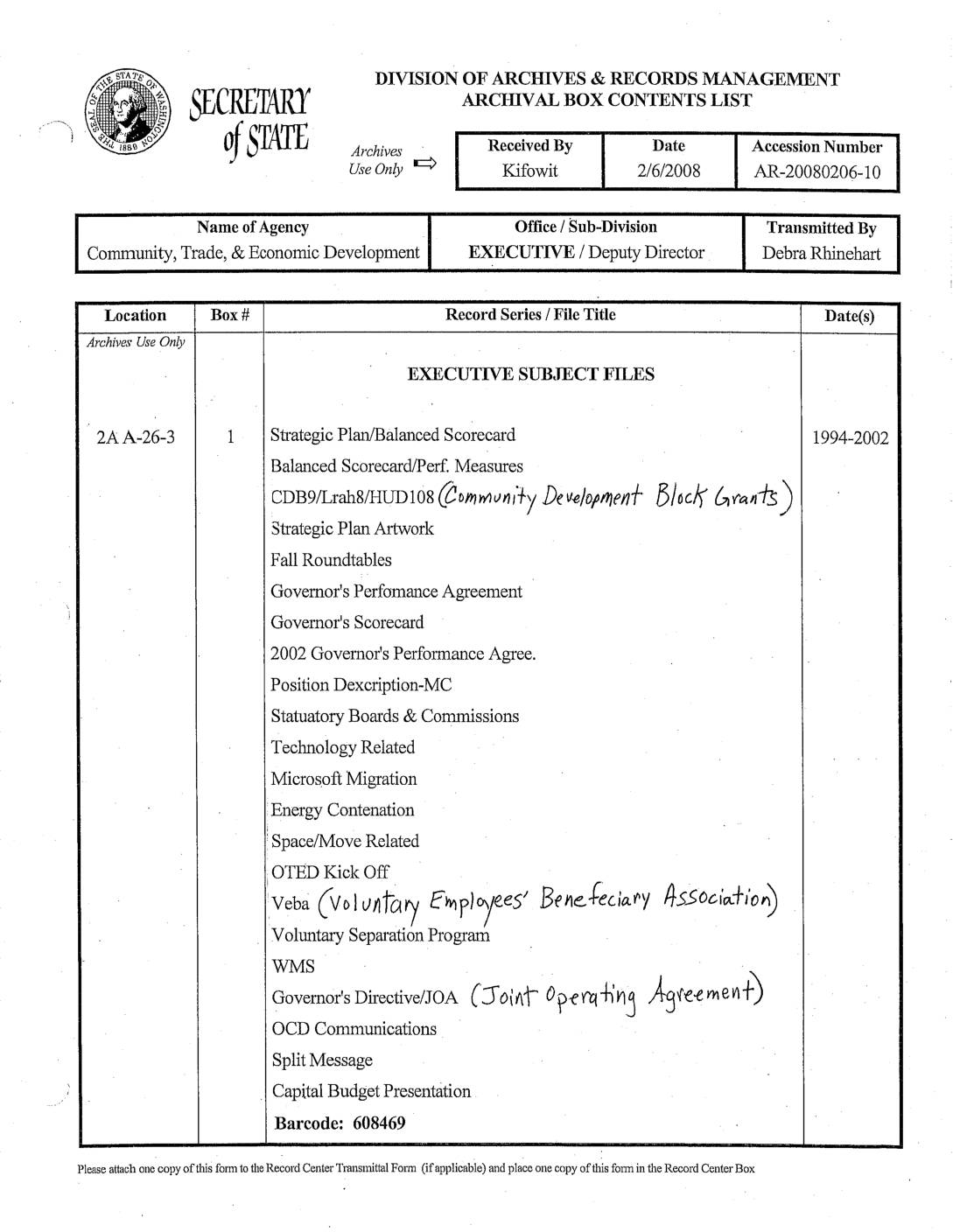
EXH AR20080206-10: Archival Box Contents List — Community, Trade, & Economic Development Executive Subject Files, 1994–2002
This document is an archival box contents list from the Washington State Division of Archives & Records Management, cataloging Executive Subject Files from the Community, Trade, & Economic Development agency covering the years 1994–2002. The files include records related to strategic planning, Governor's performance agreements, rural economic development, trade missions, and various state programs. The records were received by the archives on February 6, 2008, and transmitted by Deputy Director Debra Rhinehart. -
 1995-05-25
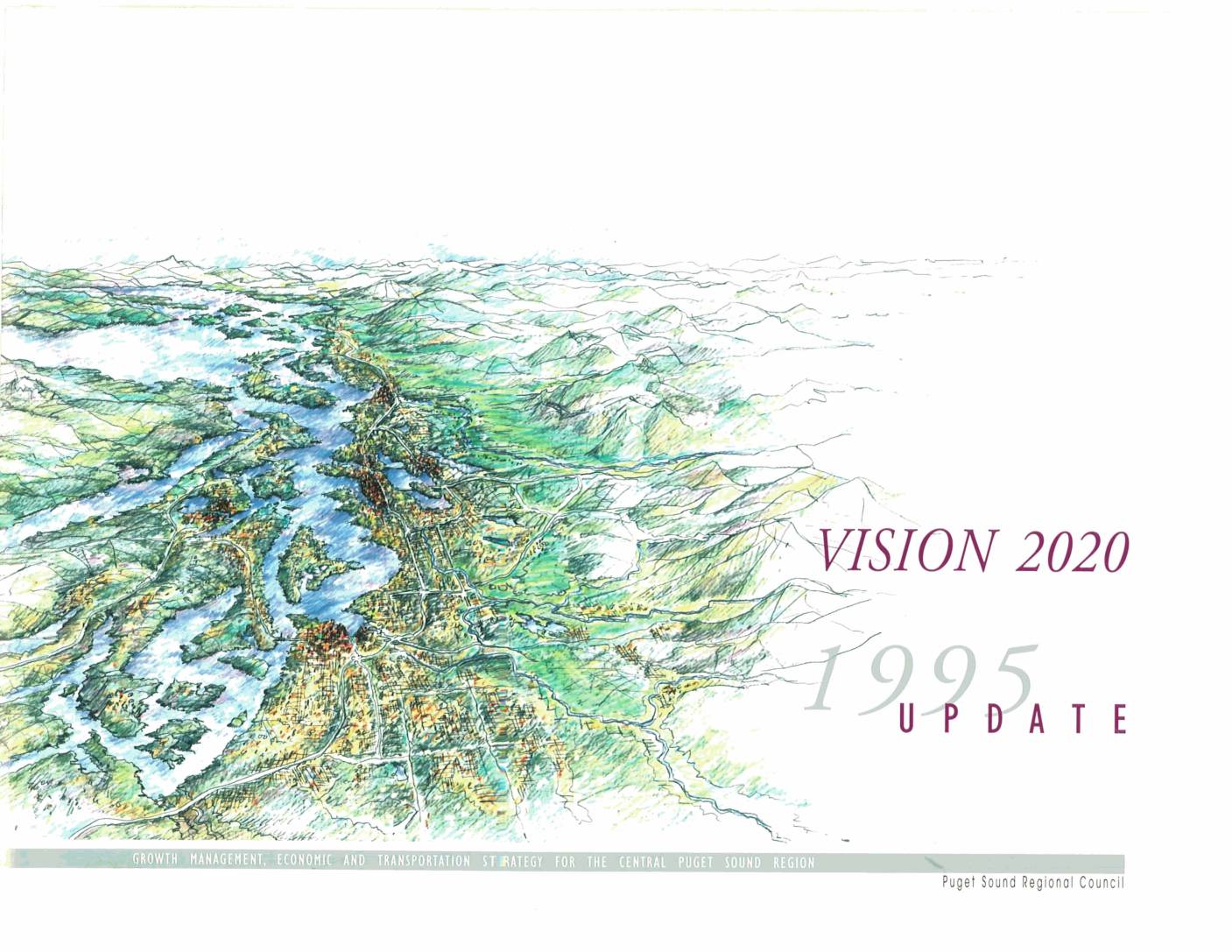
Vision 2020, 1995 update: Growth management, economic and transportation strategy for the central Puget Sound region
Vision 2020: 1995 Update is a growth management, economic, and transportation strategy document produced by the Puget Sound Regional Council for the central Puget Sound region, adopted May 25, 1995. It provides regional policy guidance developed by the Council's Growth Management and Transportation Policy Boards, covering land use and transportation planning for King, Pierce, Snohomish, and Kitsap counties. Funding was provided by member jurisdictions and federal transportation agencies including the Federal Transit Administration and Federal Highway Administration. -
 1981-06-09
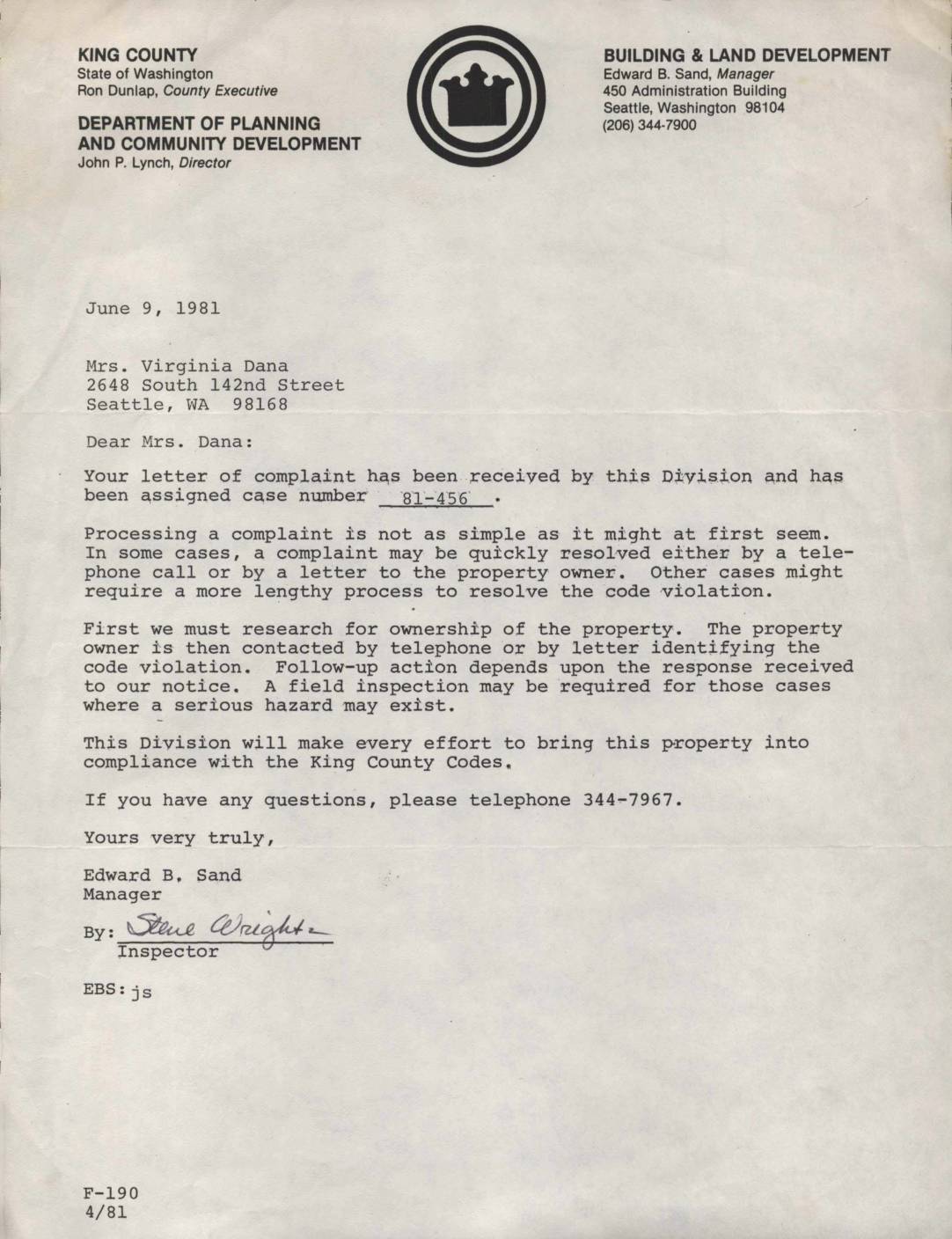
King County Department of Planning and Community Development: Letter to Virginia Dana Acknowledging Complaint Case 81-456
A June 9, 1981 letter from King County's Building & Land Development division acknowledges receipt of a complaint filed by Mrs. Virginia Dana of Seattle, assigning it case number 81-456. The letter explains the county's process for handling code violations, which may include contacting the property owner by phone or letter, and potentially conducting a field inspection if a serious hazard exists. The division pledges to make every effort to bring the property into compliance with King County Codes. -
 1980-07-18
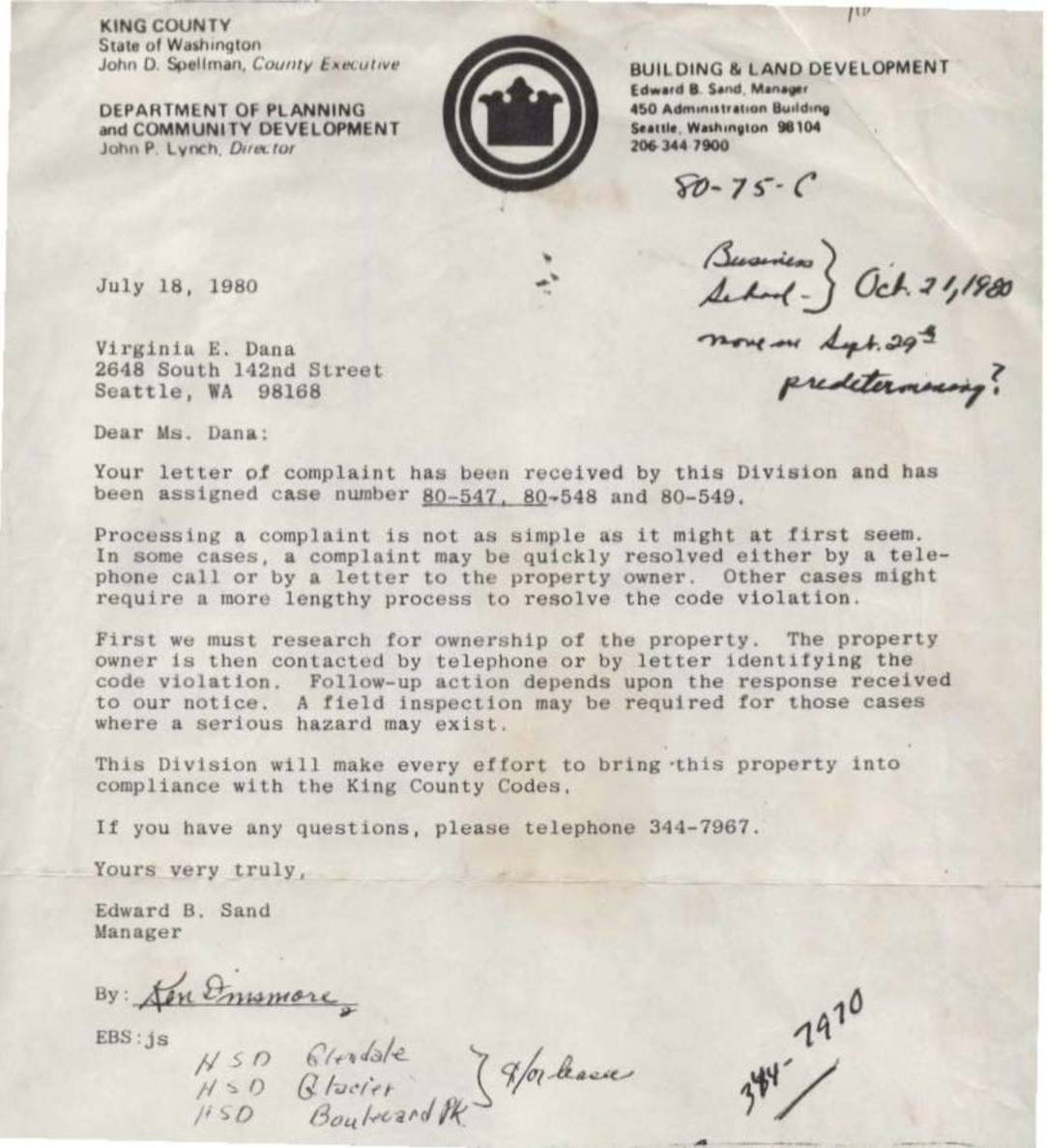
Case 80-75-C: King County Department of Planning and Community Development Letter to Virginia E. Dana Regarding Complaint Cases 80-547, 80-548, and 80-549
A July 1980 letter from King County's Building and Land Development division acknowledges a complaint filed by Virginia E. Dana, assigning it case numbers 80-547, 80-548, and 80-549, and outlines the county's process for investigating code violations. The letter explains that resolving complaints may involve researching property ownership, contacting the owner, and conducting field inspections for serious hazards. A related newspaper article covers conditional use permit hearings for tenants of closed Highline School District schools, noting that the county had recently discovered many such tenants lacked required permits. -
 1977-11-01
Highline Community Plan
The Highline Community Plan, published by the King County Planning Division in November 1977, outlines land use policies and development guidelines for the Highline communities in unincorporated King County near Seattle. The plan addresses topics including development limitations, drainage and pollution, neighborhood stability, transportation, and parks and recreation. It was developed through a structured community planning process under the King County Department of Planning and Community Development. -
 1975-02-04
Sea-Tac Communities Plan working draft memo
This 1975 working draft memo from the Port of Seattle and King County outlines updates to the Sea-Tac Communities Plan, including revised sections on noise remedies and community development programs. It provides socioeconomic data for the Sea-Tac area, noting that median family incomes ranged widely from $3,600 in White Center public housing to $18,700 in Normandy Park, with Sea-Tac Airport serving as the primary local employer with over 15,200 jobs and $160 million in annual payroll.