TagAviation Emissions(88)
-
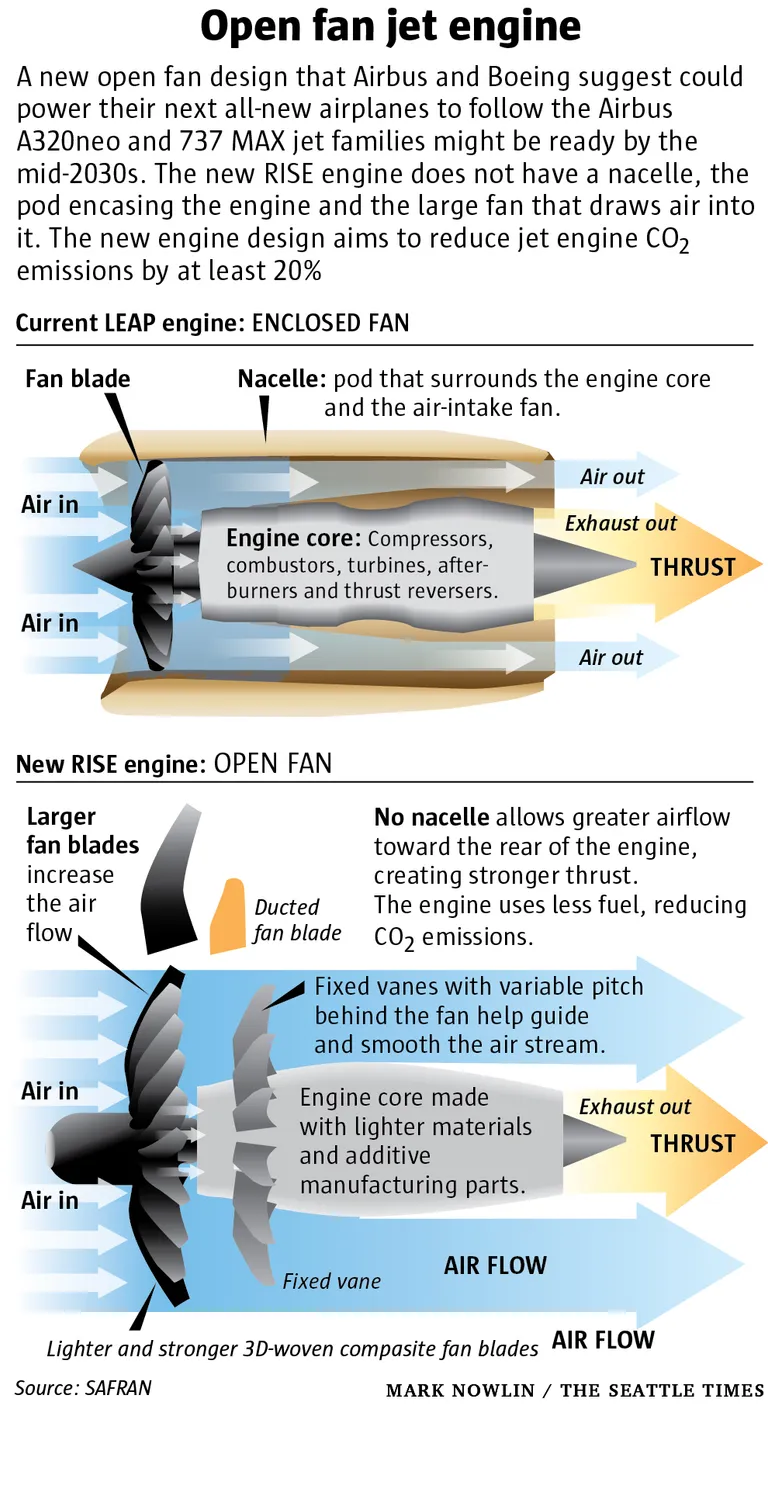
CFM RISE Open-Fan Engine vs. LEAP Enclosed-Fan Engine Comparison Infographic
Infographic from The Seattle Times (Mark Nowlin, sourced from SAFRAN) comparing the current LEAP enclosed-fan jet engine with the new RISE open-fan engine design proposed by Airbus and Boeing. The RISE engine eliminates the nacelle, uses larger 3D-woven composite fan blades and lighter engine core materials, and aims to reduce CO₂ emissions by at least 20%, with potential readiness by the mid-2030s. -
 2023-05-02
Contrails and their impact on climate
This Delta Air Lines presentation from the 2023 Aviation Noise & Emissions Symposium explains what contrails are, how they form, and why they matter for the climate. Contrails are line-shaped clouds created by aircraft engine exhaust or air pressure changes, forming through a rapid process in which exhaust particles become water droplets and then ice crystals within seconds. The presentation explores how to measure contrails' environmental impact and what solutions, including route adjustments, Delta is pursuing to reduce it. -
 2023-05-02
Unleaded aviation gasoline
Swift Fuels, a West Lafayette, Indiana-based company, presented on unleaded aviation gasoline at the Aviation Noise & Emissions Symposium 2023 at UC Davis. The company markets two premium unleaded avgas products: UL94, sold since 2015 with FAA STC approval and ASTM D7547 certification, and a forthcoming high-octane 100R formula. These fuels are designed as lead-free alternatives to conventional aviation gasoline, with approvals from both engine and airframe original equipment manufacturers. -
 2023-05-01
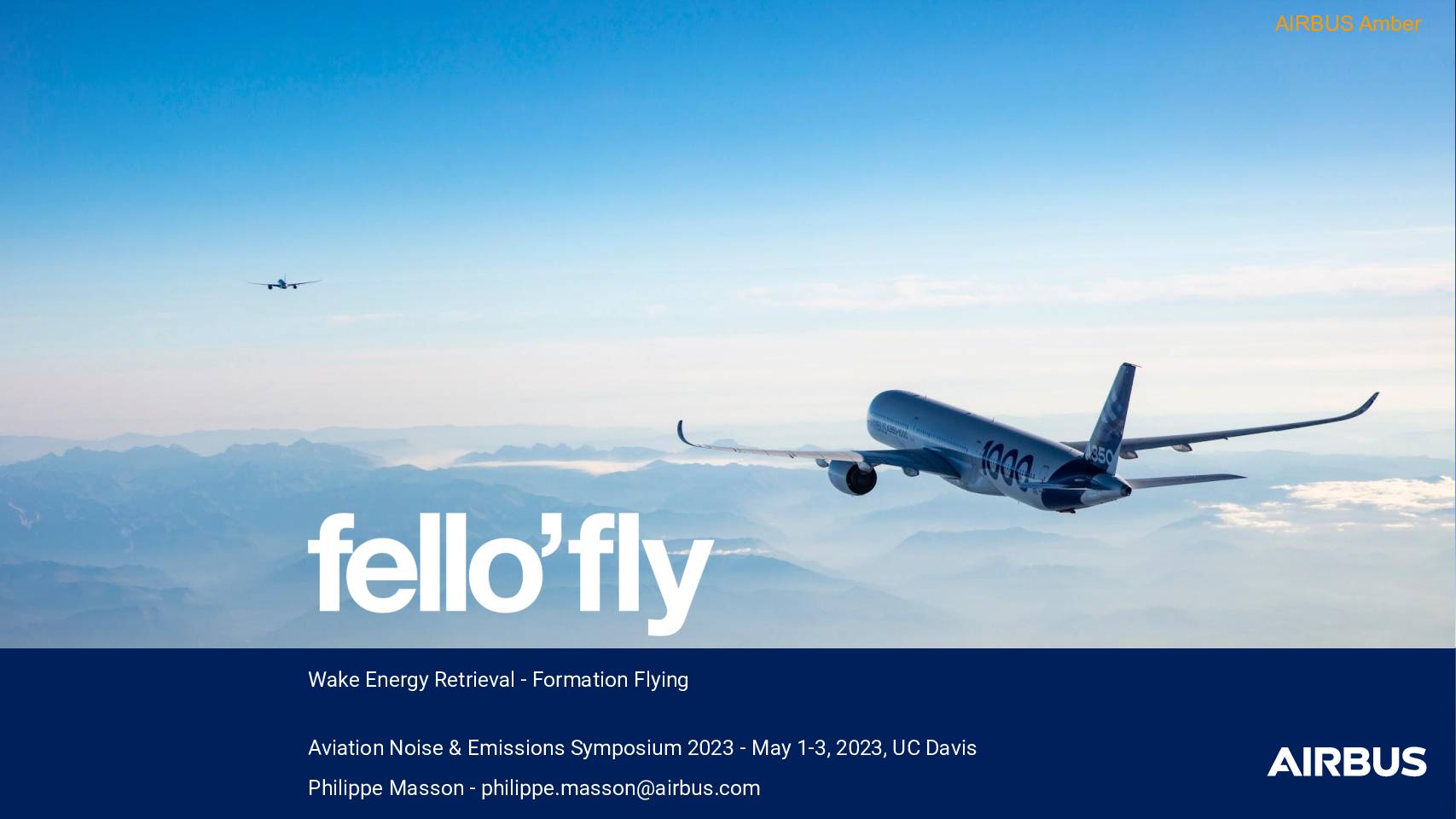
Fello’fly: Wake Energy Retrieval – Formation Flying
Airbus's 'fello'fly' program explores formation flying as a fuel-saving technique, where a follower aircraft positions itself in the smooth updraft of a leading aircraft's wake to recover otherwise wasted kinetic energy. This approach can reduce trip fuel consumption and emissions by around 5% for the follower aircraft, making it most beneficial on long-haul routes exceeding 2,000 nautical miles. Key factors affecting savings include aircraft pairing, the follower's position on the vortex, time spent in formation, and fuel used to enter the formation. -
 2023-03-01
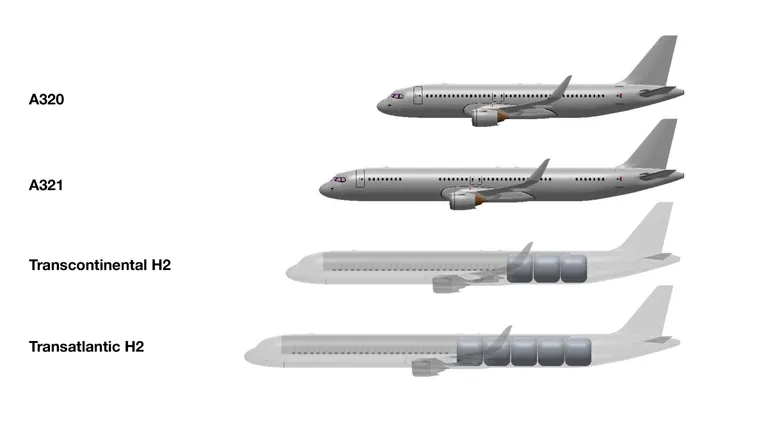
Aircraft Size Comparison – A320, A321, and Transcontinental/Transatlantic H2 Aircraft
The image compares four narrow-body aircraft configurations: the conventional Airbus A320 and A321, alongside two hydrogen-powered concept variants labeled 'Transcontinental H2' and 'Transatlantic H2.' The H2 variants show large cylindrical hydrogen fuel tanks visible in the aft fuselage section, illustrating how liquid hydrogen storage would be integrated into the A320/A321 airframe for medium- and long-range zero-emission flight. -
 2023-02-14
Aviation Noise and Emissions Mitigation Act (H.R. 1048)
H.R. 1048, the Aviation Noise and Emissions Mitigation Act, introduced in February 2023, would direct the EPA to establish a 3-year pilot grant program to measure aircraft and airport noise and emissions—including greenhouse gases, particulate matter, and ultrafine particles—in communities near airports and flight paths. Grant recipients would be required to use technology capable of tracing noise and emissions to specific sources, produce neighborhood- and ZIP Code-level data, and work with local organizations to develop mitigation strategies. The program aims to create a replicable national model for ongoing monitoring and to identify frontline communities disproportionately impacted by aviation-related pollution. -
 2022-10-26
Delta Air Lines Sustainability Overview
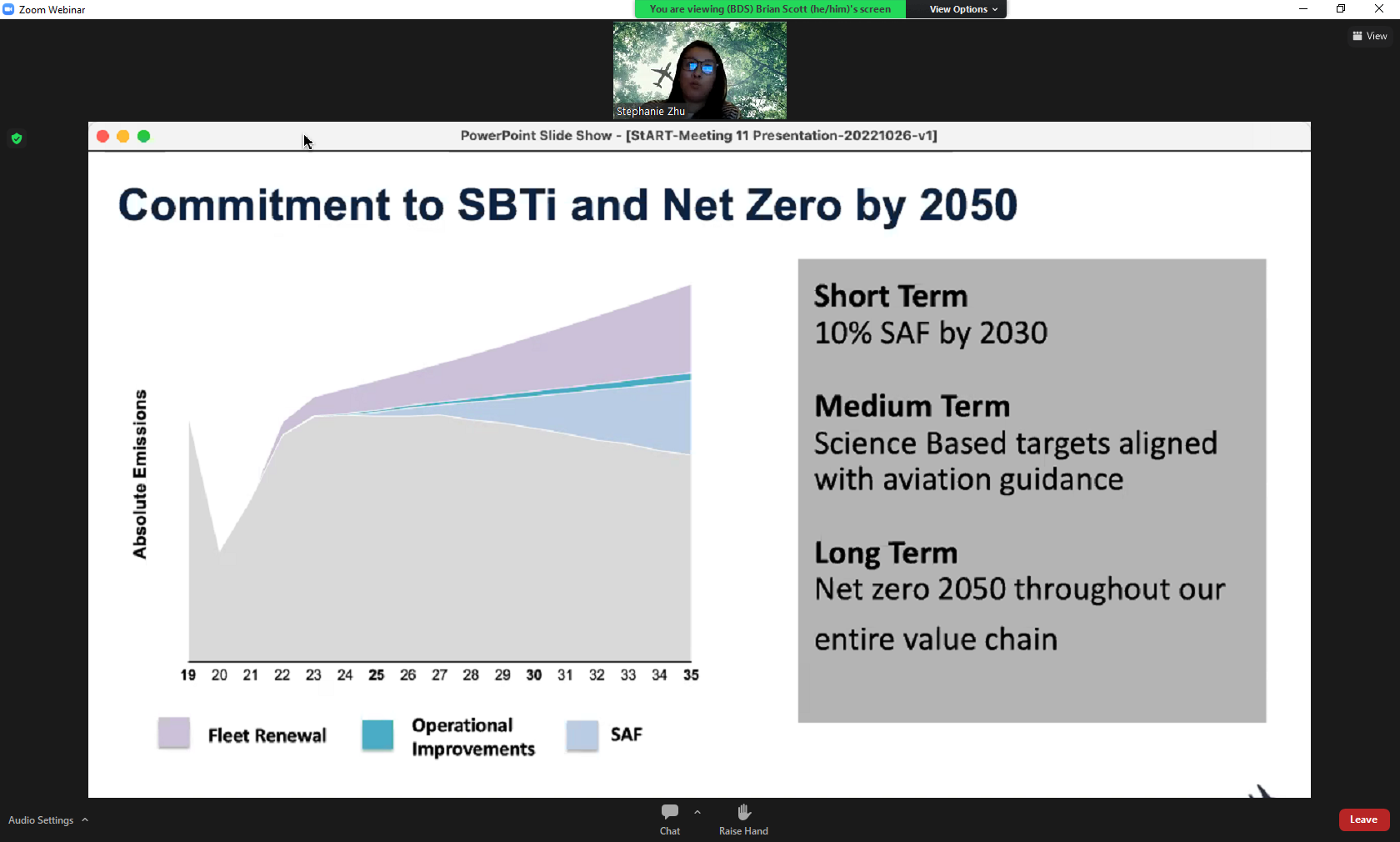
Delta Air Lines has committed to reaching net zero carbon emissions by 2050, with shorter-term goals including using 10% Sustainable Aviation Fuel (SAF) by 2030 and setting science-based emissions targets aligned with aviation industry guidance. To reduce its environmental footprint, Delta has retired over 200 older aircraft and replaced them with newer, more fuel-efficient models that burn 20-25% less fuel. The airline's emissions reduction strategy relies on three main levers: fleet renewal, operational improvements, and increased use of SAF. -
 2022-10-26
StART Meeting 11 Slide: Commitment to SBTi and Net Zero by 2050 (2022-10-26)
A Zoom Webinar screenshot showing a PowerPoint slide titled 'Commitment to SBTi and Net Zero by 2050,' presented during StART (Sea-Tac Airport Roundtable) Meeting 11 on 2022-10-26. The slide outlines short-term (10% SAF by 2030), medium-term (science-based targets aligned with aviation guidance), and long-term (net zero 2050 across the entire value chain) emissions goals, with a chart showing projected absolute emissions reductions via Fleet Renewal, Operational Improvements, and SAF. Participant Stephanie Zhu is visible in the video thumbnail. -
 2022-10-01
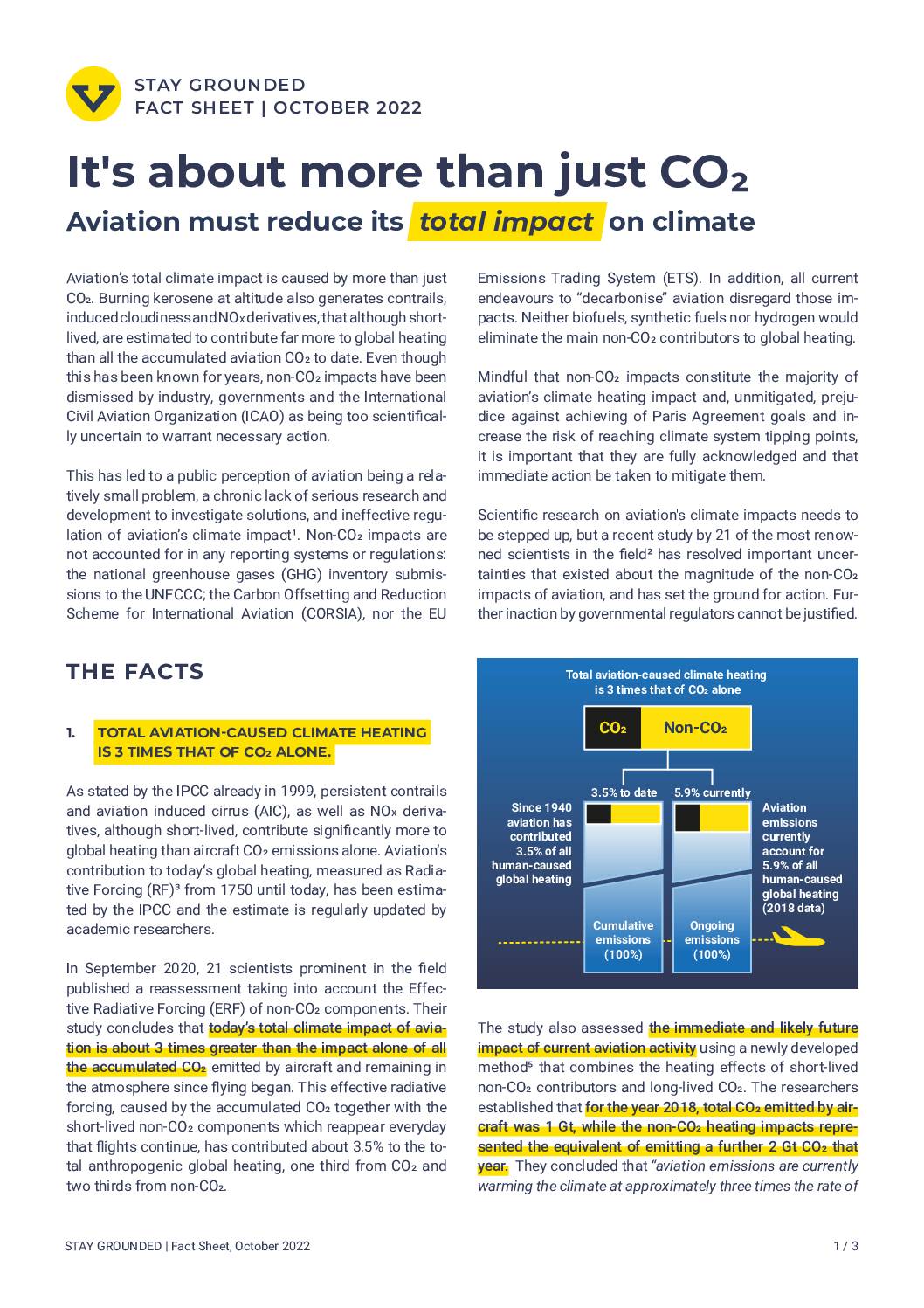
It’s About More Than Just CO₂: Aviation Must Reduce Its Total Impact on Climate
Aviation's climate impact is roughly three times greater than its CO2 emissions alone, because burning jet fuel at altitude also produces contrails, induced cloudiness, and NOx byproducts that add significant additional warming. A 2020 study by 21 leading scientists found that in 2018, aviation accounted for approximately 5.9% of all human-caused global heating when these non-CO2 effects are included. The fact sheet calls for immediate action including contrail-avoidance flight routing, cleaner fuels, stricter emissions regulations, and reduced air traffic overall. -
 2022-08-20
The Effect of Occupational Exposures to Aircraft Ultrafine Particles on Acute Cardiorespiratory Health, and Control Using Personal Protective Equipment
A University of Washington thesis by Mariah Dittmore investigates whether short-term exposure to ultrafine particles from aircraft engines causes measurable cardiorespiratory harm at concentrations found in surrounding communities, and whether personal protective equipment can reduce that harm. The research builds on a 2018 Los Angeles study that linked walking near aircraft pollution to elevated blood inflammation markers, while noting that roadway traffic posed its own distinct respiratory risks. The findings are relevant to policy discussions around Seattle-Tacoma International Airport and the health of workers and residents exposed to aircraft emissions.