TagAviation Emissions(88)
-
 2025-09-15
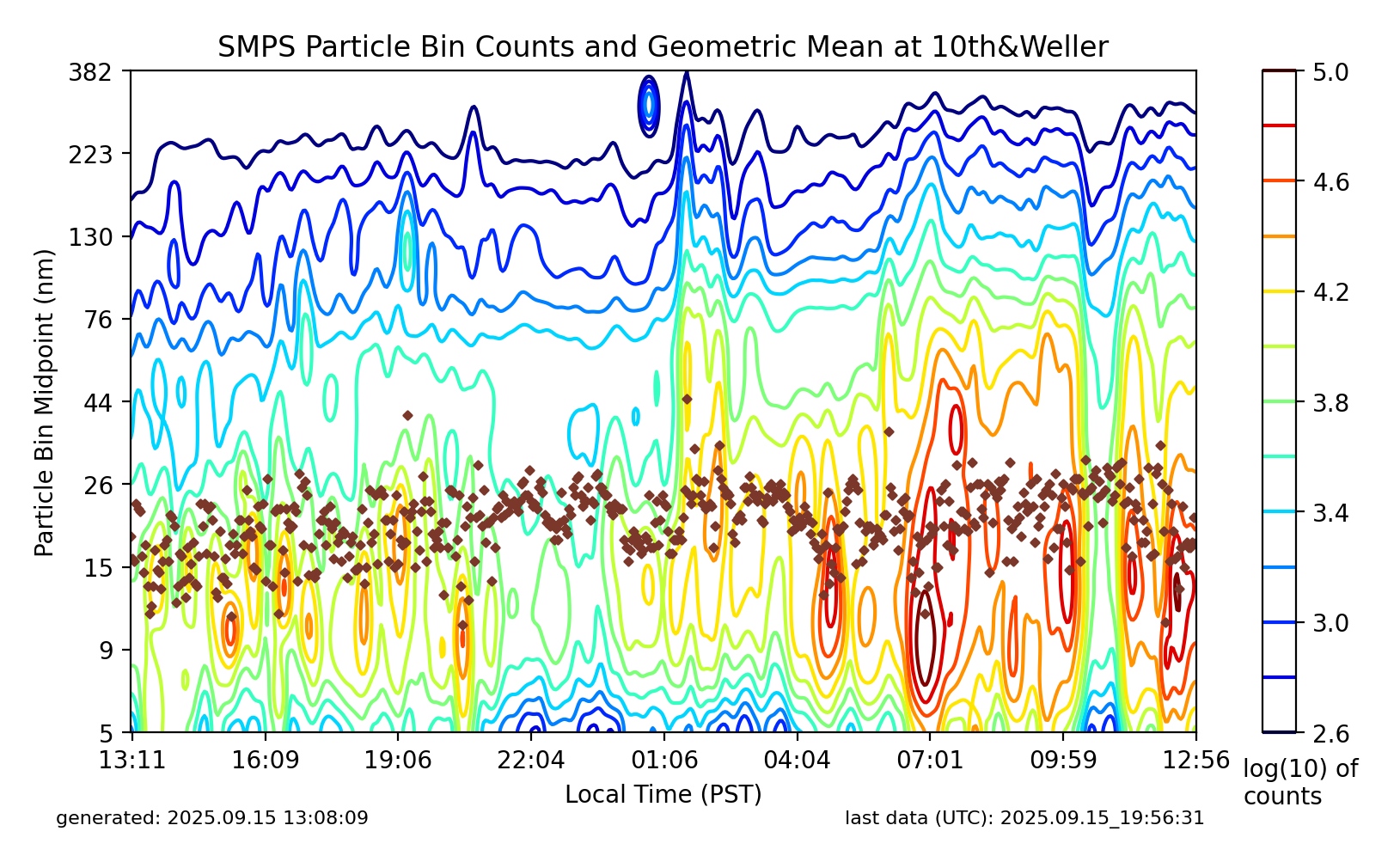
SMPS Particle Bin Counts and Geometric Mean at 10th&Weller
This plot shows Scanning Mobility Particle Sizer (SMPS) aerosol particle size distribution data (5–382 nm) collected at the 10th & Weller monitoring site, generated on 2025-09-15 at 13:08:09 PST with last UTC data timestamp of 2025-09-15 19:56:31. The contour plot displays log(10) particle counts over local PST time from approximately 13:11 on September 14 through 12:56 on September 15, with brown diamond markers indicating the geometric mean particle diameter over time. -
 2025-08-11
Impacts of Aviation Emissions on Community Health
Researchers from the University of Washington presented findings to King County's Airport Round Table Advisory Committee showing that aviation emissions pose significant public health risks to nearby communities. Airports account for 70% of airborne lead emissions in King County, primarily from piston-engine aircraft burning leaded aviation gasoline, and multiple studies link living close to such airports with elevated blood lead levels in children. The presentation also highlighted broader health harms from aviation pollutants—including ultrafine particles and nitrogen oxides—affecting neurological, cardiovascular, and respiratory health. -
 2025-04-25
2024 Environment & Sustainability annual report
The Port of Seattle's 2024 Environment & Sustainability Annual Report, presented on April 25, 2025, outlines the agency's efforts to build a more sustainable and resilient port through six strategic priorities. These include reducing emissions and waste from port operations, attracting clean fuels for maritime and aviation, protecting water quality, and engaging communities. The report covers both aviation and maritime sustainability initiatives led by the Port's Environment and Sustainability team. -
 2025-02-14
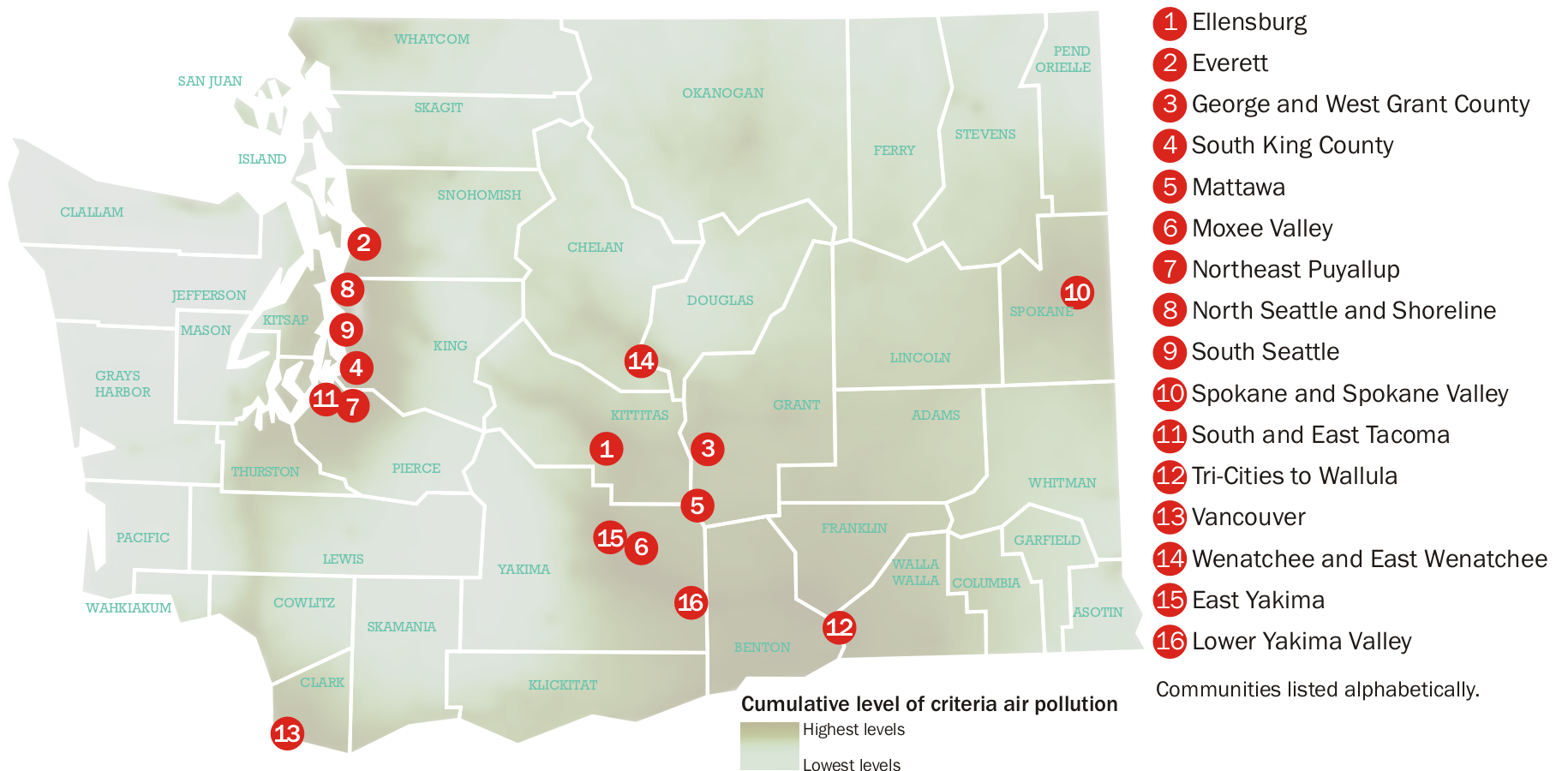
Washington State Air Pollution Map – Airport Communities
A map of Washington State identifying 16 communities with elevated cumulative criteria air pollution levels, including locations such as Spokane, Tacoma, Seattle, Yakima Valley, and Vancouver. The map uses a shading gradient to indicate highest to lowest pollution levels, with numbered red markers pinpointing each named community. -
 2025-01-14
Aviation Noise and Emissions Mitigation Act: Fact Sheet
The Aviation Noise and Emissions Mitigation Act, introduced by Rep. Adam Smith (WA-09), aims to help communities near airports — including those around Sea-Tac — deal with the health risks posed by aviation noise and air pollution. The bill would create two EPA grant programs: one funding research and neighborhood-level monitoring of noise and emissions, and another supporting mitigation efforts such as home soundproofing, public health programs, and healthcare services for affected residents. The legislation responds to studies linking airport emissions to increased risks of cancer, heart disease, and asthma, as well as findings that aircraft noise negatively affects children's learning. -
 2025-01-07
Aviation Noise and Emissions Mitigation Act (H.R. __, 119th Congress, 1st Session)
The Aviation Noise and Emissions Mitigation Act, introduced in the 119th Congress by Rep. Smith of Washington, would direct the EPA to establish a 3-year pilot grant program to measure aircraft and airport noise and emissions—including greenhouse gases, particulate matter, and ultrafine particles—in communities near airports and flight paths. Grant recipients would use advanced monitoring technology to trace pollution to specific sources, produce neighborhood- and ZIP Code-level data, and work with local agencies and community organizations to develop mitigation strategies. The program is designed to be replicable nationwide, with a focus on identifying and protecting frontline and disproportionately impacted communities. -
 2025-01-01
Cascadia Sustainable Aviation Accelerator Overview 2025
Overview document from the Cascadia Sustainable Aviation Accelerator (CSAA), a public/private trade organization focused on de-risking the regional sustainable aviation fuel (SAF) value chain across Washington, Montana, Oregon, Idaho, and British Columbia. Covers SAF as the only viable drop-in replacement for conventional jet fuel over the next 40+ years, the barrier of commercial-scale production, and -

Virgin Atlantic and Air China Aircraft on Airfield with Turbofan Engine in Foreground
A Virgin Atlantic aircraft with 'United Kingdom' livery text visible on the fuselage taxis on the airfield, with an Air China aircraft visible in the background. A large turbofan engine, likely from a third aircraft, is prominent in the foreground right. -
 2024-10-03
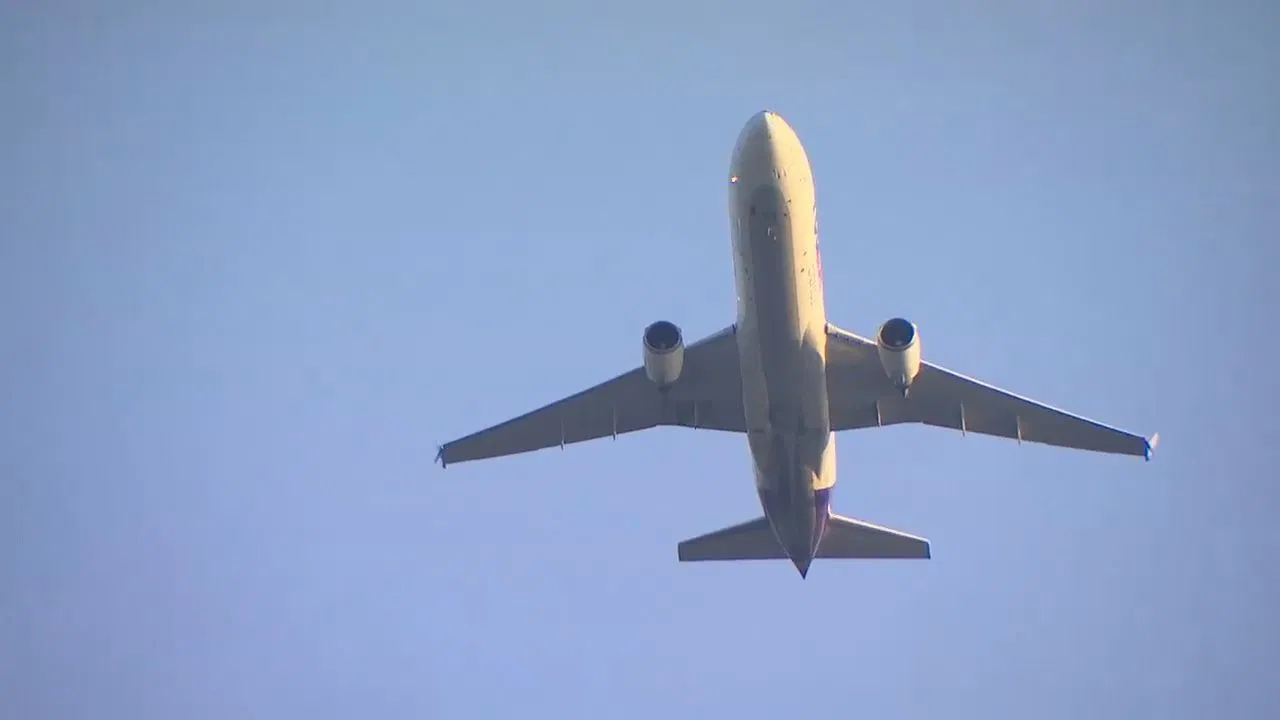
Commercial Jet Aircraft Viewed from Below Against Blue Sky
A white twin-engine narrow-body commercial jet aircraft, viewed from below against a clear blue sky, with landing gear retracted and what appears to be a purple or magenta tail livery partially visible. The aircraft type appears consistent with an Airbus A320-family or Boeing 737-family; no tail number or airline logo is legibly readable from this angle. -
 2024-08-01
Aviation Environmental Design Tool (AEDT) version 3g supplemental manual: Quick start tutorial
The Aviation Environmental Design Tool (AEDT) Version 3g is a Federal Aviation Administration software system used to model aircraft operations and calculate their environmental impacts, including noise, emissions, and fuel consumption. This Quick Start Tutorial guides users through building basic noise and emissions studies, covering steps such as adding airports, creating flight tracks, setting up receptors, and running metric results. The tool is relevant to airport noise policy analysis, as it provides a structured method for quantifying and evaluating the environmental effects of aviation activity around airports like Sea-Tac.