TagANCA(37)
-
H.R.5835 – Omnibus Budget Reconciliation Act of 1990
Included in here under Title 9: Subtitle B: Aviation Safety and Capacity Expansion – Aviation Safety and Capacity Expansion Act of 1990 – Amends the Airport and Airway Improvement Act of 1982 to include as an “airport development” activity the acquisition of land for, or work involved to construct, a burn area training structure on -
 1990-11-05
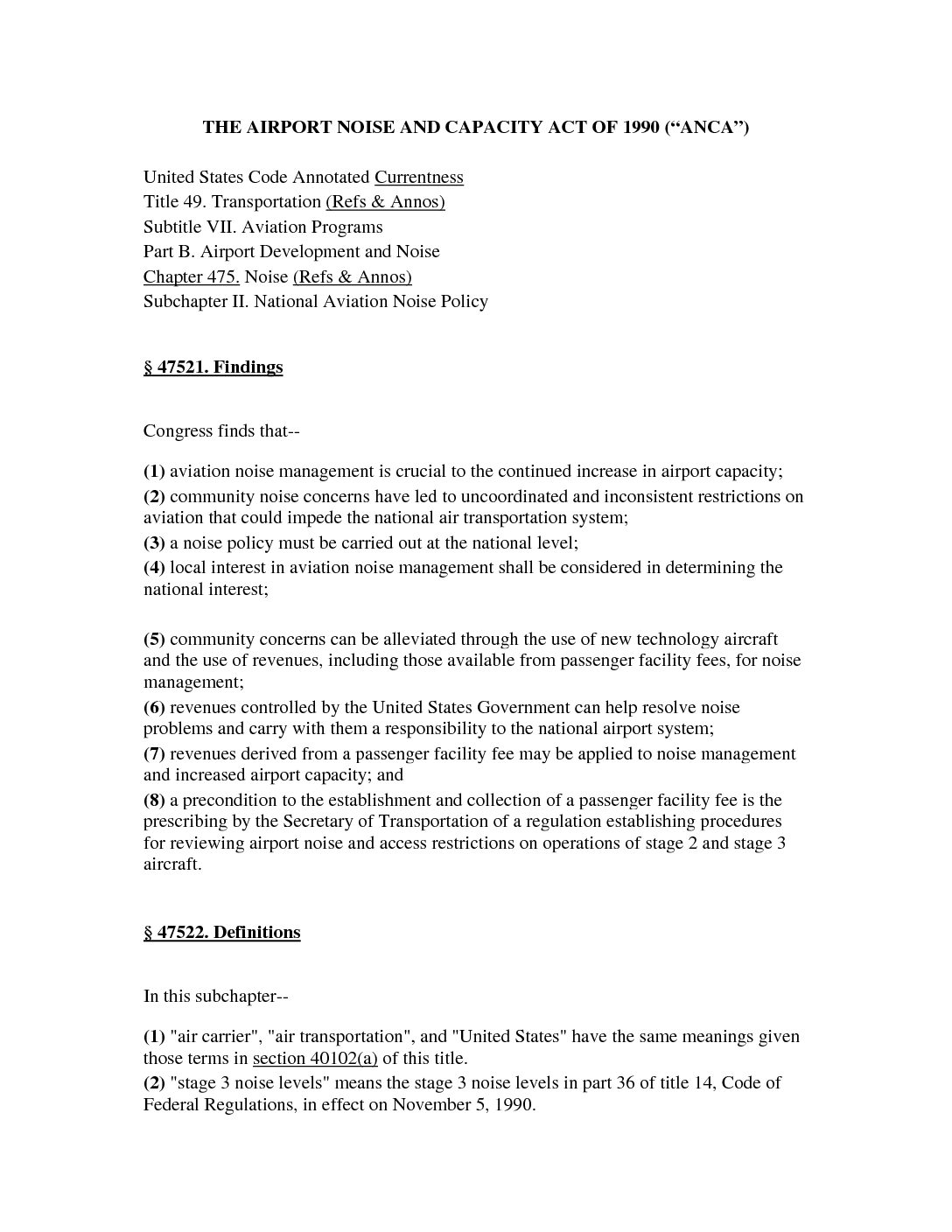
The Airport Noise and Capacity Act of 1990 (“ANCA”)
★ 32The Airport Noise and Capacity Act of 1990 (ANCA) established a national framework for managing aviation noise, requiring the Secretary of Transportation to create a uniform noise policy that phases out louder Stage 2 aircraft and regulates restrictions on quieter Stage 3 aircraft. The law ensures that any local airport noise restrictions—such as limits on flight hours or aircraft operations—go through a formal federal review process to prevent inconsistent, patchwork rules that could disrupt the national air transportation system. Passenger facility fees collected at airports may be used to fund noise reduction efforts and increase airport capacity. -
 1990-01-01
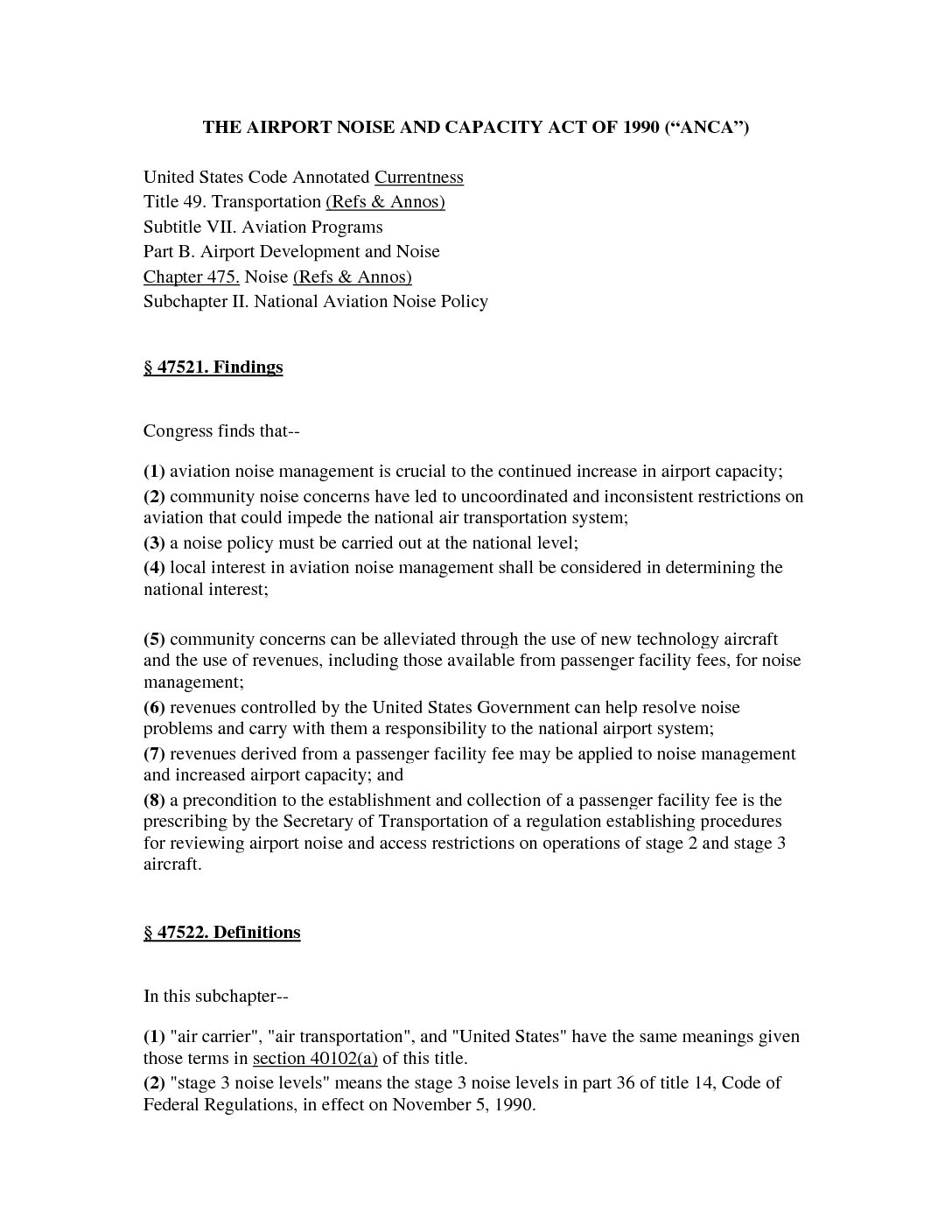
ANCA Airport Noise and Capacity Act of 1990 cover page
This is a page from the United States Code Annotated showing the Airport Noise and Capacity Act of 1990 (ANCA), Title 49, Subtitle VII, Chapter 475, Subchapter II. It includes Congressional findings (§ 47521) on aviation noise management and national noise policy, and definitions (§ 47522) including 'stage 3 noise levels' as defined in 14 CFR Part 36 effective November 5, 1990. -
 1984-07-09
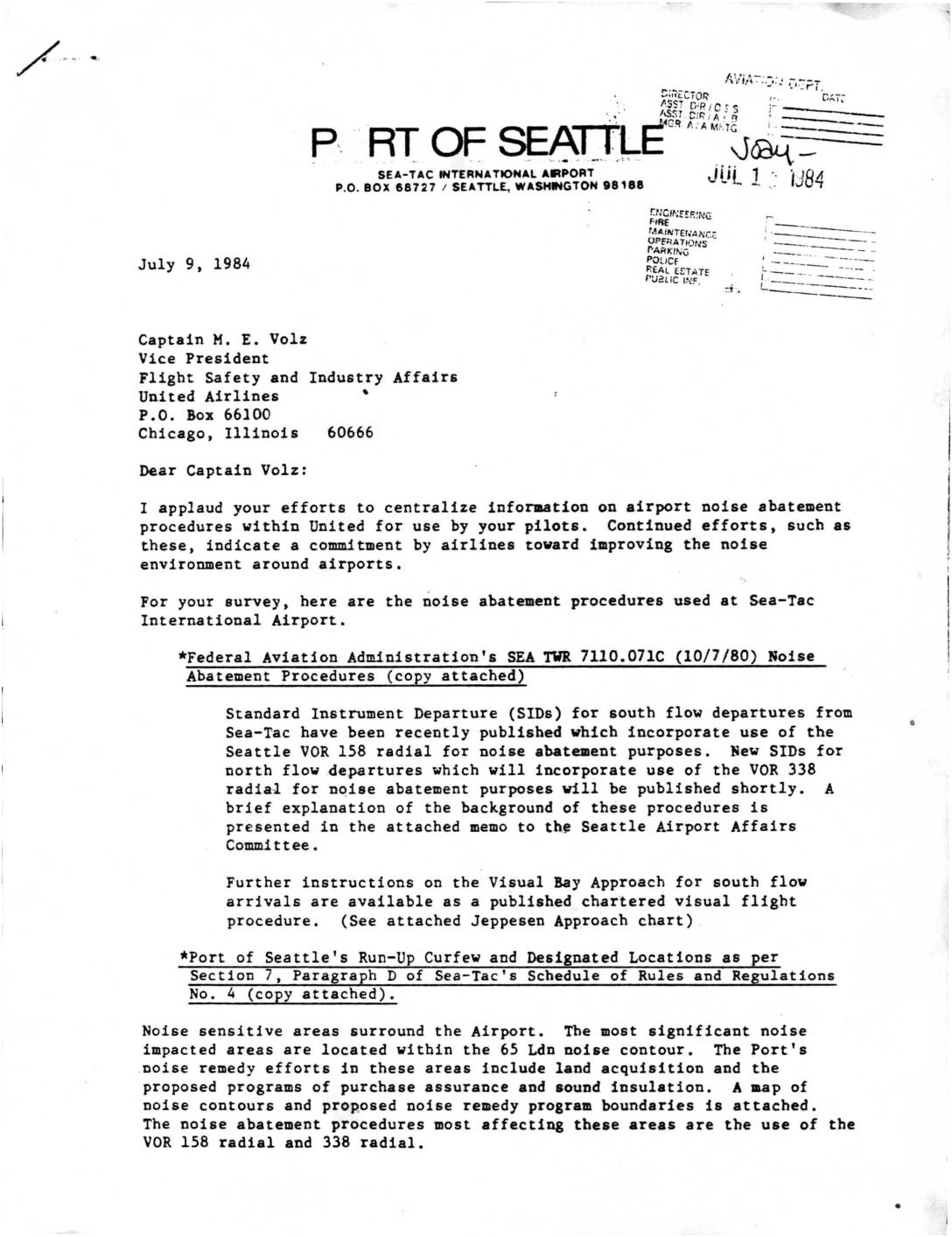
Port Of Seattle Letter to United Airlines on Sea-Tac Airport Noise Abatement Procedures
A July 9, 1984 letter from Port of Seattle to United Airlines Vice President Captain M. E. Volz outlines the noise abatement procedures in use at Seattle-Tacoma International Airport. The procedures include FAA-established Standard Instrument Departure (SID) routes using the Seattle VOR 158 and 338 radials to minimize noise over surrounding communities, a Visual Bay Approach for south flow arrivals, and a Run-Up Curfew with designated engine run-up locations. The letter also notes that the most noise-impacted areas fall within the 65 Ldn noise contour, where the Port was pursuing land acquisition, purchase assurance, and sound insulation programs as remedies. -
 1982-06-01
Sea-Tac International Airport noise exposure update
★ 32This June 1982 report, produced by the Port of Seattle, provides an update on noise exposure levels at Seattle-Tacoma (Sea-Tac) International Airport. It documents the extent of aircraft noise affecting surrounding communities, serving as an official record to inform airport noise management and land-use planning policies. The report was part of ongoing efforts by the Port of Seattle to monitor and address the impact of airport operations on nearby residents. -
 1982-06-01
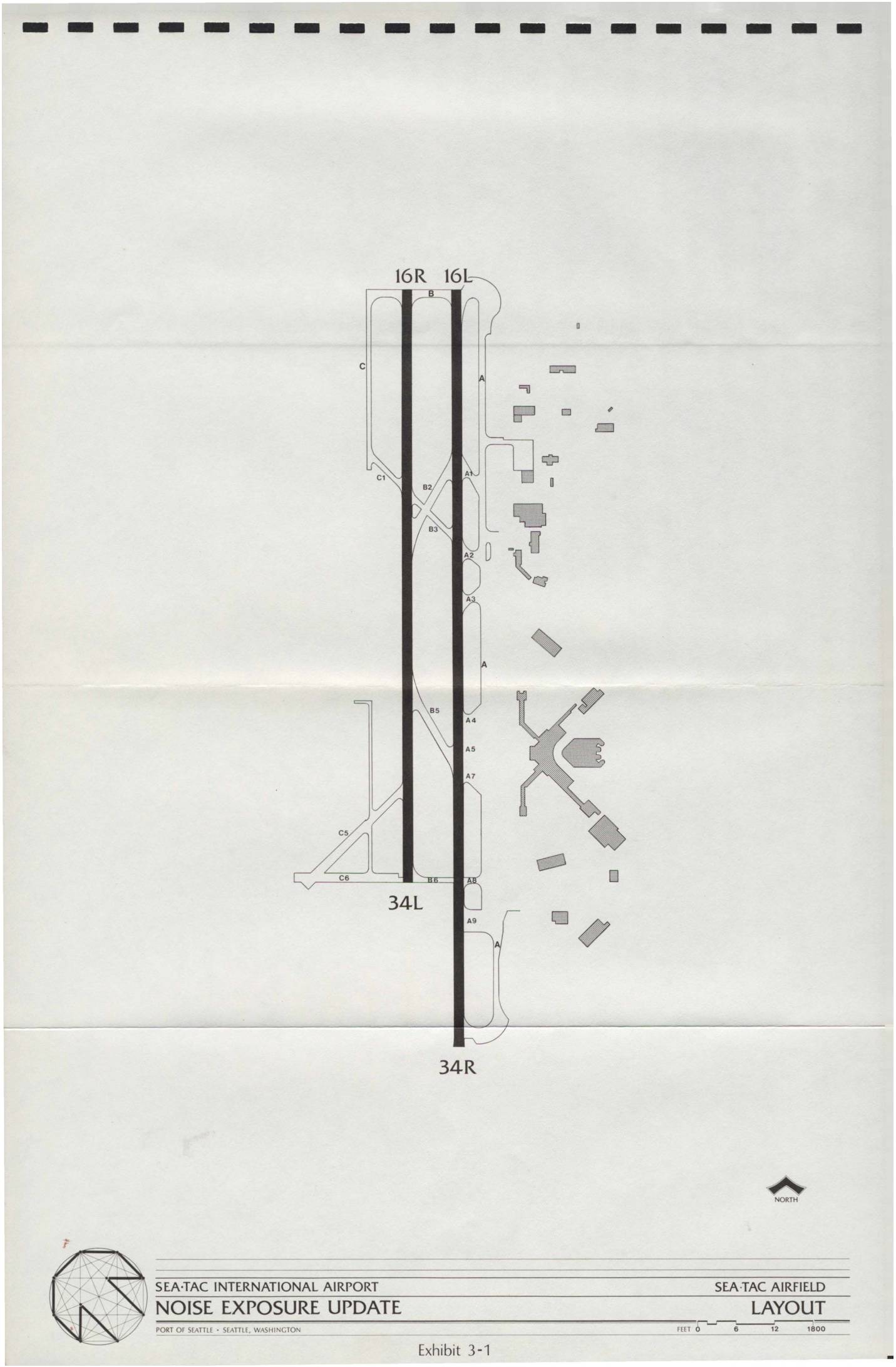
Sea-Tac International Airport Noise Exposure Update: Sea-Tac Airfield Layout and Flight Tracks
This document presents the Sea-Tac International Airport Noise Exposure Update prepared for the Port of Seattle, including a detailed airfield layout showing the two parallel runways (16R/16L and 34R/34L) and associated taxiways. It also includes flight track maps for both South Flow and North Flow operations, illustrating arrival and departure routes used by aircraft over the surrounding communities. The exhibits provide a geographic overview of how flight paths extend across the Seattle metropolitan area, informing noise exposure assessments for airport planning and policy purposes. -
 1982-02-24
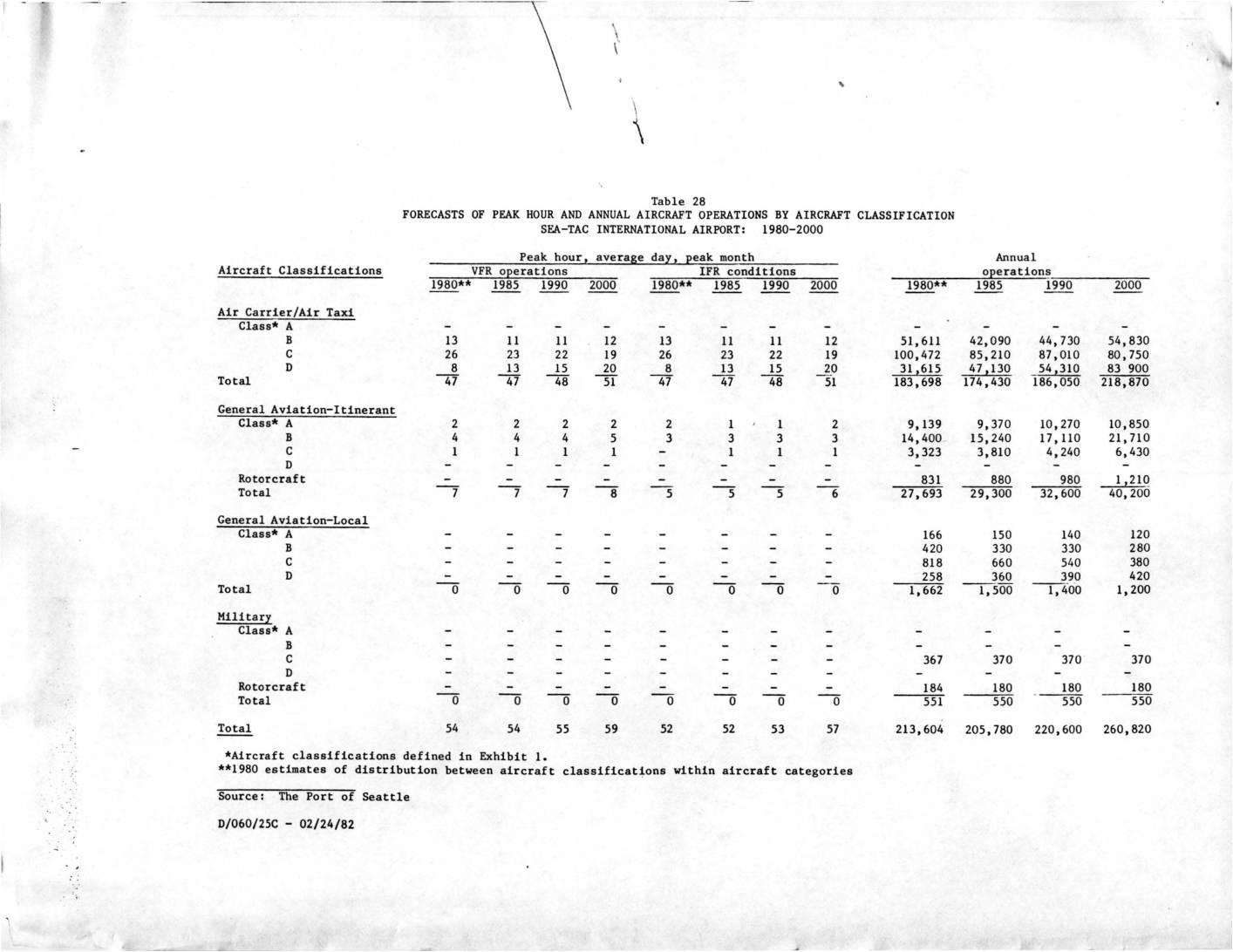
Forecasts of Peak Hour and Annual Aircraft Operations by Aircraft Classification: Sea-Tac International Airport and King County International Airport, 1980–2000
This document presents forecasts of aircraft operations at Seattle-Tacoma (Sea-Tac) International Airport and King County International Airport from 1980 to 2000, broken down by aircraft classification and flight category including air carrier, general aviation, and military. It projects that total annual operations at Sea-Tac will grow from approximately 213,600 in 1980 to over 260,800 by 2000, driven largely by increases in larger Class D air carrier aircraft. Peak hour operation estimates are provided for both Visual Flight Rules (VFR) and Instrument Flight Rules (IFR) conditions, offering planners a detailed basis for noise impact and capacity assessments. -
 1982-01-21
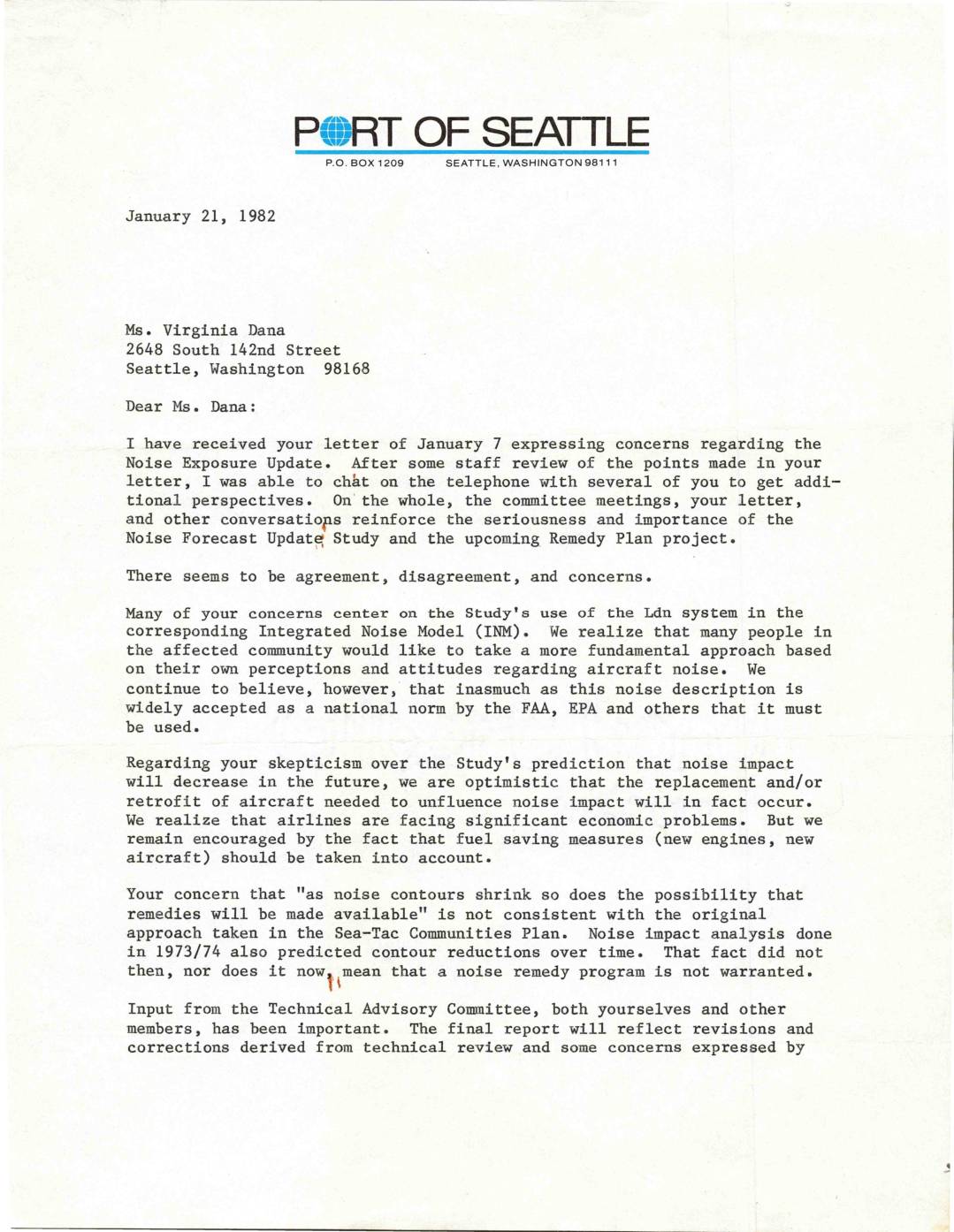
Letter from Clifford C. Muller to Virginia Dana Regarding Noise Exposure Update
In this January 1982 letter, Port of Seattle Planning Director Clifford C. Muller responds to community member Virginia Dana's concerns about the Sea-Tac Airport Noise Exposure Update Study. He addresses skepticism over the Ldn noise measurement system, defends the study's prediction that noise impact will decrease as airlines adopt quieter aircraft, and reassures Dana that shrinking noise contours do not eliminate eligibility for noise remedy programs. Muller acknowledges that the Technical Advisory Committee's input has been valuable and indicates that the upcoming Remedy Plan project will be the primary venue for addressing ongoing community concerns. -
 1982-01-07
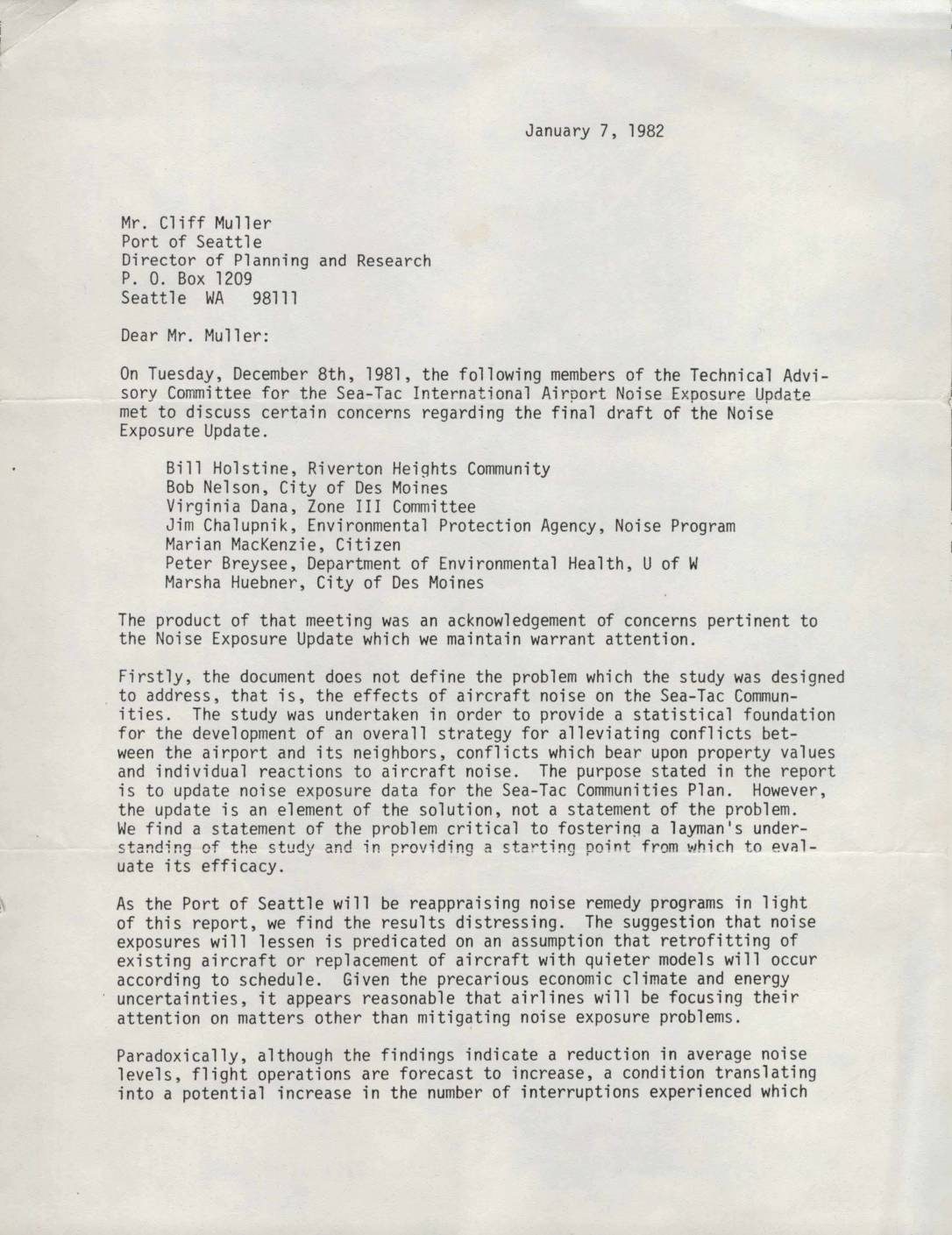
Letter to Cliff Muller, Port Of Seattle, from Technical Advisory Committee Re: Sea-Tac Noise Exposure Update Concerns
In January 1982, members of the Technical Advisory Committee for the Sea-Tac International Airport Noise Exposure Update wrote to the Port of Seattle's Director of Planning and Research to raise concerns about the final draft of the noise study. The letter argues that the report fails to clearly define the problem of aircraft noise impacts on surrounding communities, relies on optimistic assumptions about airlines adopting quieter aircraft, and uses an average noise level methodology that does not capture how residents actually experience flight disruptions. The committee also expressed frustration that their technical input and unanswered questions were largely ignored, despite their role being cited in the report as evidence of public participation. -
 1981-12-17
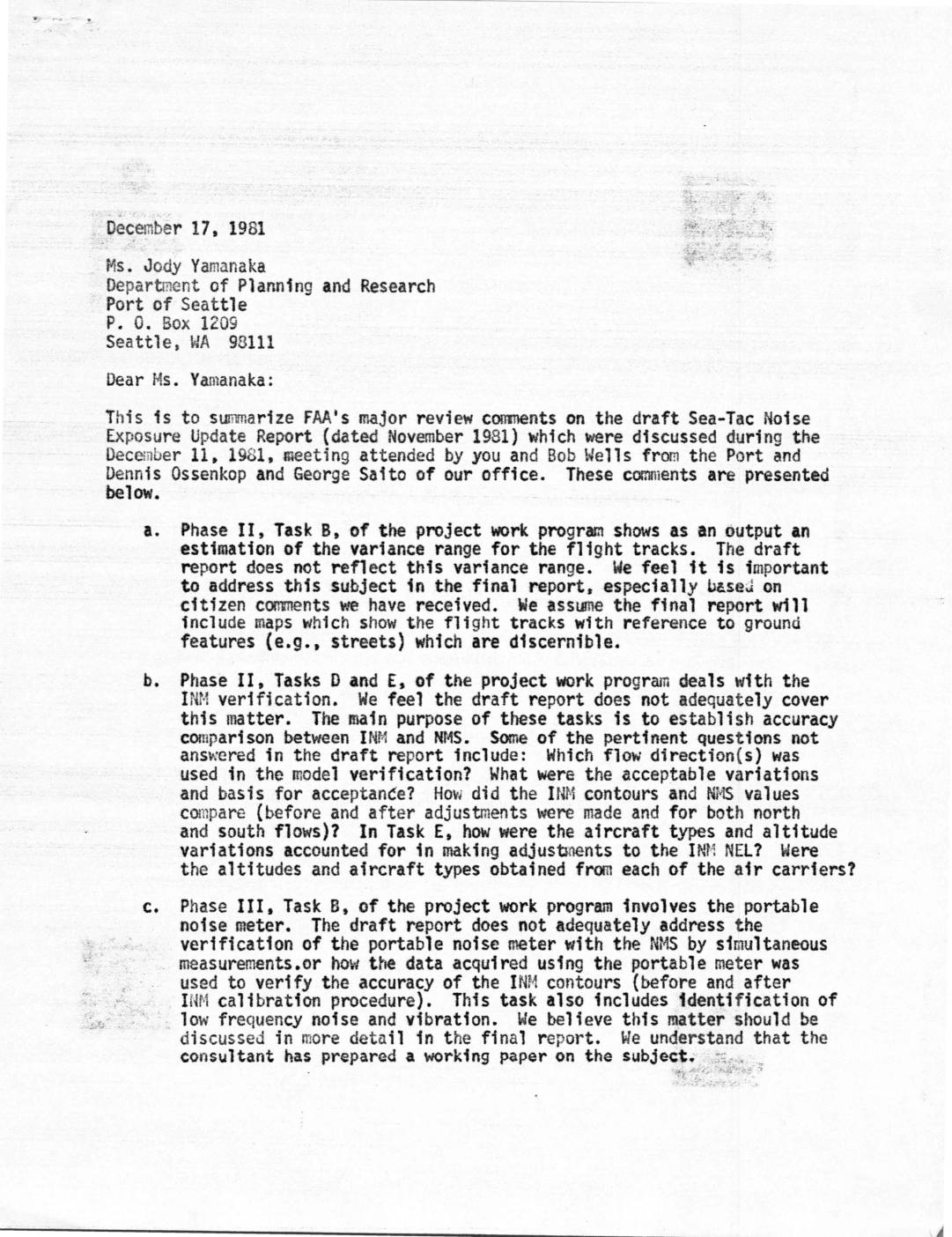
FAA Review Comments on Draft Sea-Tac Noise Exposure Update Report: Letter to Jody Yamanaka
A December 17, 1981 letter from FAA Acting Chief Mark A. Beisse to the Port of Seattle summarizes the FAA's major review comments on the draft Sea-Tac Noise Exposure Update Report. The letter identifies multiple deficiencies in the draft, including inadequate coverage of flight track variance ranges, INM model verification, portable noise meter data, and noise impact projections under different operational scenarios. The FAA requested that these issues be addressed in the final report and asked the Port to clarify whether certain project tasks, such as a population and land use survey, would be dropped from the study.