TagANCA(37)
-
Why Can’t We Have A Curfew?
Blame it on ANCA , the Airport Noise And Capacity Act Of 1990. Airport law–specifically the history of how communities lost their rights–is long. You can read a short history at our Airport Law Cheat Sheet. But one question people have is WHY CAN’T WE SLEEP AT NIGHT? So here is a summary of. The -
S.3094 – Airport Noise and Capacity Act of 1990 (ANCA)
The full text of the 1990 ANCA bill S.3094. To get a clear understanding of what the law is really about, one should look at the House version described in the Budget Resolution HR 5835 where it is referred to as the “Aviation Safety and Capacity Expansion Act”. S 3094 IS 101st CONGRESS 2d -
Part 150 (Title 14 of Code Of Federal Regulations)
These regulations govern airports noise exposure maps and noise compatibility programs. -
Part 161 (Title 14 of Code Of Federal Regulations)
Regulations governing Airport Noise and Capacity Act of 1990 -
Airport Noise Law – Airport Noise & Capacity Act 1990
A great article describing ANCA in broad strokes. -
 2015-03-11
Final Update of the LAX Part 161 Application
This 2015 presentation from Los Angeles World Airports (LAWA) provides a final update on LAX's application under FAR Part 161, a federal process requiring airports to prove that the benefits of a proposed noise restriction outweigh its costs before the FAA will approve it. The application sought to limit aircraft noise and access at LAX, but was ultimately disapproved by the FAA — consistent with the agency's history of never approving such a restriction at a commercial air carrier airport in the 25 years since the Airport Noise and Capacity Act was enacted in 1990. -
 2009-10-30
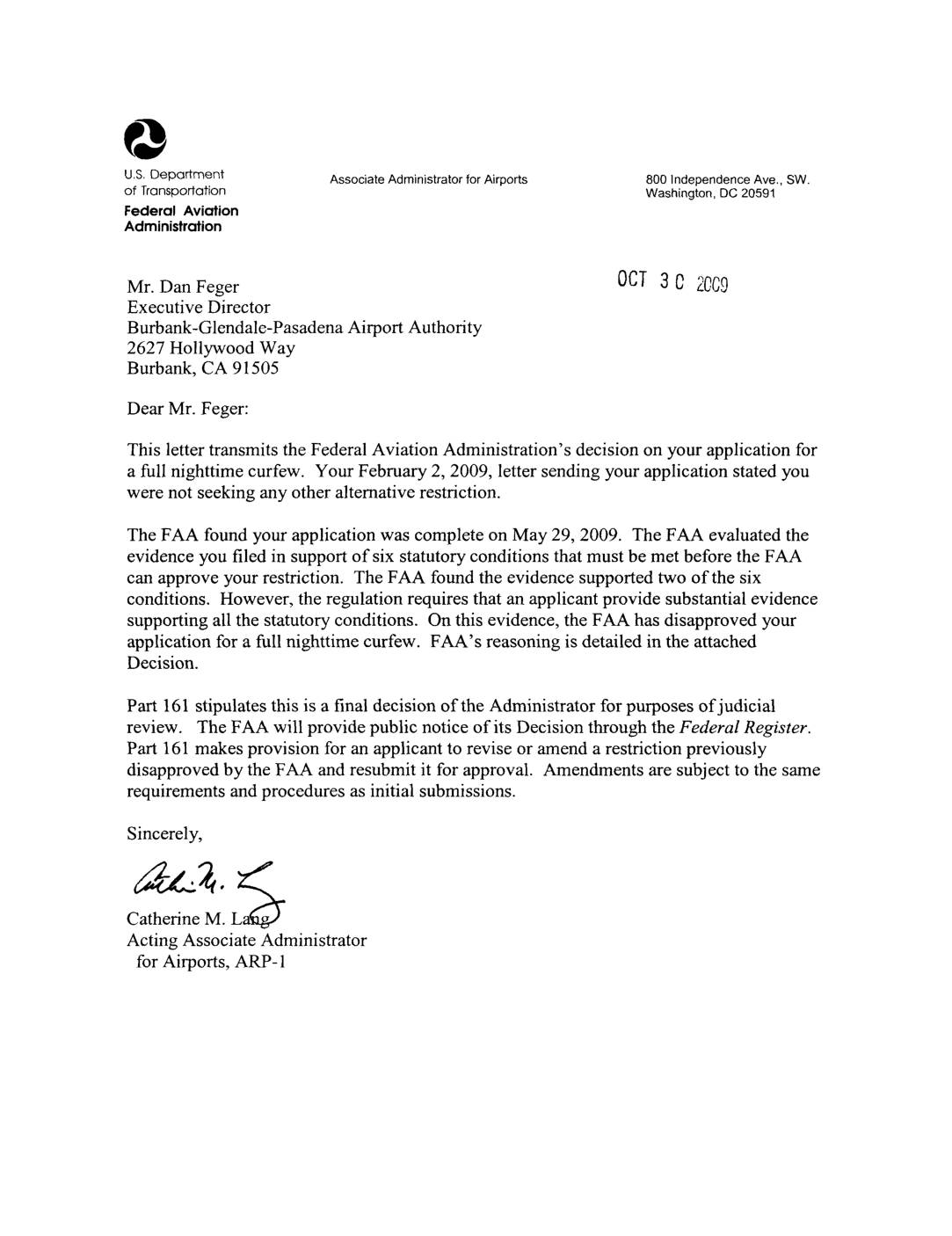
FAA Decision Letter: Disapproval of Burbank-Glendale-Pasadena Airport Authority Application for Full Nighttime Curfew at Bob Hope Airport
The FAA denied the Burbank-Glendale-Pasadena Airport Authority's 2009 application to impose a full nighttime flight curfew (10:00 p.m. to 6:59 a.m.) at Bob Hope Airport in Burbank, California. Under the Airport Noise and Capacity Act of 1990, all six statutory conditions must be supported by substantial evidence for such a restriction to be approved, but the Authority's application only satisfied two of the six required conditions. The Authority was informed it could revise and resubmit its application, subject to the same review requirements. -
 2009-09-30
FAA Airport Compliance Manual
This FAA document (Order 5190.6B), effective September 30, 2009, is the FAA Airport Compliance Manual, which guides FAA personnel on how to interpret and enforce the federal obligations that airport sponsors assume when they accept federal grant funds or federally owned property. It covers the rules and assurances airports must follow to remain in compliance with federal law, including how properties can be used and what commitments sponsors make to the U.S. government. The manual is administered by the FAA Airport Compliance Division in Washington, DC. -
 2004-06-01
Guide to Airport Noise Rules and Use Restrictions
This guide, produced by law firm Kaplan Kirsch & Rockwell and noise consulting firm Harris Miller Miller & Hanson, explains the rules and regulations governing airport noise and aircraft use restrictions at publicly owned airports. It covers who is responsible for regulating airports and aircraft, what tools airports have to manage noise, and the requirements of the Airport Noise and Capacity Act of 1990. The guide is designed for airport managers, elected officials, consultants, and community groups seeking to understand how noise disputes are handled and resolved. -
2000-01-01
DCA Reagan National – Nighttime Noise Rule
DCA Nighttime Noise Rule History: Since 1941, Reagan National (DCA) has operated as a commercial airfield, 24-hours a day, 7-days a week. In the early 1980s, louder aircraft operating at Reagan National prompted the FAA – the original airport operator – to impose nighttime noise limits and the ability to fine non-compliant operations between 10 p.m. and 6:59 a.m. which became known