Notes
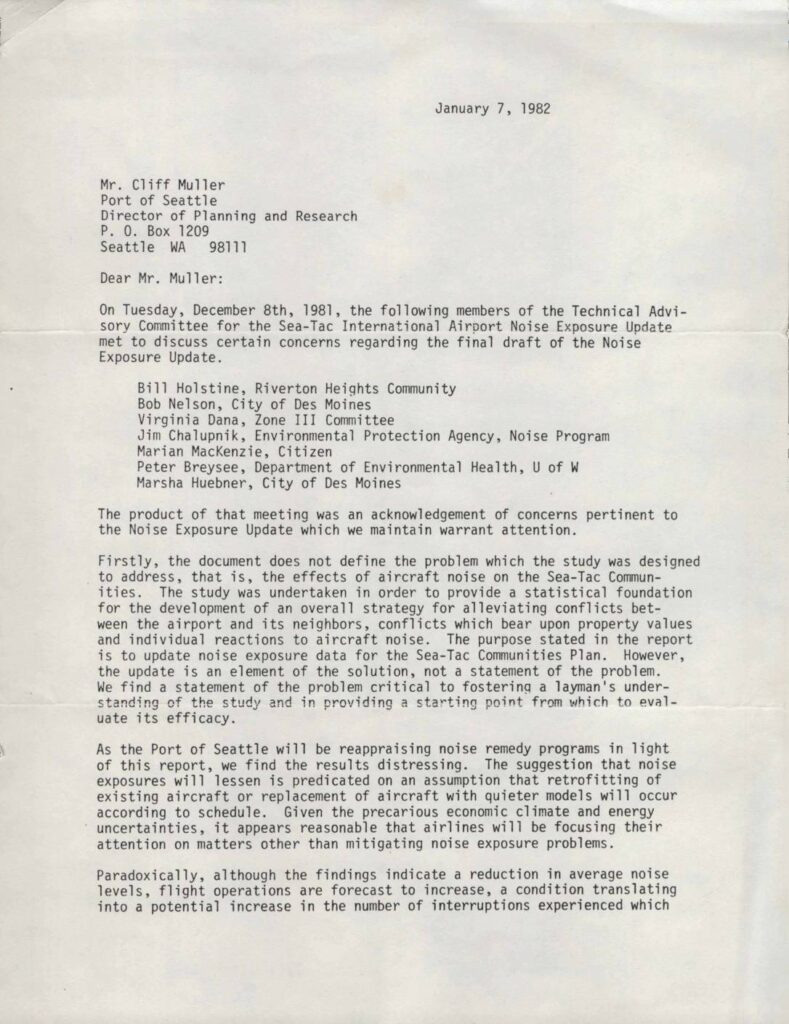
January 7, 1982 letter signed by Marsha Huebner on behalf of Technical Advisory Committee members Bob Nelson, Virginia Dana, Jim Chalupnik, Marian MacKenzie, Peter Breysee, and Bill Holstine, addressed to Cliff Muller, Director of Planning and Research, Port Of Seattle. The letter raises concerns about the final draft of the Sea-Tac International Airport Noise Exposure Update following a December 8, 1981 committee meeting. Key objections include: the report fails to define the problem of aircraft noise effects on Sea-Tac Communities; the assumption that aircraft retrofitting or replacement with quieter models will occur on schedule is questioned given the economic climate; a paradox is identified whereby average noise levels may decrease while flight operations increase, raising the number of noise interruptions; the average noise level (DNL) methodology is critiqued as inadequate to capture community noise perception; and the Technical Advisory Committee states its input was used only to meet public participation requirements and was not substantively incorporated. Copied to Oris Dunham, Director of Aviation, and Richard Ford, Executive Director.