TagAcademic Journals(54)
-
 2018-02-13
Environmental noise and the cardiovascular system
Research published in the Journal of the American College of Cardiology found that environmental noise from traffic, aircraft, and railways is linked to serious cardiovascular health risks, including high blood pressure, heart attack, heart failure, and stroke. Studies in both humans and animals show that aircraft noise — especially at night — triggers stress hormones and harmful oxidative stress in blood vessels, impairing their ability to function properly. These findings suggest that airport noise exposure is not just a quality-of-life issue but a measurable public health concern with direct effects on heart and vascular health. -
 2016-08-16
Aviation Emissions Impact Ambient Ultrafine Particle Concentrations in the Greater Boston Area
Peer-reviewed study by Hudda, Simon, Zamore, Brugge, and Durant (Tufts University, Somerville Transportation Equity Partnership) published in Environmental Science & Technology (2016), examining aviation emission impacts on ambient ultrafine particle number concentrations (PNCs) at three monitoring sites within 7.3 km of Logan International Airport (Boston, MA). PNCs measured via condensation particle counters (CPCs, TSI model -
 2016-07-01
Environmental Justice, before and after Executive Order 12898: What are agencies doing, how well are they doing it, and what else can be done?
This academic paper examines how U.S. federal agencies have addressed Environmental Justice (EJ) since President Clinton's 1994 Executive Order 12898, which required agencies to reduce disproportionate pollution burdens on low-income and minority communities. The author, a Bureau of Land Management social scientist, reviews agency compliance efforts, highlights case studies like the Flint water crisis, and argues that practical steps such as staff training and social science tools can help agencies consistently protect vulnerable communities regardless of shifting political priorities. -
 2015-05-01
Residential Sorting and Environmental Externalities: the Case of Non-linearities and Stigma in Aviation Noise Values
Academic journal article by Sotirios Thanos, Abigail L. Bristow, and Mark R. Wardman, published in the Journal of Regional Science (May 2015), examining residential sorting in response to aviation noise exposure in a housing market. Uses Spatiotemporal Hedonic Pricing (HP) and Stated Choice (SC) methods to quantify nonlinear noise depreciation ranging from 0.40 to 2.38 -
2015-05-01
Residential Sorting and Environmental Externalities: the Case of Non-linearities and Stigma in Aviation Noise Values
Academic journal article by Sotirios Thanos, Abigail L. Bristow, and Mark R. Wardman, published in the Journal of Regional Science (May 2015), examining residential sorting in response to aviation noise exposure in a housing market. Uses Spatiotemporal Hedonic Pricing (HP) and Stated Choice (SC) methods to quantify nonlinear noise depreciation ranging from 0.40 to 2.38 -
 2014-05-29
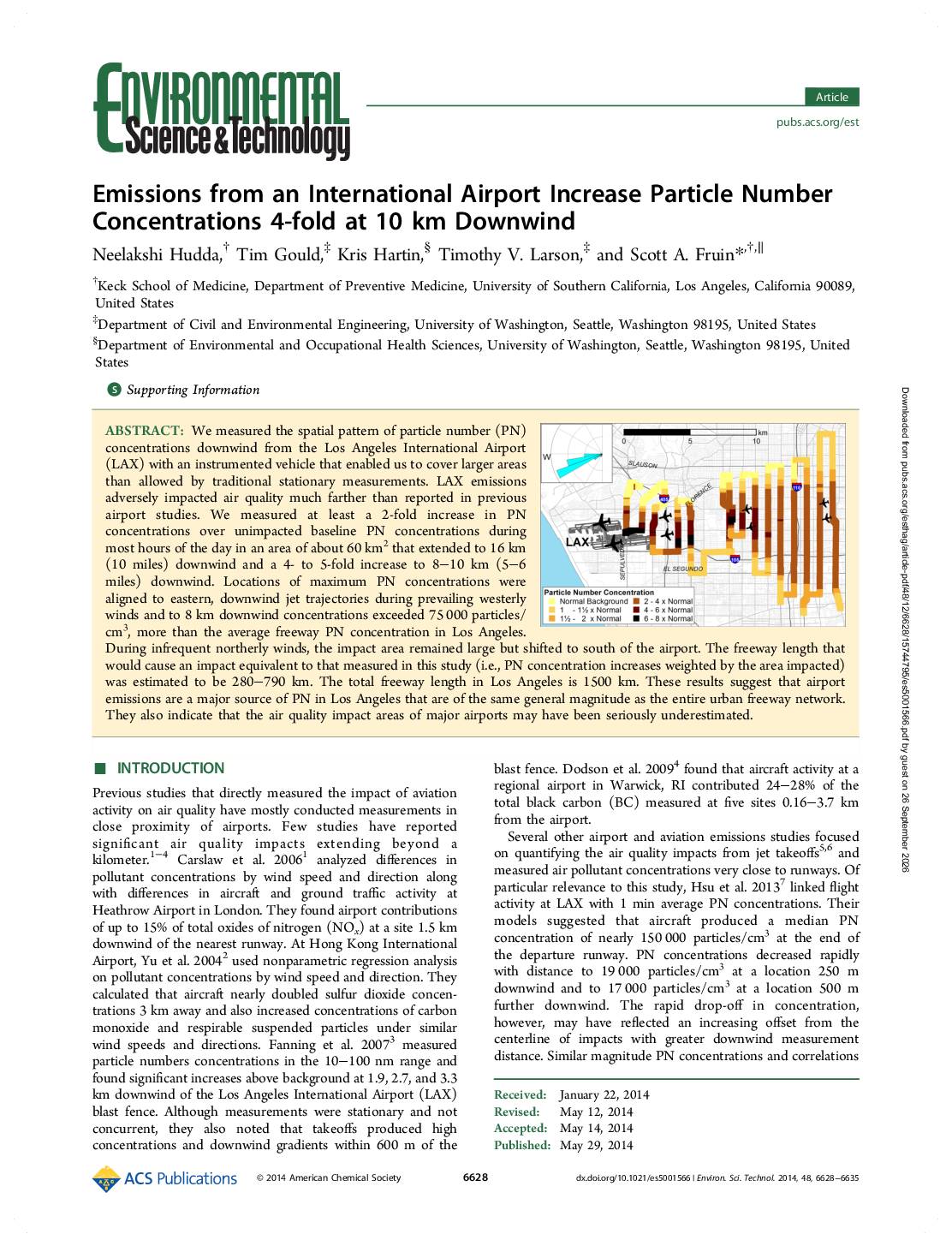
Emissions from an International Airport Increase Particle Number Concentrations 4-fold at 10 km Downwind
Peer-reviewed study published in Environmental Science & Technology (American Chemical Society, 2014) by Neelakshi Hudda, Tim Gould, Kris Hartin, Timothy V. Larson, and Scott A. Fruin measuring spatial patterns of particle number (PN) concentrations downwind of Los Angeles International Airport (LAX) using mobile monitoring platforms (MMP) from USC and University of Washington. Study found at -
 2014-05-29
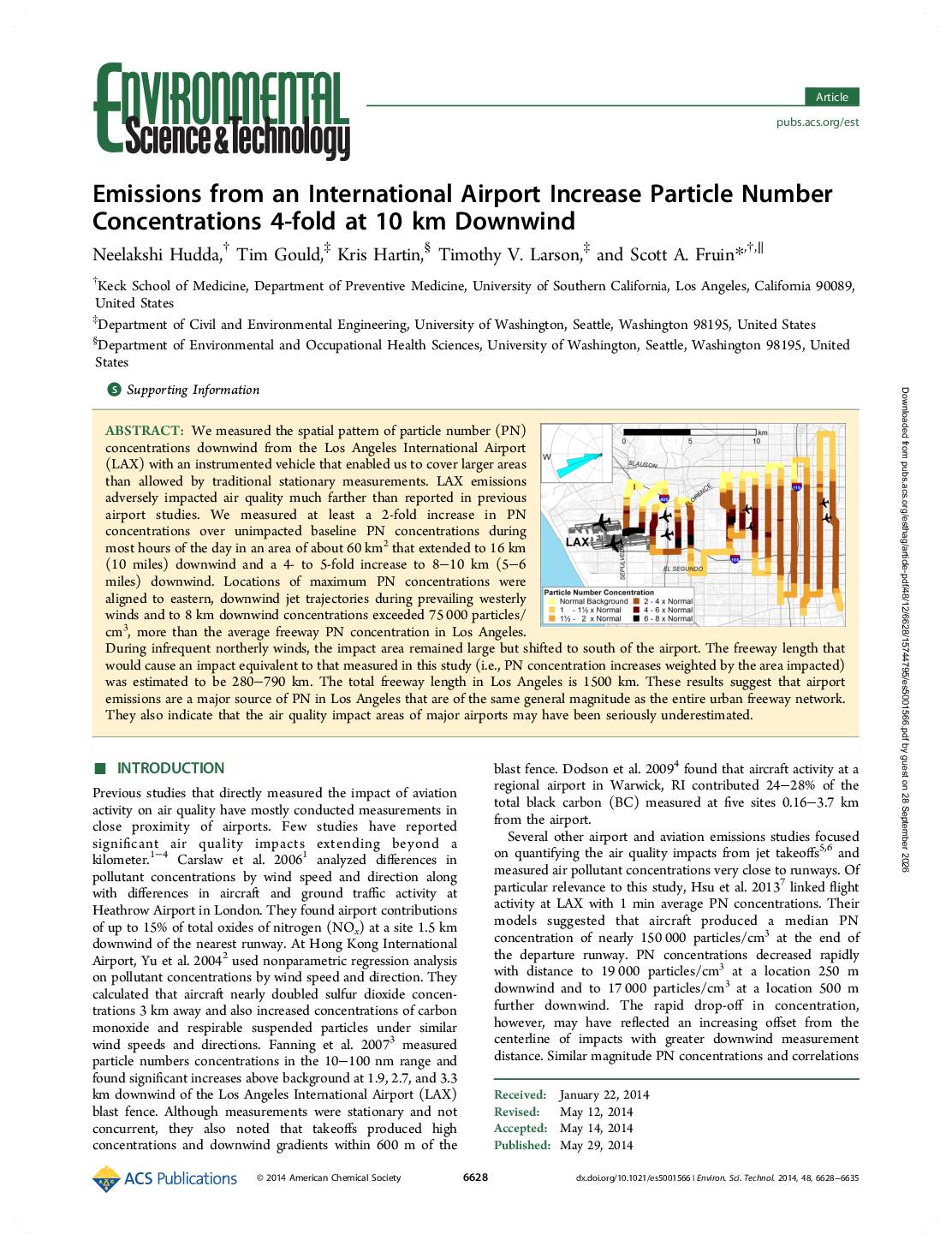
Emissions from an International Airport Increase Particle Number Concentrations 4-fold at 10 km Downwind
Peer-reviewed study published in Environmental Science & Technology (American Chemical Society, 2014) by Neelakshi Hudda, Tim Gould, Kris Hartin, Timothy V. Larson, and Scott A. Fruin (USC Keck School of Medicine / University of Washington) measuring spatial patterns of particle number (PN) concentrations downwind from Los Angeles International Airport (LAX). Using mobile monitoring platforms (MMP) -
 2011-03-01
Collaboration and Climate Action at the Local Scale
This 2011 doctoral dissertation by Linda Lyshall, submitted to Antioch University's PhD Program in Leadership and Change, examines how local-scale collaboration can drive climate action and environmental policy. The research explores the intersection of leadership, organizational behavior, and sustainability in addressing climate change at the community level. While not specific to Sea-Tac Airport noise policy, it may offer relevant frameworks for understanding collaborative governance and local environmental decision-making. -
 2010-06-01
Design and performance of a 46m high MSE wall
This engineering study describes the design and construction of a 46-meter (150-foot) tall mechanically stabilized earth (MSE) retaining wall built along the western edge of Seattle-Tacoma International Airport's third runway embankment, believed to be the tallest such wall in the western hemisphere at the time. The wall was necessary to raise the ground level by up to 50 meters while avoiding encroachment into nearby wetlands and creeks. Monitoring of the wall during and after construction confirmed it performed safely and largely as predicted. -
 2009-05-18
Low Frequency Noise. What we know, what we do not know, and what we would like to know
Academic review paper examining perception of low frequency noise and infrasound, including human responses, measurement challenges, and the historical misconceptions that have created public fear around these sound phenomena. The paper addresses hearing thresholds, sensitivity variations, and unexplained complaints of low frequency noise.