Notes
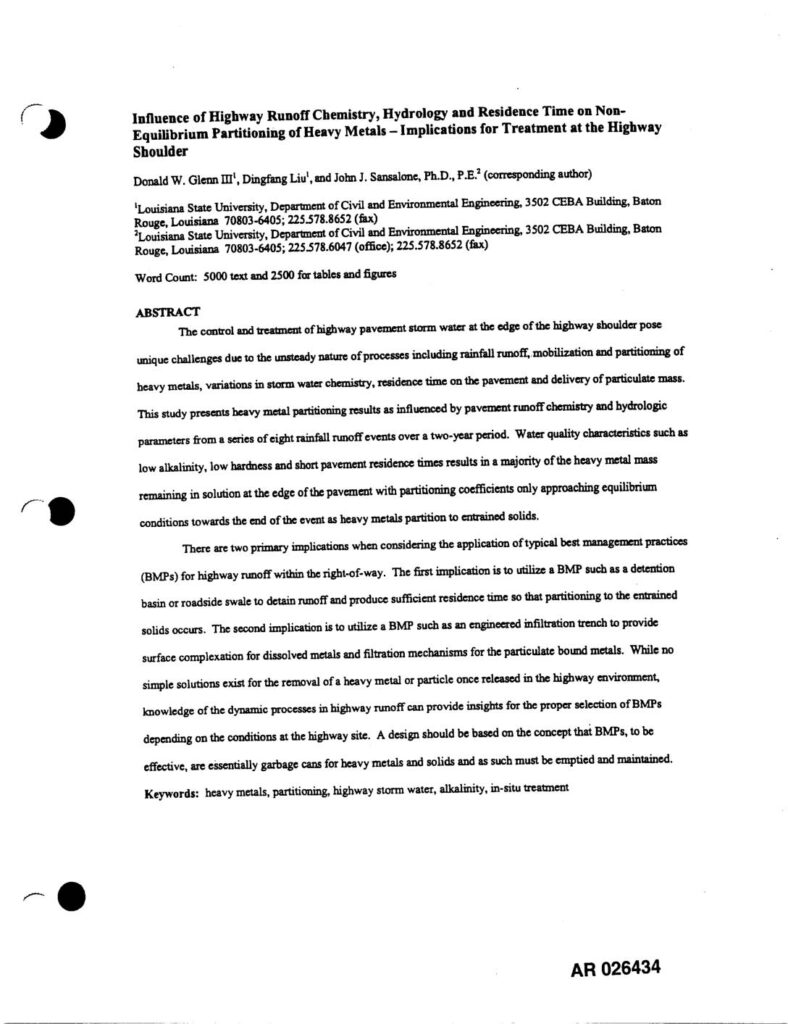
Academic journal paper (AR026434) by Donald W. Glenn III, Dingfang Liu, and John J. Sansalone of Louisiana State University, Department of Civil and Environmental Engineering, studying heavy metal partitioning in highway pavement stormwater runoff. Study conducted at an instrumented site on Interstate 75 in urban Cincinnati over eight rainfall runoff events across two years. Examines non-equilibrium partitioning of Zn, Cu, Cd, Pb, Cr, and Ni in highway runoff under low alkalinity, low hardness, and short pavement residence time conditions. Finds majority of heavy metal mass remains dissolved at edge of pavement shoulder; partitioning coefficients only approach equilibrium near end of events. Discusses implications for best management practices (BMPs) including detention basins, roadside swales, and engineered infiltration trenches. References NPDES Storm Water Phase I and Phase II Final Rule (February 2000). Filed in PCHB Third Runway EIS administrative record.