TagThird Runway(1084)
-
 2000-01-03
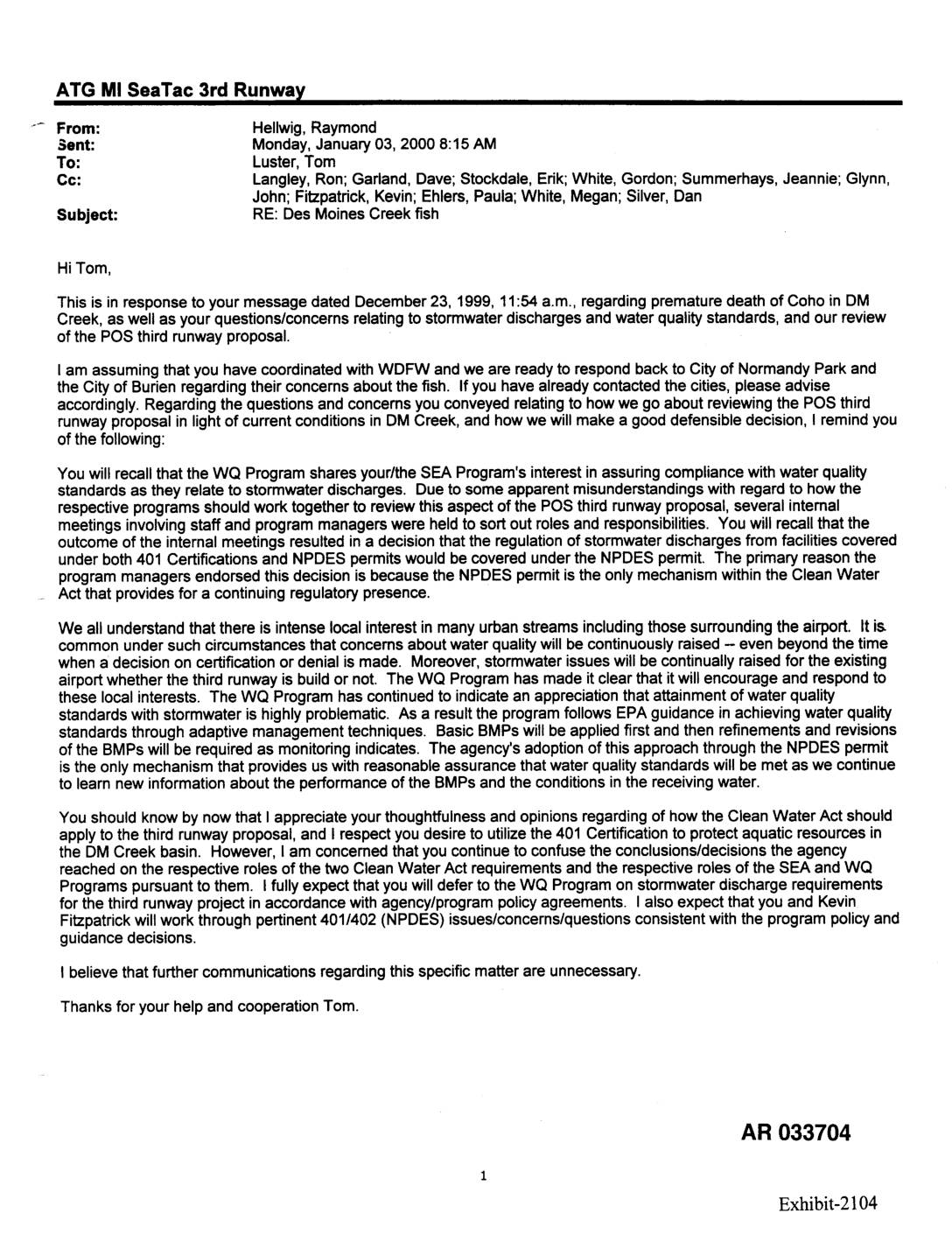
EXH AR033704: Email from Raymond Hellwig to Tom Luster RE: Des Moines Creek Fish and Third Runway Stormwater Review
Email dated January 3, 2000 from Raymond Hellwig (WQ Program) to Tom Luster (SEA Program), cc’d to Ron Langley, Dave Garland, Erik Stockdale, Gordon White, Jeannie Summerhays, John Glynn, Kevin Fitzpatrick, Paula Ehlers, Megan White, and Dan Silver. Responds to Luster’s December 23, 1999 message regarding premature death of Coho salmon in Des Moines Creek -
 2000-01-03
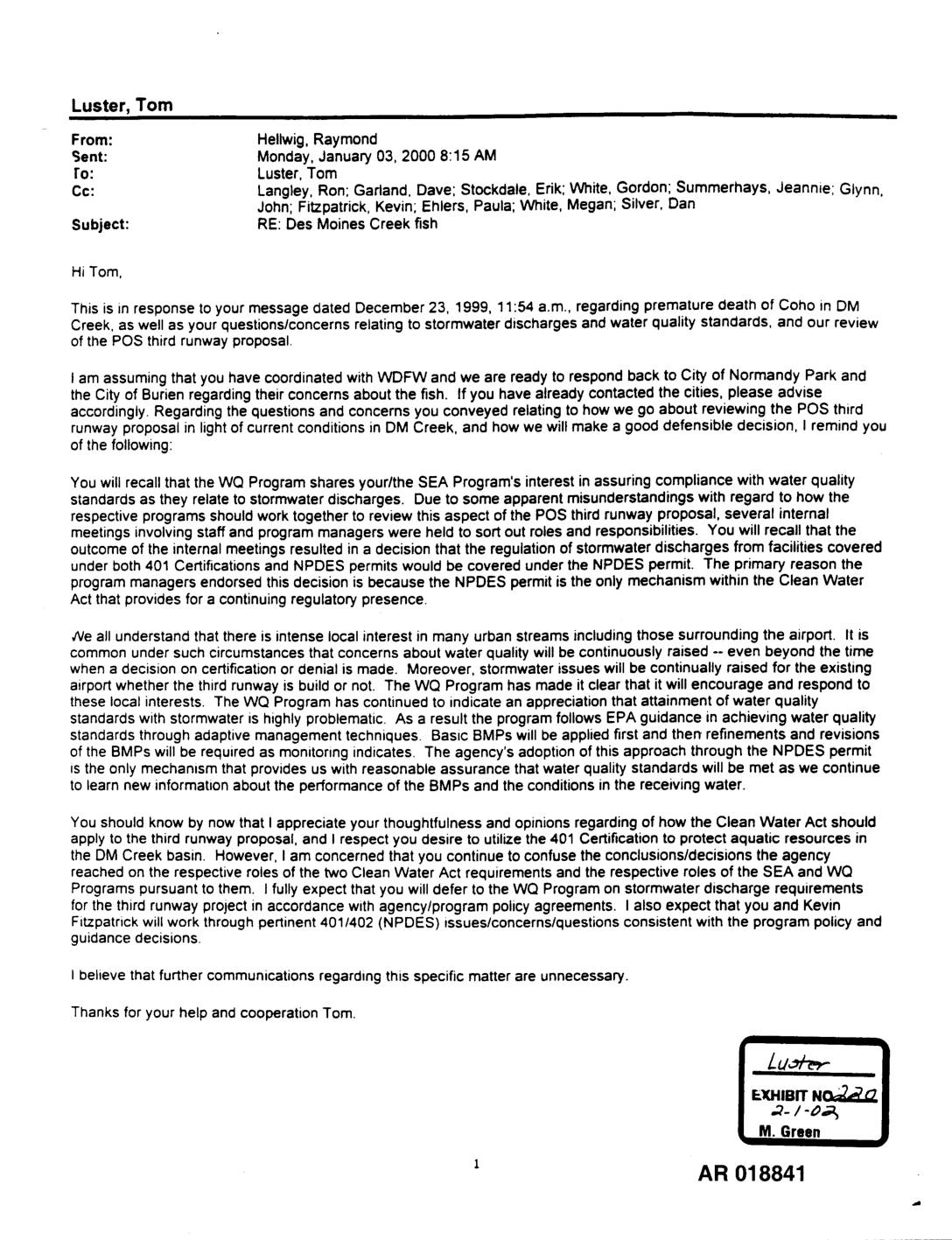
Exhibit 220: Email from Raymond Hellwig to Tom Luster re Des Moines Creek Fish and POS Third Runway Stormwater Review
A January 2000 internal email from EPA's Raymond Hellwig to Tom Luster addresses concerns about premature deaths of Coho salmon in Des Moines Creek near Sea-Tac Airport, in the context of the proposed third runway project. The email clarifies that stormwater discharge regulation will be handled through NPDES permits rather than Section 401 Water Quality Certifications, as the NPDES permit provides the only mechanism for ongoing regulatory oversight under the Clean Water Act. Hellwig directs Luster to defer to the Water Quality Program on stormwater issues and to stop raising the 401 Certification as an alternative avenue for addressing water quality standards. -
 2000-01-01
EXH AR020493: VS2DI Graphical Software — Fluid Flow & Solute/Energy Transport, Variably Saturated Porous Media
VS2DI is a graphical software package developed by the U.S. Geological Survey for simulating how fluids flow and how solutes or energy move through variably saturated porous media such as soil and rock. The software includes a preprocessor for entering simulation data, a postprocessor for visualizing results, and a numerical model engine. It was published in 2000 as part of the USGS Water-Resources Investigations Report series. -
 1999-12-01
EXH AR026410: Wildlife Hazard Management Airports — Manual Airport Personnel
This 1999 manual, prepared jointly by the Federal Aviation Administration and the U.S. Department of Agriculture, provides airport personnel with guidance on managing the safety risks posed by wildlife at airports. It covers topics including the FAA National Wildlife Strike Database, the roles of various federal agencies, and strategies for reducing bird and animal strikes on aircraft. The manual draws on strike records from 1990–1998 to illustrate the frequency, types, and impacts of wildlife encounters with aircraft. -
 1999-12-01
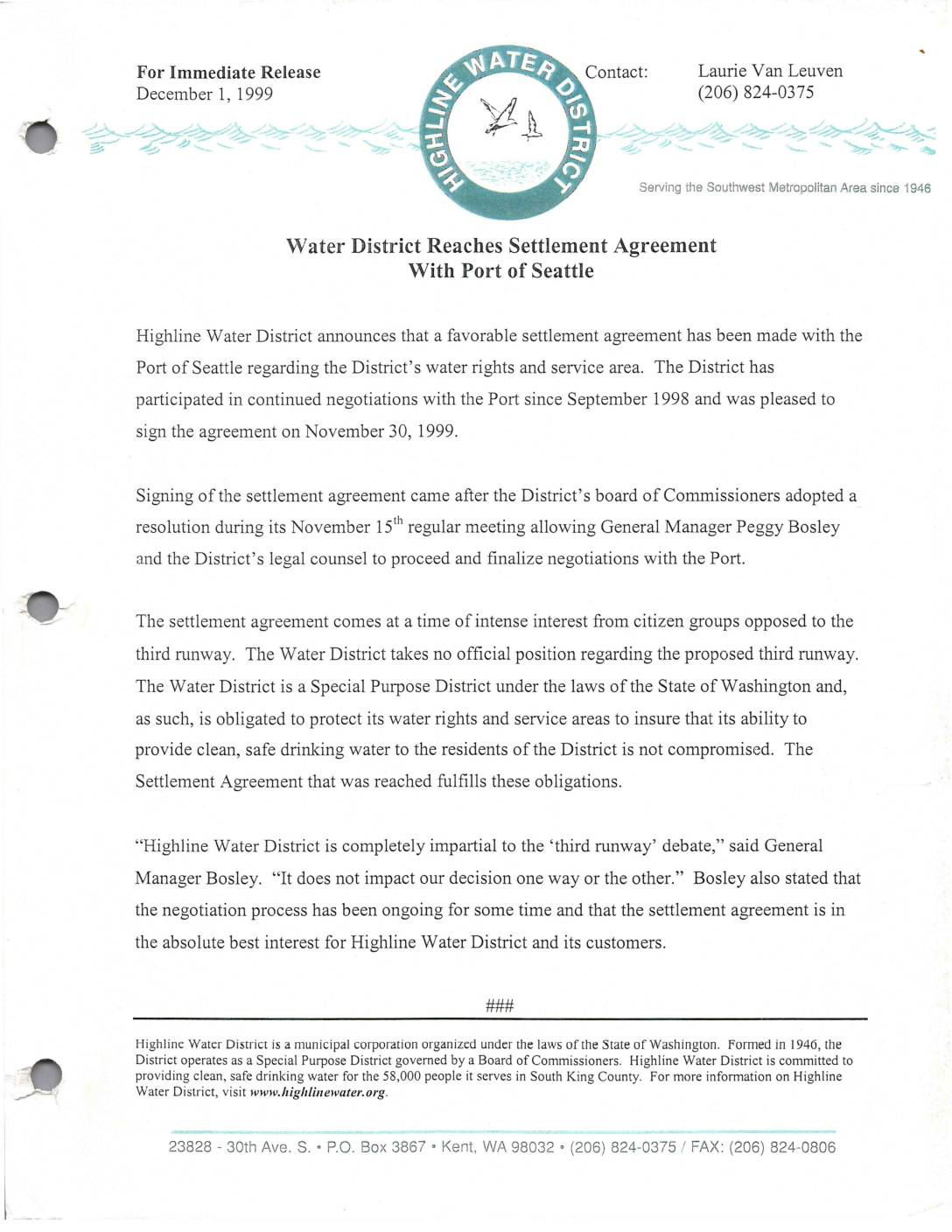
Water District reaches settlement agreement with Port Of Seattle
In November 1999, Highline Water District and the Port of Seattle reached a settlement agreement resolving competing claims over two water rights near Seattle-Tacoma International Airport. Under the deal, the Port retained rights to Well #1 for uses including Des Moines Creek flow augmentation tied to the proposed third runway project, while the District secured rights to a replacement for Well #2 to continue providing drinking water to its 58,000 customers. The District emphasized that the agreement was strictly about protecting its water rights and service area, and that it took no official position on the controversial third runway expansion. -
 1999-11-30
EXH AR026502: Letter to Seattle Public Utilities — 4th Quarterly Stormwater Monitoring Results, NEPL, STIA
A November 30, 1999 letter from Port of Seattle's Aviation Project Management Group to Seattle Public Utilities reports the fourth and final quarterly stormwater monitoring results for the Sea-Tac Airport North Employees' Parking Lot (NEPL). Testing of water samples collected throughout 1999 found pollutant levels—including metals, hydrocarbons, and suspended solids—well below Washington State residential water supply standards. Based on these results, the Port proposed ending the monitoring program and invited the City of Seattle to confer on whether further monitoring was warranted under their Interlocal Agreement. -
 1999-11-29
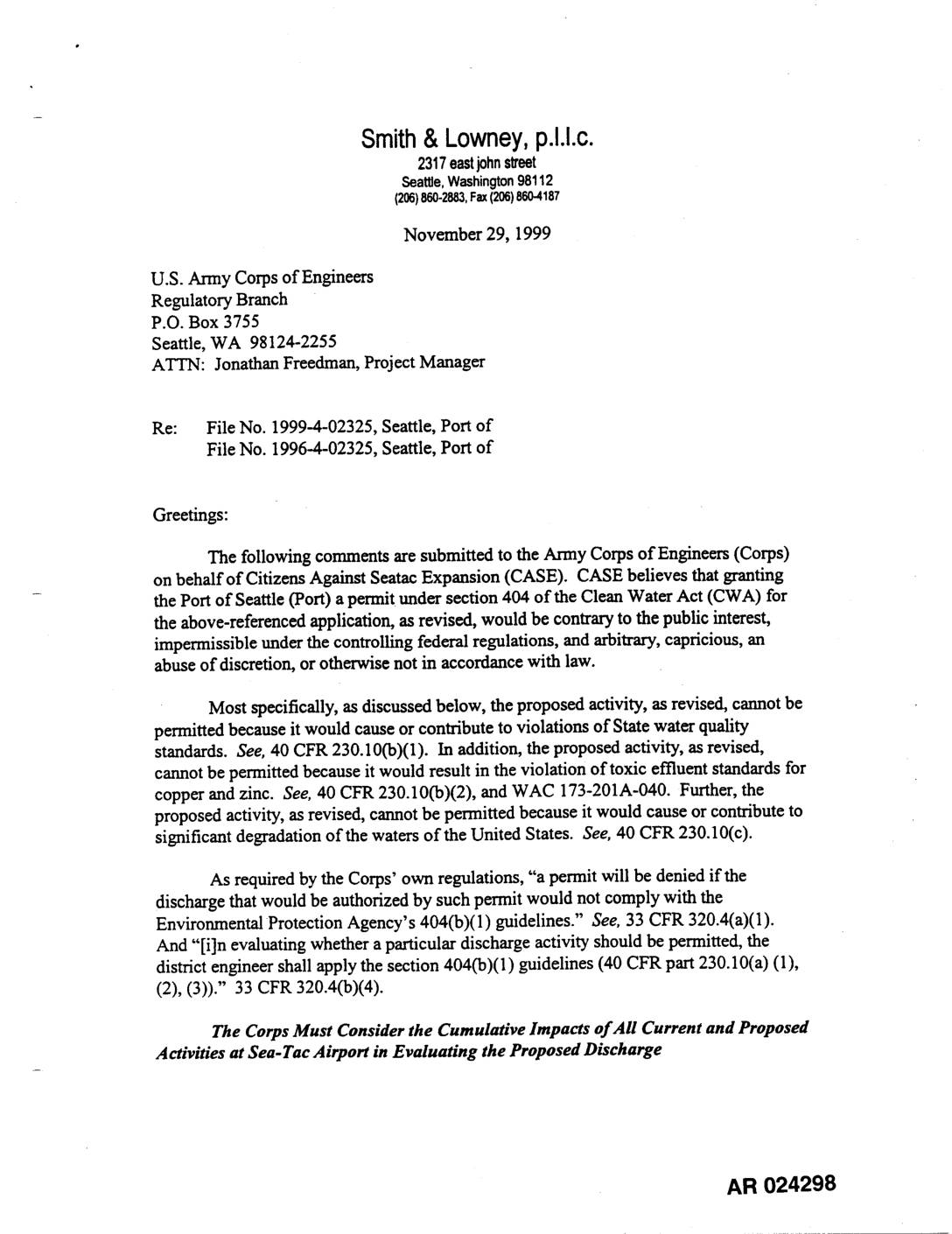
EXH AR024298: Letter to Army Corps Opposing Section 404 Permit STIA Third Runway
In a November 1999 letter to the U.S. Army Corps of Engineers, the law firm Smith & Lowney submitted comments on behalf of Citizens Against Seatac Expansion (CASE) opposing a permit for the Port of Seattle's proposed Third Runway expansion at Sea-Tac Airport. The letter argues that the permit should be denied because the project would violate federal and state water quality standards, including toxic effluent limits for copper and zinc, and cause significant degradation to U.S. waters. It urges the Corps to consider not only the direct environmental impacts of the proposed fill, but also the cumulative and secondary effects of all current and future airport operations when making its permitting decision. -
 1999-11-29
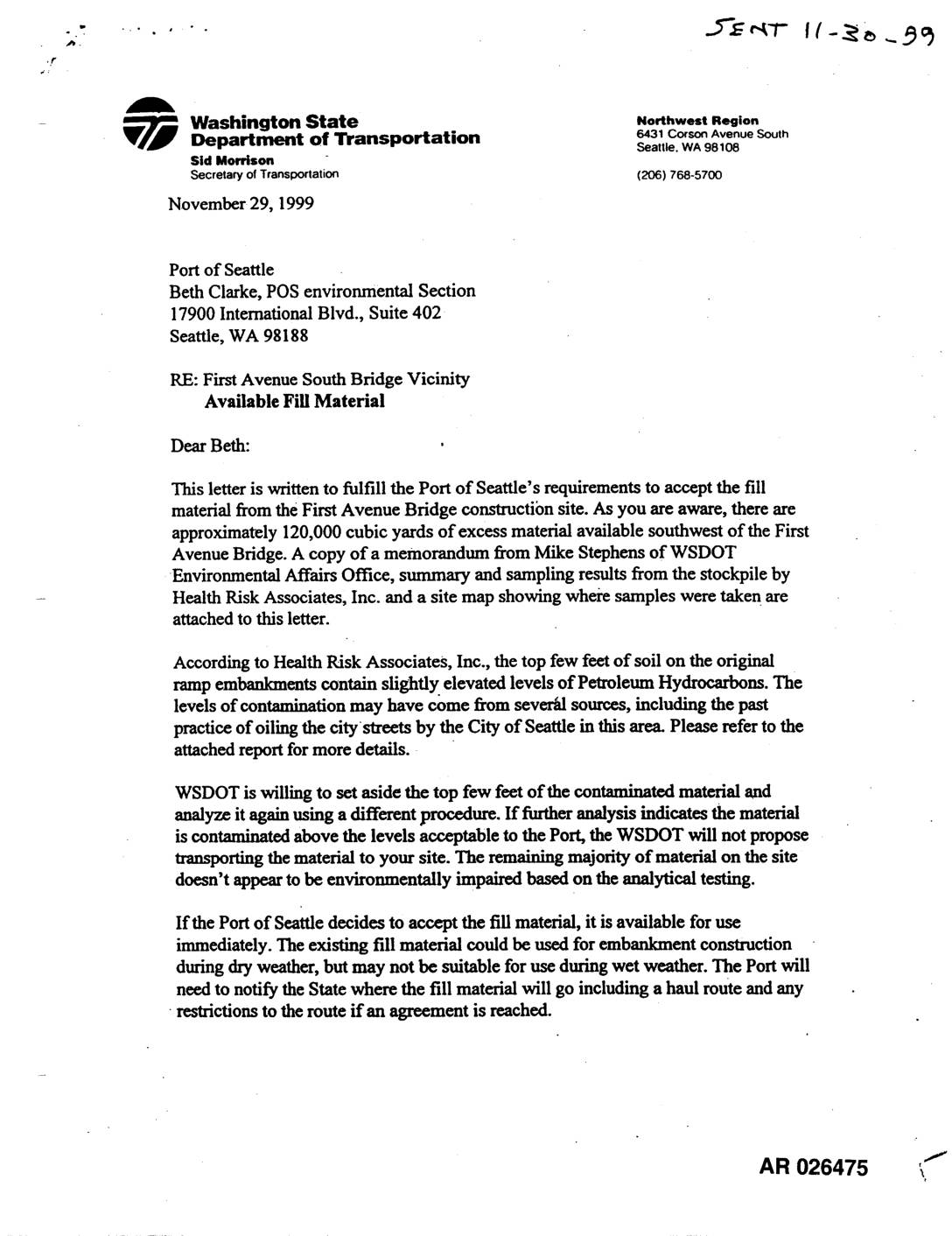
EXH AR026475: WSDOT Letter — Available Fill Material, First Ave S Bridge Construction Site
In November 1999, the Washington State Department of Transportation (WSDOT) wrote to the Port of Seattle offering approximately 120,000 cubic yards of excess fill material from the First Avenue South Bridge construction site for use in the Sea-Tac Airport third runway project. While most of the material was found to be environmentally sound, the top few feet of soil showed slightly elevated levels of petroleum hydrocarbons, which WSDOT offered to retest using a different procedure before any transfer. The Port was asked to confirm environmental acceptability and provide a haul route before an agreement could be finalized. -
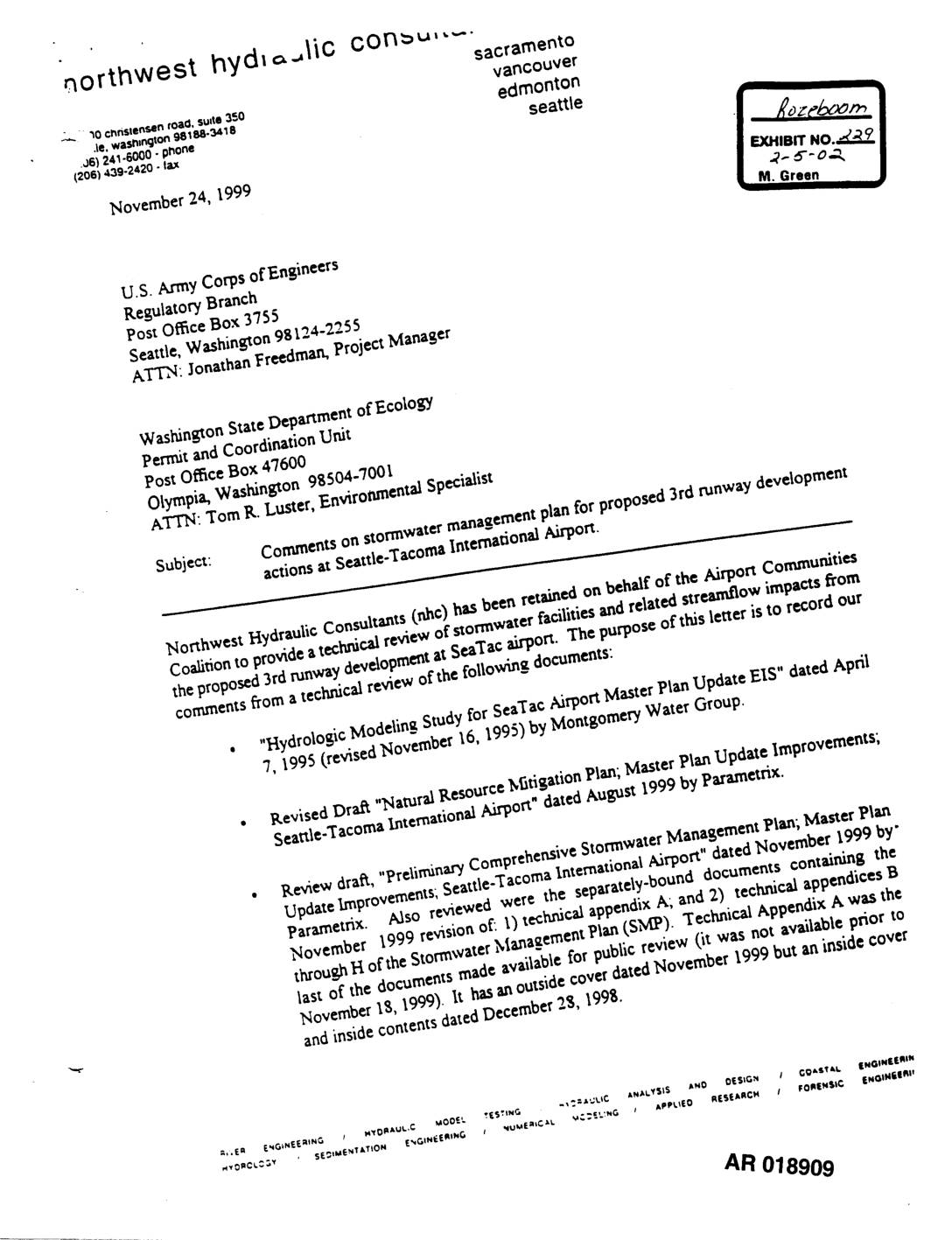 1999-11-24
Exhibit 229: NHC Letter to U.S. Army Corps of Engineers and Ecology — Technical Comments on Stormwater Management Plan for Proposed Third Runway at Sea-Tac Airport
A November 1999 technical letter from Northwest Hydraulic Consultants, submitted on behalf of the Airport Communities Coalition, identifies major deficiencies in the proposed stormwater management plan for Seattle-Tacoma International Airport's 3rd runway development. The review finds that the plan fails to comply with the 1998 King County Surface Water Design Manual and Washington State Department of Ecology guidelines, including requirements for large-site drainage reviews, offsite analysis, and flow control. The consultants warn that if the plan is approved as written, it could cause significant adverse impacts to downstream creek systems, including Miller Creek and Des Moines Creek. -
1999-11-15
City of Des Moines, et al. v. Puget Sound Regional Council, et al.
Court of Appeals of Washington,Division 1. The CITY OF DES MOINES, The City of Burien, The City of Federal Way, The City of Normandy Park, The City of Tukwila, Highline School District No. 401, and The Airport Communities Coalition, Appellants, v. The PUGET SOUND REGIONAL COUNCIL, The Executive Board of the Puget Sound Regional Council,