Notes
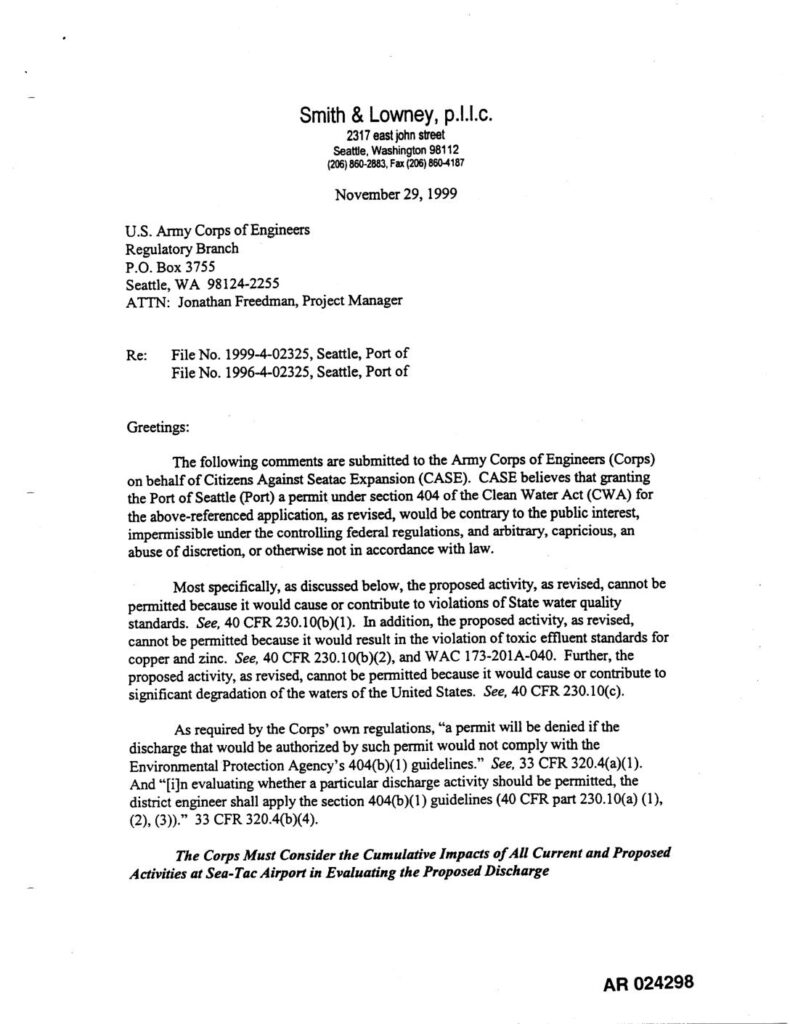
Letter dated November 29, 1999, from Smith & Lowney, p.l.l.c. (attorneys for Citizens Against Sea-Tac Expansion, CASE) to Jonathan Freedman, Project Manager, U.S. Army Corps of Engineers Regulatory Branch, regarding File No. 1999-4-02325 and File No. 1996-4-02325 (Port of Seattle). CASE opposes issuance of a Section 404 Clean Water Act permit for the Port of Seattle’s Third Runway proposal, arguing the discharge would violate State water quality standards (WAC 173-201A-040), toxic effluent standards for copper and zinc, and cause significant degradation of waters of the United States under 40 CFR 230.10(b)(1), 230.10(b)(2), and 230.10(c). Letter argues the Corps must evaluate cumulative impacts of all current and proposed Sea-Tac Airport activities, secondary effects of fill under 40 CFR 230.11(h), and projected growth impacts per 40 CFR 230.1(c) and 230.11(g). Permit denial required under 33 CFR 320.4(a)(1) and 320.4(b)(4). References Third Runway, Runway Safety Areas, and South Aviation Support Area.