TagThird Runway(1092)
-
1992-09-11
The Port Of Seattle wants to shake your hand
A 1992 brochure from the Regional Commission on Airport Affairs (RCAA) argues that the Port of Seattle broke its 1973 promises to soundproof homes affected by Sea-Tac Airport noise, noting that only 700 of 10,000 impacted homes had been insulated and no public buildings had been treated despite a recognized obligation since 1988. The brochure opposes the Port's plan to spend up to $1.2 billion on a third runway at Sea-Tac, questioning how residents can trust new commitments when past ones went unfulfilled. It calls on the Port to fulfill its existing mitigation obligations before pursuing further airport expansion. -
1992-06-27
Outline of overall position statement: Sea-Tac, June 27, 1992
A 1992 position statement argues that Seattle-Tacoma International Airport (Sea-Tac) has reached its operational, economic, and environmental capacity and should be capped at a maximum of 380,000 operations per year with no third runway authorized. The document contends that noise impacts on surrounding communities are severely underestimated, that a third runway would make no operational or economic sense, and that alternatives such as demand management, use of existing regional airports, and improved transportation systems should be pursued instead. -
1992-04-02
Engrossed Substitute House Bill 2609: Air transportation system–runway construction moratorium and studies
Washington State's Engrossed Substitute House Bill 2609, passed in March 1992 and effective April 2, 1992, placed a moratorium on the construction or extension of runways of 1,000 feet or more by cities, counties, or port districts in heavily populated western Washington counties. The bill was designed to allow the state's Air Transportation Commission time to complete a comprehensive statewide air transportation strategy, with an interim report due December 1, 1992, and a final report due December 1, 1994. The legislation aimed to balance regional aviation capacity needs with environmental and growth management policies before any major new runway infrastructure was approved. -
1992-02-13
CASE Group History and Third Runway Opposition Flyer and Petition
The CASE Group (Citizens' Alternatives to Sea-Tac Expansion) was formed in 1987 to oppose the Port of Seattle's plans to add a third runway at Sea-Tac Airport, gathering over 4,600 protest signatures and prompting the King County Council to pass a resolution against the expansion. The coalition organized public hearings, lobbied Port Commissioners, and circulated petitions urging state officials to reject expansion recommendations in favor of building a new regional airport away from densely populated areas. Their core argument was that alternatives to Sea-Tac expansion represented sounder economic and environmental choices for the Central and South Puget Sound region. -
1992-01-01
EXH 326: Aroclor 1254 Physical Chemical Environmental Properties CRCnetBASE CRC Press
This document contains detailed chemical and environmental property data for Aroclor 1254, a polychlorinated biphenyl (PCB) mixture, including its molecular weight, water solubility, vapor pressure, and environmental fate characteristics. It covers sorption coefficients, half-lives in various environmental compartments (water, soil, sediment, biota), and bioconcentration factors in fish and other organisms. The data is compiled from numerous scientific studies published between the 1970s and late 1980s. -
1991-05-01
EXH AR019107: Field Assessment Mitigation Replacement Ratios Puget Sound
This 1991 report by Sheldon and Associates, prepared for the Washington Department of Ecology, assesses wetland mitigation replacement ratios in the Puget Sound region. It evaluates compensation sites where wetlands were restored or created to offset permitted wetland losses, examining how well those sites functioned as replacements. The report provides findings, conclusions, and recommendations on compensation plan design, monitoring, and appropriate replacement ratios for regulatory guidance. -
1989-05-03
EXH AR025026: Hart Crowser Monitoring Well Installation RP, Weyerhaeuser Aviation, STIA
A May 1989 environmental report from Hart Crowser, Inc. details the installation of three groundwater monitoring wells (WY-1, WY-2, WY-3) near underground fuel storage tanks at the Weyerhaeuser Aviation facility at Sea-Tac International Airport. Soil samples collected during drilling showed no detectable petroleum contamination, and no groundwater was encountered at the site. The report was prepared to help Weyerhaeuser comply with the Port of Seattle's NPDES permit requirements and to assess subsurface soil conditions around the tanks. -
1988-03-17
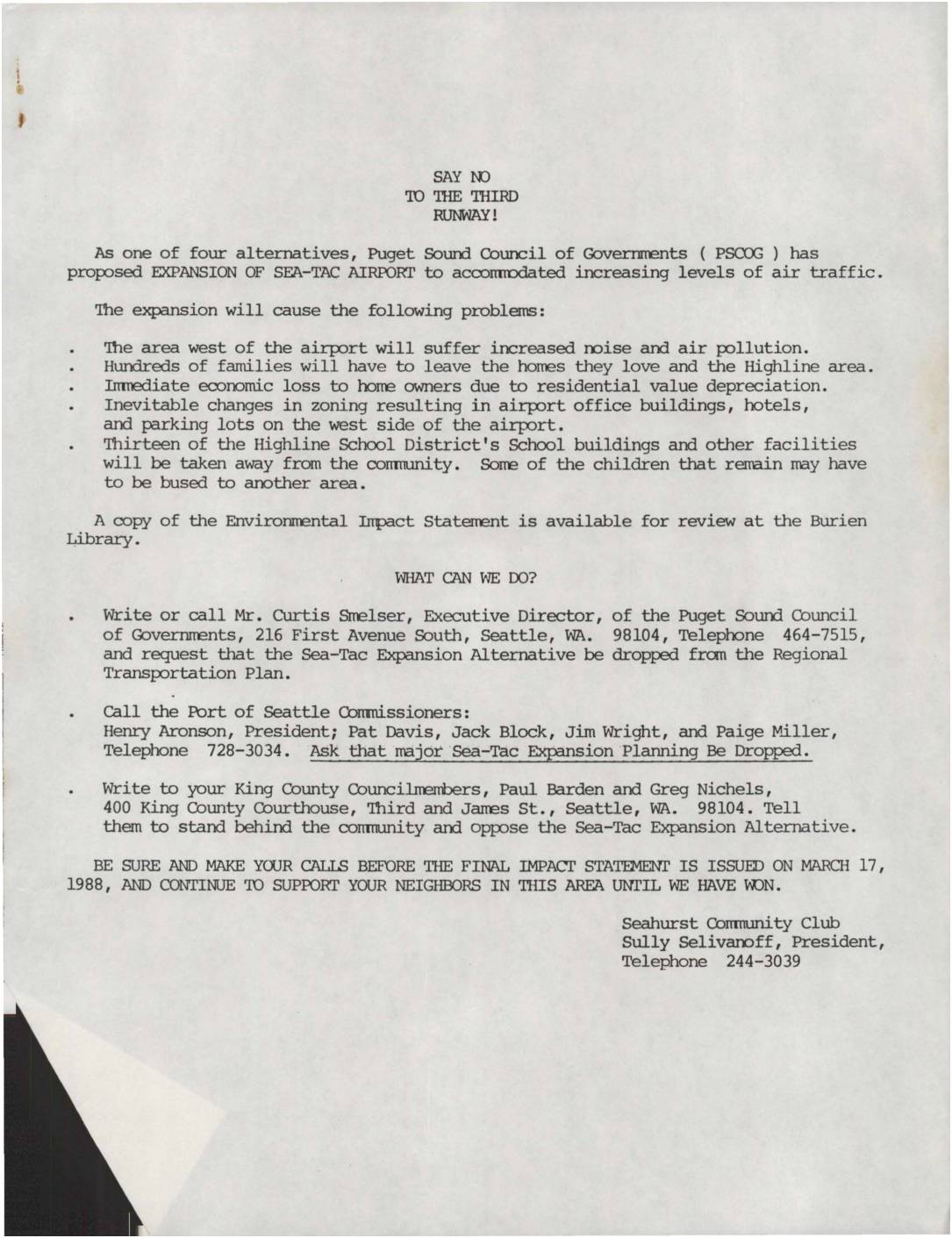
Say no to the third runway!
A flyer from the Seahurst Community Club urging residents to oppose a proposed expansion of Sea-Tac Airport, including the addition of a third runway, which was one of four alternatives being considered by the Puget Sound Council of Governments in 1988. The document warns of serious community impacts such as increased noise and air pollution, displacement of hundreds of families, falling home values, zoning changes, and the loss of 13 Highline School District facilities. Residents were directed to contact the Puget Sound Council of Governments, Port of Seattle Commissioners, and King County Councilmembers before the Final Environmental Impact Statement was issued on March 17, 1988. -
1988-03-17
Say no to the third runway!
A flyer from the Seahurst Community Club urging residents to oppose a proposed expansion of Sea-Tac Airport, including the addition of a third runway, which was one of four alternatives being considered by the Puget Sound Council of Governments in 1988. The document warns of serious community impacts such as increased noise and air pollution, displacement of hundreds of families, falling home values, zoning changes, and the loss of 13 Highline School District facilities. Residents were directed to contact the Puget Sound Council of Governments, Port of Seattle Commissioners, and King County Councilmembers before the Final Environmental Impact Statement was issued on March 17, 1988. -
1983-01-01
EXH 327: VS2D Computer Program Input Data Formats Table 3 Cards B-14–C-3
This document describes input data formats for the VS2D computer program, developed by the U.S. Geological Survey, which simulates fluid flow in variably saturated porous media. It details technical parameters for evaporation and evapotranspiration modeling, including variables for potential evaporation rates, rooting depth, root activity, and atmospheric pressure. The document also outlines time-step control settings used to manage the numerical simulation of subsurface water movement.