Skip to content
  • STNI
  • Statistics
    • Ops and Passengers
      • King County International Airport (Boeing Field) Annual Operations
    • Financials
    • Aviation fuel uplift in the State of Washington 2018 – 2025
      • Aviation Fuel Tax Revenue in the State of Washington 1983-2025
      • Aviation Fuel Uplift at Sea-Tac Airport
    • Air Quality Monitoring
    • Flight Tracking
      • Flow and Flight Tracks
      • Five Year Comparison
      • Busiest Hours and Days
    • SEL Noise Reports & Graphs
      • About The Permanent Noise Monitors
      • Minutes of Quiet by Noise Monitor
      • Noise Events mapped
      • Noise Events (SEL)
    • Runways
    • Employees
    • Real Estate
      • Port Properties and Trees mapped
    • Parking
  • Events
  • Protest
    • Regular Events
    • Policy
      • Legislative Agenda 2027
      • Airport mitigation for the twenty first century
      • Port Dracula
    • Complain about a particular flight
    • Advocacy Organizations
    • Media Outlets
    • People
    • The Port of Seattle
      • Commission Meetings
      • Public Records Requests
      • StART
      • Highline Forum
    • Contact Your Electeds
  • Resources
    • FAQs
      • FAA Occurrences/Accidents/Indents
    • The SAMP
      • SAMP Public Comment Template
        • Two versions of Appendix K: NEPA/SEPA 2018 vs 2023
      • SAMP NTP: 31 projects by the numbers
      • SEPA Draft EIS (2026)
      • SAMP Record of Decision/FONSI (2025)
      • SAMP Draft EA (October 2024)
      • 2018 Scoping
    • Port Packages
      • Port Package Property Costs
      • Port Packages mapped
      • The Port Package Explainer
      • So you want a (first-time) Port Package? Start here
      • Port Package Looker Upper
      • How do I determine if I have a Port Package or Avigation Easement?
      • Progress on Port Package Update legislation
      • Having a Port Package Problem?
      • Port Package Site Visit Follow-Up
    • Document Library
    • Explainers
      • The Airport Law Cheat Sheet
      • The Grant Explainer
    • External Articles
    • History
      • Timeline
      • The Sea-Tac Communities Plan
        • Sea-Tac Communities Plan – Planning Maps
      • PSRC Third Runway Decision Process
    • Studies
    • Videos
  • Stories
  • Mission
  • Subscribe
  • Contact
Scroll down to content

Get InformedStay Informedx

I understand that you will never share my information with anyone, you will only use it to keep me updated on relevant events and that I may unsubscribe at any time.

STNI

STNISea-Tac Noise.Info

  • Solve for Sea-Tac. Solve for every airport.
  • Since 2016, working to obtain justice for everyone living under the flight path.
  • Less Noise. Cleaner Air. Better Public Health. Compensation.
  • Everything you think you know about the airport is wrong.

TagThird Runway(1084)

Advanced Search Options

  • Dates
  • Media
    • External Articles
    • Images
    • PDFs
    • Video
    • Audio
  • Order By
  • 2000-05-03

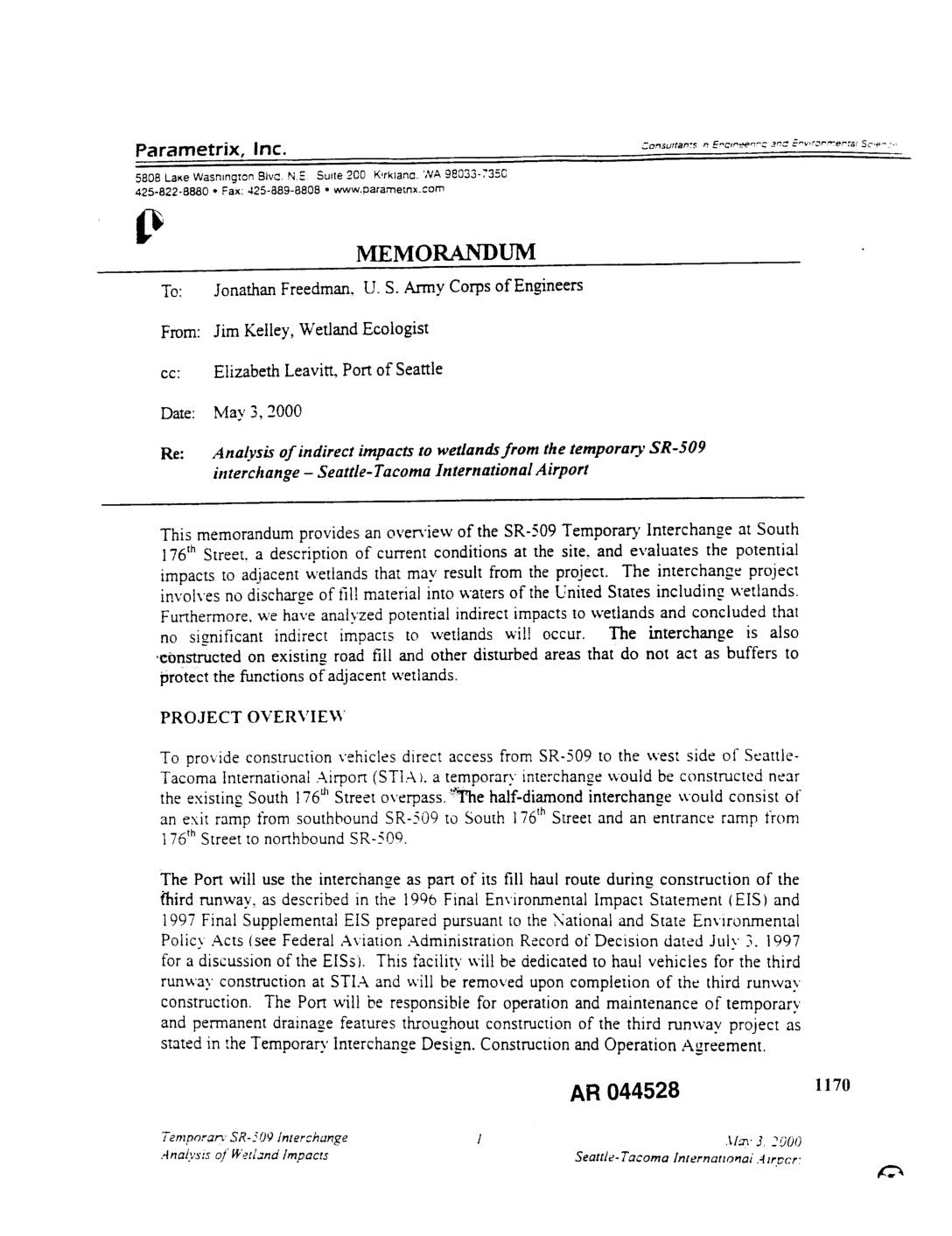
    EXH AR044528: Analysis of Indirect Impacts to Wetlands from the Temporary SR-509 Interchange – STIA

    Memorandum dated May 3, 2000 from Jim Kelley (Wetland Ecologist, Parametrix Inc.) to Jonathan Freedman (U.S. Army Corps of Engineers), cc Elizabeth Leavitt (Port of Seattle), analyzing indirect impacts to wetlands from the temporary SR-509 interchange at South 176th Street near Seattle-Tacoma International Airport. Concludes no significant indirect impacts to Wetland 43 or Wetland 44
    TagsACC, Army Corp of Engineers, Elizabeth Leavitt, Pollution Control Hearings Board, Port Of Seattle, SR509, Third RunwayFolderBox 18
  • 2000-05-02

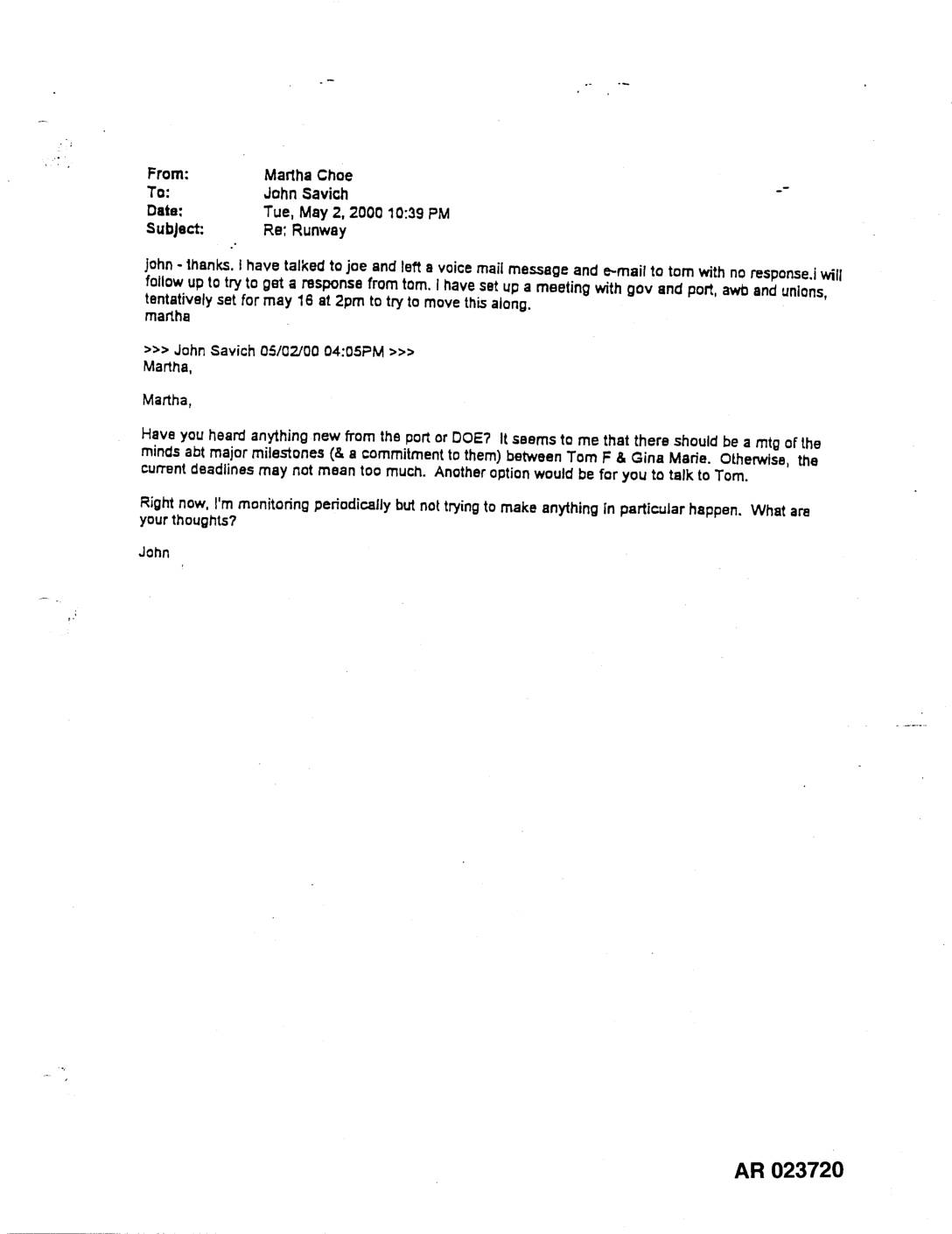
    EXH AR023720: Email Chain — Martha Choe to John Savich, Third Runway Coordination

    In a May 2, 2000 email exchange regarding Sea-Tac Airport runway issues, Martha Choe updates John Savich on her efforts to coordinate between key stakeholders, noting she has spoken with Joe and attempted to reach Tom but received no response. She has arranged a meeting tentatively scheduled for May 16 at 2pm, bringing together the Governor's office, the Port, AWB, and unions to help move the runway matter forward. John had suggested that a high-level commitment to major milestones between DOE's Tom F. and Gina Marie was needed to give existing deadlines real weight.
    TagsACC, Gina Marie Lindsey, PCHB, Pollution Control Hearings Board, Port Of Seattle, Third RunwayFolderBox 10
  • 2000-04-25

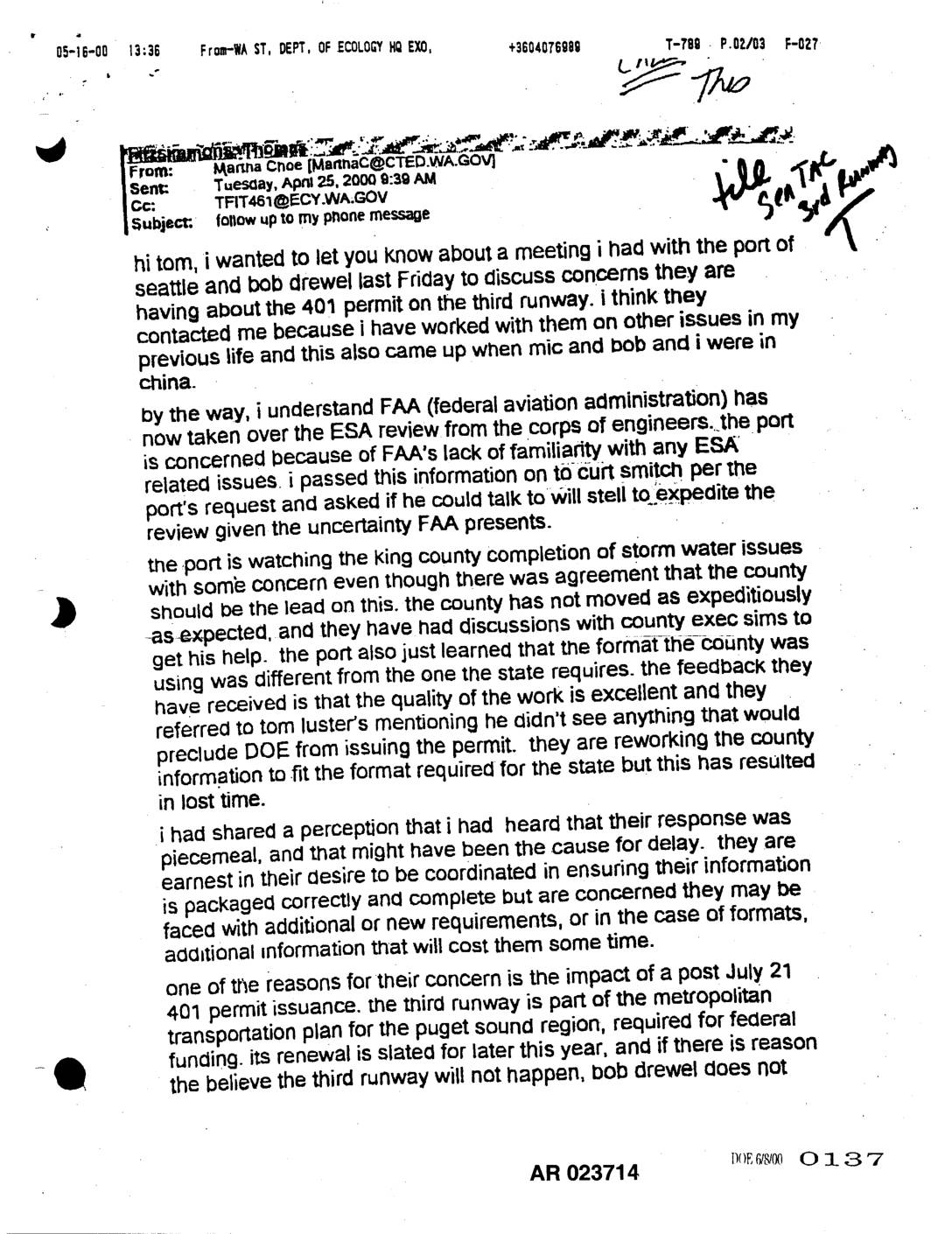
    EXH AR023714: Email Martha Choe (CTED) to Tom — 401 Permit Concerns Third Runway

    A April 25, 2000 email from Martha Choe of the Washington State Community, Trade and Economic Development office to a colleague at the Department of Ecology summarizes concerns raised by the Port of Seattle regarding delays in obtaining a 401 water quality permit for Sea-Tac Airport's proposed third runway. Key issues include the FAA's unfamiliarity with Endangered Species Act requirements after taking over the review from the Army Corps of Engineers, King County's slow progress on stormwater documentation, and formatting problems that caused further delays. The email warns that if the permit is not issued by July 21, 2000, the third runway's inclusion in the regional transportation plan—and its federal funding eligibility—could be jeopardized.
    TagsACC, Ecology, PCHB, Pollution Control Hearings Board, Port Of Seattle, Puget Sound Regional Council, Third RunwayFolderBox 10
  • 2000-04-19

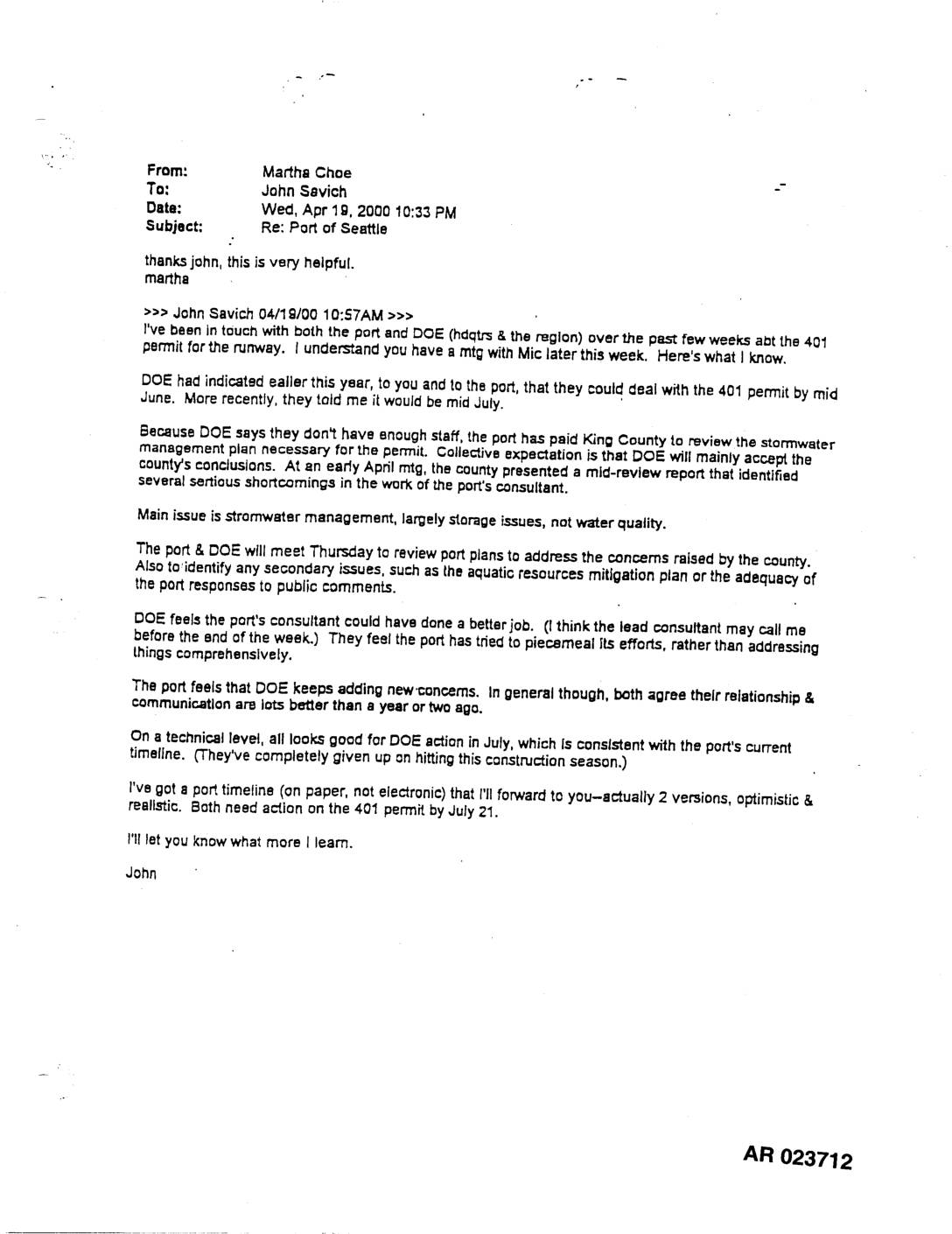
    EXH AR023712: Email Exchange 401 Permit Status STIA Third Runway

    A April 2000 email exchange between EPA staff members John Savich and Martha Choe provides an update on the status of a Clean Water Act Section 401 water quality permit for a Port of Seattle runway project. The main sticking point is stormwater storage management, with the Washington State Department of Ecology (DOE) targeting a mid-July decision after King County completed a review that identified serious shortcomings in the port's consultant work. Both the optimistic and realistic port timelines require DOE action on the 401 permit by July 21, meaning the port had already abandoned any hope of beginning construction that season.
    TagsACC, Ecology, PCHB, Pollution Control Hearings Board, Port Of Seattle, Stormwater, Third RunwayFolderBox 10
  • 2000-04-10

    EXH AR044372: Seismic Basis of Design — Third Runway Project (Hart Crowser Draft Memo to HNTB)

    Draft memorandum dated April 10, 2000 from Douglas Lindquist, Barry Chen P.E., and Mike Bailey P.E. of Hart Crowser, Inc. to Jim Thomson P.E. at HNTB regarding seismic basis of design for the Third Runway Project (J-4978-14) at Sea-Tac Airport for the Port of Seattle. Compares 475-year return period (0.36g peak acceleration, 10% probability of
    TagsACC, Earthquake, Mechanically Stabilized Earth, Pollution Control Hearings Board, Port Of Seattle, Sea-Tac Airport, Third RunwayFolderBox 18
  • 2000-04-07

    EXH AR044380: Subsurface Conditions Data Report, South MSE Wall and Adjacent Embankment, Third Runway Project, Sea-Tac International Airport

    Draft Subsurface Conditions Data Report prepared by Hart Crowser for Port Of Seattle and HNTB, project number J-4978-23, dated April 7, 2000. Covers geologic and subsurface soil conditions, hydrogeologic conditions, auger borings, Standard Penetration Test (SPT) procedures, test pit excavations, and monitoring well installation for the South MSE (Mechanically Stabilized Earth) Wall and Adjacent Embankment
    TagsACC, Mechanically Stabilized Earth, Pollution Control Hearings Board, Port Of Seattle, Sea-Tac Airport, Third RunwayFolderBox 18
  • 2000-04-05

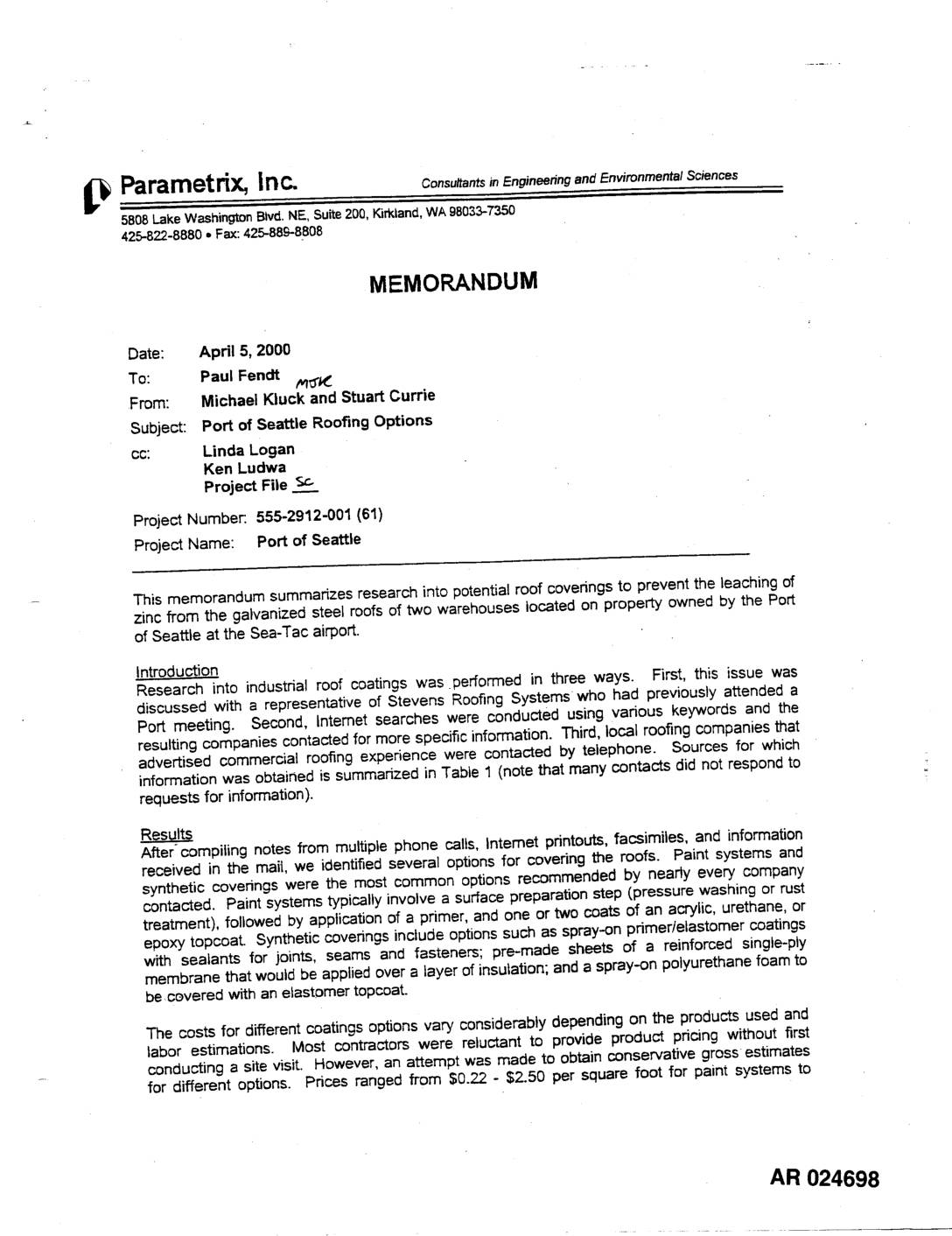
    EXH AR024698: Memo — Roofing Options for Zinc Leaching Prevention

    A April 2000 memo from engineering firm Parametrix, Inc. evaluates roofing options to prevent zinc leaching from galvanized steel roofs on two Port of Seattle warehouses at Sea-Tac Airport. The study compared paint systems (ranging from $21,000–$240,000 for both buildings) against synthetic coverings such as spray-on elastomers and single-ply membranes ($60,000–$330,000), finding that painting is cheaper but requires more frequent maintenance while synthetic coverings last longer but cost more upfront. The memo recommends that any chosen material be evaluated to ensure it does not release metals or other pollutants into stormwater runoff.
    TagsACC, Pollution Control Hearings Board, Port Of Seattle, Sea-Tac Airport, Stormwater, Third Runway, Water QualityFolderBox 10
  • 2000-03-28

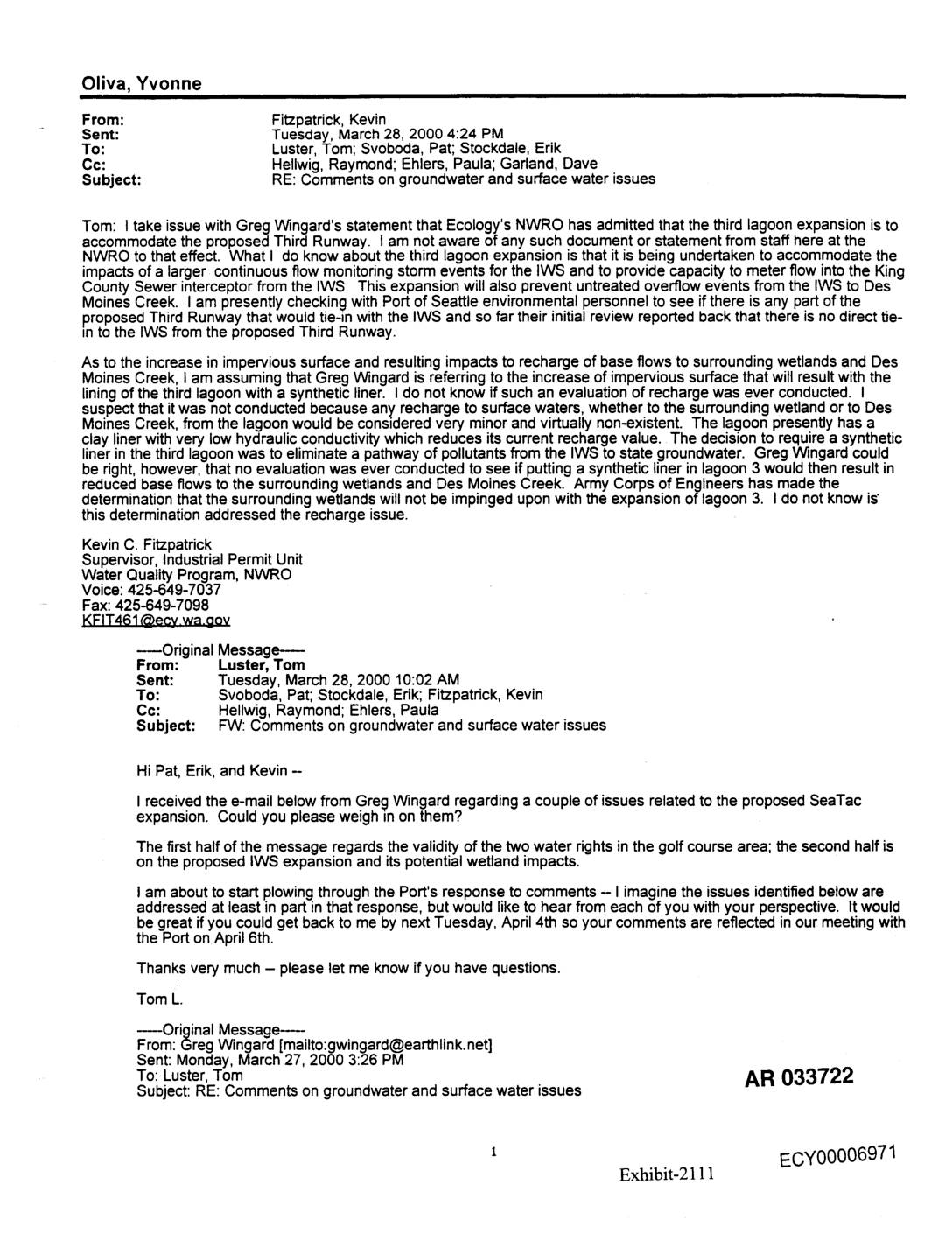
    Exhibit 2111: Email Chain RE: Comments on Groundwater and Surface Water Issues — IWS Third Lagoon Expansion and Water Rights

    Email chain dated March 28, 2000 among Kevin Fitzpatrick (Ecology NWRO Industrial Permit Unit), Tom Luster, Pat Svoboda, Erik Stockdale, and Greg Wingard regarding groundwater and surface water issues related to the proposed Sea-Tac Airport Third Runway. Fitzpatrick disputes Greg Wingard’s claim that Ecology’s NWRO admitted the third lagoon expansion of the Industrial Waste System
    TagsACC, Des Moines Creek, Ecology, Greg Wingard, Pollution Control Hearings Board, Third Runway, Water QualityFolderBox 14
  • 2000-03-20

    EXH AR044225: Draft Subsurface Conditions Data Report, North Safety Area, Third Runway Embankment, Sea-Tac Airport

    Hart Crowser draft subsurface conditions data report (project J-4978-18) prepared for Port Of Seattle and HNTB, dated March 20, 2000, covering the North Safety Area Third Runway Embankment at Sea-Tac International Airport. Report includes generalized geologic description, subsurface soil conditions, hydrogeologic conditions, laboratory test results (consolidation, CU triaxial, UU triaxial, direct shear tests), hydraulic conductivity
    TagsACC, Pollution Control Hearings Board, Port Of Seattle, Sea-Tac Airport, soil, Third RunwayFolderBox 18
  • 2000-03-07

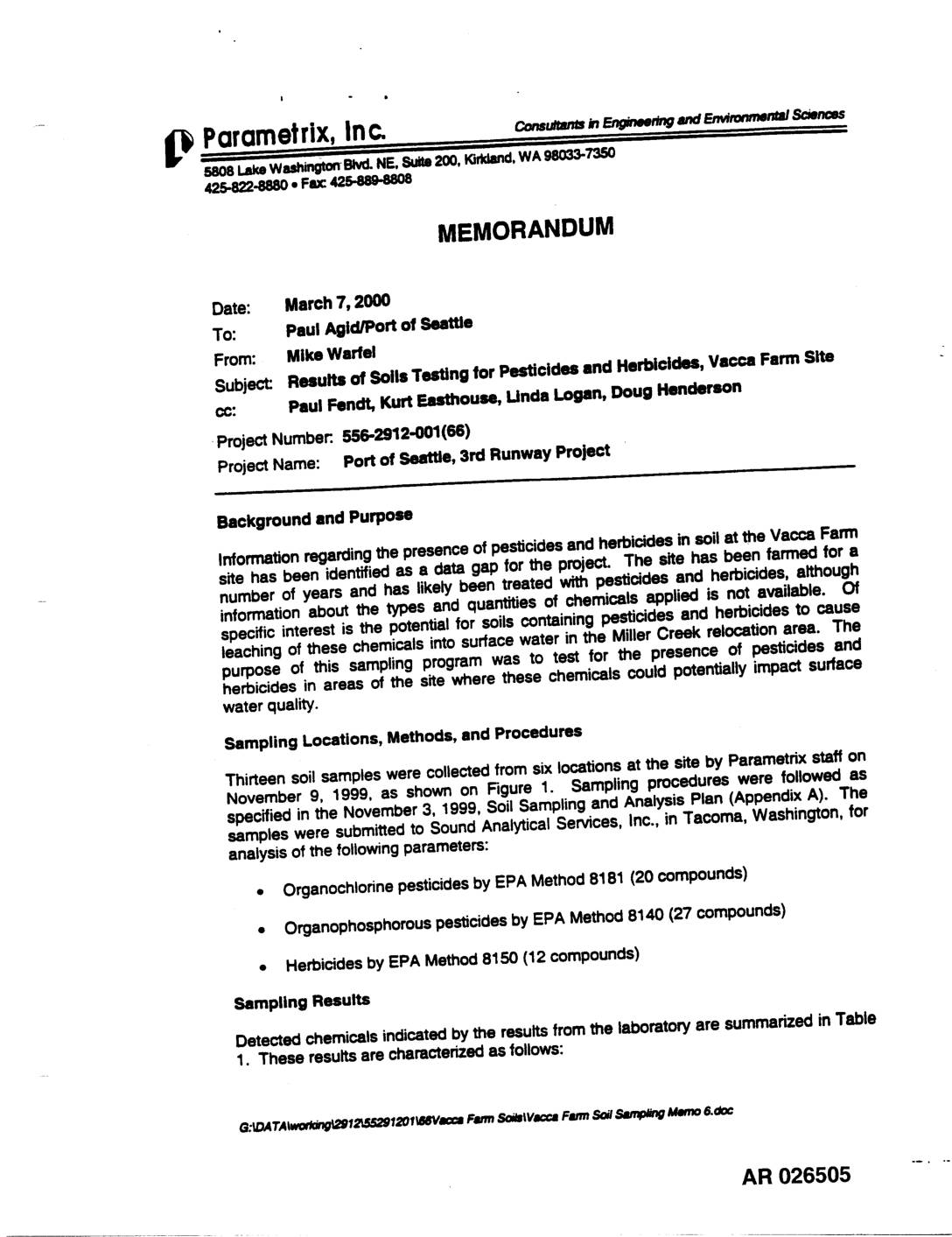
    EXH AR026505: Memo — Soils Testing Results, Pesticides & Herbicides, Vacca Farm Site

    A March 2000 Parametrix memorandum reports the results of pesticide and herbicide soil testing at the Vacca Farm site, part of the Port of Seattle's Third Runway Project. Of 59 compounds tested, only 12 were detected, primarily organochlorine pesticides, with Dieldrin slightly exceeding cleanup levels in shallow soil samples at two locations in the proposed floodplain area. The memo recommends removing the upper six inches of soil from the floodplain area for offsite disposal, while concluding that the proposed Miller Creek relocation corridor does not pose unacceptable risks to human health.
    TagsACC, Miller Creek, Model Toxics Control Act, Pollution Control Hearings Board, Port Of Seattle, soil, Third RunwayFolderBox 10

Posts pagination

Page 1 … Page 85 Page 86 Page 87 Page 88 Page 89 … Page 109
Sidebar On/Off

Upcoming Events

  • Part 150 NCP Workshop — Burien
    Add to CalendarMSaturday Oct 17: 10:00am

    Attend a Port of Seattle open house on the Part 150 Study Noise Compatibility Program (NCP). The Part 150 program determines the noise boundary around the airport and opportunities for noise mitigation such as sound insulation.

    [...]
  • Part 150 NCP Workshop — SeaTac
    Add to CalendarMMonday Oct 19: 6:00pm

    Attend a Port of Seattle open house on the Part 150 Study Noise Compatibility Program (NCP). The Part 150 program determines the noise boundary around the airport and opportunities for noise mitigation such as sound insulation.

    [...]
  • Part 150 NCP Workshop — Des Moines
    Add to CalendarMTuesday Oct 20: 6:00pm

    Attend a Port of Seattle open house on the Part 150 Study Noise Compatibility Program (NCP). The Part 150 program determines the noise boundary around the airport and opportunities for noise mitigation such as sound insulation.

    [...]

[See all...]


Issues

Sea-Tac Airport is currently undergoing the largest and longest expansion in its history, collectively known as the Sustainable Airport Master Plan (SAMP). Some of it you can already hear, but you’re probably not aware of what it all means. Here’s what you need to know.
read more...

Read This!

As the source for federal transportation grants, the Puget Sound Regional Council was charged with developing a system to meet the growing need for commercial aviation. When the search for a second airport failed, they authorized the Port of Seattle to build the Third Runway, with a mandate to develop a noise abatement and mitigation program. In their effort to stop the Third Runway, the ACC argued over every detail of the Port's efforts--including property buyouts and sound insulation. The dispute was meant to be settled by a three member Expert Arbitration Panel. This is their final report. It finds 2-1, that the Port's program was insufficient in several respects. Despite that, funding for the Third Runway was approved by the PSRC, and the 'Port Package' program, proceeded largely unchanged. Expert Arbitration Panel's final decision finding that the Port of Seattle had not shown sufficient reduction in real on-the-ground noise impacts to satisfy noise reduction conditions required for approval of a third runway at Sea-Tac International Airport. The majority decision concluded the Port's noise abatement programs were insufficient despite being impressive in scope.
continue...

  • Sea-Tac Noise.Info
  • Connect with STNI

    • Subscribe
    • Port Package Problem?
    • Donate
    • Podcast
    • Socials
      • Facebook
      • X (Twitter)
      • Bluesky
      • Instagram
  • Learn

    • Frequently Asked Questions
    • Explainers
    • Youtube
    • Research Requests
    • Complain about one flight
  • Goals

    Fulfill the promises of 1976:
    • Compensation
    • Reduced noise
    • Improved air quality
    • Environmental remediation
Login/Register
©2026•Data Privacy

Message

We use cookies to provide basic functionality. We also provide access to search engines in order to provide site analytics. We do not sell or share your data.
V V