TagThird Runway(1084)
-
 2002-10-22
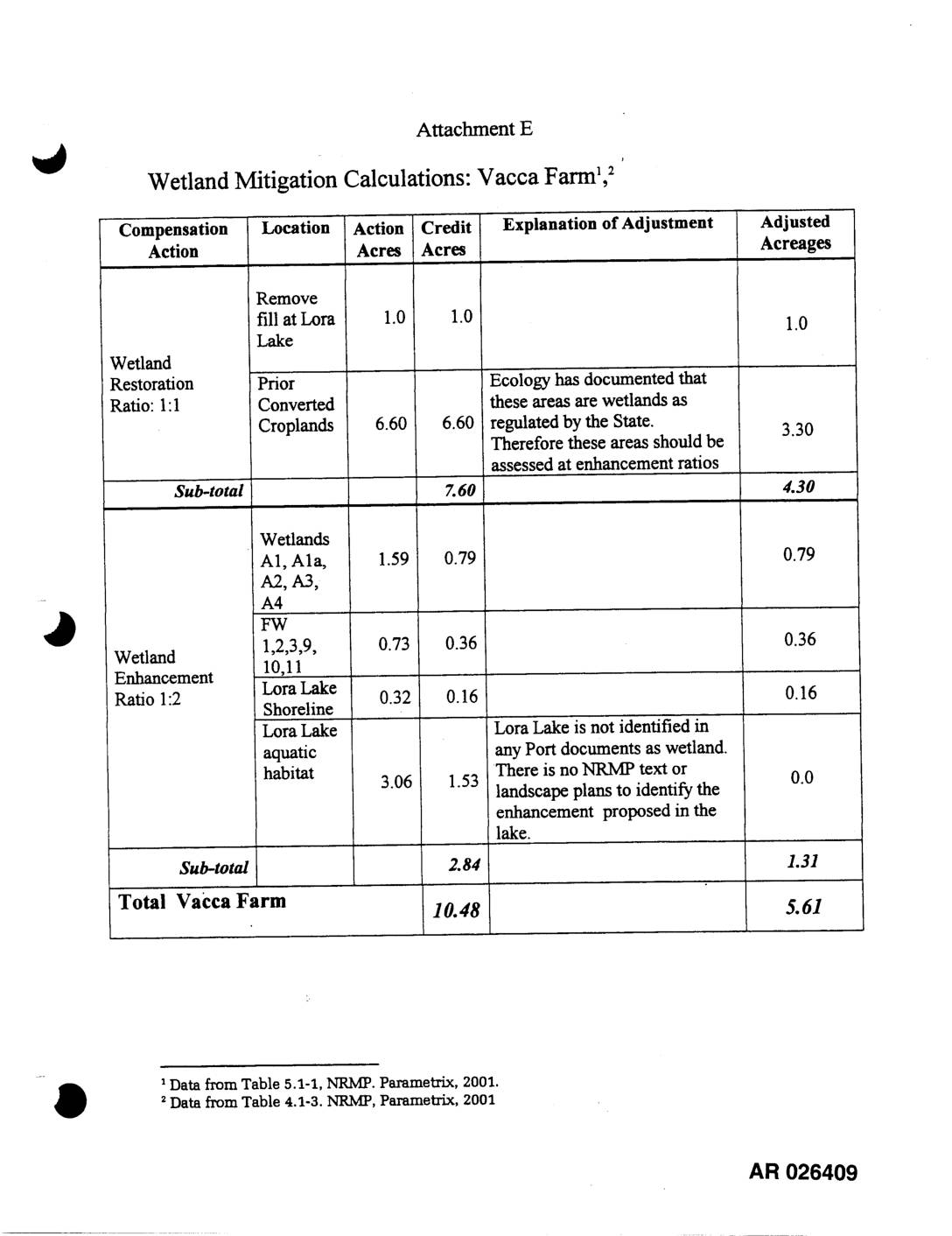
EXH AR026409: Wetland Mitigation Calculations — Vacca Farm
This document outlines wetland mitigation calculations for the Vacca Farm site, detailing compensation actions such as wetland restoration and enhancement across various locations including Lora Lake and prior converted croplands. Adjustments were made to credit acreages based on state ecology findings and documentation gaps; for example, the 6.60-acre converted cropland credit was reduced to 3.30 acres because the state identified those areas as existing wetlands requiring enhancement ratios rather than restoration ratios. In total, the site's original 10.48 credit acres were adjusted down to 5.61 acres after accounting for these regulatory and documentation considerations. -
 2002-10-22
EXH AR025787: 30% Submittal – Third Runway Embankment Construction Phase 4
This document is a 30% design submittal prepared by HNTB Corporation for the Third Runway Embankment Construction Phase 4 project at Seattle-Tacoma International Airport. It is an oversized engineering exhibit, submitted without a date, representing an early-stage design milestone in the ongoing construction of the airport's third runway. The submittal is part of the administrative record (AR 025787) related to the runway expansion project. -
 2002-10-22
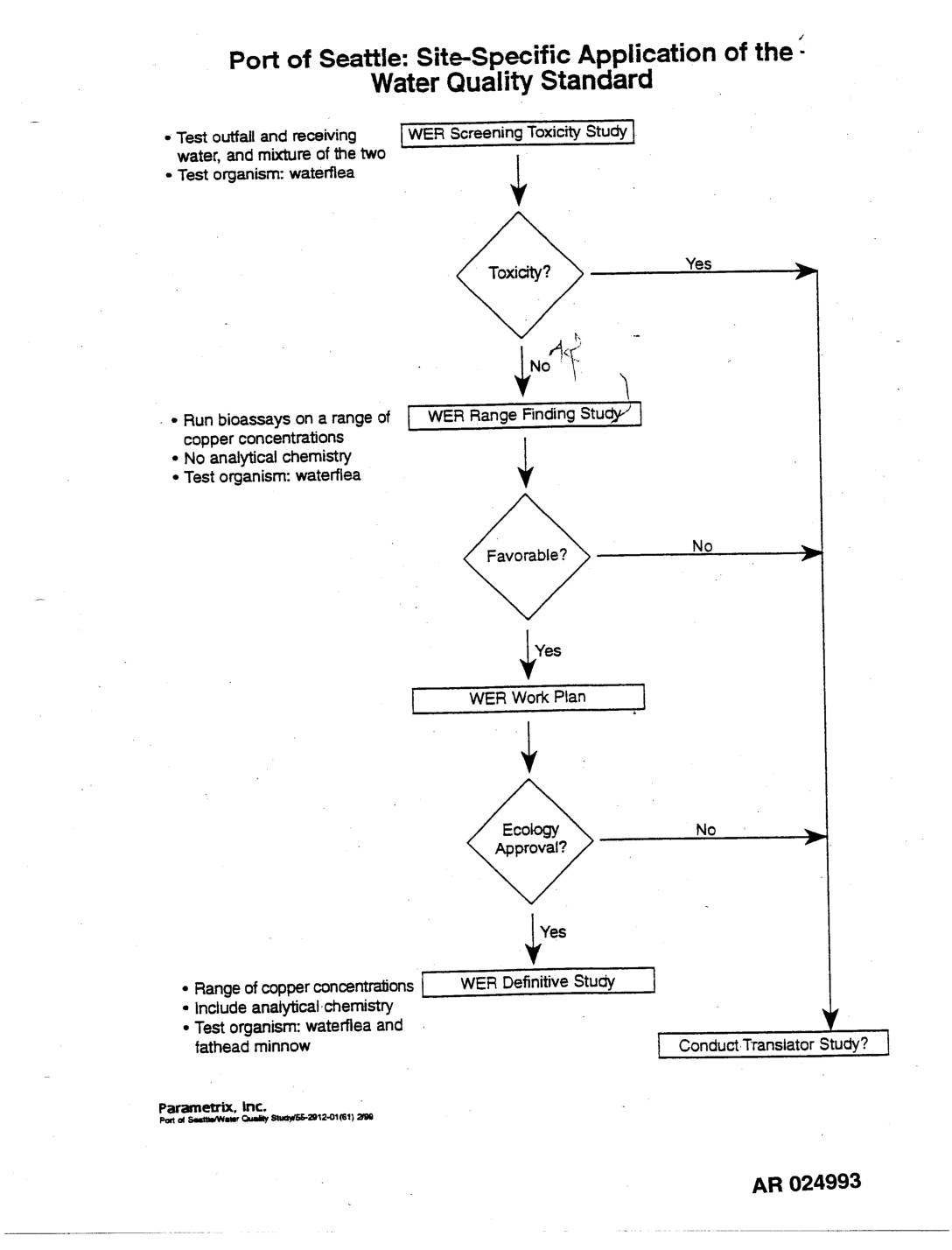
EXH AR024993: Site-Specific Water Quality Standard WER Study Process Flowchart
This document outlines the Port of Seattle's step-by-step process for applying water quality standards at a specific site, focusing on copper toxicity testing in local waterways. The flowchart guides researchers through a series of studies — including screening, range-finding, and definitive toxicity tests using waterfleas and fathead minnows — to determine whether copper levels in outfall and receiving waters pose environmental risks. Depending on test results and regulatory approval from the Washington State Department of Ecology, the process may lead to a Water Effect Ratio (WER) study or a Translator Study. -
 2002-10-22
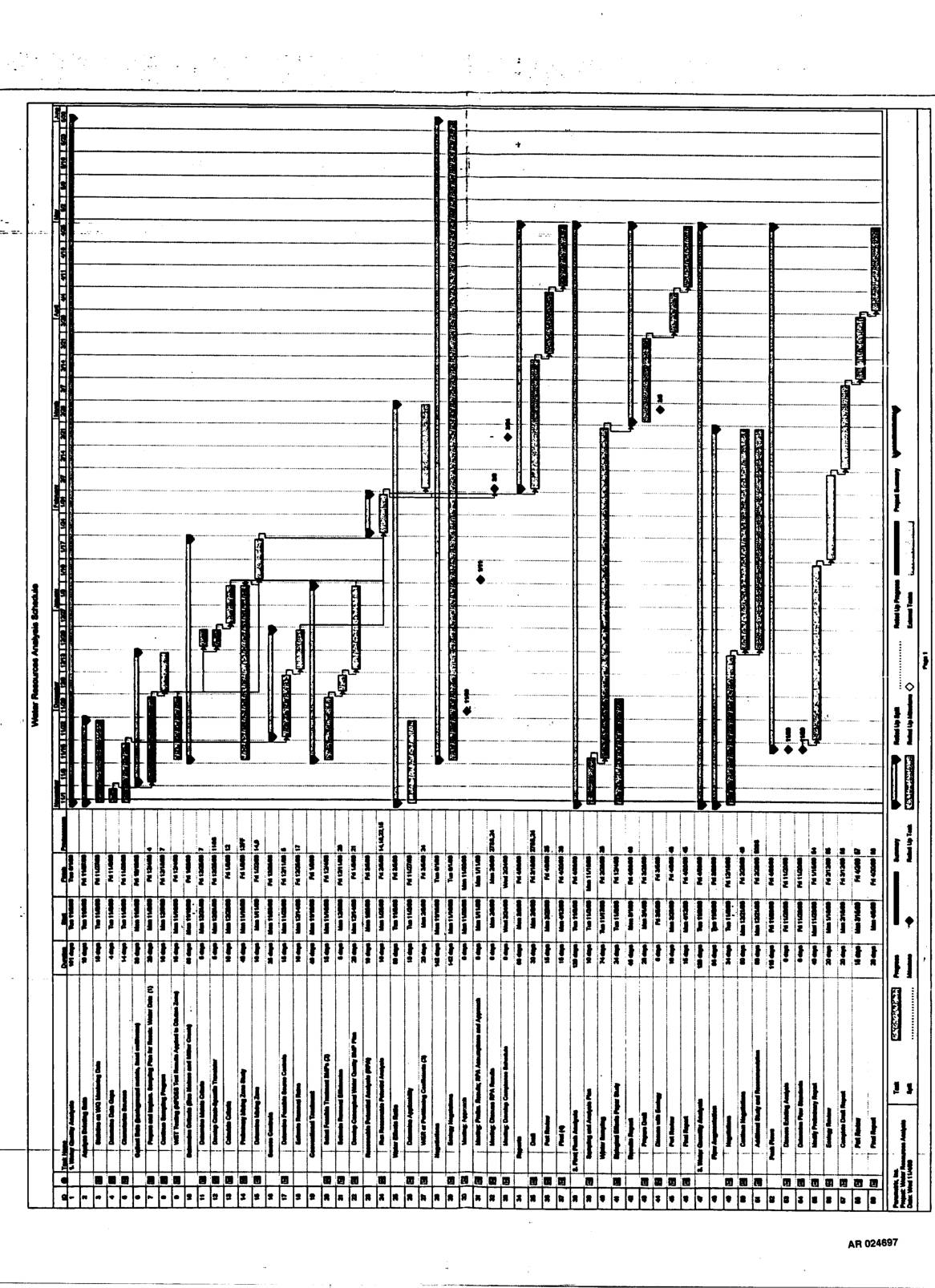
EXH AR024697: Water Resources Analysis Schedule
This document presents a Water Resources Analysis Schedule, displayed as a Gantt-style project timeline chart. It outlines the sequencing and duration of various technical tasks related to water resources analysis, including data collection, feasibility studies, treatment evaluations, and report preparation. The schedule appears to track project milestones and dependencies across multiple phases of a water resources planning effort. -
 2002-10-22
EXH AR024680: Presumed Ecology Position — Stormwater Mixing Zones
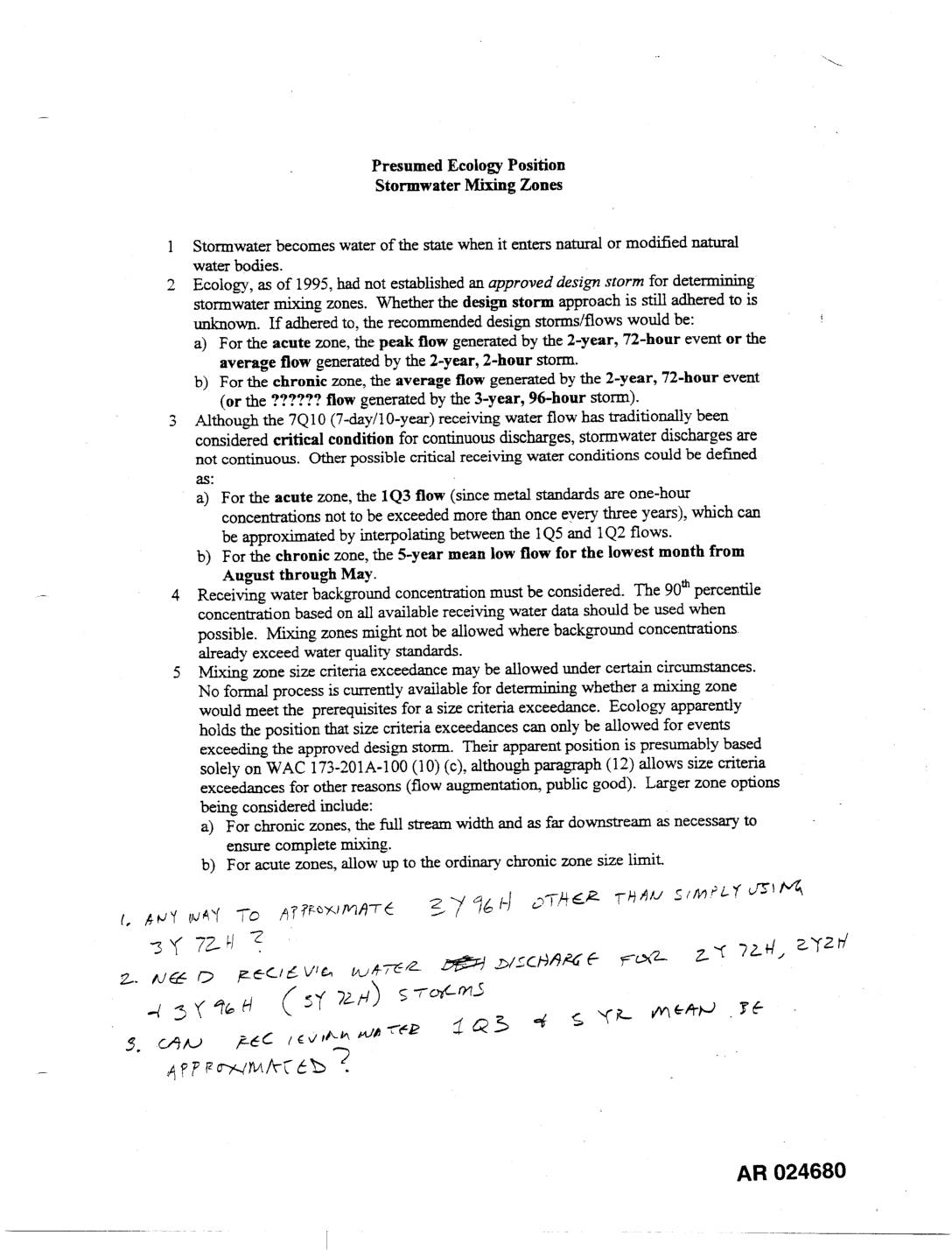
This document outlines Washington State Department of Ecology's presumed policy positions on stormwater mixing zones, addressing when stormwater becomes regulated state water and how mixing zones should be calculated. It details recommended design storms for acute and chronic mixing zones, critical receiving water flow conditions, and background concentration requirements. The document also discusses circumstances under which mixing zone size criteria exceedances may be permitted under state regulations. -
 2002-10-22
EXH AR024667: Miller Creek Below ROF — Future Low Flow Frequency & Storm Event Daily Flows
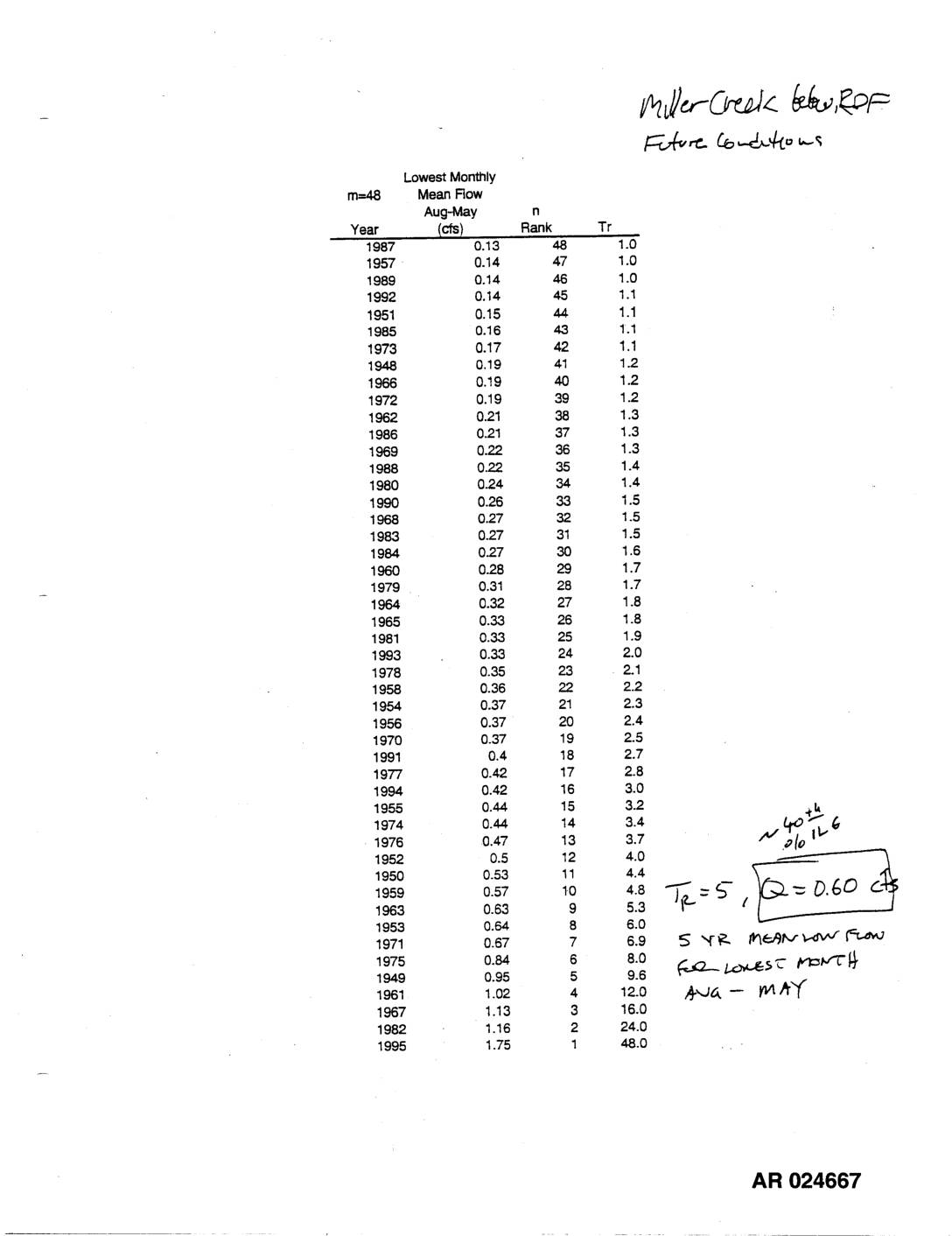
This document contains hydrological flow data for Miller Creek, including a ranked frequency analysis of the lowest monthly mean streamflows recorded between August and May from 1948 to 1995, alongside modeled daily and hourly stream flow outputs from 2-year/72-hour and 2-year/2-hour storm events simulated in August 1996. The analysis identifies a 5-year mean low flow of approximately 0.60 cubic feet per second for the lowest month in the August–May period. Acute and chronic water quality standards are also evaluated in relation to effluent and receiving water flows during the storm event. -
 2002-10-22
EXH AR024650: 3RWN Ambient & Effluent Discharge Joint Probability Analysis
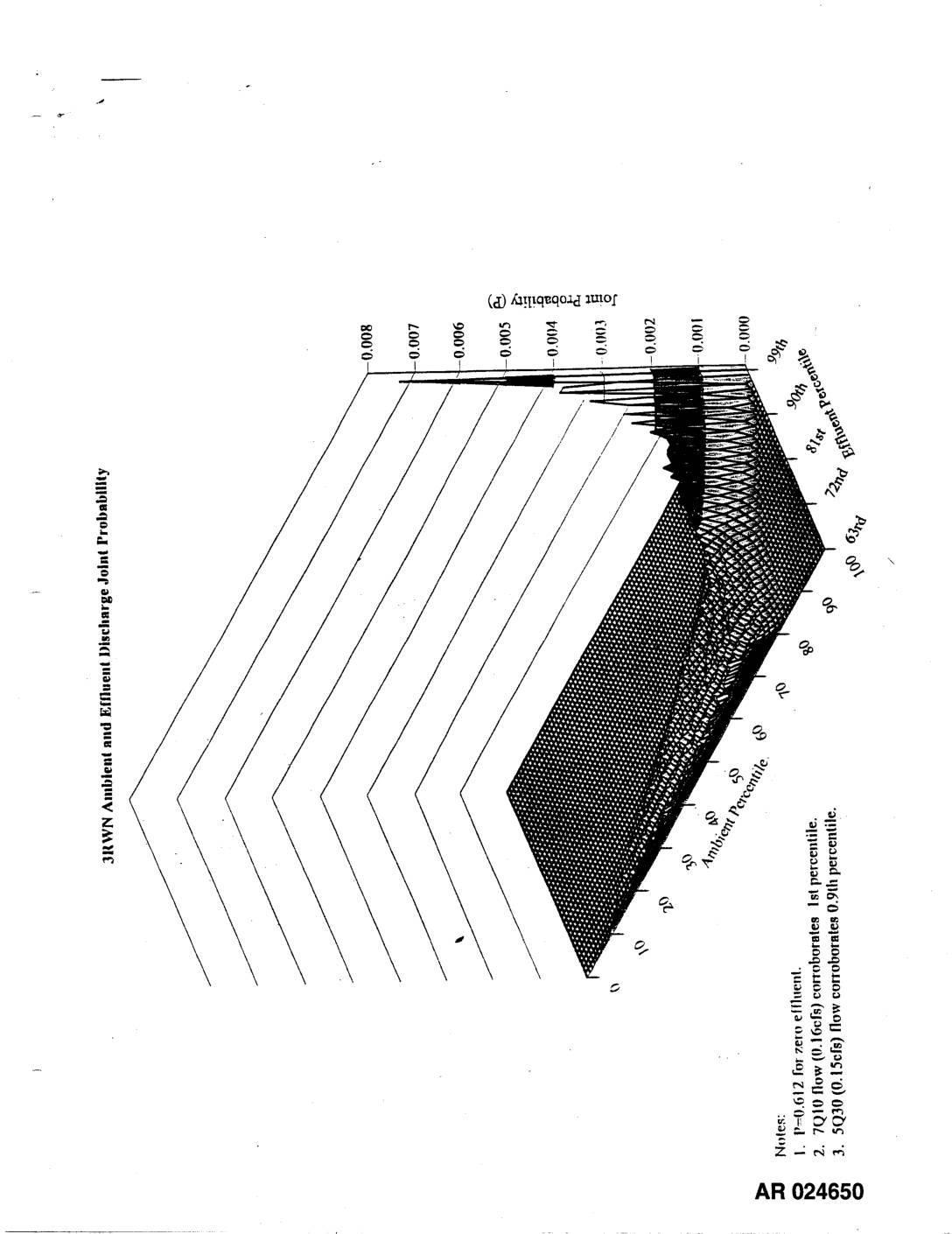
This document presents a statistical analysis of ambient water conditions and effluent discharge at a location designated 3RWN, examining the joint probability of stream flow and discharge occurring simultaneously. It includes a 3D probability surface chart, a data table showing dilution factors ranging from 3.6 to 5,294 at various probability levels, and a distribution curve of ambient stream discharge measured in cubic feet per second. The analysis notes that effluent is present approximately 38% of the time, with the 7Q10 flow of 0.16 cfs corroborating the 1st percentile and the 5Q30 flow of 0.15 cfs corroborating the 0.9th percentile. -
 2002-10-22
EXH AR024628: Stormwater Mixing Zones Mar 25 Meeting Discussion Doc STIA Third Runway EIS
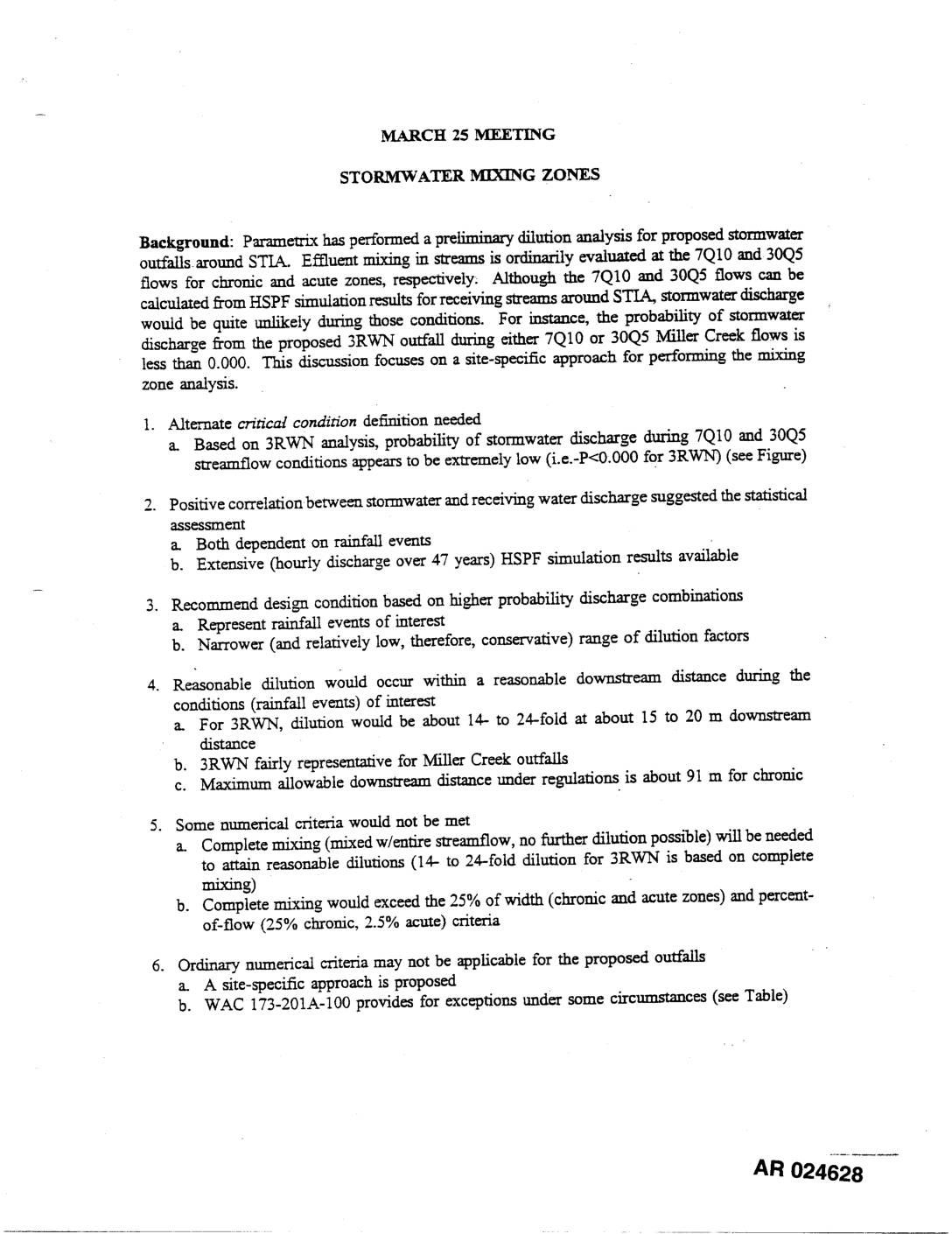
This technical document from a March 25 meeting discusses stormwater mixing zone analysis for proposed outfalls around Seattle-Tacoma International Airport (STIA). Because standard stream flow conditions (7Q10 and 30Q5) are extremely unlikely to coincide with stormwater discharge events, Parametrix proposed a site-specific approach using higher-probability rainfall-based discharge combinations instead. The analysis found that reasonable dilution of 14- to 24-fold could occur within about 15 to 20 meters downstream, though complete mixing requirements would exceed standard regulatory width and flow percentage criteria, prompting a request for exceptions under WAC 173-201A-100. -
 2002-10-22
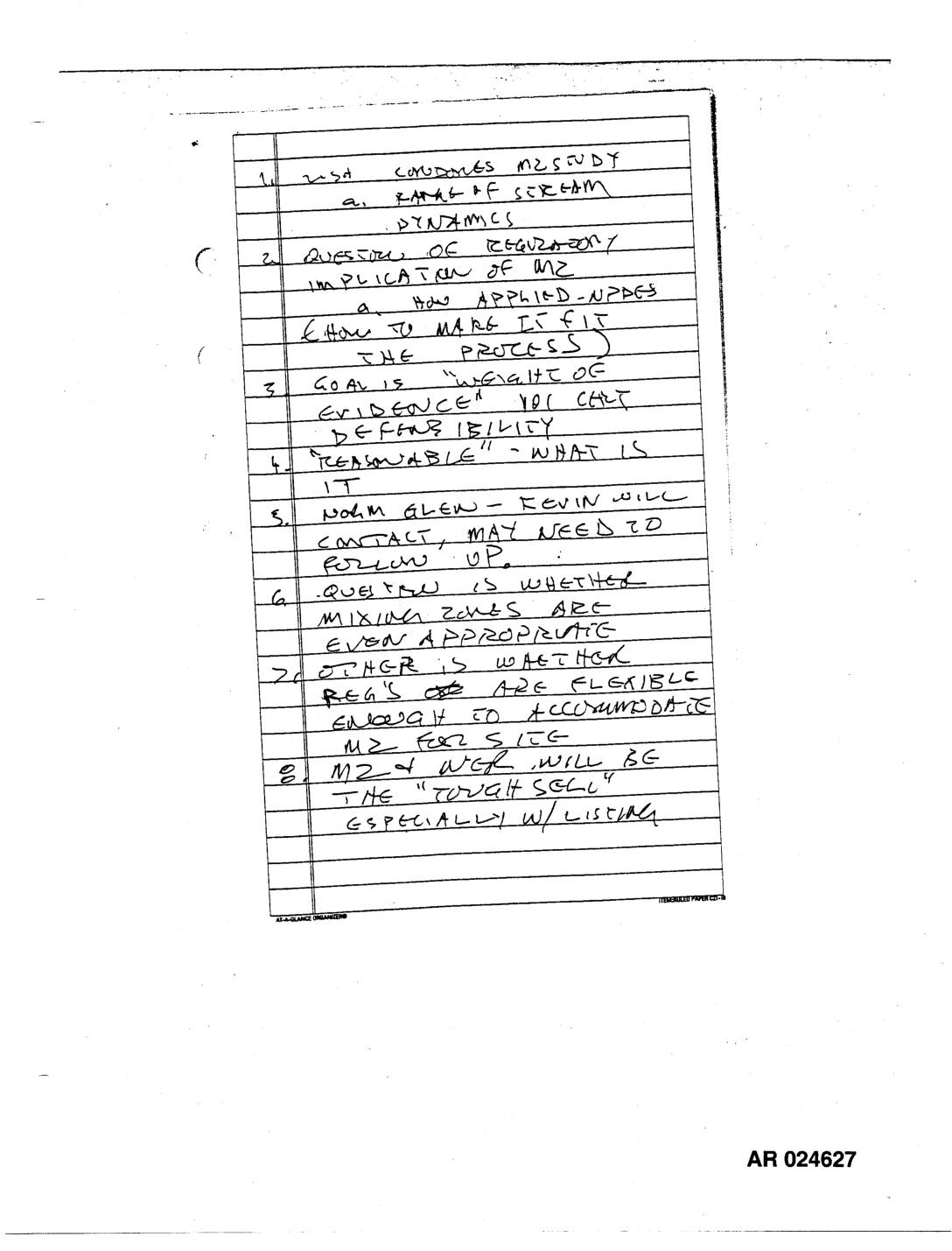
EXH AR024627: Handwritten Notes – Mixing Zones, NPDES, Regulatory Implications, Third Runway EIS
Handwritten notes outline eight key discussion points related to a mixing zone (MZ) study, including an examination of stream dynamics, regulatory questions about MZ implications under NPDES permitting, and how to weigh evidence for defensibility. The notes raise questions about whether mixing zones are appropriate at all, and whether existing regulations are flexible enough to accommodate site-specific MZ conditions. A final point flags that mixing zones near water quality listing designations will be a particularly difficult policy 'sell.' -
 2002-10-22
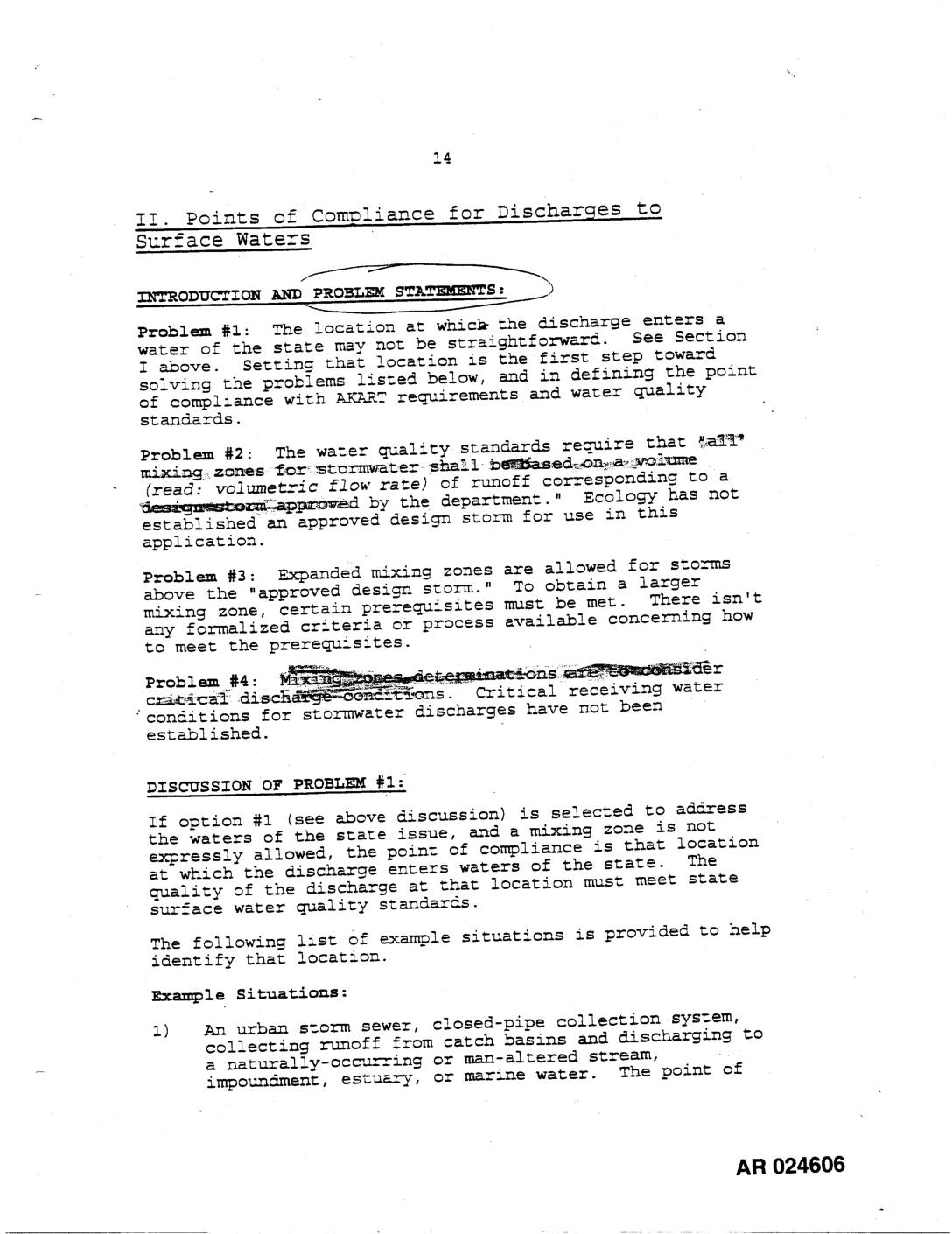
EXH AR024606: Points of Compliance — Mixing Zones & Stormwater Discharges to Surface Waters
This document outlines regulatory problems and compliance points for stormwater discharges into Washington State surface waters, focusing on where discharges must meet water quality standards. It identifies four key unresolved issues, including the lack of an approved design storm for mixing zones and undefined critical receiving water conditions. Various example situations are provided to help determine the exact location where stormwater discharge compliance must be measured.