TagThird Runway(1084)
-
 2002-10-22
EXH AR022960: Amanda Azous — Professional Biography and Recent Projects
This document provides a professional biography and project portfolio for Amanda Azous, an environmental scientist and sole proprietor of Azous Environmental Sciences based in Washington State. Her work focuses on wetland delineation, ecological restoration, watershed analysis, and land use planning, primarily in the San Juan County and Puget Sound regions. While her expertise informs broader environmental policy in Washington State, this document contains no information directly related to Sea-Tac Airport noise policy. -
 2002-10-21
EXH 260: Declaration Donald E. Weitkamp PhD — ACC v. Dept of Ecology PCHB No. 01-133
This legal declaration by fish biologist Donald E. Weitkamp was submitted to Washington's Pollution Control Hearings Board in a case involving Seattle-Tacoma International Airport's expansion, including a proposed third runway. Weitkamp argues that the project's stormwater controls and water quality conditions under the §401 Certification are adequate to protect nearby streams, and disputes claims that salmon species are present near the airport's property along the headwaters of Miller, Walker, and Des Moines Creeks. He contends that these streams have already been significantly altered by surrounding urban development, making them more suitable for warm-water fish species than for salmonids. -
 2002-10-21
EXH 258: CV Don Weitkamp PhD Fisheries Biologist Parametrix
This document is a professional biography and project experience summary for Dr. Don Weitkamp, a fisheries biologist with a Ph.D. from 1976, who has spent decades studying salmon habitat, water quality, and shoreline restoration in the Pacific Northwest. His work has focused on rivers, estuaries, and coastal areas including Commencement Bay, the Green-Duwamish River, and Elliott Bay, involving biological assessments, habitat restoration, and hydroelectric dam impacts. This document does not contain information related to Sea-Tac Airport noise policy. -
 2002-10-21
EXH 257: ACC Interrogatories Nos. 1-19 and Requests for Production Nos. 1-6 — Objections and Responses
This document contains the Port of Seattle's formal objections and responses to interrogatories filed by the Airport Communities Coalition (ACC) before Washington State's Pollution Control Hearings Board (Case No. 01-160). The Port identifies over a dozen expert witnesses it intends to use, including specialists in geotechnical engineering, toxicology, hydrology, and groundwater science from firms such as Parametrix, Inc. and Hart Crowser, Inc. The case involves a dispute between the ACC and the Port of Seattle regarding environmental and pollution control issues related to Sea-Tac Airport operations. -
 2002-10-21
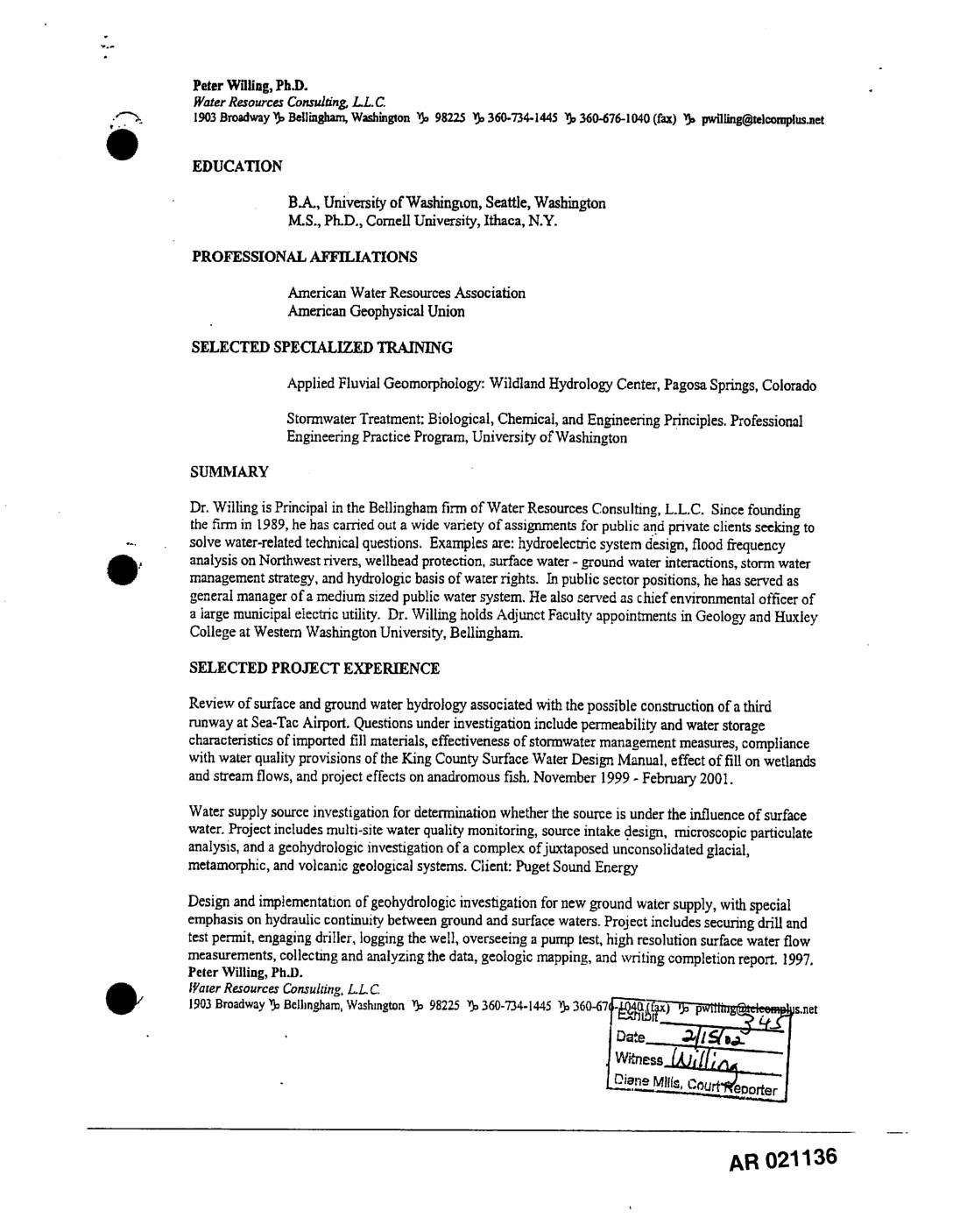
EXH 345: Curriculum Vitae Peter Willing PhD Water Resources Consulting LLC
This document is the curriculum vitae of Dr. Peter Willing, a water resources consultant based in Bellingham, Washington, who was retained to review surface and ground water hydrology related to the possible construction of a third runway at Sea-Tac Airport from November 1999 to February 2001. His investigation addressed issues including stormwater management effectiveness, compliance with the King County Surface Water Design Manual, and potential project effects on wetlands, stream flows, and anadromous fish. Dr. Willing holds a Ph.D. from Cornell University and has broad experience in flood analysis, water rights, and geohydrologic investigations across the Pacific Northwest. -
 2002-10-21
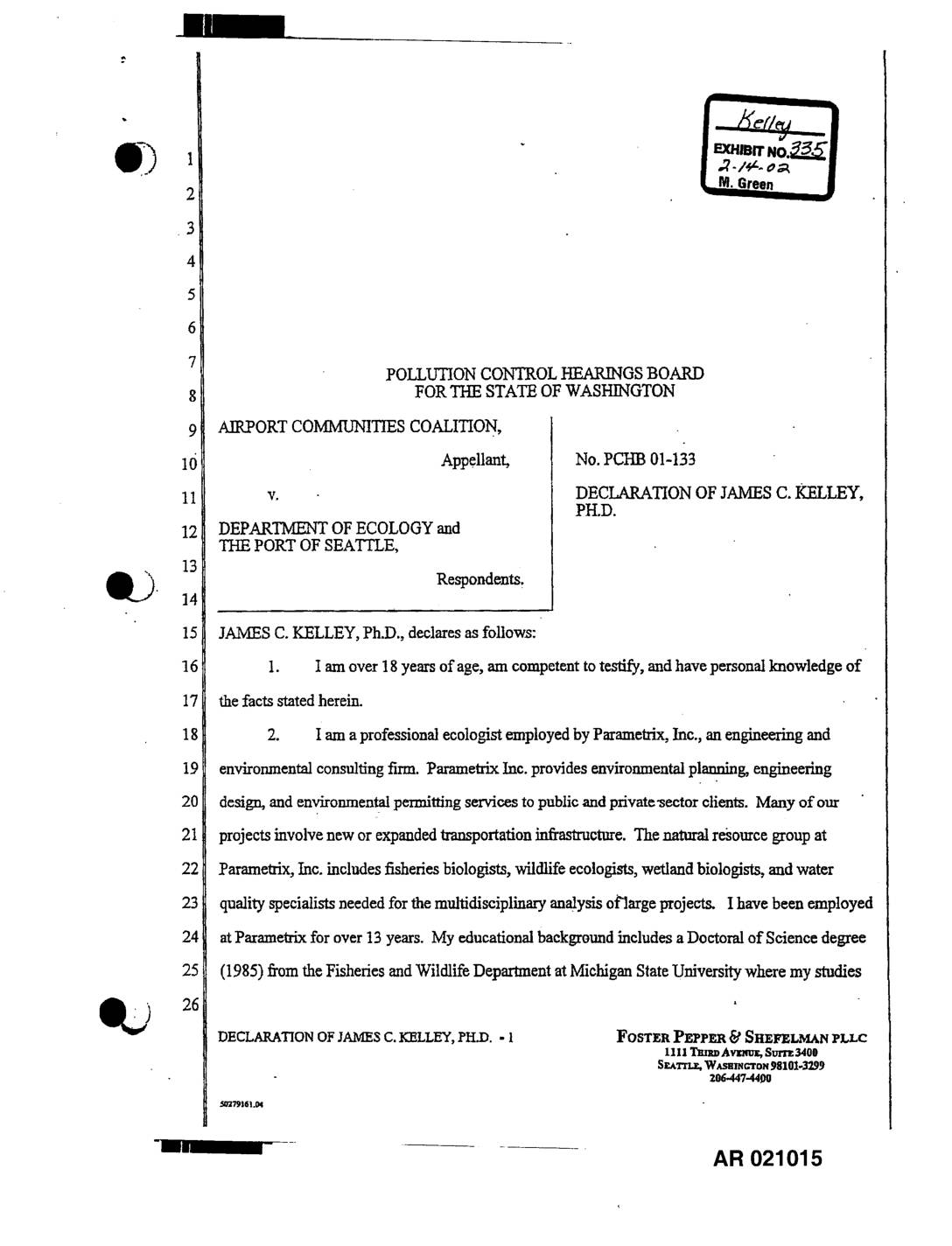
EXH 335: Declaration James C. Kelley PhD — Wetland Impacts Mitigation STIA Master Plan Update PCHB 01-133
In this legal declaration, ecologist James C. Kelley, Ph.D., testifies about the environmental impact of Seattle-Tacoma International Airport's Master Plan Update, which permanently fills 18.37 acres of wetland. He describes a comprehensive mitigation plan designed to replace lost ecological functions in the Miller, Walker, and Des Moines Creek basins. Kelley also notes that the affected wetlands and streams were already significantly degraded by decades of logging, farming, and urban development before the airport expansion. -
 2002-10-21
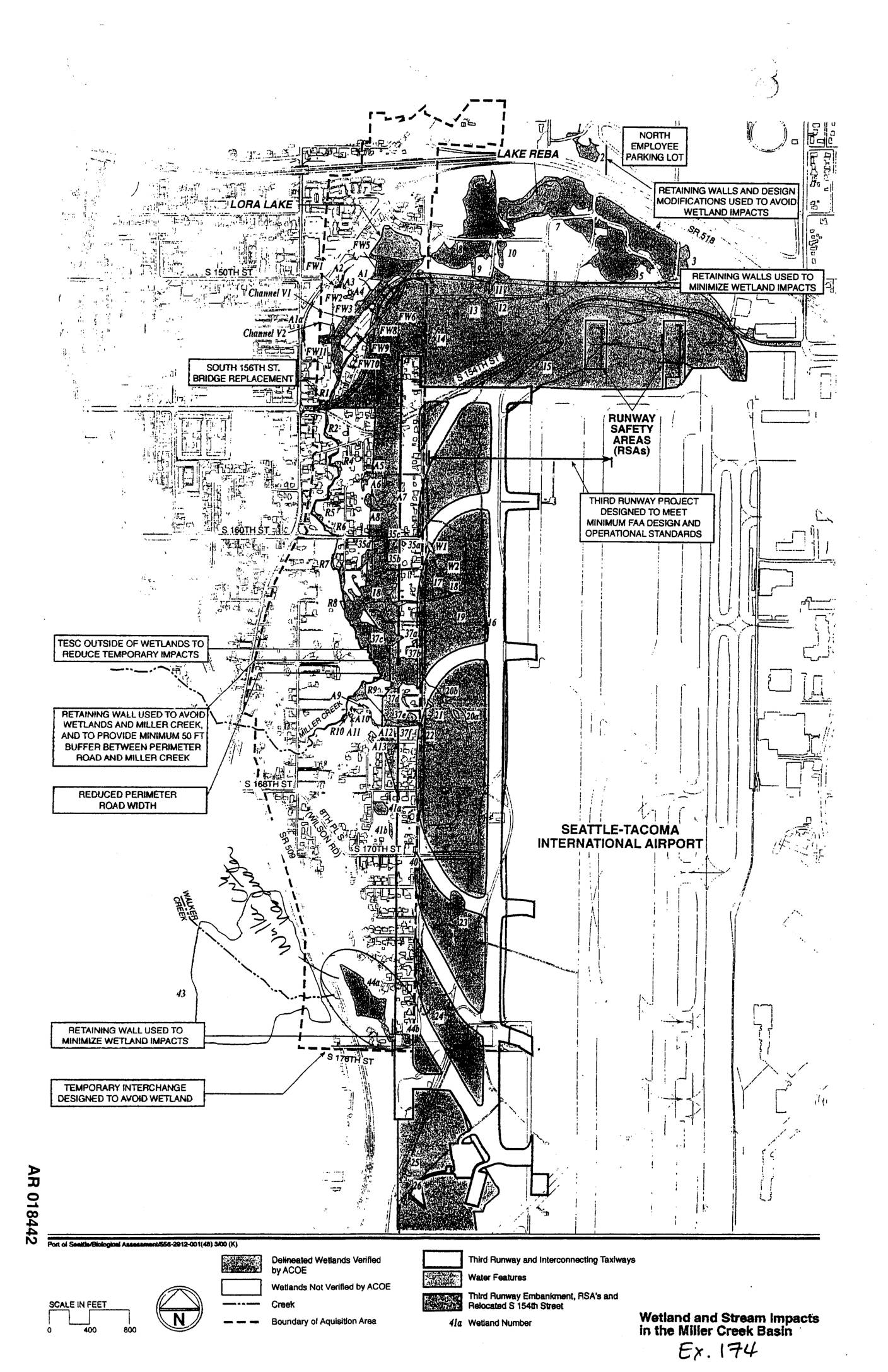
EXH AR018442: Wetland and Stream Impacts in the Miller Creek Basin — Sea-Tac Airport Third Runway Project
Exhibit AR018442 is a detailed map of wetland and stream impacts in the Miller Creek Basin associated with the Seattle-Tacoma International Airport Third Runway project. The map shows delineated wetlands verified by the Army Corps of Engineers (ACOE), wetlands not verified by ACOE, water features, Third Runway embankment, Runway Safety Areas (RSAs), relocated S 154th -
 2002-10-21
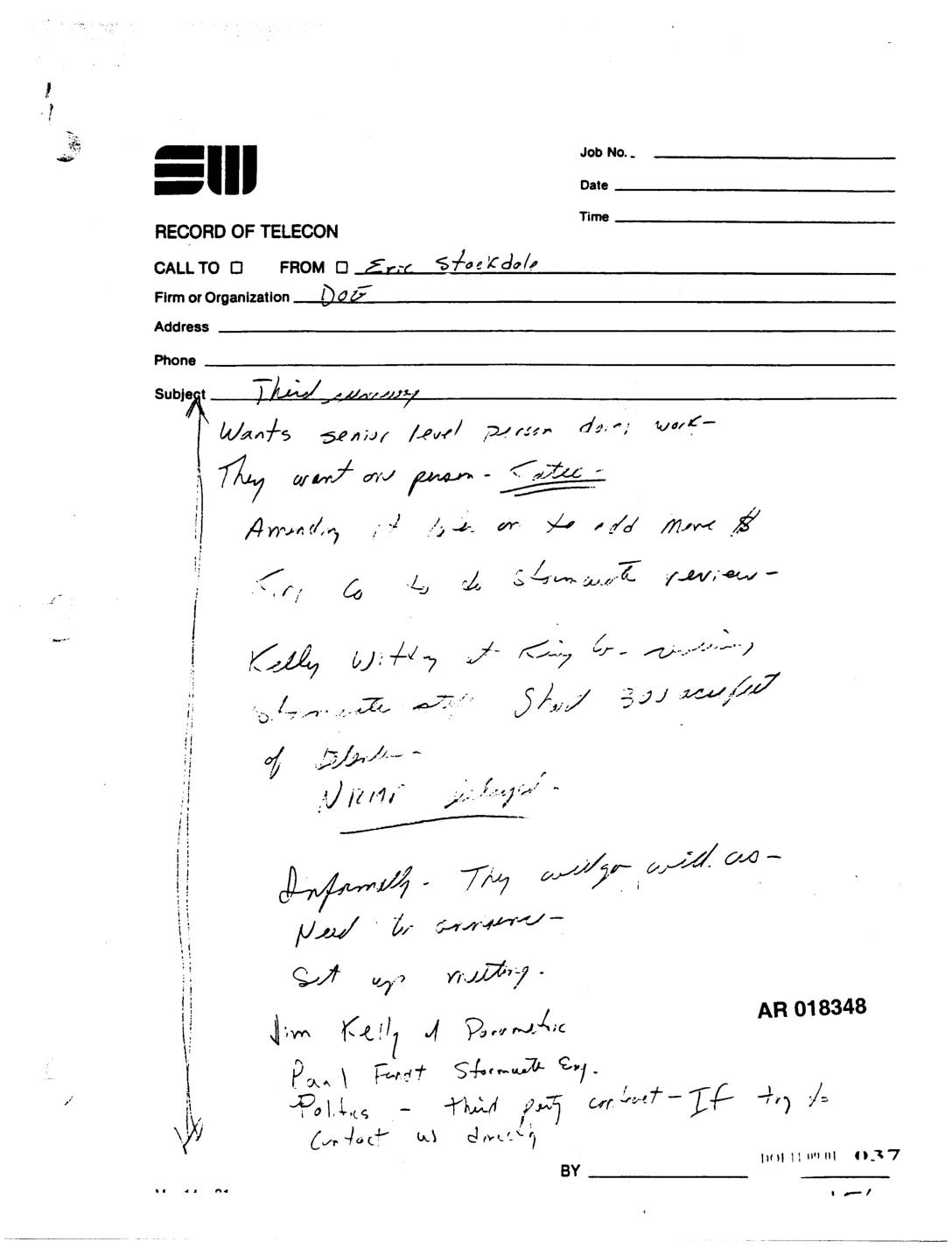
EXH AR018348: Record of Telecon — Eric Stockdale, DOE, Third Runway Stormwater Review
Handwritten record of telecon from Eric Stockdale of DOE (Department of Ecology). Notes reference a senior level person doing work, mention of Kelly, King County, stormwater review, ‘Shou 333 receipt of Bilski’, NEMI biology, informal discussion, need to set up meeting. Also references Jim Kelly of Parometric, Paul Fordt Stormwater Engineer, Politics — third party -
 2002-10-21
EXH 325: VS2DT Solute Transport Variably Saturated Porous Media Table of Contents
This technical report documents VS2DT, a computer program that models how chemical solutes move through variably saturated porous soil and rock, accounting for processes such as advection, hydrodynamic dispersion, decay, adsorption, and ion exchange. The document includes the underlying mathematical theory, numerical methods, data input instructions, and verification problems comparing the program's results against known analytical solutions. While primarily a groundwater contaminant transport modeling tool, it has no direct connection to airport noise policy. -
 2002-10-21
EXH AR016605: Prefiled Testimony of Dr. Michael Riley — ACC v. Ecology and Port Of Seattle, PCHB No. 01-160
Prefiled testimony of Dr. Michael Riley, Civil Engineer, in PCHB No. 01-160, Airport Communities Coalition (ACC) v. State of Washington Department of Ecology and Port Of Seattle. Riley performed modeling analysis of fill criteria in the 401 Certification for the Third Runway embankment at Sea-Tac Airport, using conservative assumptions including maximum metal concentrations allowed by