TagSea-Tac Airport(1855)
-
 1982-01-01
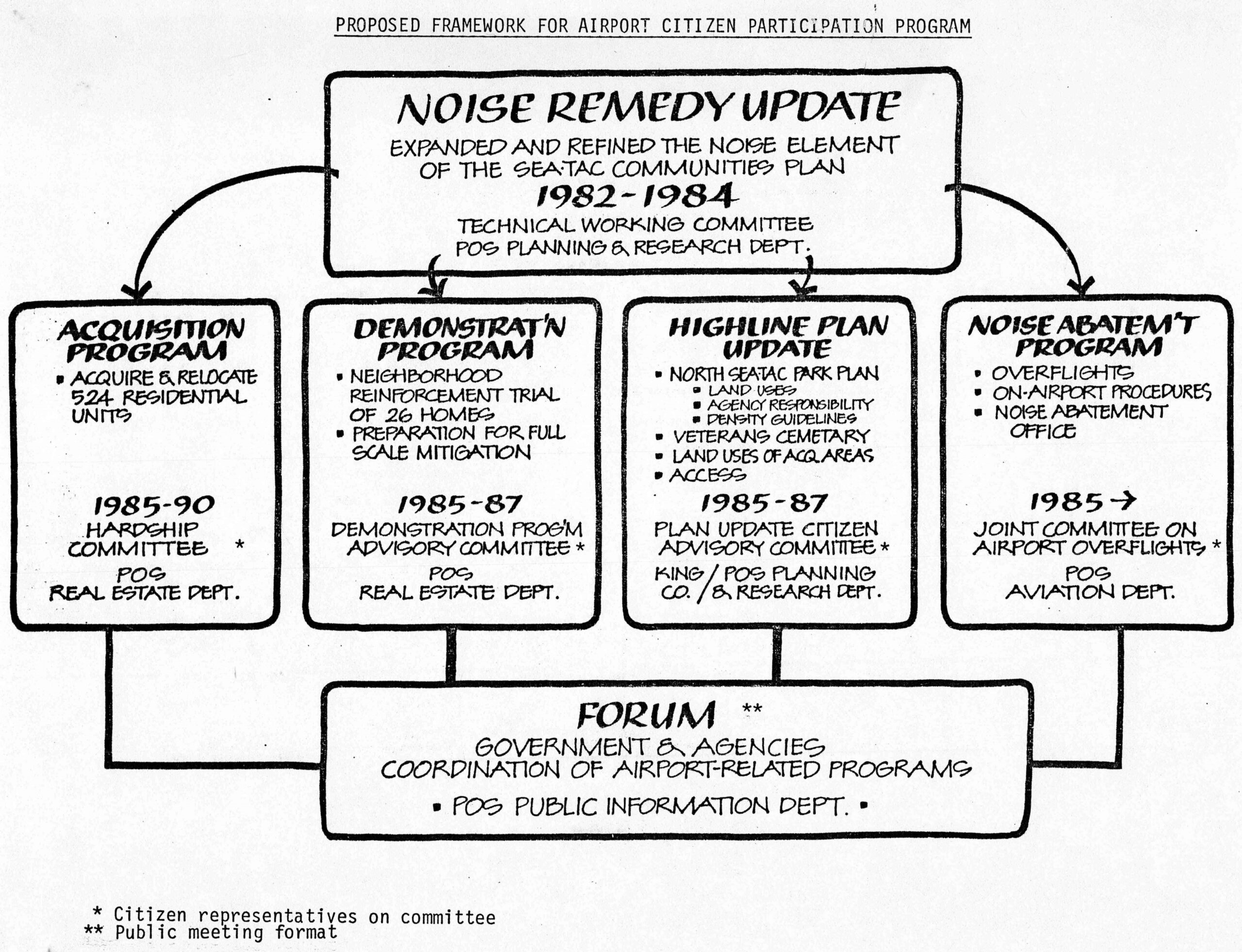
Noise Remedy Update Org Chart Airport Citizen Participation Program 1982-1990 0001
A hand-drawn organizational chart outlining the Proposed Framework for the Sea-Tac Airport Citizen Participation Program, centered on the Noise Remedy Update (1982–1984) administered by the Technical Working Committee and POS Planning & Research Dept. The framework branches into four programs—Acquisition Program (1985–90), Demonstration Program (1985–87), Highline Plan Update (1985–87), and Noise Abatement Program (1985→)—all feeding into a Forum coordinated by the POS Public Information Department. -
 1982-01-01
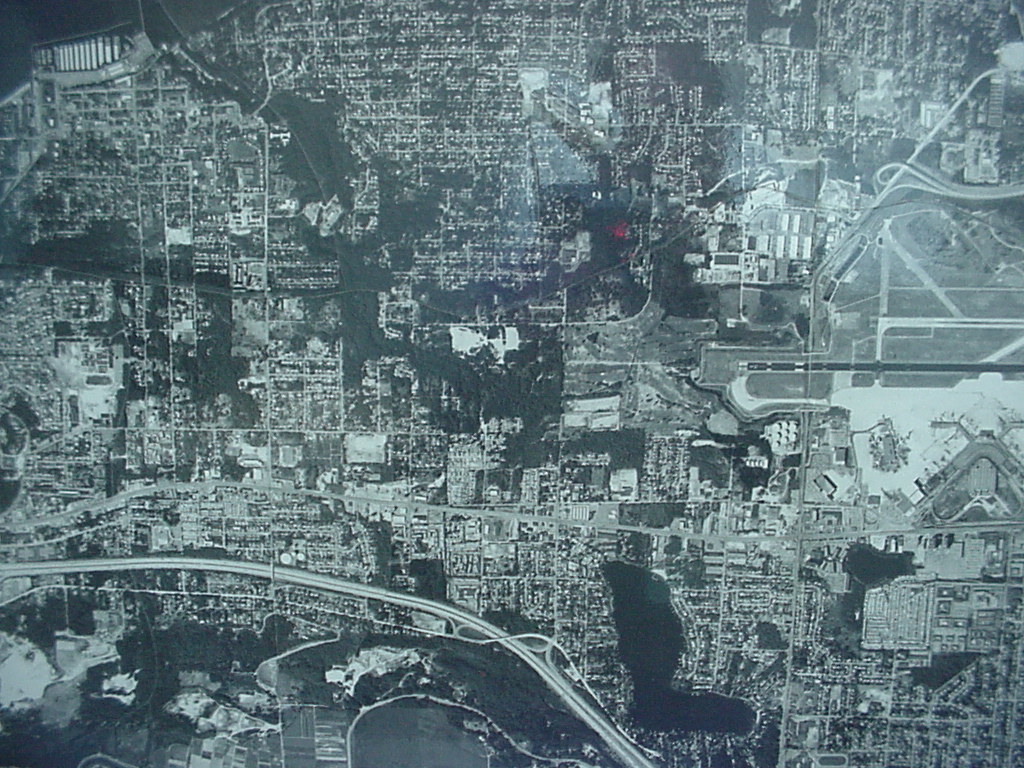
Aerial Photograph of Sea-Tac Airport Runway Complex and Surrounding Urban Area, 1982
Black-and-white aerial photograph showing a densely developed urban grid with residential and commercial areas. A runway complex is visible in the upper right quadrant, and a river or waterway curves through the lower portion of the image, consistent with an airport noise study context. -
 1981-12-29
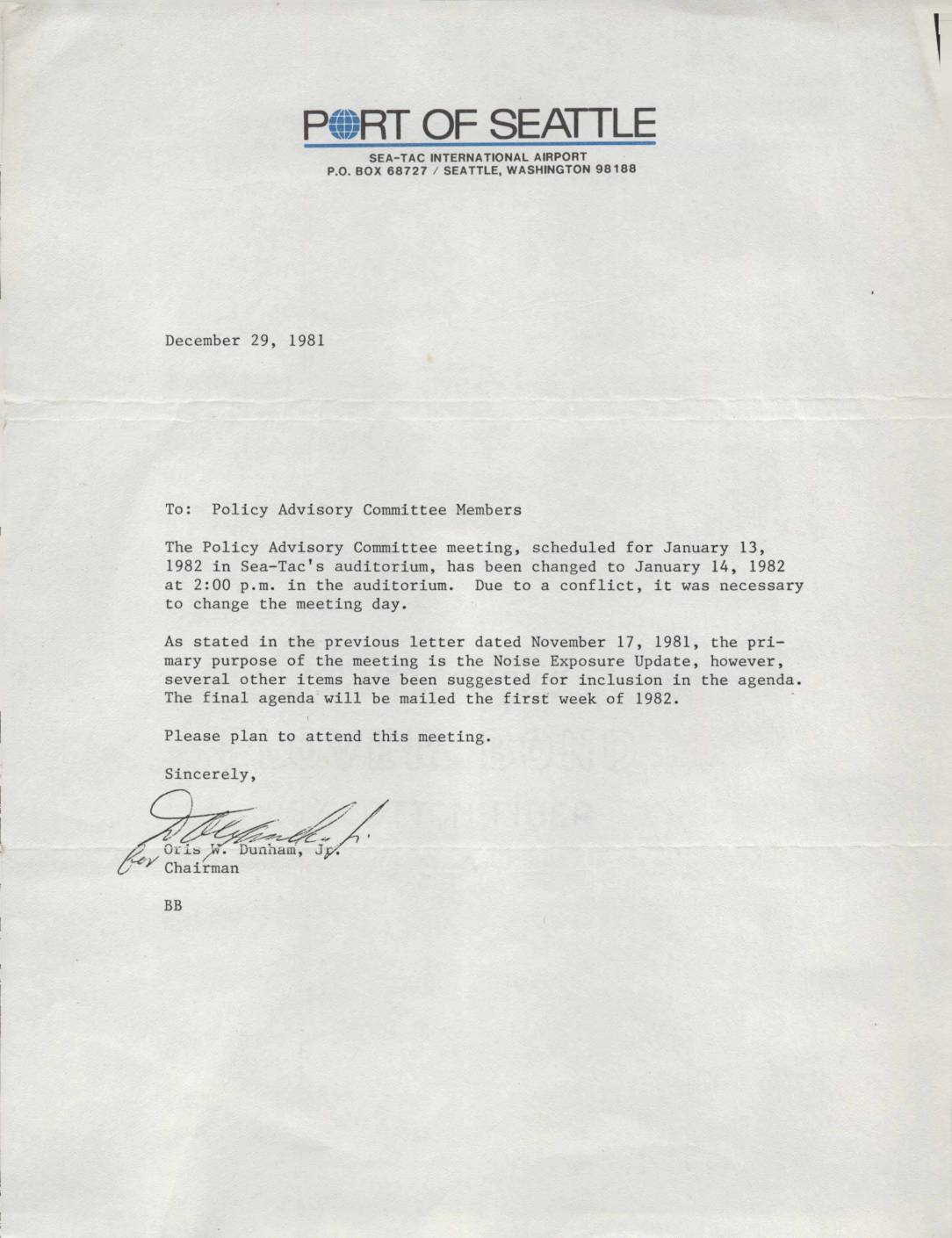
Policy Advisory Committee meeting date change notice
A December 29, 1981 letter from Port of Seattle Chairman Oris W. Dunham, Jr. notifies Policy Advisory Committee members that their upcoming meeting has been rescheduled from January 13 to January 14, 1982 at 2:00 p.m. in Sea-Tac's auditorium due to a scheduling conflict. The primary focus of the meeting remains the Noise Exposure Update, with additional agenda items also planned for discussion. Members were advised that the final agenda would be mailed during the first week of 1982. -
 1981-12-17
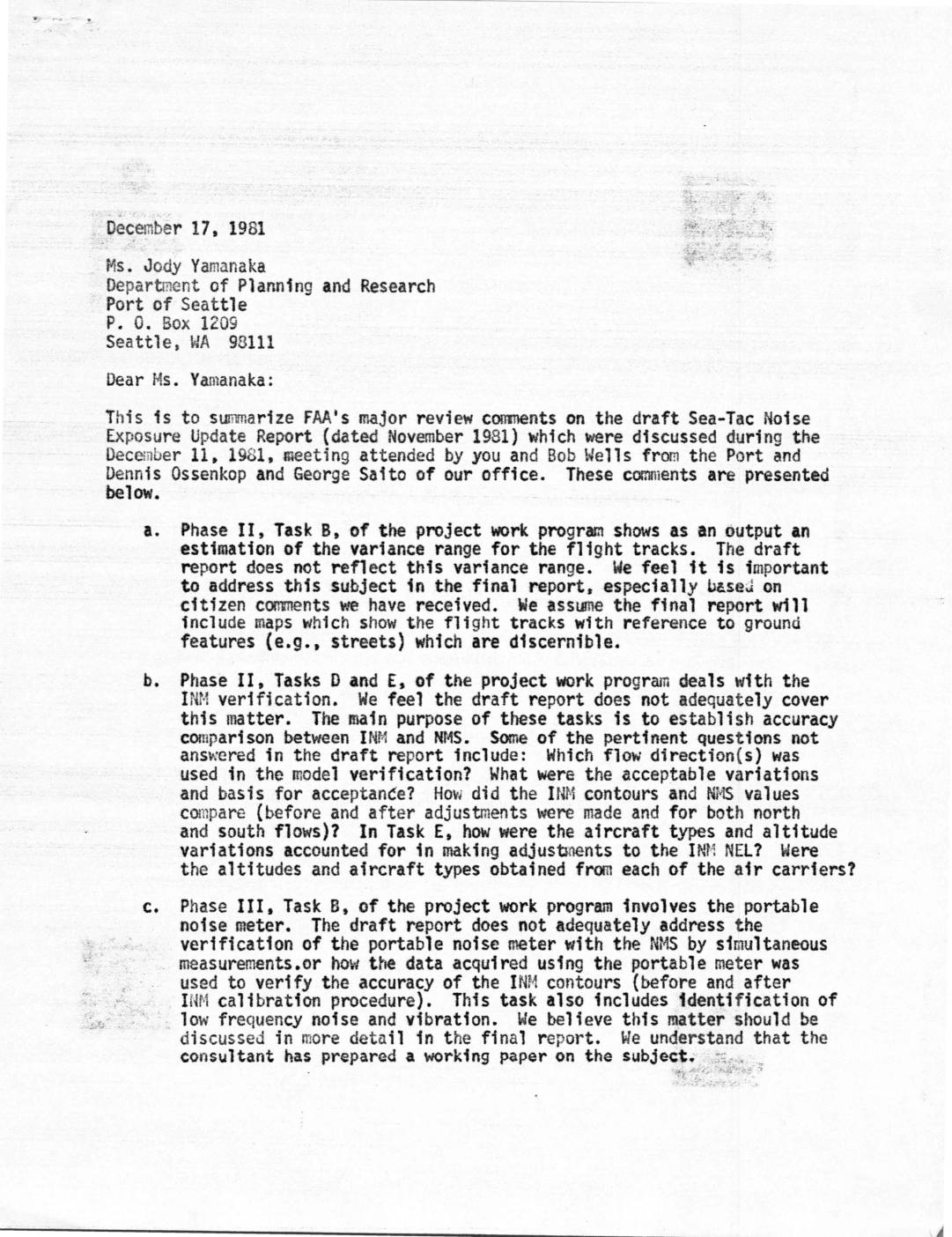
FAA Review Comments on Draft Sea-Tac Noise Exposure Update Report: Letter to Jody Yamanaka
A December 17, 1981 letter from FAA Acting Chief Mark A. Beisse to the Port of Seattle summarizes the FAA's major review comments on the draft Sea-Tac Noise Exposure Update Report. The letter identifies multiple deficiencies in the draft, including inadequate coverage of flight track variance ranges, INM model verification, portable noise meter data, and noise impact projections under different operational scenarios. The FAA requested that these issues be addressed in the final report and asked the Port to clarify whether certain project tasks, such as a population and land use survey, would be dropped from the study. -
 1981-11-17
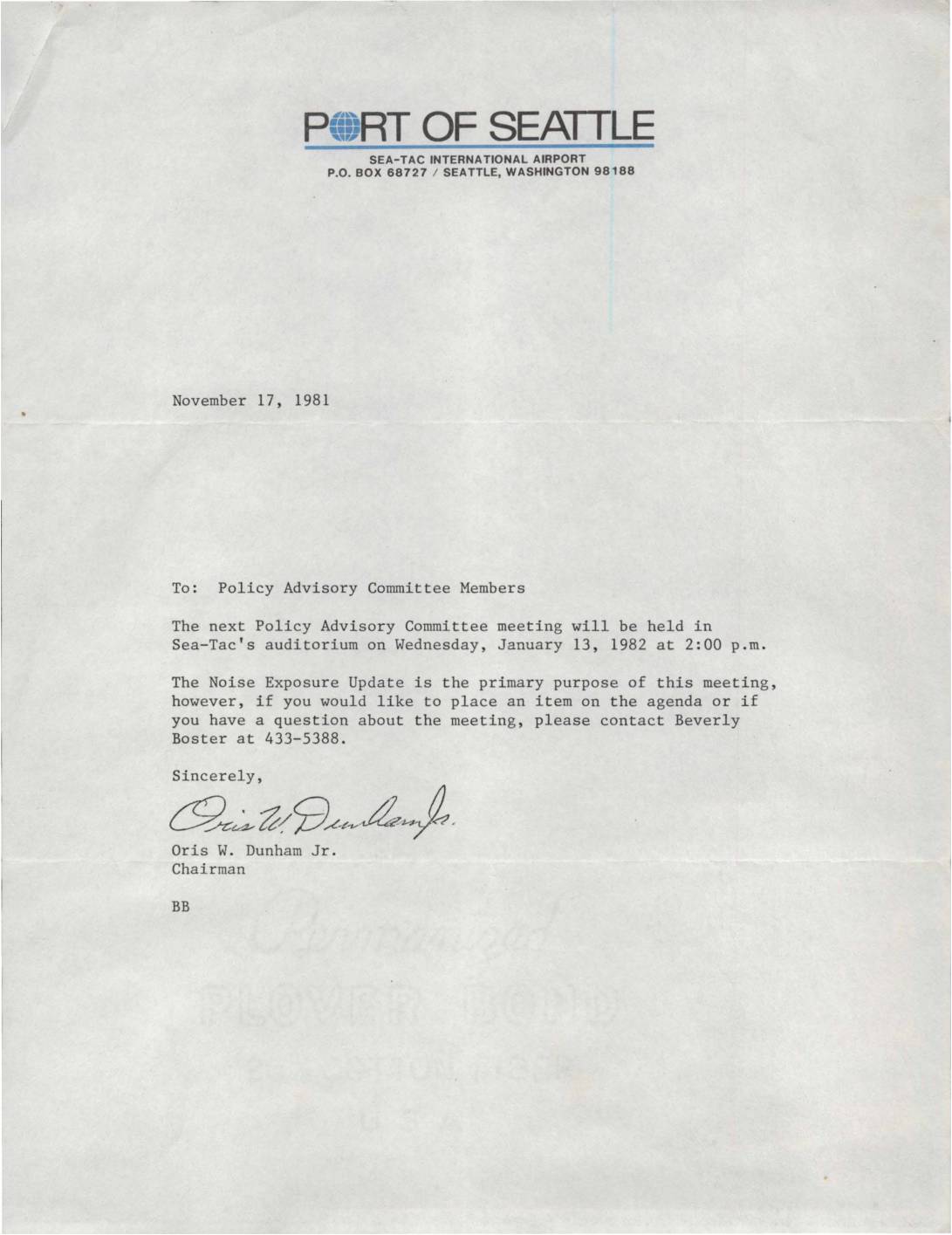
Policy Advisory Committee Meeting Notice: Noise Exposure Update, January 13, 1982
A November 1981 letter from Sea-Tac International Airport Chairman Oris W. Dunham Jr. notifies Policy Advisory Committee members of an upcoming meeting scheduled for January 13, 1982, at 2:00 p.m. in Sea-Tac's auditorium. The primary agenda item is a Noise Exposure Update. Committee members wishing to add agenda items or ask questions were directed to contact Beverly Boster at 433-5388. -
 1981-11-16
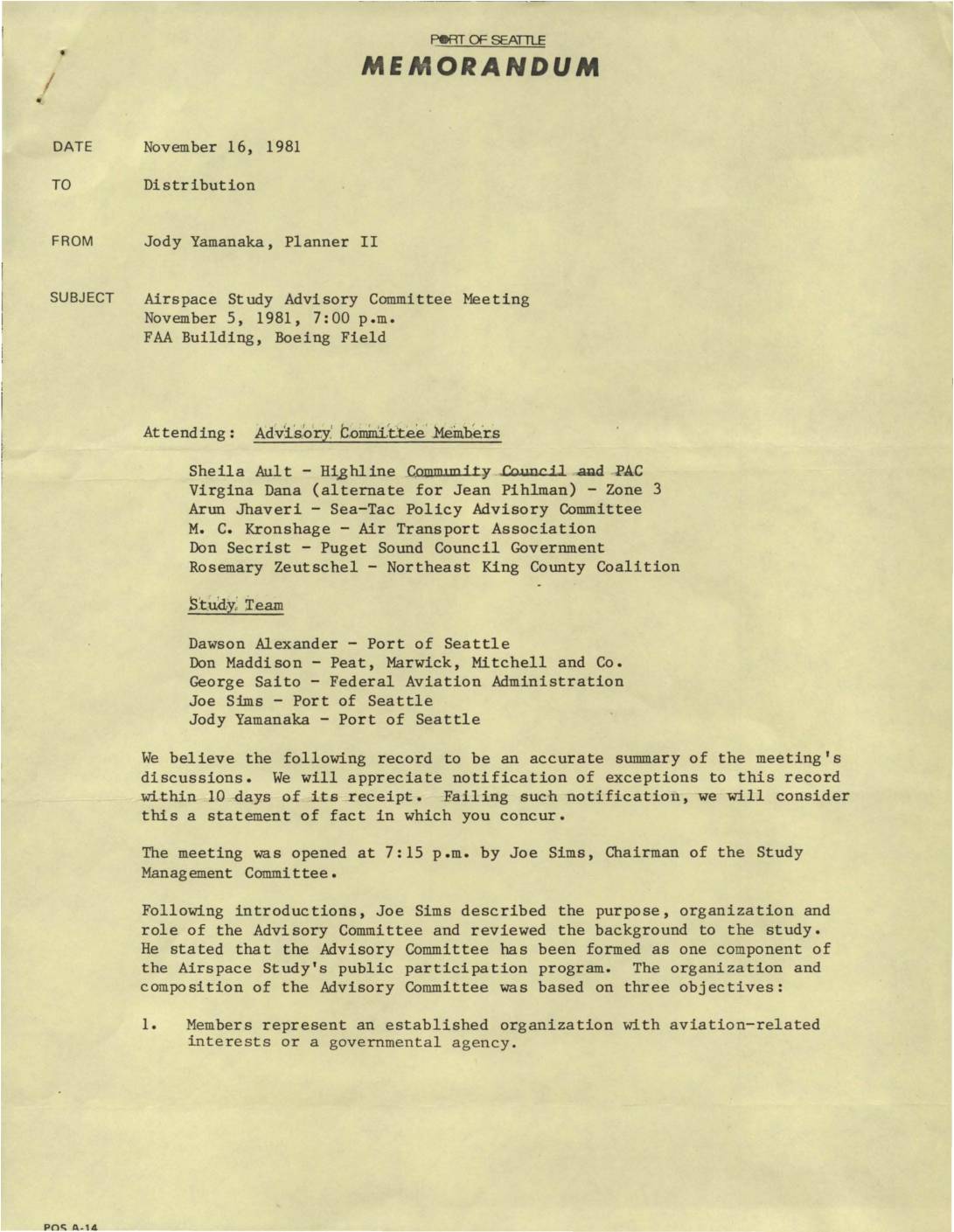
Airspace Study Advisory Committee Meeting November 5, 1981
Meeting minutes from the Airspace Study Advisory Committee discussing the study of airspace interaction between Sea-Tac Airport and Boeing Field. The committee reviewed the study’s purpose, organization, scope, and schedule, with presentations on air traffic control and local airspace structure. -
 1981-11-03
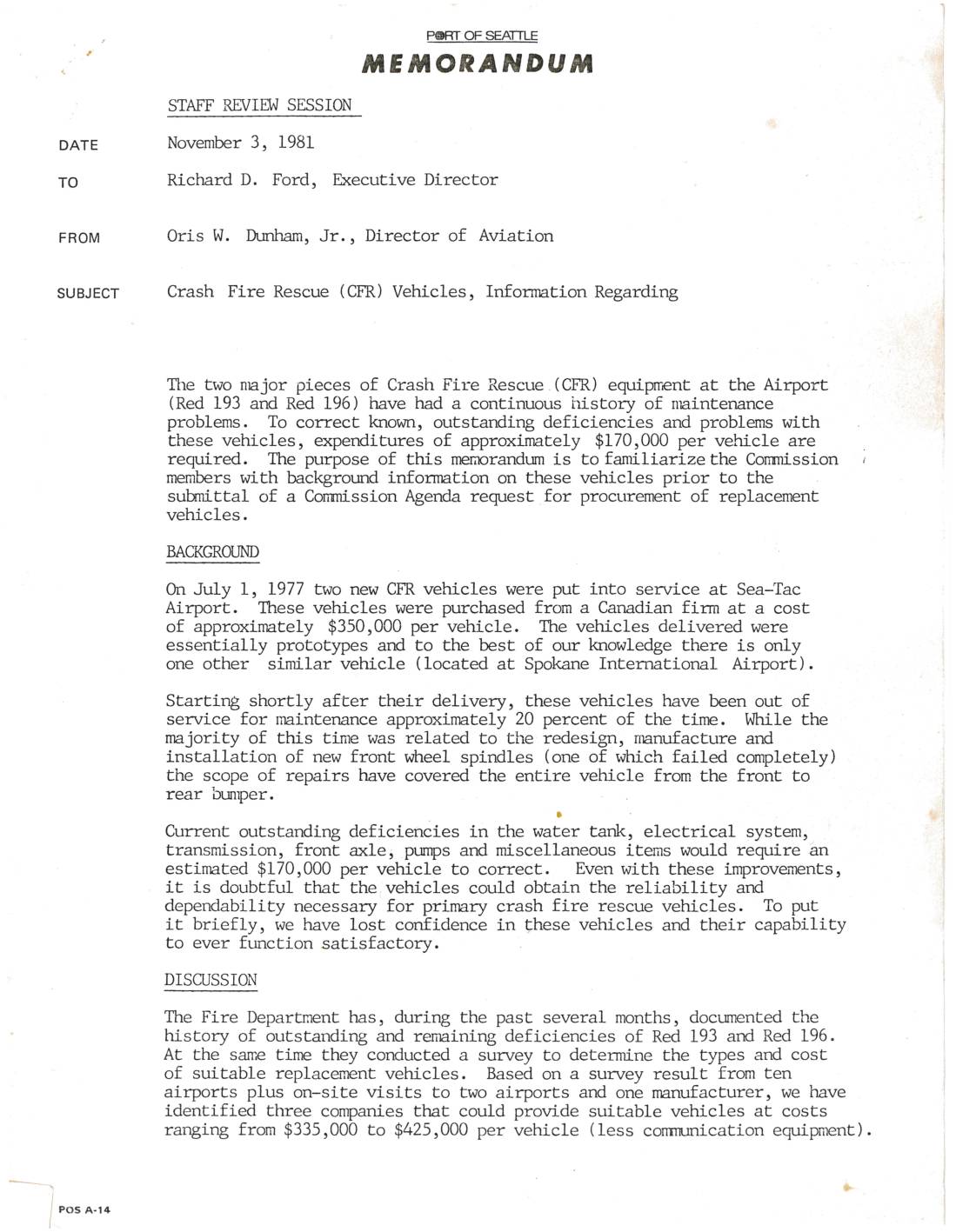
Crash Fire Rescue (CFR) Vehicles, Information Regarding
A 1981 Port of Seattle internal memorandum from the Director of Aviation recommends replacing two aging Crash Fire Rescue vehicles (Red 193 and Red 196) at Sea-Tac Airport, which had been out of service roughly 20% of the time since their 1977 purchase and would each require $170,000 in repairs. The memo also recommends acquiring a new Rapid Intervention Vehicle, as suggested by FAA inspectors. Funding of $1 million was already included in the Airport's 1982 Capital Budget, to be supplemented by proceeds from selling the two problem vehicles. -
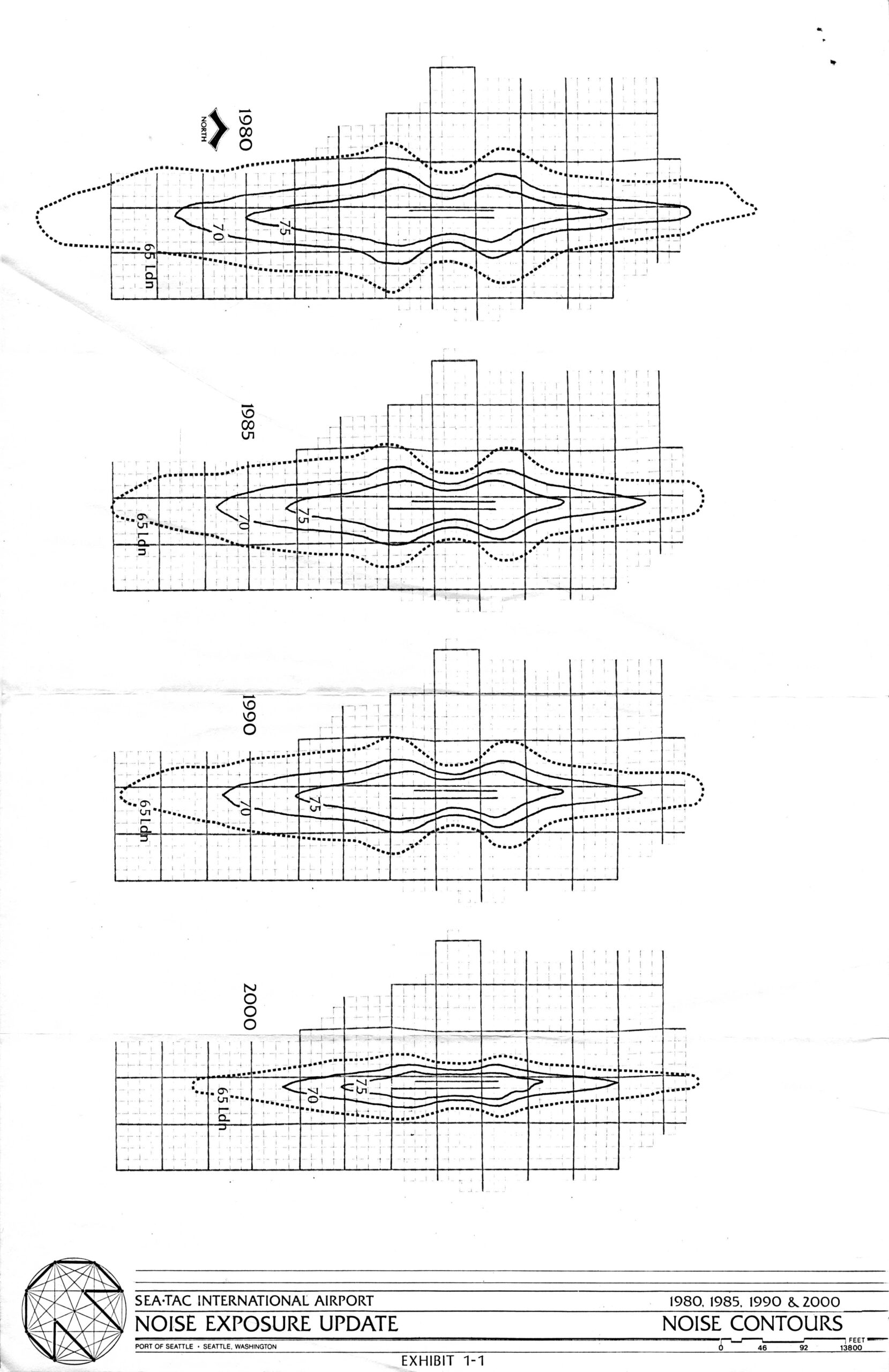
Forecasted Noise Contour Map 1980, 1985,1990, 2000
Exhibit 1-1 from the Port of Seattle's Sea-Tac International Airport Noise Exposure Update, showing four panels of DNL (Ldn) noise contour maps at the 65, 70, and 75 dB levels for the years 1980, 1985, 1990, and 2000. The contours illustrate the projected lateral and longitudinal extent of aircraft noise impact around the airport's runway alignment over those two decades. -
 1981-10-28
Airspace Study: Sea-Tac International Airport and King County International Airport
★ 32This 1981 airspace study, prepared by Peat, Marwick, Mitchell & Co., examines how the shared use of airspace between Seattle-Tacoma International Airport (Sea-Tac) and King County International Airport (Boeing Field) affects the capacity of both airports. The two-phase study analyzes projected congestion and delays through the year 2000 and evaluates operational and policy alternatives to reduce airspace conflicts. A public information program was also included to keep the community informed of the study's findings and implications. -
 1981-10-16
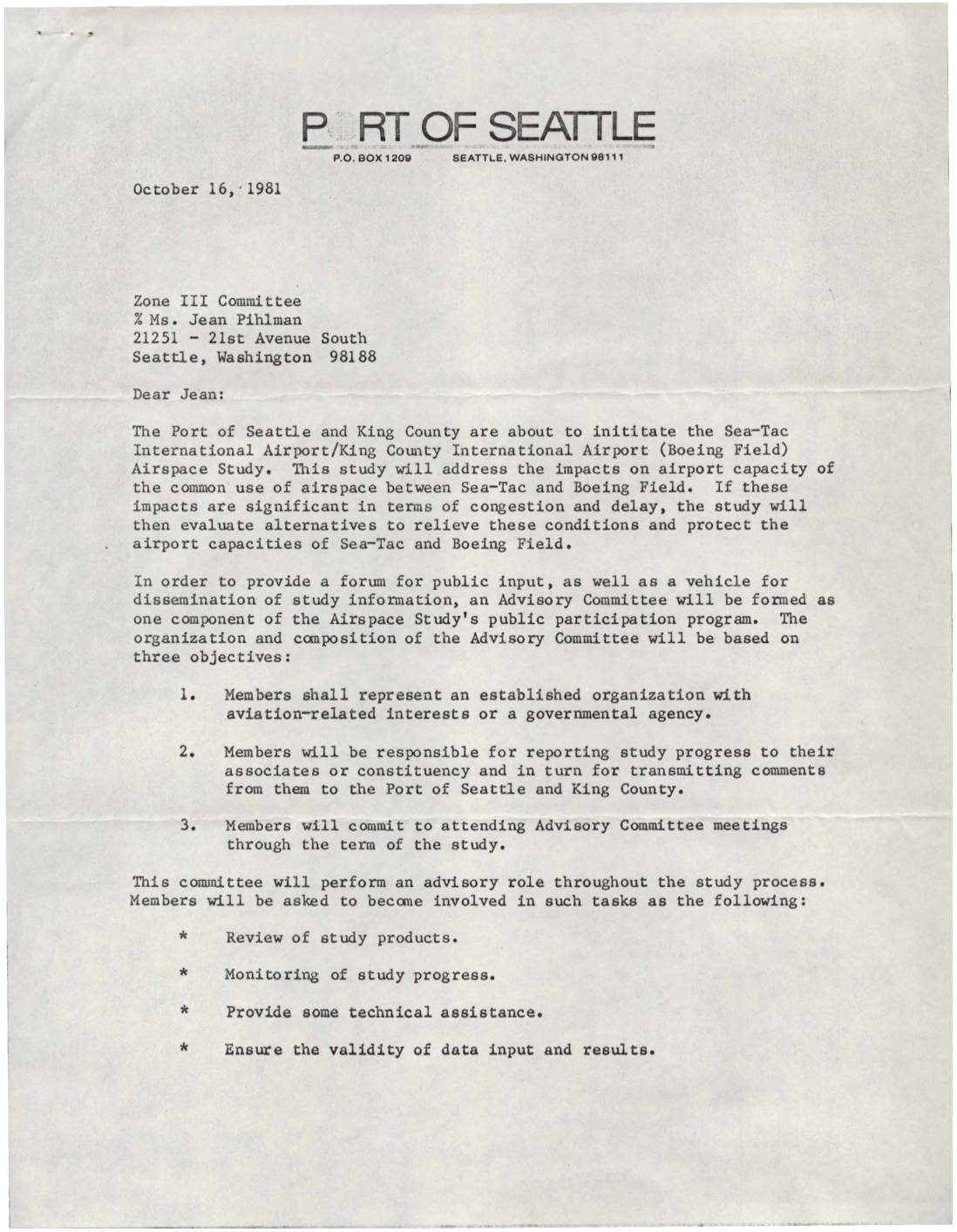
Port Of Seattle Letter to Zone III Committee: Invitation to Join Sea-Tac/Boeing Field Airspace Study Advisory Committee
In October 1981, the Port of Seattle invited the Zone III Committee to join an Advisory Committee for the Sea-Tac International Airport and Boeing Field Airspace Study, which aimed to examine how shared airspace between the two airports affected capacity and congestion. Advisory Committee members would be expected to review study materials, monitor progress, and relay information between the study team and their organizations, meeting no more than eight times over 12 months. The first meeting was scheduled for November 5, 1981, at the Federal Aviation Administration Building at Boeing Field.