TagSea-Tac Airport(1855)
-
 1982-04-01
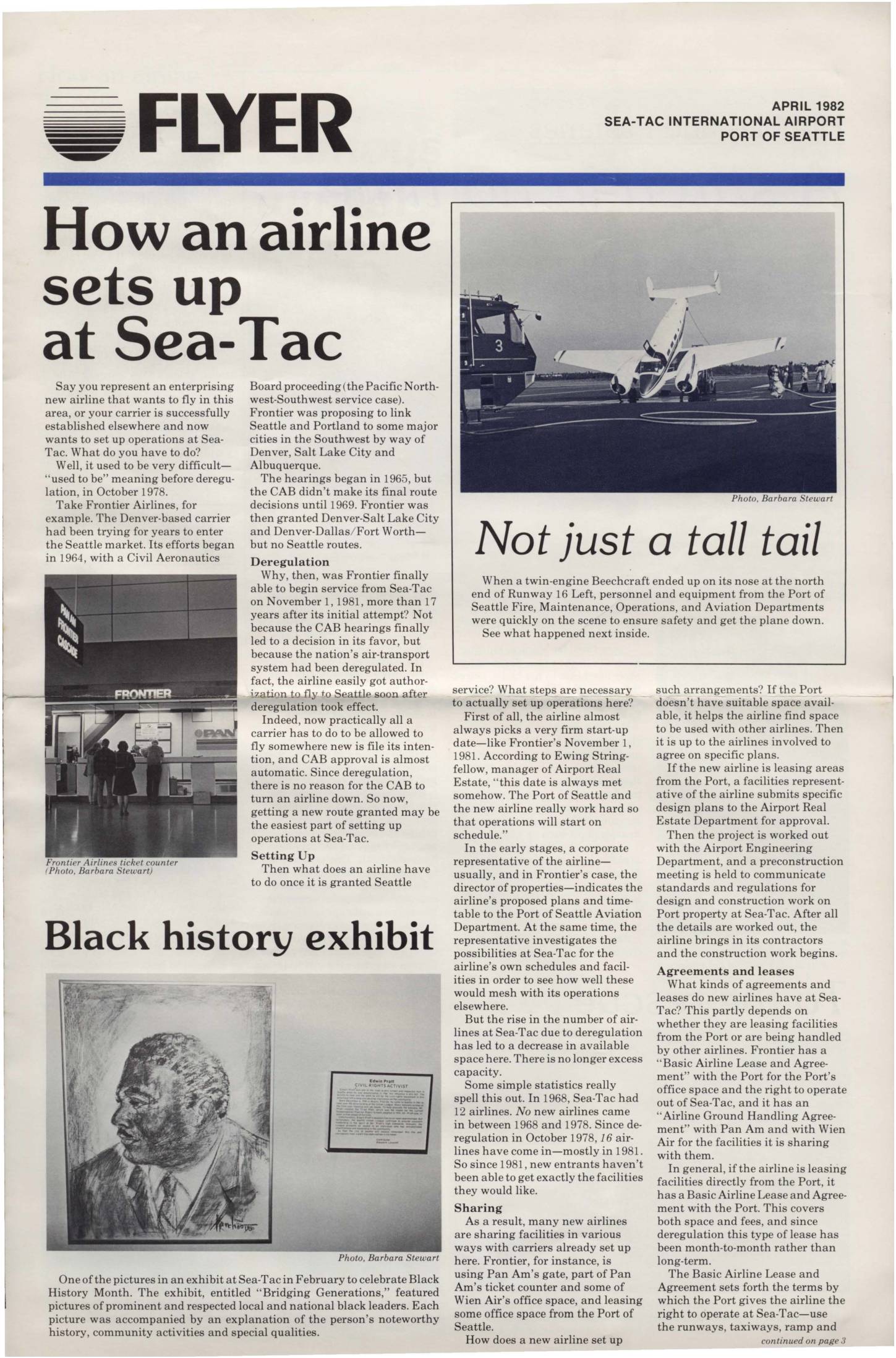
Flyer: How An Airline Sets Up At Sea-Tac
This April 1982 edition of the Sea-Tac Flyer, the Port of Seattle's employee newsletter, explains how airlines set up operations at Seattle-Tacoma International Airport following federal deregulation in 1978. It details the process new carriers must follow, including obtaining route authorization, negotiating facility leases or sharing arrangements with established airlines, and working with Port departments on construction and agreements. The issue also covers airline announcements, a Black History Month exhibit, and other employee news from the airport. -
 1982-04-01
Preliminary Assessment of Airspace Interactions: Seattle-Tacoma International Airport and King County International Airport
A 1982 draft working paper prepared by Peat, Marwick, Mitchell & Co. for the Port of Seattle assessed airspace interactions between Seattle-Tacoma International Airport (Sea-Tac) and King County International Airport (Boeing Field). The study analyzed existing and projected airfield capacities, aircraft delays, and the effects of overlapping airspace on both airports, taking into account factors such as air traffic demand, aircraft mix, weather conditions, and runway procedures. Its findings were intended to help the Port of Seattle determine whether more detailed investigation and mitigation measures were needed in a subsequent phase of the study. -
 1982-03-23
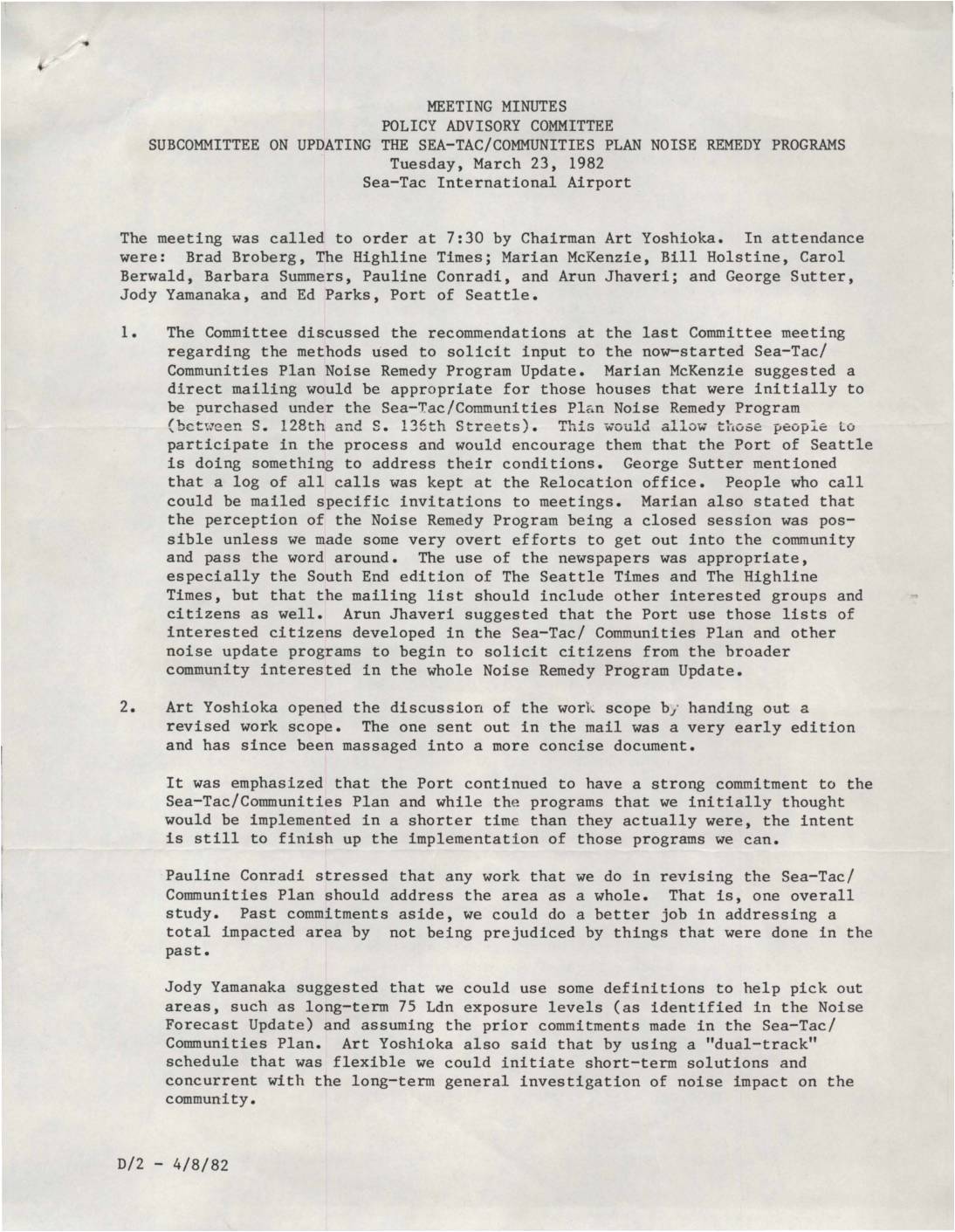
Meeting minutes: Policy Advisory Committee subcommittee on updating the Sea-Tac/Communities Plan noise remedy programs
These are the meeting minutes from a March 23, 1982 Policy Advisory Committee session at Sea-Tac International Airport, focused on updating the Sea-Tac/Communities Plan Noise Remedy Program. The committee discussed how to engage affected residents between South 128th and South 135th Streets through direct mailings and community outreach, debated whether to address noise impact areas individually or as a whole, and reviewed the status of ongoing housing acquisitions, with the Port having already spent $28–$29 million on housing acquisition and relocation. Key concerns included funding limitations, construction in potential acquisition zones, hardship cases for vulnerable residents, and the timeline for completing the program. -
 1982-02-24
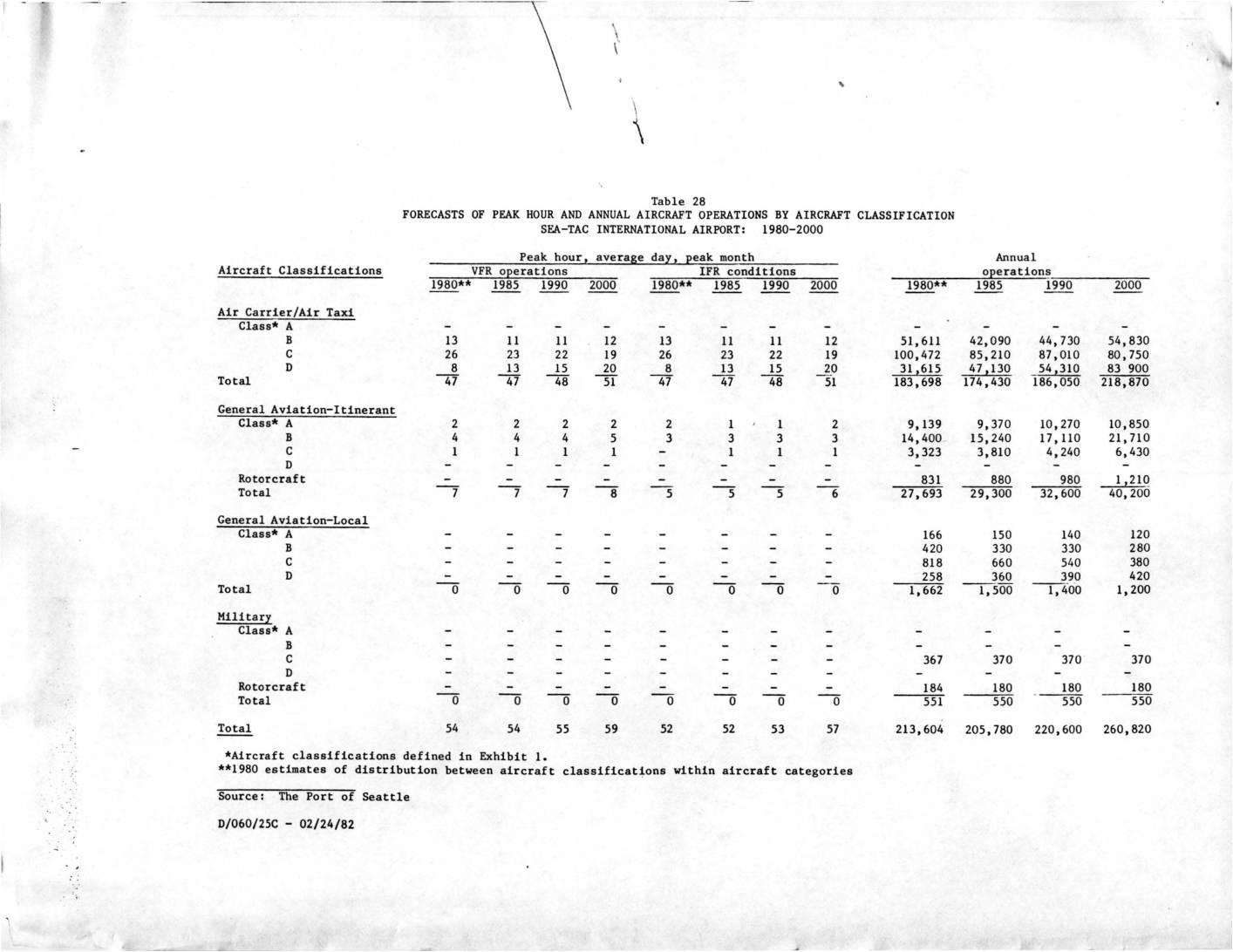
Forecasts of Peak Hour and Annual Aircraft Operations by Aircraft Classification: Sea-Tac International Airport and King County International Airport, 1980–2000
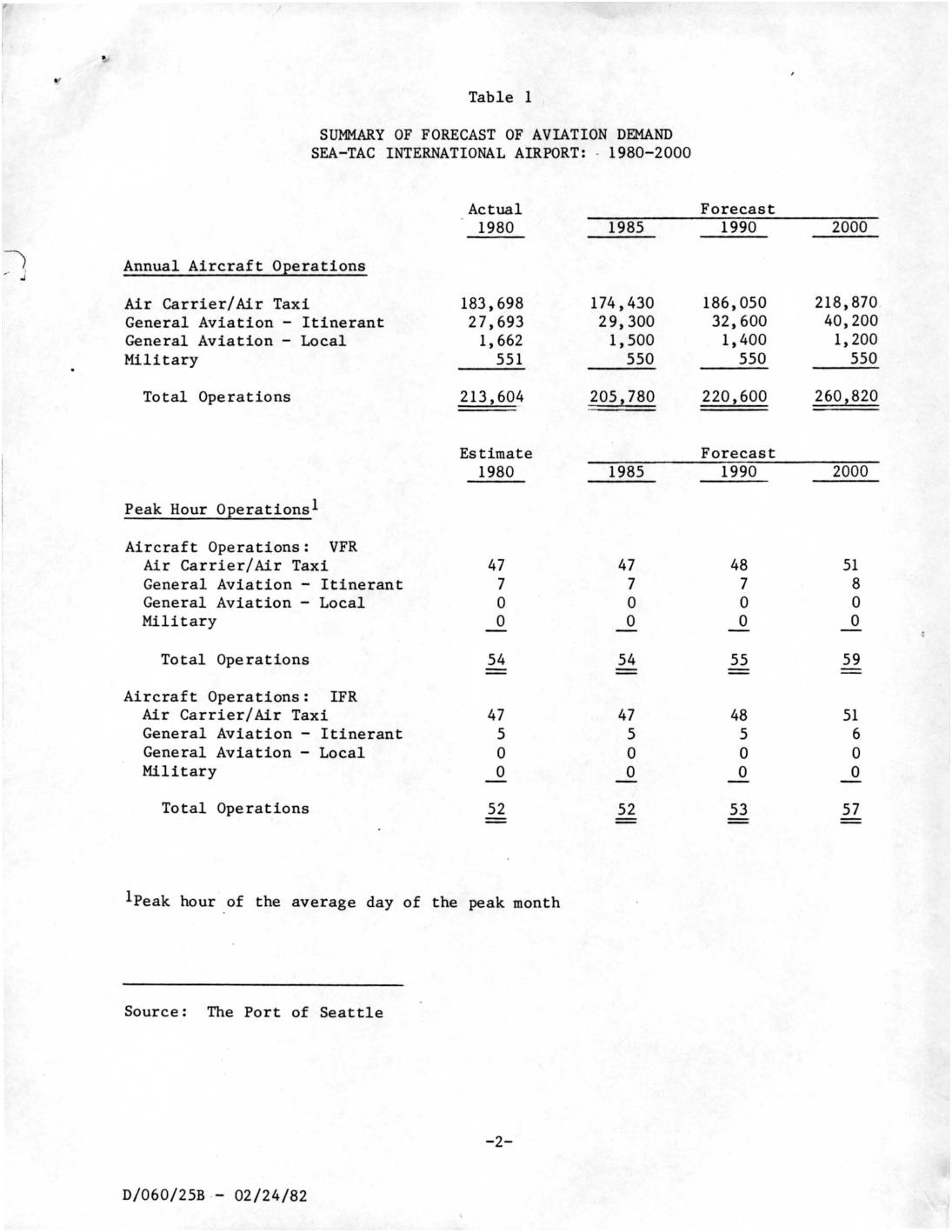
This document presents forecasts of aircraft operations at Seattle-Tacoma (Sea-Tac) International Airport and King County International Airport from 1980 to 2000, broken down by aircraft classification and flight category including air carrier, general aviation, and military. It projects that total annual operations at Sea-Tac will grow from approximately 213,600 in 1980 to over 260,800 by 2000, driven largely by increases in larger Class D air carrier aircraft. Peak hour operation estimates are provided for both Visual Flight Rules (VFR) and Instrument Flight Rules (IFR) conditions, offering planners a detailed basis for noise impact and capacity assessments. -
 1982-02-24
Summary of forecast of aviation demand Sea-Tac International Airport: 1980-2000
This 1982 Port of Seattle report forecasts aviation demand at Seattle-Tacoma International Airport from 1980 to 2000, projecting total annual aircraft operations to grow from approximately 213,600 to 260,800. The forecast covers air carrier, general aviation, and military operations, and includes peak hour operation estimates under both VFR and IFR conditions. The projections were developed in connection with the Sea-Tac International Noise Exposure Update and draw on passenger origination models tied to regional income and airfare trends. -
 1982-02-02
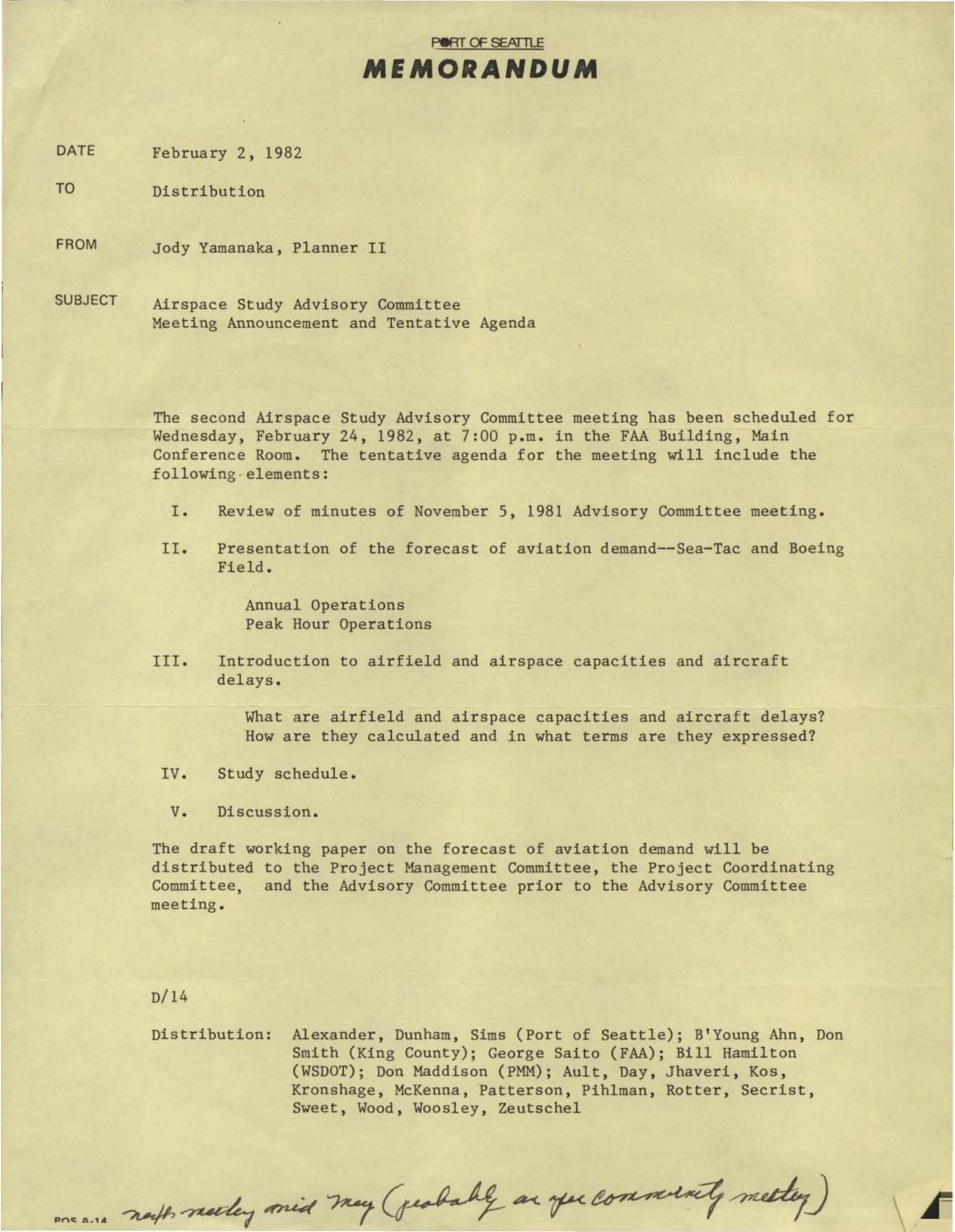
Airspace Study Advisory Committee Meeting Announcement and Tentative Agenda
Port of Seattle memorandum announcing the second Airspace Study Advisory Committee meeting scheduled for February 24, 1982. The agenda includes aviation demand forecasts for Sea-Tac and Boeing Field, discussion of airfield and airspace capacities, and aircraft delays. -
 1982-01-01
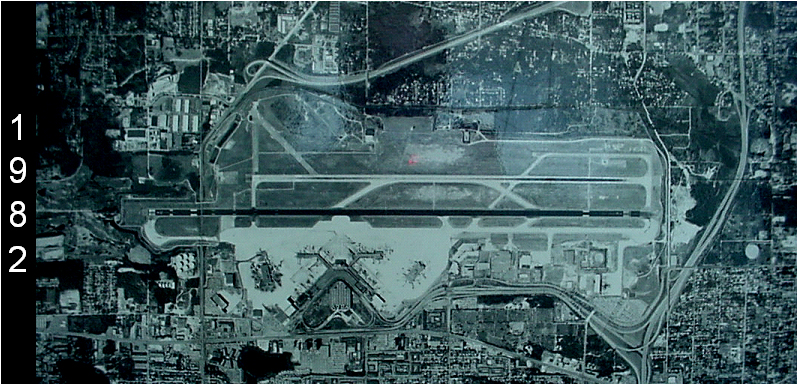
Sea-Tac Airport Aerial View, 1982
An aerial photograph of Seattle-Tacoma International Airport dated 1982, showing the runway configuration, terminal area, and surrounding urban development. The year '1982' is visible as text on the left side of the image. -
 1982-01-01
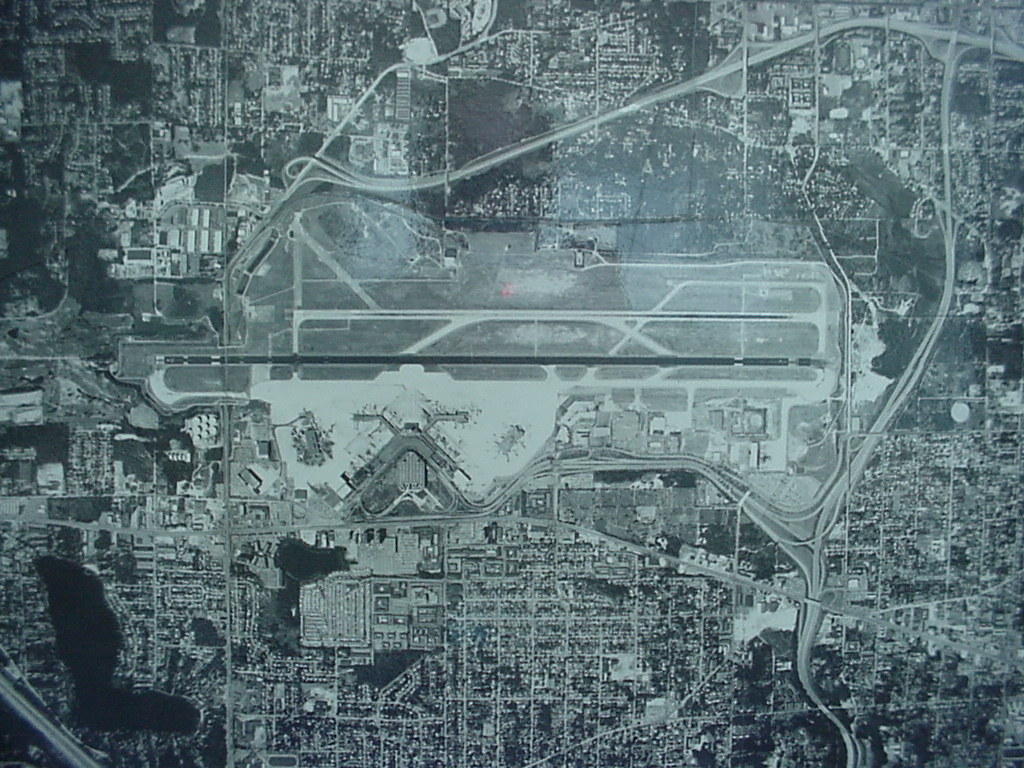
Sea-Tac Airport Aerial View, 1982
Black-and-white aerial photograph showing a large commercial airport with multiple parallel runways, terminal buildings with gate concourses, and surrounding urban development including residential neighborhoods, roads, and highway interchanges. No visible text, date, or identifying labels are present in the image. -
 1982-01-01
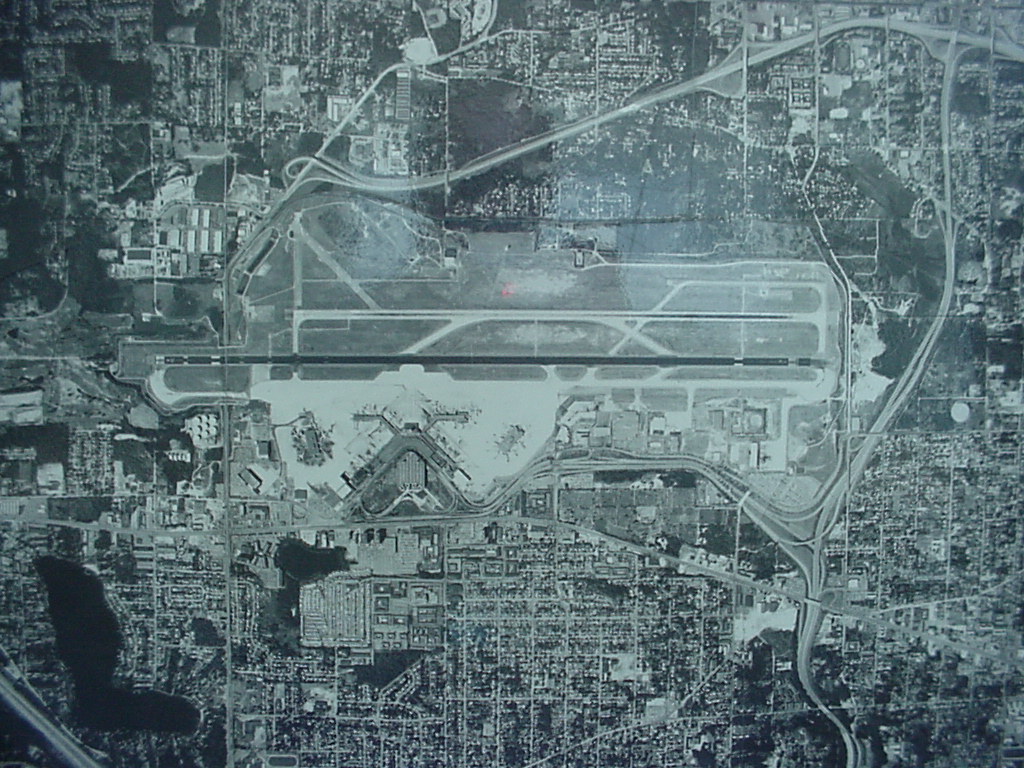
Sea-Tac Airport Aerial View, 1982
Black-and-white aerial photograph showing a large commercial airport with parallel runways, terminal buildings with gate fingers, surrounding roadway infrastructure, and dense urban development on multiple sides. No visible text, date, or identifying labels are present in the image. -
 1982-01-01
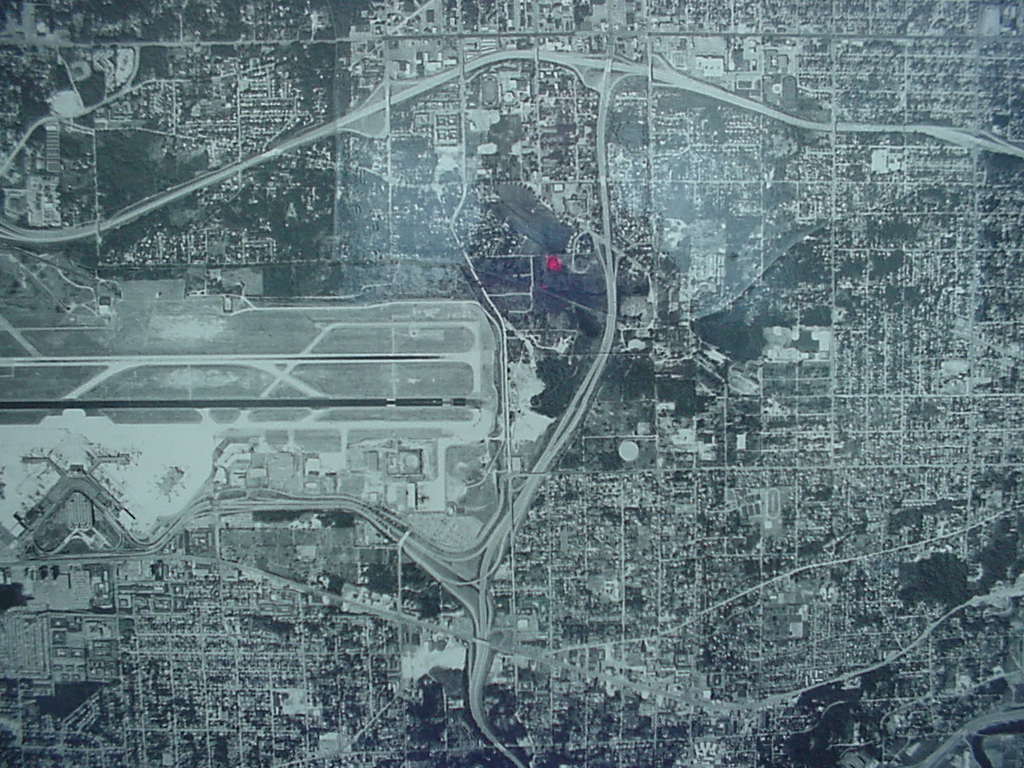
Sea-Tac Airport Aerial Photograph, 1982
Black-and-white aerial photograph showing a large commercial airport with parallel runways and terminal facilities at left, surrounded by a dense urban street grid. A single red dot marker is visible near the center of the image, possibly indicating a specific location of interest for noise or planning purposes.