Skip to content
  • STNI
  • Statistics
    • Ops and Passengers
      • King County International Airport (Boeing Field) Annual Operations
    • Financials
    • Aviation fuel uplift in the State of Washington 2018 – 2025
      • Aviation Fuel Tax Revenue in the State of Washington 1983-2025
      • Aviation Fuel Uplift at Sea-Tac Airport
    • Air Quality Monitoring
    • Flight Tracking
      • Flow and Flight Tracks
      • Five Year Comparison
      • Busiest Hours and Days
    • SEL Noise Reports & Graphs
      • About The Permanent Noise Monitors
      • Minutes of Quiet by Noise Monitor
      • Noise Events mapped
      • Noise Events (SEL)
    • Runways
    • Employees
    • Real Estate
      • Port Properties and Trees mapped
    • Parking
  • Events
  • Protest
    • Regular Events
    • Policy
      • Legislative Agenda 2027
      • Airport mitigation for the twenty first century
      • Port Dracula
    • Complain about a particular flight
    • Advocacy Organizations
    • Media Outlets
    • People
    • The Port of Seattle
      • Commission Meetings
      • Public Records Requests
      • StART
      • Highline Forum
    • Contact Your Electeds
  • Resources
    • FAQs
      • FAA Occurrences/Accidents/Indents
    • The SAMP
      • SAMP Public Comment Template
        • Two versions of Appendix K: NEPA/SEPA 2018 vs 2023
      • SAMP NTP: 31 projects by the numbers
      • SEPA Draft EIS (2026)
      • SAMP Record of Decision/FONSI (2025)
      • SAMP Draft EA (October 2024)
      • 2018 Scoping
    • Port Packages
      • Port Package Property Costs
      • Port Packages mapped
      • The Port Package Explainer
      • So you want a (first-time) Port Package? Start here
      • Port Package Looker Upper
      • How do I determine if I have a Port Package or Avigation Easement?
      • Progress on Port Package Update legislation
      • Having a Port Package Problem?
      • Port Package Site Visit Follow-Up
    • Document Library
    • Explainers
      • The Airport Law Cheat Sheet
      • The Grant Explainer
    • External Articles
    • History
      • Timeline
      • The Sea-Tac Communities Plan
        • Sea-Tac Communities Plan – Planning Maps
      • PSRC Third Runway Decision Process
    • Studies
    • Videos
  • Stories
  • Mission
  • Subscribe
  • Contact
Scroll down to content

Get InformedStay Informedx

I understand that you will never share my information with anyone, you will only use it to keep me updated on relevant events and that I may unsubscribe at any time.

STNI

STNISea-Tac Noise.Info

  • Solve for Sea-Tac. Solve for every airport.
  • Since 2016, working to obtain justice for everyone living under the flight path.
  • Less Noise. Cleaner Air. Better Public Health. Compensation.
  • Everything you think you know about the airport is wrong.

TagSea-Tac Airport(1855)

Advanced Search Options

  • Dates
  • Media
    • External Articles
    • Images
    • PDFs
    • Video
    • Audio
  • Order By
  • 1989-12-01

    Draft Environmental Assessment for Proposed Changes to Air Traffic Arrival and Departure Routes at Seattle-Tacoma International Airport

    This 1989 draft Environmental Assessment, prepared by the FAA's Air Traffic Division, evaluates proposed changes to arrival and departure flight routes at Seattle-Tacoma International Airport. The changes aimed to reduce air traffic congestion and improve airspace efficiency, particularly during peak demand periods when south-arrival capacity (42 aircraft/hour) lagged significantly behind north-arrival capacity (56 aircraft/hour). The inefficiency was linked to a requirement routing turbojet aircraft through Elliott Bay, a legacy of noise abatement agreements with local governments and the Port of Seattle dating back to 1970.
    TagsAir Traffic Control, environmental assessment, FAA, Noise Abatement Procedures, Sea-Tac AirportFolderFour Post Plan
  • 1989-12-01

    Draft environmental assessment for proposed changes to air traffic arrival and departure routes at Seattle-Tacoma International Airport

    This 1989 FAA draft Environmental Assessment examines proposed changes to arrival and departure flight routes at Seattle-Tacoma International Airport, aimed at reducing air traffic congestion and improving airspace efficiency. The document identifies a key inefficiency: during good weather and peak demand, south-landing capacity (42 aircraft/hour) was significantly lower than north-landing capacity (56 aircraft/hour), largely due to a requirement routing turbojet aircraft through Elliott Bay. The assessment traces the issue back to noise abatement procedures established since 1970 that prioritized limiting jet overflights in certain Seattle metropolitan areas over operational efficiency.
    TagsAir Traffic Control, environmental assessment, FAA, Noise Abatement Procedures, Sea-Tac AirportFolderFAA
  • 1989-05-03

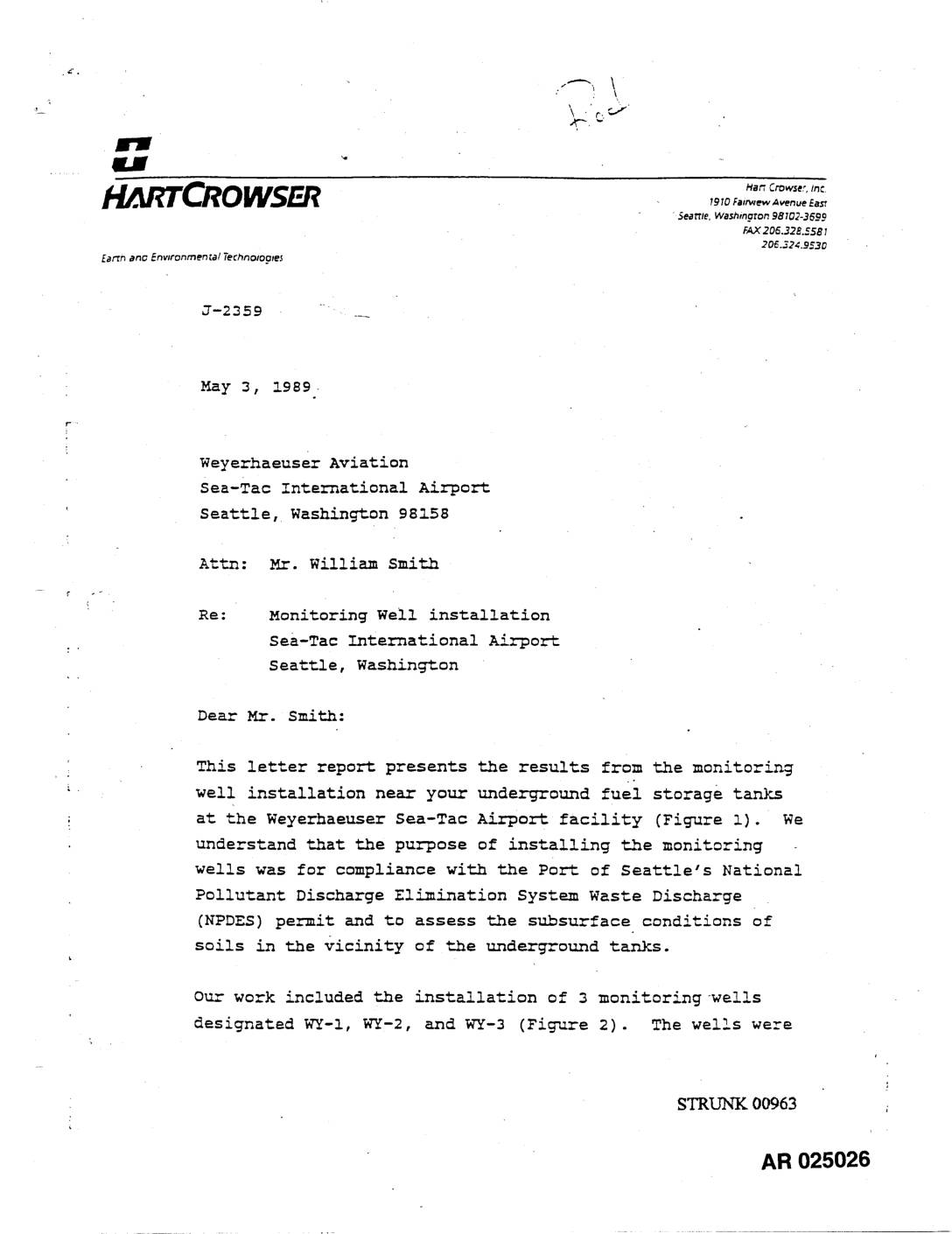
    EXH AR025026: Hart Crowser Monitoring Well Installation RP, Weyerhaeuser Aviation, STIA

    A May 1989 environmental report from Hart Crowser, Inc. details the installation of three groundwater monitoring wells (WY-1, WY-2, WY-3) near underground fuel storage tanks at the Weyerhaeuser Aviation facility at Sea-Tac International Airport. Soil samples collected during drilling showed no detectable petroleum contamination, and no groundwater was encountered at the site. The report was prepared to help Weyerhaeuser comply with the Port of Seattle's NPDES permit requirements and to assess subsurface soil conditions around the tanks.
    TagsACC, NPDES, Pollution Control Hearings Board, Port Of Seattle, Sea-Tac Airport, soil, Third RunwayFolderBox 10
  • 1989-04-20

    Resolution No. 3042, as amended: Interagency agreement with Puget Sound Council of Governments for long term air carrier system planning

    In April 1989, the Port of Seattle Commission passed Resolution No. 3042 authorizing the Executive Director to enter into an agreement with the Puget Sound Council of Governments (PSCOG) to develop a long-term regional air carrier system plan for the Puget Sound area. The resolution was prompted by a recognized need for additional air carrier capacity beyond the year 2000, following a 1988 Airspace Study Update of Seattle-Tacoma International Airport. The agreement allowed the Port to seek federal FAA funding and hire consultants to study long-term aviation capacity options for the region.
    TagsPort Of Seattle, PSCOG, Puget Sound Council of Governments, Regional Airport System Plan, Sea-Tac AirportFolderResolutions
  • 1988-10-25

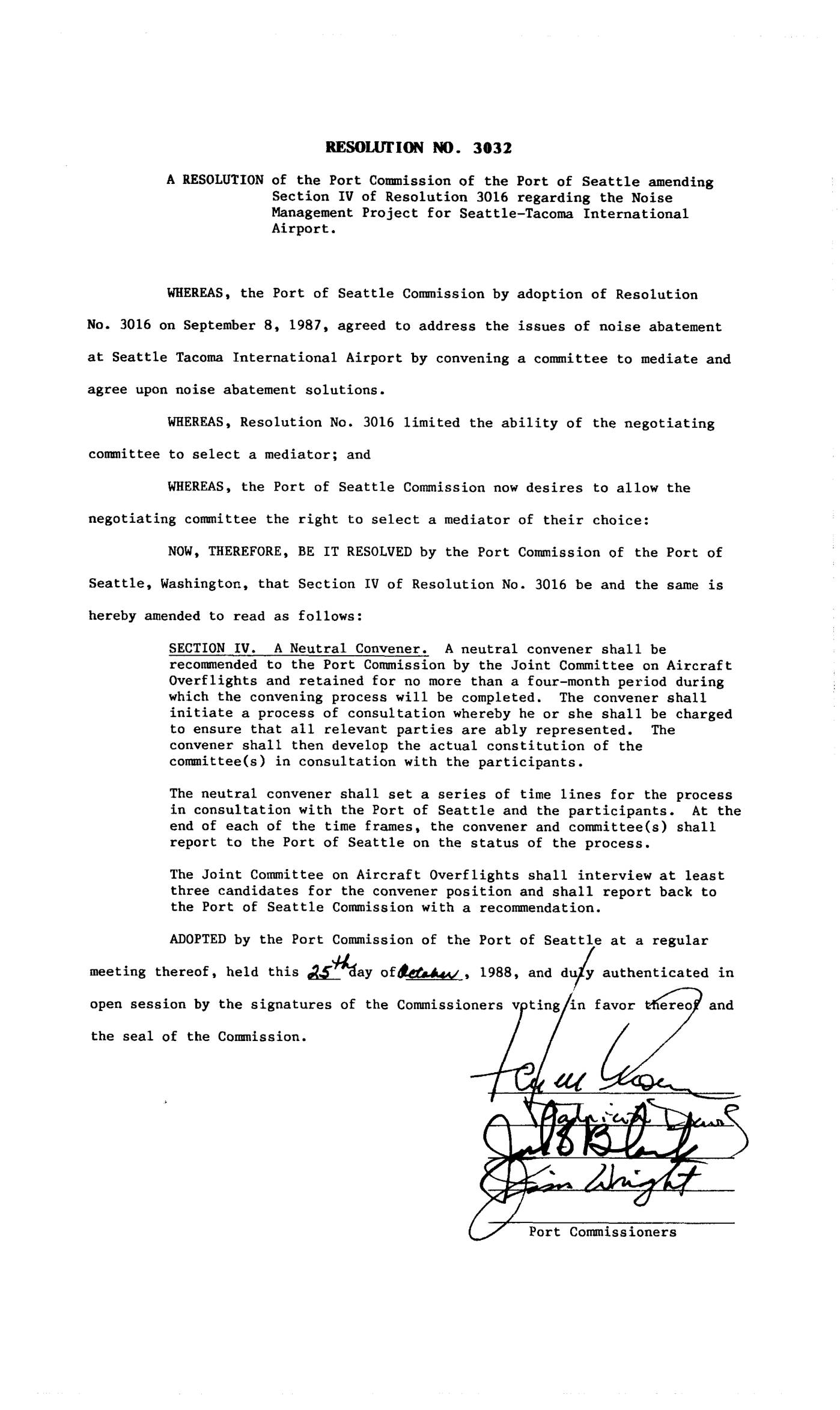
    Resolution No. 3032: Amending Section IV of Resolution 3016 regarding the Noise Management Project for Seattle-Tacoma International Airport

    Resolution No. 3032, adopted by the Port of Seattle Commission on October 25, 1988, amends an earlier resolution (No. 3016) concerning noise management at Seattle-Tacoma International Airport. The key change gives the negotiating committee—known as the Joint Committee on Aircraft Overflights—the freedom to select their own neutral convener (mediator) from at least three interviewed candidates, rather than being restricted as under the previous rules. The chosen convener would be retained for up to four months to organize a mediation process, ensure all relevant parties are represented, and report regularly to the Port Commission on progress.
    TagsNoise, Port Of Seattle, Port Of Seattle Commission, Sea-Tac AirportFolderNoise Mitigation
  • 1988-09-08

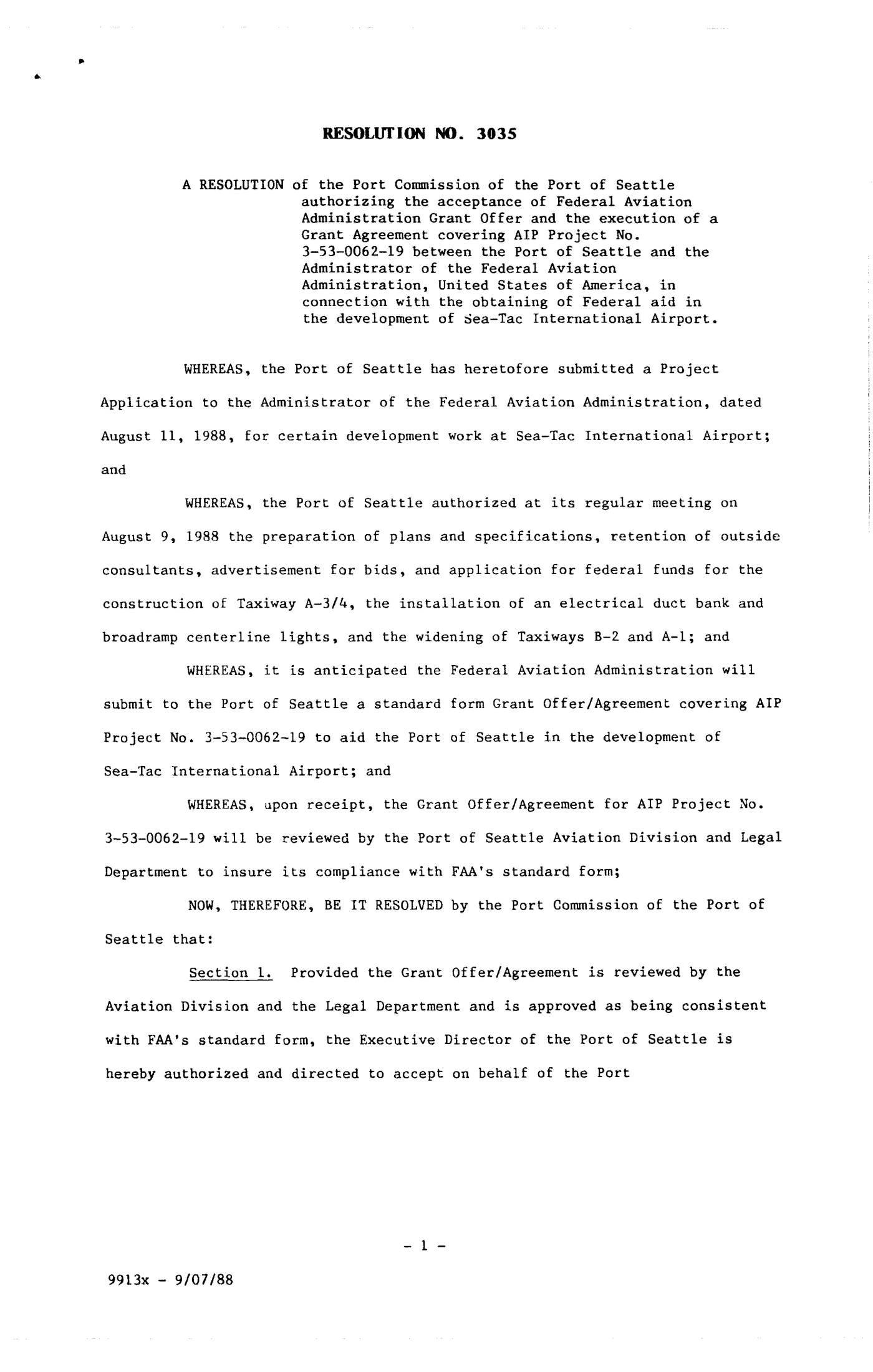
    Resolution No. 3035: Authorization to accept FAA grant offer for AIP Project No. 3-53-0062-19

    In September 1988, the Port of Seattle Port Commission passed Resolution No. 3035, authorizing the acceptance of a Federal Aviation Administration grant (AIP Project No. 3-53-0062-19) to fund development work at Sea-Tac International Airport. The project included construction of Taxiway A-3/4, installation of an electrical duct bank and broadramp centerline lights, and widening of Taxiways B-2 and A-1. The resolution directed the Executive Director to sign the grant agreement on the Port's behalf, provided it was reviewed and approved by the Aviation Division and Legal Department.
    TagsAIP, FAA, Port Of Seattle, Sea-Tac Airport, TaxiwaysFolderGrant Programs
  • 1988-01-01

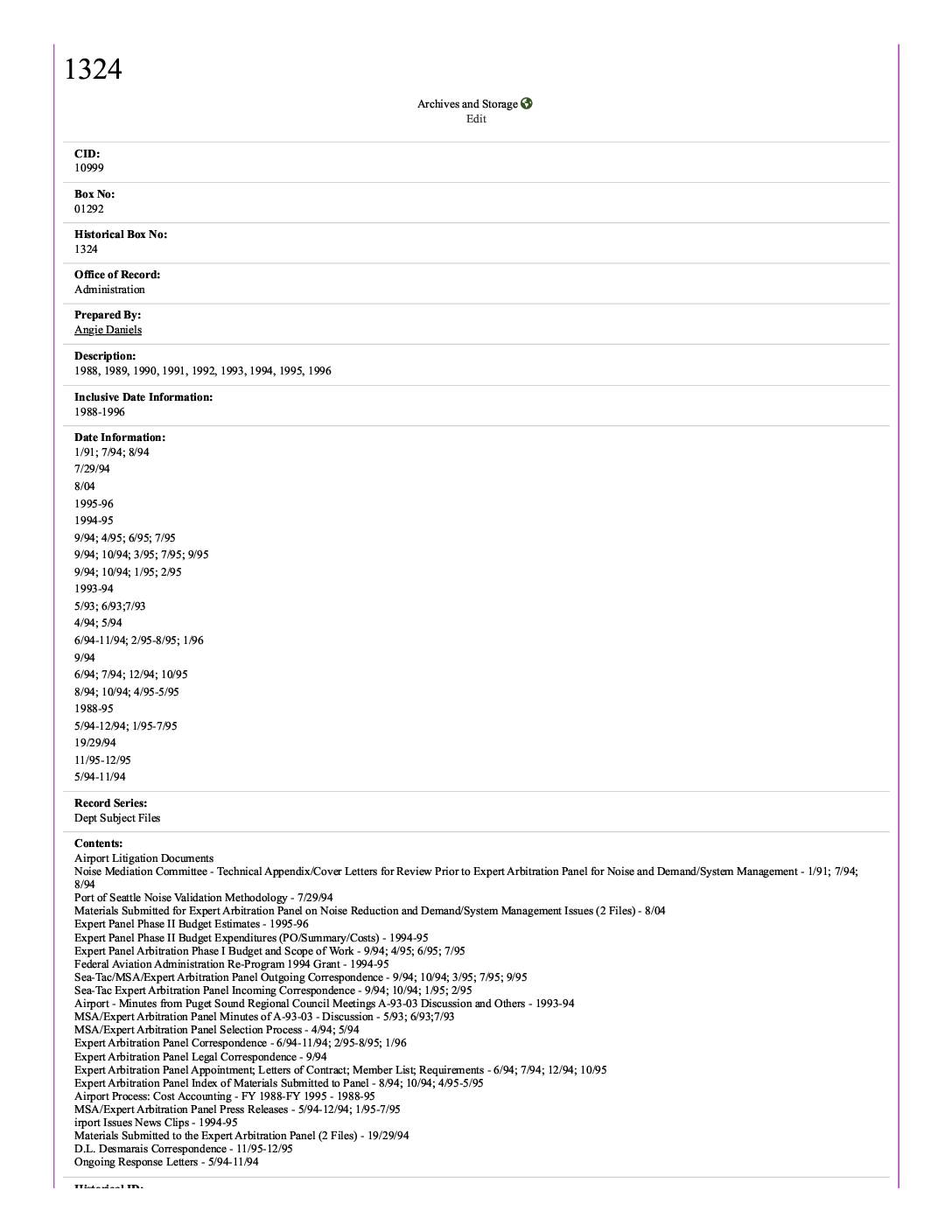
    Airport Litigation Documents: Expert Arbitration Panel Correspondence and Records, 1988–1996

    This archival box (Historical Box No. 1324) contains Airport Litigation Documents related to Sea-Tac Airport noise issues, spanning 1988 to 1996. The materials include correspondence, budget estimates, press releases, and documents submitted to an Expert Arbitration Panel addressing noise reduction and demand/system management. Records are held at the Washington State Archives and were prepared by the Port of Seattle's Administration office.
    TagsExpert Arbitration Panel, Port Of Seattle, Puget Sound Regional Council, Sea-Tac AirportFolderRecords Transferred to WA State Archives
  • 1324 expert panel correspondence archives pdf
    1988-01-01

    Airport Litigation Documents: Expert Arbitration Panel Correspondence and Records, 1988–1996

    An Archives and Storage catalog record (CID 10999, Box 01292) prepared by Angie Daniels for the Administration office, documenting Department Subject Files related to Sea-Tac Airport noise litigation and the MSA/Expert Arbitration Panel process. Contents include correspondence, budget estimates, FAA grant documents, press releases, and materials submitted to the Expert Arbitration Panel on noise reduction and demand/system management issues, spanning 1988–1996.
    TagsExpert Arbitration Panel, Port Of Seattle, Puget Sound Regional Council, Sea-Tac AirportFolderRecords Transferred to WA State Archives
  • 1987-10-01

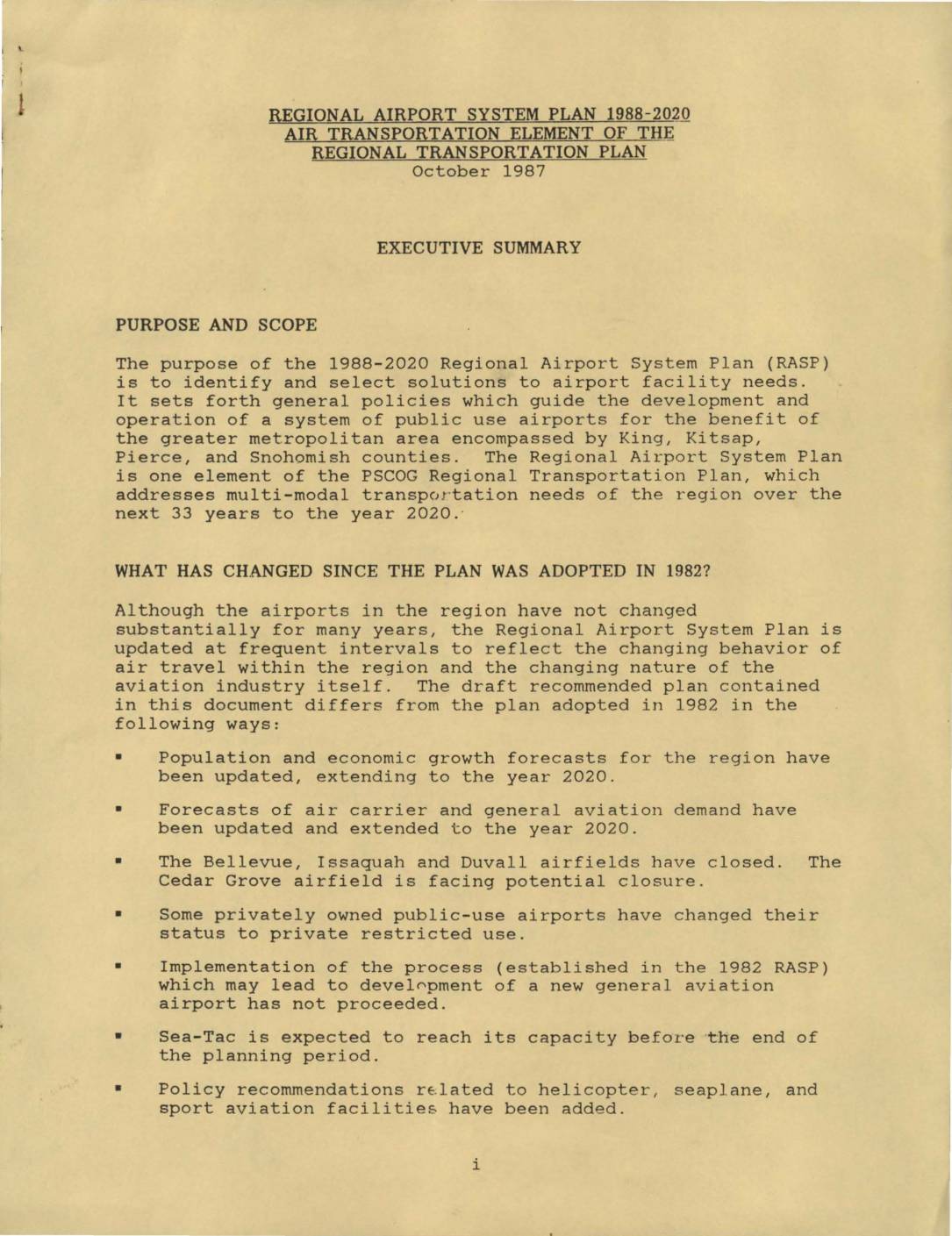
    Regional Airport System Plan 1988-2020: Air transportation element of the Regional Transportation Plan

    ★
    The 1988-2020 Regional Airport System Plan, published in October 1987, outlines policies for managing and developing public-use airports across King, Kitsap, Pierce, and Snohomish counties through the year 2020. A central finding is that Sea-Tac Airport was projected to reach full capacity within 10 to 15 years, with intolerable aircraft delays expected unless alternative measures were taken. The plan also addresses noise and flight track mitigation programs, land use compatibility near airports, and the potential role of satellite airports such as Paine Field, Bremerton National, and Tacoma Narrows in relieving pressure on Sea-Tac.
    CategoriesKey Documents TagsGeneral Aviation, Puget Sound Regional Council, RASP, Regional Airport System Plan, Sea-Tac AirportFolderStudies
  • 1987-01-01

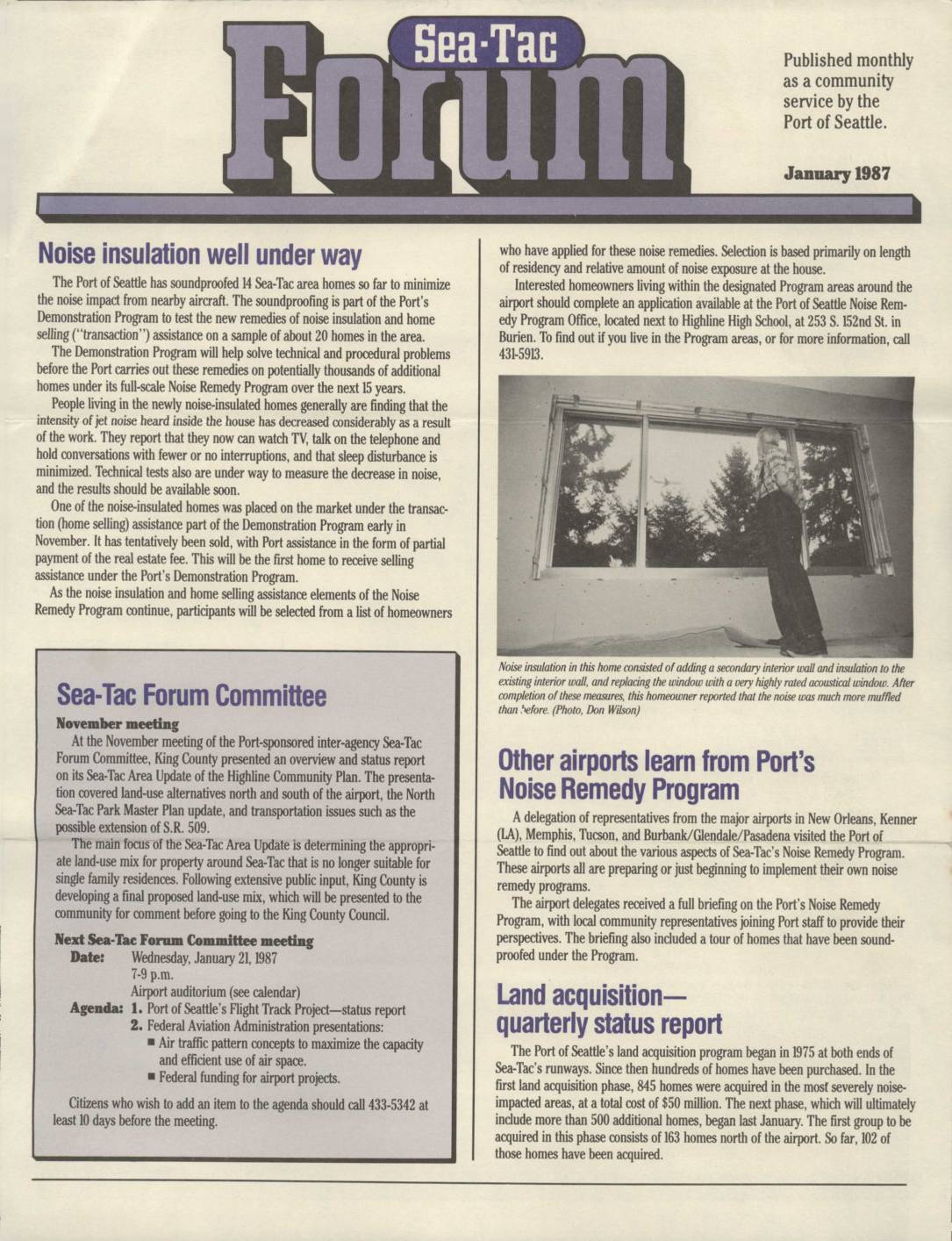
    Sea-Tac Forum: January 1987

    This January 1987 edition of the Sea-Tac Forum newsletter reports on the Port of Seattle's ongoing Noise Remedy Program, which had already soundproofed 14 homes near Sea-Tac Airport and provided selling assistance to homeowners in high-noise areas. The program, part of a broader 15-year plan expected to benefit thousands of households, was drawing interest from major airports across the country seeking to launch similar initiatives. The newsletter also includes a community calendar of January 1987 meetings related to airport noise, land use, and flight track planning.
    TagsHighline Community Plan, King County, Noise Remedy Program, Port Of Seattle, Sea-Tac AirportFolderFlyers

Posts pagination

Page 1 … Page 169 Page 170 Page 171 Page 172 Page 173 … Page 186
Sidebar On/Off

Upcoming Events

  • Part 150 NCP Workshop — Burien
    Add to CalendarMSaturday Oct 17: 10:00am

    Attend a Port of Seattle open house on the Part 150 Study Noise Compatibility Program (NCP). The Part 150 program determines the noise boundary around the airport and opportunities for noise mitigation such as sound insulation.

    [...]
  • Part 150 NCP Workshop — SeaTac
    Add to CalendarMMonday Oct 19: 6:00pm

    Attend a Port of Seattle open house on the Part 150 Study Noise Compatibility Program (NCP). The Part 150 program determines the noise boundary around the airport and opportunities for noise mitigation such as sound insulation.

    [...]
  • Part 150 NCP Workshop — Des Moines
    Add to CalendarMTuesday Oct 20: 6:00pm

    Attend a Port of Seattle open house on the Part 150 Study Noise Compatibility Program (NCP). The Part 150 program determines the noise boundary around the airport and opportunities for noise mitigation such as sound insulation.

    [...]

[See all...]


Issues

Sea-Tac Airport is currently undergoing the largest and longest expansion in its history, collectively known as the Sustainable Airport Master Plan (SAMP). Some of it you can already hear, but you’re probably not aware of what it all means. Here’s what you need to know.
read more...

Read This!

As the source for federal transportation grants, the Puget Sound Regional Council was charged with developing a system to meet the growing need for commercial aviation. When the search for a second airport failed, they authorized the Port of Seattle to build the Third Runway, with a mandate to develop a noise abatement and mitigation program. In their effort to stop the Third Runway, the ACC argued over every detail of the Port's efforts--including property buyouts and sound insulation. The dispute was meant to be settled by a three member Expert Arbitration Panel. This is their final report. It finds 2-1, that the Port's program was insufficient in several respects. Despite that, funding for the Third Runway was approved by the PSRC, and the 'Port Package' program, proceeded largely unchanged. Expert Arbitration Panel's final decision finding that the Port of Seattle had not shown sufficient reduction in real on-the-ground noise impacts to satisfy noise reduction conditions required for approval of a third runway at Sea-Tac International Airport. The majority decision concluded the Port's noise abatement programs were insufficient despite being impressive in scope.
continue...

  • Sea-Tac Noise.Info
  • Connect with STNI

    • Subscribe
    • Port Package Problem?
    • Donate
    • Podcast
    • Socials
      • Facebook
      • X (Twitter)
      • Bluesky
      • Instagram
  • Learn

    • Frequently Asked Questions
    • Explainers
    • Youtube
    • Research Requests
    • Complain about one flight
  • Goals

    Fulfill the promises of 1976:
    • Compensation
    • Reduced noise
    • Improved air quality
    • Environmental remediation
Login/Register
©2026•Data Privacy

Message

We use cookies to provide basic functionality. We also provide access to search engines in order to provide site analytics. We do not sell or share your data.
V V