Skip to content
  • STNI
  • Statistics
    • Ops and Passengers
      • King County International Airport (Boeing Field) Annual Operations
    • Financials
    • Aviation fuel uplift in the State of Washington 2018 – 2025
      • Aviation Fuel Tax Revenue in the State of Washington 1983-2025
      • Aviation Fuel Uplift at Sea-Tac Airport
    • Air Quality Monitoring
    • Flight Tracking
      • Flow and Flight Tracks
      • Five Year Comparison
      • Busiest Hours and Days
    • SEL Noise Reports & Graphs
      • About The Permanent Noise Monitors
      • Minutes of Quiet by Noise Monitor
      • Noise Events mapped
      • Noise Events (SEL)
    • Runways
    • Employees
    • Real Estate
      • Port Properties and Trees mapped
    • Parking
  • Events
  • Protest
    • Regular Events
    • Policy
      • Legislative Agenda 2027
      • Airport mitigation for the twenty first century
      • Port Dracula
    • Complain about a particular flight
    • Advocacy Organizations
    • Media Outlets
    • People
    • The Port of Seattle
      • Commission Meetings
      • Public Records Requests
      • StART
      • Highline Forum
    • Contact Your Electeds
  • Resources
    • FAQs
      • FAA Occurrences/Accidents/Indents
    • The SAMP
      • SAMP Public Comment Template
        • Two versions of Appendix K: NEPA/SEPA 2018 vs 2023
      • SAMP NTP: 31 projects by the numbers
      • SEPA Draft EIS (2026)
      • SAMP Record of Decision/FONSI (2025)
      • SAMP Draft EA (October 2024)
      • 2018 Scoping
    • Port Packages
      • Port Package Property Costs
      • Port Packages mapped
      • The Port Package Explainer
      • So you want a (first-time) Port Package? Start here
      • Port Package Looker Upper
      • How do I determine if I have a Port Package or Avigation Easement?
      • Progress on Port Package Update legislation
      • Having a Port Package Problem?
      • Port Package Site Visit Follow-Up
    • Document Library
    • Explainers
      • The Airport Law Cheat Sheet
      • The Grant Explainer
    • External Articles
    • History
      • Timeline
      • The Sea-Tac Communities Plan
        • Sea-Tac Communities Plan – Planning Maps
      • PSRC Third Runway Decision Process
    • Studies
    • Videos
  • Stories
  • Mission
  • Subscribe
  • Contact
Scroll down to content

Get InformedStay Informedx

I understand that you will never share my information with anyone, you will only use it to keep me updated on relevant events and that I may unsubscribe at any time.

STNI

STNISea-Tac Noise.Info

  • Solve for Sea-Tac. Solve for every airport.
  • Since 2016, working to obtain justice for everyone living under the flight path.
  • Less Noise. Cleaner Air. Better Public Health. Compensation.
  • Everything you think you know about the airport is wrong.

TagSea-Tac Airport(1855)

Advanced Search Options

  • Dates
  • Media
    • External Articles
    • Images
    • PDFs
    • Video
    • Audio
  • Order By
  • 1990-05-03

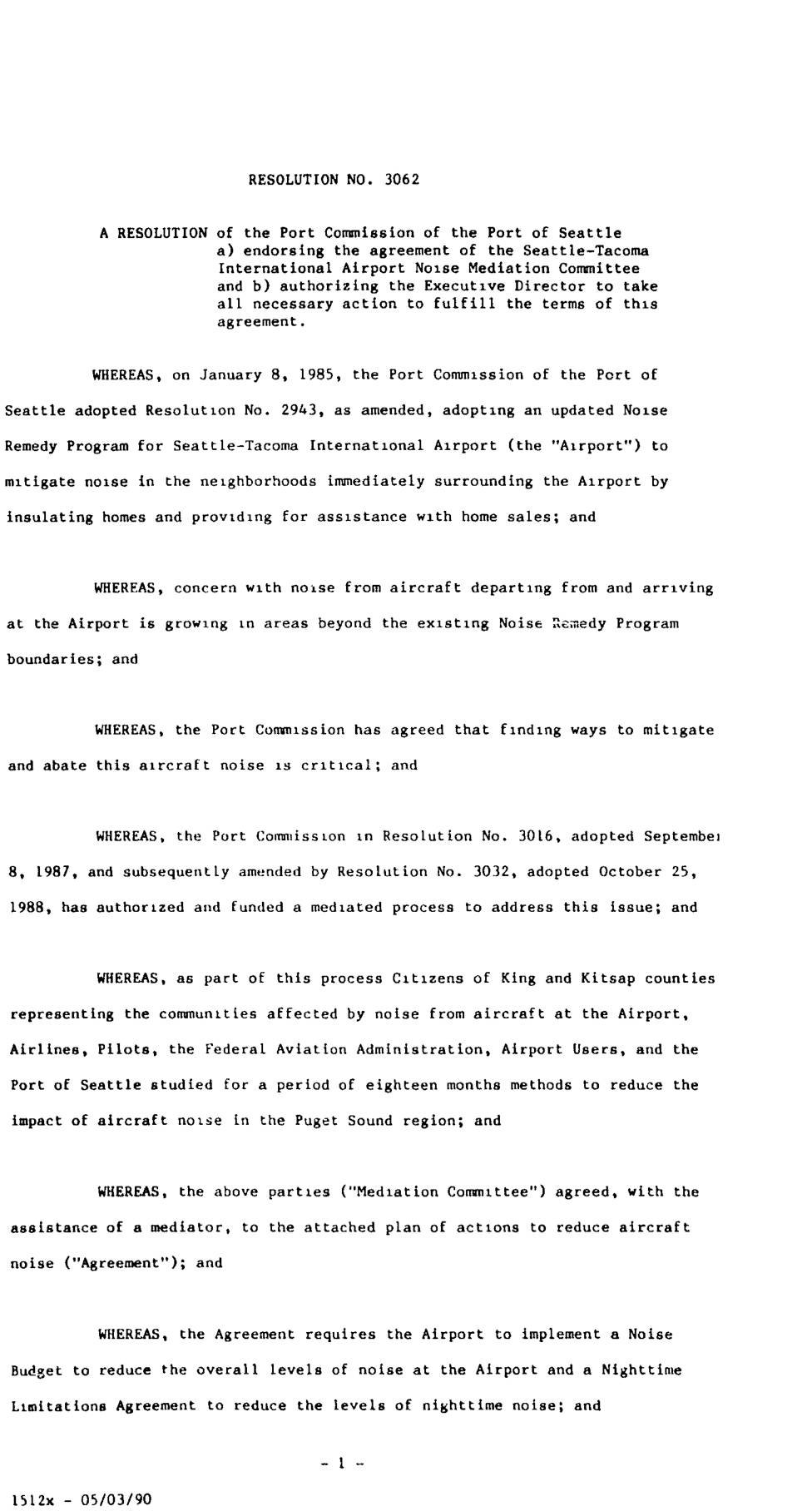
    Resolution No. 3062: Endorsing the agreement of the Seattle-Tacoma International Airport Noise Mediation Committee

    In 1990, the Port of Seattle's Port Commission passed Resolution No. 3062, endorsing an agreement reached by the Seattle-Tacoma International Airport Noise Mediation Committee after 18 months of study by community representatives, airlines, pilots, the FAA, and airport users. The agreement established a Noise Budget and Nighttime Limitations program aimed at reducing aircraft noise levels by at least 50% by 2001 compared to a 1989 baseline, while also expanding the existing Noise Remedy Program to insulate more homes and remove financial burdens from homeowners. The resolution authorized the Executive Director to implement the agreement's terms, including revising airport regulations, entering noise limitation agreements with airline tenants, and installing a Noise Management System to monitor compliance.
    TagsNoise Abatement Procedures, Noise Remedy Program, Port Of Seattle Commission, Sea-Tac Airport, Sea-Tac Noise Abatement CommitteeFolderNoise Mitigation
  • 1990-04-02

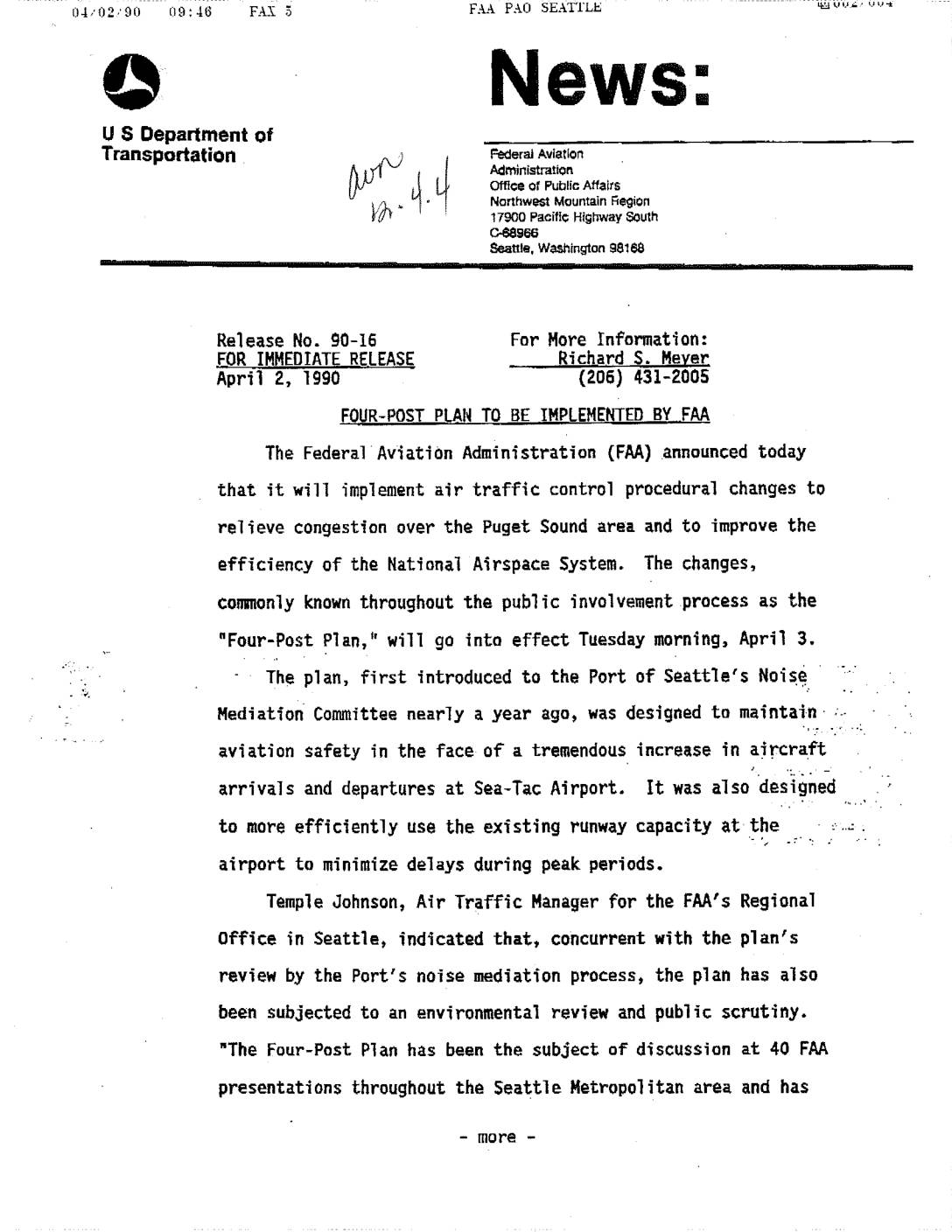
    Four-Post Plan to Be Implemented by FAA

    On April 2, 1990, the FAA announced it would implement the 'Four-Post Plan,' a set of air traffic control procedural changes at Seattle-Tacoma International Airport designed to reduce congestion, improve efficiency, and address worsening arrival delays. The plan, developed after nearly a year of public meetings, environmental review, and computer simulation of 13 alternatives, was determined to produce no significant noise impact on surrounding communities. The FAA cited a 30,000 increase in annual landings and takeoffs since 1988 and the failure of mediation talks to produce an agreed-upon flight path solution as key reasons for moving forward with the changes.
    TagsAir Traffic Control, FAA, Four Post Plan, Sea-Tac AirportFolderFour Post Plan
  • 1990-03-31

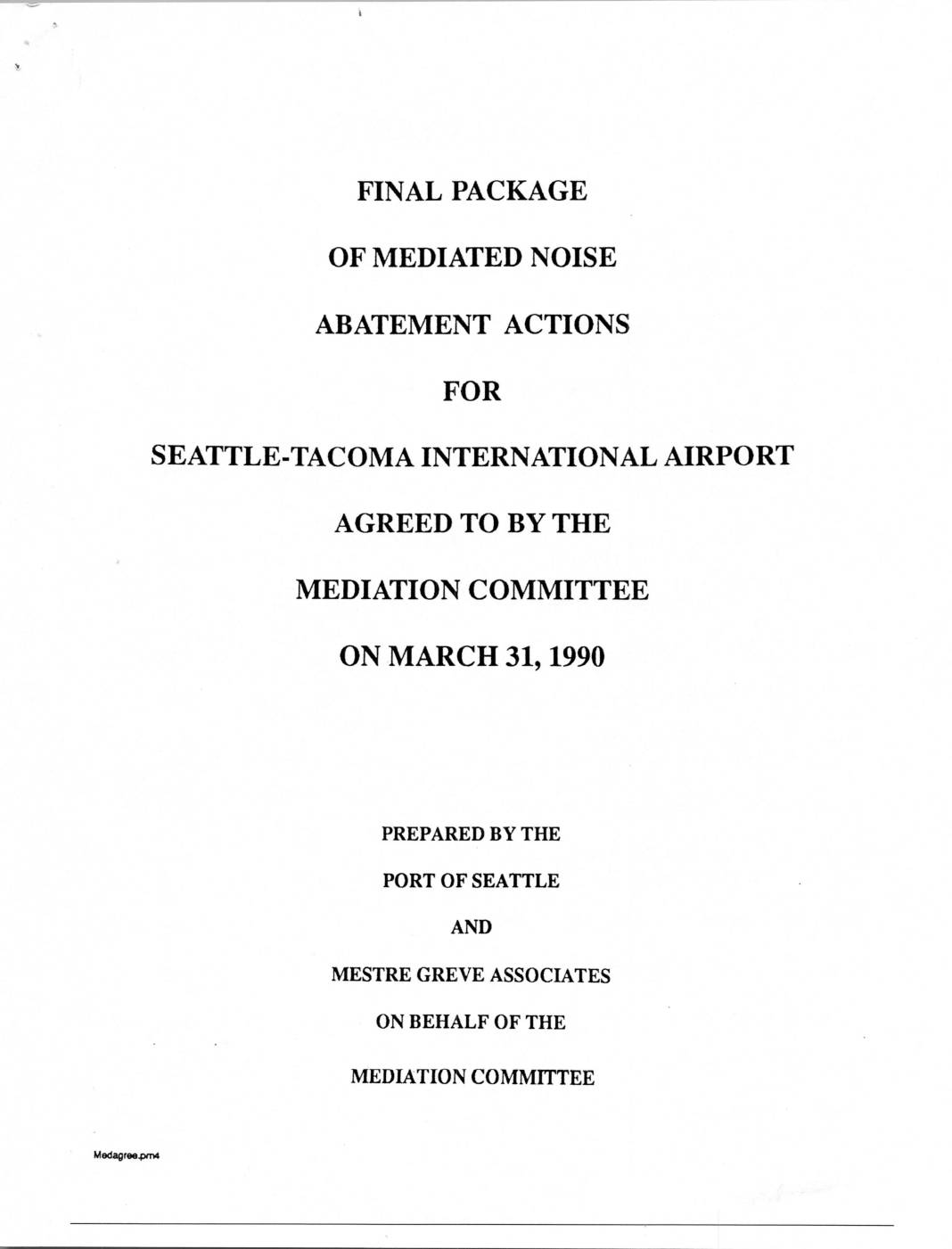
    Final package of mediated noise abatement actions for Seattle-Tacoma International Airport

    This document outlines the Final Package of Mediated Noise Abatement Actions for Seattle-Tacoma International Airport, agreed upon by the Mediation Committee on March 31, 1990. It covers a wide range of noise reduction measures, including nighttime flight restrictions, a noise remedy and insulation program for affected communities, improved flight corridor procedures, and a comprehensive noise management and monitoring system. According to technical consultants, full implementation of these agreements could reduce noise levels by approximately 50% in the communities surrounding the airport.
    TagsNoise Abatement Procedures, Noise Mitigation, Port Of Seattle, Sea-Tac Airport, Sea-Tac Noise Abatement CommitteeFolderSP #2
  • 1990-03-27

    Final environmental assessment for proposed changes to air traffic arrival and departure routes at Seattle-Tacoma International Airport

    This 1990 Final Environmental Assessment, prepared by the FAA's Air Traffic Division in Seattle, evaluates proposed changes to arrival and departure flight routes at Seattle-Tacoma International Airport. The document was signed by Air Traffic Division Manager Temple H. Johnson, Jr. on March 27, 1990, and examines the potential environmental impacts of rerouting aircraft traffic in and out of Sea-Tac. It serves as an official federal record relevant to noise and environmental policy affecting communities around the airport.
    TagsAir Traffic Control, environmental assessment, FAA, NEPA, Sea-Tac AirportFolderFederal
  • 1990-01-01

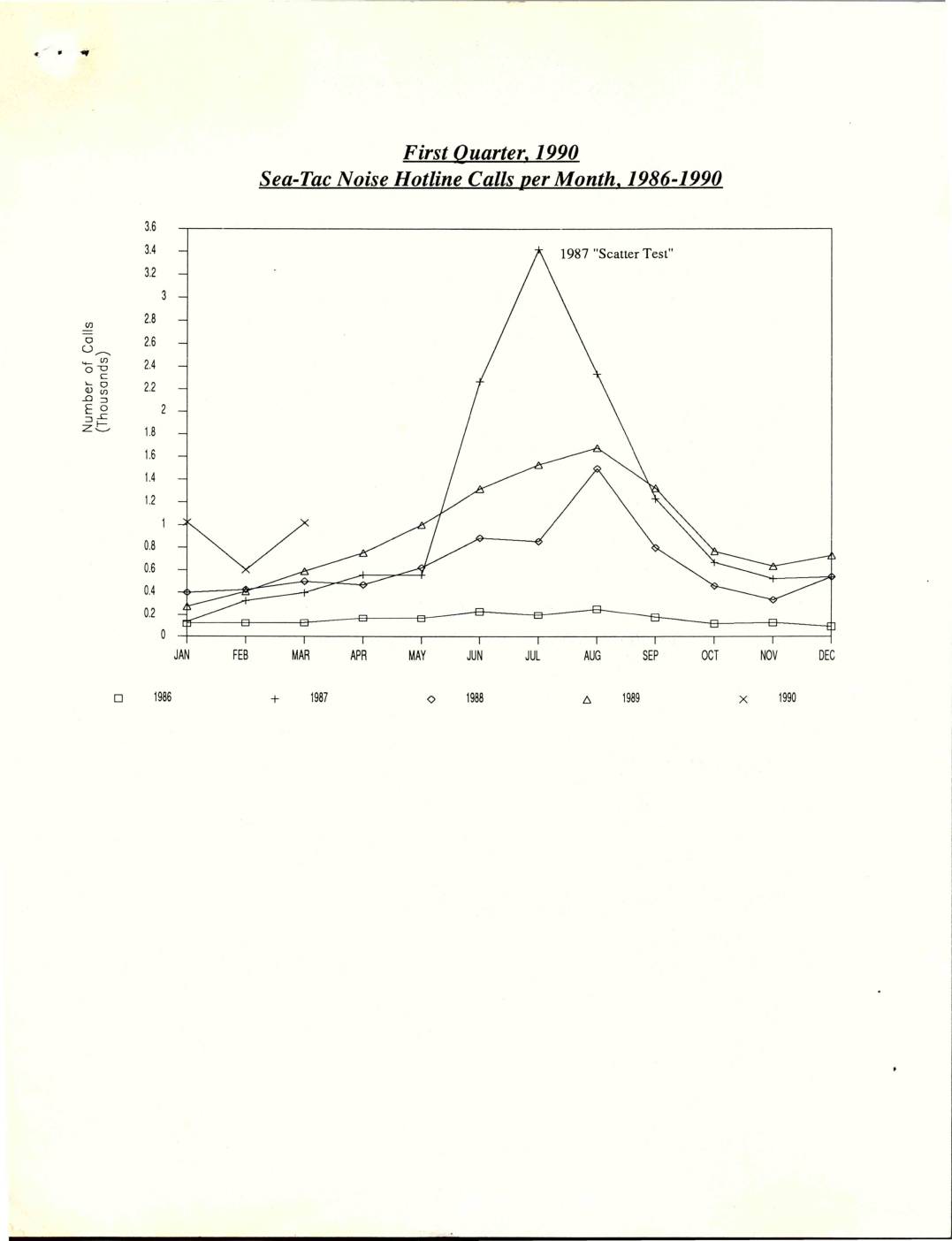
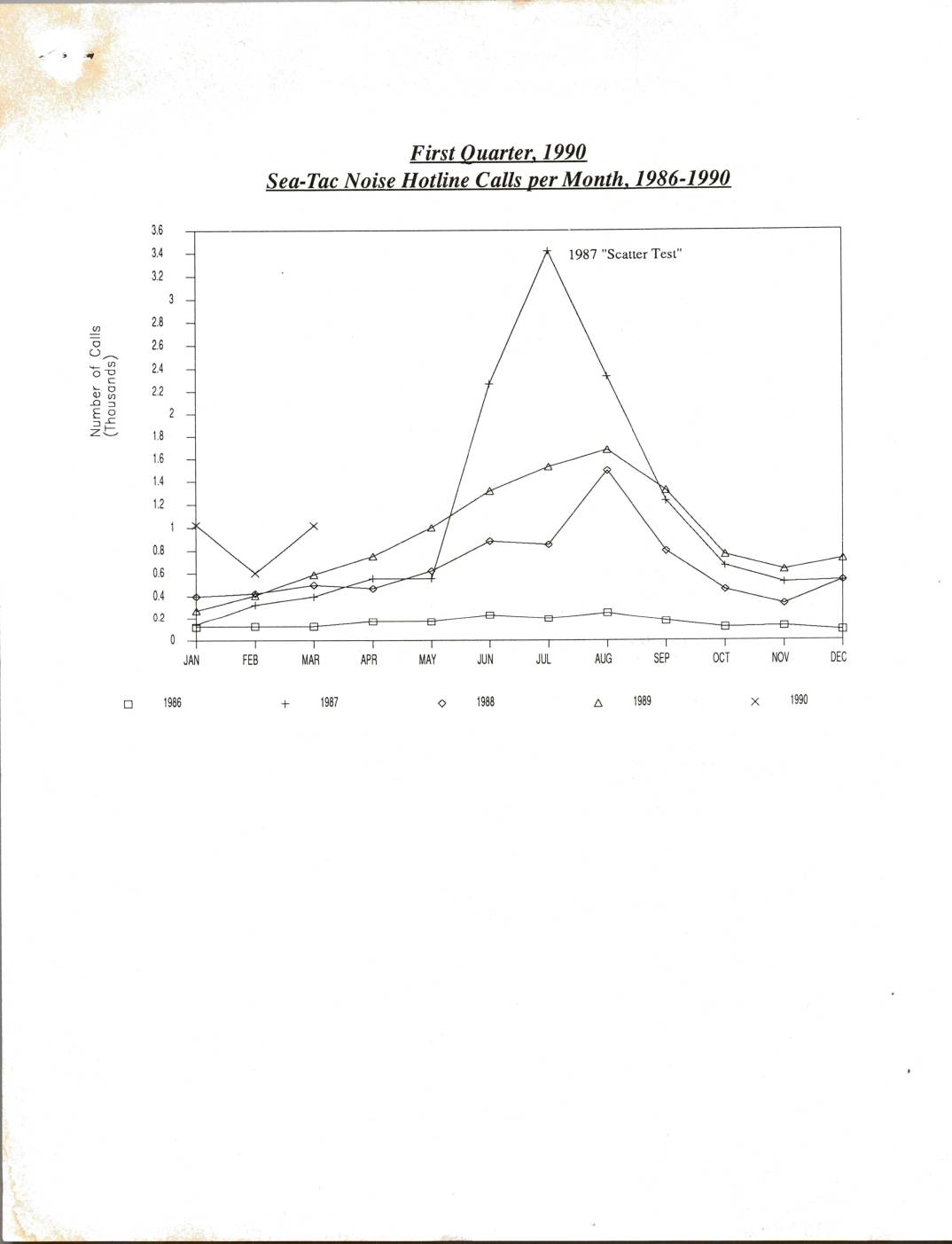
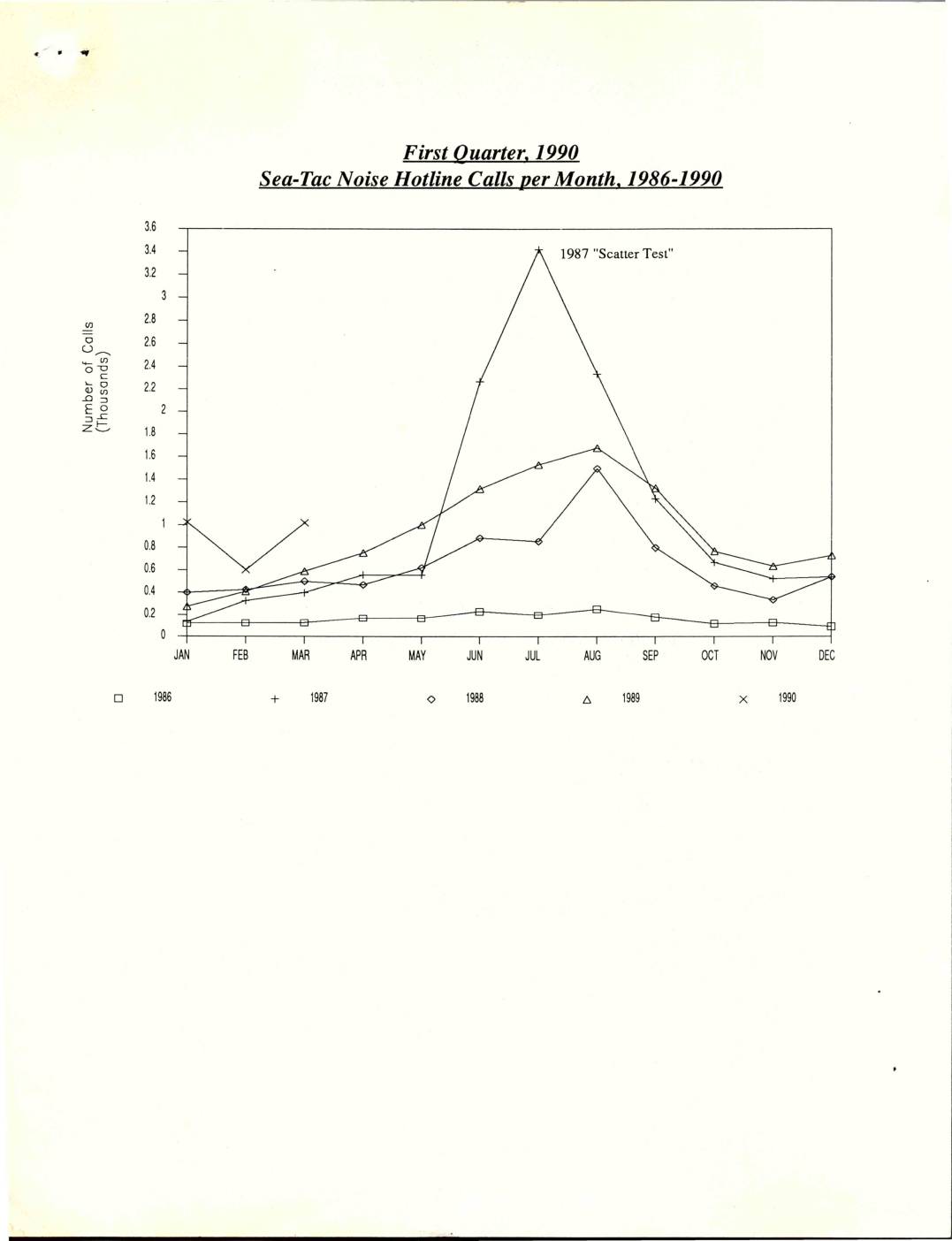
    First Quarter, 1990: Sea-Tac Noise Hotline Calls per Month, 1986–1990

    This report summarizes Sea-Tac Airport noise hotline activity for the first quarter of 1990, showing call volumes compared to prior years (1986–1989). The majority of complaints were about departures to the north (57.2%) and were characterized as 'too loud' (57.5%), with Beacon Hill/Mt Baker generating the highest number of calls by zip code (377 total). Call volumes in early 1990 remained relatively low compared to the spike seen during the 1987 'Scatter Test' period.
    CategoriesHistory TagsNoise Complaints, Port Of Seattle, Sea-Tac AirportFolderNoise
  • 1990-01-01

    First Quarter, 1990: Sea-Tac Noise Hotline Calls per Month and Complaint Analysis

    This report summarizes Sea-Tac Airport noise hotline complaint calls for the First Quarter of 1990, tracking call volumes from 1986 through early 1990 and noting a significant spike during the 1987 'Scatter Test.' The majority of complaints (57.2%) concerned northbound departures, while callers most commonly described aircraft as 'too loud' (57.5%) or 'too frequent' (22.2%). A zip-code breakdown shows complaints originated from communities across the greater Seattle-Tacoma region, with areas such as E. Queen Anne Hill and North Renton/Maple Wood among the higher-volume sources.
    TagsNoise Complaints, Port Of Seattle, Sea-Tac Airport, StatisticsFolderNoise
  • 1990-01-01

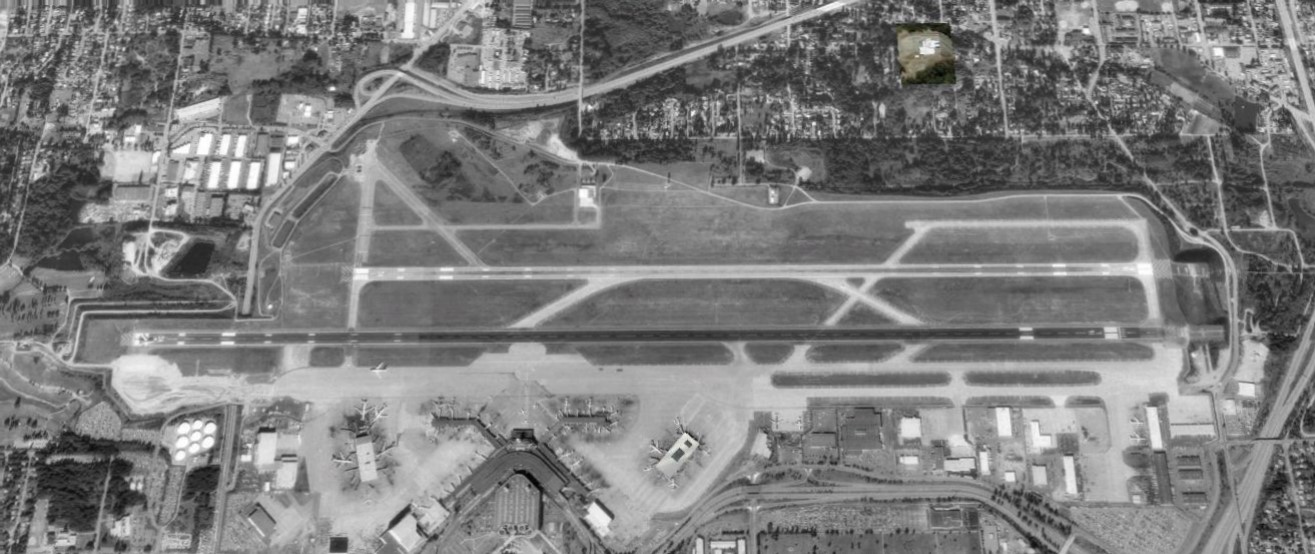
    Sea-Tac Airport 1990 Second Runway

    Black-and-white aerial satellite or reconnaissance photograph showing a commercial airport with two parallel runways, taxiways, a terminal building with jet bridges, and surrounding suburban development. No visible text, watermarks, or captions are present to confirm the specific airport identity or date.
    TagsAirport Expansion, History, Runways, Sea-Tac Airport, Second RunwayFolderRunways
  • 1990-01-01

    First Quarter, 1990: Sea-Tac Noise Hotline Calls per Month, 1986-1990

    This chart tracks monthly calls to the Sea-Tac Airport Noise Hotline from 1986 through the first quarter of 1990, measured in thousands of calls. A notable spike is visible in mid-1987, labeled the 'Scatter Test,' during which calls peaked at approximately 3,400 in July before sharply declining. Overall call volumes in 1988 and 1989 were moderate, generally ranging between 400 and 1,700 calls per month, with summer months consistently showing the highest activity across all years.
    TagsNoise Complaints, Sea-Tac AirportFolderNoise
  • 1990-01-01

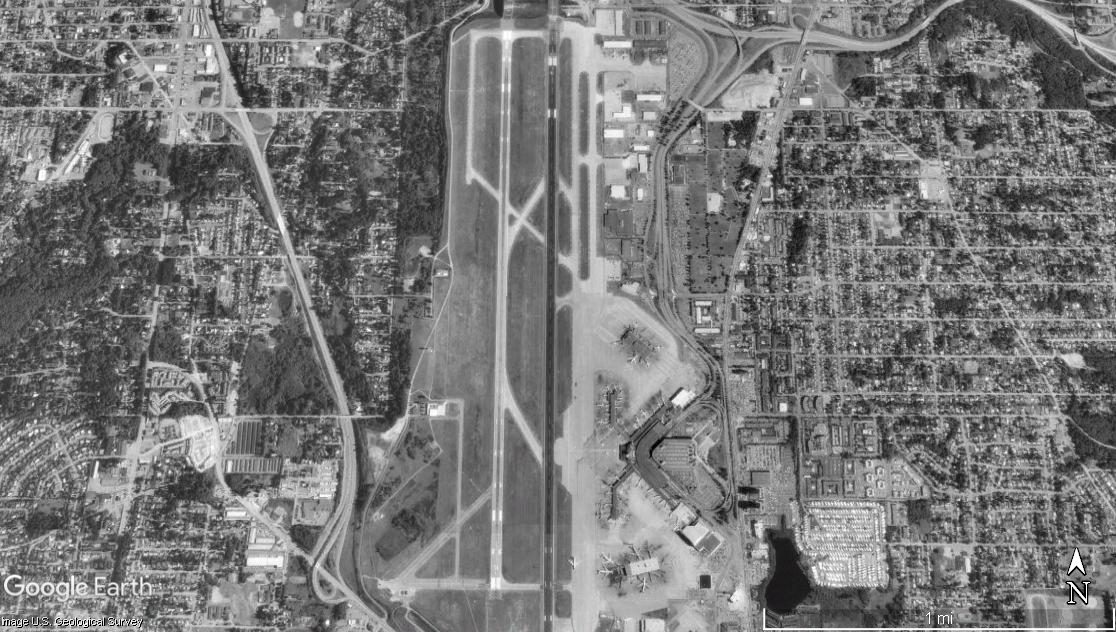
    Satellite Image of Single-Runway Airport With Urban Development

    Google Earth satellite image (U.S. Geological Survey) showing a single primary runway airport surrounded by dense urban development. Visible features include parallel taxiways, terminal apron areas with parked aircraft, and a highway corridor to the west. This does not appear to be Sea-Tac Airport, which has multiple parallel runways.
    TagsRunways, Sea-Tac Airport, Second RunwayFolderRunways
  • 1990-01-01

    Final environmental assessment: Proposed changes to air traffic arrival and departure routes at Seattle-Tacoma International Airport, Volume II

    This 1990 Final Environmental Assessment, published by the U.S. Department of Transportation's Federal Aviation Administration, examines proposed changes to air traffic arrival and departure routes at Seattle-Tacoma International Airport. Volume II of the document compiles public comments received in response to the Draft Environmental Assessment, reflecting community input on how the proposed route changes could affect noise and other environmental conditions in the Seattle, Washington area.
    TagsAir Traffic Control, environmental assessment, FAA, NEPA, Sea-Tac AirportFolderFederal

Posts pagination

Page 1 … Page 168 Page 169 Page 170 Page 171 Page 172 … Page 186
Sidebar On/Off

Upcoming Events

  • Part 150 NCP Workshop — Burien
    Add to CalendarMSaturday Oct 17: 10:00am

    Attend a Port of Seattle open house on the Part 150 Study Noise Compatibility Program (NCP). The Part 150 program determines the noise boundary around the airport and opportunities for noise mitigation such as sound insulation.

    [...]
  • Part 150 NCP Workshop — SeaTac
    Add to CalendarMMonday Oct 19: 6:00pm

    Attend a Port of Seattle open house on the Part 150 Study Noise Compatibility Program (NCP). The Part 150 program determines the noise boundary around the airport and opportunities for noise mitigation such as sound insulation.

    [...]
  • Part 150 NCP Workshop — Des Moines
    Add to CalendarMTuesday Oct 20: 6:00pm

    Attend a Port of Seattle open house on the Part 150 Study Noise Compatibility Program (NCP). The Part 150 program determines the noise boundary around the airport and opportunities for noise mitigation such as sound insulation.

    [...]

[See all...]


Issues

Sea-Tac Airport is currently undergoing the largest and longest expansion in its history, collectively known as the Sustainable Airport Master Plan (SAMP). Some of it you can already hear, but you’re probably not aware of what it all means. Here’s what you need to know.
read more...

Read This!

As the source for federal transportation grants, the Puget Sound Regional Council was charged with developing a system to meet the growing need for commercial aviation. When the search for a second airport failed, they authorized the Port of Seattle to build the Third Runway, with a mandate to develop a noise abatement and mitigation program. In their effort to stop the Third Runway, the ACC argued over every detail of the Port's efforts--including property buyouts and sound insulation. The dispute was meant to be settled by a three member Expert Arbitration Panel. This is their final report. It finds 2-1, that the Port's program was insufficient in several respects. Despite that, funding for the Third Runway was approved by the PSRC, and the 'Port Package' program, proceeded largely unchanged. Expert Arbitration Panel's final decision finding that the Port of Seattle had not shown sufficient reduction in real on-the-ground noise impacts to satisfy noise reduction conditions required for approval of a third runway at Sea-Tac International Airport. The majority decision concluded the Port's noise abatement programs were insufficient despite being impressive in scope.
continue...

  • Sea-Tac Noise.Info
  • Connect with STNI

    • Subscribe
    • Port Package Problem?
    • Donate
    • Podcast
    • Socials
      • Facebook
      • X (Twitter)
      • Bluesky
      • Instagram
  • Learn

    • Frequently Asked Questions
    • Explainers
    • Youtube
    • Research Requests
    • Complain about one flight
  • Goals

    Fulfill the promises of 1976:
    • Compensation
    • Reduced noise
    • Improved air quality
    • Environmental remediation
Login/Register
©2026•Data Privacy

Message

We use cookies to provide basic functionality. We also provide access to search engines in order to provide site analytics. We do not sell or share your data.
V V