Skip to content
  • STNI
  • Statistics
    • Ops and Passengers
      • King County International Airport (Boeing Field) Annual Operations
    • Financials
    • Aviation fuel uplift in the State of Washington 2018 – 2025
      • Aviation Fuel Tax Revenue in the State of Washington 1983-2025
      • Aviation Fuel Uplift at Sea-Tac Airport
    • Air Quality Monitoring
    • Flight Tracking
      • Flow and Flight Tracks
      • Five Year Comparison
      • Busiest Hours and Days
    • SEL Noise Reports & Graphs
      • About The Permanent Noise Monitors
      • Minutes of Quiet by Noise Monitor
      • Noise Events mapped
      • Noise Events (SEL)
    • Runways
    • Employees
    • Real Estate
      • Port Properties and Trees mapped
    • Parking
  • Events
  • Protest
    • Regular Events
    • Legislation 2026
    • Complain about a particular flight
    • Advocacy Organizations
    • Media Outlets
    • People
    • The Port of Seattle
      • Commission Meetings
      • Public Records Requests
      • StART
      • Highline Forum
    • Contact Your Electeds
  • Resources
    • FAQs
      • FAA Occurrences/Accidents/Indents
    • The SAMP
      • SAMP Public Comment Template
        • Two versions of Appendix K: NEPA/SEPA 2018 vs 2023
      • SAMP NTP: 31 projects by the numbers
      • SEPA Draft EIS (2026)
      • SAMP Record of Decision/FONSI (2025)
      • SAMP Draft EA (October 2024)
      • 2018 Scoping
    • Port Packages
      • Port Package Property Costs
      • Port Packages mapped
      • The Port Package Explainer
      • So you want a (first-time) Port Package? Start here
      • Port Package Looker Upper
      • How do I determine if I have a Port Package or Avigation Easement?
      • Progress on Port Package Update legislation
      • Having a Port Package Problem?
      • Port Package Site Visit Follow-Up
    • Document Library
    • Explainers
      • The Airport Law Cheat Sheet
      • The Grant Explainer
    • External Articles
    • History
      • Timeline
      • The Sea-Tac Communities Plan
        • Sea-Tac Communities Plan – Planning Maps
      • PSRC Third Runway Decision Process
    • Studies
    • Videos
  • Stories
  • Mission
  • Subscribe
  • Contact
Scroll down to content

Get InformedStay Informedx

I understand that you will never share my information with anyone, you will only use it to keep me updated on relevant events and that I may unsubscribe at any time.

STNI

STNISea-Tac Noise.Info

  • Solve for Sea-Tac. Solve for every airport.
  • Since 2016, working to obtain justice for everyone living under the flight path.
  • Less Noise. Cleaner Air. Better Public Health. Compensation.
  • Everything you think you know about the airport is wrong.

TagPort Of Seattle(2405)

Advanced Search Options

  • Dates
  • Media
    • External Articles
    • Images
    • PDFs
    • Video
    • Audio
  • Order By
  • 2000-03-20

    EXH AR044225: Draft Subsurface Conditions Data Report, North Safety Area, Third Runway Embankment, Sea-Tac Airport

    Hart Crowser draft subsurface conditions data report (project J-4978-18) prepared for Port Of Seattle and HNTB, dated March 20, 2000, covering the North Safety Area Third Runway Embankment at Sea-Tac International Airport. Report includes generalized geologic description, subsurface soil conditions, hydrogeologic conditions, laboratory test results (consolidation, CU triaxial, UU triaxial, direct shear tests), hydraulic conductivity
    TagsACC, Pollution Control Hearings Board, Port Of Seattle, Sea-Tac Airport, soil, Third RunwayFolderBox 18
  • 2000-03-07

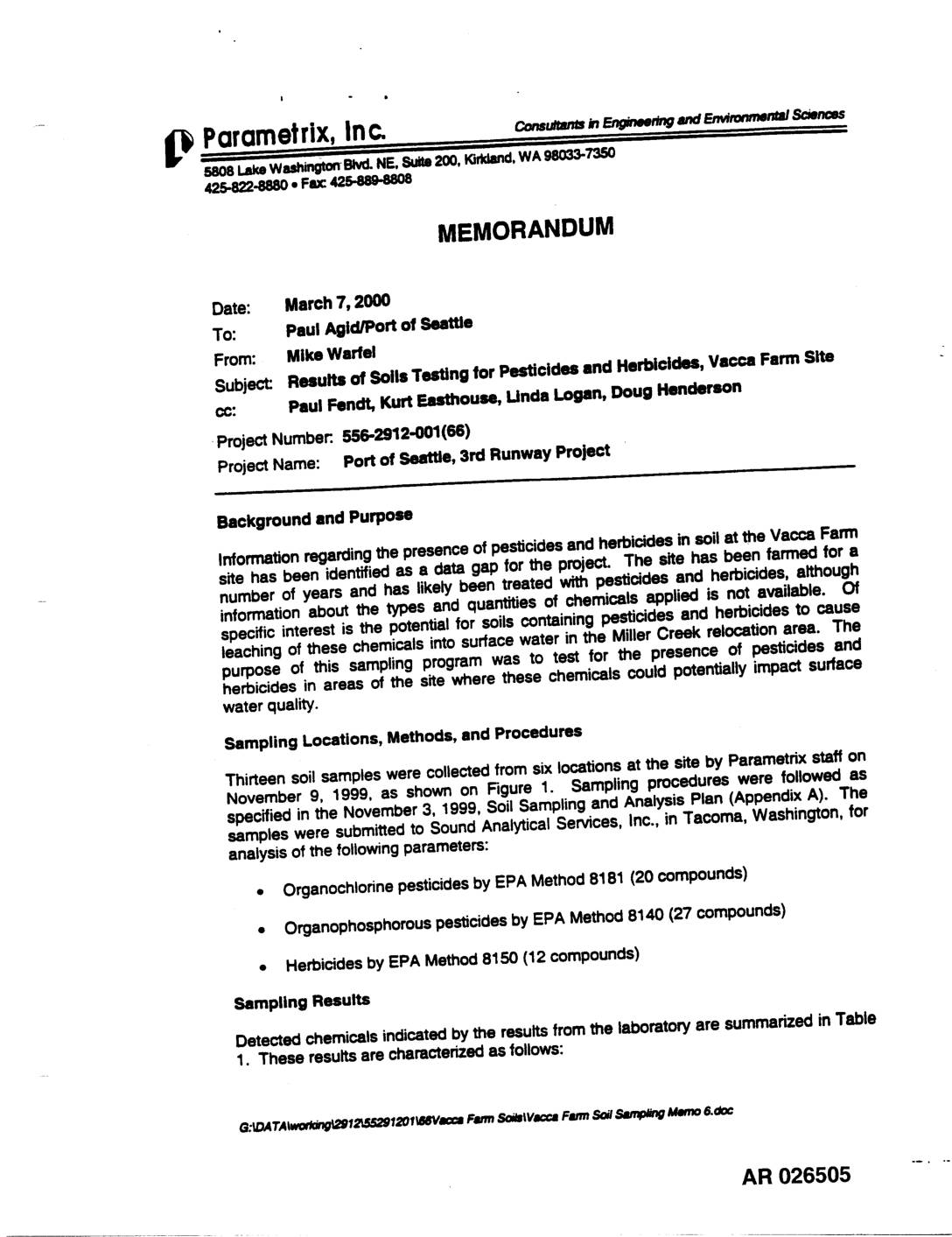
    EXH AR026505: Memo — Soils Testing Results, Pesticides & Herbicides, Vacca Farm Site

    A March 2000 Parametrix memorandum reports the results of pesticide and herbicide soil testing at the Vacca Farm site, part of the Port of Seattle's Third Runway Project. Of 59 compounds tested, only 12 were detected, primarily organochlorine pesticides, with Dieldrin slightly exceeding cleanup levels in shallow soil samples at two locations in the proposed floodplain area. The memo recommends removing the upper six inches of soil from the floodplain area for offsite disposal, while concluding that the proposed Miller Creek relocation corridor does not pose unacceptable risks to human health.
    TagsACC, Miller Creek, Model Toxics Control Act, Pollution Control Hearings Board, Port Of Seattle, soil, Third RunwayFolderBox 10
  • 2000-03-01

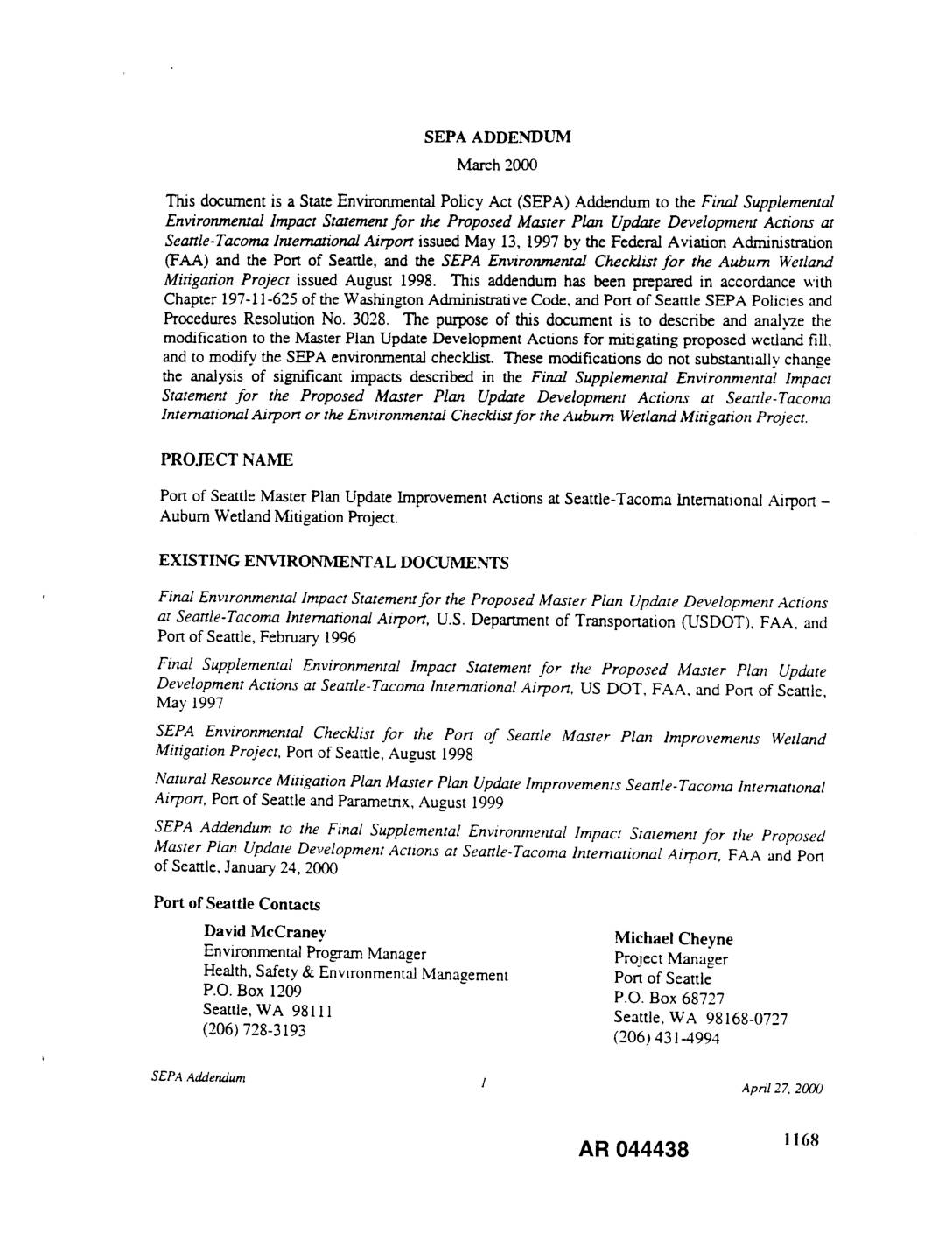
    EXH AR044438: SEPA Addendum — Port Of Seattle Master Plan Update, Auburn Wetland Mitigation Project, STIA

    SEPA Addendum (April 27, 2000) prepared by Port Of Seattle and FAA as addendum to the Final Supplemental Environmental Impact Statement for the Proposed Master Plan Update Development Actions at Seattle-Tacoma International Airport (STIA), and to the SEPA Environmental Checklist for the Auburn Wetland Mitigation Project (August 1998). Documents modification to Master Plan Update wetland
    TagsACC, Auburn Wetland, Environmental Impact Statement, Pollution Control Hearings Board, Port Of Seattle, SEPA, Third RunwayFolderBox 18
  • 2000-02-29

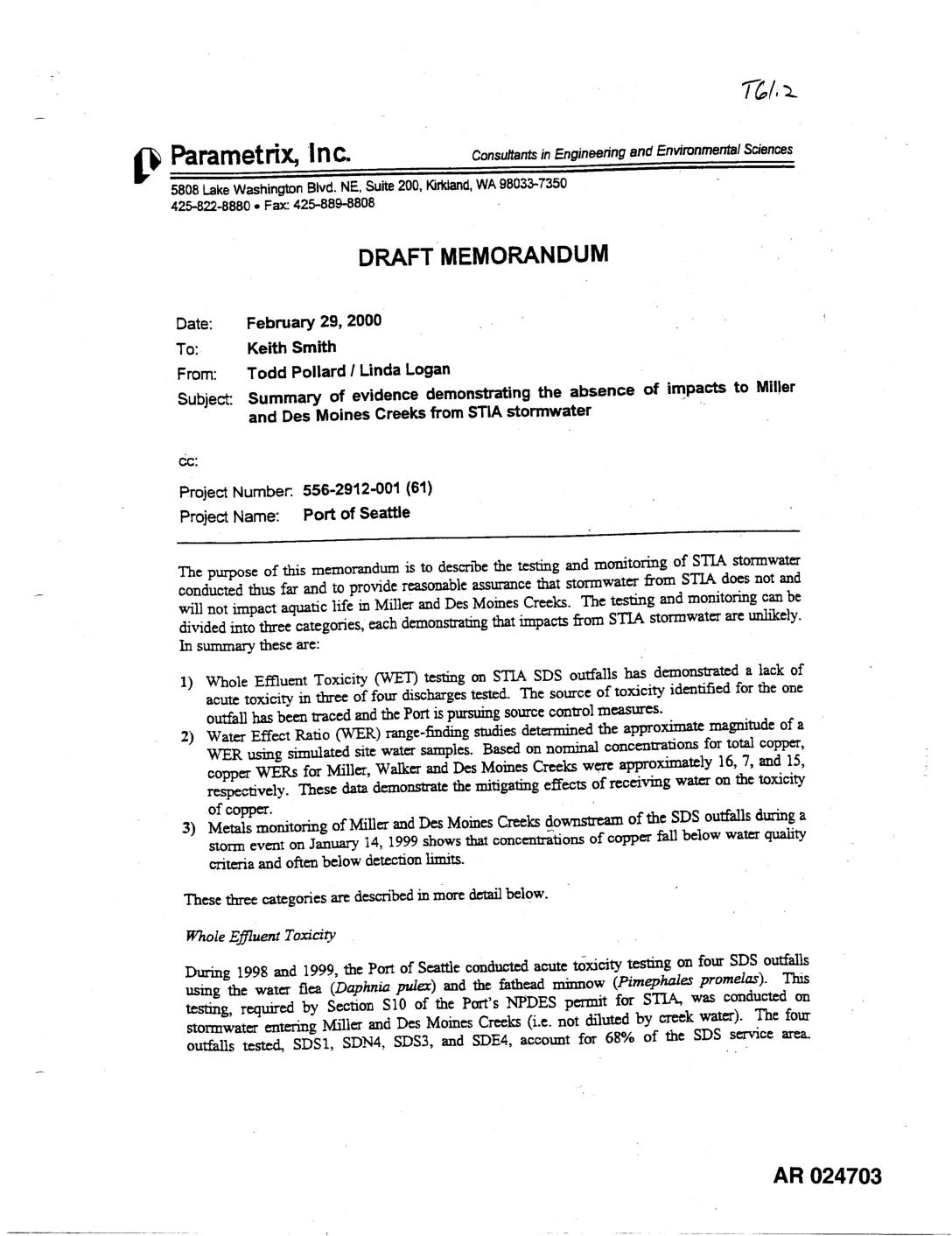
    EXH AR024703: Draft Memo — Evidence Summary, No Impacts to Miller & Des Moines Creeks from STIA Stormwater

    A February 2000 draft memo from environmental consultants Parametrix summarizes testing and monitoring data concluding that stormwater runoff from Seattle-Tacoma International Airport (STIA) does not harm aquatic life in nearby Miller and Des Moines Creeks. Three lines of evidence are presented: whole effluent toxicity tests showing most outfalls are non-toxic, water effect ratio studies demonstrating that creek water significantly reduces copper toxicity, and metals monitoring confirming that copper concentrations in the creeks fell below water quality standards. The one outfall found to be toxic (SDN1) was traced to zinc leaching from galvanized rooftops, with the Port of Seattle pursuing corrective measures.
    TagsACC, Des Moines Creek, Pollution Control Hearings Board, Port Of Seattle, Stormwater, Third Runway, Water QualityFolderBox 10
  • 2000-02-28

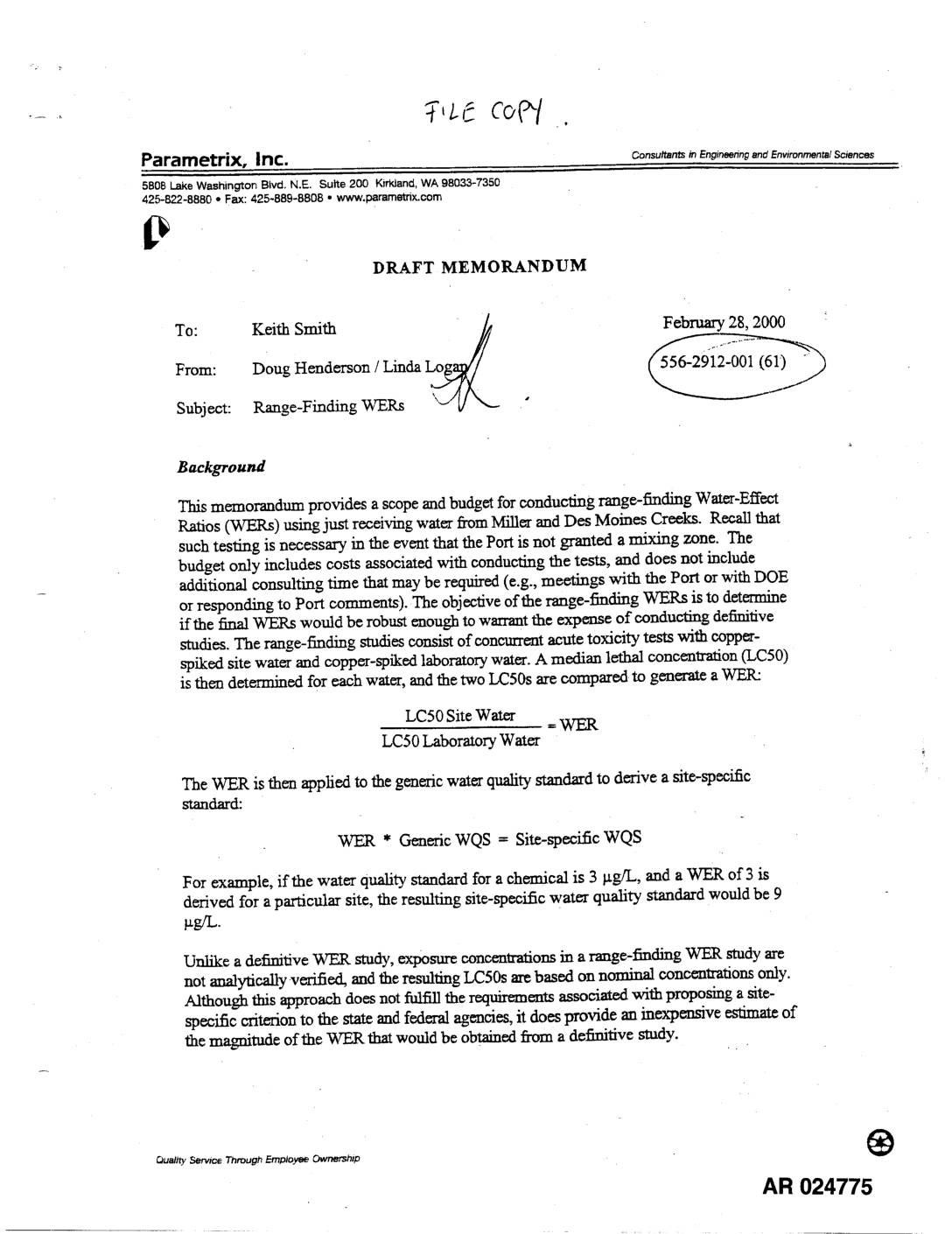
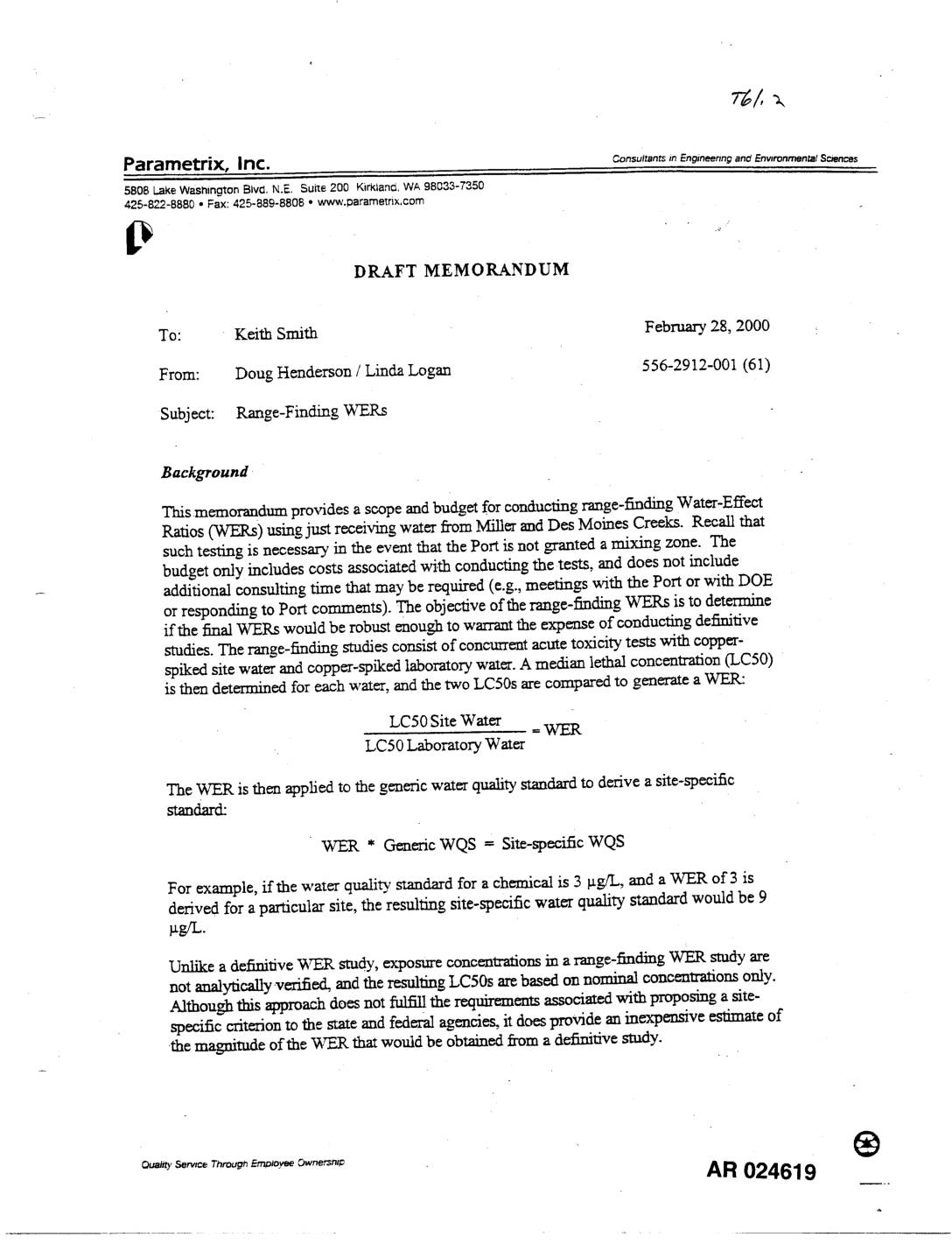
    EXH AR024775: Draft Memo Range-Finding WERs Miller and Des Moines Creeks

    A February 2000 draft memorandum from Parametrix, Inc. outlines a scope and budget for range-finding Water-Effect Ratio (WER) studies using receiving water from Miller and Des Moines Creeks, conducted in connection with stormwater discharge permitting near the Port. The studies involve acute toxicity tests with copper-spiked water to determine whether site-specific water quality standards could be higher than generic state standards, potentially eliminating the need for a mixing zone. Estimated costs range from $2,110 for one creek site to $2,650 for two sites.
    TagsACC, Des Moines Creek, Ecology, PCHB, Pollution Control Hearings Board, Port Of Seattle, Water QualityFolderBox 10
  • 2000-02-28

    EXH AR024619: Draft Memo Range-Finding Water-Effect Ratios Miller & Des Moines Creeks

    A February 2000 draft memorandum from Parametrix, Inc. outlines a scope and budget for range-finding Water-Effect Ratio (WER) studies using receiving water from Miller and Des Moines Creeks, intended to help determine whether copper discharge standards at a Port facility could be adjusted through site-specific water quality criteria. The studies involve acute toxicity tests comparing copper-spiked site water to copper-spiked laboratory water, with estimated costs ranging from $2,110 for one site to $2,650 for two sites. Results from earlier 1999 range-finding tests suggested WERs high enough to potentially justify more definitive studies, but new tests without mixing zone assumptions were recommended to better assess achievable permit limits.
    TagsACC, Des Moines Creek, PCHB, Pollution Control Hearings Board, Port Of Seattle, Third Runway, Water QualityFolderBox 10
  • 2000-02-14

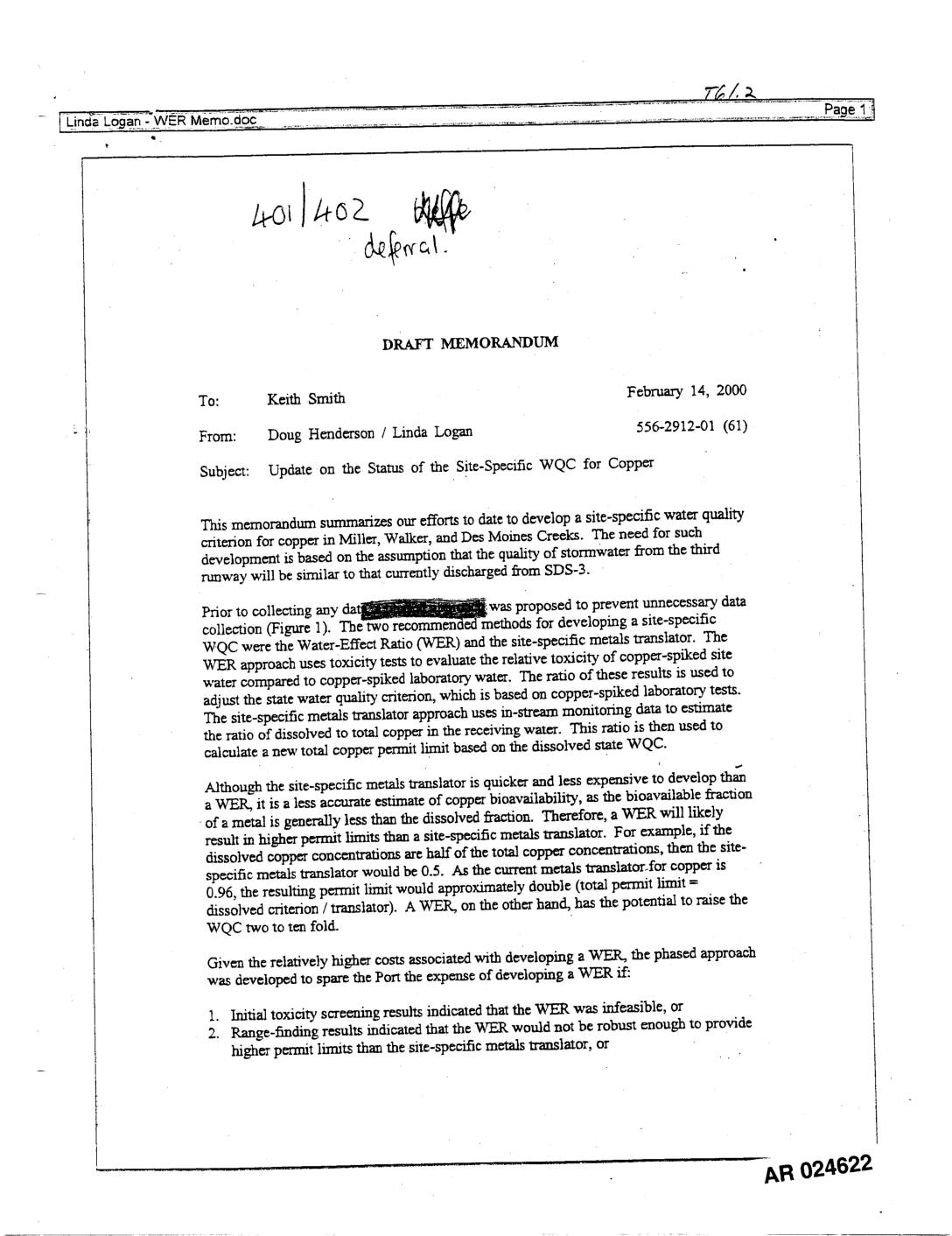
    EXH AR024622: Draft Memo — Site-Specific WQC Copper Status Update, Miller, Walker & Des Moines Creeks

    A February 2000 internal draft memorandum from environmental consultants to Port of Seattle staff summarizes efforts to develop a site-specific water quality criterion for copper in Miller, Walker, and Des Moines Creeks, in connection with stormwater runoff anticipated from a proposed third runway at Sea-Tac Airport. The memo evaluates two technical approaches—the Water-Effect Ratio (WER) and the site-specific metals translator—for potentially raising copper discharge permit limits, and outlines initial toxicity screening and range-finding study results. It also describes ongoing negotiations with the Washington State Department of Ecology regarding unresolved issues such as mixing zones, AKART requirements, and critical sampling conditions.
    TagsACC, Des Moines, PCHB, Pollution Control Hearings Board, Port Of Seattle, Third Runway, Water QualityFolderBox 10
  • 2000-02-08

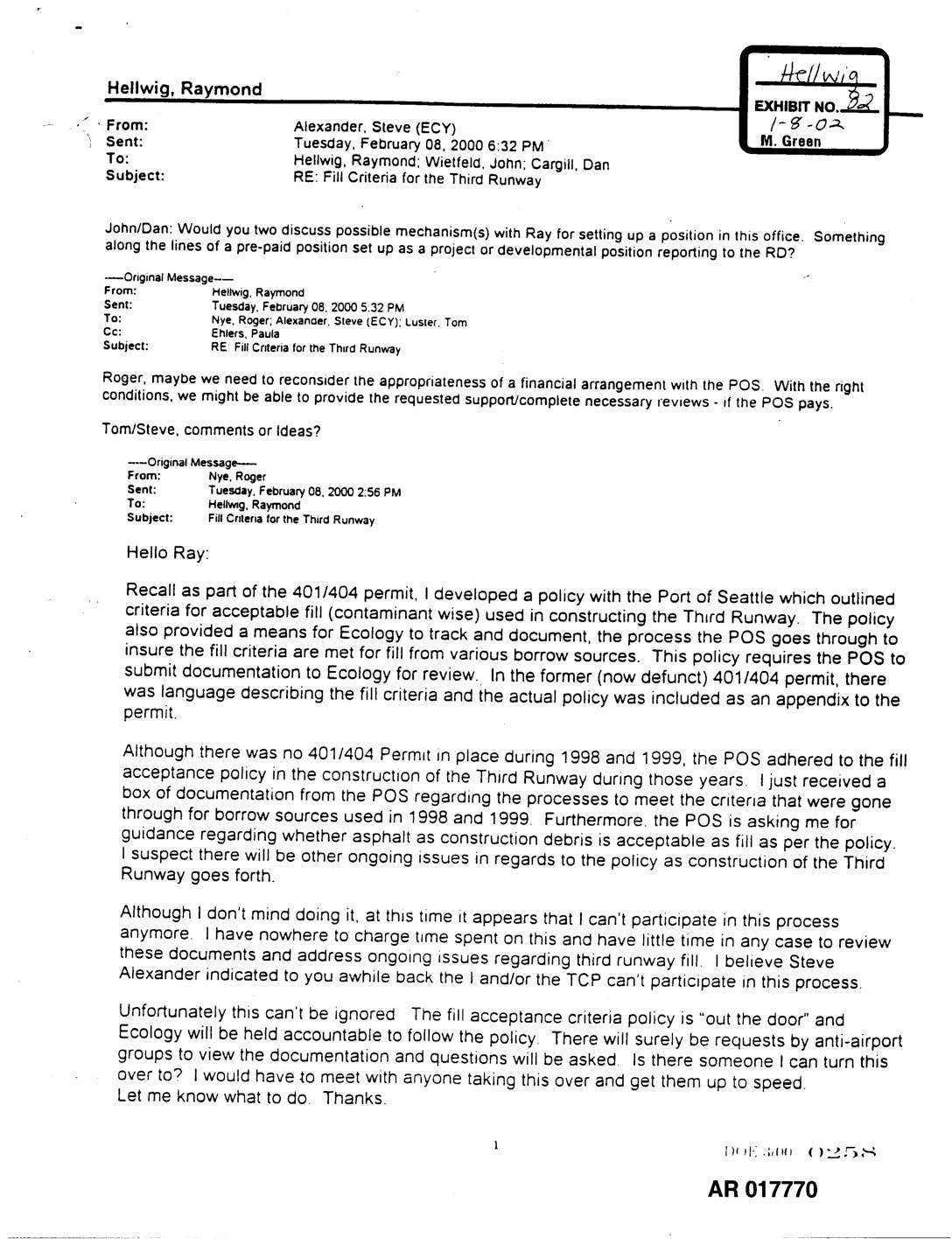
    Exhibit 82: Email Chain RE Fill Criteria for the Third Runway — Ecology/Port Of Seattle Financial Arrangement Discussion

    Email chain dated February 8, 2000 among Washington State Department of Ecology staff (Roger Nye, Raymond Hellwig, Steve Alexander) regarding fill criteria compliance for the Third Runway at Sea-Tac Airport. Roger Nye describes the 401/404 permit fill acceptance policy developed with Port Of Seattle governing contaminant criteria for borrow sources used in Third Runway construction
    TagsACC, Clean Water Act, Ecology, Fill Dirt, Pollution Control Hearings Board, Port Of Seattle, Third RunwayFolderBox 08
  • 2000-02-01

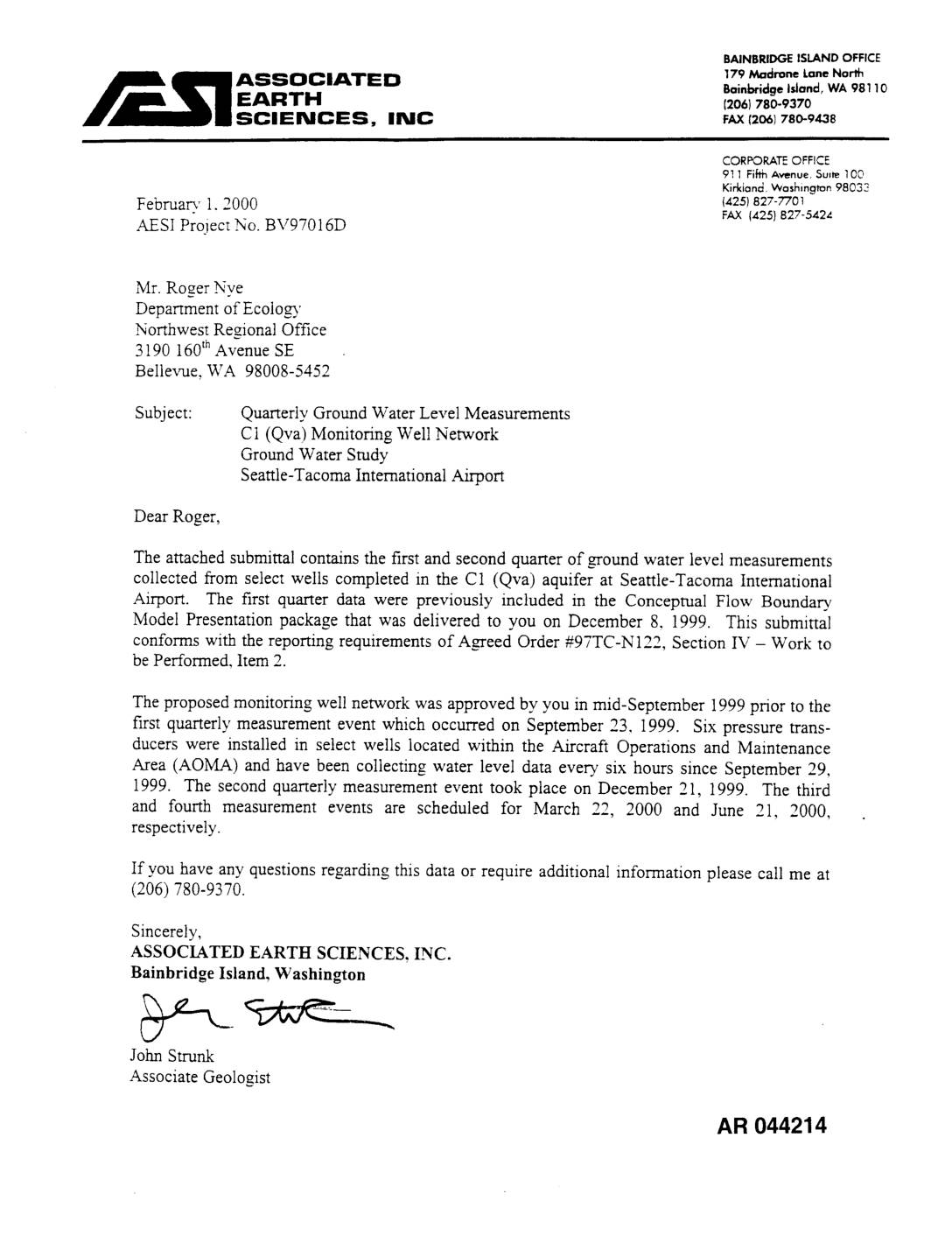
    EXH AR044214: Quarterly Ground Water Level Measurements, C1 (Qva) Monitoring Well Network, Ground Water Study, STIA

    Letter dated February 1, 2000 from John Strunk, Associated Earth Sciences, Inc. (AESI Project No. BV97016D) to Roger Nye, Washington Department of Ecology Northwest Regional Office, submitting first and second quarter ground water level measurements from the C1 (Qva) aquifer monitoring well network at Seattle-Tacoma International Airport. Reports on six pressure transducers installed in the
    TagsACC, Ecology, Environment, Pollution Control Hearings Board, Port Of Seattle, Sea-Tac Airport, Water QualityFolderBox 18
  • 2000-01-31

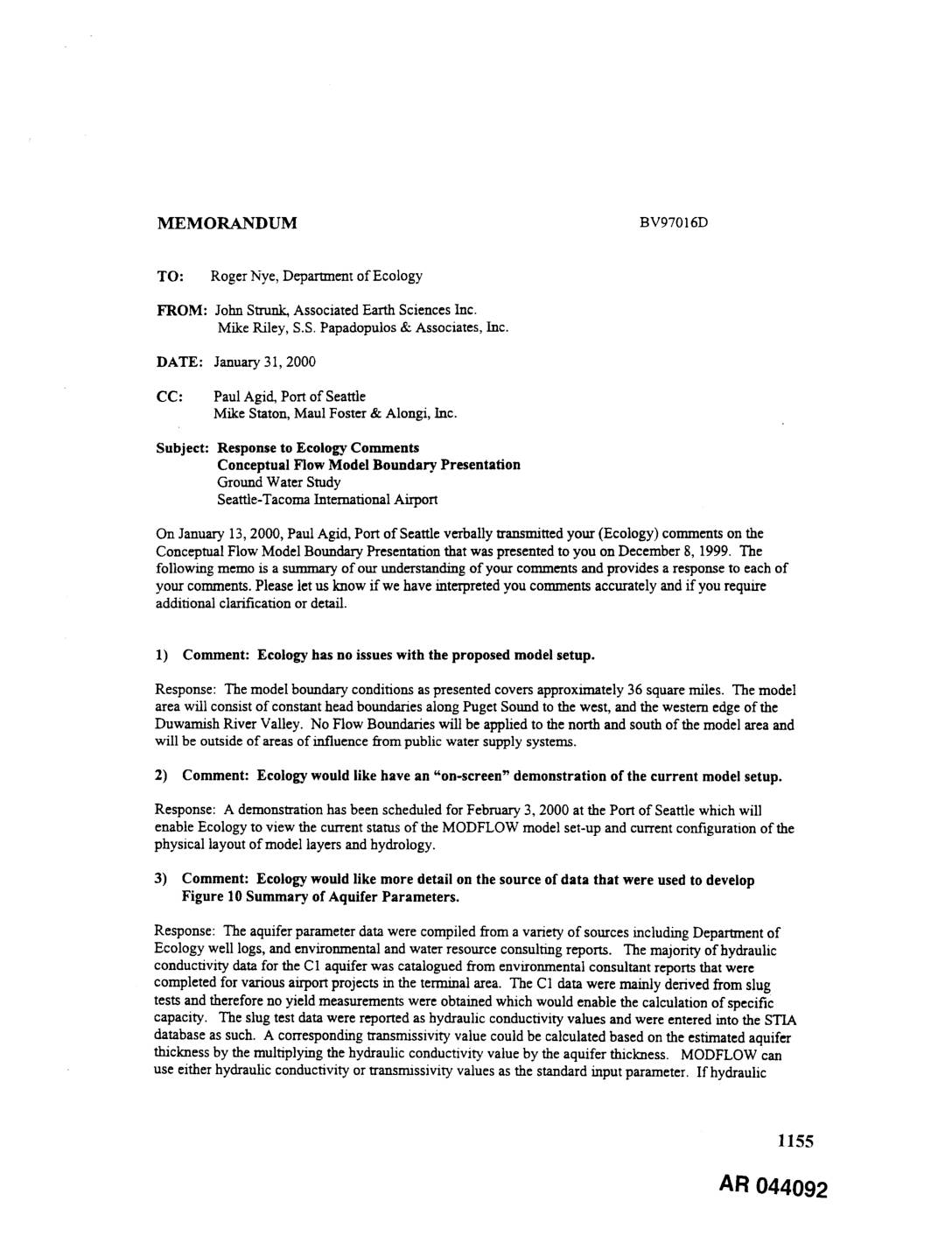
    EXH AR044092: Memorandum — Response to Ecology Comments on Conceptual Flow Model Boundary Presentation, Ground Water Study, STIA

    Memorandum BV97016D dated January 31, 2000, from John Strunk (Associated Earth Sciences Inc.) and Mike Riley (S.S. Papadopulos & Associates, Inc.) to Roger Nye, Department of Ecology, responding to nine Ecology comments on the Conceptual Flow Model Boundary Presentation for the Seattle-Tacoma International Airport ground water study. Topics addressed include MODFLOW model setup covering approximately
    TagsACC, Ecology, Environment, Pollution Control Hearings Board, Port Of Seattle, Sea-Tac AirportFolderBox 18

Posts pagination

Page 1 … Page 201 Page 202 Page 203 Page 204 Page 205 … Page 241
Sidebar On/Off

Upcoming Events

  • Port of Seattle Regular Commission Meeting September 22, 2026
    Add to CalendarMTuesday Sep 22: 12:00pm
    17801 International Blvd, Seattle, WA 98158
    2026 09 22 rm packet pdf

    Order of Business 10:30 a.m. 1. Call to Order 2. Executive Session – if necessary, pursuant to RCW 42.30.110 (executive sessions are not open to the public) 12:00 p.m. – Public Session Reconvene or Call to Order and Pledge of Allegiance 3. Approval of the Agenda 4. Special Orders of the Day 4a. Presentation of

    [...]
  • Highline Forum Agenda – September 23, 2026
    Add to CalendarMWednesday Sep 23, 2:30pm - 4:30pm
    City of Des Moines, Police Services Building,
    Highline forum agenda final 23sept2026 pdf

    Highline Forum Agenda Theme: Part 150 Update and PortJobs Overview 2:30pm – Convene Meeting/Introductions Port Co-Chair, Commissioner Mohamed 2:35pm – Public Comments Audience The meeting will be held in person and virtually. Those wishing to provide public comment may: 1) Deliver public comment via email; 2) Deliver public comment via Microsoft Teams; or 3) Deliver

    [...]

[See all...]


Help study childhood asthma. Get free HEPA filter!

read more...

Issues

Sea-Tac Airport is currently undergoing the largest and longest expansion in its history, collectively known as the Sustainable Airport Master Plan (SAMP). Some of it you can already hear, but you’re probably not aware of what it all means. Here’s what you need to know.
read more...

Read This!

As the source for federal transportation grants, the Puget Sound Regional Council was charged with developing a system to meet the growing need for commercial aviation. When the search for a second airport failed, they authorized the Port of Seattle to build the Third Runway, with a mandate to develop a noise abatement and mitigation program. In their effort to stop the Third Runway, the ACC argued over every detail of the Port's efforts--including property buyouts and sound insulation. The dispute was meant to be settled by a three member Expert Arbitration Panel. This is their final report. It finds 2-1, that the Port's program was insufficient in several respects. Despite that, funding for the Third Runway was approved by the PSRC, and the 'Port Package' program, proceeded largely unchanged. Expert Arbitration Panel's final decision finding that the Port of Seattle had not shown sufficient reduction in real on-the-ground noise impacts to satisfy noise reduction conditions required for approval of a third runway at Sea-Tac International Airport. The majority decision concluded the Port's noise abatement programs were insufficient despite being impressive in scope.
continue...

  • Sea-Tac Noise.Info
  • Connect with STNI

    • Subscribe
    • Port Package Problem?
    • Donate
    • Podcast
    • Socials
      • Facebook
      • X (Twitter)
      • Bluesky
      • Instagram

    "Sea-Tac Master Plan Update 1996: Wetland Impact/Mitigation Sites — Vicinity Map, Wetlands Affected, and Classification/Size/Impact Tables" — , 1996

  • Learn

    • Frequently Asked Questions
    • Explainers
    • Youtube
    • Research Requests
    • Make a complaint
  • Goals

    Fulfill the promises of 1976:
    • Compensation
    • Reduced noise
    • Improved air quality
    • Environmental remediation
Login/Register
©2026•Data Privacy

Message

We use cookies to provide basic functionality. We also provide access to search engines in order to provide site analytics. We do not sell or share your data.
V V