Tagnon-aviation transportation(43)
-
 2022-09-01
Destination 2030: Investment strategy
The Destination 2030 plan outlines a long-range transportation investment strategy for the central Puget Sound region, prioritizing maintenance and preservation of existing infrastructure while expanding multimodal travel options. Key investment principles include completing gaps in regional transportation systems, linking spending to measurable outcomes, and supporting compact urban development connected by efficient transit. -
 2022-05-01
Puget Sound Regional Council Annual Report 2022
The Puget Sound Regional Council (PSRC) 2022 Annual Report highlights key regional planning achievements, including the opening of the Northgate Link Light Rail Extension, the adoption of the region's first Regional Housing Strategy, and updates to the Regional Transportation Plan. The report also notes the passage of the federal Bipartisan Infrastructure Law and Washington State's Move Ahead transportation package, which together provide historic funding for transit, roads, bridges, and ferries. While focused broadly on regional growth and transportation planning for the central Puget Sound area, this document does not address Sea-Tac Airport noise policy specifically. -
 2021-11-17
Sound Transit update: Highline Forum
A November 2021 Sound Transit update presented to the Highline Forum outlines plans to open 28 new light rail stations by 2024, including extensions to Federal Way, Lynnwood, East Link, and other corridors in the greater Seattle region. The presentation also addresses a financial affordability gap, explaining that some projects have two possible delivery dates — an earlier target date contingent on securing additional funding, and a later affordability date if extra financial capacity cannot be achieved. -
 2021-01-14
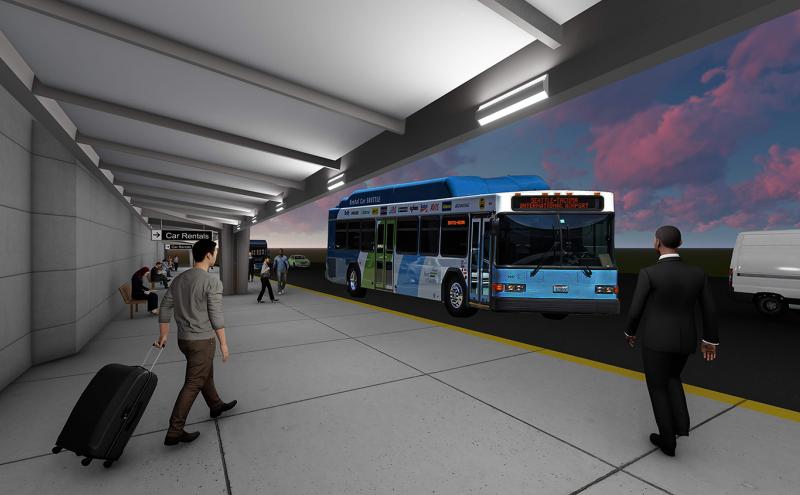
Sea-Tac Airport Arrivals Bus Canopy Expansion Rendering (January 2021)
A rendered illustration of the Seattle-Tacoma International Airport ground transportation area, showing a blue transit bus with a destination sign reading 'Seattle-Tacoma International Airport' and a 'Car Rentals' directional sign. The scene depicts passengers with luggage at a covered bus platform, consistent with a planning or noise-policy document related to Sea-Tac Airport facilities. -
 2020-11-18
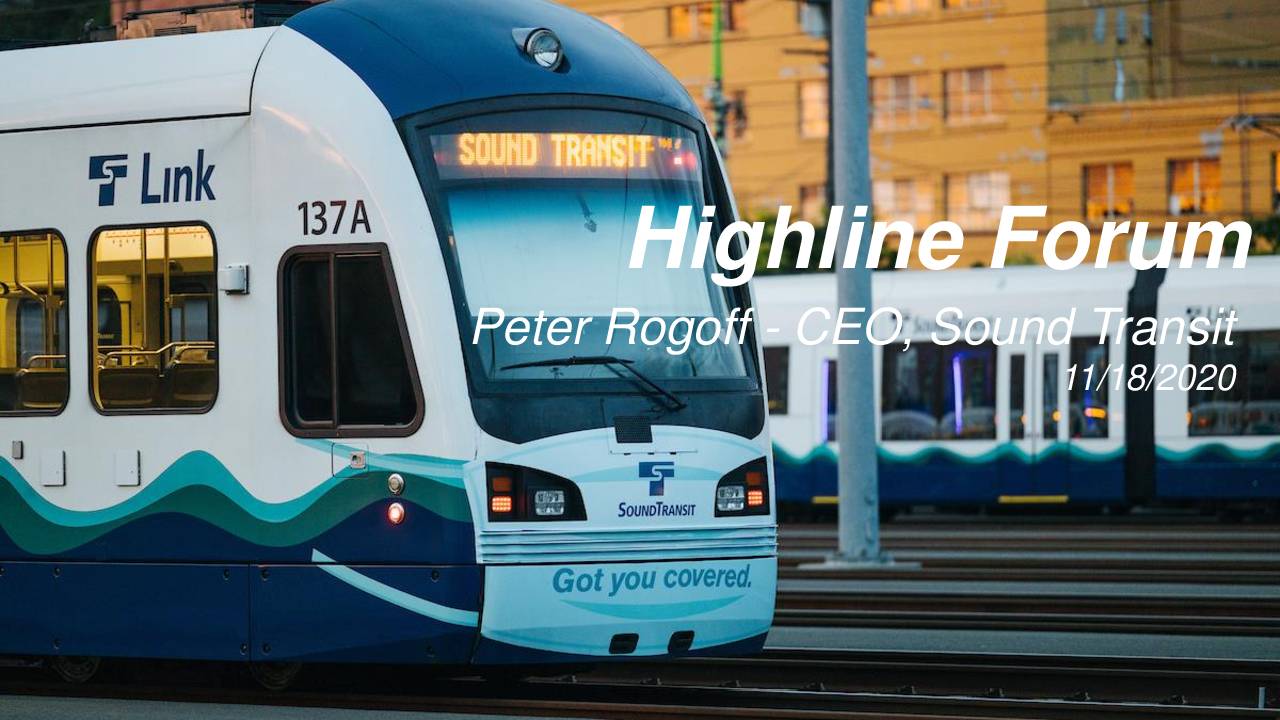
Highline Forum: Sound Transit Presentation by CEO Peter Rogoff
Sound Transit CEO Peter Rogoff presented to the Highline Forum in November 2020, outlining multiple light rail extensions under construction across the greater Seattle region. A key highlight for the Sea-Tac area is the Federal Way Link Extension, a 7.8-mile line with three new stations scheduled to open in 2024, which will connect the Federal Way Transit Center to Seattle-Tacoma International Airport in approximately 15 minutes. -
 2020-05-29
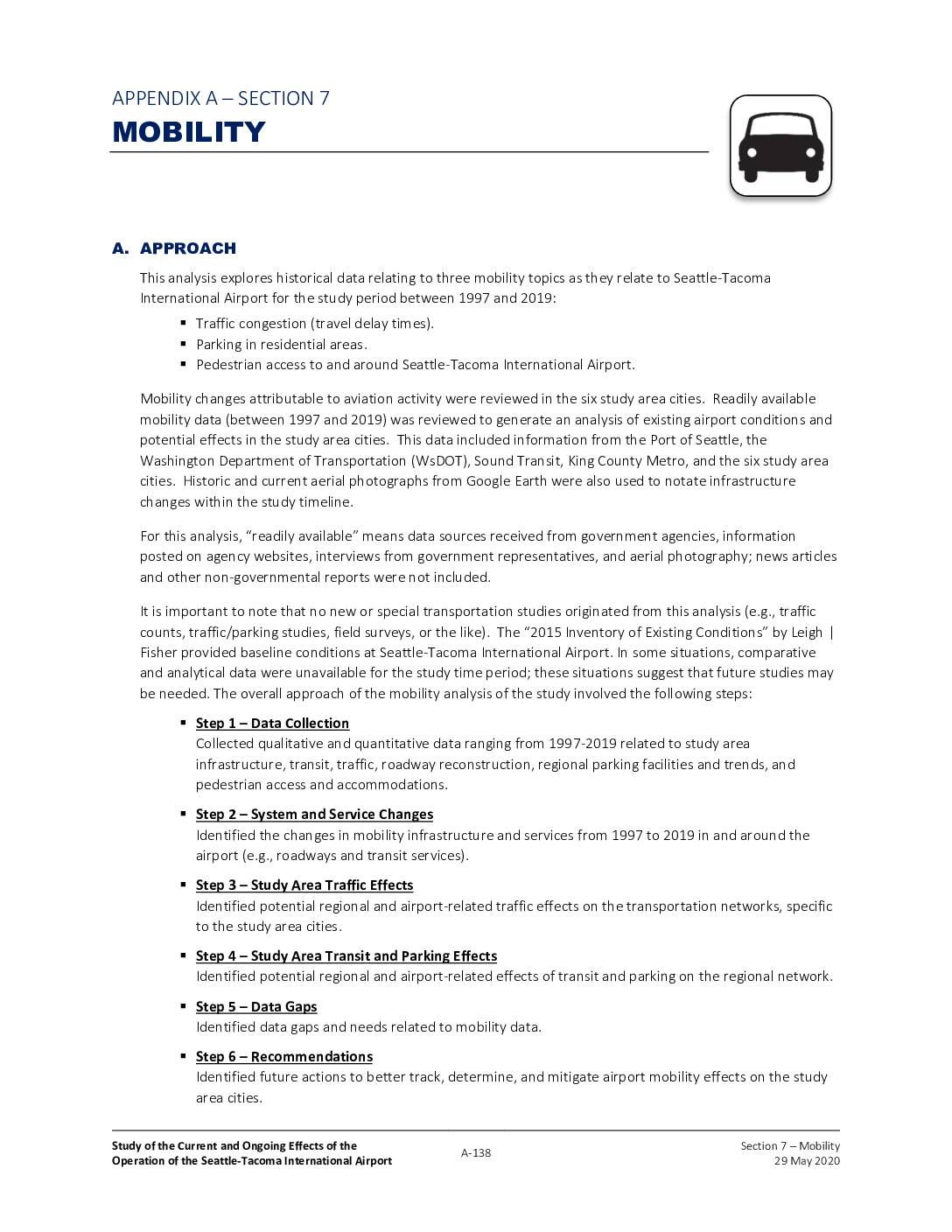
Sea-Tac Airport Communities Impact Study: Appendix A, Section 7 – Mobility
This 2020 report examines how Seattle-Tacoma International Airport has affected mobility in surrounding communities between 1997 and 2019, focusing on traffic congestion, residential parking, and pedestrian access. It documents major infrastructure changes such as the 2010 consolidation of rental car facilities to an off-site location 1.5 miles from the terminal and the expansion of the main parking garage from 10,000 to roughly 13,000 spaces. The analysis draws on data from government agencies including the Port of Seattle, WsDOT, Sound Transit, and King County Metro to identify transportation impacts and recommend future tracking measures. -
 2020-05-01
SR 518 Corridor Planning Study
The SR 518 Corridor Planning Study, published by the Washington State Department of Transportation (WSDOT) in May 2020, examines the stretch of State Route 518 running from SR 509 to Interstate 5 (milepost 0.00 to 3.42) in the Seattle area near Sea-Tac Airport. The study was conducted by WSDOT's Management of Mobility Division to evaluate transportation conditions and identify potential improvements along this key corridor. It was formally approved by WSDOT leadership in November 2019 and includes standard civil rights and accessibility notices in both English and Spanish. -
2020-05-01
SR 518 Corridor Planning Study
The SR 518 Corridor Planning Study, published by the Washington State Department of Transportation (WSDOT) in May 2020, examines the stretch of State Route 518 running from SR 509 to Interstate 5 (milepost 0.00 to 3.42) in the Seattle area near Sea-Tac Airport. The study was conducted by WSDOT's Management of Mobility Division to evaluate transportation conditions and identify potential improvements along this key corridor. It was formally approved by WSDOT leadership in November 2019 and includes standard civil rights and accessibility notices in both English and Spanish. -
 2020-01-22
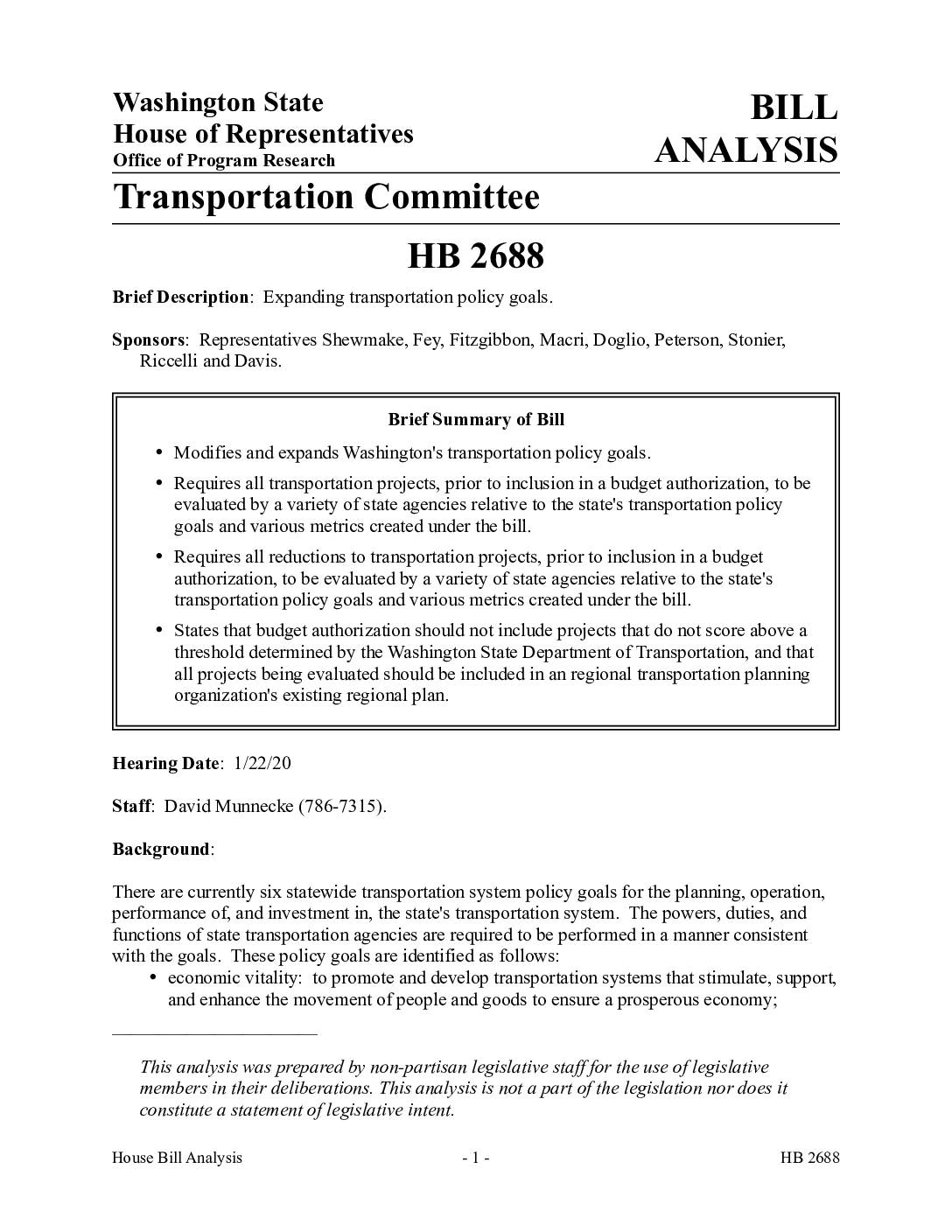
HB 2688 bill analysis: Expanding transportation policy goals
Washington State House Bill 2688 proposes expanding and modifying the state's transportation policy goals by adding new priorities such as accessibility, health and resilience, and equity and environmental justice, while removing existing goals like mobility and stewardship. The bill would require all transportation projects to be evaluated against these updated goals and specific metrics before receiving budget authorization, with projects failing to meet a minimum score threshold being excluded from funding. The evaluation process would involve multiple state agencies and must include public input from vulnerable and highly impacted communities. -
 2020-01-17
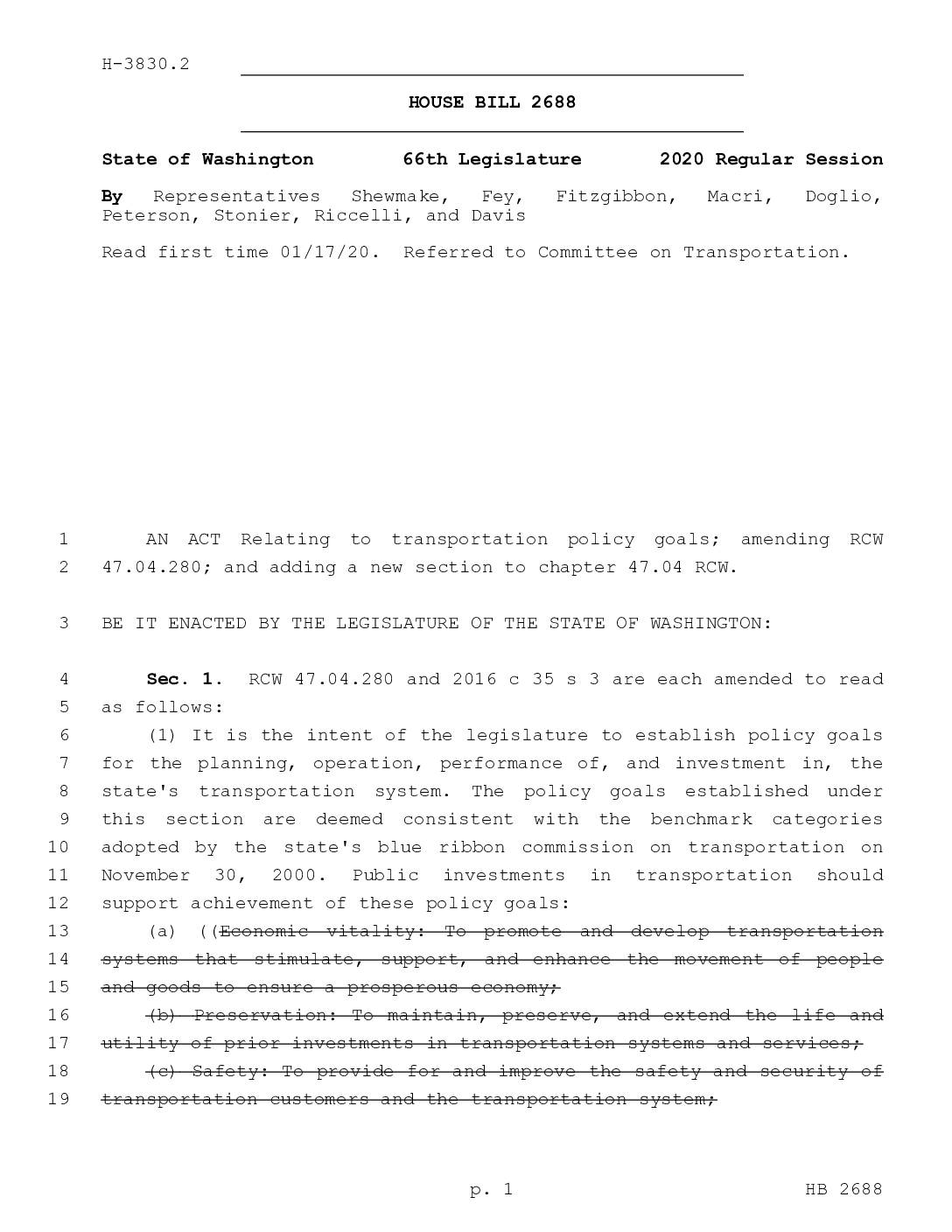
House Bill 2688: Relating to transportation policy goals
Washington House Bill 2688, introduced in the 2020 legislative session, proposes updating the state's transportation policy goals to prioritize accessibility, environmental justice, public health, and climate by replacing older goals focused primarily on economic vitality and mobility. The bill would require transportation projects to undergo a multi-agency evaluation—including input from vulnerable and impacted communities—before receiving budget authorization. Projects that do not meet a minimum score based on the new policy goals would generally be excluded from funding.