TagNoise Mitigation(218)
-
 2002-10-21
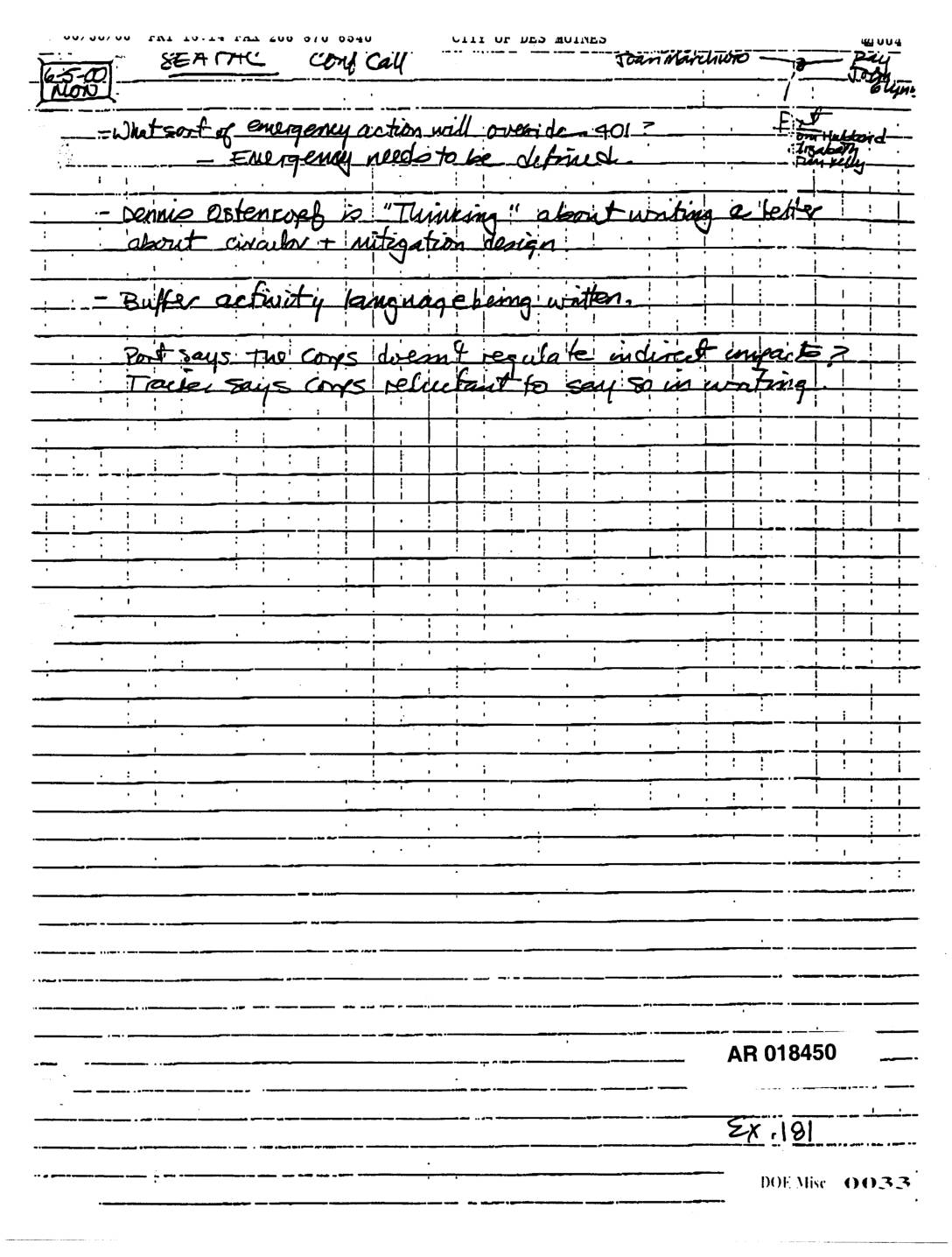
EXH AR018450: Handwritten Conference Call Notes — Seattle and Des Moines, Army Corps Indirect Impacts and Mitigation
AR 018450 (DOE Misc 0033, Exhibit 191). Handwritten notes from a conference call between Seattle and City of Des Moines discussing what emergency action will override Section 401, Army Corps of Engineers regulation of indirect impacts, buffer activity language, and mitigation design. Dennis Ostencorp referenced as thinking about writing a letter on circular and mitigation -
 2002-06-03
Record of approval: Federal Aviation Regulation Part 150 noise compatibility program, Seattle-Tacoma International Airport, Seattle, Washington
This document is the FAR Part 150 Noise Compatibility Program Study Update for Seattle-Tacoma International Airport (Sea-Tac), approved by the FAA in June 2002. It outlines a series of measures aimed at reducing aircraft noise, including establishing a public oversight committee, exploring noise barriers and ground run-up enclosures, and encouraging the voluntary phase-out of older, louder Stage 2 jet aircraft. The FAA approved some measures outright, while others—such as revised maintenance run-up regulations and the voluntary aircraft phase-out—were disapproved pending submission of additional supporting information. -
 2001-06-22
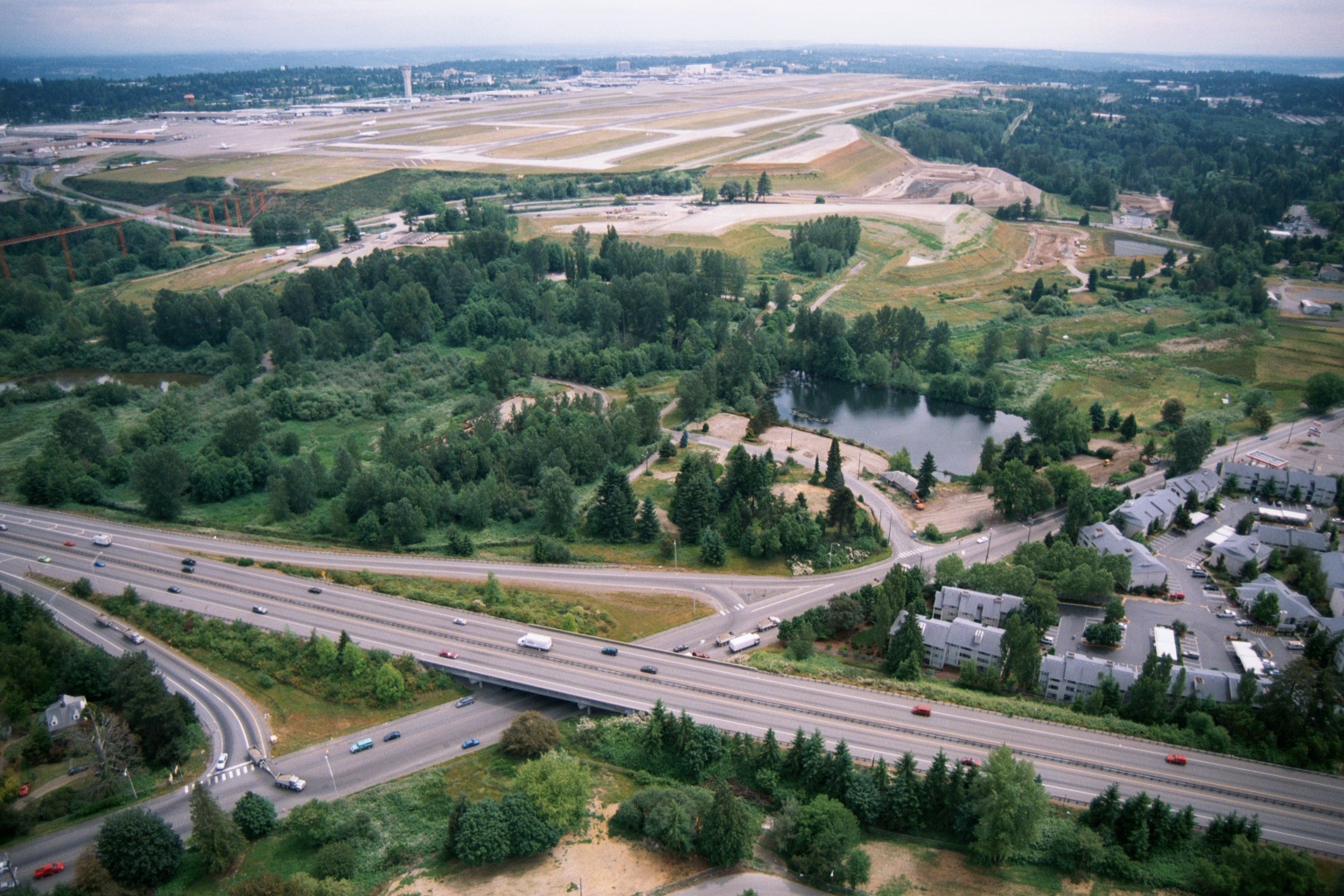
Aerial View of Sea-Tac Airport Runways with Adjacent Residential Development and Highway Interchange
Aerial photograph showing Sea-Tac Airport runways and taxiways in the background, with a forested noise buffer area, a retention pond, and a multi-lane highway interchange in the foreground. Residential apartment buildings are visible to the right, illustrating the proximity of the airport to surrounding communities relevant to noise-policy planning. -
 2001-06-22
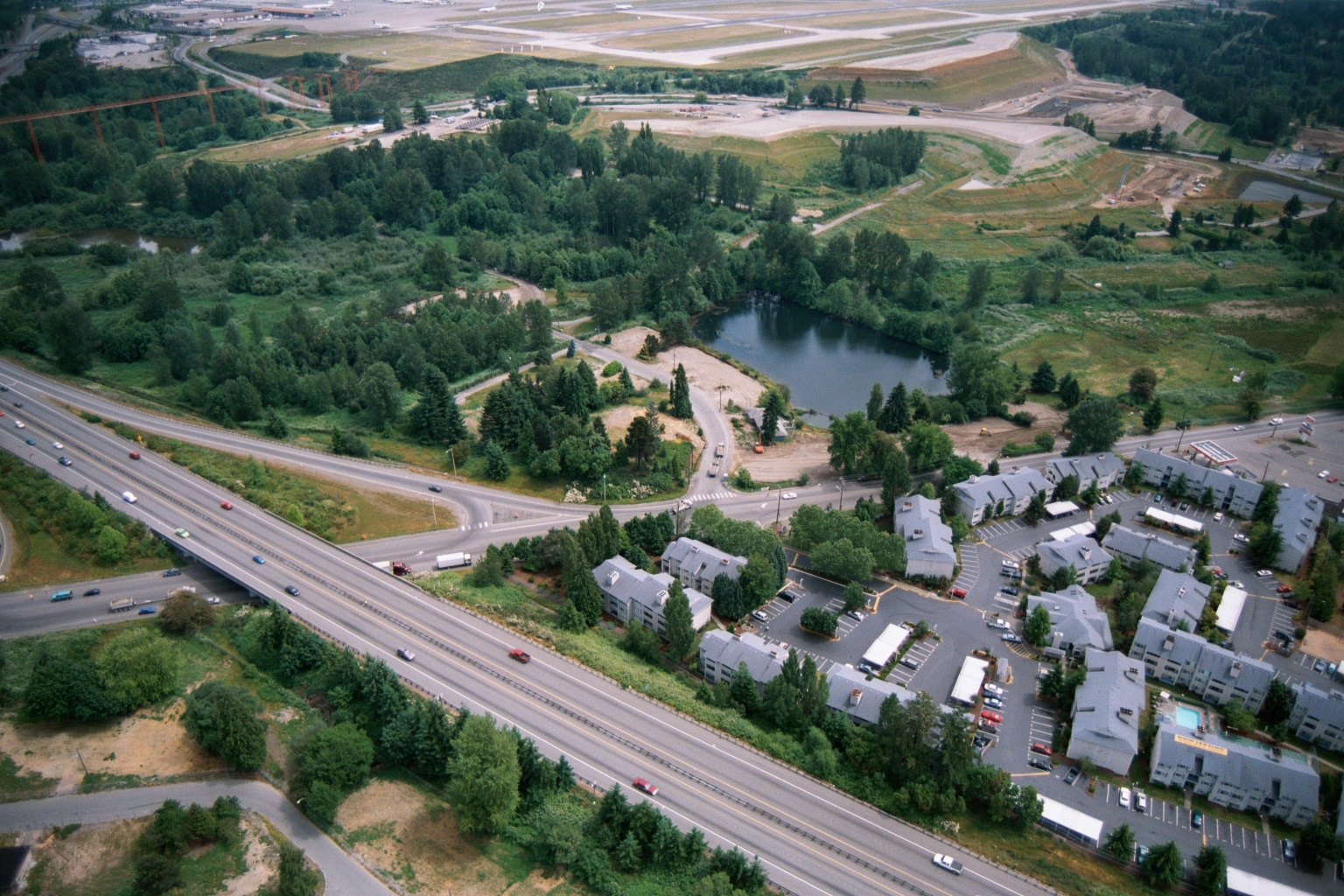
Aerial View of Highway Interchange, Residential Complex, and Sea-Tac Airport Runway Infrastructure
Aerial photograph showing a multi-lane highway interchange (likely I-5 or SR-99 corridor near Sea-Tac Airport) with a residential apartment complex, a small retention pond, dense tree buffers, and what appears to be airport runway infrastructure visible in the upper background. No visible text, watermarks, or captions are present in the image. -
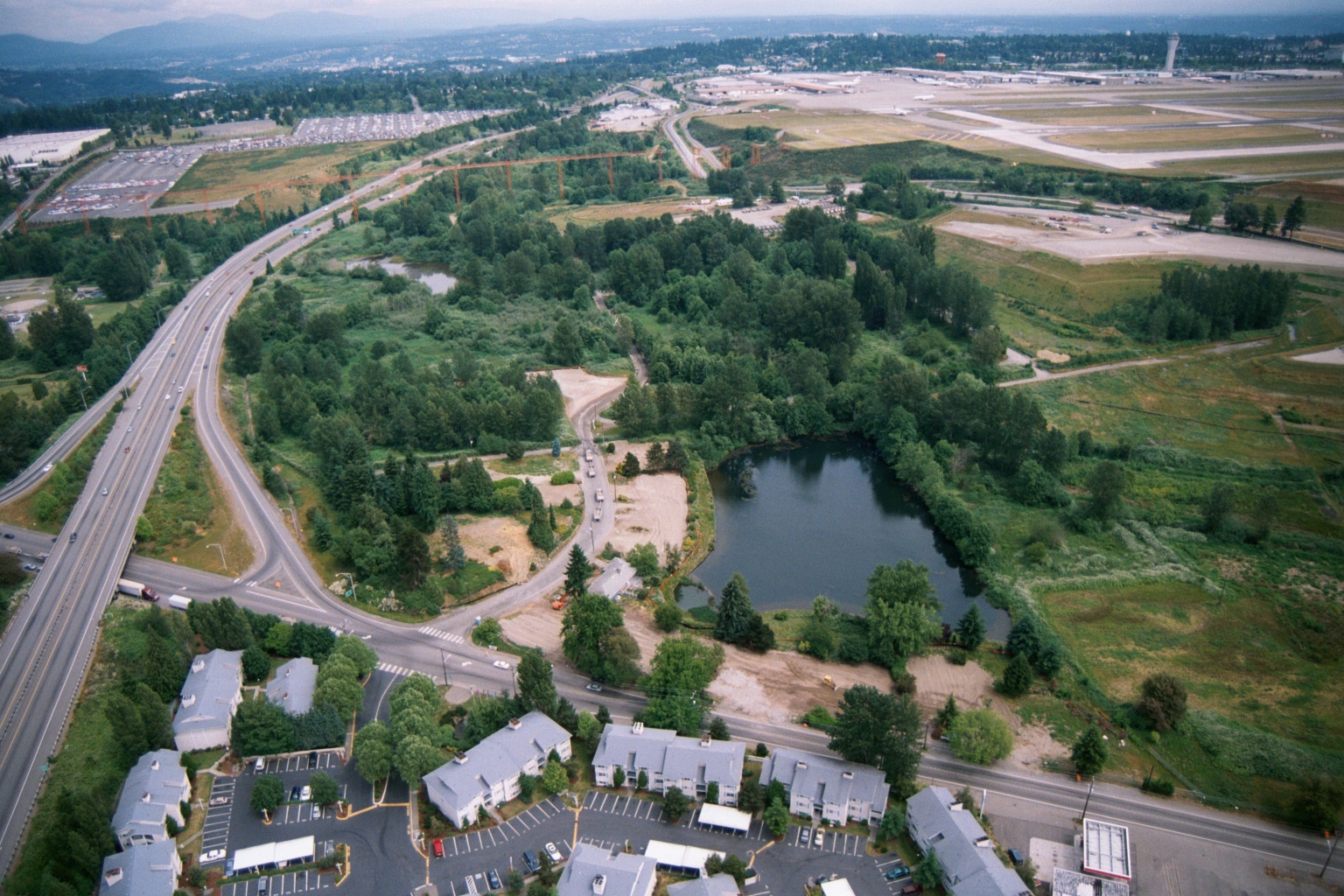 2001-06-22
Aerial View of Sea-Tac Airport Runway Area and Surrounding Residential Development
Aerial photograph looking north toward Seattle-Tacoma International Airport (Sea-Tac), showing the airport's runways and tarmac in the upper right, a curved highway interchange (likely SR-99 or I-5 corridor area), a retention pond surrounded by green space, and apartment complexes in the foreground. The image appears to document land use and development patterns in the airport noise-impact zone, likely in the SeaTac/Tukwila area of Washington State. -
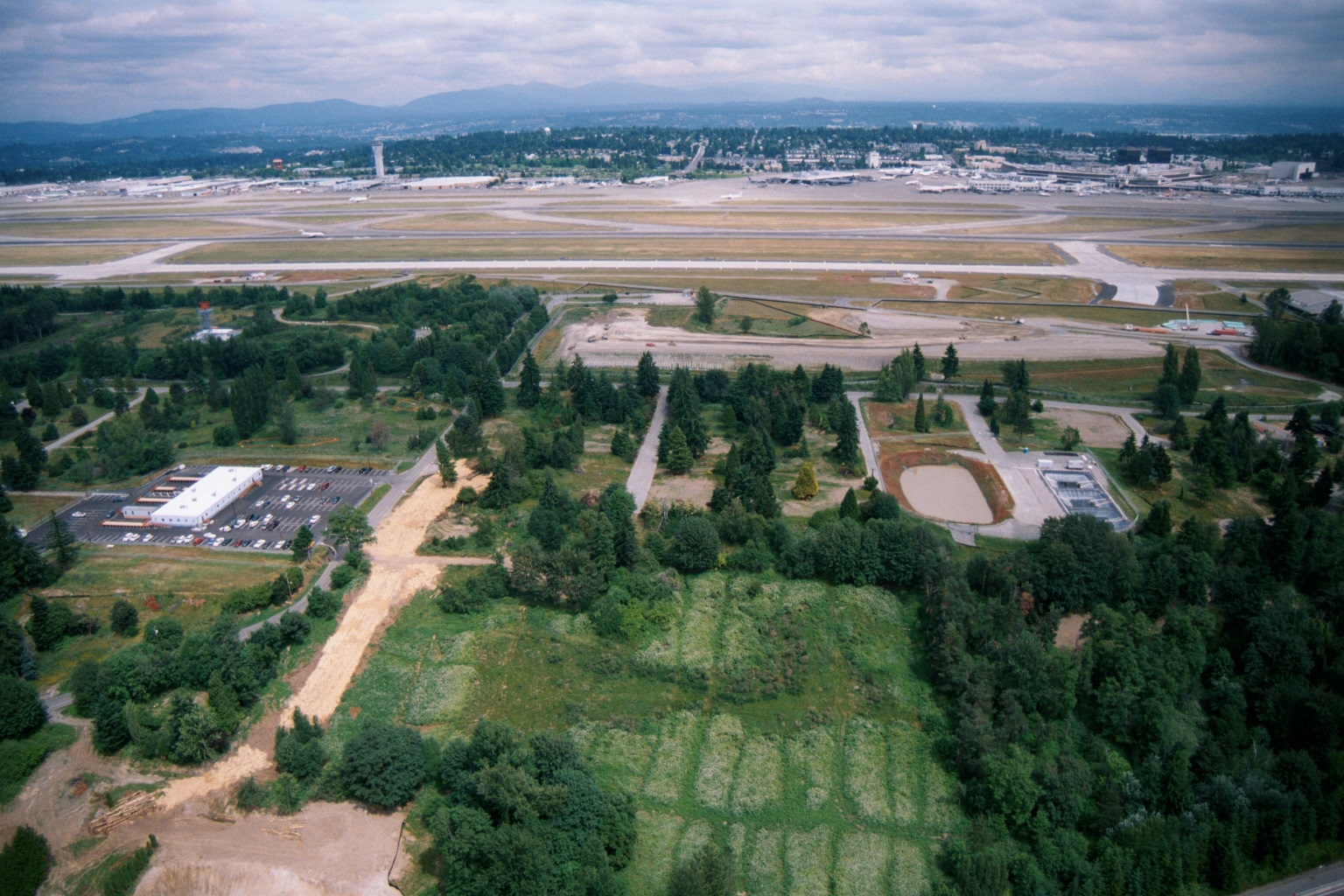 2001-06-22
Aerial View Looking North Over Sea-Tac Airport Runway System and Adjacent Land
An aerial photograph looking northward over Sea-Tac Airport, showing the airport's runway system, taxiways, control tower, and terminal area in the background. The foreground shows undeveloped and partially developed land adjacent to the airport, including a small commercial or administrative building with a parking lot, cleared gravel paths, and vegetated buffers, consistent with airport noise-mitigation or land-use planning activities. -
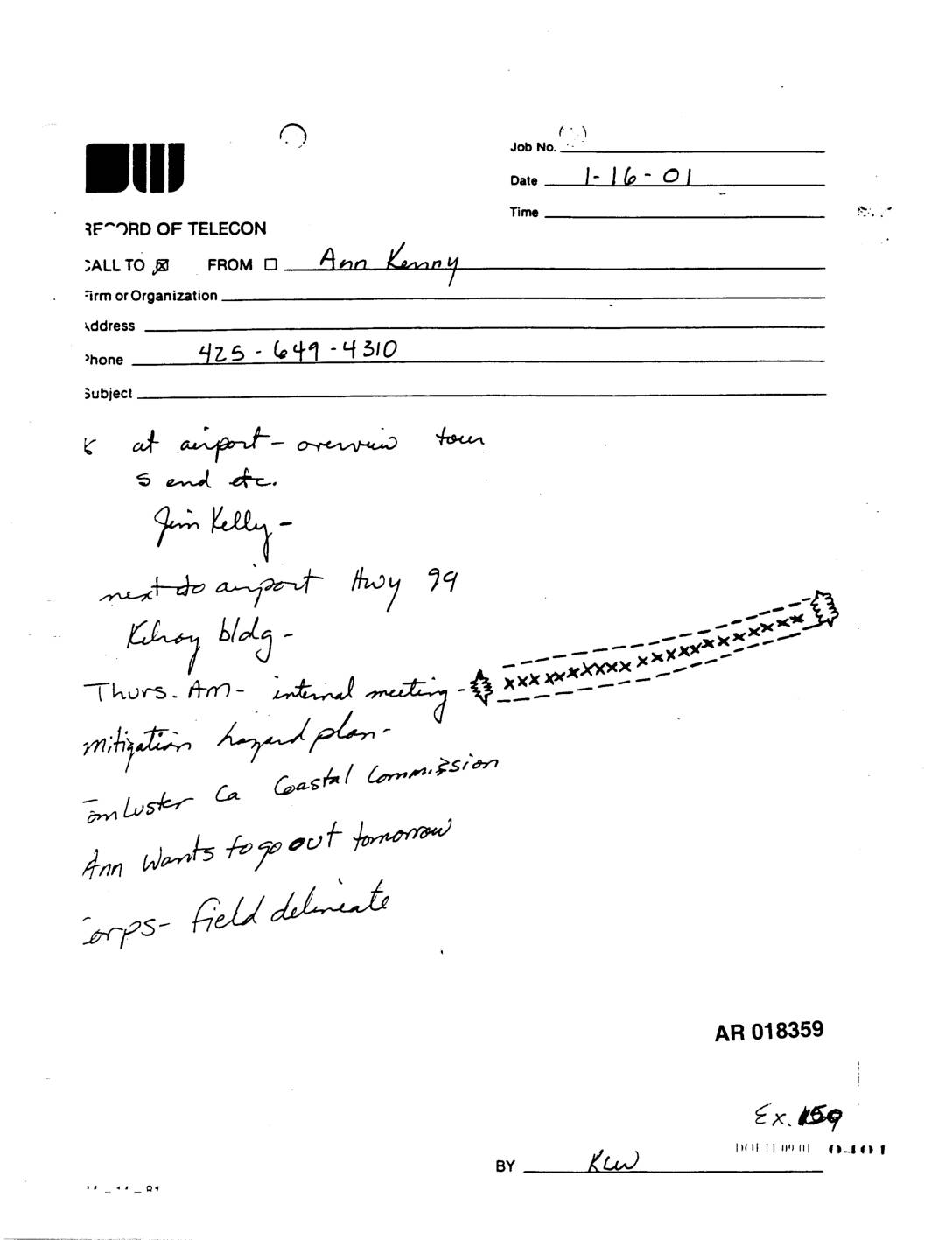 2001-01-16
Exhibit 159: Record of Telecon — Ann Kenny, Airport Overview Tour and Internal Meeting Notes
Record of telecon dated 1-16-01, call from Ann Kenny (phone 425-649-4310) regarding airport overview tour, field delineation by Corps of Engineers, Jim Kelly, Kilroy building next to airport on Hwy 99, Thursday AM internal meeting, mitigation hazard plan, and California Coastal Commission. Ann wants to go out tomorrow for Corps field delineation. AR 018359, Exhibit -
 1998-12-28
Airport Improvement Program: FAA complying with requirement for local involvement in noise mitigation projects
A 1998 U.S. General Accounting Office report examined whether the FAA was required to enforce a policy mandating written declarations of local support before awarding noise mitigation grants to Seattle-Tacoma International Airport. The report found that while FAA policy called for such written declarations from affected cities and counties, neither federal law nor FAA regulations legally required them. FAA officials maintained they still met the broader statutory requirement of ensuring noise mitigation projects were consistent with local plans. -
 1998-01-01
MAC Part 150 Residential Sound Insulation Program: 1992–1997 Completion & Funding Summary
The MAC Part 150 Residential Sound Insulation Program completed sound insulation work on 3,673 homes near Minneapolis-St. Paul International Airport between 1992 and 1997, at a total cost of $76.6 million. Funding came from two sources: $28.7 million in FAA Airport Improvement Program (AIP) grants and $48.6 million in MSP Passenger Facility Charges (PFC). The program grew significantly over its six-year run, peaking in 1996 with 1,002 homes insulated at a cost of $20.7 million. -
 1997-07-01
Property Acquisition Financial Feasibility Study
This 1997 Puget Sound Regional Council study examines the financial feasibility of acquiring and redeveloping properties negatively affected by major regional transportation facilities, including Sea-Tac International Airport, the Auburn Rail Yard, and a proposed Everett HOV facility. It evaluates potential funding mechanisms—such as a state-financed revolving fund or public/private partnerships—to convert noise-impacted land within the 65–75 DNL noise contours to compatible non-residential uses. The study covers roughly 100 acres across three case-study areas and was initiated under Regional Council Resolution A-96-02 adopted in July 1996.