TagMiller Creek(252)
-
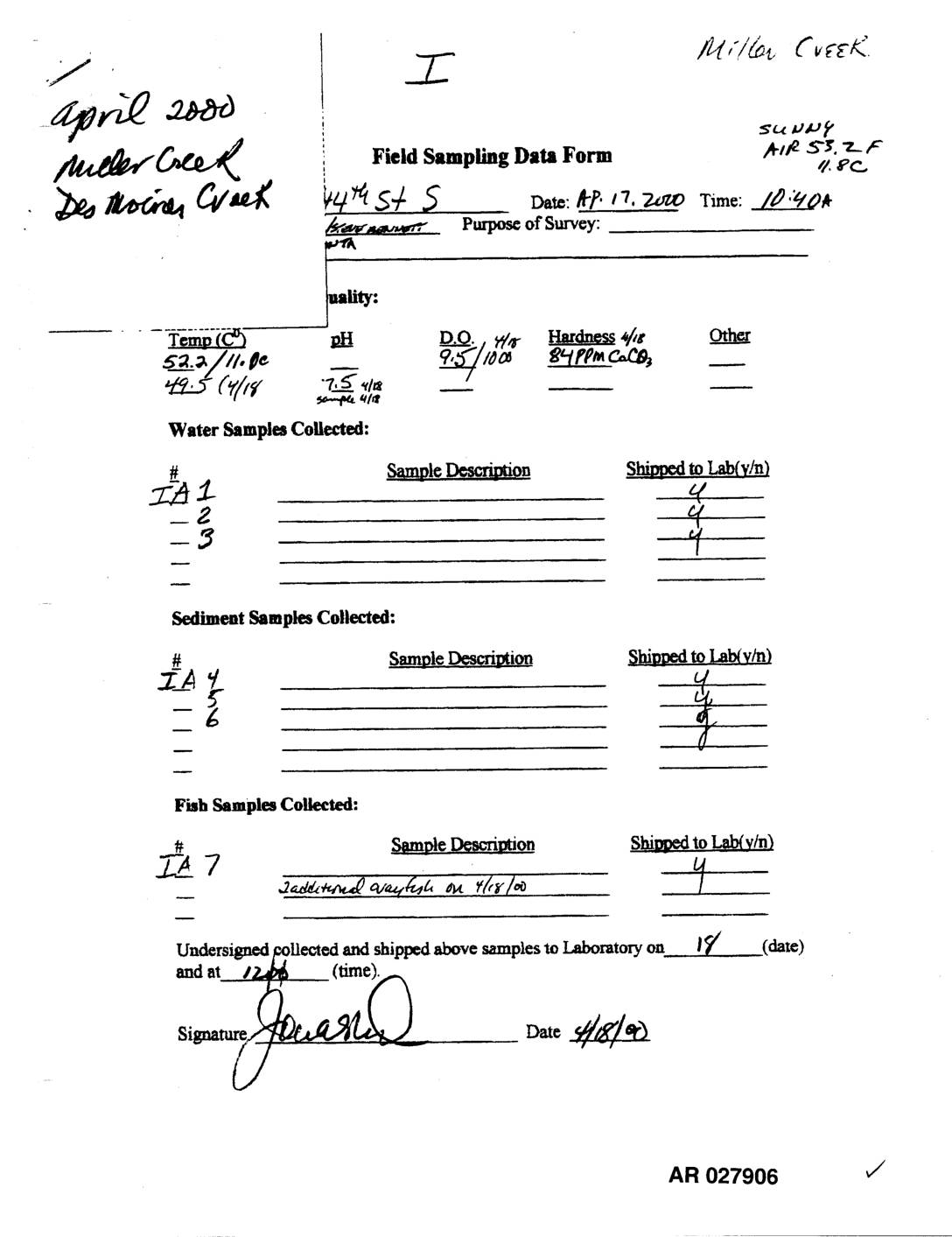 2000-04-17
EXH AR027906: Field Sampling Data Forms — Miller Creek / Des Moines Creek Survey, April 2000
Field Sampling Data Forms (AR 027906–027908) documenting environmental sampling at Miller Creek and Des Moines Creek survey sites including 144th St S and S 157th Pl, dated April 17, 2000. Water quality measurements recorded: temperature 53.2°F/11.0°C and 49.5°C (4/19), pH 7.5, dissolved oxygen 9.5/100, hardness 84 PPM CaCO3 (site IA) and 120 ppm (site IB). -
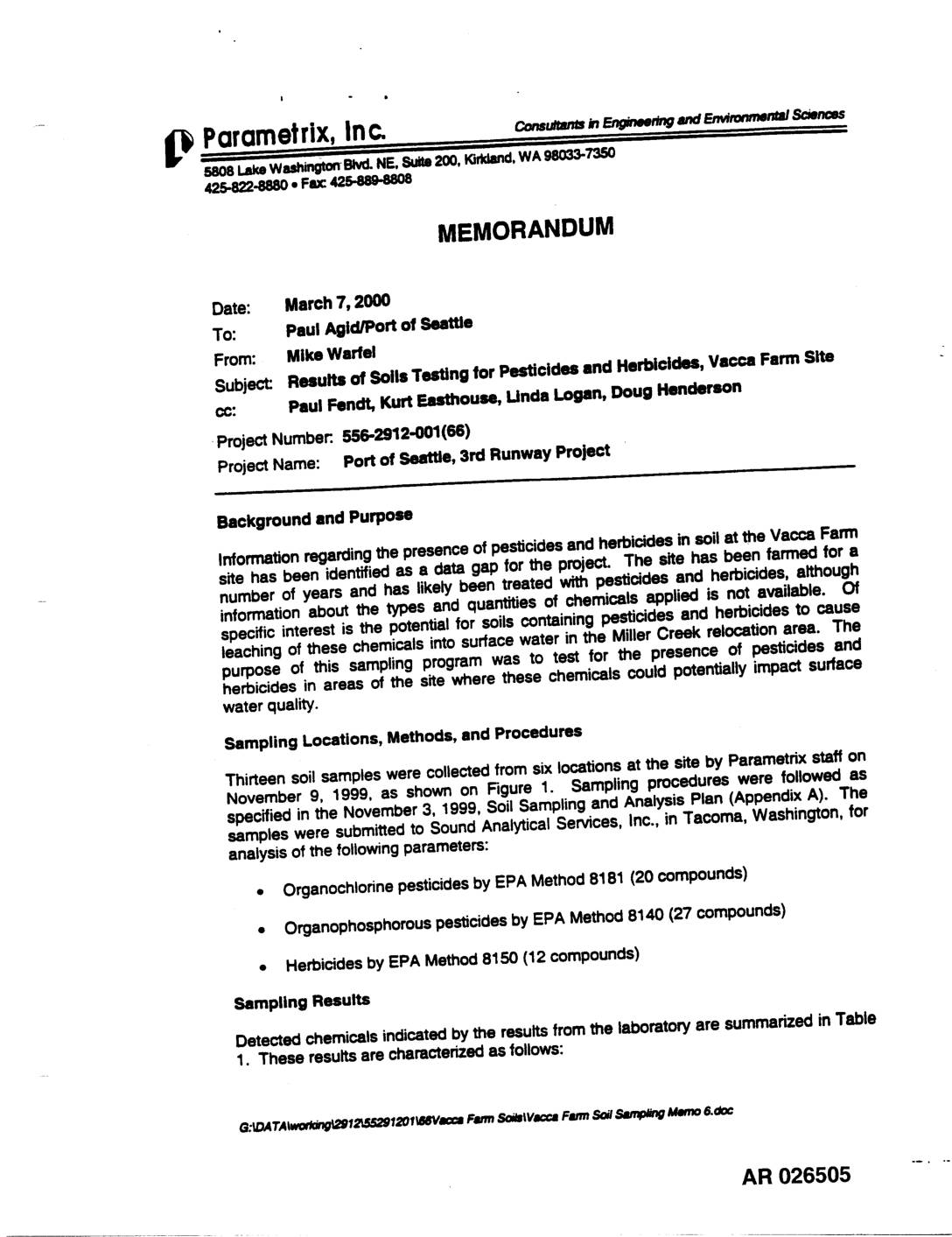 2000-03-07
EXH AR026505: Memo — Soils Testing Results, Pesticides & Herbicides, Vacca Farm Site
A March 2000 Parametrix memorandum reports the results of pesticide and herbicide soil testing at the Vacca Farm site, part of the Port of Seattle's Third Runway Project. Of 59 compounds tested, only 12 were detected, primarily organochlorine pesticides, with Dieldrin slightly exceeding cleanup levels in shallow soil samples at two locations in the proposed floodplain area. The memo recommends removing the upper six inches of soil from the floodplain area for offsite disposal, while concluding that the proposed Miller Creek relocation corridor does not pose unacceptable risks to human health. -
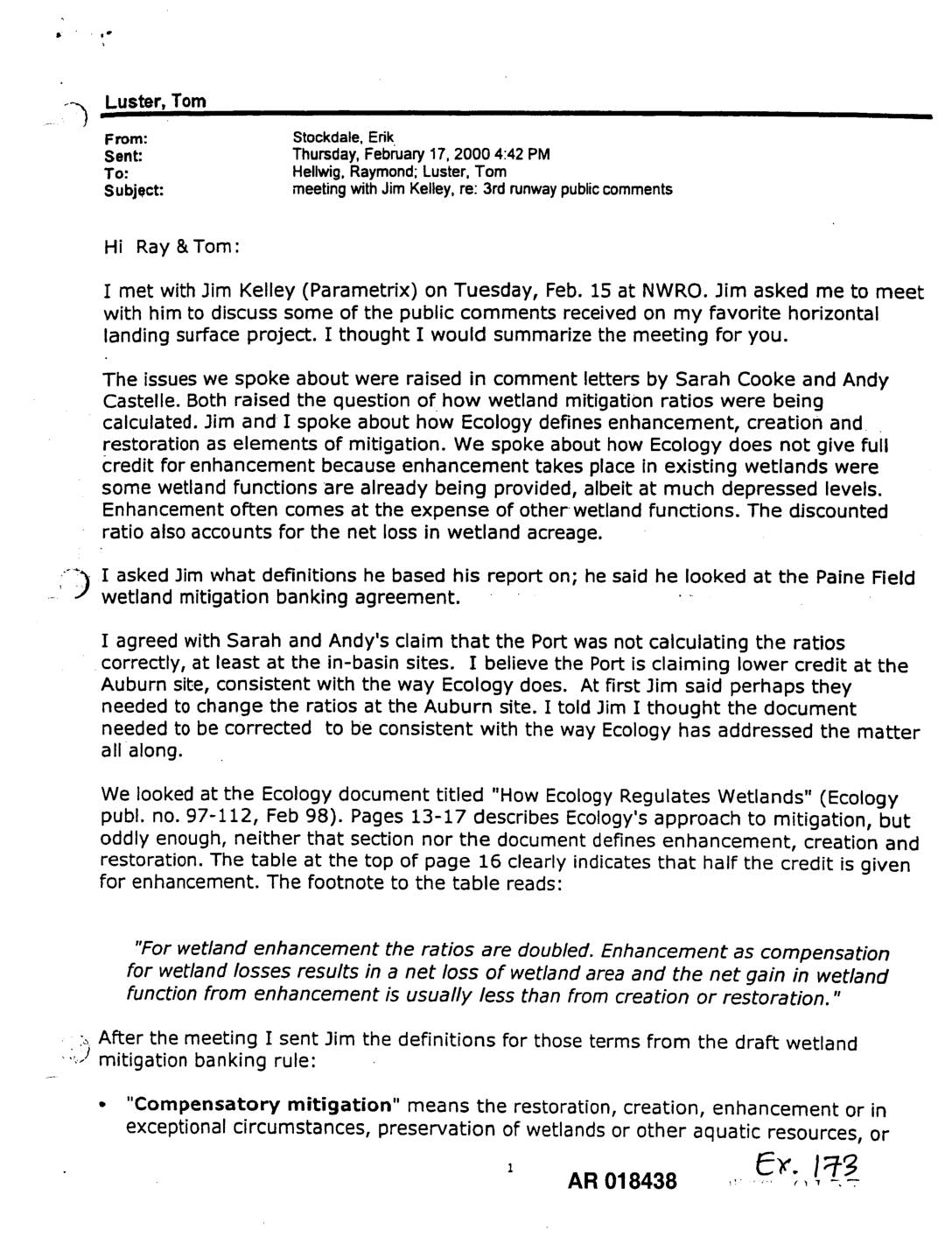 2000-02-17
Exhibit 173: Email — Meeting with Jim Kelley (Parametrix) Re Third Runway Public Comments on Wetland Mitigation Ratios
Email from Erik Stockdale (Ecology NWRO) to Raymond Hellwig and Tom Luster, dated February 17, 2000, summarizing a February 15 meeting with Jim Kelley of Parametrix regarding public comments on the Sea-Tac Airport third runway project (AR 018438–018440, Exhibit 173). Issues raised by commenters Sarah Cooke and Andy Castelle concerned incorrect wetland mitigation ratio calculations -
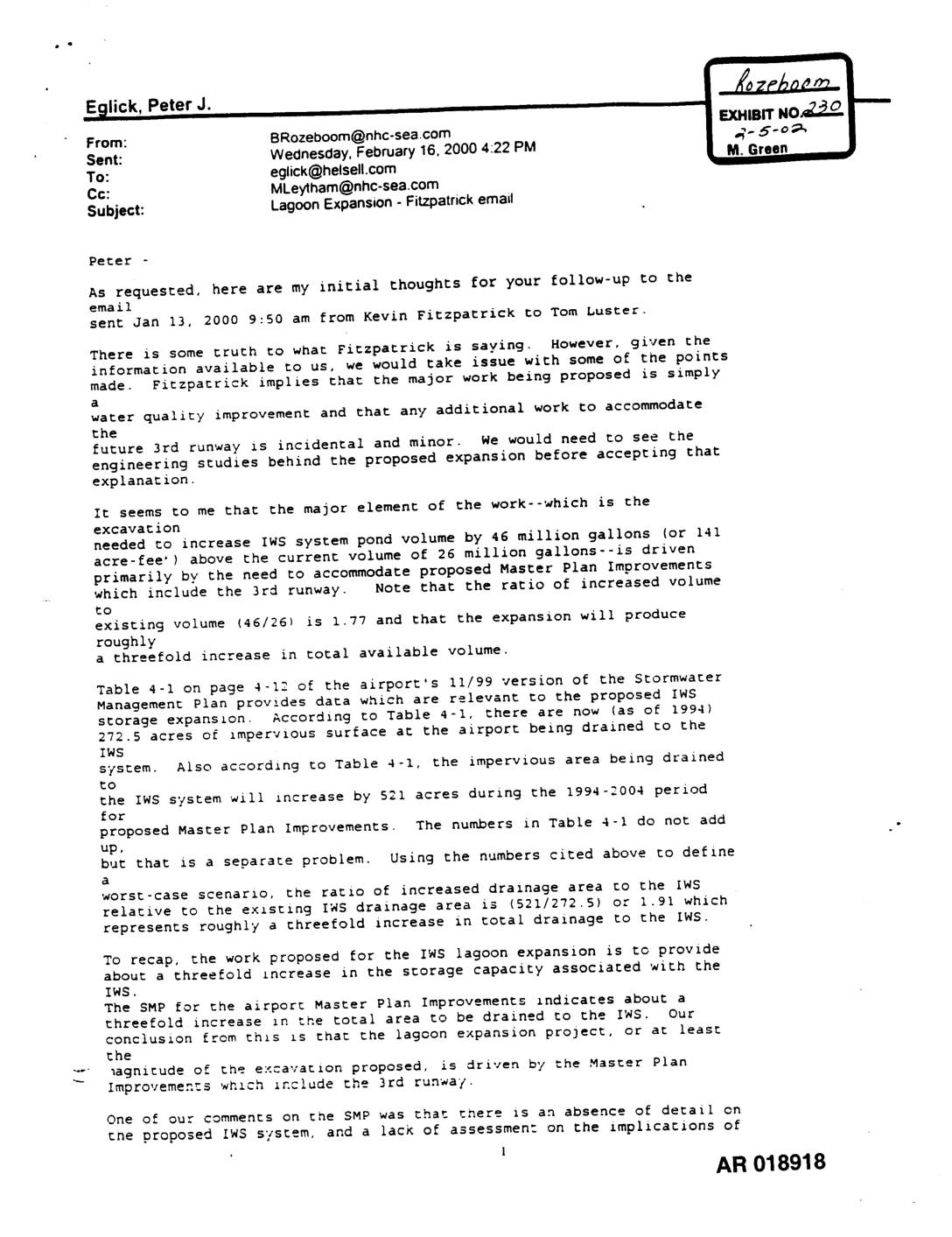 2000-02-16
Exhibit 230: Email from Bill Rozeboom (Northwest Hydraulic Consultants) to Peter Eglick Re: IWS Lagoon Expansion and Fitzpatrick Email Analysis
A February 2000 email from hydraulic consultant Bill Rozeboom argues that the proposed expansion of Sea-Tac Airport's Integrated Wetlands System (IWS) lagoon—tripling its storage capacity—is primarily driven by the airport's Master Plan Improvements, including the proposed third runway, rather than being a routine water quality project. Rozeboom notes that the planned increase in impervious drainage area (roughly 521 additional acres) closely mirrors the proposed increase in IWS storage volume, supporting his conclusion that the third runway is the primary driver of the expansion. He also raises concerns that the environmental documents fail to adequately assess the impact of large-scale out-of-basin water transfers on aquifer recharge and stream base flows in the Miller Creek and Des Moines Creek basins. -
 1999-12-17
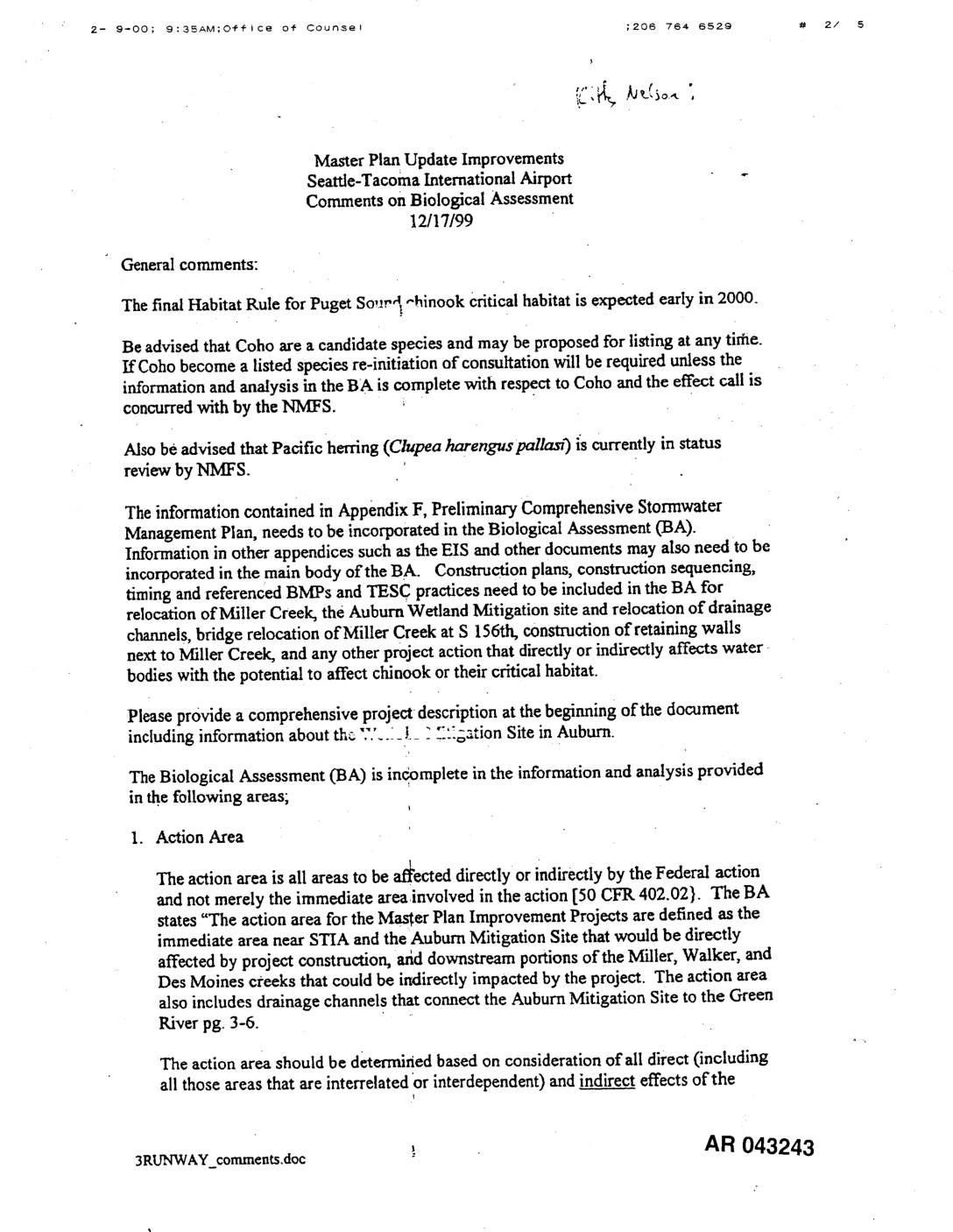
EXH AR043243: NMFS Comments on Biological Assessment for Sea-Tac Airport Master Plan Update Improvements
NMFS (National Marine Fisheries Service) Office of Counsel comments dated 12/17/99 on the Biological Assessment (BA) for Seattle-Tacoma International Airport Master Plan Update Improvements. AR 043243. Comments identify deficiencies in action area definition (50 CFR 402.02), matrix/checklist completeness, direct and indirect effects analysis, and cumulative effects regarding Puget Sound Chinook salmon critical habitat, Coho salmon, -
 1999-12-13
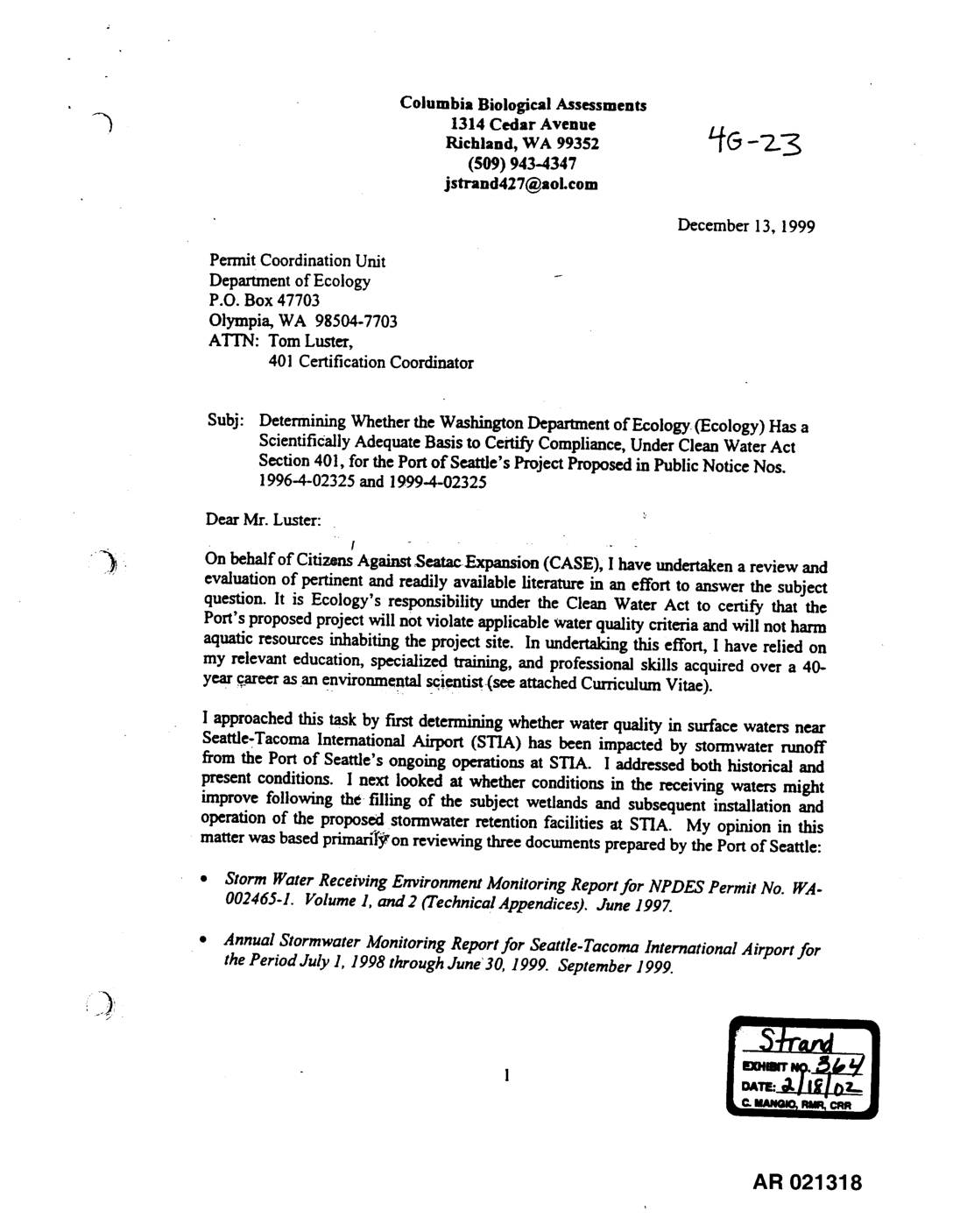
EXH 364: Letter Columbia Biological Assessments to Ecology CWA §401 Certification STIA Third Runway
A December 1999 environmental assessment prepared for Citizens Against Seatac Expansion (CASE) concludes that the Port of Seattle failed to provide sufficient scientific evidence to assure compliance with Clean Water Act water quality standards for its Seattle-Tacoma International Airport expansion project. The report found that stormwater runoff from the airport was causing ongoing violations of toxic substances criteria — particularly for copper and zinc — in nearby Miller and Des Moines Creeks, with pollutant levels sometimes exceeding EPA limits by more than tenfold. The author argues that Ecology therefore lacked a scientifically defensible basis to issue a Section 401 water quality certification for the proposed wetland-filling and stormwater management improvements. -
 1999-11-24
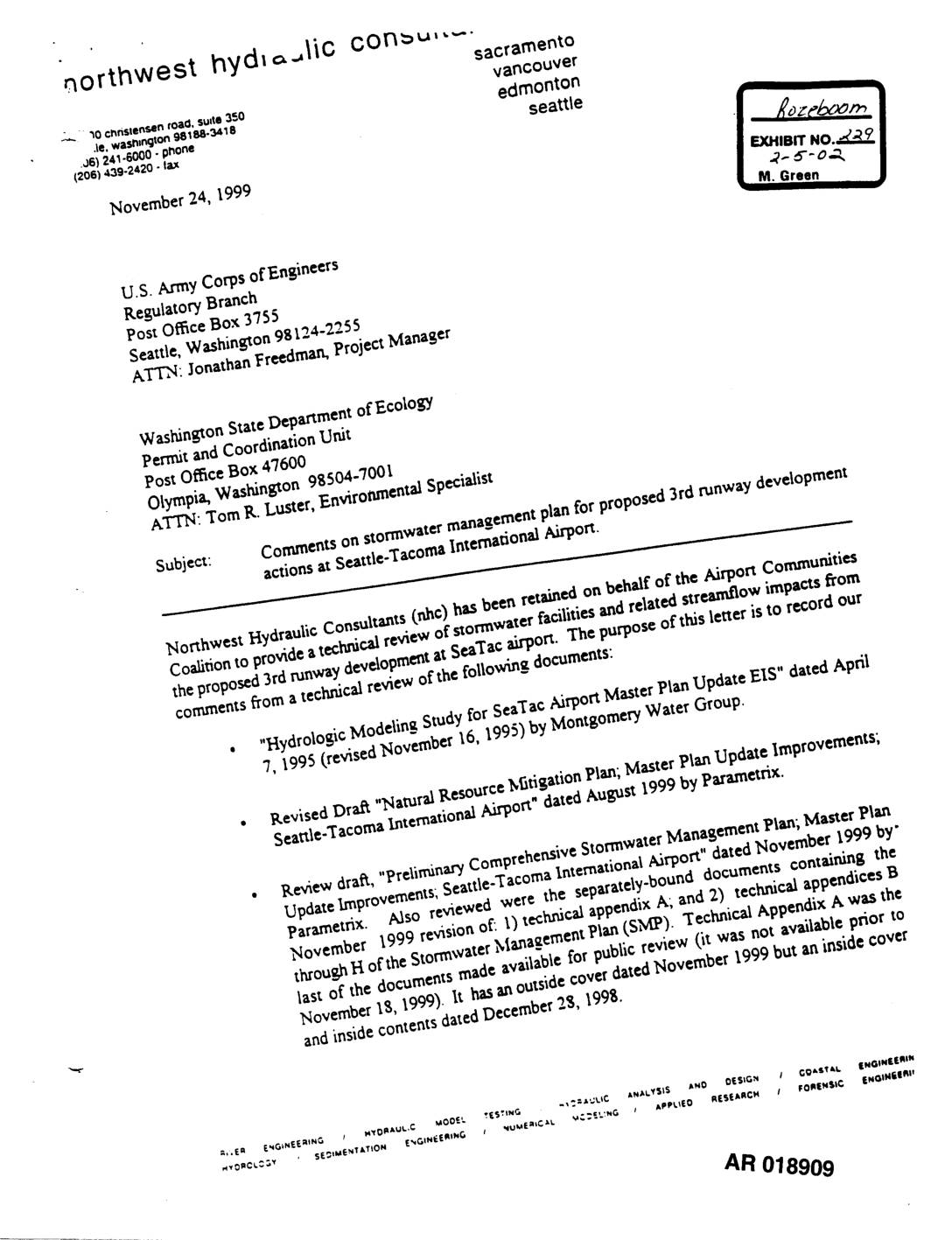
Exhibit 229: NHC Letter to U.S. Army Corps of Engineers and Ecology — Technical Comments on Stormwater Management Plan for Proposed Third Runway at Sea-Tac Airport
A November 1999 technical letter from Northwest Hydraulic Consultants, submitted on behalf of the Airport Communities Coalition, identifies major deficiencies in the proposed stormwater management plan for Seattle-Tacoma International Airport's 3rd runway development. The review finds that the plan fails to comply with the 1998 King County Surface Water Design Manual and Washington State Department of Ecology guidelines, including requirements for large-site drainage reviews, offsite analysis, and flow control. The consultants warn that if the plan is approved as written, it could cause significant adverse impacts to downstream creek systems, including Miller Creek and Des Moines Creek. -
 1999-08-18
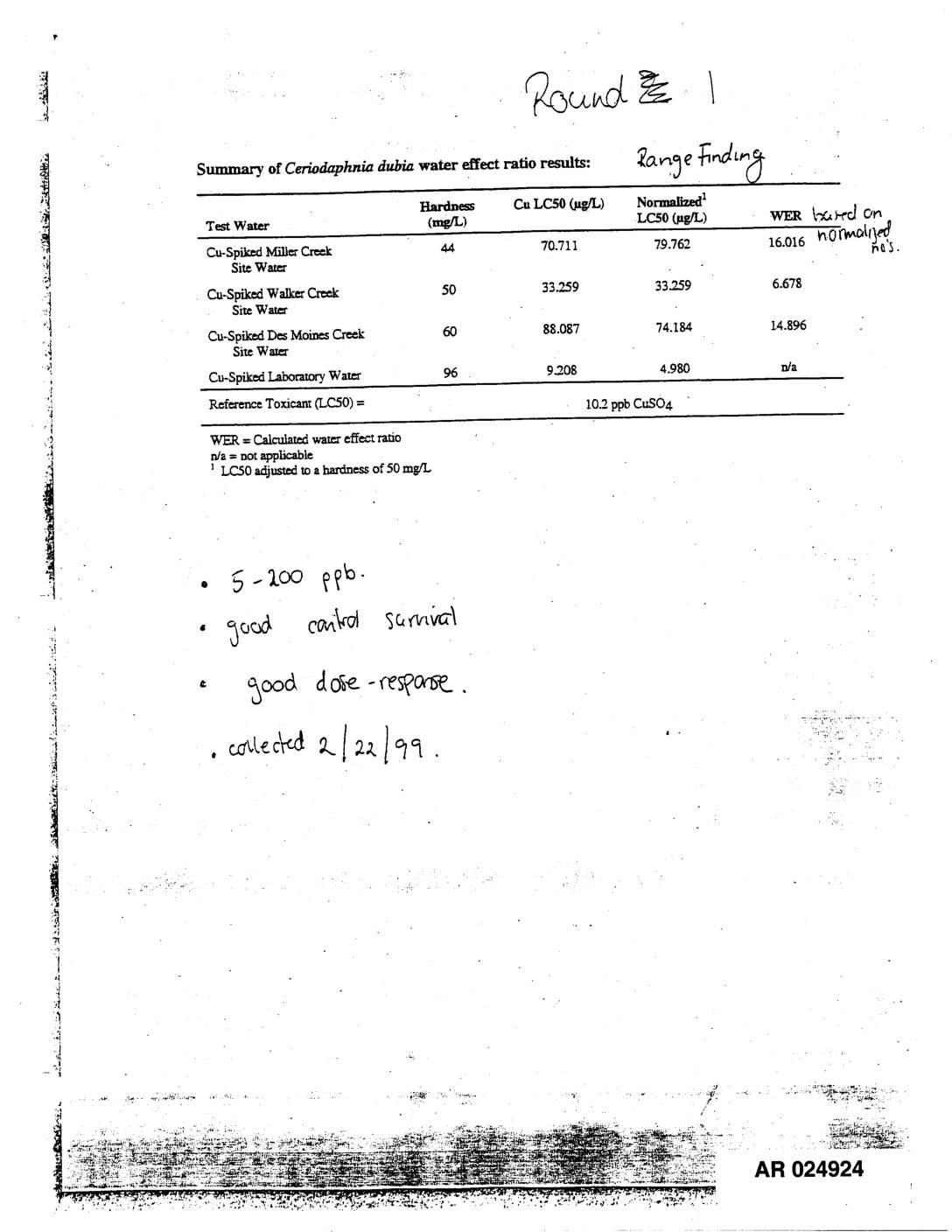
EXH AR024924: Draft Memo — Range-Finding Water-Effect Ratio Results, Ceriodaphnia dubia, STIA Third Runway WER Study
This draft memorandum from Parametrix (dated April 20, 1999) summarizes range-finding toxicity tests conducted as part of a water-effect ratio (WER) study examining copper levels in streams receiving stormwater runoff from Seattle-Tacoma International Airport (STIA). Water samples were collected from Miller Creek, Walker Creek, and Des Moines Creek during a storm event in February 1999 and tested using the organism Ceriodaphnia dubia to measure copper toxicity. Results showed water effect ratios ranging from 6.7 to 16.0, leading researchers to recommend pursuing a definitive WER study and a site-specific water quality standard for copper. -
 1999-08-11
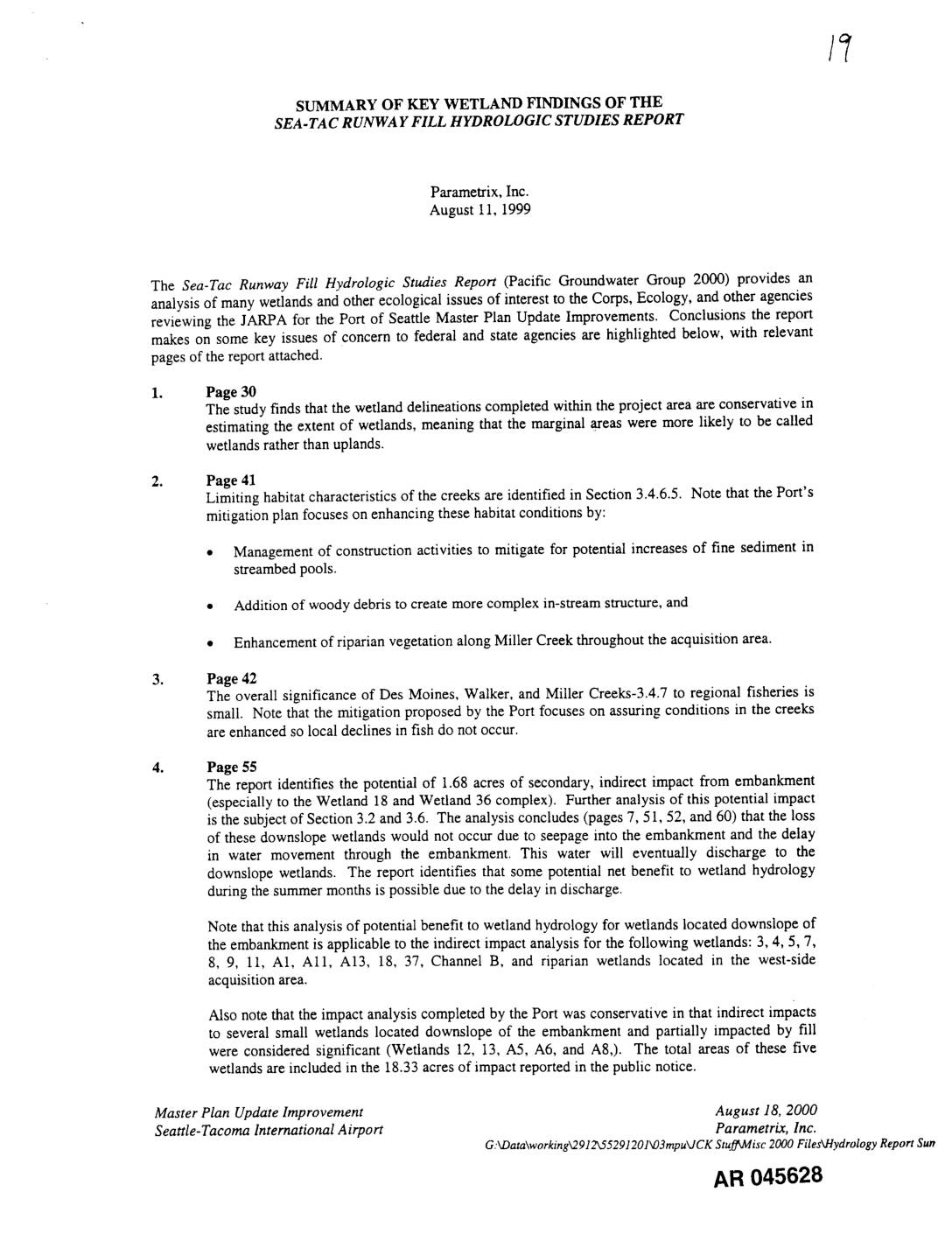
EXH AR045628: Summary of Key Wetland Findings of the Sea-Tac Runway Fill Hydrologic Studies Report
Parametrix, Inc. summary (August 11, 1999) of key wetland findings from the Sea-Tac Runway Fill Hydrologic Studies Report (Pacific Groundwater Group 2000), prepared for the Port Of Seattle Master Plan Update Improvements JARPA review. Covers wetland delineation conservatism, limiting habitat characteristics of Miller Creek, Walker Creek, and Des Moines Creek, salmonid habitat significance, indirect embankment -
 1999-08-09
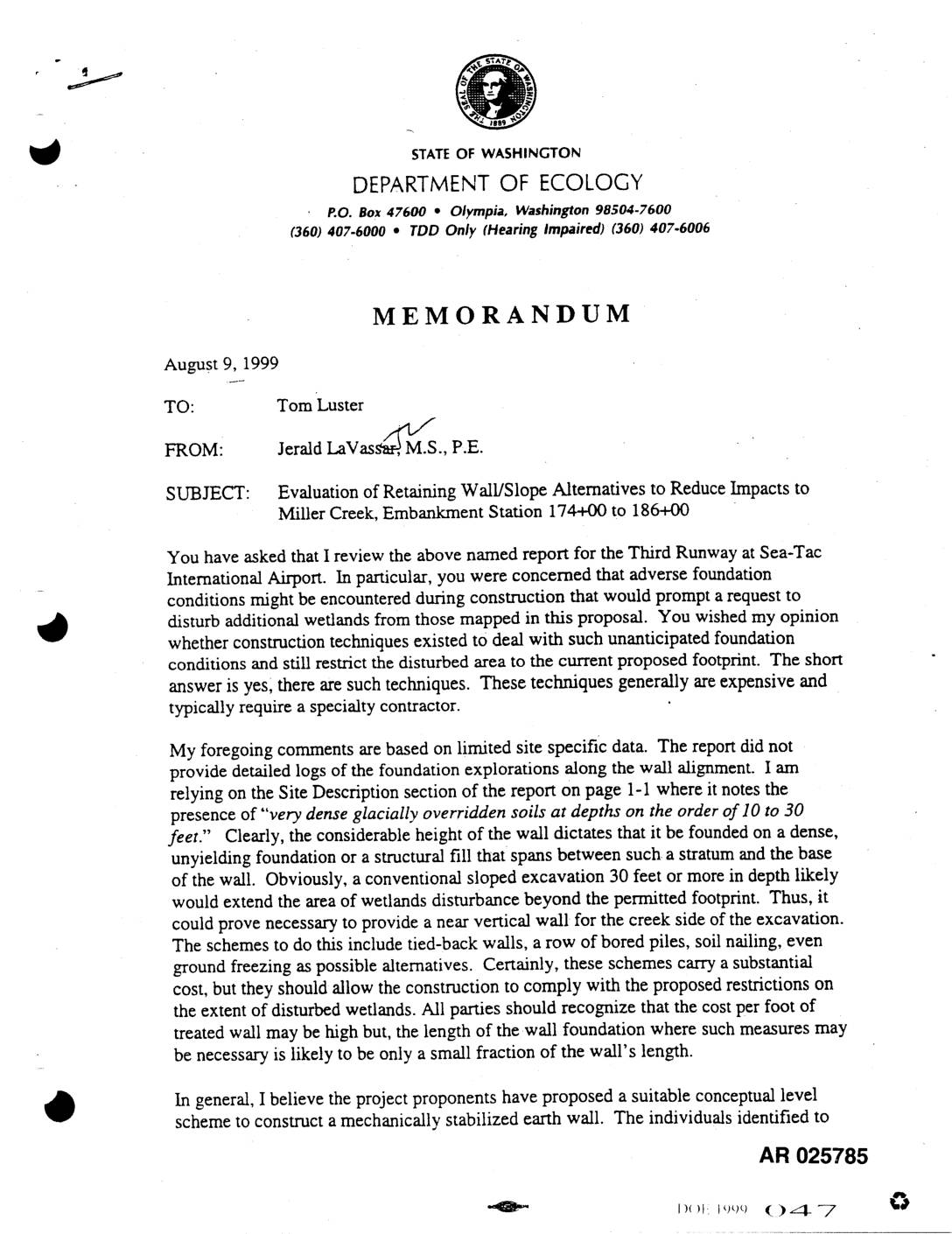
EXH AR025785: Ecology Memo — Retaining Wall/Slope Alternatives, Miller Creek, Sta 174+00–186+00
A 1999 memo from the Washington State Department of Ecology evaluates construction techniques for a retaining wall near Miller Creek at Sea-Tac International Airport's Third Runway project. The memo concludes that specialized methods such as tied-back walls, bored piles, soil nailing, or ground freezing can address difficult underground soil conditions while keeping construction within the approved wetlands disturbance footprint, though at significant cost. The author also recommends installing monitoring devices in the wall and backfill to confirm the structure performs as designed throughout its service life.