Notes
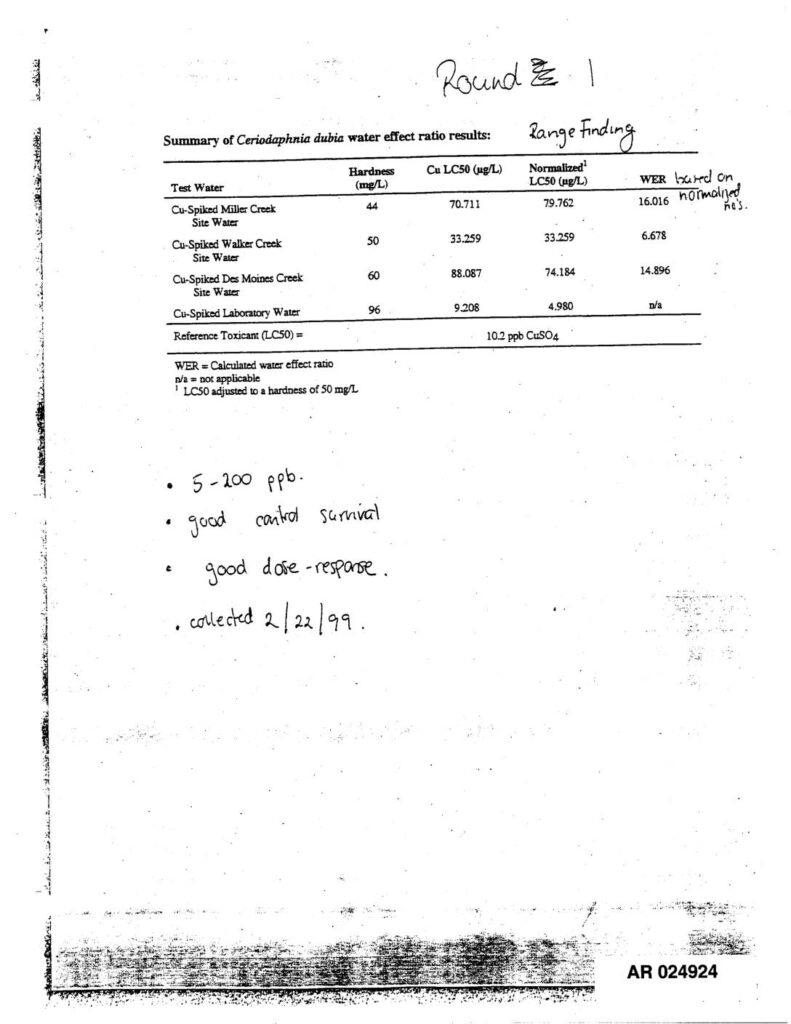
Draft memorandum dated August 18, 1999 from Doug Henderson and Linda Logan (Parametrix) to Port Of Seattle project files, summarizing range-finding water-effect ratio (WER) results for copper in streams receiving Seattle-Tacoma International Airport stormwater. Tests used Ceriodaphnia dubia spiked with copper (Cu) across Miller Creek, Walker Creek, Des Moines Creek, and laboratory water at hardness values of 44, 50, 60, and 96 mg/L. Cu LC50 values ranged from 9.208 to 88.087 µg/L; normalized LC50s ranged from 4.980 to 79.762 µg/L; calculated WERs ranged from 6.678 to 16.016. Reference toxicant LC50 was 10.2 ppb CuSO4 (acceptable). Samples collected February 23, 1999 during a qualifying storm event. Document AR024924–AR024926; exhibit filed in PCHB third-runway EIS administrative record.