TagMiller Creek(260)
-
1997-06-08
No Impact on Ground Water? Comments on DOE and Port Of Seattle Agreement for Ground Water Study at Sea-Tac Airport
A 1997 public comment letter from a Seattle resident raises concerns that a planned ground water study near Seattle-Tacoma International Airport is too limited in scope to accurately assess pollution risks to local drinking water. The author documents an airport outfall discharging oil, grease, and glycols just south of a drinking water well head, and argues the study must be expanded to include outfalls, fuel depot leaks, abandoned underground tanks, and the effects of massive planned construction. The letter urges regulators to require more rigorous sampling conditions and to openly address the water quality impacts of the airport's proposed Third Runway expansion. -
1997-06-01
Exhibit AR022300: Port Of Seattle Storm Water Receiving Environment Monitoring Report for NPDES Permit No. WA-002465-1
This June 1997 report, prepared by the Port of Seattle for Washington State's Department of Ecology, presents storm water receiving environment monitoring results conducted under NPDES Permit No. WA-002465-1. It covers water quality topics including instream toxicity bioassays, sediment quality, identification of pollution sources, metals speciation, vegetation management, and streambank erosion in Miller Creek and Des Moines Creek watersheds near Sea-Tac Airport. The findings assess the environmental impact of airport storm water runoff on local waterways and identify contributing pollution sources within each creek basin. -
1997-05-20
Storm Water Outfall 007 1997-05-20
Seattle-Tacoma International Airport Outfall 007 (SON 2) Location : Just south of well head that supplies drinking water to the Seattle area, – south side of 8154 St near landing light towers on north end of airport – approximately 2000 feet southwest of Reba Detention facility According to EPA NPDES Form 351 0-2F : -Receiving -
1996-12-01
Miller Creek Relocation Plan for Proposed Master Plan Update Improvements at Seattle-Tacoma International Airport
This 1996 plan by Parametrix, Inc. outlines the proposed relocation of Miller Creek to accommodate expansion improvements at Seattle-Tacoma International Airport. It assesses the creek's existing ecological conditions—including fish habitat, hydrology, and riparian vegetation—and identifies the construction impacts the relocation would cause. The document then presents mitigation goals, site selection rationale, and engineering details for redesigning the creek channel to offset environmental impacts. -
1996-12-01
Sea-Tac Master Plan Update 1996: Wetland Impact/Mitigation Sites — Vicinity Map, Wetlands Affected, and Classification/Size/Impact Tables
Port of Seattle application documents (Sheet 1–3 of 44, December 1996) supporting implementation of the Seattle-Tacoma International Airport Master Plan Update, covering wetland impact and mitigation sites in King County, WA. Sheets include a vicinity map showing Miller Creek Relocation, Bow Lake, Angle Lake, Lora Lake, Auburn Wetland mitigation site, Des Moines Creek Watershed, and -
1996-12-01
Sea-Tac Master Plan Update 1996: Wetland Impact/Mitigation Sites — Vicinity Map, Wetlands Affected, and Classification/Size/Impact Tables
This 1996 document outlines the Port of Seattle's wetland impact and mitigation plan associated with the Seattle-Tacoma International Airport Master Plan Update. It includes vicinity maps showing the airport's location in King County, Washington, and identifies numerous wetland sites affected by planned airport improvements. Detailed tables classify each impacted wetland by type—forested, shrub-scrub, or emergent—and quantify the acreage disturbed across sections of Townships 22N and 23N, Range 4E. -
1996-08-22
EXH AR026790: NPDES Permit WA-002465-1 Modification Response to Comments
This 1996 document summarizes public responses to a proposed modification of the water discharge permit (NPDES Permit No. WA-002465-1) for Sea-Tac International Airport, operated by the Port of Seattle. It addresses concerns raised at a June 1996 public hearing in Burien, WA, including questions about self-monitoring of water samples, erosion and water flow in Miller Creek, and the Department of Ecology's enforcement and fining process. The document outlines how Ecology responded to community concerns and describes permit changes, such as a new condition requiring the Port to assess the airport's impact on local creek hydrology. -
1995-08-16
Letter regarding 3rd Runway DEIS and Miller Creek drainage settlement agreement
A 1995 letter from Allan M. Furney to Chester Beattie of the Airport Communities Coalition summarizes a 1974 settlement agreement between King County, the Washington State Highway Commission, and local citizens regarding flooding and drainage problems in the Miller Creek watershed. The settlement requires King County to improve water quality, prevent excess stormwater runoff into Miller Creek, and construct appropriate drainage facilities, while prohibiting full channelization of the creek. The letter raises concerns that proposed SeaTac Airport third-runway expansion plans, as outlined in the Draft EIS, would violate these settlement provisions by significantly increasing impervious surface area and stormwater flows into the Miller Creek drainage basin. -
1974-01-06
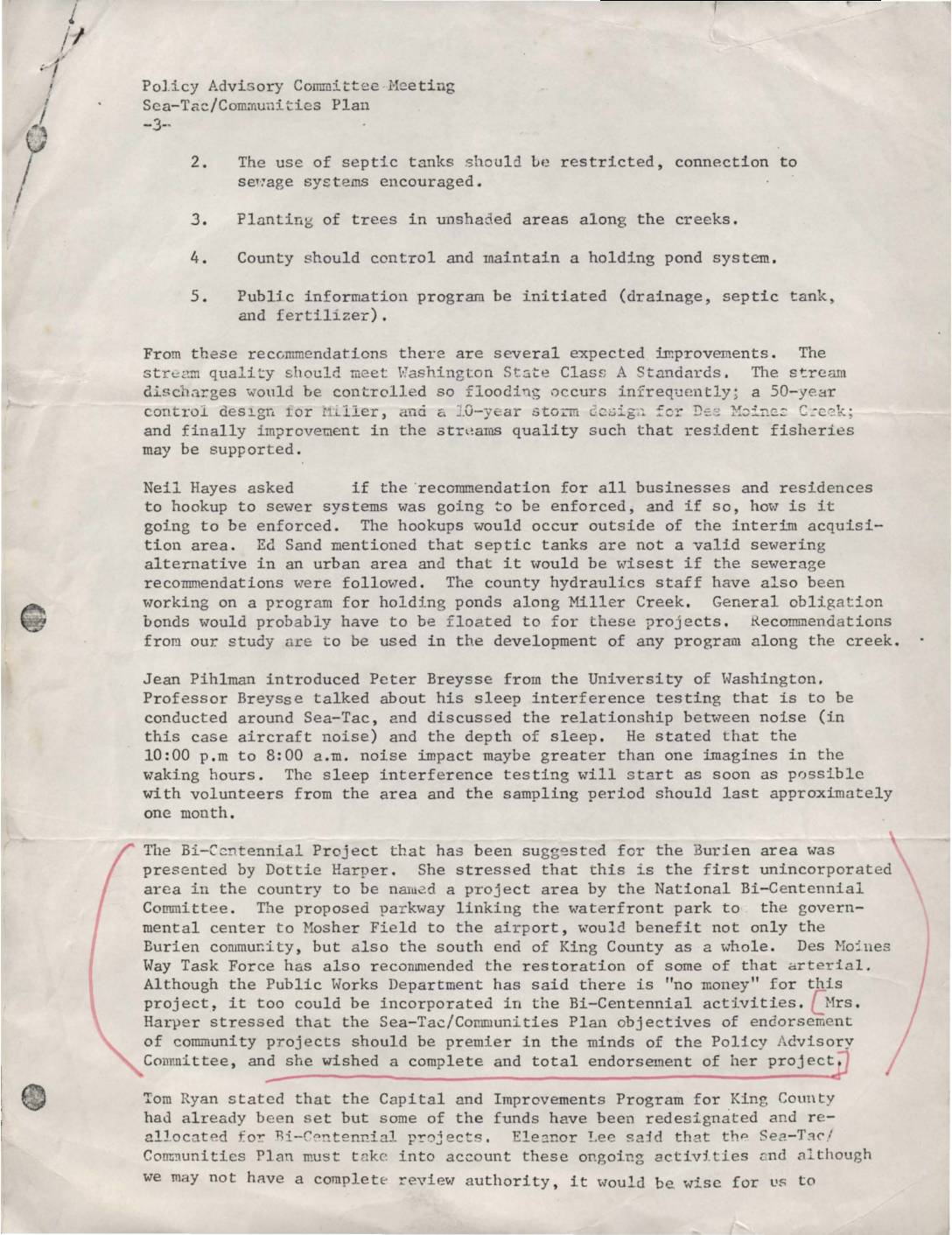
Policy Advisory Committee meeting, Sea-Tac-Communities Plan
This document summarizes a Policy Advisory Committee meeting for the Sea-Tac/Communities Plan, covering recommendations to improve local creek water quality through sewer hookups, tree planting, and holding ponds. It also describes a University of Washington study on how nighttime aircraft noise disrupts sleep for residents near Sea-Tac Airport. Additionally, a proposed Bi-Centennial parkway project linking Burien's waterfront to the airport was presented, with a request for the committee's full endorsement. -
1957-07-17
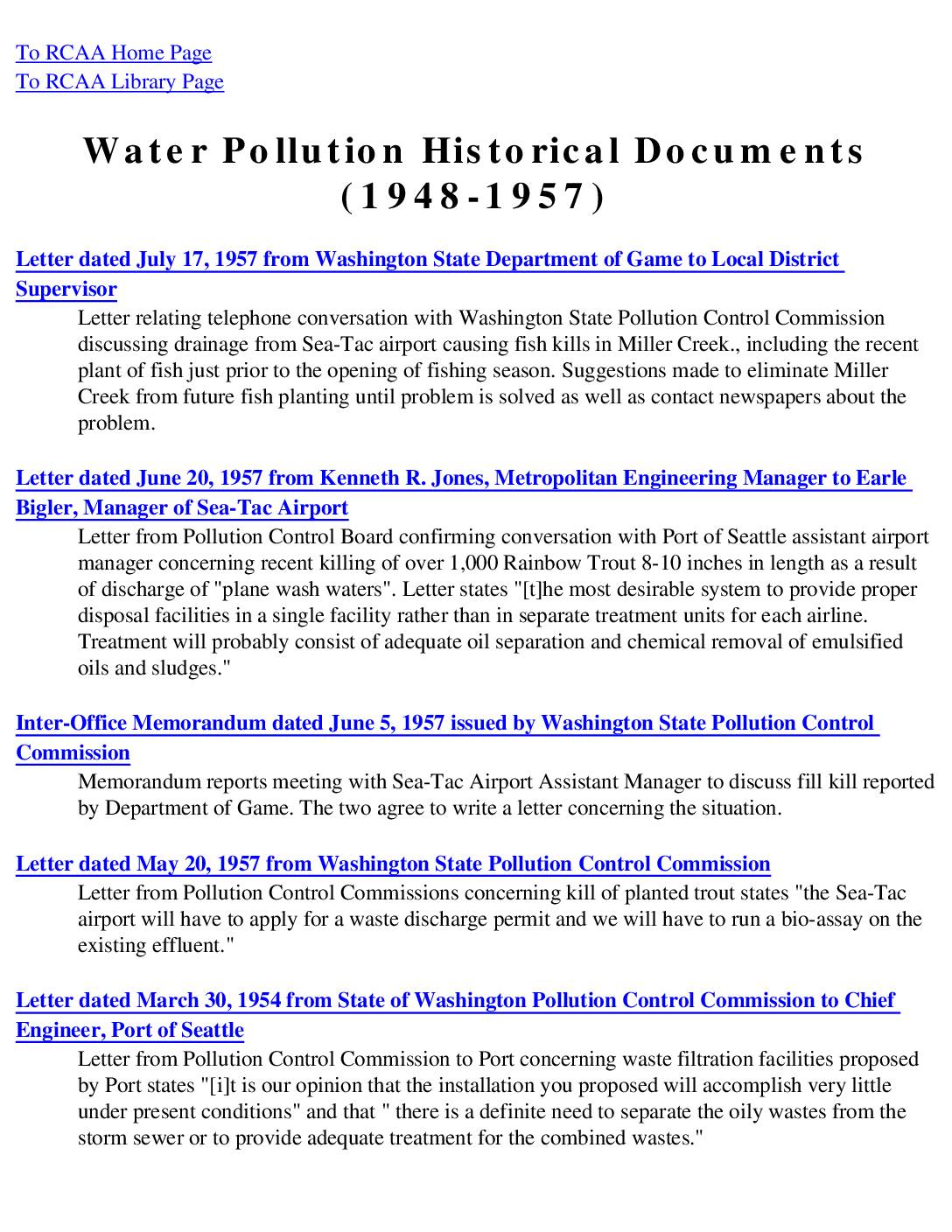
Water pollution historical documents (1948-1957)
This collection of historical documents from 1948 to 1957 chronicles ongoing water pollution problems caused by Sea-Tac Airport's drainage of aircraft wash water, oils, and chemicals into nearby Miller Creek and Des Moines Creek. The records show repeated fish kills, contamination of private property, and years of failed or inadequate treatment solutions, prompting complaints from residents, state legislators, and wildlife agencies. Despite numerous proposals and temporary fixes, the Washington State Pollution Control Commission continued to pressure the Port of Seattle to develop a permanent waste disposal system throughout the period.