TagHealth(103)
-
 2019-09-01
Research, policies, and program options for improving indoor environmental quality
This EPA report, prepared by David Mudarri PhD in 2018, reviews the state of science on indoor environmental quality and outlines research, policy, and program options for improving it. The synthesis paper was developed to help the EPA establish research goals, objectives, and priorities across a wide range of indoor environmental topics and time frames. It is intended solely for internal EPA use due to the inclusion of copyrighted material from broad-based review articles. -
Novel cardiovascular risk factors: air pollution, air temperature, pain, and sleep duration
For the podcast associated with this article, please visit https://academic.oup.com/eurheartj/pages/Podcasts. Traditionally, we have used age, gender, body mass index, blood pressure, lipids, smoking, and diabetes to assess cardiovascular (CV) risk. However, up until recently, the CV risk provided by environemental hazards such as pollution,1–3 noise,4–6 temperature,7 sleep duration8, and air quality,9,10 among others, have been -
 2019-01-07
Resolution No. 408 requiring monitoring and health impact assessments of Sea-Tac Airport operations
In January 2019, the City of Burien, Washington considered Resolution No. 408, which called for air quality monitoring and health impact assessments of Sea-Tac Airport operations. The resolution highlighted that air traffic had exceeded the airport's projected levels by over 30% and that no air quality monitors existed near the six closest cities to the airport. The Burien Airport Committee recommended adopting the resolution, citing concerns about residents' exposure to pollutants linked to cancer, cardiovascular disease, and other serious health conditions. -
 2018-12-19
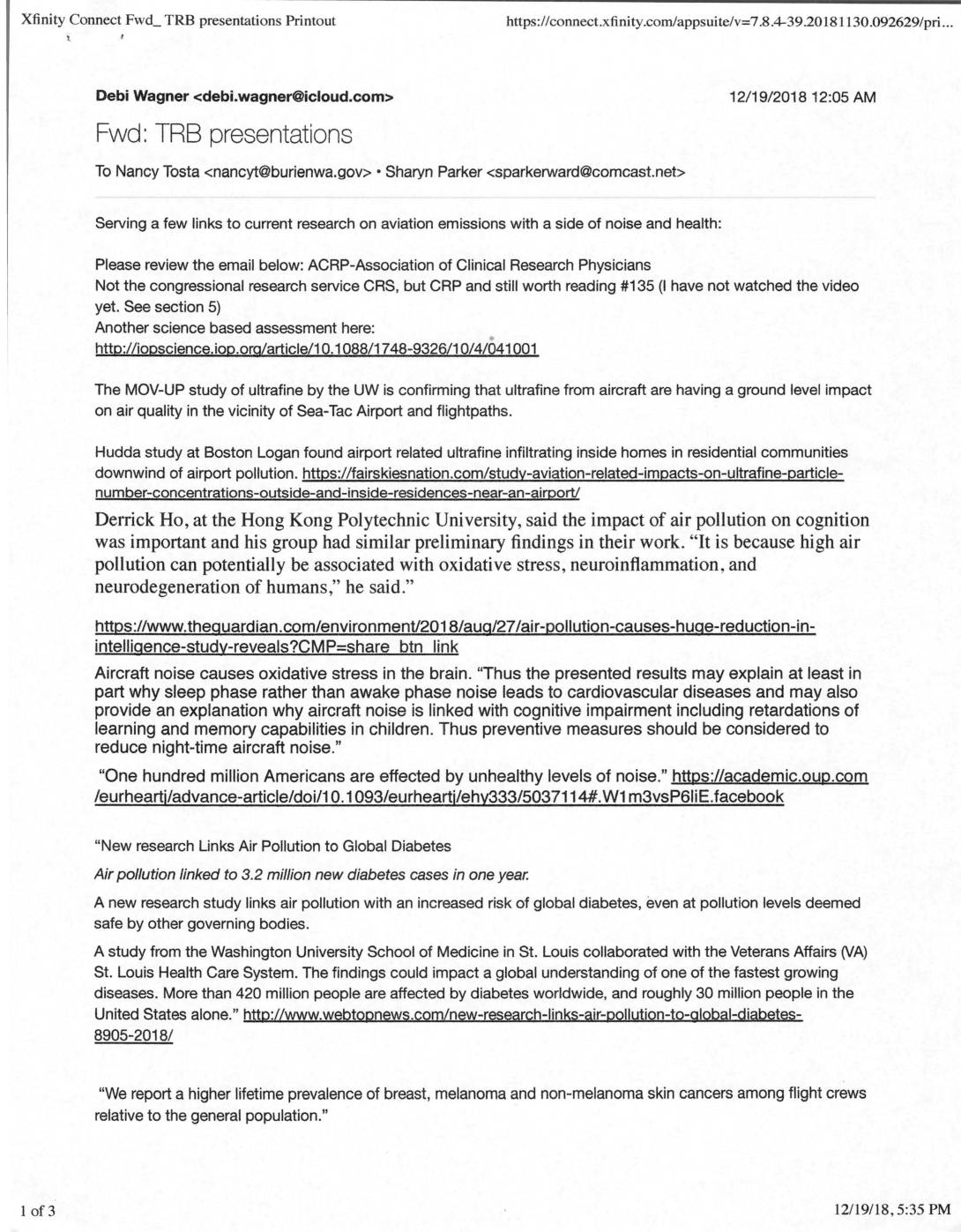
Fwd: TRB presentations
A December 2018 email chain forwarded by community advocate Debi Wagner to Burien city officials shares research links connecting aviation emissions and aircraft noise to serious public health concerns, including ultrafine particle pollution, cognitive impairment, cardiovascular disease, and cancer. The email references studies such as the University of Washington's MOV-UP study confirming ground-level ultrafine particle impacts near Sea-Tac Airport, as well as EPA Region X recommendations for resources on airport air quality and public health. The correspondence highlights growing community and regulatory interest in understanding the health effects of airport operations on neighborhoods surrounding Sea-Tac. -
 2018-08-15
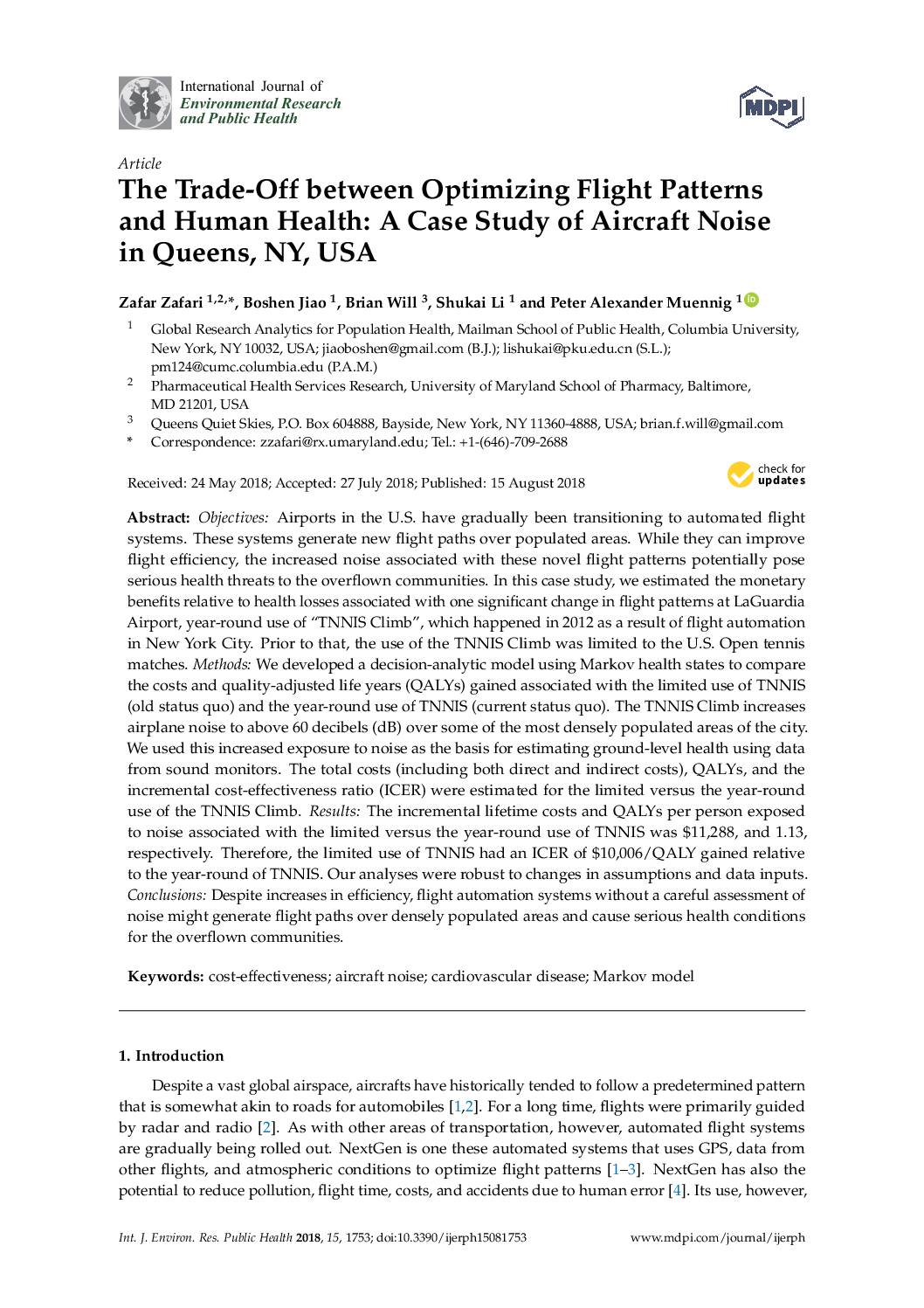
The Trade-Off between Optimizing Flight Patterns and Human Health: A Case Study of Aircraft Noise in Queens, NY, USA
Peer-reviewed article published in the International Journal of Environmental Research and Public Health (MDPI) by Zafari, Jiao, Will, Li, and Muennig (Columbia University/University of Maryland) examining the health and economic costs of year-round use of the TNNIS Climb departure route at LaGuardia Airport (LGA), Queens, NY, implemented in 2012 under the FAA NextGen automated flight -
 2018-05-01
Health based criteria for use in managing airport and aircraft noise
This 2018 Harvard University master's thesis by Bryan Johnson examines health-based criteria that could be used to better manage noise from airports and aircraft. The research explores how noise exposure standards and guidelines could be grounded in public health evidence, offering a framework for more effective noise policy. It is relevant to ongoing discussions about managing community noise impacts around busy airports like Sea-Tac. -
 2018-02-13
Environmental noise and the cardiovascular system
Research published in the Journal of the American College of Cardiology found that environmental noise from traffic, aircraft, and railways is linked to serious cardiovascular health risks, including high blood pressure, heart attack, heart failure, and stroke. Studies in both humans and animals show that aircraft noise — especially at night — triggers stress hormones and harmful oxidative stress in blood vessels, impairing their ability to function properly. These findings suggest that airport noise exposure is not just a quality-of-life issue but a measurable public health concern with direct effects on heart and vascular health. -
2017 Washington State Senate Bill 6032 Sec. 602 (19) MOV-UP Study
“$125,000 of the general fund—state appropriation for fiscal year 2018 and $125,000 of the general fund—state appropriation for fiscal year 2019 are provided solely for the University of Washington school of public health to study the air quality implications of air traffic at the international airport in the state that has the highest total annual -
 2017-10-19
H.R. 4087 – Protecting Airport Communities from Particle Emissions Act
H.R. 4087, the 'Protecting Airport Communities from Particle Emissions Act,' introduced in October 2017, directs the FAA to study ultrafine particles (tiny airborne particles under 100 nanometers) around the 20 busiest U.S. airports, including their health effects on surrounding communities. The study must examine particle sources, concentration patterns, and health impacts such as heart disease, asthma, and nervous system disorders, with special attention to disproportionate effects on communities of color and economically vulnerable residents. The FAA is required to coordinate with the EPA and Department of Health and Human Services and report findings to Congress within two years.