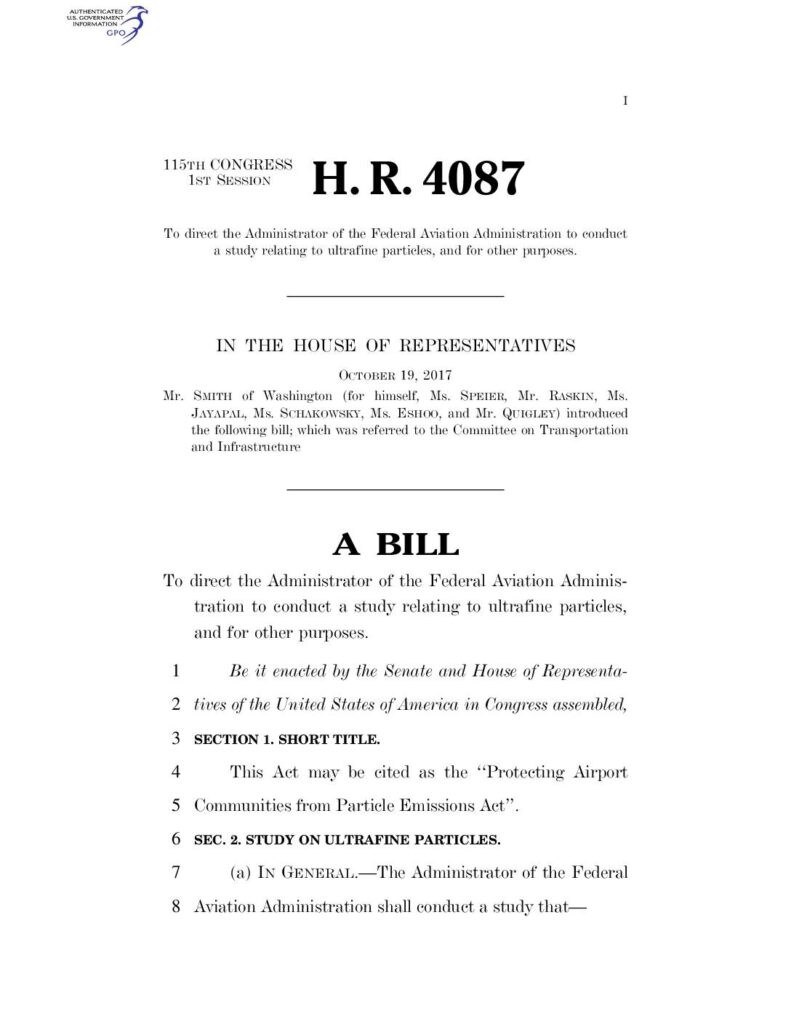
H.R. 4087, the 'Protecting Airport Communities from Particle Emissions Act,' introduced in October 2017, directs the FAA to study ultrafine particles (tiny airborne particles under 100 nanometers) around the 20 busiest U.S. airports, including their health effects on surrounding communities. The study must examine particle sources, concentration patterns, and health impacts such as heart disease, asthma, and nervous system disorders, with special attention to disproportionate effects on communities of color and economically vulnerable residents. The FAA is required to coordinate with the EPA and Department of Health and Human Services and report findings to Congress within two years.Open full document
Notes
A bill introduced in the 115th Congress directing the FAA Administrator to conduct a study on ultrafine particles (defined as particles under 100 nanometers in diameter) near the 20 largest U.S. airports. The study would examine health impacts, spatial distribution, aircraft contributions, and disproportionate effects on communities of color and economically insecure residents. The FAA must submit a report to Congress within two years of enactment.