TagFAA(687)
-
 2019-11-27
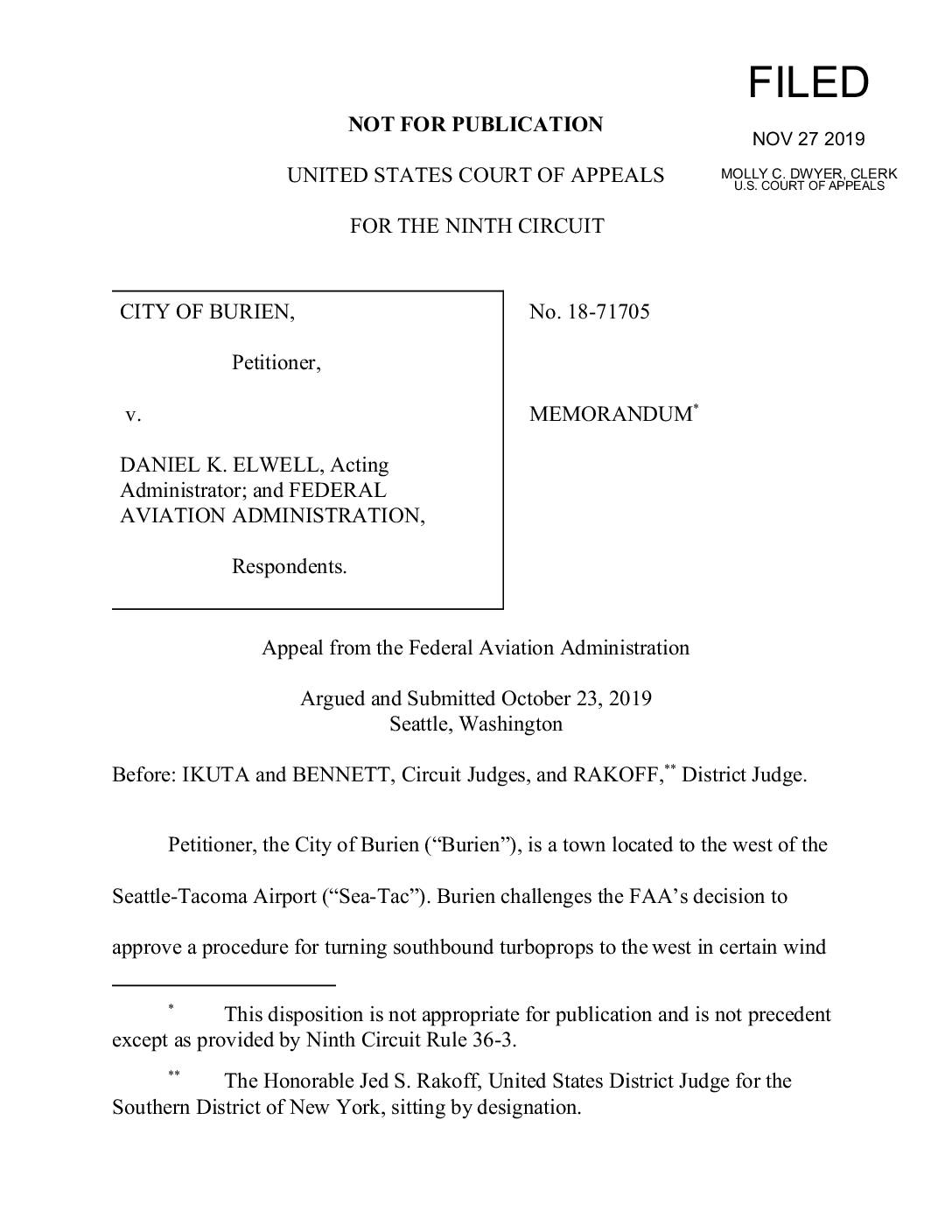
City of Burien v. Federal Aviation Administration: Ninth Circuit Memorandum Decision (No. 18-71705)
Ninth Circuit Court of Appeals unpublished memorandum decision in City of Burien v. Daniel K. Elwell and Federal Aviation Administration, No. 18-71705, filed November 27, 2019. The court partially agreed with Burien that the FAA acted arbitrarily and capriciously under NEPA (42 U.S.C. §§ 4321 et seq.) by approving the ‘Burien 250 Turn’ procedure — -
 2019-11-27
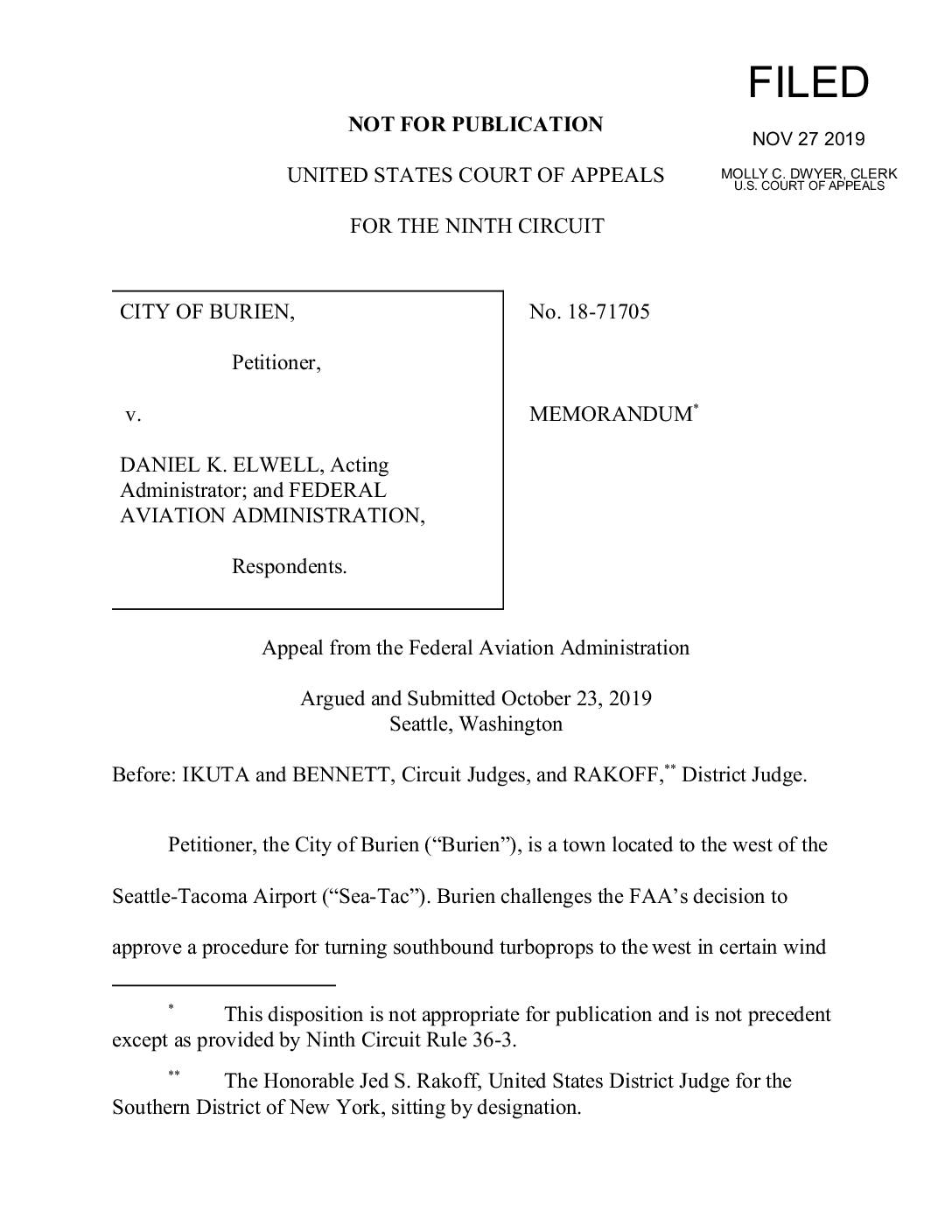
City of Burien v. Elwell: Ninth Circuit Memorandum on FAA NEPA Compliance for Sea-Tac 250 Turn Procedure
The City of Burien challenged the FAA's approval of a flight procedure that automatically routes southbound turboprop planes westward after takeoff from Seattle-Tacoma Airport, concentrating low-flying aircraft noise over the city. The Ninth Circuit Court of Appeals found that the FAA acted improperly by failing to consider all reasonably foreseeable future actions at Sea-Tac when it assessed whether the procedure's cumulative environmental and noise impacts warranted a full environmental review. The court agreed with Burien that the FAA's use of a categorical exclusion to bypass that review was arbitrary and capricious under the National Environmental Policy Act. -
 2019-10-31
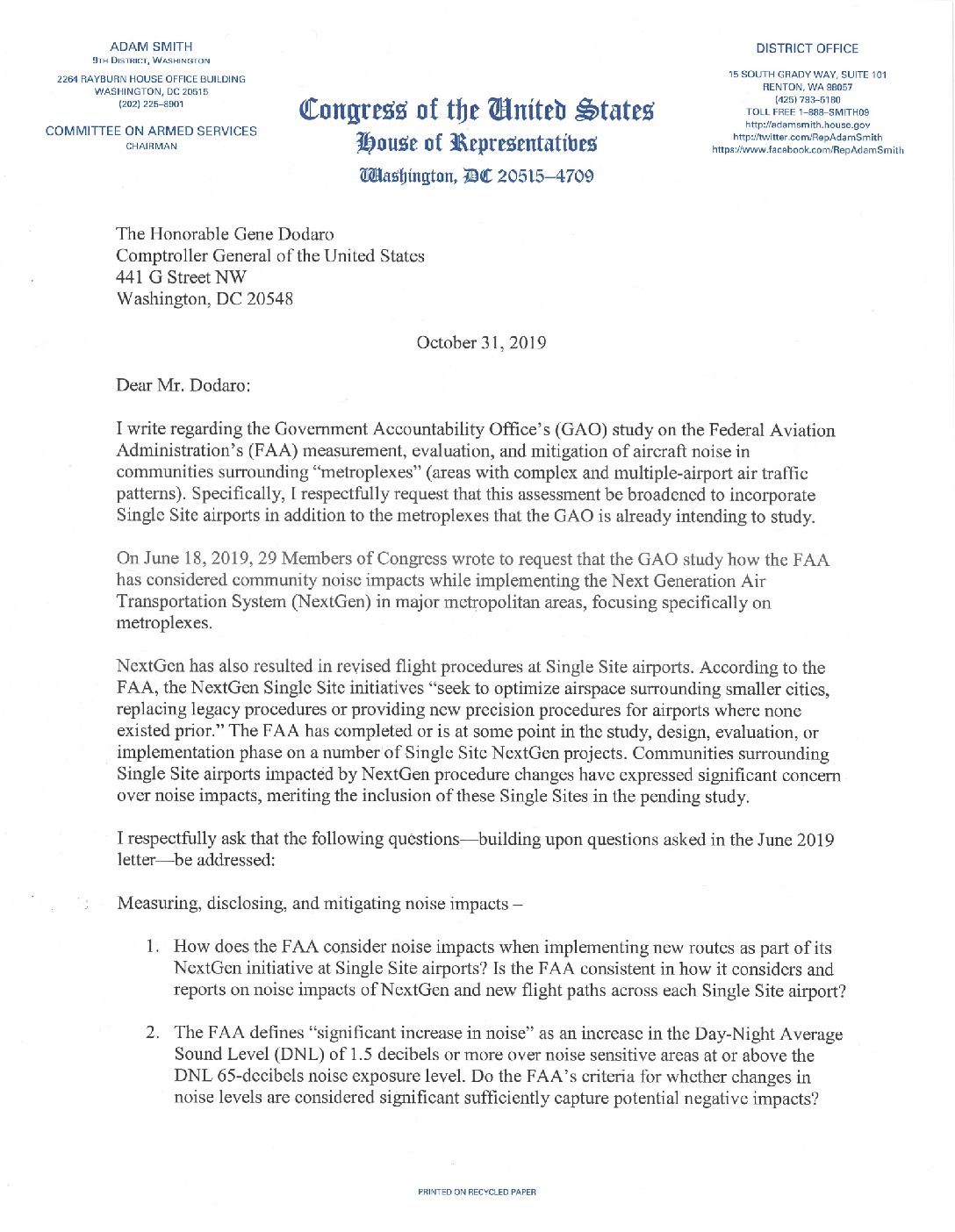
Letter from Adam Smith to Gene Dodaro regarding GAO study on FAA noise impacts at Single Site airports
In October 2019, Congressman Adam Smith (WA-9th District) wrote to the Government Accountability Office requesting that its study on FAA aircraft noise management be expanded beyond major metropolitan 'metroplexes' to also include Single Site airports, such as those affected by NextGen flight procedure changes near smaller cities. The letter asks the GAO to examine how the FAA measures, discloses, and mitigates noise impacts at these airports, whether its current noise standards adequately protect communities, and how effectively it engages the public when implementing new flight routes. The request was driven by significant community concern over increased noise resulting from NextGen-related flight path changes at Single Site airports. -
Quiet Skies Coalition Update
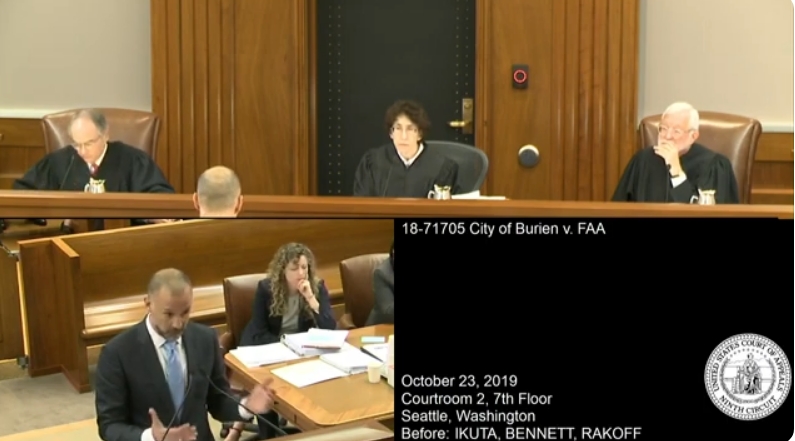
Good Friends & Citizens of Burien, On Wednesday, the City of Burien appeared before the United States Court of Appeals for the Ninth Circuit in Seattle. Our attorney Matt Adams of Dentons law firm and the FAA’s attorney presented oral arguments before a panel of three judges who asked pointed questions of both sides. My -
 2019-10-23
Burien v FAA #18-71705 oral arguments before US Court of Appeals Ninth Circuit
18-71705-2019-11-27.pdf Judge Ikuta: Good morning. Matthew Adams (Burien): And may it please the court, my name is Matthew Adams appearing for the City of Burien. I’m joined by Lisa Marshall, the City Attorney. I’d like to reserve three minutes if I could and I’ll keep my eye on the clock. This case is about -
 2019-09-28
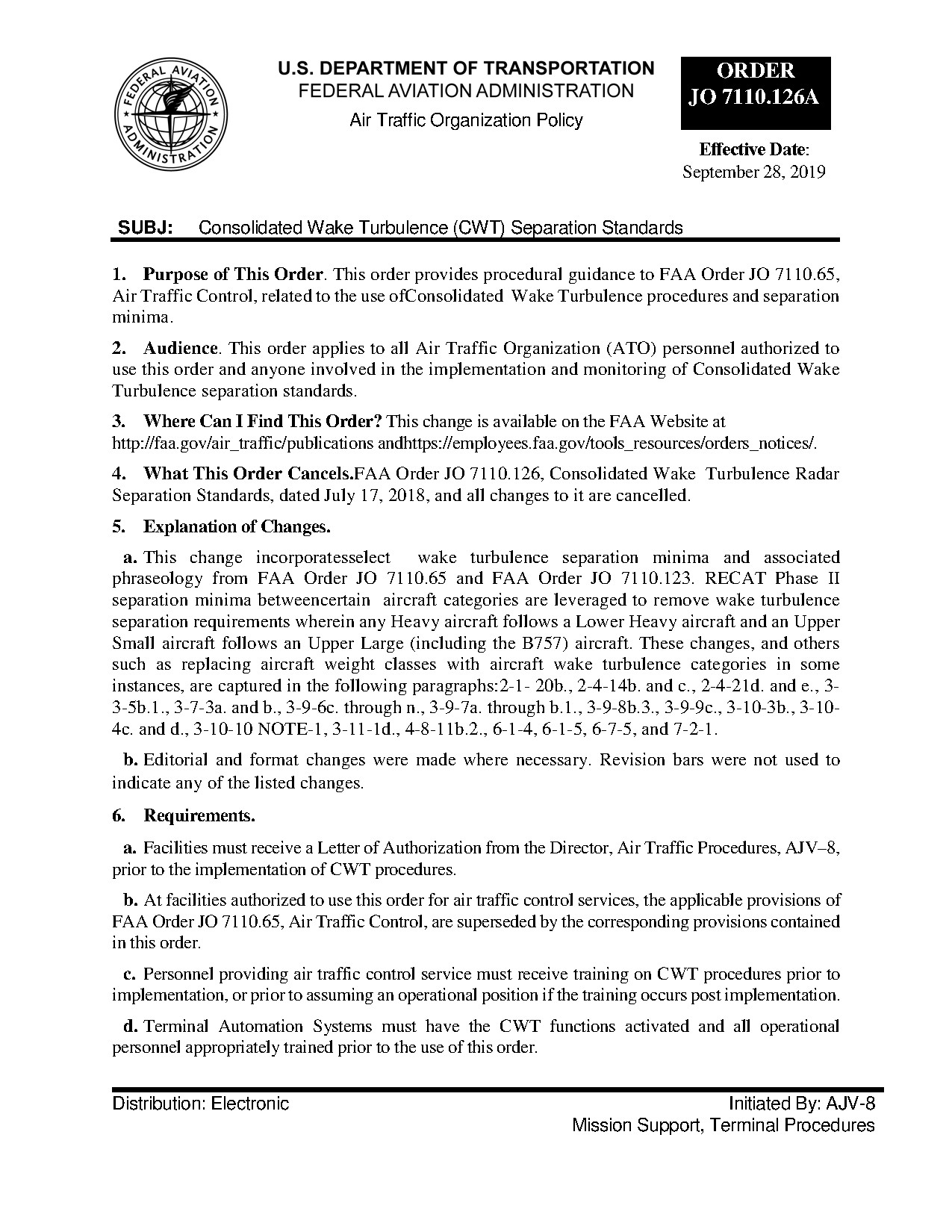
FAA Order JO 7110.126A: Consolidated Wake Turbulence (CWT) Separation Standards
FAA Order JO 7110.126A, effective September 28, 2019, updates the rules air traffic controllers use to maintain safe distances between aircraft to avoid wake turbulence. The order introduces a nine-category system for classifying aircraft by their wake turbulence characteristics, replacing older weight-based separation standards with more precise, data-driven minimums that can reduce unnecessary spacing between certain aircraft pairs. These updated standards are designed to improve traffic flow and runway efficiency at busy airports across the national airspace system. -
 2019-09-03
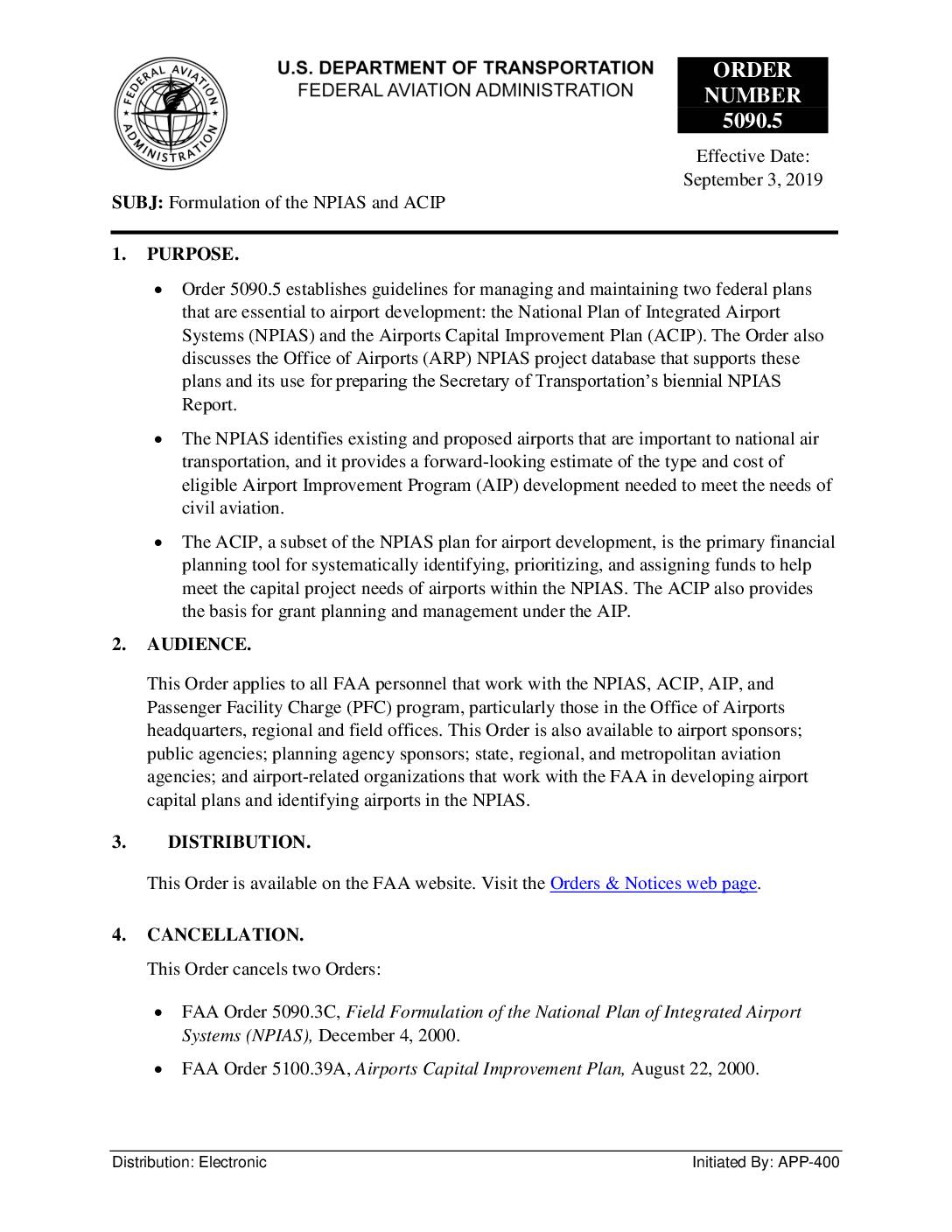
Formulation of the NPIAS and ACIP
FAA Order 5090.5, effective September 3, 2019, establishes guidelines for managing the National Plan of Integrated Airport Systems (NPIAS) and the Airports Capital Improvement Plan (ACIP), which together identify airports important to national air transportation and prioritize federal funding for airport development projects. The order serves as a financial planning tool for systematically assigning Airport Improvement Program (AIP) funds to qualifying airports across the country. Note that this document addresses broad national airport capital planning policy and does not contain specific provisions related to Sea-Tac Airport noise mitigation or local noise policy. -
 2019-09-01
Research, policies, and program options for improving indoor environmental quality
This EPA report, prepared by David Mudarri PhD in 2018, reviews the state of science on indoor environmental quality and outlines research, policy, and program options for improving it. The synthesis paper was developed to help the EPA establish research goals, objectives, and priorities across a wide range of indoor environmental topics and time frames. It is intended solely for internal EPA use due to the inclusion of copyrighted material from broad-based review articles. -
 2019-08-27
FAA has made progress in implementing its Metroplex program, but benefits for airspace users have fallen short of expectations
A 2019 U.S. Department of Transportation Inspector General report found that the FAA's Metroplex program—designed to modernize flight routes using satellite-based navigation in busy metropolitan areas—fell significantly short of its promised benefits, delivering only $31.1 million in annual savings compared to the $61.6 million minimum originally projected. The program also faced delays of up to four years, driven largely by community concerns about aircraft noise, which is directly relevant to ongoing noise issues around airports like Sea-Tac. Key obstacles such as unclear pilot-controller terminology and a slow procedure amendment process remained unresolved at the time of the report.