Notes
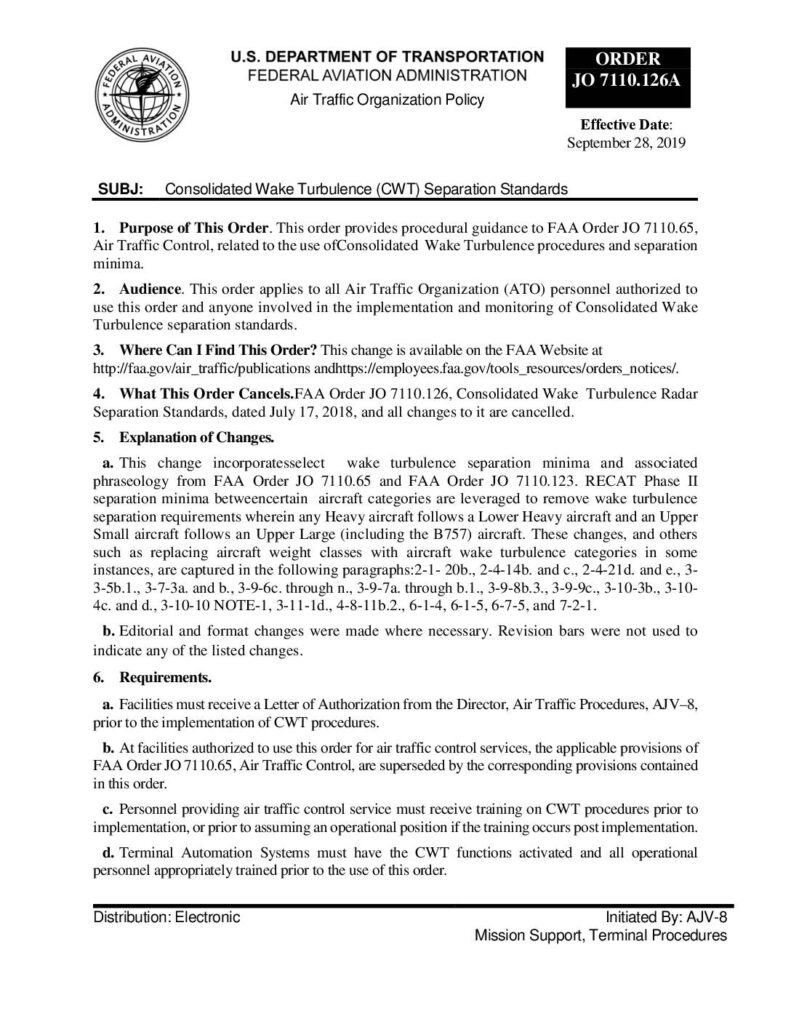
FAA Order JO 7110.126A, effective September 28, 2019, issued by Air Traffic Organization (ATO), Mission Support, Terminal Procedures (AJV-8), establishes Consolidated Wake Turbulence (CWT) separation standards superseding JO 7110.126 dated July 17, 2018. The order defines a nine-category aircraft wake turbulence classification system (Categories A through I: Super/A388, Upper Heavy, Lower Heavy, Non-Pairwise Heavy, B757, Upper Large, Lower Large, Upper Small, Lower Small) and incorporates RECAT Phase II pairwise separation minima from JO 7110.123, eliminating wake turbulence separation requirements for Heavy aircraft following Lower Heavy aircraft and Upper Small following Upper Large (including B757). Requires Letter of Authorization from Director, Air Traffic Procedures AJV-8, Terminal Automation Systems with CWT functions activated, FDIO or EFSTS at tower facilities, and mandatory weekly wake encounter and MOR reporting for the first six months post-implementation. Aircraft type designator table (TBL A-1) lists categorized aircraft including A388, B747, B767, B772, B787, DC10, MD11, B737, B757, B752, B753, A320, CRJ series, and others for use with STARS and ASDE-X automation systems.