Skip to content
  • STNI
  • Statistics
    • Ops and Passengers
      • King County International Airport (Boeing Field) Annual Operations
    • Financials
    • Aviation fuel uplift in the State of Washington 2018 – 2025
      • Aviation Fuel Uplift at Sea-Tac Airport
    • Air Quality Monitoring
    • Flight Tracking
      • Flow and Flight Tracks
      • Five Year Comparison
      • Busiest Hours and Days
    • SEL Noise Reports & Graphs
      • About The Permanent Noise Monitors
      • Minutes of Quiet by Noise Monitor
      • Noise Events mapped
      • Noise Events (SEL)
    • Runways
    • Employees
    • Real Estate
      • Port Properties and Trees mapped
    • Parking
  • Events
  • Protest
    • Regular Events
    • Legislation 2026
    • Complain about a particular flight
    • Advocacy Organizations
    • Media Outlets
    • People
    • The Port of Seattle
      • Commission Meetings
      • Public Records Requests
      • StART
      • Highline Forum
    • Contact Your Electeds
  • Resources
    • FAQs
      • FAA Occurrences/Accidents/Indents
    • The unSustainable Airport Master Plan
      • SAMP NTP: 31 projects by the numbers
      • SEPA Draft EIS (2026)
      • SAMP Record of Decision/FONSI (2025)
      • SAMP Draft EA (October 2024)
      • 2018 Scoping
    • Port Packages
      • Port Package Property Costs
      • Port Packages mapped
      • The Port Package Explainer
      • So you want a (first-time) Port Package? Start here
      • Port Package Looker Upper
      • How do I determine if I have a Port Package or Avigation Easement?
      • Progress on Port Package Update legislation
      • Having a Port Package Problem?
      • Port Package Site Visit Follow-Up
    • Document Library
    • Explainers
      • The Airport Law Cheat Sheet
      • The Grant Explainer
    • External Articles
    • History
      • Timeline
      • The Sea-Tac Communities Plan
        • Sea-Tac Communities Plan – Planning Maps
      • PSRC Third Runway Decision Process
    • Studies
    • Videos
  • Stories
  • Mission
  • Subscribe
  • Contact
Scroll down to content

Get InformedStay Informedx

I understand that you will never share my information with anyone, you will only use it to keep me updated on relevant events and that I may unsubscribe at any time.

STNI

STNISea-Tac Noise.Info

  • Solve for Sea-Tac. Solve for every airport.
  • Since 2016, working to obtain justice for everyone living under the flight path.
  • Less Noise. Cleaner Air. Better Public Health. Compensation.
  • Everything you think you know about the airport is wrong.

TagEcology(60)

Advanced Search Options

  • Dates
  • Media
    • External Articles
    • Images
    • PDFs
    • Video
    • Audio
  • Order By
  • 2001-04-17

    Documents catalogued as published in 2001

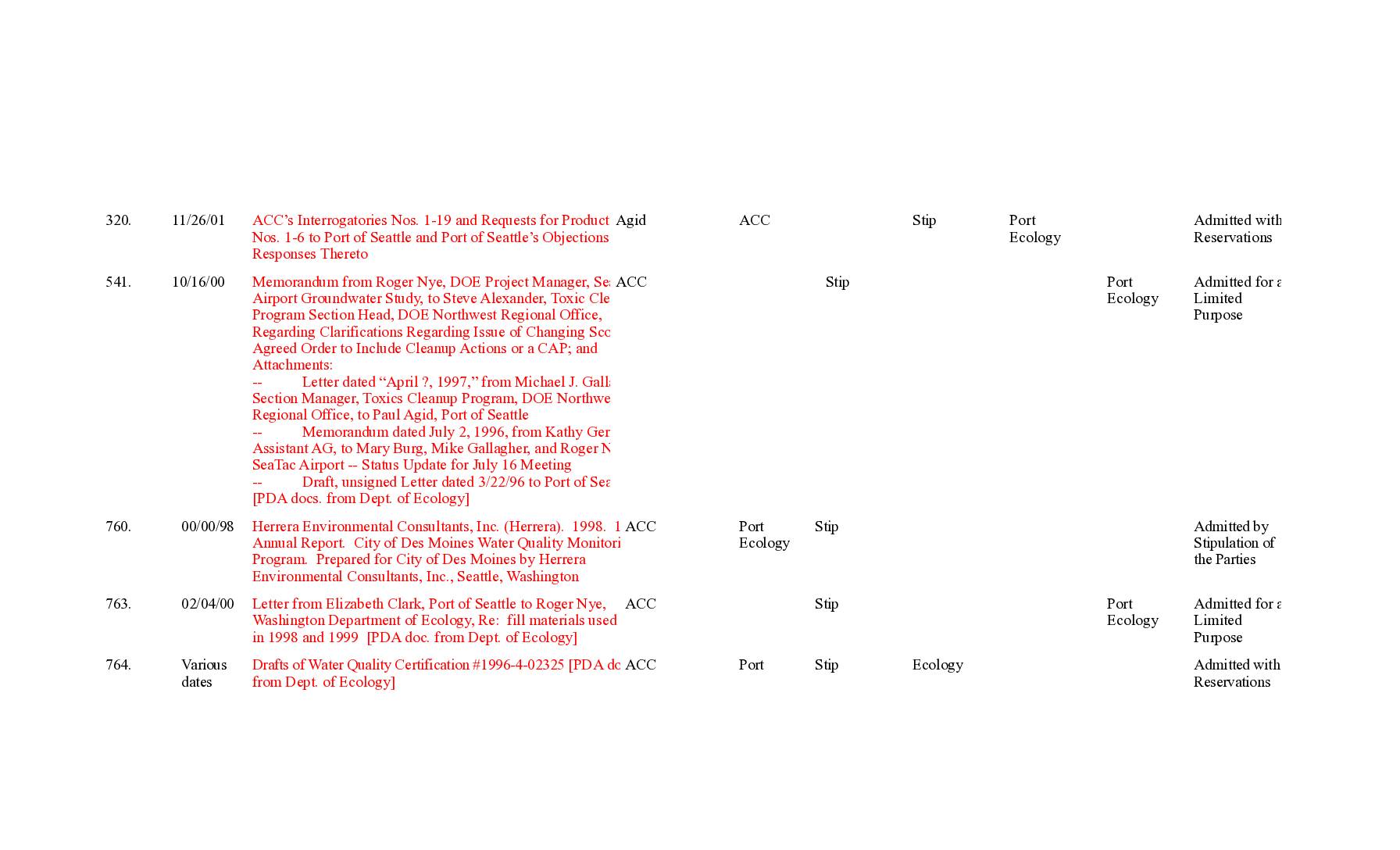
    This is a catalogued index of documents from 2001 related to the proposed Third Runway at Seattle-Tacoma International Airport, covering regulatory filings, public comments, and environmental studies. It includes records from agencies such as the Department of Ecology, the Corps of Engineers, and King County, addressing topics like stormwater management, NPDES permits, groundwater studies, and the impact of the February 2001 Nisqually Earthquake on airport structures. The catalog serves as a reference guide directing researchers to archival notebooks and specific shelf locations where the full documents are stored.
    TagsACC, Army Corp of Engineers, Ecology, RCAA, Sea-Tac Airport, Third Runway
  • 2000-12-14

    Puget Sound Water Quality Management Plan 2000

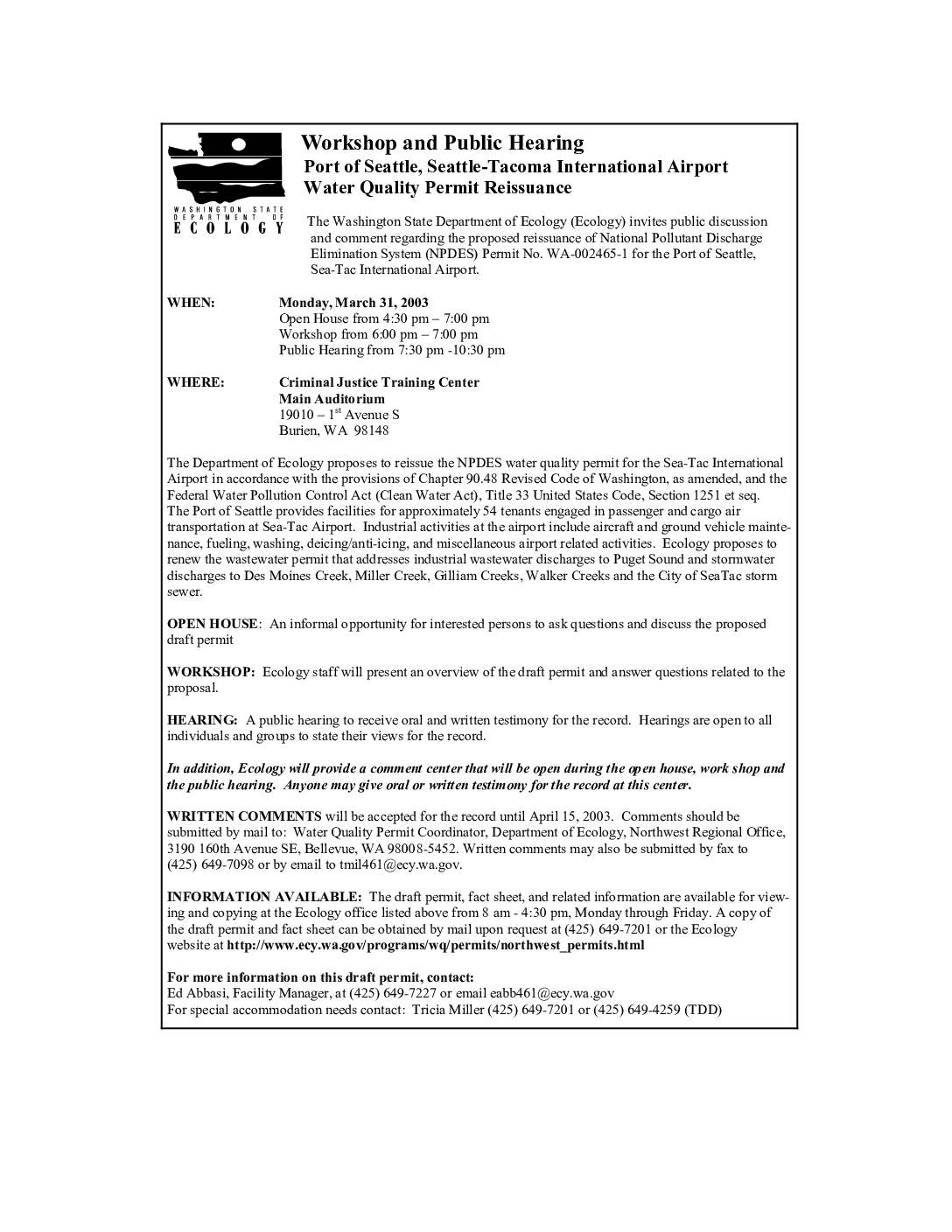
    The 2000 Puget Sound Water Quality Management Plan, adopted December 14, 2000, outlines coordinated local, state, tribal, and federal actions to restore and protect the health of Puget Sound in Washington State. The plan introduces new programs addressing aquatic nuisance species and Georgia Basin water coordination, while substantially revising existing stormwater, habitat, and wetlands protection programs. It builds on earlier management plans dating back to 1987 and calls for renewed commitment to funding and policy improvements.
    TagsEcology, Environment, Puget Sound, Stormwater, Water Quality
  • 2000-03-01

    Addressing community health concerns around SeaTac Airport: Response to the question, ‘Is it possible to monitor jet engine exhaust emissions or to model their path using data on prevailing winds and takeoff patterns?’

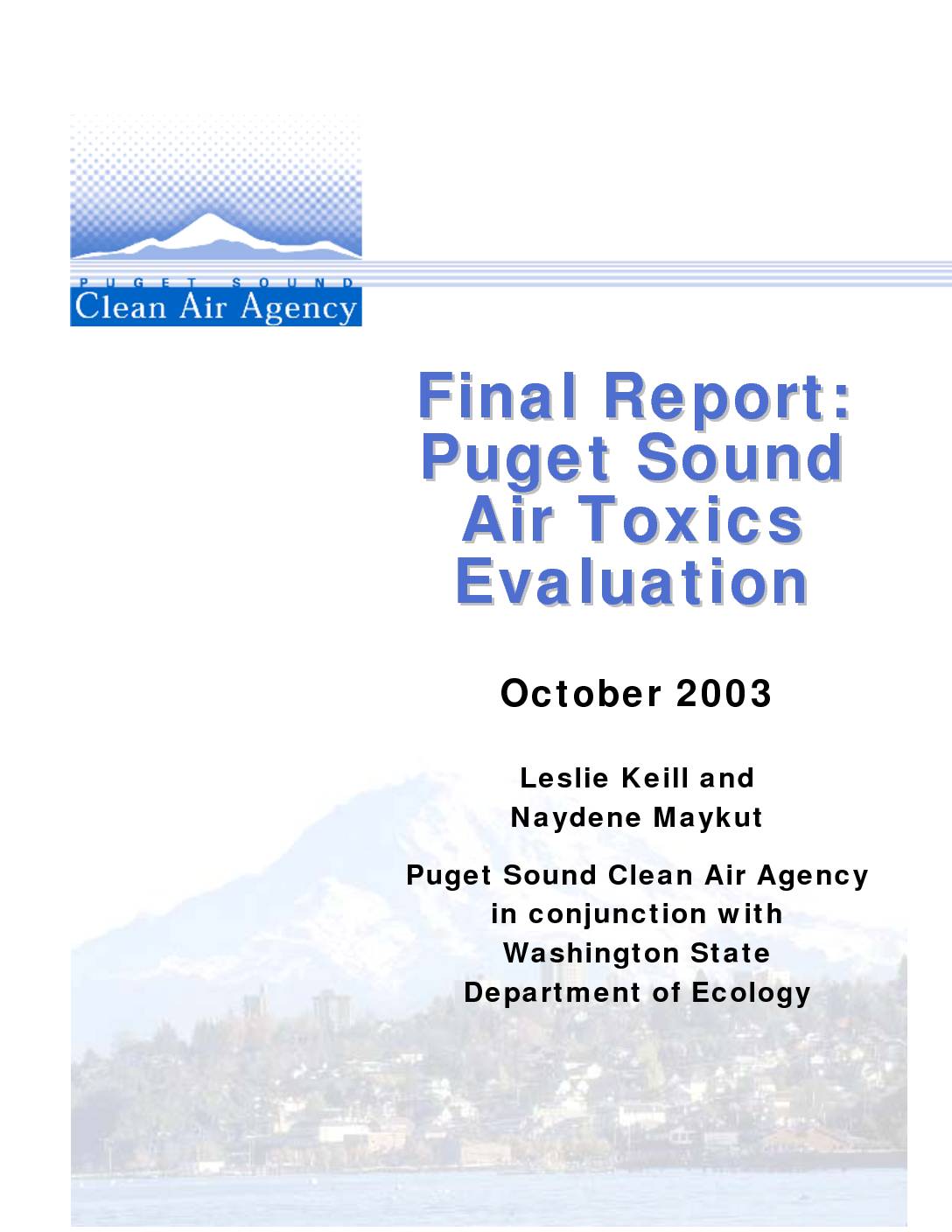
    This March 2000 report, prepared by Washington State health and environmental agencies, examines whether jet engine exhaust emissions from Seattle-Tacoma International Airport can be monitored or modeled using wind and takeoff data. It reviews previous air quality studies, outlines health and environmental justice concerns for nearby communities, and recommends a structured air quality monitoring study with specific methods, data analysis approaches, and estimated costs. The report was developed in consultation with community representatives, the EPA, and local universities.
    TagsEcology, EPA, John Williamson, King County Public Health, PSCleanAir, Puget Sound Clean Air Agency, University Of Washington, Washington State Department Of Health, Washington State University
  • 1999-12-13

    1998/1999 SeaTac oxides of nitrogen and particulate monitoring study

    This 1998/1999 study by the Washington State Department of Ecology monitored levels of oxides of nitrogen and particulate matter in the SeaTac area, likely in relation to emissions from Seattle-Tacoma International Airport and surrounding traffic. Prepared by Jim Frost and Doug Knowlton of Ecology's Air Program, the report assessed local air quality conditions during that period. It serves as a technical reference for understanding pollution levels near the airport in the late 1990s.
    TagsDoug Knowlton, Ecology, Jim Frost, pollutionStudy TopicsAir Quality
  • 1999-05-20

    Sea-Tac Airport spatial nitrogen dioxide study final report

    A 1999 University of Washington study measured nitrogen dioxide (NO2) levels around Seattle-Tacoma International Airport to determine whether aircraft operations were harming local air quality. Researchers found that NO2 levels at all monitoring sites remained well below federal safety standards, and that regional conditions and nearby freeways — not aircraft — were the primary drivers of local pollution. The study concluded that airport operations had only a small, difficult-to-isolate effect on community NO2 levels, estimated at less than 7 parts per billion above background levels.
    TagsDoug Urry, Ecology, John Williamson, pollution, Timothy Larson, University Of Washington
  • Ecology Focus STIA Environmental Update November 1997_0001

    TagsEcology, Newsletter, Third Runway
  • Memorandum Of Agreement Air Quality Monitoring 1996

    TagsEcology, EIS, Environmental Impact Statement, Environmental Protection Agency, EPA, Mic Dinsmore, Port Of Seattle, PSCAA, Puget Sound Clean Air Agency, Third Runway
  • 1993-01-01

    Stormwater erosion and sediment control for large parcel construction

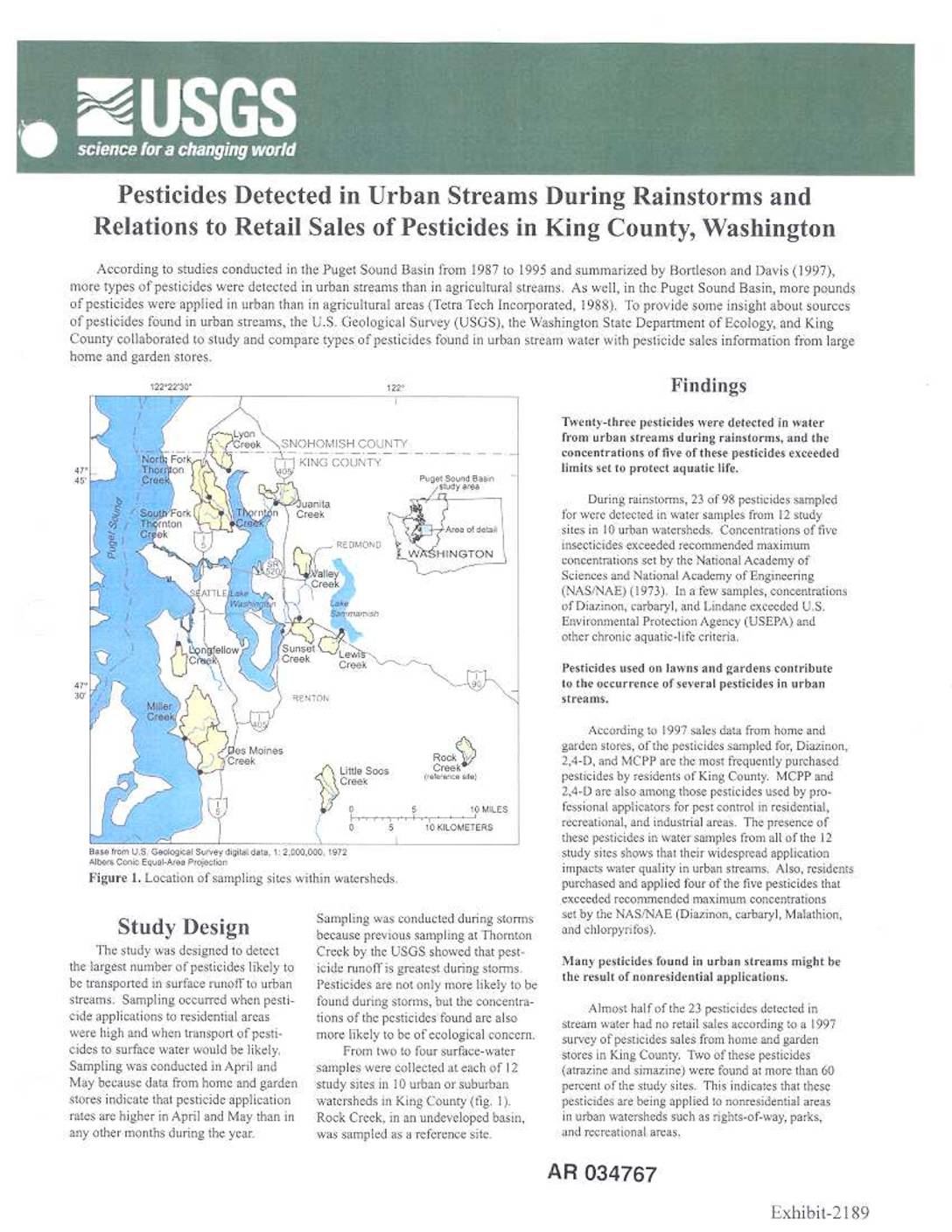
    This Washington State Department of Ecology report outlines stormwater erosion and sediment control requirements for large construction projects involving one or more acres of disturbed land in the Puget Sound Basin. It describes best management practices (BMPs) such as covering exposed soil, trapping sediment onsite, and protecting adjacent properties from runoff and sediment. Developers are required to create an erosion and sediment control plan and are financially responsible for its implementation.
    TagsConstruction, Ecology, NPDES, RCAA, Stormwater, Water Quality
  • 1991-10-30

    Sea-Tac Airport identified as a major polluter

    A May 1991 Washington State Department of Ecology study, requested by state Representative Greg Fisher, identified Seattle-Tacoma International Airport as a major indirect source of air pollution, responsible for approximately 8% of carbon monoxide and 5% of nitrogen oxide emissions in King County. The report found that idling jets on the runway were the primary source of carbon monoxide, while aircraft climb and approach operations generated the most nitrogen oxide, with local pollution hotspots identified near South 154th Street, Seattle Christian School, and Tyee Golf Course. The study recommended minimizing runway queuing, reducing airport automobile traffic, exploring alternative fuels for ground support vehicles, and conducting further ground-level air quality testing around the airport.
    TagsEcology, pollution
  • 1989-01-01

    Puget Sound water quality: An annotated bibliography of agency materials

    This 1989 annotated bibliography from the Puget Sound Water Quality Authority catalogs agency publications related to Puget Sound water quality, covering topics such as nonpoint source pollution, shellfish safety, oil spills, and stormwater management. It lists reports, newsletters, and pamphlets from federal, state, and local agencies—including the EPA, Washington Department of Ecology, and various county departments—along with contact information for obtaining each document. The bibliography serves as a resource guide for researchers, planners, and community members concerned with environmental water quality issues in the Puget Sound region.
    TagsEcology, Environment, Puget Sound, Stormwater, Water Quality

Posts pagination

Page 1 … Page 4 Page 5 Page 6
Sidebar On/Off

Help study childhood asthma. Get free HEPA filter!

read more...

Issues

Sea-Tac Airport is currently undergoing the largest and longest expansion in its history, collectively known as the Sustainable Airport Master Plan (SAMP). Some of it you can already hear, but you’re probably not aware of what it all means. Here’s what you need to know.
read more...

Read This!

As the source for federal transportation grants, the Puget Sound Regional Council was charged with developing a system to meet the growing need for commercial aviation. When the search for a second airport failed, they authorized the Port of Seattle to build the Third Runway, with a mandate to develop a noise abatement and mitigation program. In their effort to stop the Third Runway, the ACC argued over every detail of the Port's efforts--including property buyouts and sound insulation. The dispute was meant to be settled by a three member Expert Arbitration Panel. This is their final report. It finds 2-1, that the Port's program was insufficient in several respects. Despite that, funding for the Third Runway was approved by the PSRC, and the 'Port Package' program, proceeded largely unchanged. Expert Arbitration Panel's final decision finding that the Port of Seattle had not shown sufficient reduction in real on-the-ground noise impacts to satisfy noise reduction conditions required for approval of a third runway at Sea-Tac International Airport. The majority decision concluded the Port's noise abatement programs were insufficient despite being impressive in scope.
continue...

The Podcast!

Subscribe to the only podcast devoted to policies, politics, history, impacts for people living under the flight path everywhere. It’s definitely not just about noise!
  • Sea-Tac Noise.Info
  • Connect with STNI

    • Subscribe
    • Port Package Problem?
    • Donate
    • Podcast
    • Socials
      • Facebook
      • X (Twitter)
      • Bluesky
      • Instagram

    "FAA Safety Summit" — , 2023

  • Learn

    • Frequently Asked Questions
    • Explainers
    • Youtube
    • Research Requests
    • Make a complaint
  • Goals

    Fulfill the promises of 1976:
    • Compensation
    • Reduced noise
    • Improved air quality
    • Environmental remediation
Login/Register
©2026•Data Privacy

Message

We use cookies to provide basic functionality. We also provide access to search engines in order to provide site analytics. We do not sell or share your data.
V V