TagACC(1548)
-
 1999-04-30
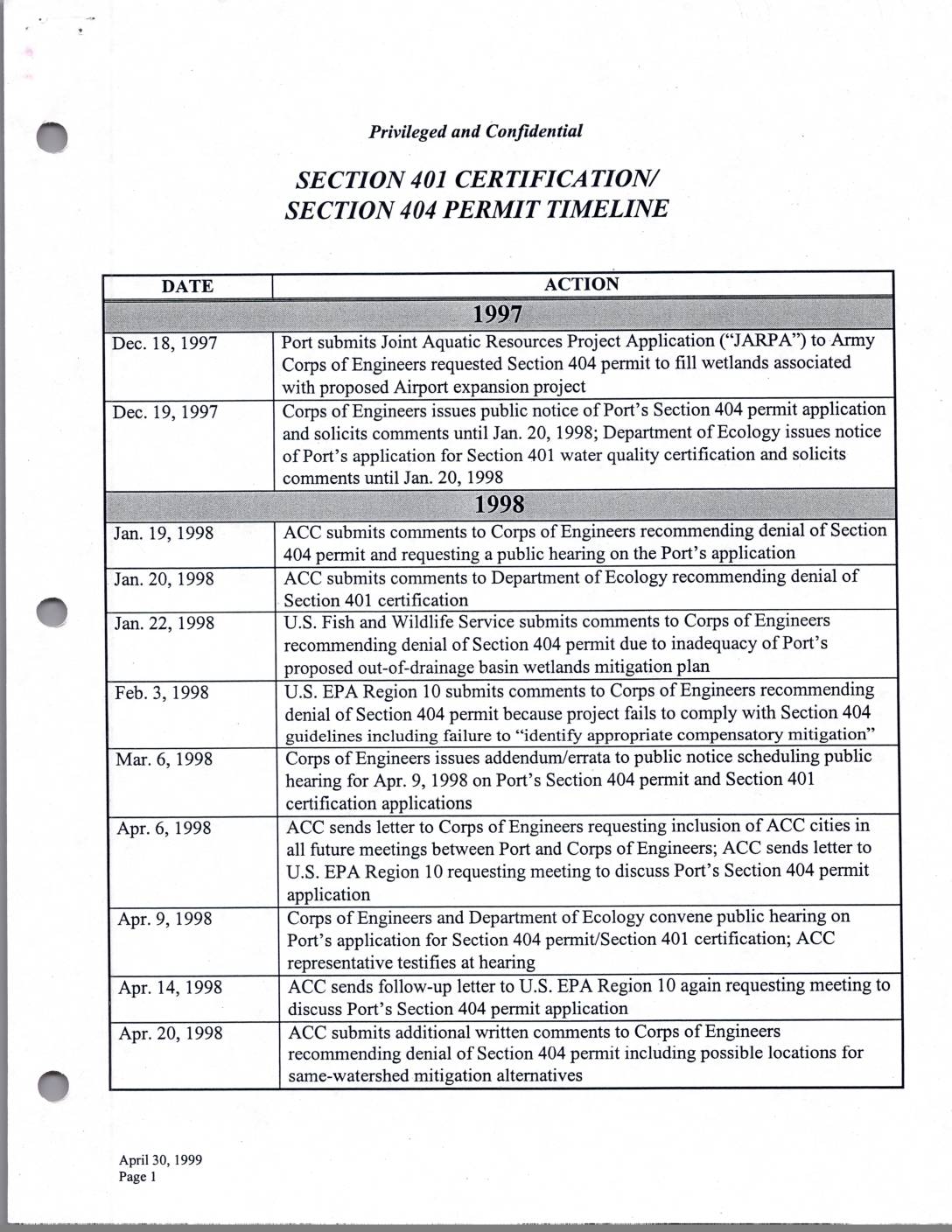
Section 401 Certification / Section 404 Permit Timeline
Privileged and confidential chronological timeline prepared by ACC (Airport Communities Coalition) dated April 30, 1999, documenting the Section 401 water quality certification and Section 404 wetlands fill permit process related to the Port of Seattle Sea-Tac Airport Third Runway expansion project. Covers December 1997 through projected year 2000, including Port’s JARPA submission to Army Corps -
 1999-04-22
EXH AR022190: Stormwater Monitoring Procedure Manual STIA NPDES WA-002465-1 Rev 6
This is a Procedure Manual for stormwater monitoring at Sea-Tac International Airport, developed by Port of Seattle Environmental Services to comply with NPDES Permit WA-002465-1. It outlines sampling locations, monitoring schedules, deicing event protocols, and quality assurance procedures for collecting and reporting stormwater data. The manual covers topics ranging from automatic and manual sampling methods to laboratory accreditation and discharge monitoring report requirements. -
 1999-04-21
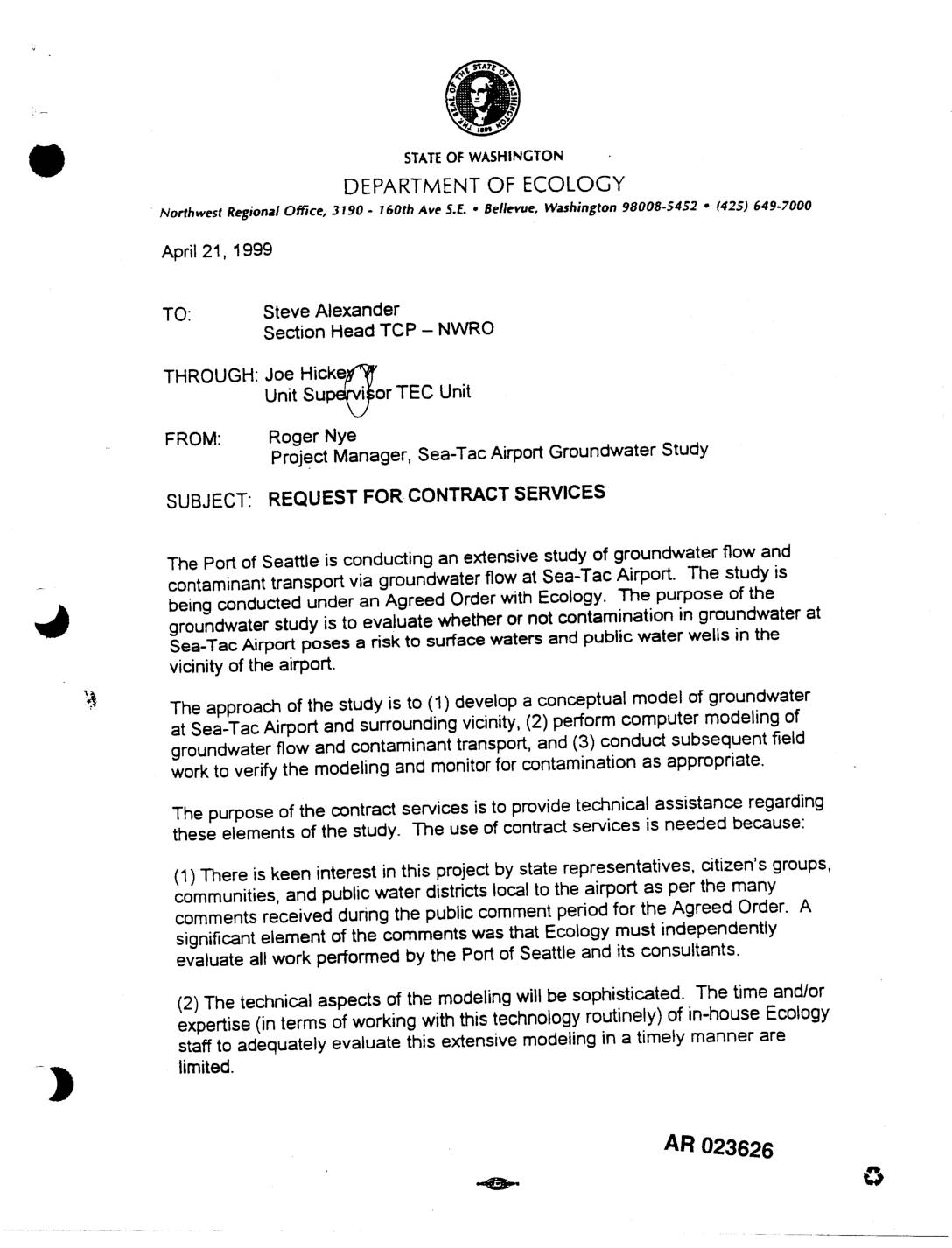
EXH AR023626: Contract Services Request — STIA Groundwater Study
In April 1999, the Washington State Department of Ecology requested contract services to independently review a groundwater study being conducted by the Port of Seattle at Sea-Tac Airport. The study aimed to determine whether groundwater contamination at the airport posed a risk to nearby surface waters and public water wells. Contract experts were needed to evaluate the Port's conceptual groundwater models, three-dimensional MODFLOW computer simulations, and proposed field monitoring work. -
 1999-04-19
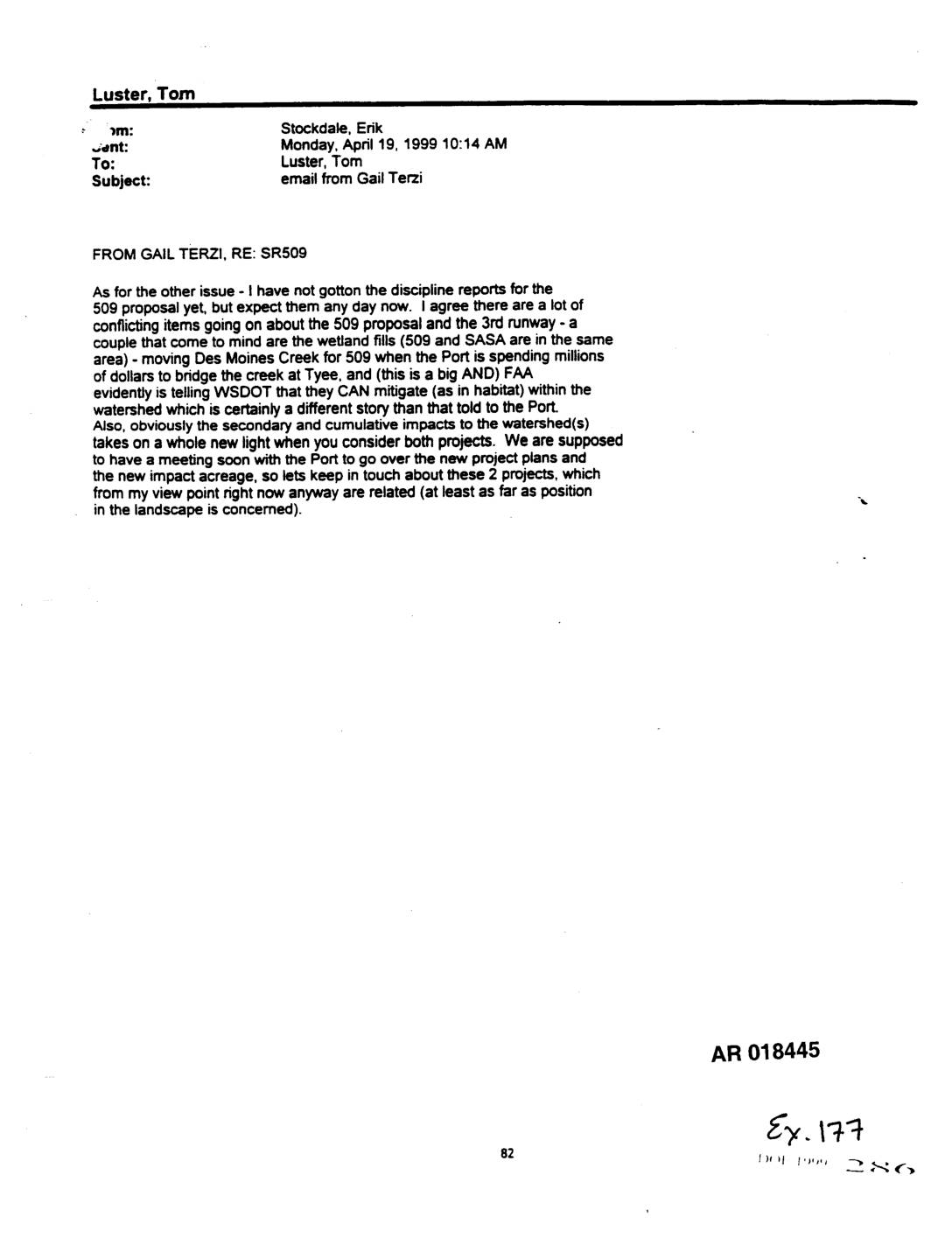
Exhibit 177: Email from Gail Terzi Regarding SR509 and Third Runway Conflicts
Email forwarded by Erik Stockdale to Tom Luster, originating from Gail Terzi, regarding SR509 proposal conflicts with Sea-Tac Airport third runway (SASA). Key issues include wetland fills in overlapping areas, moving Des Moines Creek for SR509 while Port Of Seattle spends millions bridging the creek at Tyee, and FAA telling WSDOT they CAN mitigate habitat -
 1999-04-17
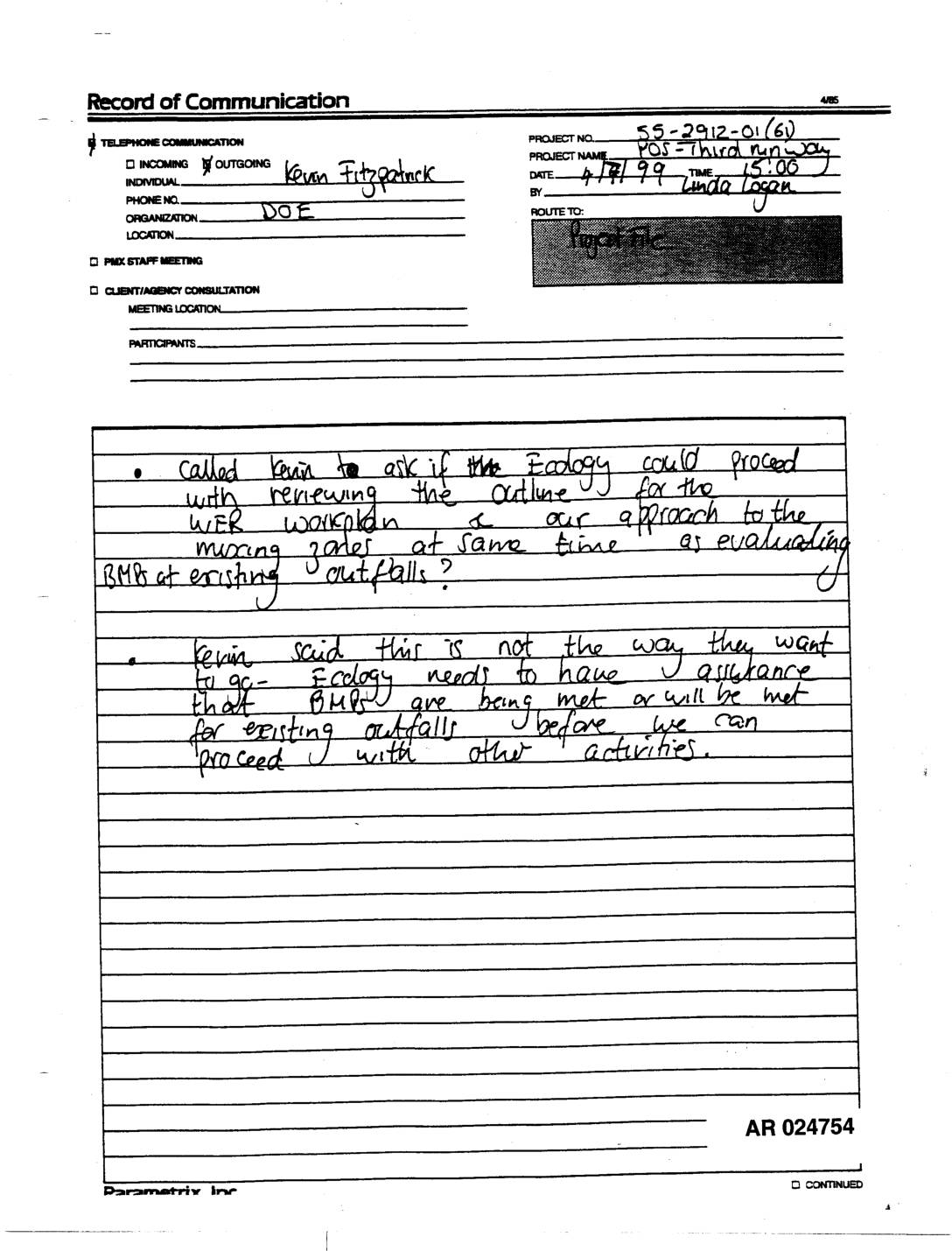
EXH AR024754: DOE Outgoing Call — Third Runway BMP Workplan and Existing Outfalls
A April 17, 1999 outgoing telephone call was made to Kevin Fitzpatrick at the DOE regarding Project No. 55-2912-01(6), the POS Third Runway. The caller asked whether Ecology could proceed with reviewing the outline for the WER workplan and their approach to the mixing zones at the same time as evaluating BMPs at existing outfalls. Fitzpatrick responded that this was not acceptable to Ecology, stating that BMPs for existing outfalls must be addressed or confirmed as met before other project activities could proceed. -
 1999-04-14
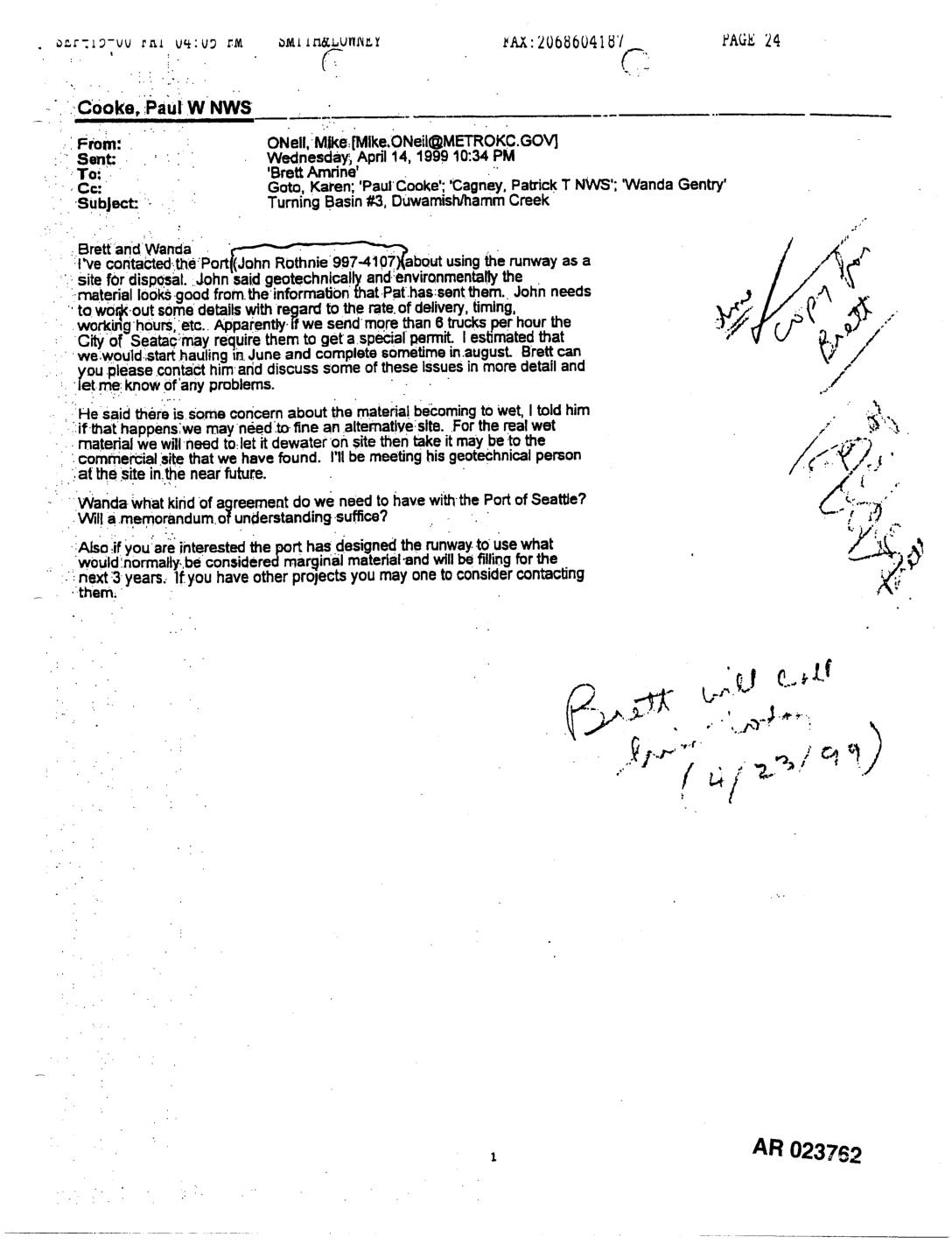
EXH AR023762: Email Turning Basin #3 Duwamish/Hamm Creek Disposal Site Runway Coordination
A April 14, 1999 email from Mike O'Neil of Metro King County discusses plans to use a Port of Seattle runway at Sea-Tac Airport as a disposal site for dredged material from Turning Basin #3 on the Duwamish/Hamm Creek project. The Port's contact, John Rothnie, found the material geotechnically and environmentally acceptable, but noted that sending more than 6 trucks per hour could trigger a special permit requirement from the City of SeaTac. Hauling was estimated to begin in June 1999 and conclude in August, with contingency plans for dewatering especially wet material at an alternative commercial site. -
 1999-04-12
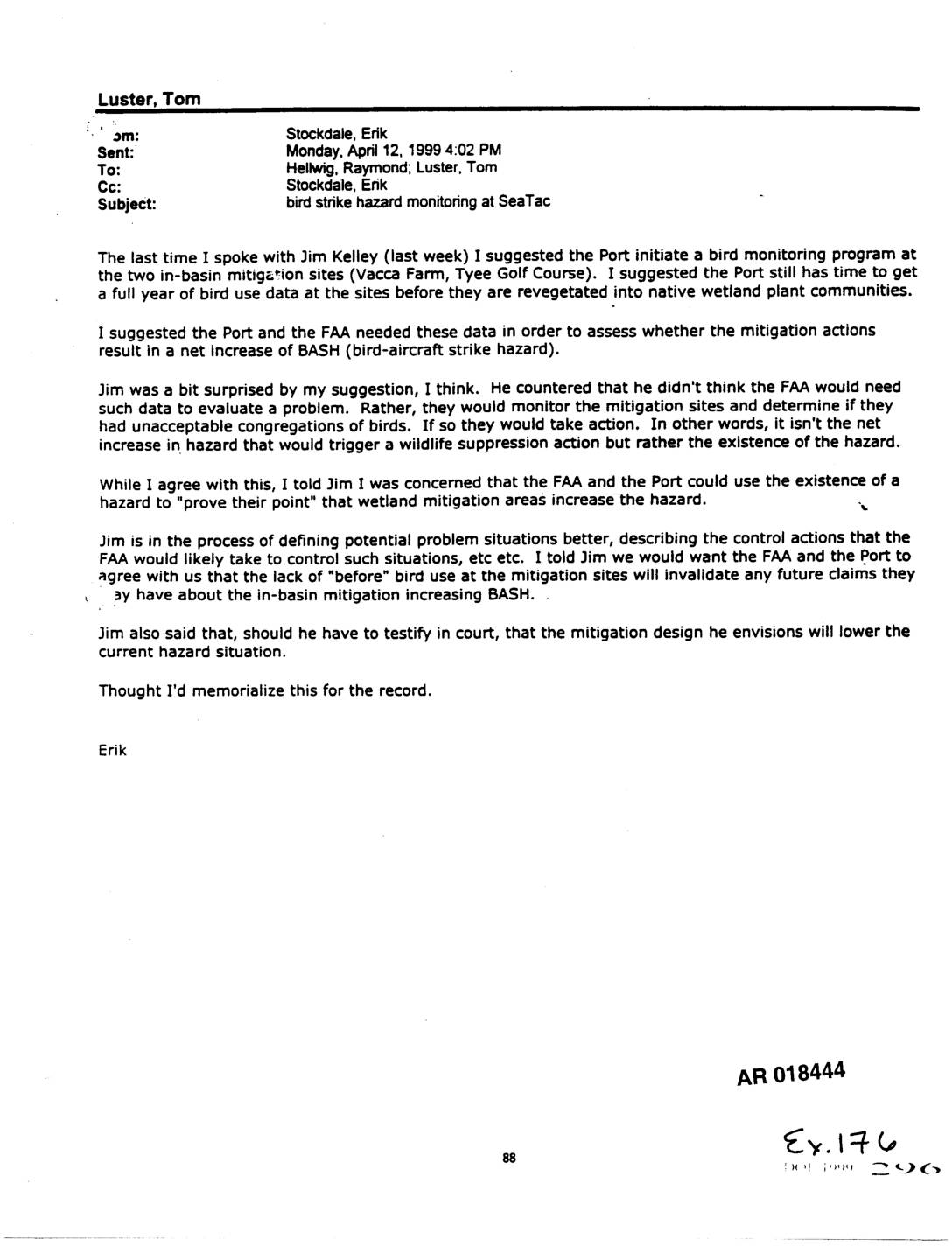
EXH AR018444: Email on Bird Strike Hazard Monitoring at Sea-Tac Airport — Vacca Farm and Tyee Golf Course Mitigation Sites
Email dated April 12, 1999 from Erik Stockdale to Raymond Hellwig and Tom Luster (cc: Erik Stockdale) regarding bird strike hazard (BASH) monitoring at Sea-Tac Airport in-basin mitigation sites Vacca Farm and Tyee Golf Course. Stockdale recounts conversation with Jim Kelley (FAA) about the need for baseline ‘before’ bird use data at mitigation sites prior -
 1999-04-01
EXH AR026946: Assessment of Spawning and Habitat in Three Puget Sound Streams, Washington
BioAnalysts, Inc. report by T.W. Hillman, J.R. Stevenson, and D.J. Snyder prepared for Airport Communities Coalition (ACC), Des Moines, WA. Surveys of habitat composition and condition, redd (nest) abundance and distribution, and spawning population characteristics of coho (Oncorhynchus kisutch), chum (O. keta), and cutthroat trout (O. clarki) in Miller Creek, Walker Creek, and Des Moines -
 1999-03-30
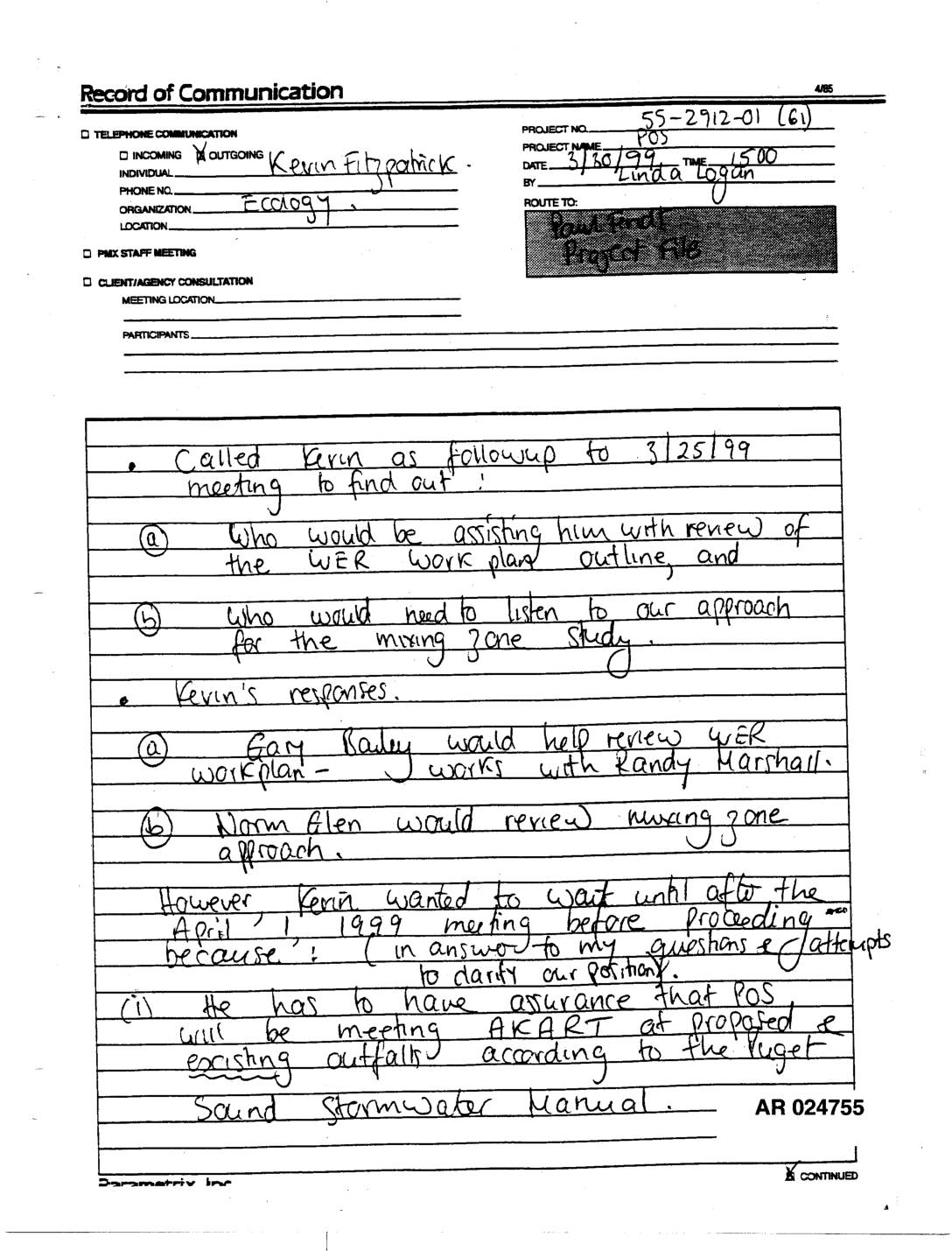
EXH AR024755: Outgoing Call — Kevin Fitzpatrick, Ecology, WER Work Plan & Mixing Zone Study
A March 30, 1999 follow-up phone call was made to Kevin Fitzpatrick of Ecology regarding a WER (Waste Equivalency Ratio) work plan renewal and a mixing zone study approach for a project near Sea-Tac Airport. Fitzpatrick indicated that Gary Bailey would assist with the WER work plan alongside Randy Marshall, and Norm Glen would review the mixing zone approach, but Kevin wanted to wait until after an April 1, 1999 meeting before proceeding. Key outstanding questions included whether existing outfalls already meet treatment standards and whether the Puget Sound Stormwater Manual technology standards would apply to existing outfalls at the site. -
 1999-03-29
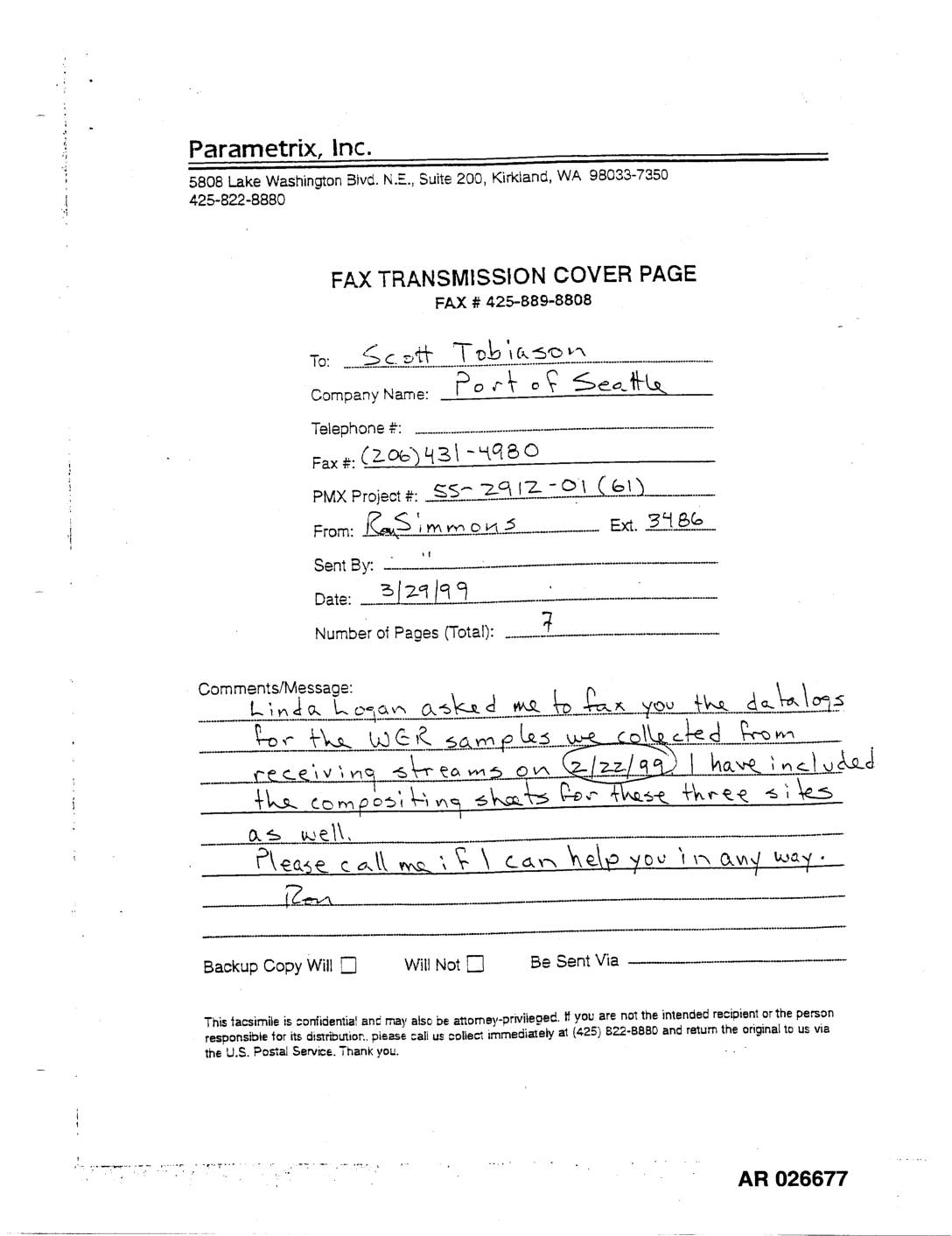
EXH AR026677: Parametrix Fax — WGR Sample Datalogs & Flow Weighting Worksheets, Walker WC Sites (2/22/99)
This document consists of a fax transmission from Parametrix, Inc. to Scott Tobiason at the Port of Seattle, dated March 29, 1999, transmitting water quality data logs and flow weighting calculation worksheets for WGR (water quality) samples collected from receiving streams on February 22, 1999. The attached field data logs record measurements such as pH, temperature, dissolved oxygen, and water levels at a site designated 'WC,' along with observations of rain, sheen, and water color during sampling. A flow weighting calculation worksheet for the 'Walker' site summarizes subsample volumes and calculates a total storm flow of 33,030 units for a 30-inch pipe.