The most requested documents–and all related-content
This page is an attempt to solve a problem we’ve had since the beginning: how to get visitors to study documents and all the related content which often provides the necessary context. For example, most studies are meant to be read by specialists. If you are a layperson, you may only be interested in the ‘one-pager’. This page shows you both.
-
 2002-09-01
A prospective study of some effects of aircraft noise on cognitive performance in schoolchildren
A study tracking 326 schoolchildren around Munich's old and new airports found that exposure to aircraft noise impaired children's reading and long-term memory, while children who were relieved of noise when the old airport closed showed improvements in those same areas. Researchers tested the children before and after the airports switched operations, carefully matching noise-exposed and non-exposed groups by socioeconomic background. The findings suggest that aircraft noise has measurable, but potentially reversible, effects on key cognitive skills in school-age children. -
 2022-01-01
Environmental noise: compendium of WHO and other UN guidance on health and environment, 2022 update
★ 32A 2022 World Health Organization report on environmental noise outlines the health risks posed by traffic, aircraft, and leisure noise, including increased risk of heart disease, sleep disturbance, and hearing impairment. The report recommends that aircraft noise levels stay below 45 dB for average exposure and below 40 dB at night to protect public health. It also defines mitigation strategies ranging from reducing noise at the source to behavior change and community education. -
 1996-02-01
Final Environmental Impact Statement for proposed Master Plan Update development actions at Seattle-Tacoma International Airport
This 1996 Final Environmental Impact Statement, prepared jointly by the FAA and the Port of Seattle, evaluates proposed expansion plans at Seattle-Tacoma International Airport through the year 2020, including the construction of a third parallel runway up to 8,500 feet long, a new north terminal, and various landside improvements. The document assesses environmental consequences across 24 categories—including noise, air quality, water quality, and human health—for a range of alternatives, from building a new regional airport to a no-build option. Ultimately, the Port of Seattle selected Alternative 3 as the preferred option, concluding that Sea-Tac was the only feasible site to address the region's growing air transportation needs. -
 1997-05-13
Final Supplemental Environmental Impact Statement for the Proposed Master Plan Update Development Actions at Seattle-Tacoma International Airport, Volume 1: Main Text and Appendices A through C-1
This 1997 Final Supplemental Environmental Impact Statement (SEIS) examines the environmental effects of proposed expansion plans at Seattle-Tacoma International Airport, including construction of a new third parallel runway, terminal improvements, and parking upgrades. The study was prompted by faster-than-expected growth in air travel demand during the mid-1990s, which exceeded earlier forecasts and required updated analysis of noise, air quality, wetland, and community impacts. The document was jointly prepared by the FAA and the Port of Seattle to ensure the proposed developments met federal and Washington State environmental policy requirements. -
 2025-10-01
NBER: How airplane noise impacts home values, October 2025
NBER Working Paper No. 34431 by Florian Allroggen, R. John Hansman, Christopher R. Knittel, Jing Li, Xibo Wan, and Juju Wang (MIT, Tufts, University of Connecticut), October 2025. Estimates causal effect of aviation noise on U.S. housing prices using quasi-experimental variation from FAA performance-based navigation (PBN) procedures and runway reconfigurations at three major U.S. airports. -
 1974-09-01
Sea-Tac Communities Plan final report Noise Study Volume II
This 1974 noise study, prepared by MAN-Acoustics and Noise, Inc. for the Port of Seattle and King County, examines aircraft noise impacts on communities surrounding Seattle-Tacoma International Airport. It covers noise measurement methodologies, noise exposure calculations, effects of weather and aircraft location, maintenance runups, thrust reverser noise, and background noise levels. The report also evaluates potential noise control alternatives and flight operational changes aimed at reducing noise burdens on nearby residents. -
 1997-02-01
Sea-Tac International Airport impact mitigation study: Initial assessment and recommendations
★ 32The HOK Study. 1997 initial assessment and recommendations report for the Sea-Tac International Airport Impact Mitigation Study, prepared by Hellmuth, Obata + Kassabaum and Raytheon Infrastructure Services. The study was funded by a State of Washington grant on behalf of the cities of Burien, Des Moines, Federal Way, Normandy Park, and Tukwila, as well as -
 1982-06-01
Sea-Tac International Airport noise exposure update
★ 32This June 1982 report, produced by the Port of Seattle, provides an update on noise exposure levels at Seattle-Tacoma (Sea-Tac) International Airport. It documents the extent of aircraft noise affecting surrounding communities, serving as an official record to inform airport noise management and land-use planning policies. The report was part of ongoing efforts by the Port of Seattle to monitor and address the impact of airport operations on nearby residents. -
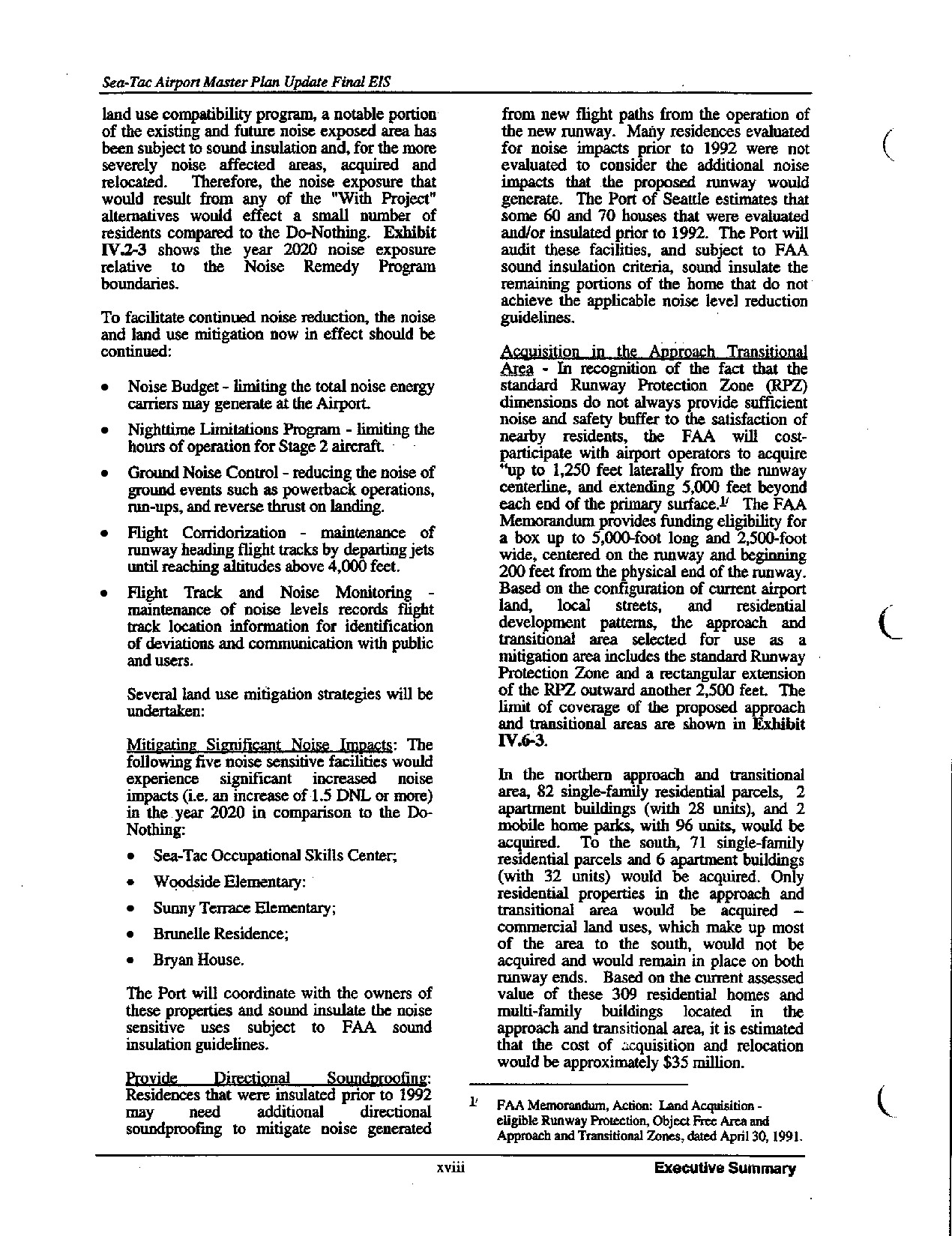
Sea-Tac-Airport-Final-EIS-Feb.-1996-Vol
This page is from the Executive Summary of the Sea-Tac Airport Master Plan Update Final Environmental Impact Statement (EIS), discussing noise mitigation strategies including sound insulation, noise budget limits, nighttime limitations, flight corridorization, and land acquisition in the Approach Transitional Area. It estimates acquisition and relocation costs for approximately 309 residential homes and multi-family buildings at roughly $35 million, referencing an FAA Memorandum dated April 30, 1991. -
 1992-10-01
The Flight Plan Project Final Environmental Impact Statement
The Flight Plan Project, a joint effort by the Puget Sound Regional Council and the Port of Seattle, produced this 1992 Final Environmental Impact Statement to evaluate long-term commercial air transportation options for the central Puget Sound region. It examines system-level alternatives ranging from expanding Sea-Tac Airport to building new airport facilities, assessing trade-offs related to noise, air quality, land use, and regional quality of life. The document serves as a programmatic planning tool, with no single preferred alternative identified, intended to guide future site-specific environmental reviews and regional airport policy decisions. -
The Sea-Tac Communities Plan
★Overview The draft Sea-Tac Communities Plan (STCP) (known as “the Redbook” was delivered to the King County Council and Port of Seattle Commissioners in January 1975 after eighteen months of work and a $641,000 grant from the FAA. The authors were the Policy Advisory Committee, a twelve member group of citizens, King County, Port staff,