TagUniversity Of Washington(27)
-
 2020-12-05
The relationship between flight traffic, ultrafine particles and noise from the Seattle Aircraft Air and Noise Study
Researchers from the University of Washington School of Public Health examined how aircraft flight traffic at Seattle-Tacoma International Airport relates to ultrafine particle pollution and noise levels in surrounding communities. The study highlights that neighborhoods such as Beacon Hill and other South King County areas already rank among the most environmentally burdened in Washington State, facing cumulative hazards including both air and noise pollution from aircraft. The findings are intended to inform policy discussions about the health impacts of airport operations on nearby, often disadvantaged, communities. -
 2020-10-19
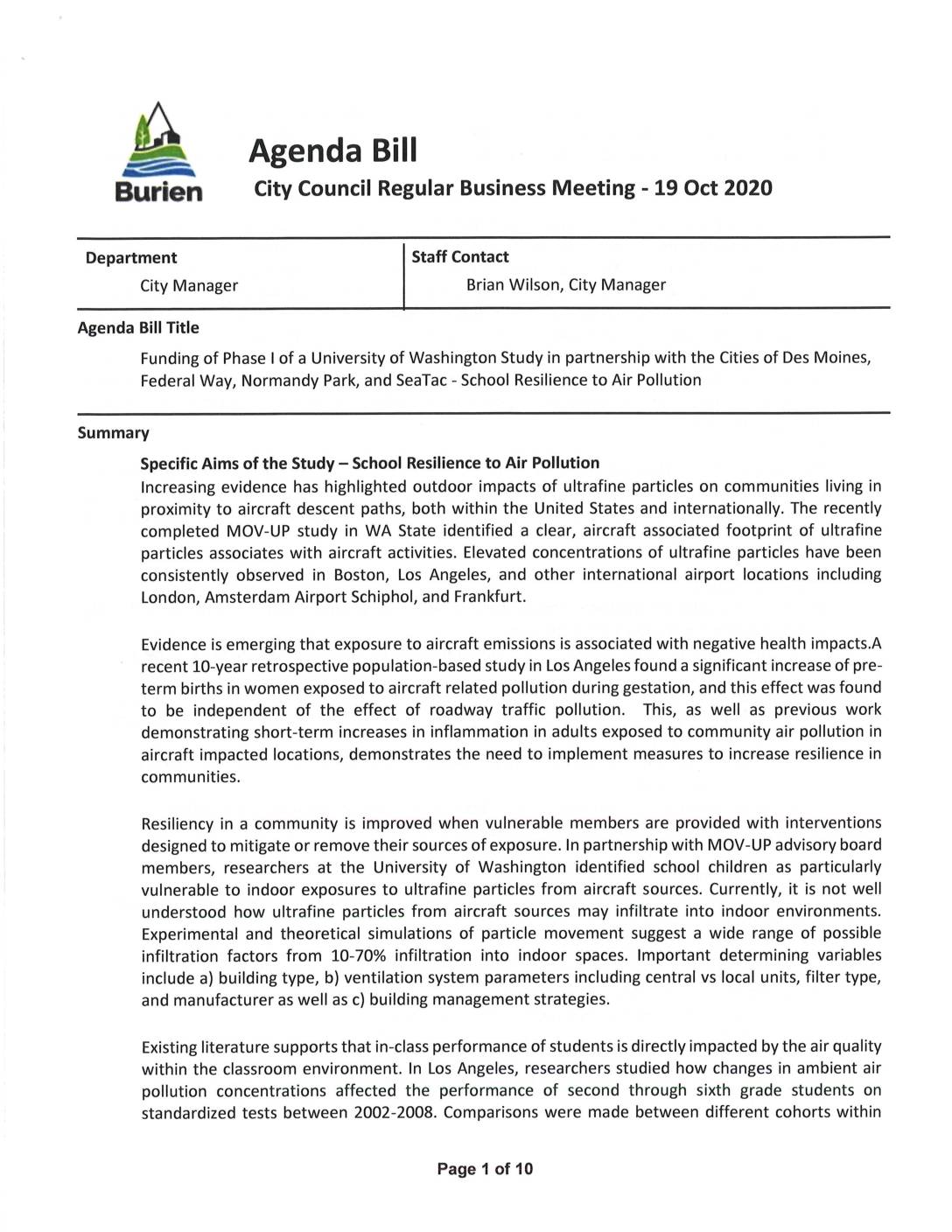
Funding of Phase I of a University of Washington study in partnership with the cities of Des Moines, Federal Way, Normandy Park, and SeaTac — School resilience to air pollution
In October 2020, the City of Burien considered joining Des Moines, Federal Way, Normandy Park, and SeaTac in funding a $62,500 University of Washington study examining how ultrafine particles from aircraft emissions penetrate school buildings near Sea-Tac Airport. The first phase of the study would assess the air filtration efficiency of five schools located north and south of the airport, while a proposed second phase ($250,000) would test interventions to improve indoor air quality and measure their impact on student health and academic performance. Each participating city was asked to contribute $12,500, with the City Manager recommending approval of an Interlocal Agreement to move the project forward. -
 2020-07-12
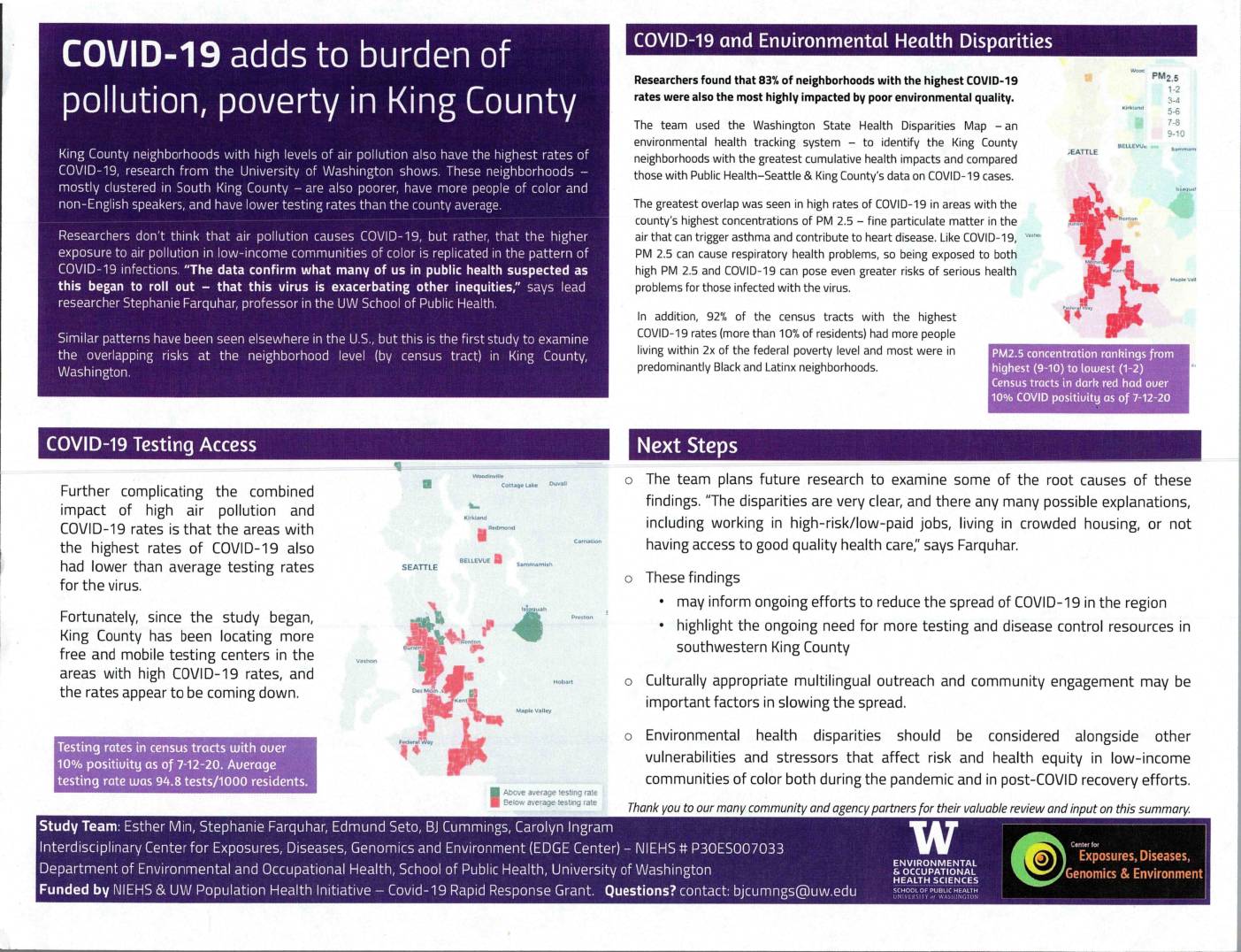
COVID-19 adds to burden of pollution, poverty in King County
A University of Washington study found that King County neighborhoods with the highest air pollution levels, concentrated in South King County, also experienced the highest COVID-19 infection rates. These areas are predominantly lower-income communities of color with below-average COVID-19 testing access. Researchers note that environmental health disparities, not air pollution as a direct cause, mirror the patterns of COVID-19 spread, and call for more testing resources and culturally appropriate outreach in affected communities. -
 2020-07-01
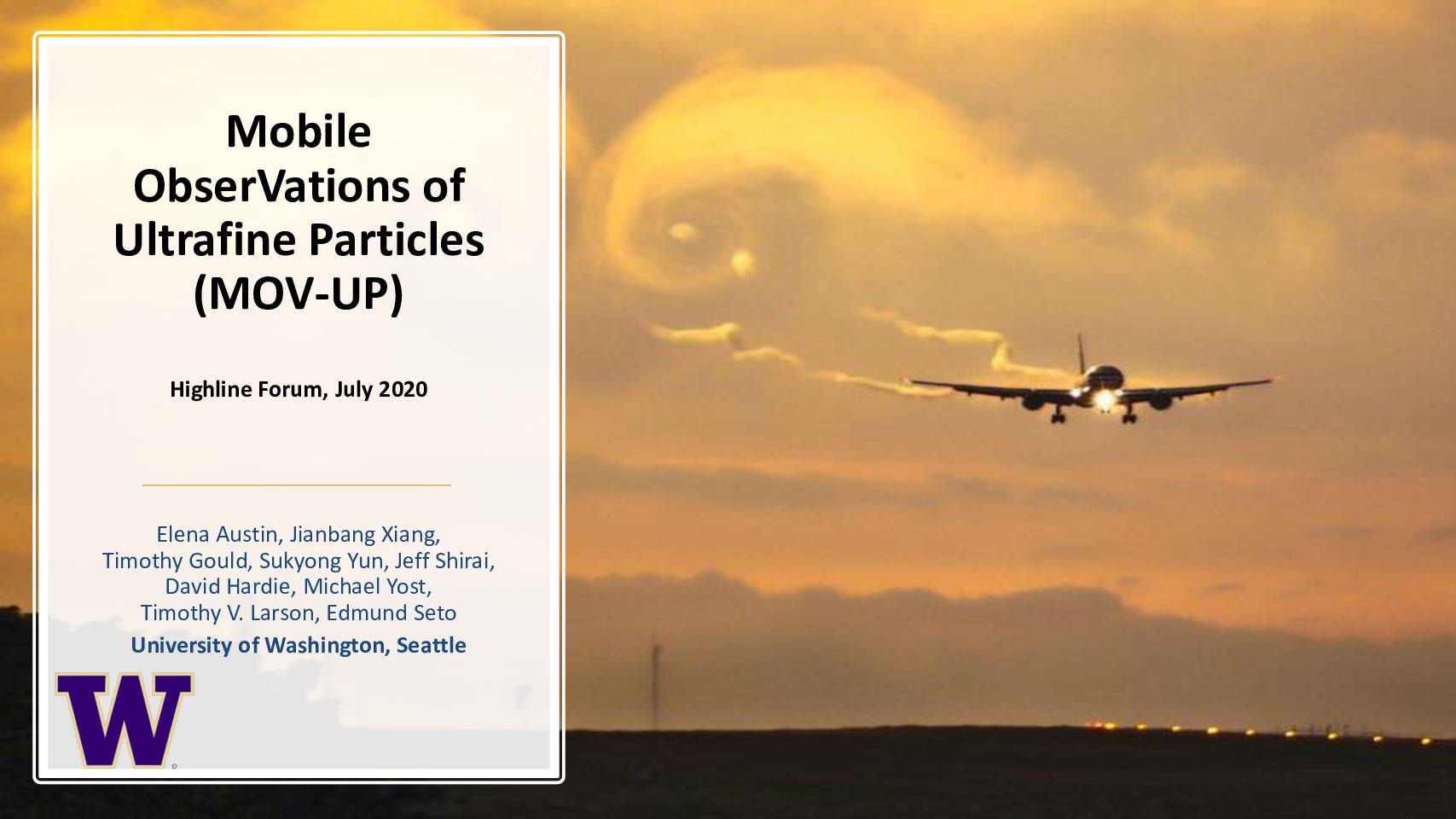
Mobile ObserVations of Ultrafine Particles (MOV-UP)
Researchers at the University of Washington conducted the MOV-UP study to measure ultrafine particle (UFP) pollution around Seattle-Tacoma International Airport and the neighborhoods affected by its air traffic. The study aimed to determine how much of the UFP exposure in surrounding communities comes specifically from jet aircraft, which emit extremely tiny particles (under 30 nanometers) along flight paths, versus other sources like diesel vehicles on nearby roads. Findings and community feedback were shared with local governments to inform air quality and noise policy decisions. -
 2020-05-25
Community health impacts of airports
This presentation by Kim Serry, a University of Washington public health graduate student, reviews research on the community health impacts of airports, covering pollutants, health effects, and which populations are most affected. The session, produced in partnership with Public Health Seattle King County and the UW Center for Health Innovation and Policy Science, also examines local conditions relevant to the Sea-Tac area. The 30-35 minute recorded presentation concludes with an open question-and-answer period. -
 2020-01-01
Understanding the health effects of jet pollution around Sea-Tac Airport
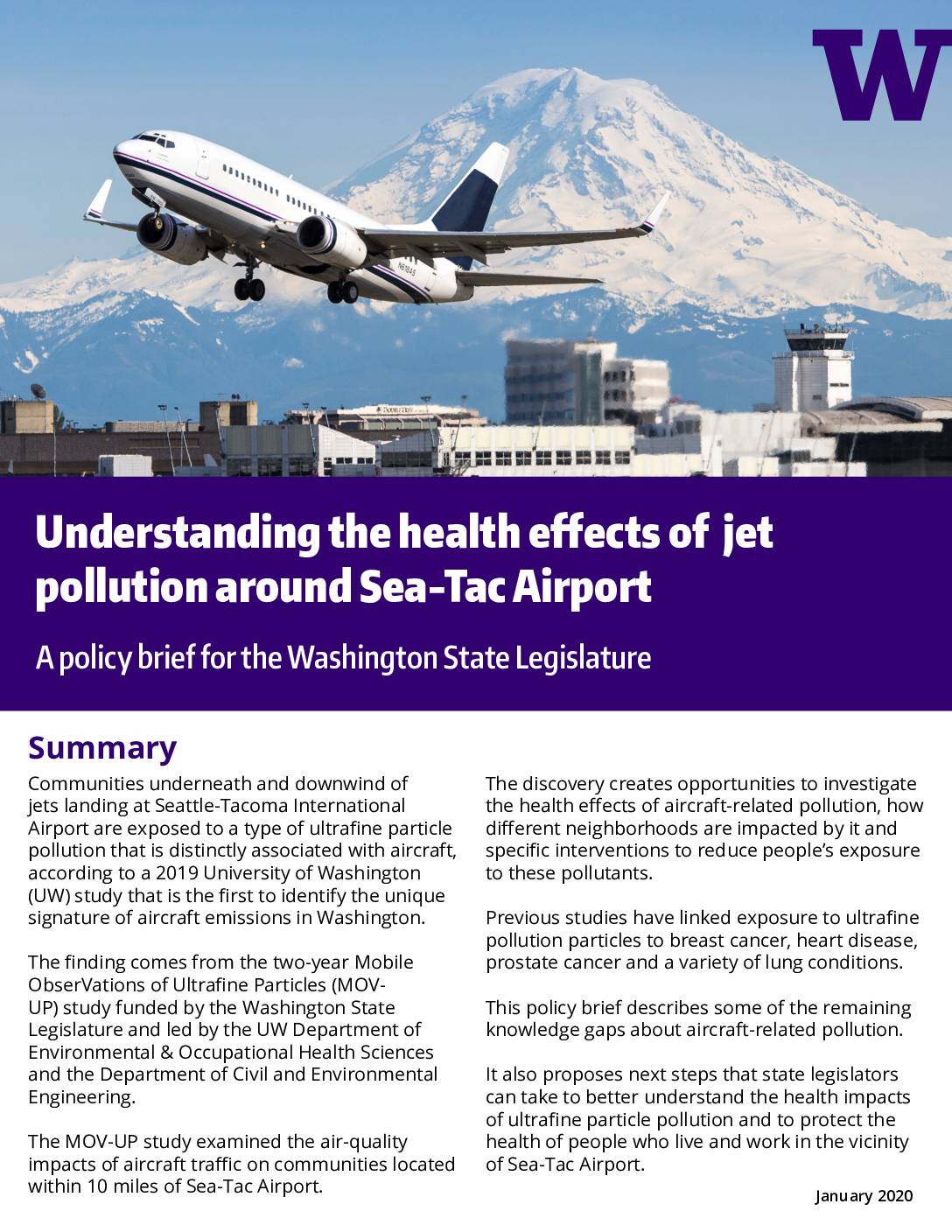
A 2019 University of Washington study found that communities within 10 miles of Seattle-Tacoma International Airport are exposed to ultrafine particle pollution uniquely linked to aircraft emissions, distinct from roadway traffic pollution. These microscopic particles — 700 times thinner than a human hair — are not currently regulated by federal or state air-quality standards, and prior research has associated them with breast cancer, heart disease, prostate cancer, and lung conditions. The policy brief calls on Washington State legislators to fund a follow-up two-year study to investigate the health impacts on nearby communities, which tend to be poorer and more racially diverse than King County as a whole. -
Sea-Tac Airport exposes communities to unique kind of pollution, UW study says
SEATAC, Wash. – Planes landing at Sea-Tac Airport are polluting nearby communities and schools with a unique set of substances, a new University of Washington study confirms. The two-year project found that ultrafine particle pollution from aircraft landings within a 10-mile radius of the airport expose communities to more pollution over a larger area than -
 2019-12-01
Mobile ObserVations of Ultrafine Particles: The MOV-UP study report
★ 32The MOV-UP (Mobile ObserVations of Ultrafine Particles) study was a two-year University of Washington research project, funded by the State of Washington, that measured air quality impacts from aircraft traffic on communities living near and beneath the flight paths of Seattle-Tacoma International Airport. Researchers used mobile monitoring methods to collect ultrafine particle data across the affected neighborhoods, working alongside local governments, community members, and an advisory group of agency and city representatives. The findings are intended to inform policymakers and the public about the air pollution risks associated with airport operations in the Seattle-Tacoma region. -
 2019-05-07
Federal Way Mayor and City Council Letter to UW Professors Larson and Seto Requesting Expansion of MOV-UP Ultrafine Particle Study Near Sea-Tac Airport
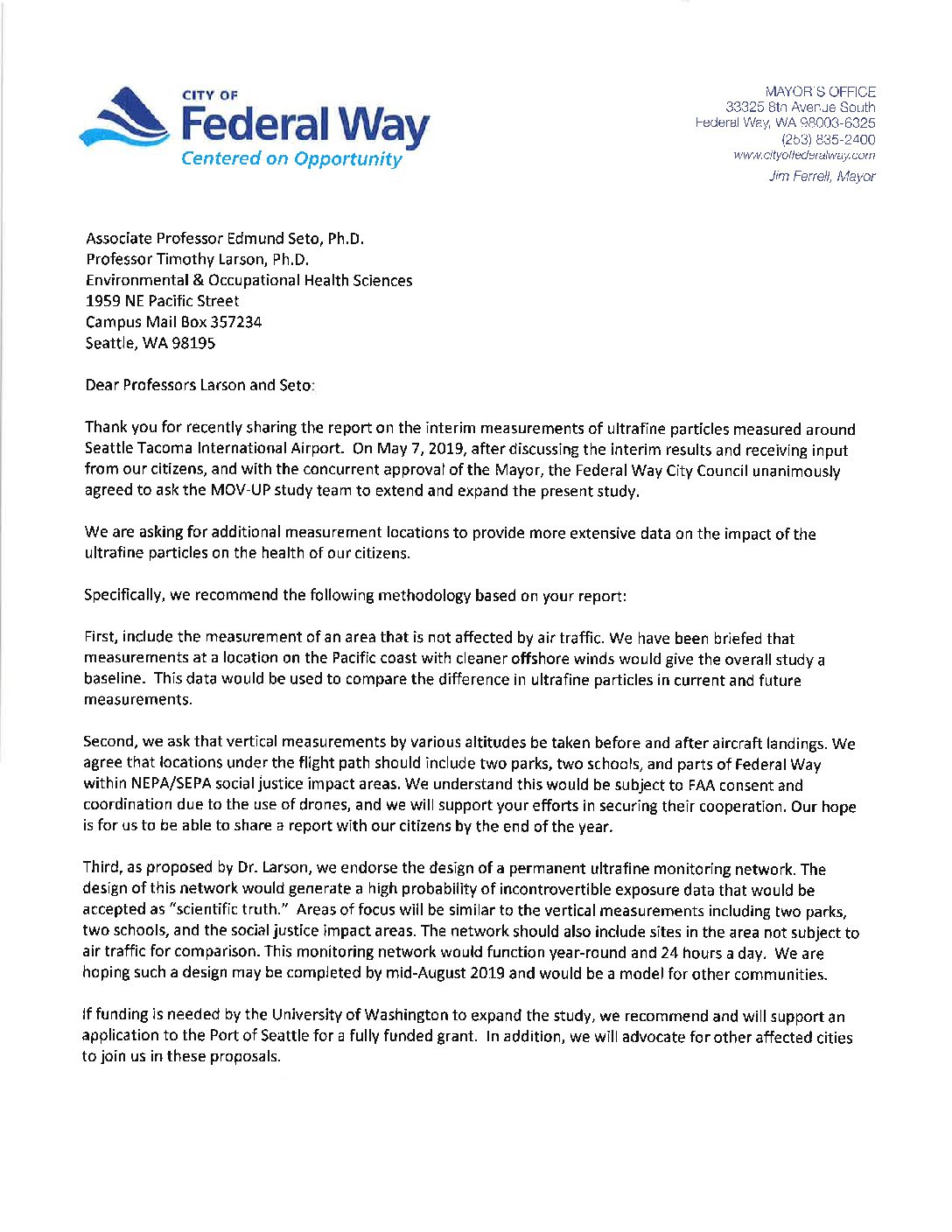
In May 2019, Federal Way Mayor Jim Ferrell and the unanimous City Council wrote to University of Washington researchers requesting an expansion of the MOV-UP study measuring ultrafine particle pollution around Seattle-Tacoma International Airport. The letter calls for three key additions: a baseline measurement site unaffected by air traffic, drone-based vertical air sampling before and after aircraft landings at parks, schools, and social justice impact areas, and the design of a permanent 24/7 ultrafine particle monitoring network. The city also offered to support a Port of Seattle grant application to fund the expanded research and pledged to encourage other affected communities to join the effort. -
 2019-04-01
Ambient Ultrafine Particles Near Sea-Tac Airport: Presentation to the Federal Way Transportation & Planning Commission
Researchers from the University of Washington studied ultrafine particles (UFPs) — tiny airborne pollutants less than 100 nanometers in diameter — near Seattle-Tacoma International Airport. Their findings highlight that jet aircraft engines produce exceptionally small particles (under 30 nanometers), while diesel vehicles also contribute elevated UFP levels within about 200 meters of major roads. Although UFPs are currently unregulated, a growing body of scientific evidence suggests they pose significant health risks to nearby communities.