TagThird Runway(1084)
-
 2000-06-12
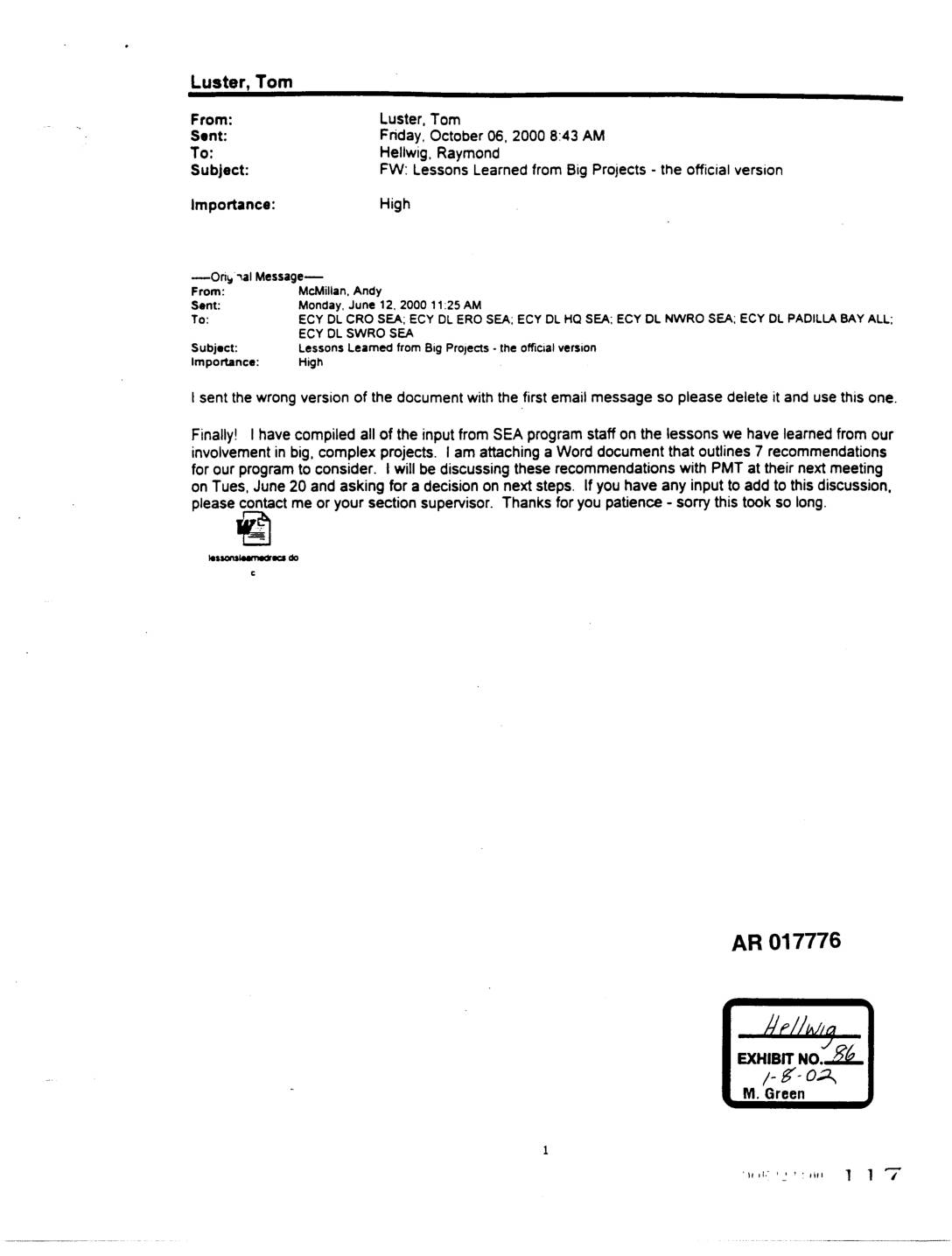
EXH AR017776: Lessons Learned from “Big” Projects — Recommendations for SEA Program
Email from Andy McMillan (SEA program) dated June 12, 2000, forwarded by Tom Luster to Raymond Hellwig on October 6, 2000, transmitting the official version of a Word document titled “Lessons Learned from Big Projects: Recommendations for SEA Program.” The attached document outlines 7 recommendations developed from SEA program staff experiences with large, complex projects -
 2000-06-06
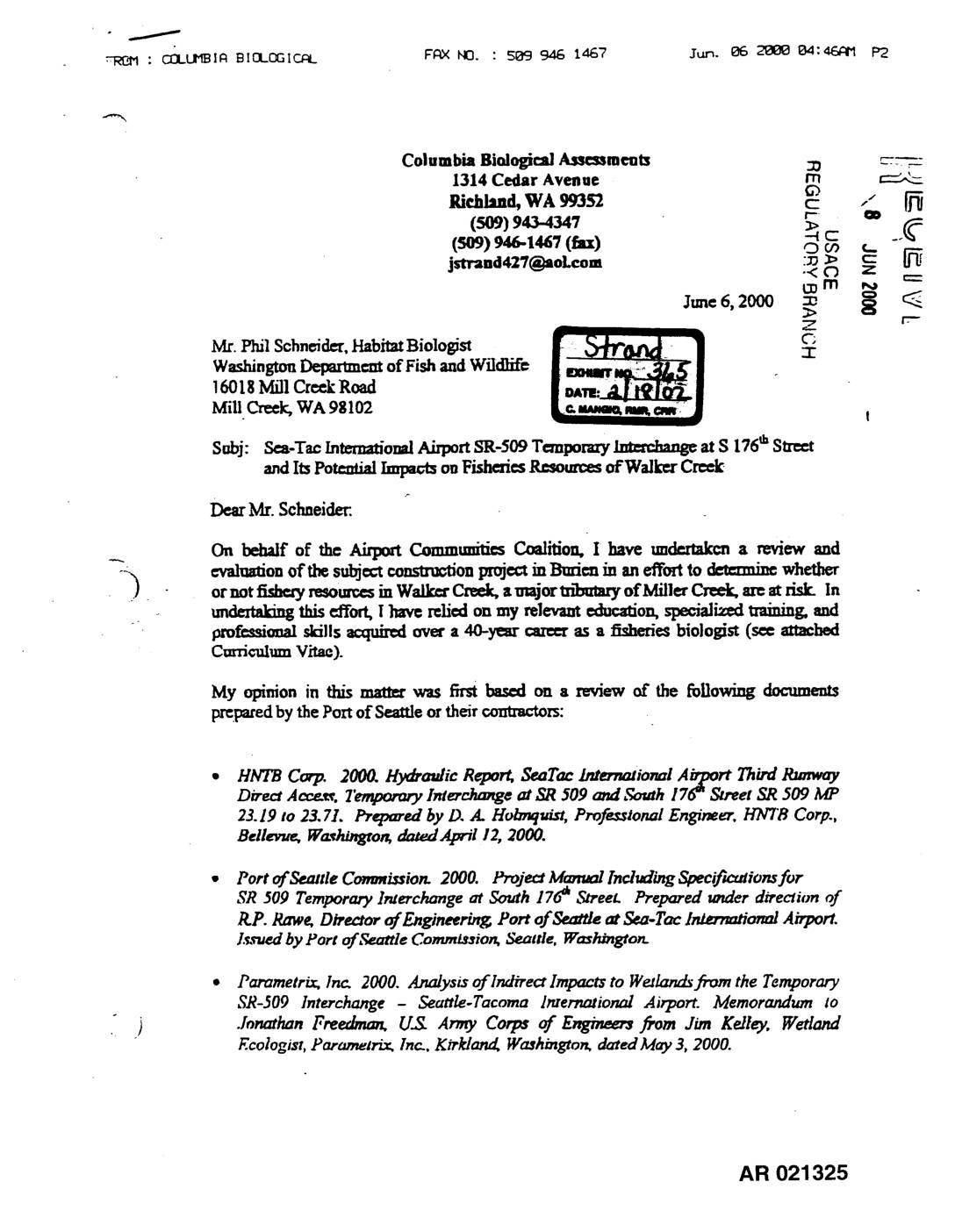
EXH AR021325: Columbia Biological Assessments to WDFW — SR-509 Temp Interchange Fisheries Impacts S 176th St
A fisheries biologist hired by the Airport Communities Coalition assessed the potential environmental impacts of a temporary SR-509 interchange construction project near Seattle-Tacoma International Airport, concluding that the project posed serious risks to fish and wetland resources in Walker Creek. The report found that proposed erosion control measures, such as silt fences and whattles, were grossly inadequate given the steep terrain (slopes of 40–60%) adjacent to Wetlands 43 and 44, and that sediment-laden stormwater runoff containing metals and polycyclic aromatic hydrocarbons would likely reach these sensitive areas. The biologist also criticized the Port of Seattle and its contractor, Parametrix, Inc., for failing to conduct fish species inventories and for providing little documentation to support their claim that no significant wetland impacts would occur. -
 2000-06-01
EXH AR045252: Subsurface Conditions Data Report, West MSE Wall, Third Runway Embankment, Sea-Tac Airport
Hart Crowser draft subsurface conditions data report (project J-4978.21) prepared for Port Of Seattle and HNTB, June 2000, covering the West MSE (Mechanically Stabilized Earth) Wall for the Third Runway Embankment at Sea-Tac International Airport. Report includes generalized geologic conditions, subsurface soil conditions, consolidation test results, CU and UU triaxial compression test results, hydrogeologic conditions, -
 2000-06-01
EXH AR045402: Preliminary Stability and Settlement Analyses — Subgrade Improvements, MSE Wall Support, Third Runway Project
Hart Crowser report (J-4978-22) prepared for HNTB, June 2000, analyzing preliminary stability and settlement for subgrade improvements supporting Mechanically Stabilized Earth (MSE) walls at the Sea-Tac Airport Third Runway Project. Covers three MSE wall locations — North Safety Area, West MSE Wall, South MSE Wall — with analysis of subgrade improvement alternatives including overexcavation and -
2000-05-31
Just out of Port, Locke sails into environmental tempest
By O. Casey corr May 31, 2000 Publication: Seattle Times, The (WA) Page: B6 Word Count: 733 NORMANDY PARK – Just west of Sea-Tac Airport, down a leafy valley patrolled by eagles, Miller Creek teems with ducks, trout, salmon and potential trouble for Gov. Gary Locke. The creek is a showcase for why Locke can’t -
 2000-05-30
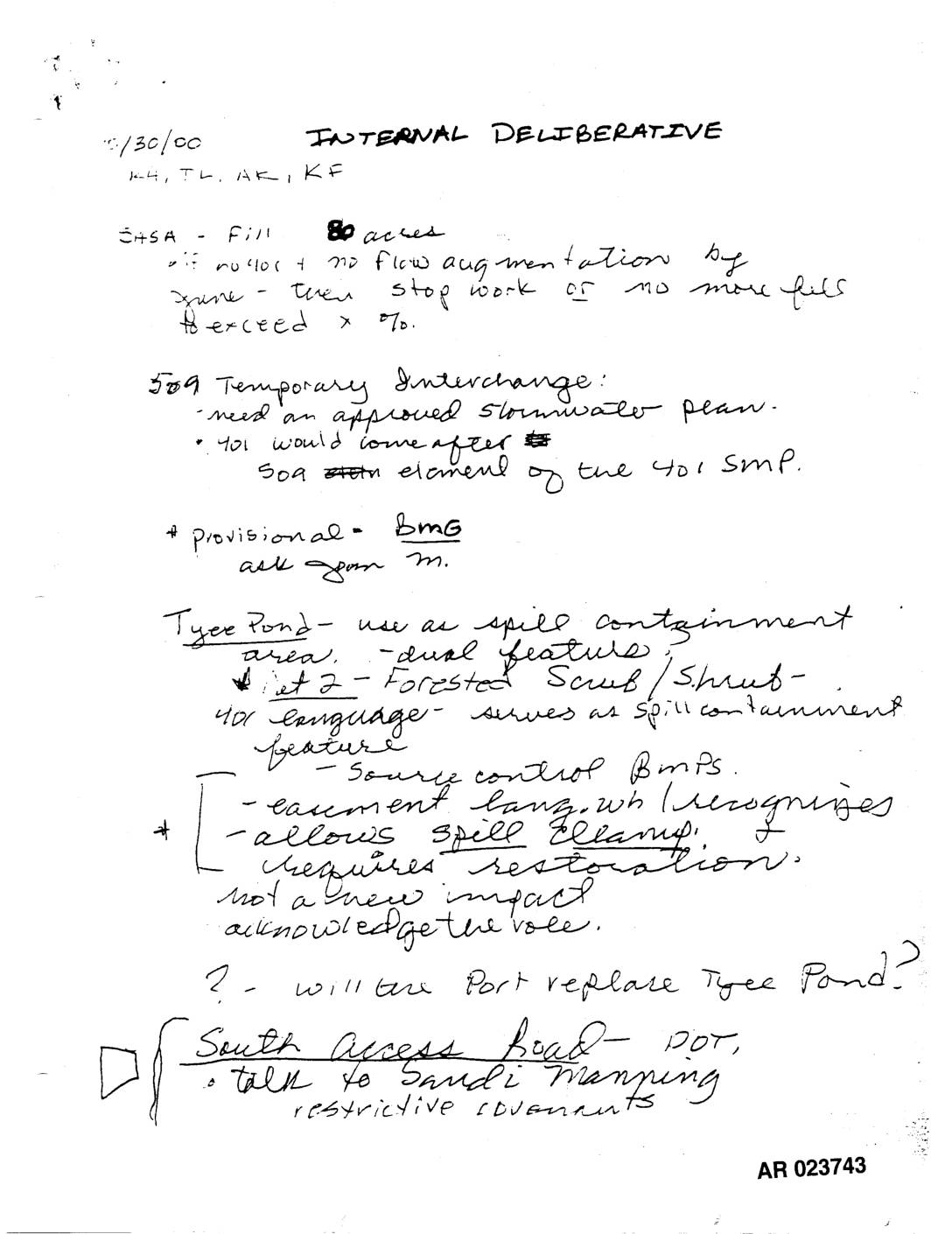
EXH AR023743: Internal Deliberative Notes — Third Runway EIS Fill, Stormwater, Tyee Pond, Soil Fill Criteria, Water Quality BMPs
These internal deliberative notes from 5/30/00 discuss fill and stormwater management issues related to a construction or development project, covering topics such as soil fill acceptance criteria, Best Management Practices (BMPs) for water quality, spill containment features at Tyee Pond, and monitoring requirements for dissolved metals. The notes reference coordination among multiple regulatory frameworks including Section 401, CZM, and MTCA, and address questions about impervious liner hydrologic impacts and remediation procedures. Key action items include developing an approved stormwater plan, establishing soil sampling protocols for borrow sites, and determining upfront versus incremental BMP implementation strategies. -
 2000-05-25
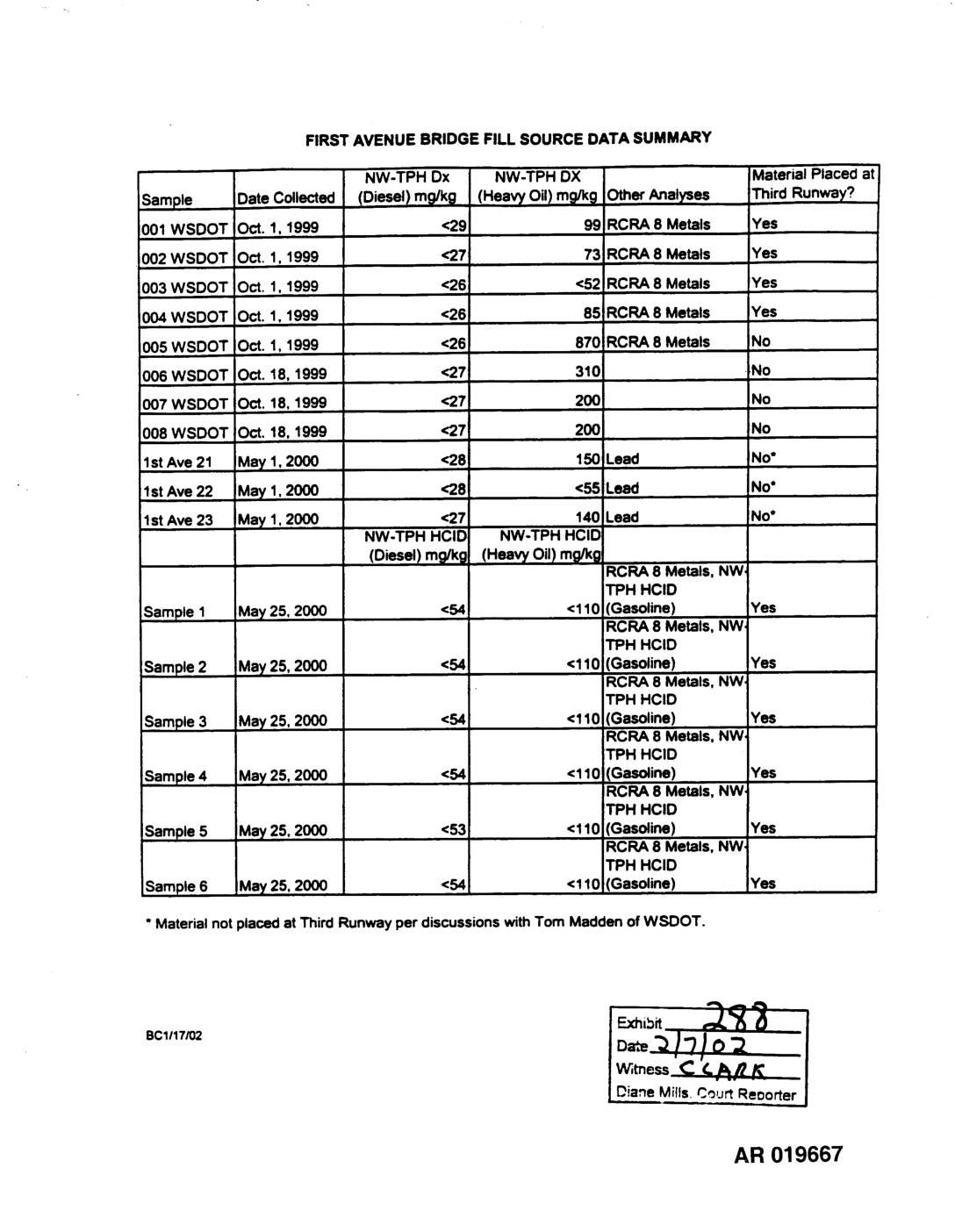
EXH 288: First Avenue Bridge Fill Source Data Summary
This document summarizes soil contamination test results for fill material taken from the First Avenue Bridge site, collected between October 1999 and May 2000. Samples were tested for petroleum hydrocarbons (diesel and heavy oil ranges) as well as RCRA 8 metals and other contaminants, with results indicating varying levels of heavy oil detected across samples. The table notes which soil samples were ultimately placed at the Third Runway construction site at Sea-Tac Airport, with several samples excluded due to contamination concerns. -
 2000-05-24
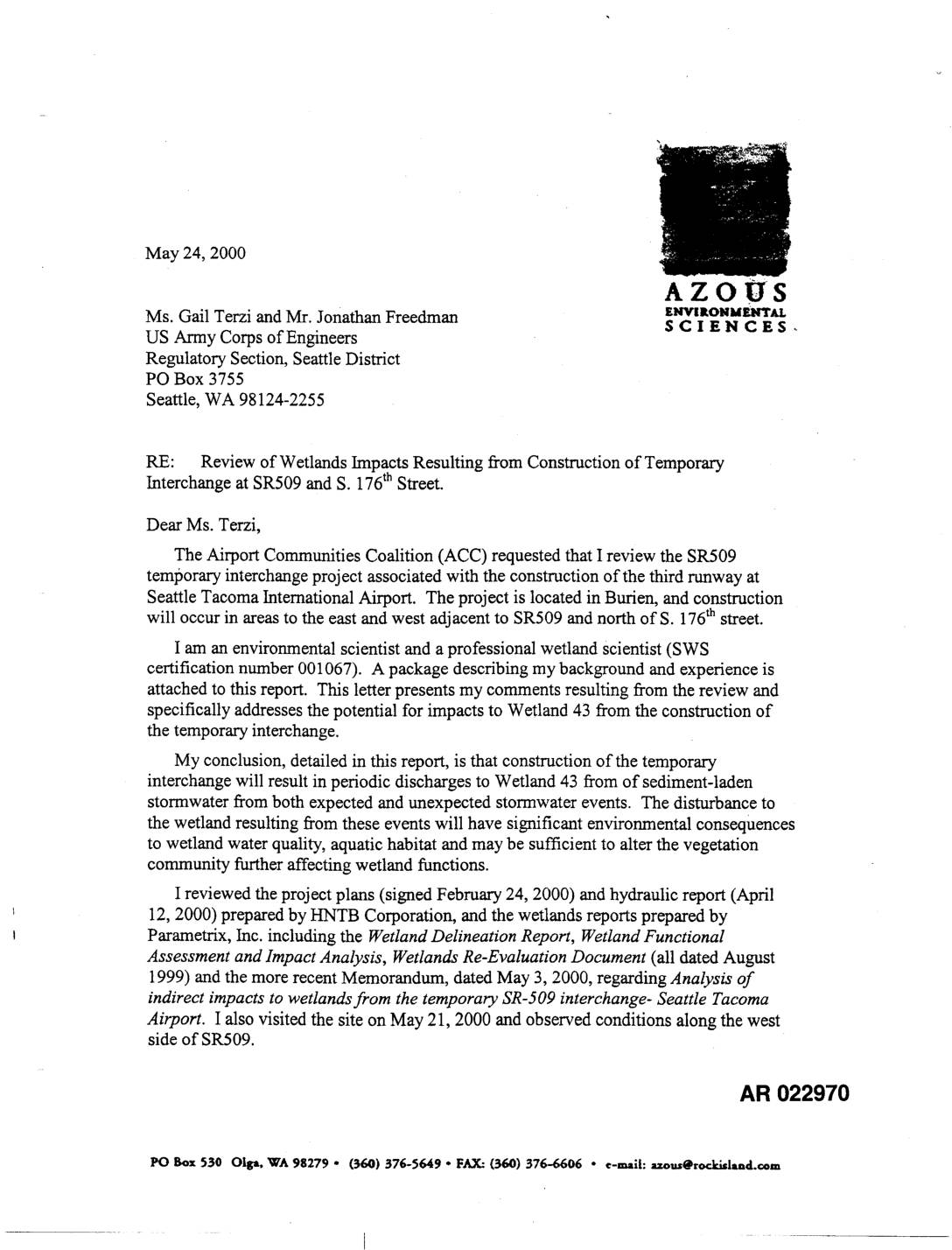
EXH AR022970: ACC Review Letter — SR509 Temp Interchange Wetland 43 Impacts
A professional wetland scientist reviewed the construction plans for a temporary SR509 interchange near Seattle-Tacoma International Airport and concluded that the project would cause harmful sediment-laden stormwater runoff to discharge into nearby Wetland 43. The report found that the wetland boundary was significantly closer to the construction zone than project documents indicated, and that the steep slopes and sparse vegetation of the construction site made sediment runoff unavoidable. The scientist determined that the planned temporary erosion control measures were inadequate to protect the wetland, particularly during unexpected storm events. -
 2000-05-23
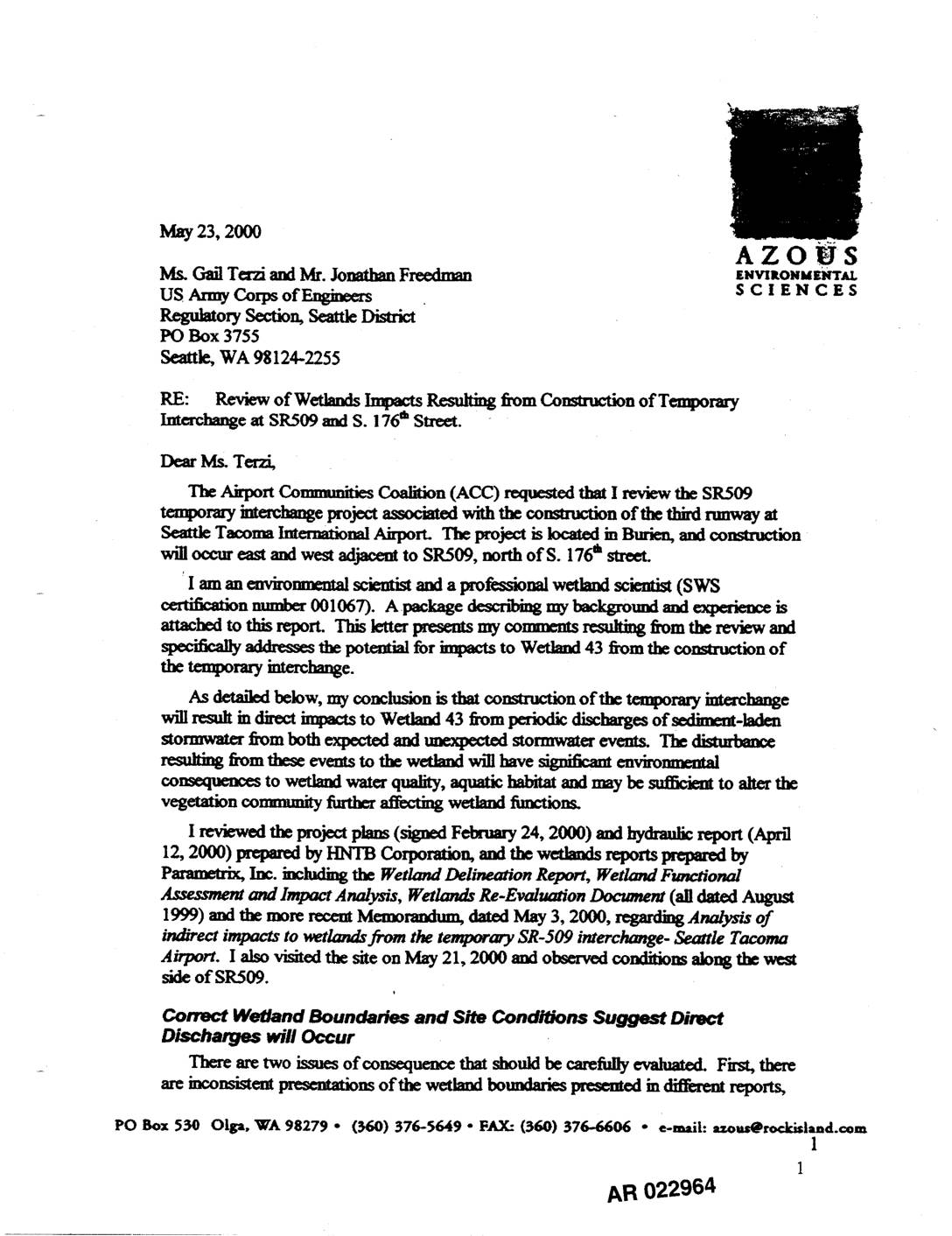
EXH AR022964: ACC Review Letter — Wetlands Impacts, Temp Interchange SR-509 & S. 176th St
A May 2000 environmental science review raised concerns that construction of a temporary highway interchange near Seattle-Tacoma International Airport's third runway would cause direct sediment runoff into the adjacent Wetland 43. The report found that the wetland boundary was up to 50 feet closer to the construction zone than project documents indicated, and that the steep slopes and inadequate erosion controls would fail to prevent sediment-laden stormwater from damaging the wetland's water quality and aquatic habitat. -
 2000-05-22
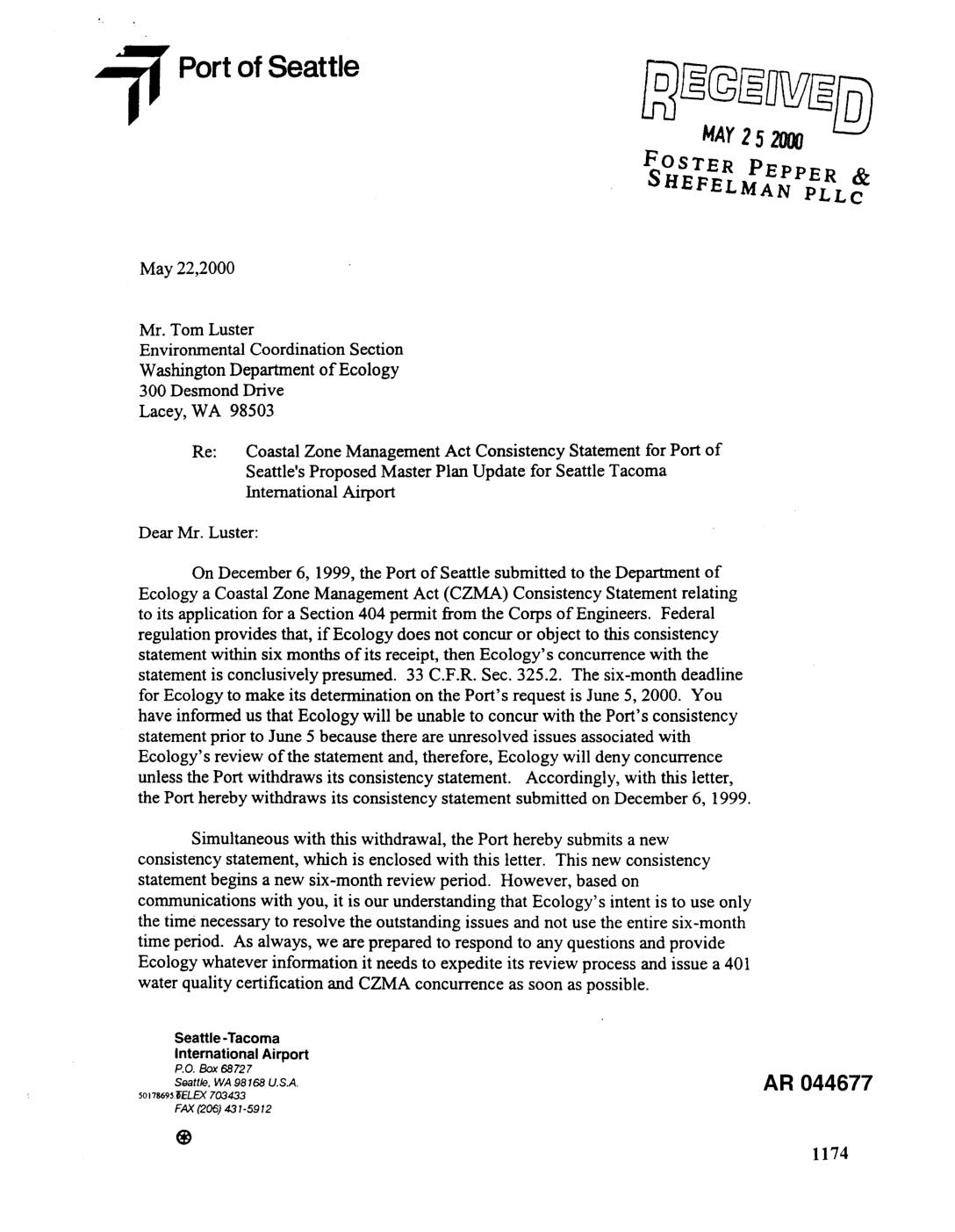
EXH AR044677: Port Of Seattle Letter Withdrawing and Resubmitting CZMA Consistency Statement for Sea-Tac Airport Third Runway
Letter dated May 22, 2000 from Elizabeth Leavitt, Manager of Aviation Environmental Programs at Port Of Seattle, to Tom Luster at Washington Department of Ecology (Environmental Coordination Section), withdrawing the December 6, 1999 CZMA Consistency Statement and simultaneously submitting a new one to reset the six-month review period under 33 C.F.R. Sec. 325.2. The withdrawal