TagStormwater(373)
-
 2002-10-22
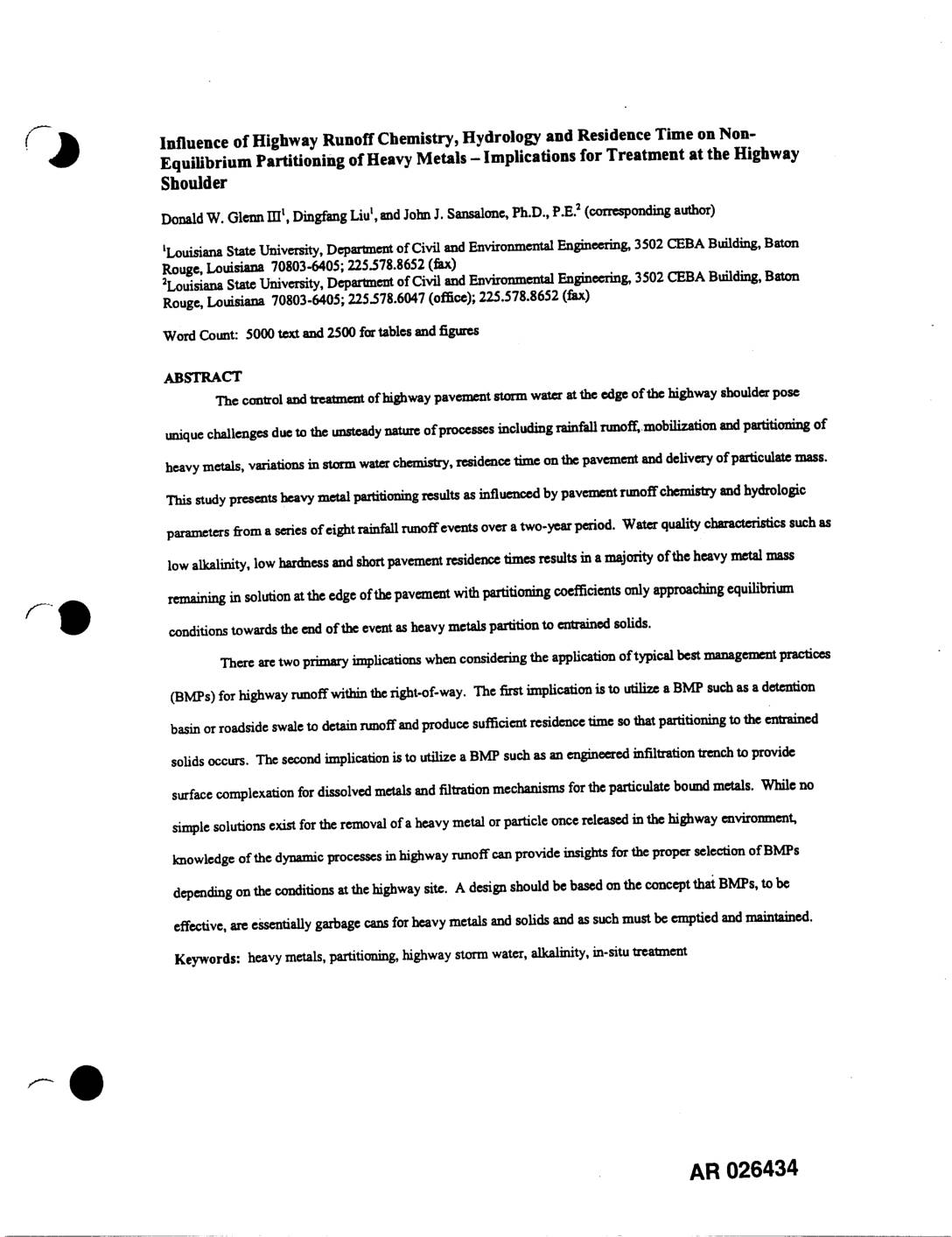
EXH AR026434: Highway Runoff Chemistry Hydrology Residence Time Non-Equilibrium Partitioning Heavy Metals Treatment
This research study examines how heavy metals in highway stormwater runoff behave as water flows off pavement, finding that most heavy metals remain dissolved rather than attaching to solid particles due to low alkalinity and short travel times on the pavement surface. The study, conducted on Interstate 75 in Cincinnati over two years, explores how best management practices like detention basins or infiltration trenches could be used to capture these metals before they reach receiving waters. -
 2002-10-22
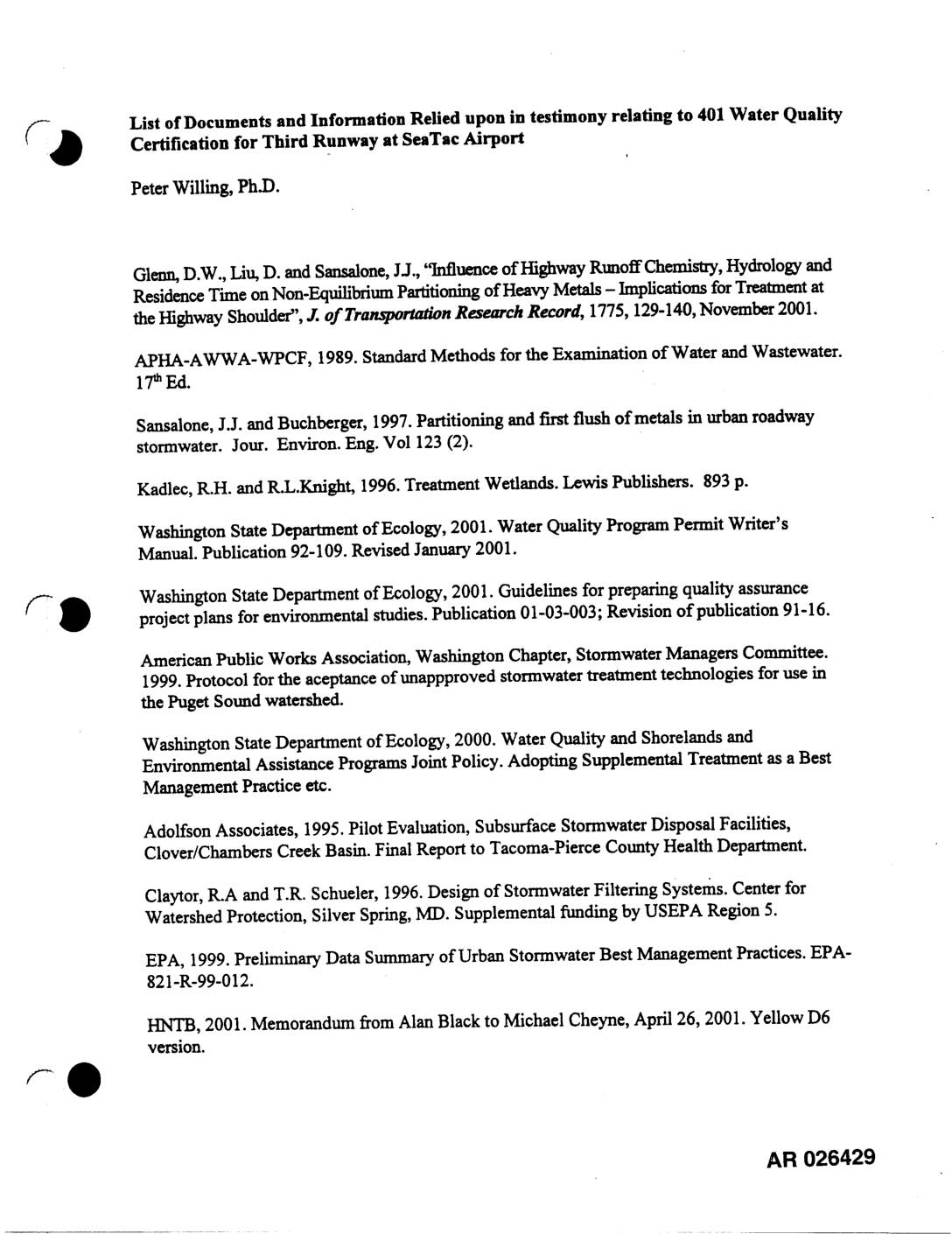
Exhibit 713: List of Documents and Information Relied Upon in Testimony Relating to 401 Water Quality Certification for Third Runway at Sea-Tac Airport
Reference list compiled by Peter Willing, Ph.D., of documents relied upon in testimony regarding the 401 Water Quality Certification for the Third Runway at Sea-Tac Airport. Sources cited include studies on highway runoff chemistry, heavy metals partitioning, urban stormwater BMPs, treatment wetlands, NPDES permits, and Port of Seattle annual stormwater monitoring reports (1998–2001). Key references -
 2002-10-22
EXH 711: Bibliography — Stormwater & Aquatic Environmental References, STIA EIS
This document is a reference bibliography (Exhibit B) listing scientific and regulatory sources related to environmental monitoring at Seattle-Tacoma International Airport. It includes studies on stormwater quality, aircraft de-icing and anti-icing fluid toxicity, aquatic habitat assessment, and sediment guidelines, drawn from sources such as the Port of Seattle, Parametrix Inc., and various environmental agencies. The references support environmental compliance reporting under the airport's NPDES stormwater permit. -
 2002-10-22
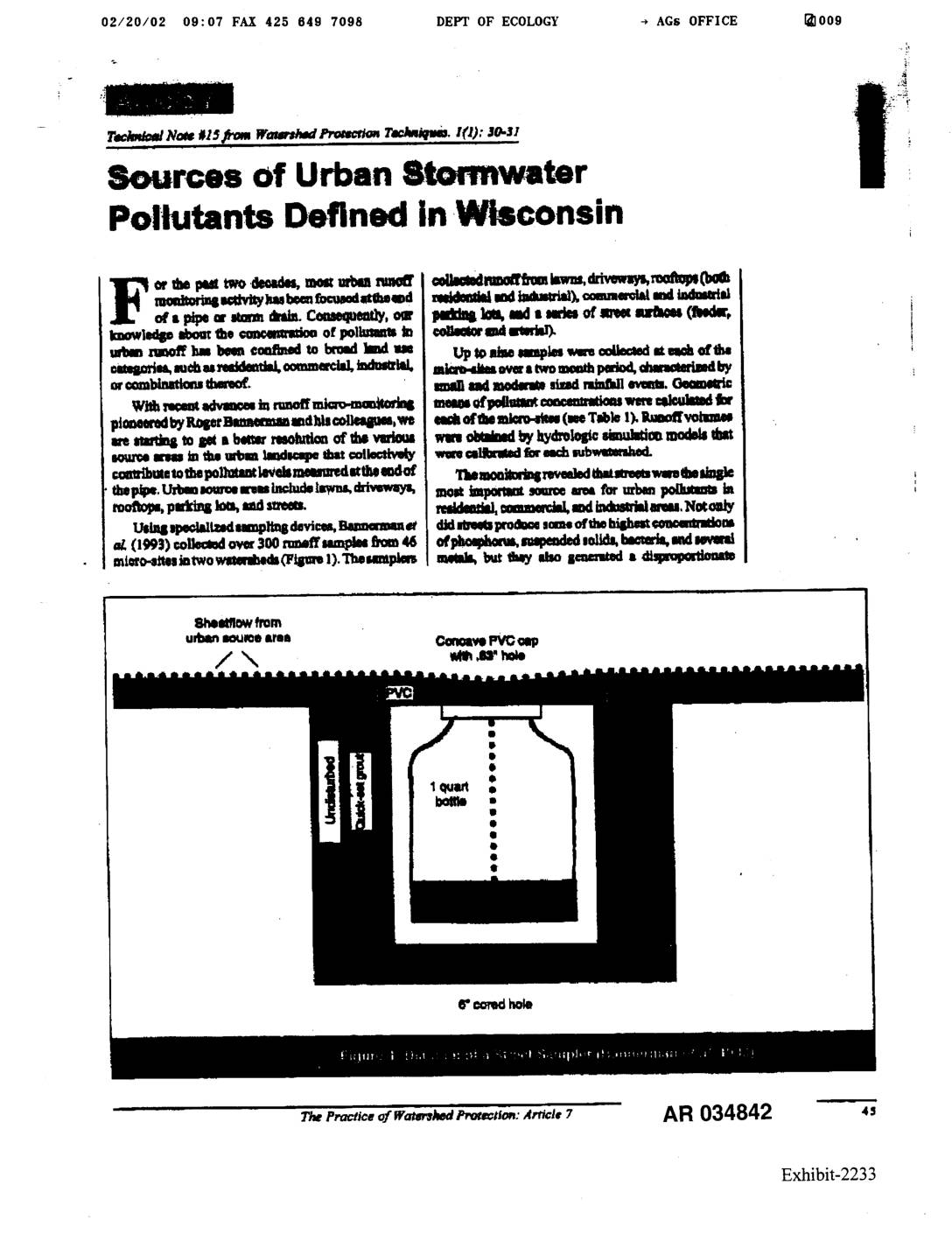
Exhibit 2233: Sources of Urban Stormwater Pollutants Defined in Wisconsin
Technical Note #15 from Watershed Protection Techniques, I(1):30-31, covering sources of urban stormwater pollutants as defined in Wisconsin. Based on Bannerman, R., D. Owens, R. Dodds, and N. Hornewer (1993) study published in Water Science & Technology (28):3-5, pp. 241-259. Over 300 runoff samples collected from 46 micro-sites in two watersheds. Documents pollutant concentrations of -
 2002-10-22
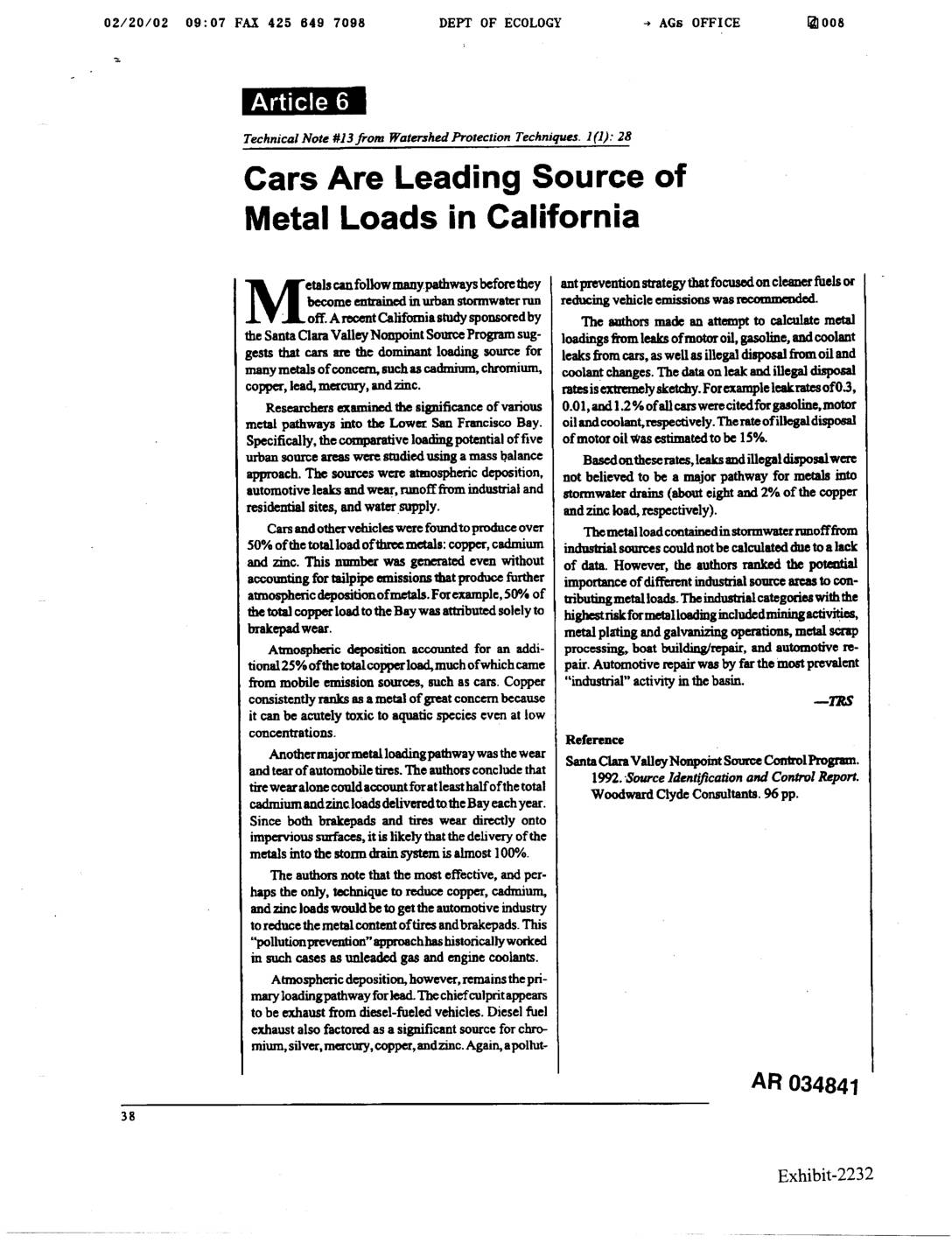
EXH AR034841: Cars Are Leading Source of Metal Loads in California
Technical Note #13 from Watershed Protection Techniques 1(1):28, summarizing a Santa Clara Valley Nonpoint Source Program study on metal pathways into the Lower San Francisco Bay. Cars and vehicles found to produce over 50% of total loads of copper, cadmium, and zinc; brake pad wear alone accounts for 50% of total copper load; tire wear -
 2002-10-22
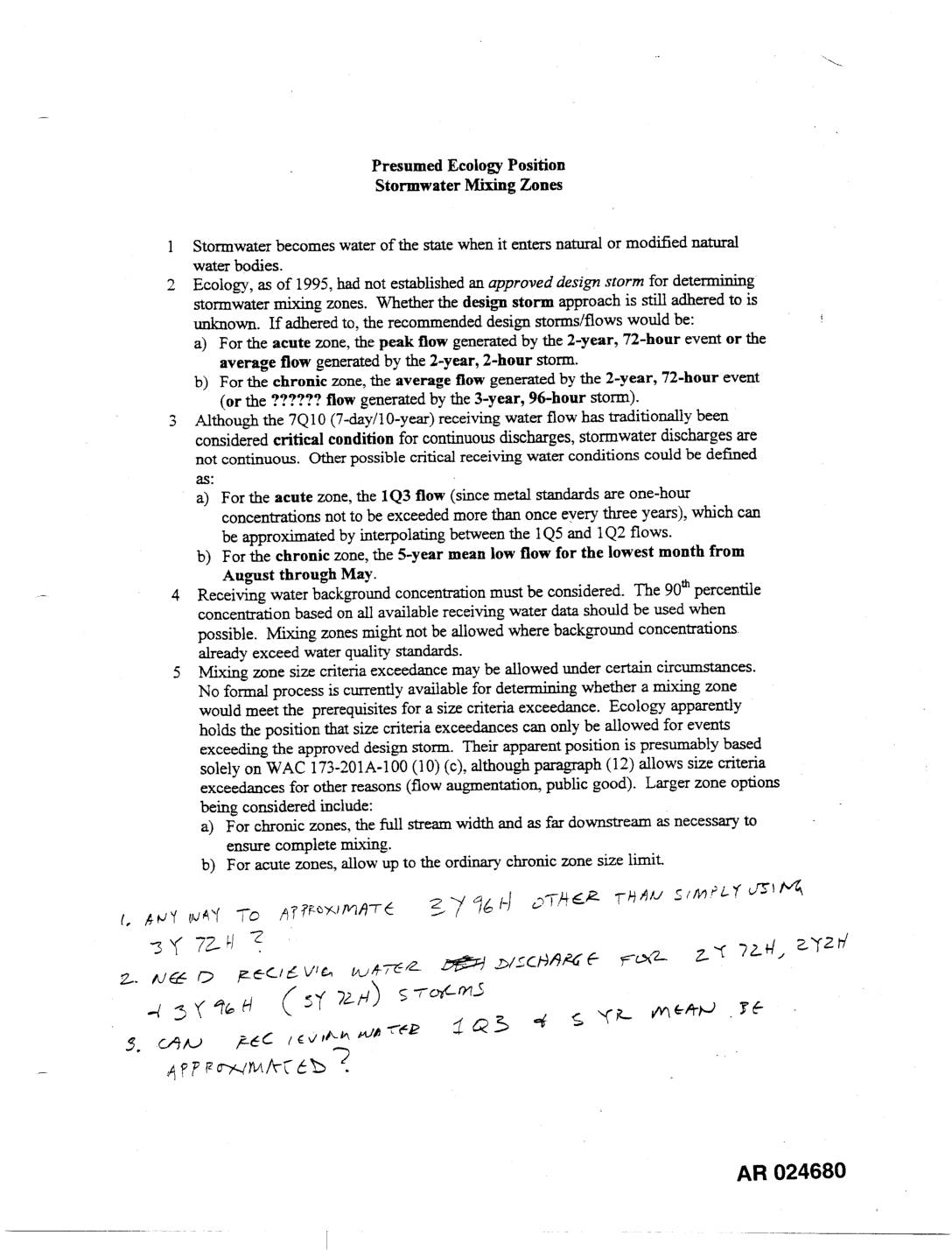
EXH AR024680: Presumed Ecology Position — Stormwater Mixing Zones
This document outlines Washington State Department of Ecology's presumed policy positions on stormwater mixing zones, addressing when stormwater becomes regulated state water and how mixing zones should be calculated. It details recommended design storms for acute and chronic mixing zones, critical receiving water flow conditions, and background concentration requirements. The document also discusses circumstances under which mixing zone size criteria exceedances may be permitted under state regulations. -
 2002-10-22
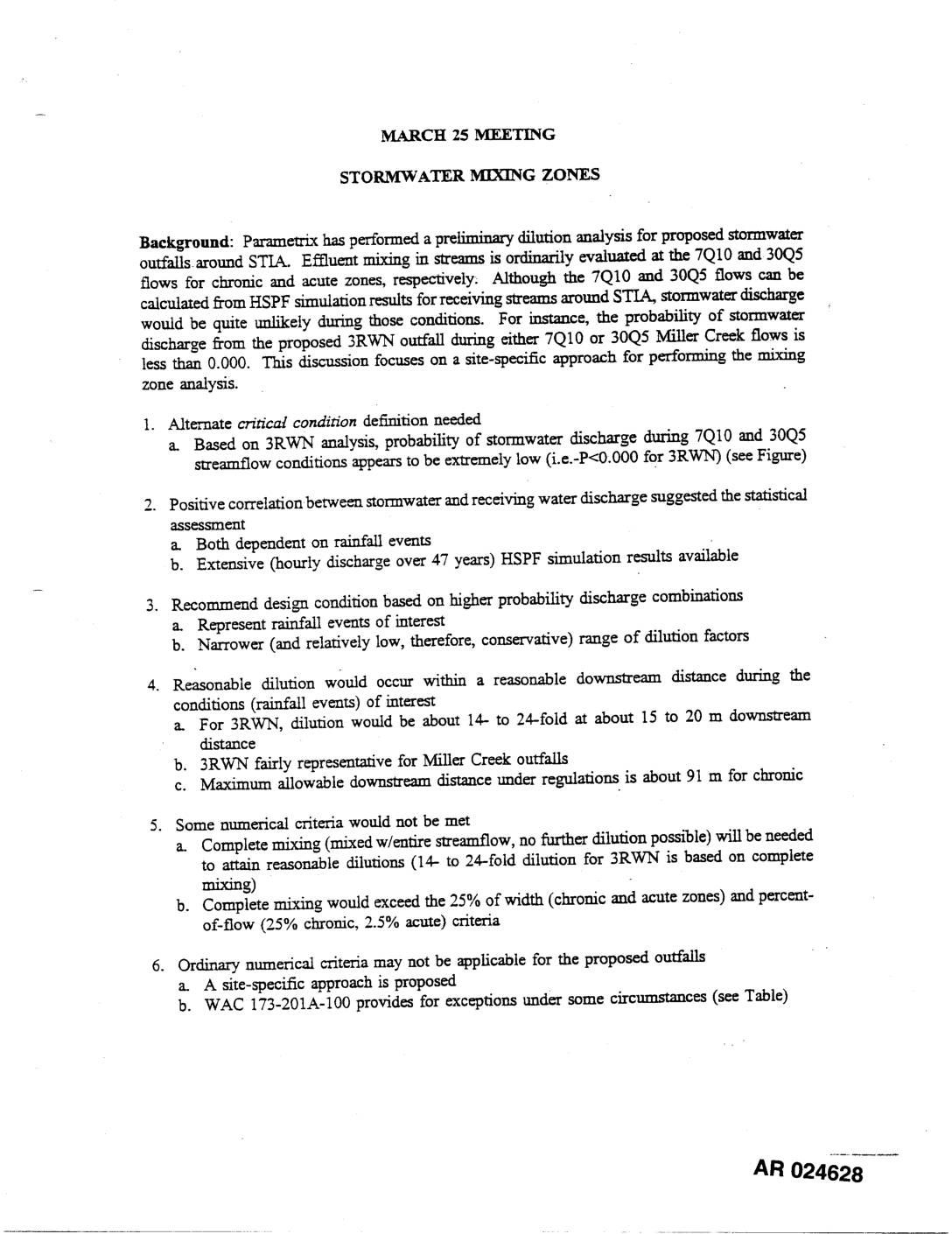
EXH AR024628: Stormwater Mixing Zones Mar 25 Meeting Discussion Doc STIA Third Runway EIS
This technical document from a March 25 meeting discusses stormwater mixing zone analysis for proposed outfalls around Seattle-Tacoma International Airport (STIA). Because standard stream flow conditions (7Q10 and 30Q5) are extremely unlikely to coincide with stormwater discharge events, Parametrix proposed a site-specific approach using higher-probability rainfall-based discharge combinations instead. The analysis found that reasonable dilution of 14- to 24-fold could occur within about 15 to 20 meters downstream, though complete mixing requirements would exceed standard regulatory width and flow percentage criteria, prompting a request for exceptions under WAC 173-201A-100. -
 2002-10-22
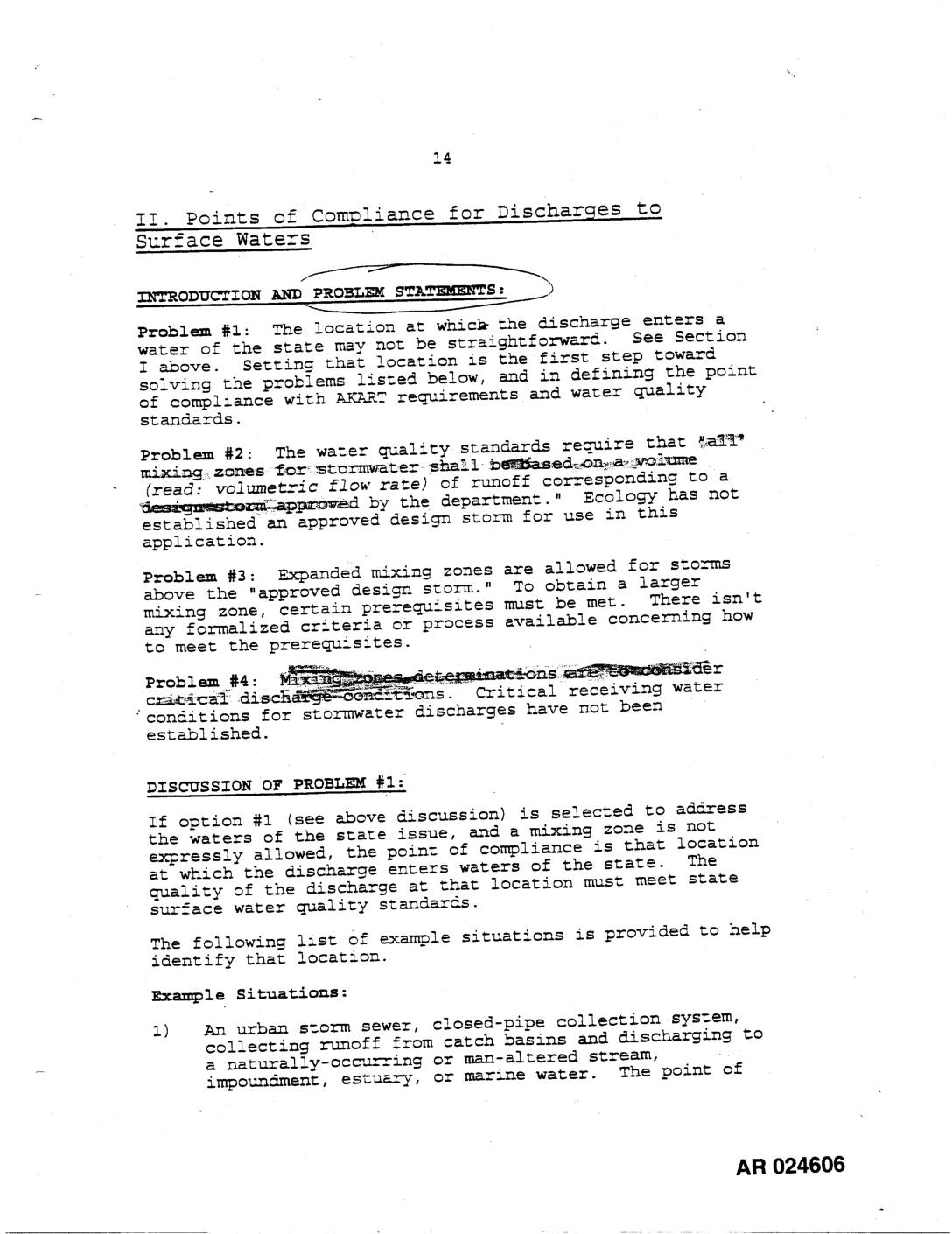
EXH AR024606: Points of Compliance — Mixing Zones & Stormwater Discharges to Surface Waters
This document outlines regulatory problems and compliance points for stormwater discharges into Washington State surface waters, focusing on where discharges must meet water quality standards. It identifies four key unresolved issues, including the lack of an approved design storm for mixing zones and undefined critical receiving water conditions. Various example situations are provided to help determine the exact location where stormwater discharge compliance must be measured. -
 2002-10-22
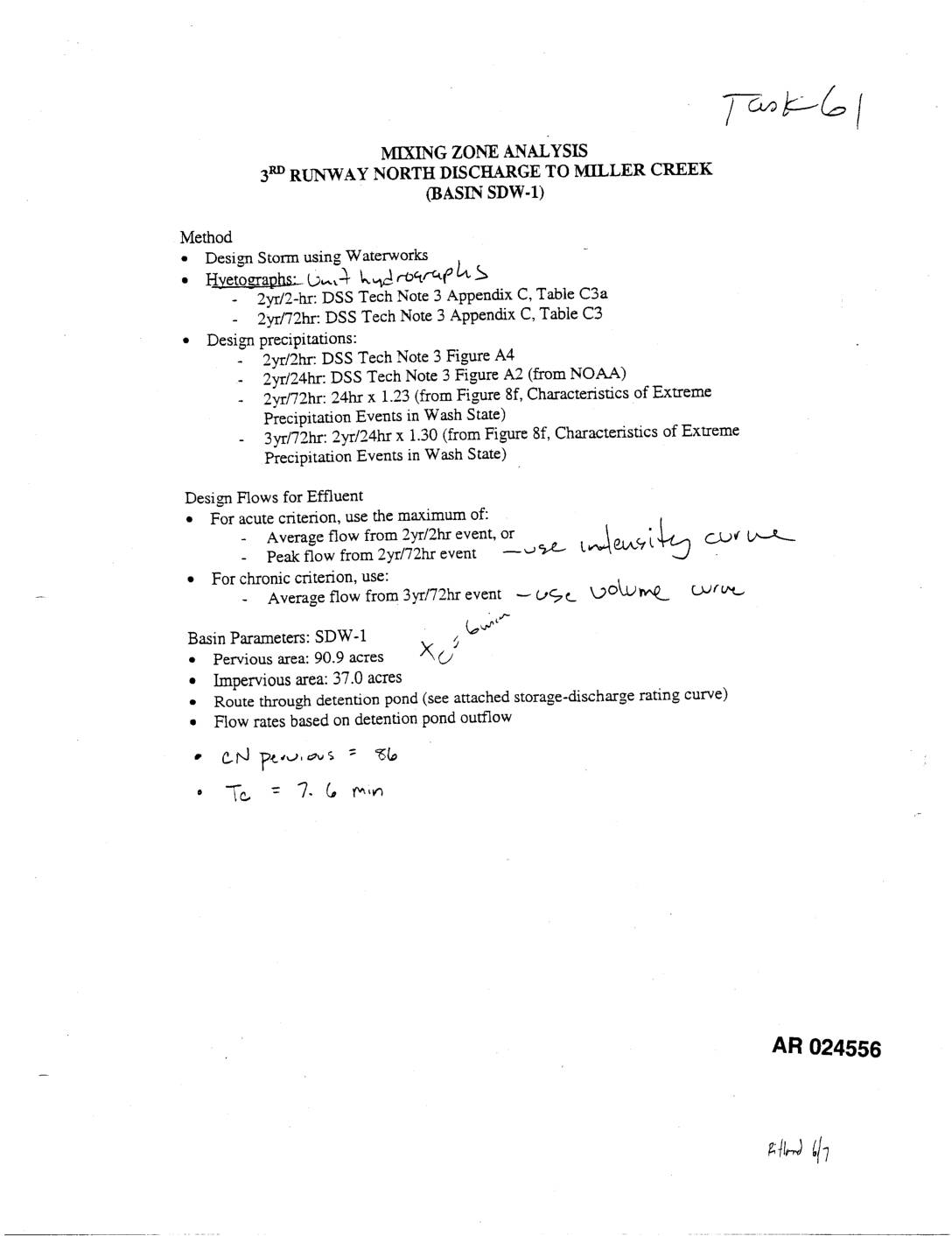
EXH AR024556: Mixing Zone Analysis — 3rd Runway North Discharge Miller Creek (Basin SDW-1)
This technical document describes a mixing zone analysis for stormwater discharge from the 3rd Runway North at Sea-Tac Airport into Miller Creek, designated as Basin SDW-1. The analysis uses design storm modeling with various rainfall scenarios (2-year/2-hour, 2-year/72-hour, and 3-year/72-hour events) to calculate effluent flow rates for both acute and chronic water quality criteria. Stormwater from the basin's approximately 128 acres of pervious and impervious area is routed through a detention pond before discharge, with outflow rates determined by a storage-discharge rating curve. -
 2002-10-22
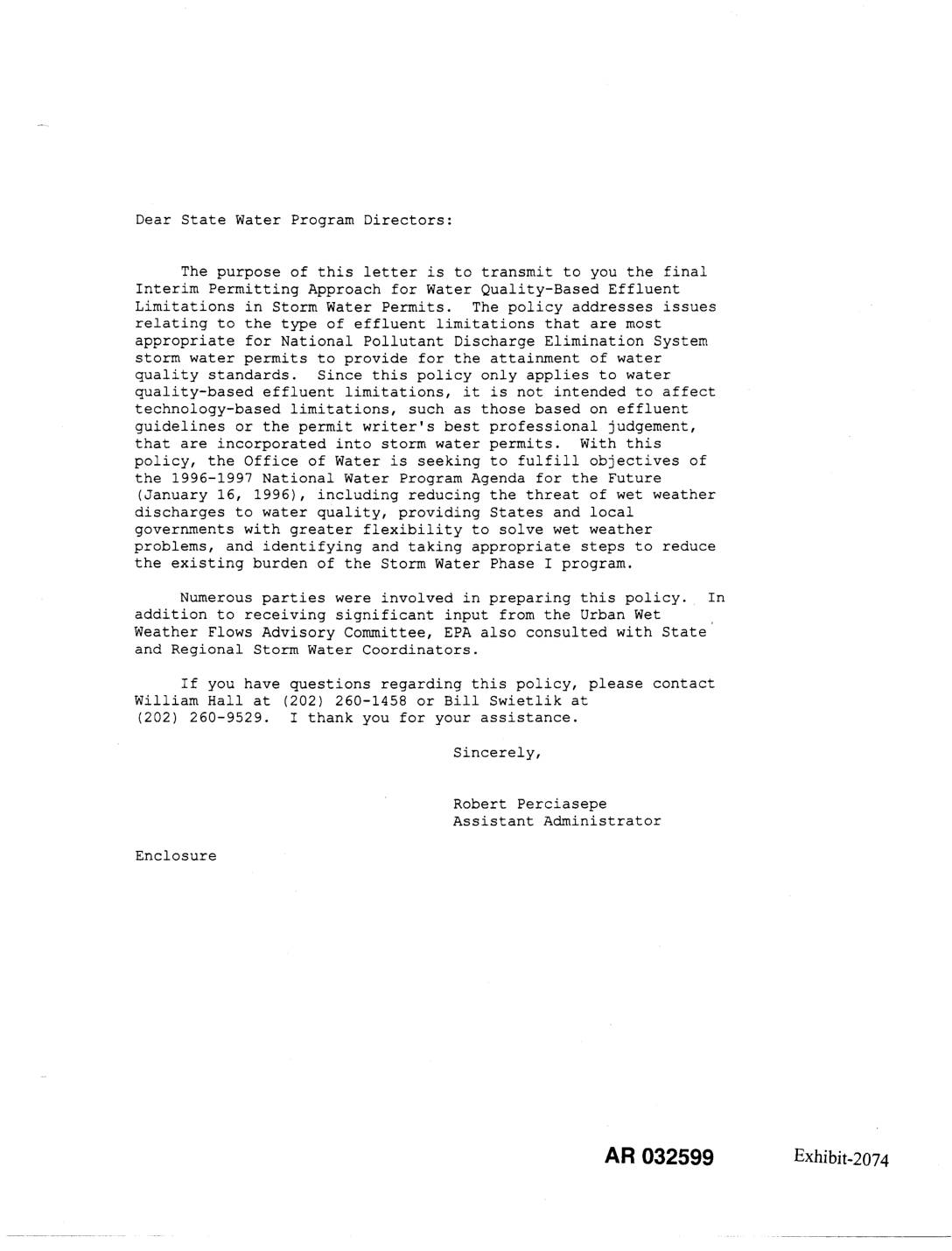
EXH AR032599: Interim Permitting Approach for Water Quality-Based Effluent Limitations in Storm Water Permits
Letter and memorandum from EPA Assistant Administrator Robert Perciasepe transmitting the final Interim Permitting Approach for Water Quality-Based Effluent Limitations in Storm Water Permits to State Water Program Directors and EPA Water Management Division Directors. The policy addresses NPDES storm water permit effluent limitations, adopting best management practices (BMPs) in lieu of numeric water quality-based