TagStormwater(373)
-
 2003-09-04
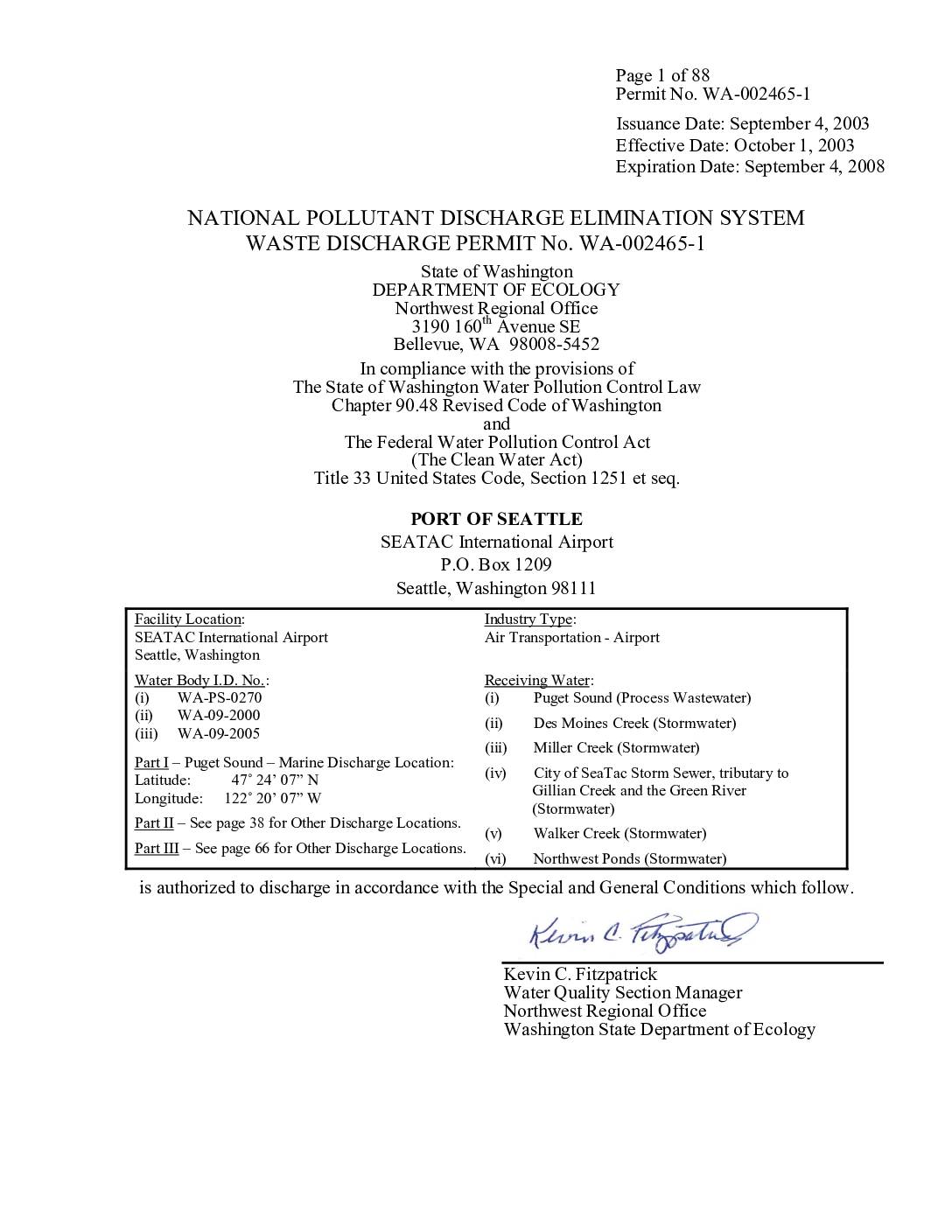
National Pollutant Discharge Elimination System waste discharge permit No. WA-002465-1
This is a National Pollutant Discharge Elimination System (NPDES) water discharge permit issued by the Washington State Department of Ecology to the Port of Seattle for Seattle-Tacoma International Airport, effective October 1, 2003 through September 4, 2008. The permit governs how the airport is authorized to discharge industrial wastewater and stormwater runoff into surrounding water bodies, including Puget Sound, Des Moines Creek, Miller Creek, and Walker Creek. It sets out special conditions covering discharge limitations, monitoring requirements, toxicity testing, and operations and maintenance standards to protect water quality in the region. -
 2003-09-04
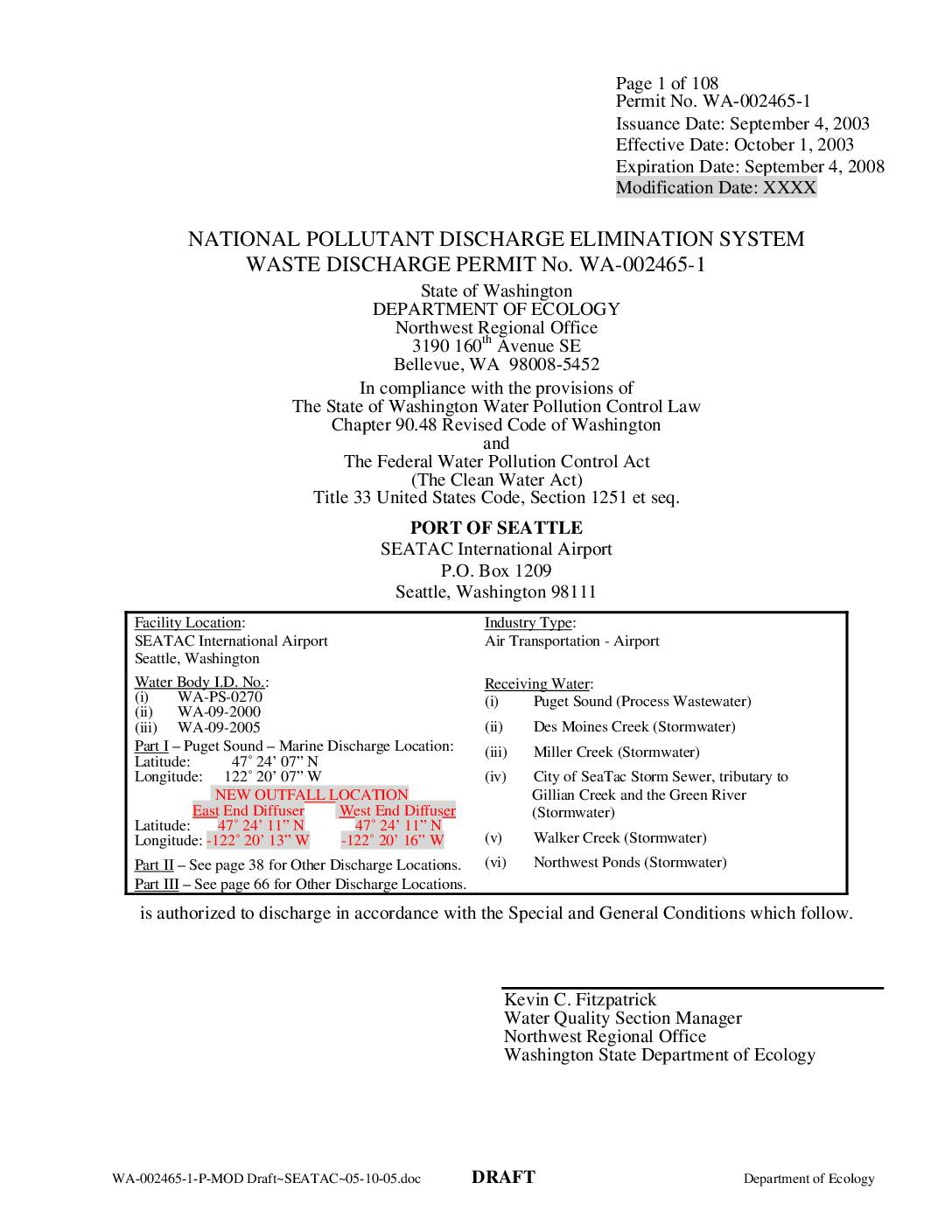
National Pollutant Discharge Elimination System waste discharge permit No. WA-002465-1
This is a National Pollutant Discharge Elimination System (NPDES) waste discharge permit issued by the Washington State Department of Ecology to the Port of Seattle for SeaTac International Airport, originally effective October 1, 2003. The permit regulates the discharge of industrial wastewater and stormwater into receiving waters including Puget Sound, Des Moines Creek, Miller Creek, Walker Creek, and other local waterways. It sets effluent limits, monitoring requirements, and operational standards for the airport's Industrial Wastewater System to protect water quality in the surrounding region. -
 2003-09-04
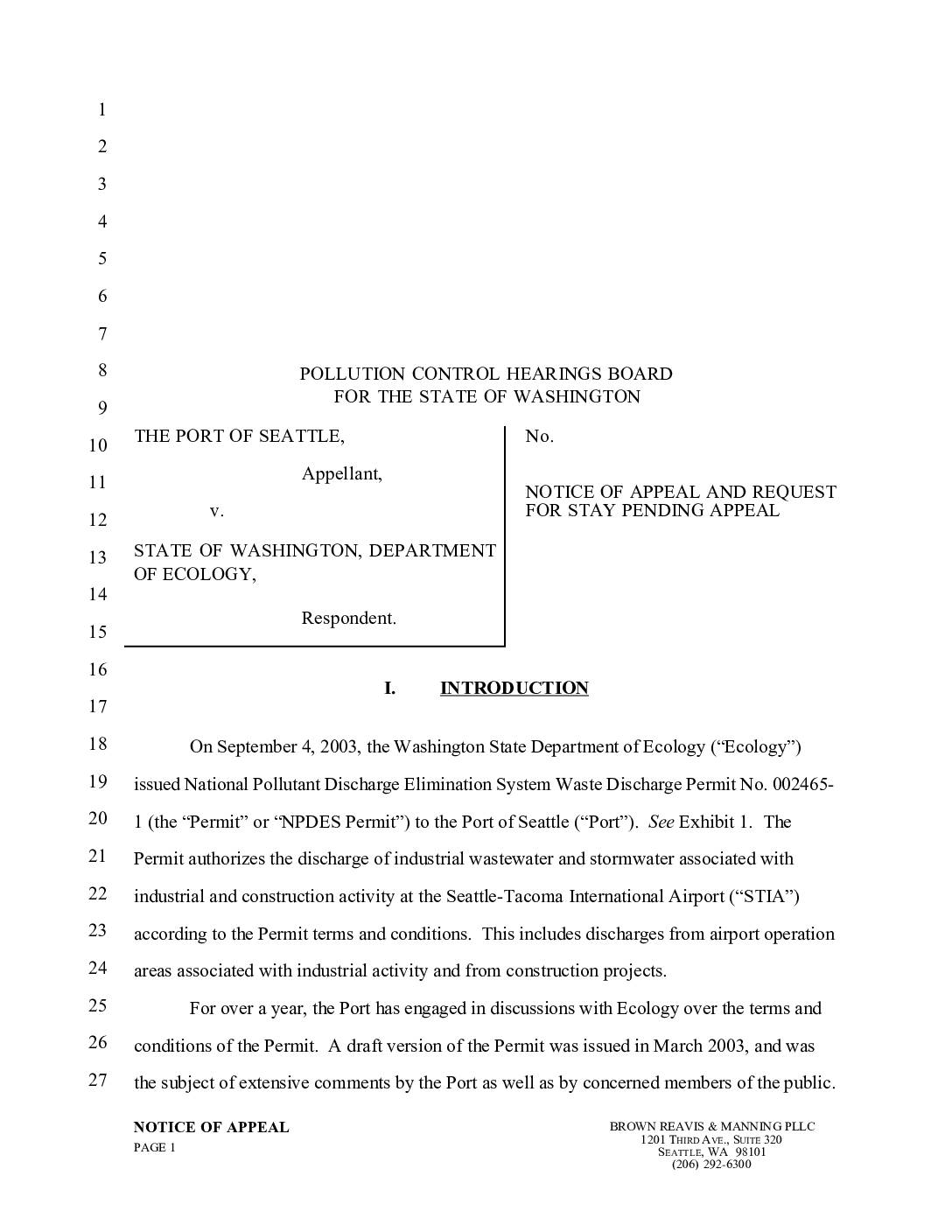
Notice of appeal and request for stay pending appeal
The Port of Seattle filed a Notice of Appeal against the Washington State Department of Ecology challenging the terms of a 2003 water discharge permit issued for Seattle-Tacoma International Airport (Sea-Tac). The permit, which governs industrial wastewater and stormwater runoff from airport operations and construction activities, was contested by the Port as imposing undue burdens without corresponding environmental benefits. Over the following six years, the Port faced more than $150 million in projected costs to implement water quality and stormwater control measures under the permit's requirements. -
 2003-03-31
Response to comments: NPDES proposed waste discharge permit no. WA-002465-1, Port Of Seattle, Seattle-Tacoma International Airport
This document is a public responsiveness summary from Washington State's Department of Ecology regarding an NPDES wastewater discharge permit issued to the Port of Seattle for Seattle-Tacoma International Airport. It compiles and responds to comments received during a March 2003 public meeting and hearing, covering concerns about the airport's treated industrial wastewater, stormwater runoff, and construction runoff discharges. The summary addresses feedback from a range of stakeholders, including the Port of Seattle, local legislators, advocacy groups, and individual residents. -
 2003-03-31
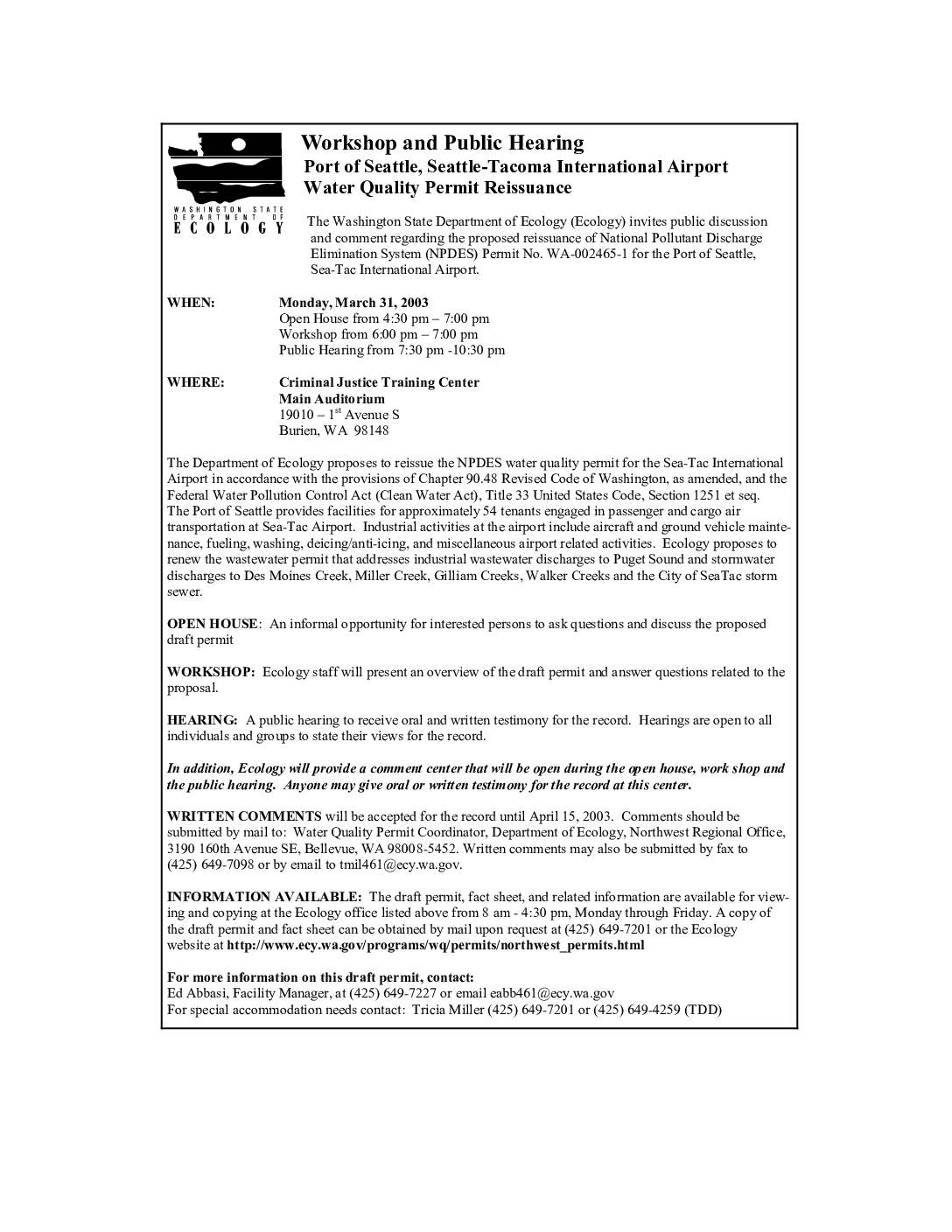
Workshop and public hearing: Port Of Seattle, Seattle-Tacoma International Airport water quality permit reissuance
The Washington State Department of Ecology held a public workshop and hearing on March 31, 2003, to discuss the proposed reissuance of a water quality permit for Seattle-Tacoma International Airport. The permit covers industrial wastewater discharges to Puget Sound and stormwater runoff to nearby creeks from airport activities such as aircraft maintenance, fueling, washing, and deicing. Written public comments were accepted through April 15, 2003. -
 2002-10-23
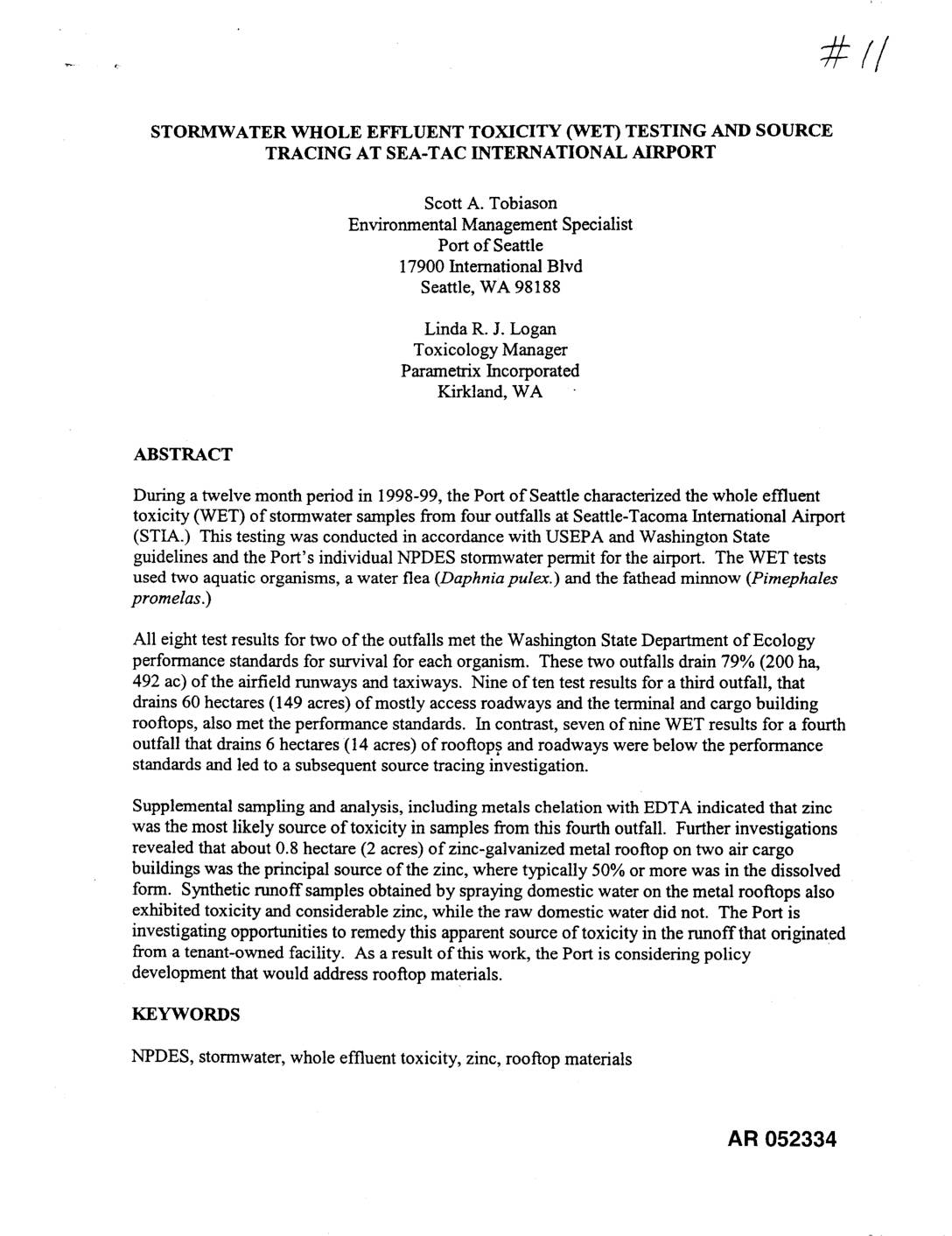
EXH AR052334: Stormwater Whole Effluent Toxicity (WET) Testing and Source Tracing at Sea-Tac International Airport
Paper by Scott A. Tobiason (Port Of Seattle) and Linda R. J. Logan (Parametrix Incorporated) documenting stormwater whole effluent toxicity (WET) testing at Seattle-Tacoma International Airport (STIA) during 1998-99 across four NPDES permit outfalls. WET tests used Daphnia pulex and Pimephales promelas (fathead minnow); outfall SDN1 draining 6 hectares of rooftops and roadways failed Washington -
 2002-10-22
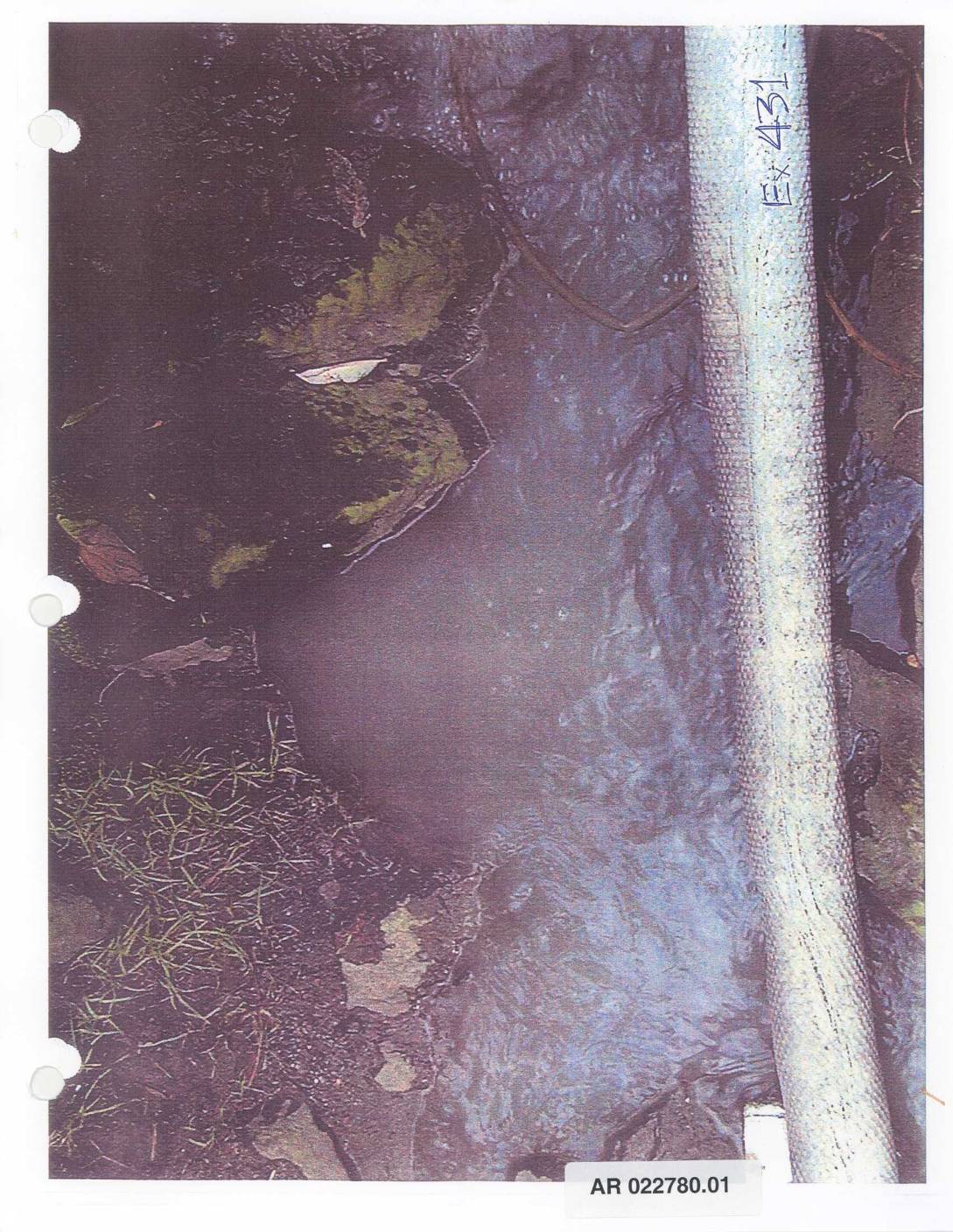
EXH 431: Photo Pipe & Water Seepage Third Runway Construction Site
This document, labeled Exhibit 431 and bearing reference number AR 022780.01, is a photograph from the administrative record, appearing to show ground-level environmental conditions near a pipe or post, with visible soil, leaf litter, pine needles, and wet or saturated ground surface. The image likely documents site conditions relevant to environmental or noise mitigation proceedings associated with Seattle-Tacoma International Airport. No additional text or descriptive caption accompanies the photograph. -
 2002-10-22
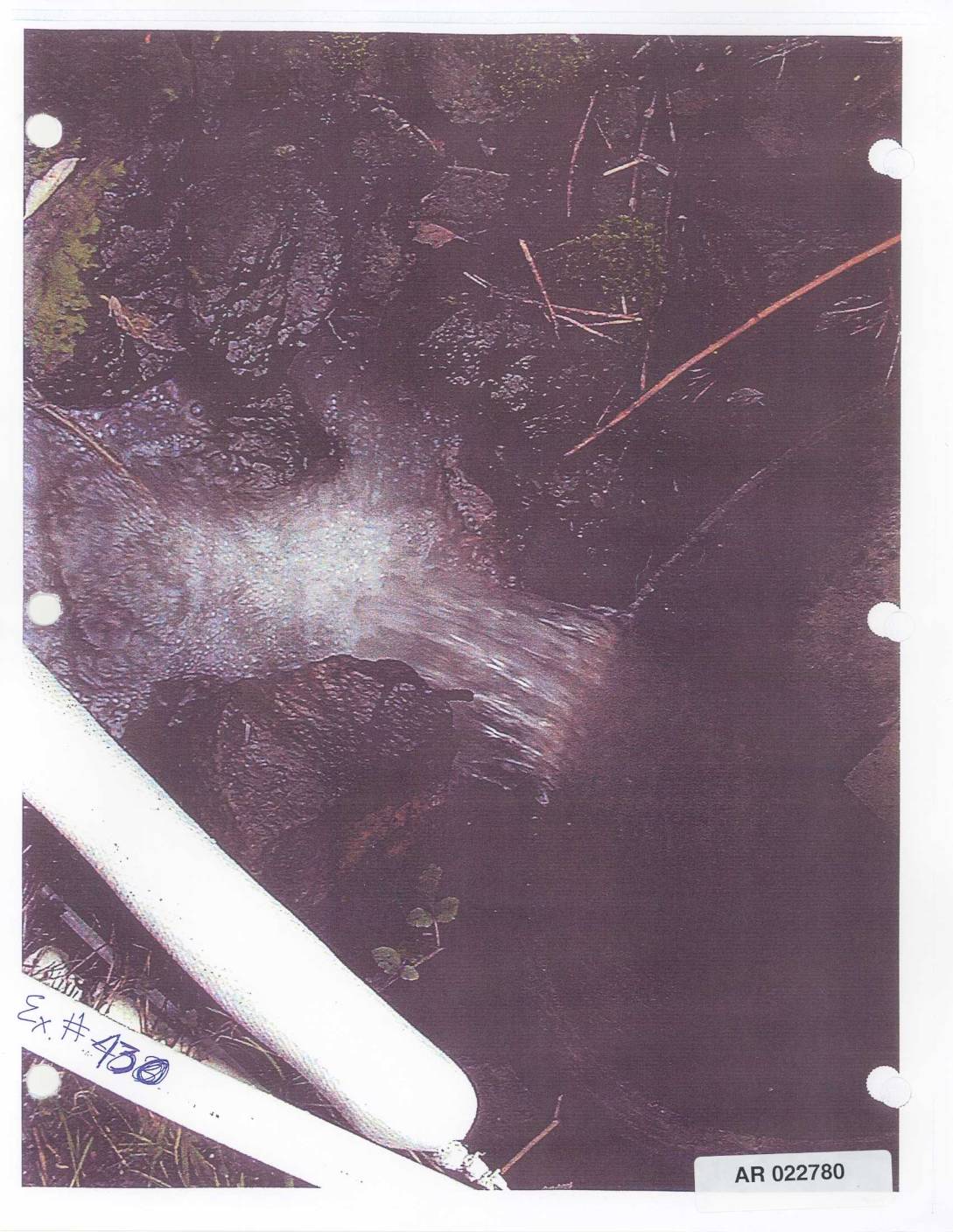
Exhibit 430: AR 022780 — Photograph of Discharge or Seepage at Construction Site, Third Runway EIS
This document, labeled Exhibit #430 and archived as AR 022780, is a photograph showing what appears to be a ground-level view of a wet or muddy outdoor area with debris, sticks, and small plants visible. A white pipe or tube is partially visible in the lower left corner of the image. The photo appears to have been submitted as evidence or documentation in a proceeding related to Sea-Tac Airport noise or environmental policy matters. -
 2002-10-22
EXH AR012680: Declaration of Linda R.J. Logan, Ph.D. — PCHB No. 01-133, ACC v. Ecology and Port Of Seattle
Declaration of Linda R.J. Logan, Ph.D. (Division Manager, Parametrix, Inc.) filed before the Washington Pollution Control Hearings Board (PCHB No. 01-133) in Airport Communities Coalition (ACC) v. Department of Ecology and Port Of Seattle. Logan holds a Ph.D. in Environmental Geochemistry and Health and over 10 years of consulting experience in risk assessment, stormwater quality, -
 2002-10-22
EXH AR026488: Water Quality Assessment Summary — Master Plan Update STIA
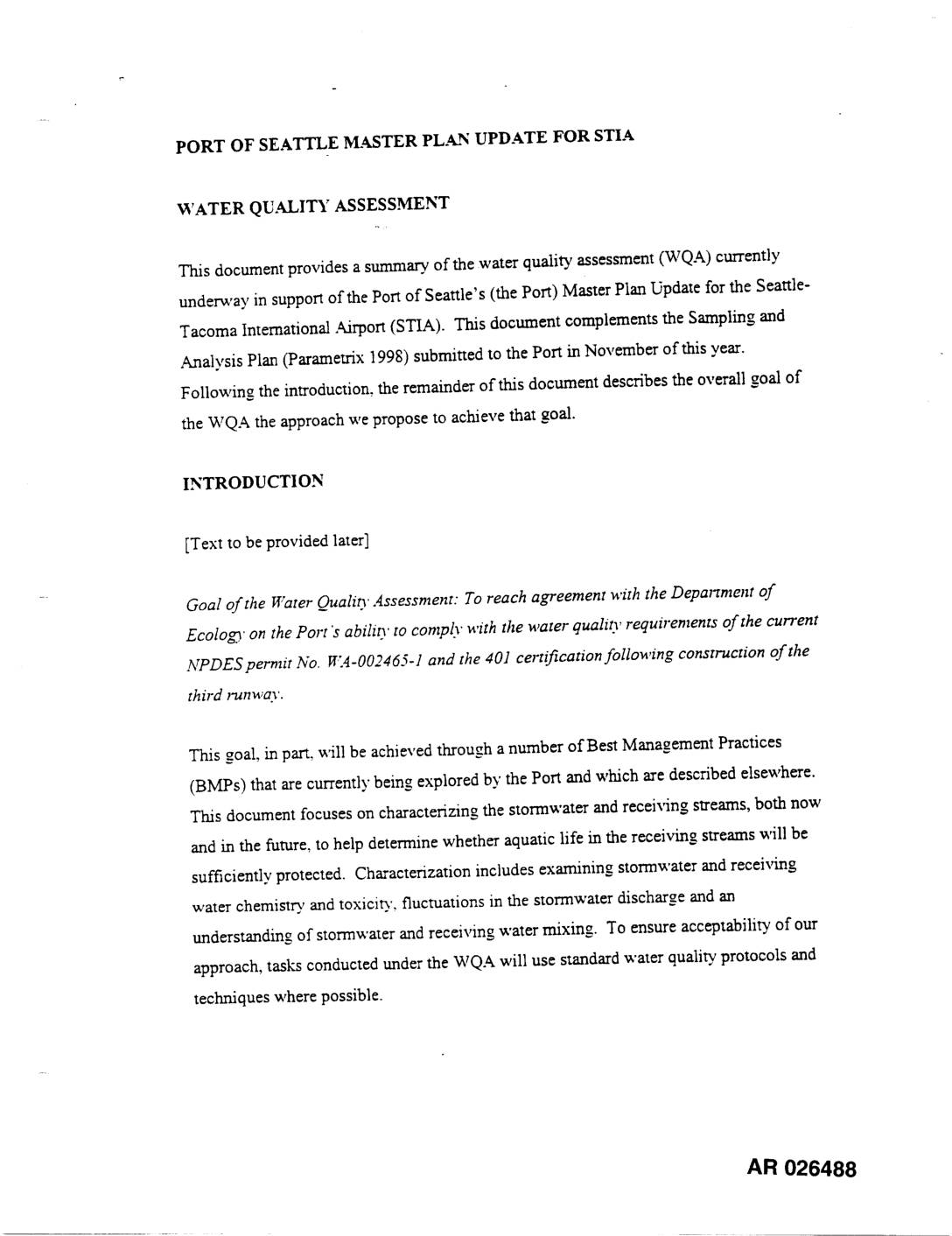
This document outlines a Water Quality Assessment (WQA) conducted in support of the Port of Seattle's Master Plan Update for Seattle-Tacoma International Airport (STIA), focused on evaluating the airport's ability to meet water quality requirements under its NPDES permit following construction of a proposed third runway. The assessment uses three approaches: a Water Effect Ratio (WER) study to adjust water quality standards for site-specific conditions, a mixing zone analysis to determine where standards must be met in receiving streams, and an examination of variability in stormwater quality. The goal is to reach agreement with the Washington Department of Ecology on whether aquatic life in nearby receiving streams will be adequately protected.